

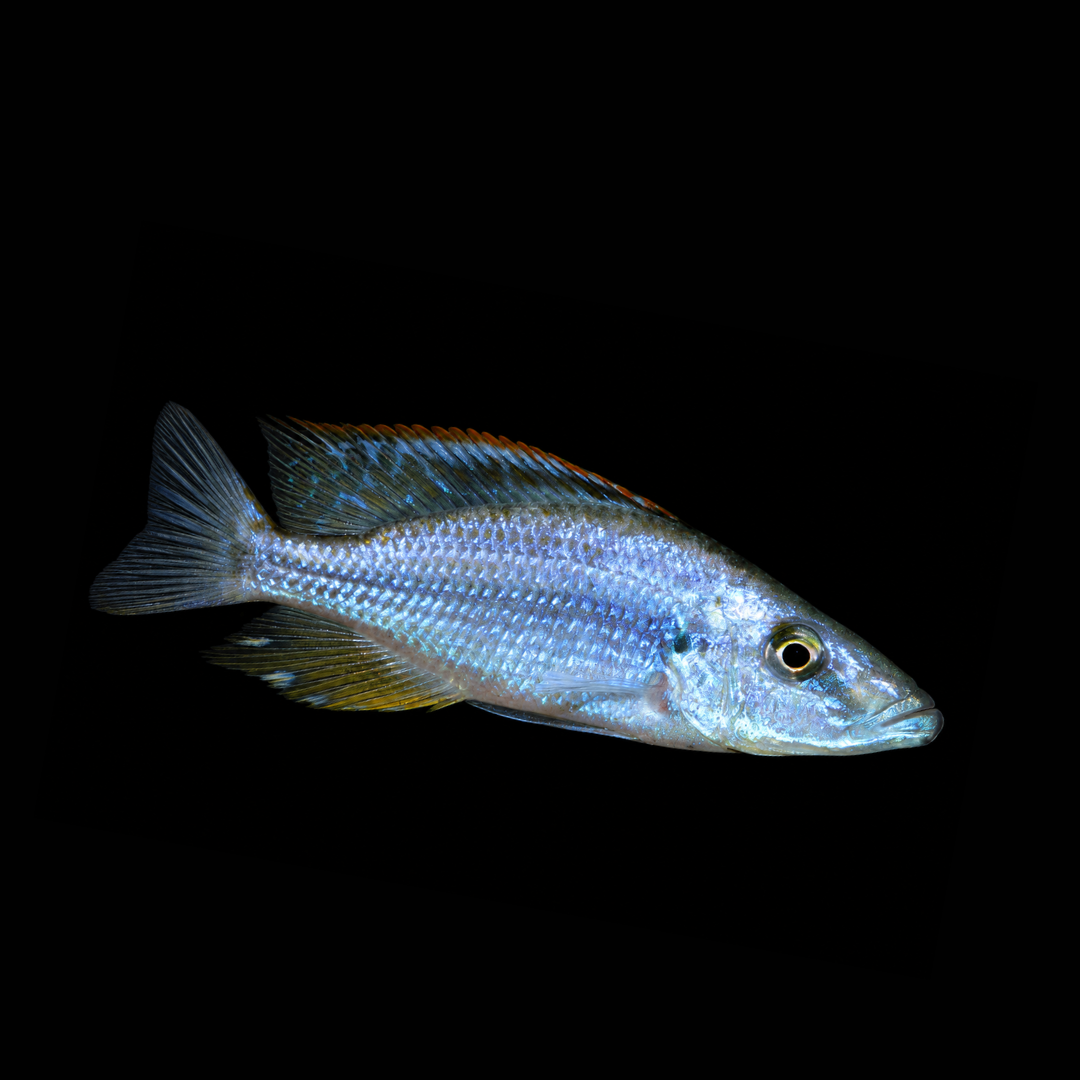
解説 / Description
ディミディオクロミス・コンプレシケプスは、マラウイ湖を中心とする水域に生息する大型の魚食性シクリッドです。頭部から体にかけて強く側扁した独特の体型を持ち、浅い水草帯では小魚を狙う捕食者として暮らしています。成熟したオスは青みの強い金属光沢を見せ、細長い吻と薄い体型が相まって、ほかのマラウイ湖産シクリッドとは異なる鋭い印象を与えます。見た目の迫力に反して、飼育では単純な攻撃性だけで性格を判断できる魚ではなく、広い遊泳空間、安定した水質、適切な混泳相手をそろえることが重要です。 Dimidiochromis compressiceps is a large piscivorous cichlid from the Lake Malawi system. It has a strongly laterally compressed head and body and lives as a predator of small fishes, particularly in shallow vegetated habitats. Mature males develop a strong metallic blue sheen, while the elongated snout and thin body give the species a distinctive appearance among Lake Malawi cichlids. Despite its formidable look, successful aquarium care depends not simply on managing aggression, but on providing ample swimming space, stable water conditions, and appropriately chosen tank mates.
基本情報 / Basic Information
| 学名 / Scientific Name | Dimidiochromis compressiceps |
|---|---|
| 通称 / Common Name | ディミディオクロミス・コンプレシケプス、ハプロクロミス・コンプレシケプス、アイバイターDimidiochromis compressiceps, Malawi Eyebiter |
| 分類 / Family | シクリッド科・プセウドクレニラブルス亜科・ハプロクロミス族Family Cichlidae, subfamily Pseudocrenilabrinae, tribe Haplochromini |
| 英名 / English Name | Malawi Eyebiter |
| 分布 / Distribution | マラウイ湖、上部シレ川、マロンベ湖。浅い水草帯を中心に見られます。Lake Malawi, the upper Shire River, and Lake Malombe, especially in shallow vegetated habitats. |
| 最大体長 / Max Size | 最大で約23cm。飼育下でも十分に大型化するため、成魚時の体格を前提に設備を選ぶ必要があります。Up to about 23 cm in total length. Aquarium equipment should be selected with the adult size in mind. |
| 寿命 / Lifespan | 本種について信頼できる資料で一律の標準寿命を示すことは難しく、飼育環境や個体差によって幅があります。A single well-established standard lifespan is difficult to state for this species, and longevity varies with husbandry and individual condition. |
飼育環境 / Aquarium Environment
| 水槽サイズ / Tank Size | 大型で遊泳力のある魚なので、成魚の長期飼育では180〜200cmクラスの大型水槽を目安にすると安心です。水量だけでなく、水槽の横幅と前後幅を確保し、十分な直線遊泳距離を取れることを優先します。500Lを超える規模の水槽が現実的な選択肢になります。Because this is a large and active swimmer, an aquarium in the 180–200 cm class is a practical target for long-term adult care. Horizontal length and front-to-back depth are more important than volume alone, and systems exceeding roughly 500 L are realistic choices. |
|---|---|
| 水温 / Temperature | 22〜28℃を目安に安定させます。日本では冬季の加温だけでなく、夏季の高水温対策も必要になることがあります。 Maintain approximately 22–28°C. In Japan, summer heat control may be necessary in addition to winter heating. |
| 水質 / Water Quality | 弱アルカリ性からアルカリ性の硬水を基本とし、pH7.5〜8.5前後、硬度9〜19dGH程度をひとつの目安にします。日本の軟水地域では、サンゴ砂やアラゴナイト系ろ材などを利用して緩やかに硬度とpHを補い、数値を追い込むことよりも急変を避けて安定させることを重視します。Slightly alkaline to alkaline hard water is appropriate, with roughly pH 7.5–8.5 and 9–19 dGH serving as useful reference values. In soft-water areas, coral sand or aragonite-based media can be used to raise mineral content gradually. Stability is more important than forcing the water to an exact number. |
| レイアウト / Layout | 底床には細かい砂を用い、遊泳空間を広く残したうえで、側面や後景に岩組みや丈夫な水草を配置します。バリスネリアのような細長い葉を持つ水草は、本種が自然下で利用する水草帯の雰囲気を再現するうえで相性のよい選択肢です。岩や装飾物を詰め込みすぎず、視線を遮る場所と開けた空間の両方をつくります。Use fine sand and preserve a broad open swimming area, with rocks and hardy plants placed mainly along the sides and rear. Ribbon-like plants such as Vallisneria are well suited to recreating the character of the vegetated habitats used by the species in nature. Avoid overcrowding the tank with decor, and provide both visual barriers and open water. |
| 注意点 / Precautions | 大型で素早く泳ぐため、驚いた際の飛び出しや水槽内での衝突に注意が必要です。フタは隙間なく固定し、ろ過能力にも余裕を持たせます。魚食性の大型シクリッドは排泄量も多いため、定期的な換水とろ材の状態確認を続け、水質の悪化を防ぐことが大切です。As a large and fast-swimming fish, it can jump or collide with aquarium furnishings when startled. Use a securely fitted lid and provide generous filtration capacity. Large predatory cichlids also produce substantial waste, so regular water changes and routine filter maintenance are essential. |
餌と給餌 / Feeding
| 餌の種類 / Diet | 自然下では小魚、とくに若いウタカ類などを捕食します。飼育下では大型シクリッド向けの高品質な人工飼料を主食にし、冷凍ミシス、クリル、エビ類などを補助的に与えると管理しやすくなります。In nature it preys on small fishes, including juvenile Utaka and other schooling fishes. In captivity, high-quality prepared foods for large cichlids can form the staple diet, supplemented with frozen mysis, krill, and shrimp. |
|---|---|
| 給餌のポイント / Feeding Tips | 導入直後に人工飼料への反応が鈍い場合は、冷凍餌などを利用しながら徐々に慣らします。活餌は嗜好性が高い一方、水質を悪化させやすく、餌生物から病原体を持ち込む可能性もあるため、常用せず人工飼料を中心に組み立てるほうが安定した管理につながります。食べ残しが出ない量を意識し、過給餌を避けます。If newly introduced fish are slow to accept prepared foods, frozen foods can be used during the transition. Live foods are highly attractive but may foul the water and can introduce pathogens, so a prepared-food-centered diet is easier to manage consistently. Feed only what the fish can consume and avoid overfeeding. |
性格と混泳 / Temperament and Tank Mates
| 性格 / Temperament | 魚食性が強く、口に入る大きさの魚は捕食対象になります。一方、同程度の大きさの魚に対して常に無差別に攻撃するタイプではなく、環境や個体によっては比較的落ち着いて振る舞います。ただし、成熟したオスは縄張り意識を示すため、同種のオス同士を狭い水槽で維持するのは避けたほうが安全です。The species is strongly piscivorous, and fish small enough to be swallowed may become prey. It is not necessarily indiscriminately aggressive toward similarly sized fishes, however, and some individuals remain relatively composed in suitable surroundings. Mature males can become territorial, so keeping multiple males together in limited space is best avoided. |
|---|---|
| 混泳の相性 / Compatibility | 混泳相手には、簡単に飲み込まれない大きさがあり、極端に攻撃的ではない大型のマラウイ湖産シクリッドなどを選びます。小型魚や幼魚は捕食される可能性が高いため不向きです。反対に、本種を一方的に追い回すほど攻撃性の強い魚も避けます。繁殖群を組む場合は、オス1匹に対して複数のメスを用意すると、特定のメスに追尾が集中しにくくなります。Choose tank mates that are too large to swallow and are not excessively aggressive, such as appropriately sized Lake Malawi cichlids. Small fishes and juveniles are unsuitable because they are likely to be treated as prey. At the other extreme, species aggressive enough to harass D. compressiceps continuously should also be avoided. In breeding groups, one male with several females helps spread courtship pressure. |
病気と対策 / Diseases and Prevention
| かかりやすい病気 / Common Diseases | 本種だけに特有とされる代表的な病気は、一般的な飼育資料では明確ではありません。実際の飼育では、ほかの大型シクリッドと同様に、水質悪化、過密、混泳ストレス、外傷などをきっかけとする体調不良に注意します。No major disease uniquely characteristic of this species is clearly established in commonly available husbandry references. As with other large cichlids, health problems are more often associated with poor water quality, crowding, social stress, or physical injury. |
|---|---|
| 対策と予防 / Prevention | 予防の基本は、安定した水質、十分なろ過、定期換水、適切な給餌、余裕のある飼育密度を維持することです。新しい魚を追加するときは、体表、ヒレ、呼吸、食欲を確認し、既存個体との相性も観察します。pHや硬度を一度に大きく変えず、日常管理の中で緩やかに安定させます。Prevention is based on stable water conditions, adequate filtration, regular water changes, appropriate feeding, and sensible stocking density. When adding new fish, check the skin, fins, respiration, and appetite, and observe social compatibility carefully. Avoid sudden changes in pH or hardness. |
増やし方(繁殖) / Breeding
| 雌雄の判別 / Sexing | 成熟したオスは青みの強い金属光沢が現れ、繁殖期には発色がさらに鮮やかになります。メスや未成熟個体は銀色から灰褐色を基調とした控えめな色調を保つことが多く、成熟すると雌雄差が分かりやすくなります。Mature males develop a strong metallic blue sheen that becomes especially vivid during breeding. Females and immature fish usually retain more subdued silver to gray-brown coloration, making sex differences easier to recognize with maturity. |
|---|---|
| 繁殖形態 / Reproduction | マラウイ湖産ハプロクロミス類に一般的な母系口内保育を行います。産卵後、メスは受精した卵を口の中に収容し、仔魚が自力で泳げる段階まで保護します。口内保育中のメスは摂餌量が大きく減るため、繁殖前から十分な体力をつけておくことが重要です。Like many Lake Malawi haplochromine cichlids, this species is a maternal mouthbrooder. After spawning, the female carries the fertilized eggs in her mouth and protects the developing young until they are able to swim independently. Because feeding is greatly reduced during brooding, females should be well conditioned beforehand. |
| 繁殖のポイント / Breeding Tips | オスの求愛が特定のメスに集中しないよう、複数のメスを組み合わせ、逃げ場と視線を遮る場所を確保します。底床には細かい砂を用意し、繁殖行動を妨げない広さを残します。口内保育中のメスが継続的に追われる場合は、ストレスを減らせる管理方法を検討します。Keep several females with a male so that courtship pressure is not focused on a single fish, and provide retreats and visual barriers. Fine sand is suitable for the substrate, while enough open space should remain for courtship. If a mouthbrooding female is persistently harassed, management should be adjusted to reduce stress. |
雑学と豆知識 / Trivia and Fun Facts
| 1. 学名は何度も組み替えられてきた / 1. Its scientific name has changed more than once | 本種は1908年にParatilapia compressicepsとして記載され、その後はHaplochromis compressicepsやCyrtocara compressicepsという名前でも扱われてきました。現在の有効名はDimidiochromis compressicepsです。日本の観賞魚市場では旧属名の「ハプロクロミス」が長く親しまれてきたため、現在でも「ハプロクロミス・コンプレシケプス」という販売名に出会うことがあります。The species was described in 1908 as Paratilapia compressiceps and has also been treated under the names Haplochromis compressiceps and Cyrtocara compressiceps. Its currently accepted name is Dimidiochromis compressiceps. In the Japanese aquarium trade, the older genus name Haplochromis remained familiar for many years, so the former combination is still occasionally seen in sales listings. |
|---|---|
| 2. 「アイバイター」という名前だけでは食性を説明できない / 2. The name “Eyebiter” does not describe its whole diet | Malawi Eyebiterという英名は非常に印象的ですが、信頼性の高い魚類データベースでは、本種の主な餌は小魚、とくに若いウタカ類や群泳性の魚とされています。そのため、「他魚の眼だけを専門に食べる魚」と理解するのは適切ではありません。名前の強烈さよりも、水草帯で小魚を狙う魚食性シクリッドとして捉えるほうが、実際の生態に近い理解になります。The English name Malawi Eyebiter is memorable, but reliable fish databases describe the species primarily as a predator of small fishes, especially juvenile Utaka and other schooling fishes. It is therefore misleading to understand it simply as a specialist that feeds only on the eyes of other fish. Its ecology is better understood in the broader context of piscivory in shallow vegetated habitats. |
| 3. 強く側扁した頭部と体は、本種を見分ける重要な特徴 / 3. Its compressed head and body are key identifying features | 本種は頭部から胴体まで強く側扁しており、この形態は分類資料でも識別上の重要な特徴として扱われています。細長い吻と薄い体型によって正面から見た輪郭が小さく、水草の間に入り込んだときには独特の存在感を見せます。成魚の姿を横から見るだけでなく、正面や斜め前から観察すると、本種ならではの体型がよく分かります。The strongly compressed head and body are important diagnostic features of the species. Together with the elongated snout, this gives the fish a remarkably narrow frontal profile. Viewing an adult from the front or at an angle, rather than only from the side, makes this distinctive morphology especially apparent. |
| 4. 視覚もほかのマラウイ湖産シクリッドとは異なる / 4. Its visual system differs from that of some other Malawi cichlids | 視覚研究では、本種がSWS2a、RH2a、LWSという組み合わせの錐体オプシン遺伝子を発現し、約447nm、535〜536nm、565〜569nm付近に対応する視覚色素を持つことが報告されています。これは、紫外線側に感度を寄せる一部の岩礁性シクリッドとは異なる構成です。体型だけでなく、光を捉える仕組みにも種ごとの生態差が表れている点は、マラウイ湖のシクリッド進化を考えるうえで興味深い特徴です。Vision studies have reported expression of the cone opsin genes SWS2a, RH2a, and LWS in this species, corresponding to visual pigments near 447 nm, 535–536 nm, and 565–569 nm. This differs from the more ultraviolet-shifted systems found in some rock-dwelling Malawi cichlids. The contrast shows that ecological diversification among Lake Malawi cichlids is reflected not only in body shape, but also in sensory biology. |
| 5. 頭部の形は成長の初期段階から作り分けられる / 5. Its distinctive head shape begins developing early | 頭蓋発生を比較した研究では、本種とCopadichromis azureusの成魚で見られる大きな頭部形態の違いが、胚や仔魚の段階に現れる小さな骨格発生の差から始まり、成長に伴って拡大していくことが示されています。完成した成魚だけを見ると極端な違いに見えますが、その特徴は成長のかなり早い時期から少しずつ組み立てられているのです。Comparative studies of craniofacial development have shown that the large adult differences between D. compressiceps and Copadichromis azureus begin as relatively subtle skeletal differences during embryonic and larval development. These differences are amplified as the fish grows. The striking adult head shape is therefore the end result of developmental divergence that starts much earlier in life. |
| 6. 地域型と改良品種は分けて考えたい / 6. Locality forms and ornamental strains should be distinguished | 本種は広い範囲に分布するため、産地によって色調の異なる個体が知られています。観賞魚市場では「ゴールド」「ゴールドヘッド」といった呼び名や、OB、アルビノなどの個体も流通します。ただし、産地に由来する自然個体群と、交雑や選択繁殖を含む改良系統は同じものではありません。血統やロケーションを重視する場合は、販売名だけで判断せず、由来が確認できる個体を選ぶことが大切です。Because the species occurs across a broad area, locality-associated color differences are known. The aquarium trade also uses names such as “Gold” or “Gold Head,” and OB or albino fish are available. Natural locality populations and ornamental lines produced through selective breeding or hybrid ancestry, however, should not be treated as equivalent. Aquarists who value locality or lineage should verify provenance rather than relying on a sales name alone. |
まとめ / Conclusion
ディミディオクロミス・コンプレシケプスの魅力は、単に「大きくて青いシクリッド」という言葉だけでは表せません。水草帯で小魚を狙う魚食性、正面から見ると驚くほど薄い体、前方へ伸びた吻、成熟したオスが見せる金属光沢。そのどれもが、この魚がマラウイ湖の環境の中で独自の生き方を築いてきたことを感じさせます。 The appeal of Dimidiochromis compressiceps cannot be reduced to being simply a large blue cichlid. Its piscivorous life among aquatic vegetation, remarkably narrow frontal profile, elongated snout, and metallic coloration in mature males all reflect a distinctive way of life shaped within the Lake Malawi ecosystem.
成魚を健やかに育てるには、十分な広さの水槽と安定したアルカリ性の水質、余裕のあるろ過、そして捕食関係や縄張り争いを見越した混泳計画が欠かせません。必要な設備は小さくありませんが、それに応えるだけの姿と行動を見せてくれる魚です。ゆったりと泳ぐ成魚を正面から眺めたとき、この種が長くアフリカンシクリッド愛好家を惹きつけてきた理由を、きっと実感できるでしょう。 Healthy long-term care requires a spacious aquarium, stable alkaline water, generous filtration, and a stocking plan that accounts for both predation and territorial behavior. The system it needs is substantial, but the fish rewards that commitment with an unusual combination of form, color, and behavior. Seeing a mature specimen glide through a large aquarium—especially from the front—makes it easy to understand why this species has remained so memorable among African cichlid enthusiasts.

気になる道具や飼い方を見つけてみませんか?
 アイのアクアグッズ案内エーハイム、安いのと高いのは何が違う? コタロウと見比べる外部フィルター道具の特徴や使い方、選ぶときのポイントをアイが紹介します。記事はコチラ →
 アイのアクアグッズ案内コケを食べるコイの仲間に合わせる飼育用品|フライングフォックス・アルジイーター・ガラ道具の特徴や使い方、選ぶときのポイントをアイが紹介します。記事はコチラ →
 アイのアクアグッズ案内そのごはん、泳いでる! 卵から始めるブラインシュリンプの孵化と道具選び道具の特徴や使い方、選ぶときのポイントをアイが紹介します。記事はコチラ →
 アイのアクアグッズ案内水槽のコケ掃除|道具の選び方とお掃除生体の得意・不得意道具の特徴や使い方、選ぶときのポイントをアイが紹介します。記事はコチラ →
さまざまな飼育テーマをご紹介。リンク先の記事には広告・商品紹介が含まれます。
案内・紹介記事一覧へ →分布マップ
ディミディオクロミス・コンプレシケプス(Dimidiochromis compressiceps)は、マラウイ湖、上部シレ川、マロンベ湖に分布し、特に浅い水草帯で見られます。
※この地図は、記事に記載された「マラウイ湖、上部シレ川、マロンベ湖」という分布情報をもとに、分布地域全体が見えるよう設定した概略表示です。マーカーは地理的な代表地点を示すもので、実際の採集地点・観察地点を示すものではありません。
参考文献
- FishBase — Dimidiochromis compressiceps
本種の分布、体長、生息環境、食性などの基礎情報。
FishBaseの種情報を見る - Eschmeyer’s Catalog of Fishes — Dimidiochromis compressiceps
現在の有効学名、原記載名、分布の確認に用いた分類資料。
分類情報を見る - Carleton, K. L. & Kocher, T. D. (2001). Cone opsin genes of African cichlid fishes: tuning spectral sensitivity by differential gene expression. Molecular Biology and Evolution, 18(8), 1540–1550.
本種を含むアフリカンシクリッドの視物質と分光感度を調べた研究。
論文情報を見る - Carleton, K. L. et al. (2008). Visual sensitivities tuned by heterochronic shifts in opsin gene expression. BMC Biology, 6, 22.
本種を含むシクリッドの成長に伴うオプシン発現と視覚感度を扱う研究。
論文本文を見る - Le Pabic, P., Cooper, W. J. & Schilling, T. F. (2016). Developmental basis of phenotypic integration in two Lake Malawi cichlids. EvoDevo, 7, 3.
本種とコパディクロミス・アズレウスの頭部骨格を比較し、発生・成長と形態の違いを調べた研究。
論文本文を見る - Merck Veterinary Manual — Management of Aquarium Fish.
水質管理、導入時の隔離など、観賞魚の一般的な管理に関する資料。本種専用の飼育条件を示すものではありません。
管理資料を見る




コメント