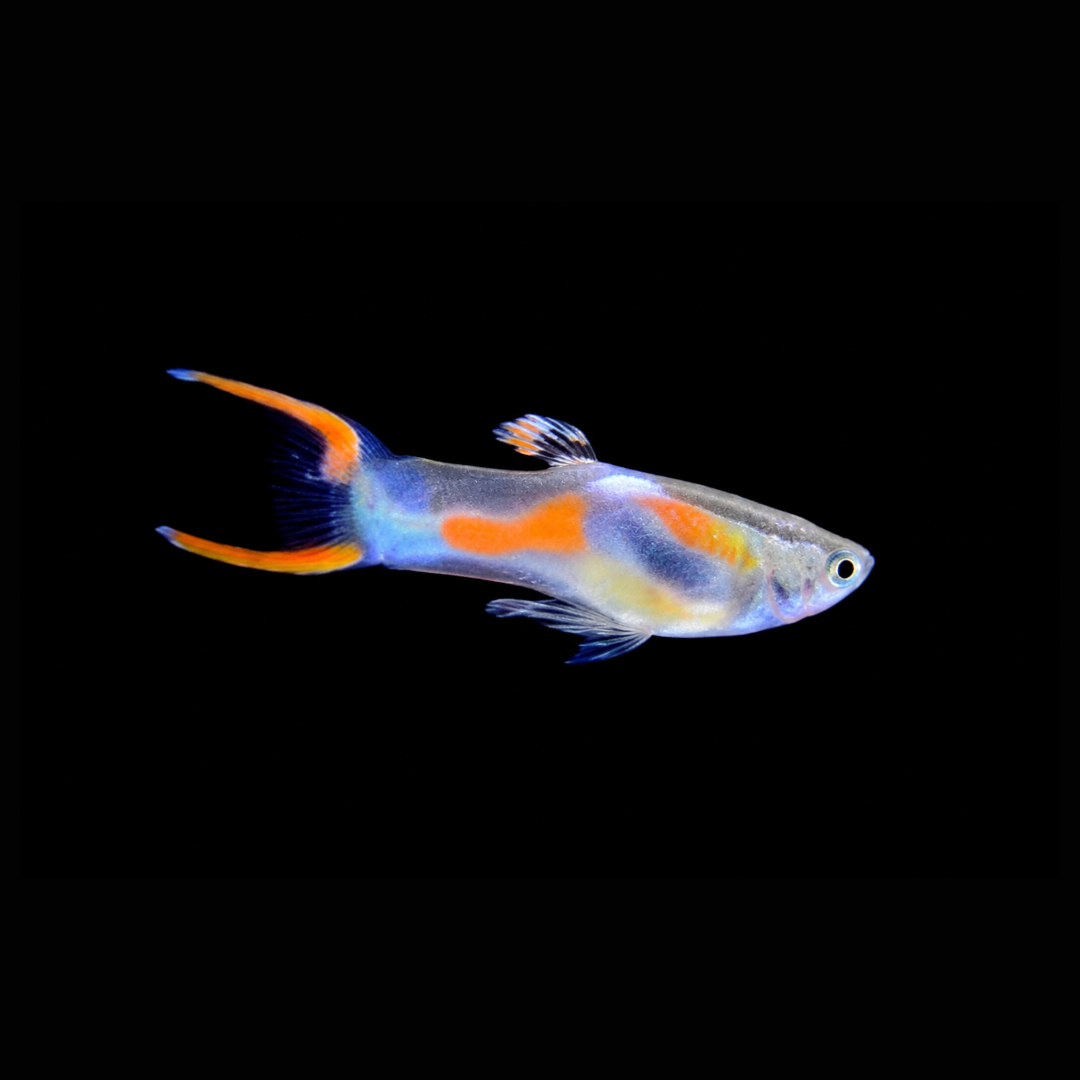
エンドラーズ・ライブベアラーは、南米ベネズエラ北東部のごく限られた沿岸低地に生息する、グッピーに近縁の小さな卵胎生メダカです。オスの体長は2〜3cmほどしかありませんが、体側には蛍光色のようなオレンジや赤、金属質の緑や青、くっきりとした黒い帯が並び、泳ぐたびに宝石のような光を放ちます。一方、メスはオスの倍近くまで成長し、銀色から淡い黄褐色の落ち着いた体色をしています。改良グッピーのような長いヒレを持たない、原種らしい引き締まった体つきも魅力です。丈夫で繁殖させやすいことから、初心者からベテランまで幅広いアクアリストに親しまれてきました。2005年にグッピーとは別の種 Poecilia wingei として記載され、現在はIUCNレッドリストで絶滅危惧種(EN)に評価されています。原産地では生息環境の悪化やグッピーとの交雑が進んでいるとされ、交雑させずに純血の系統を受け継いでいく飼育者の取り組みが、この魚の将来を支える役割を担いつつあります。Endler’s livebearer is a small livebearing fish closely related to the guppy, found only in a narrow stretch of coastal lowland in northeastern Venezuela. Males measure just 2 to 3 cm, yet their flanks display near-fluorescent orange and red, metallic green and blue, and bold black bars that flash like jewels as they swim. Females grow nearly twice as large and have a subdued silver to pale yellowish-brown coloration. Another appeal is the trim, wild-type body without the long fins of fancy guppies. Hardy and easy to breed, the species has long been popular with beginners and experienced aquarists alike. It was described as a species separate from the guppy, Poecilia wingei, in 2005, and it is currently assessed as Endangered (EN) on the IUCN Red List. Habitat degradation and hybridization with guppies are thought to be advancing in its native range, and hobbyists who keep pure lines without hybridization are increasingly helping to secure this fish’s future.
カダヤシ目 カダヤシ科 グッピー属(アカントファケルス亜属)Cyprinodontiformes, Poeciliidae, genus Poecilia (subgenus Acanthophacelus)
英名 / English Name
Endler’s livebearer
分布 / Distribution
ベネズエラ北東部。クマナ周辺からパリア半島の付け根にあたるカンポマ周辺にかけての、カリアコ湾沿岸の低地に点在するラグーンや水路、エル・ティグレ川などに分布します。最初の発見地であるパトス湖の個体群は、すでに失われたともいわれています。Northeastern Venezuela, in lagoons, channels and streams such as the El Tigre river scattered across the coastal lowlands of the Gulf of Cariaco, from around Cumaná to the Campoma area at the base of the Paria Peninsula. The population of Laguna de Patos, where the species was first found, is said to have already been lost.
最大体長 / Max Size
オス約2〜3cm、メス約3.5〜5cmMales about 2–3 cm, females about 3.5–5 cm
寿命 / Lifespan
1〜2年程度が目安で、環境が良ければ3年前後生きることもあるとされています。出産を繰り返すメスは体力を消耗しやすく、オスより短命になる場合があります。Typically around 1 to 2 years, and reportedly up to about 3 years in good conditions. Females that give birth repeatedly tend to wear out and may live shorter lives than males.
飼育環境 / Aquarium Environment
水槽サイズ / Tank Size
数匹を観賞するだけなら30cm規格水槽(約12L)でも飼育できます。繁殖を続けるグループとして安定させるなら、水量30〜50L以上の45cm規格水槽〜60cm規格水槽が適しています。よく殖える魚なので、余裕のあるサイズを選んでおくと水質も安定しやすくなります。A few fish kept purely for display can live in a 30 cm standard tank (about 12 L). To keep a stable breeding group, a 45 cm to 60 cm standard tank holding 30 to 50 L or more is better suited. Because the species multiplies readily, choosing a roomier tank also makes water quality easier to keep stable.
水温 / Temperature
24〜28℃が理想です。高水温には比較的強いものの、日本の冬は室温のままでは水温が下がりすぎるため、ヒーターで保温してください。24–28°C is ideal. The fish copes fairly well with warm water, but water left at room temperature becomes too cold in Japanese winters, so use a heater.
水質 / Water Quality
pH7.0〜8.5の弱アルカリ性で、総硬度(GH)8〜20°dGH程度の中〜高硬度の水を好みます。日本の水道水は全国平均で約3°dGH前後の軟水なので、砂利系の底床に少量のサンゴ砂を混ぜたり、カキガラ系のろ材を使ったりしてpH7.2〜8.0前後に保つと、発色や繁殖力を引き出しやすくなります。国内で何世代も繁殖されてきた個体は弱酸性の軟水にも耐えますが、そうした環境が長く続くと体色のくすみや繁殖力の低下につながりやすいとされます。原産地には汽水域もあり塩分にも強い魚ですが、通常は淡水で問題なく飼育できます。Prefers slightly alkaline water at pH 7.0–8.5 with moderate to high hardness of around 8–20 °dGH. Japanese tap water is soft, averaging roughly 3 °dGH nationwide, so mixing a little coral sand into a gravel substrate or using oyster-shell filter media to hold the pH around 7.2–8.0 helps bring out color and breeding vigor. Fish bred in Japan for many generations tolerate soft, slightly acidic water, but long periods in such conditions tend to dull coloration and reduce fertility. The native range includes brackish water and the fish tolerates salt, but it normally does perfectly well in fresh water.
レイアウト / Layout
ウィローモスやミクロソリウム、浮草など、弱アルカリ性の硬めの水にも強い水草を密に植えましょう。オスに追われるメスの逃げ場と、稚魚の隠れ家を同時に確保できます。水草の表面に付く微生物や藻類は、格好のおやつにもなります。ろ過は強い水流を生むものより、稚魚を吸い込みにくいスポンジフィルターなど穏やかなものが向いています。体色を引き立てたい場合は、やや暗めの底床や背景がよく映えます。Plant densely with species that tolerate hard, slightly alkaline water, such as Java moss, Java fern and floating plants. This gives females a refuge from pursuing males and fry a place to hide at the same time. The microorganisms and algae on plant surfaces also make a welcome snack. Gentle filtration such as a sponge filter, which is unlikely to suck in fry, suits the species better than equipment that creates strong currents. Darker substrates and backgrounds help the colors stand out.
注意点 / Precautions
グッピーや別系統のエンドラーズとは簡単に交雑するため、系統を維持したい場合は1つの水槽で1系統だけを飼うようにしてください。性比はオス1匹に対してメス2〜3匹以上が目安で、繁殖させたくない場合はオスだけで群泳させるのが適しています。小型で飛び出すこともあるため、フタを用意しておくと安心です。高水温や汚れた水にも強く、野外に放されると定着するおそれがあるため、殖えすぎた個体も決して自然の水辺に放してはいけません。Because the fish hybridizes easily with guppies and with other Endler lines, keep only one line per tank if you want to preserve a strain. Aim for at least two to three females per male; if you do not want breeding, keeping a group of males only works well. These small fish may jump, so a lid is reassuring. They tolerate warm and polluted water well and could become established if released, so surplus fish must never be released into natural waters.
餌と給餌 / Feeding
餌の種類 / Diet
雑食性で、自然下では小さな底生動物やデトリタス、藻類などを幅広く食べています。飼育下では小型魚用の顆粒・フレークフードやスピルリナ配合の植物性フードを主食にし、ブラインシュリンプ幼生や冷凍赤虫を副食として加えると、栄養のバランスが整います。Omnivorous; in the wild it eats a wide range of small bottom-dwelling invertebrates, detritus and algae. In the aquarium, use granules or flakes for small fish and spirulina-based plant foods as the staple, and add newly hatched brine shrimp or frozen bloodworms as supplements for a balanced diet.
給餌のポイント / Feeding Tips
口が小さいので、粒の細かい餌を数分で食べきれる量だけ、1日1〜2回与えるのが基本です。繁殖期や出産前後のメスには動物性タンパク質の多い餌を意識して与えると、体力の維持や発色の向上につながります。稚魚にはパウダー状の餌やブラインシュリンプ幼生を1日2〜3回与えましょう。The mouth is small, so feed fine foods once or twice a day in amounts eaten within a few minutes. Giving protein-rich foods to breeding females and to females before and after giving birth helps maintain their condition and improves coloration. Feed fry powdered food or newly hatched brine shrimp two to three times a day.
性格と混泳 / Temperament and Tank Mates
性格 / Temperament
温和で活発です。オスは一日中メスへの求愛を繰り返すほど熱心で、オス同士がヒレを広げて見せ合う姿もよく見られますが、深刻な争いになることはまれです。Peaceful and active. Males court females eagerly throughout the day and are often seen flaring their fins at one another, but serious fights are rare.
混泳の相性 / Compatibility
ドワーフコリドラス、小型のレインボーフィッシュ(ルリメダカやシュードムギル属)、おとなしい小型カラシン類などとは問題なく混泳できます。グッピーとの同居は交雑の原因になるため避けてください。小型のエビ類と一緒にすると稚エビが食べられることがあるため、エビの繁殖を目的とした水槽には向きません。反対に、口の大きな魚や大型の甲殻類はエンドラーズを捕食するので、組み合わせないようにしましょう。Mixes well with dwarf corydoras, small rainbowfish such as the threadfin rainbow and Pseudomugil species, and peaceful small tetras. Avoid keeping it with guppies, as this leads to hybridization. Baby shrimp may be eaten when kept with dwarf shrimp, so it is unsuitable for shrimp-breeding tanks. Conversely, large-mouthed fish and large crustaceans will prey on Endlers and should not be kept with them.
病気と対策 / Diseases and Prevention
かかりやすい病気 / Common Diseases
丈夫な魚ですが、水質の悪化や夏場の高水温がきっかけで尾ぐされ病(カラムナリス症)を発症することがあります。また、短い間隔で出産を繰り返したメスが、産後に体色がくすみ急に痩せてしまう産後の消耗もよく知られたトラブルです。水温が急に変化したときは、白点病にも注意が必要です。Although hardy, the fish can develop fin rot (columnaris disease) triggered by poor water quality or high summer temperatures. Another well-known problem is post-partum exhaustion, in which females that give birth at short intervals lose color and become thin rapidly after delivery. Watch for white spot disease when the water temperature changes suddenly.
対策と予防 / Prevention
週に1回程度、20〜30%の換水で硝酸塩を低く保ち、過密飼育を避けることが何よりの予防です。メスにはオスと離して休ませる期間を設け、出産の前後は栄養価の高い餌で体力を支えましょう。ヒレ先が白く濁るなど尾ぐされ病の初期症状が見られた場合、隔離して0.5%の塩水浴を行うこともあります。ただし、原因菌は低濃度の塩分では抑えきれないとされるため、症状が進むようなら、グリーンFゴールド顆粒や観パラDなどの魚病薬による薬浴へ速やかに切り替えます。重症の場合はエルバージュエースが使われることもあります。塩や薬は水草やろ過バクテリアにも影響するため、治療は必ず別の容器で行ってください。The best prevention is to change 20–30% of the water about once a week to keep nitrate low, and to avoid overcrowding. Give females rest periods away from males, and support them with nutritious food before and after giving birth. When early signs of fin rot appear, such as whitish fin edges, a 0.5% salt bath in isolation is sometimes used. However, the causative bacteria are not considered to be suppressed by such low salinity, so if symptoms progress, switch promptly to a medicated bath with fish medicines such as Green F Gold granules or Kanpara D. Elbagu Ace may be used in severe cases. Salt and medicines also affect plants and filter bacteria, so always treat fish in a separate container.
増やし方(繁殖) / Breeding
雌雄の判別 / Sexing
雌雄の見分けは簡単です。オスは小さく体色が派手で、臀ビレが細長い交尾器(ゴノポディウム)に変化しています。メスは体が大きく、銀色〜黄褐色の地味な体色で、扇形の臀ビレと、その付け根付近にある黒っぽい胎斑が目印です。オスは生後3〜5週ほどで色づき始めます。Sexing is easy. Males are small and brightly colored, with the anal fin modified into a slender copulatory organ (gonopodium). Females are larger and plain silver to yellowish-brown, recognizable by a fan-shaped anal fin and a dark gravid spot near its base. Males begin to color up at about 3 to 5 weeks of age.
繁殖形態 / Reproduction
体内受精を行う卵胎生で、メスはお腹の中で育てた稚魚をそのまま産み出します。メスは精子を体内に蓄えておけるため、一度の交尾で複数回出産できます。妊娠期間は約20〜25日と短く、1回に5〜30匹ほどの稚魚を産みます。出産が近づくと胎斑が濃くなり、お腹が角張った箱のような形に見えてきます。A livebearer with internal fertilization; females give birth to fry that have developed inside the body. Because females can store sperm, a single mating can lead to several births. Gestation is short, about 20–25 days, and each brood numbers roughly 5 to 30 fry. As birth approaches, the gravid spot darkens and the belly takes on a squarish, box-like shape.
繁殖のポイント / Breeding Tips
オスとメスを一緒に飼うだけで自然に殖えていきます。改良グッピーと比べて親が稚魚を襲うことは少ないとされますが、生まれた直後の稚魚は動きが鈍く、大きなメスに食べられてしまうこともあります。より多くの稚魚を残したい場合は、狭い産卵ネットよりも、外掛け式の育成ボックスや水草を茂らせた別の水槽に出産間近のメスを移し、産み終えたら元に戻す方法が安心です。稚魚は生後約2カ月で繁殖できるようになるため、系統を計画的に維持したいときは、生後3〜4週頃までに雌雄を分け、優れた種親を選んで交配させましょう。Simply keeping males and females together leads to natural breeding. Parents are said to prey on their fry less often than fancy guppies do, but newborns are sluggish at first and may be eaten by a large female. To raise more fry, move a female close to giving birth into a hang-on breeding box or a separate, heavily planted tank rather than a cramped breeding net, and return her once she has finished. Fry can breed at about two months of age, so if you want to maintain a line deliberately, separate the sexes by about 3 to 4 weeks of age and pair carefully selected breeders.
雑学と豆知識 / Trivia and Fun Facts
1. 約70年越しの「名前」の物語 / 1. A Name Seventy Years in the Making
この魚が初めて採集されたのは1937年、魚類学者フランクリン・ボンドがベネズエラのクマナ近郊にあるパトス湖で行った調査でのことでした。しかし標本は博物館に収められたまま発表されず、長く忘れられていました。転機となったのは1975年です。進化生物学者のジョン・エンドラー博士が、ボンドの記録を知らないまま同じ湖でこの魚を再発見したのです。標本を受け取った遺伝学者クラウス・カルマン博士はこれを独立した種と考え、ドイツの愛好家たちに「エンドラーズ・ライブベアラー」の名で紹介しました。カルマン博士はサプライズのつもりで本人に知らせなかったため、エンドラー博士は後になって、自分の名を冠した魚が世界に広まっていることを知ったと伝えられています。その後も愛好家の間で親しまれながら正式な学名のない時代が続き、2005年にポーザー、ケンプケス、イスブリュッカーの3名によって、ようやく Poecilia wingei として記載されました。最初の採集からおよそ70年を経て、この小さな魚は正式な名前を得たことになります。The fish was first collected in 1937 by ichthyologist Franklyn Bond during a survey of Laguna de Patos near Cumaná, Venezuela. The specimens, however, sat unpublished in a museum and were long forgotten. The turning point came in 1975, when evolutionary biologist Dr. John Endler rediscovered the fish in the same lake without knowing of Bond’s record. Geneticist Dr. Klaus Kallman, who received specimens, regarded it as a distinct species and introduced it to German hobbyists as “Endler’s livebearer.” Kallman reportedly kept this a surprise, so Endler only learned later that a fish bearing his name had spread around the world. The fish remained popular among hobbyists without a formal scientific name until 2005, when Poeser, Kempkes and Isbrücker finally described it as Poecilia wingei. Some seventy years after its first collection, the little fish at last received its official name.
2. 学名に刻まれた酵母遺伝学の開拓者 / 2. A Pioneer of Yeast Genetics Honored in the Name
属名の Poecilia はギリシャ語で「多彩な」を意味する言葉に由来し、この仲間の色彩の豊かさをよく表しています。一方、種小名の wingei は、デンマークの生物学者ウヴィンド・ヴィンゲ博士(1886〜1964年)にちなんだものです。ヴィンゲ博士は酵母遺伝学の開拓者として知られていますが、1920年代にはグッピーの交配実験を重ね、オスの色彩模様がY染色体と結びついて父から息子へ受け継がれる仕組みをいち早く明らかにしました。エンドラーズのオスが代々受け継ぐ鮮やかな模様を理解するうえでも、この研究が土台となっています。The genus name Poecilia comes from a Greek word meaning “many-colored,” aptly describing the rich coloration of the group. The species name wingei honors Danish biologist Dr. Øjvind Winge (1886–1964). Although best known as a pioneer of yeast genetics, Winge also conducted guppy breeding experiments in the 1920s and was among the first to show that male color patterns are linked to the Y chromosome and passed from father to son. His work remains the foundation for understanding the vivid patterns that Endler males inherit generation after generation.
3. 独立した種か、分かれつつある途中か / 3. A Separate Species, or One Still Splitting Off?
エンドラーズとグッピーは、ヒレの条数や鱗の数がほぼ同じで、水槽内では簡単に交雑して子孫を残します。それでも別種とされたのは、両者が同じ場所にいても、オスの色彩、とくに体側中央の黒い帯や求愛のしかたがはっきり異なることが観察されたためでした。2009年には、ミトコンドリアDNAの解析から別種とする見方を支持する研究も発表されています。ところが2014年、ベネズエラ北東部の複数の水系を対象にした大規模な遺伝解析で、水系をまたいだ遺伝子の行き来が今も続いていることが示されました。この研究は、両者はまだ完全には分かれておらず、メスの好みによって色の違いが保たれている「種が分かれつつある途中の段階」にあるという見方を示しています。一方、性染色体の研究では、エンドラーズとグッピーが共通の性染色体を持ちながらも、エンドラーズのY染色体には同じ塩基配列の繰り返しがグッピーより多く蓄積していることが報告されています。つまり、ごく近い間柄でありながら、遺伝子のレベルでは違いも生まれていることを示す結果です。学術的な議論は今も続いていますが、観賞魚の世界や保全の取り組みでは Poecilia wingei の名が広く定着しています。Endlers and guppies have nearly identical counts of fin rays and scales and readily hybridize in aquariums to produce offspring. They were nonetheless treated as separate species because, even where they live together, male coloration, especially the black bar along the mid-flank, and courtship behavior were observed to differ clearly. In 2009, a study based on mitochondrial DNA also supported treating them as separate species. In 2014, however, a large genetic analysis across several river systems in northeastern Venezuela showed that genes are still flowing between drainages. That study suggested the two have not yet fully separated and are at a stage of splitting into species, with color differences maintained by female preference. Meanwhile, sex chromosome research has reported that although Endlers and guppies share the same sex chromosome system, the Endler Y chromosome has accumulated more repetitive DNA sequences than the guppy’s. In other words, the results show that despite their close relationship, differences are also emerging at the genetic level. The scientific debate continues, but the name Poecilia wingei is firmly established in the aquarium hobby and in conservation efforts.
4. 進化を目の前で示したエンドラー博士の実験 / 4. Endler’s Experiment That Showed Evolution in Action
名前の由来となったエンドラー博士は、トリニダード島の野生グッピーを使った古典的な研究で知られています。強い捕食魚がいる川ではオスが地味になり、捕食の危険が少ない川ではメスに好まれる派手なオスが増えることに着目した博士は、捕食者の多い川の地味なグッピーを、捕食者の少ない川へ移しました。すると、わずか2年ほど、世代にしておよそ15世代のうちに、オスの斑点は大きく鮮やかなものへと変わっていきました。1980年に発表されたこの研究は、天敵に狙われにくい姿を残す自然選択と、メスに選ばれやすい姿を残す性選択とが、野外でも目に見える速さで生き物の姿を変えることを示した例として、今も教科書で紹介されています。博士がベネズエラでこの魚を再発見したのは、こうした南米各地での調査の途中のことでした。Dr. Endler, for whom the fish is named, is known for a classic study of wild guppies in Trinidad. Noting that males are drab in streams with strong predators, while flashy males favored by females become common where predation risk is low, he moved drab guppies from a stream with many predators to one with few. Within only about two years, roughly 15 generations, the males’ spots became larger and brighter. Published in 1980, this study is still featured in textbooks as an example showing that natural selection, which favors forms less likely to be caught by predators, and sexual selection, which favors forms more likely to be chosen by females, can change an animal’s appearance at a visible pace in the wild. It was during such fieldwork across South America that Endler rediscovered this fish in Venezuela.
5. 緑の水の中で輝くための金属光沢 / 5. Metallic Sheen for Shining in Green Water
エンドラーズのオスが、ほかのグッピーの仲間にも劣らない強い金属光沢を持つ理由については、興味深い仮説があります。原産地のパトス湖などは藻類が多く、水が緑色に濁った環境でした。見通しの悪い水中でもメスに自分の存在を気づいてもらうため、光をはね返す金属的な輝きが発達したのではないか、という考え方です。水槽のライトを浴びてきらめく姿には、そんな故郷の水の名残が見えるのかもしれません。There is an intriguing hypothesis for why Endler males carry a metallic sheen as strong as that of any other guppy relative. Native waters such as Laguna de Patos were rich in algae and turbid green. The idea is that a reflective, metallic shine developed so that males could make females notice them even in such poor visibility. The way they glitter under aquarium lights may carry a trace of those home waters.
6. 環境で変わる求愛と、オスだけで育つことの影響 / 6. Courtship That Changes with Circumstances, and the Effect of Male-Only Rearing
オスは普段、メスの正面に回り込み、体をS字に曲げてヒレを広げ、震わせながら丁寧に求愛します。ところが、ライバルの多い環境を経験したオスは、この求愛を減らし、メスの背後から素早く交尾を試みる回数を増やすことが確認されています。さらに、匂いの好みを調べた実験では、オスだけの水槽で30日間育てられたオスがオス同士で求愛するようになり、メスよりもオスの匂いを好むようになったと報告されています。この傾向は、その後メスと一緒にしても続いたといいます。つまり、観賞用にオスだけで長く飼っていた個体を後から種親にしようとすると、繁殖行動が鈍る可能性があるということです。飼育者にとっても見逃せない知見といえるでしょう。Males normally court carefully, swinging in front of the female, bending the body into an S shape and quivering with fins spread. However, males that have experienced many rivals have been shown to court less and to make more quick mating attempts from behind the female. In an odor-preference experiment, males reared for 30 days in male-only tanks began courting each other and came to prefer the scent of males over that of females, and this tendency reportedly persisted even after they were housed with females. In other words, males kept alone for display over long periods may show weaker breeding behavior if they are later used as breeders, a finding well worth noting for hobbyists.
7. 血統を表すクラスN・P・K / 7. Class N, P and K: Labels of Lineage
グッピーと簡単に交雑してしまうことから、エンドラーズの世界ではヒレの形や色ではなく、「どこから来たか」による分類が使われています。アメリカの愛好家が考案したこの基準では、原産地で採集された個体まで交雑なく記録をたどれる系統をクラスN、見た目は純血に見えても記録をたどれない系統をクラスP、グッピーなどとの交雑系統をクラスKと呼び分けます。純血の個体は小柄で尾の付け根が細く、パステル調の色が出ないのに対し、交雑系統は体が大きく、尾ビレが伸びやすい傾向があるとされます。ただし、これはあくまで目安であり、見た目が原種らしくても交雑の可能性を否定できないからこそ、記録をたどれるかどうかが重視されているのです。体側に黒い帯が走るブラックバー、採集地点ごとに番号で管理されるカンポマ系、色のコントラストが強いエル・ティグレ系などがクラスNの代表的な系統です。一方、水色の輝きが美しいジャパンブルーや、タイガー、ピンクスカーレットといった華やかな品種の多くはクラスKにあたります。どちらが優れているということではなく、正しく区別したうえでそれぞれの魅力を楽しむことが大切です。Because Endlers hybridize so easily with guppies, the hobby classifies them not by fin shape or color but by where they came from. Under a system devised by an American hobbyist, lines that can be traced without hybridization back to fish collected in the native range are Class N, lines that look pure but cannot be traced are Class P, and hybrids with guppies or other species are Class K. Pure fish tend to be small with a slender tail base and no pastel colors, while hybrids tend to be larger with longer tails. These are only guidelines, however; because hybridization cannot be ruled out even in a wild-looking fish, traceable records are what count. Representative Class N lines include Black Bar with its dark flank bar, the Campoma lines managed by collection-site numbers, and the high-contrast El Tigre. Many showy varieties, such as the sky-blue Japan Blue, Tiger and Pink Scarlet, are Class K. Neither is better than the other; what matters is to distinguish them correctly and enjoy each for its own appeal.
8. 故郷で迫る危機と、日本の水辺を守るために / 8. Threats at Home, and Protecting Japan’s Waters
原産地では、発見地のパトス湖が隣接するゴミ処分場からの汚染を受けて個体群が失われたといわれているほか、外来魚の侵入、干ばつや海面上昇によるラグーンの消失、放流されたグッピーとの交雑などが脅威になっているとされます。こうした状況から、世界中の飼育者が純血の系統を維持することは、この種の遺伝的な多様性を守る助けになると期待されています。一方で、日本の水辺に放されれば、今度はエンドラーズ自身が外来種になってしまいます。国内では、同じカダヤシ科で北米原産のカダヤシが特定外来生物に指定され、飼育や譲渡が禁じられているほか、温泉の排水が流れ込む水域などでは、グッピーが野生化した例も知られています。「入れない、捨てない、拡げない」を守ることが、この魚と日本の自然の両方を大切にすることにつながります。In the native range, the Laguna de Patos population is said to have been lost to pollution from an adjacent waste dump, and other threats are thought to include invasive fish, the loss of lagoons to drought and sea-level rise, and hybridization with released guppies. Against this backdrop, the maintenance of pure lines by hobbyists worldwide is expected to help preserve the species’ genetic diversity. Released into Japanese waters, however, Endlers would themselves become an invasive species. In Japan, the mosquitofish, a North American member of the same family, is designated an Invasive Alien Species whose keeping and transfer are prohibited, and guppies are known to have become feral in waters fed by hot-spring runoff. Following the principle of not introducing, not releasing and not spreading helps protect both this fish and Japan’s natural environment.
まとめ / Conclusion
エンドラーズ・ライブベアラーは、指先ほどの小さな体に鮮やかな金属光沢をまとい、水草の間を休みなく泳ぎ回る宝石のような魚です。丈夫で殖やしやすく、日本の軟水を少し整えてあげるだけで、本来の輝きと、親から子へ命がつながっていく様子を間近で見せてくれます。Endler’s livebearer is a jewel-like fish that wears a vivid metallic sheen on a fingertip-sized body and swims tirelessly among the plants. Hardy and easy to breed, it shows its true brilliance, and the passing of life from parent to offspring, up close with only a little adjustment of Japan’s soft water.
故郷の水辺で数を減らしつつある一方、その血統は世界各地の水槽の中で受け継がれています。交雑させずに系統を守り、決して自然に放さないという飼育者一人ひとりの心がけが、この小さな輝きを次の世代へとつないでいきます。While it is dwindling in its home waters, its lineage lives on in aquariums around the world. The care of each keeper who protects lines from hybridization and never releases fish into the wild is what carries this small brilliance on to the next generation.
Poeser, F. N., Kempkes, M. & Isbrücker, I. J. H. (2005). Description of Poecilia (Acanthophacelus) wingei n. sp. from the Paría Peninsula, Venezuela, including notes on Acanthophacelus Eigenmann, 1907 and other subgenera of Poecilia Bloch and Schneider, 1801 (Teleostei, Cyprinodontiformes, Poeciliidae). Contributions to Zoology, 74(1/2), 97–115.
Schories, S., Meyer, M. K. & Schartl, M. (2009). Description of Poecilia (Acanthophacelus) obscura n. sp., (Teleostei: Poeciliidae), a new guppy species from western Trinidad, with remarks on P. wingei and the status of the “Endler’s guppy”. Zootaxa, 2266, 35–50.
Herdegen, M., Alexander, H. J., Babik, W., Mavárez, J., Breden, F. & Radwan, J. (2014). Population structure of guppies in north-eastern Venezuela, the area of putative incipient speciation. BMC Evolutionary Biology, 14, 28. https://doi.org/10.1186/1471-2148-14-28
Morris, J., Darolti, I., Bloch, N. I., Wright, A. E. & Mank, J. E. (2018). Shared and species-specific patterns of nascent Y chromosome evolution in two guppy species. Genes, 9(5), 238. https://doi.org/10.3390/genes9050238
Darolti, I., Wright, A. E., Sandkam, B. A., Morris, J., Bloch, N. I., Farré, M., Fuller, R. C., Bourne, G. R., Larkin, D. M., Breden, F. & Mank, J. E. (2019). Extreme heterogeneity in sex chromosome differentiation and dosage compensation in livebearers. Proceedings of the National Academy of Sciences of the USA, 116(38), 19031–19036.
Winge, Ö. (1922). One-sided masculine and sex-linked inheritance in Lebistes reticulatus. Journal of Genetics, 12, 145–162.
Endler, J. A. (1980). Natural selection on color patterns in Poecilia reticulata. Evolution, 34(1), 76–91.
Řežucha, R. & Reichard, M. (2014). The effect of social environment on alternative mating tactics in male Endler’s guppy, Poecilia wingei. Animal Behaviour, 88, 195–202.
Altinok, I. & Grizzle, J. M. (2001). Effects of low salinities on Flavobacterium columnare infection of euryhaline and freshwater stenohaline fish. Journal of Fish Diseases, 24(6), 361–367.









コメント