

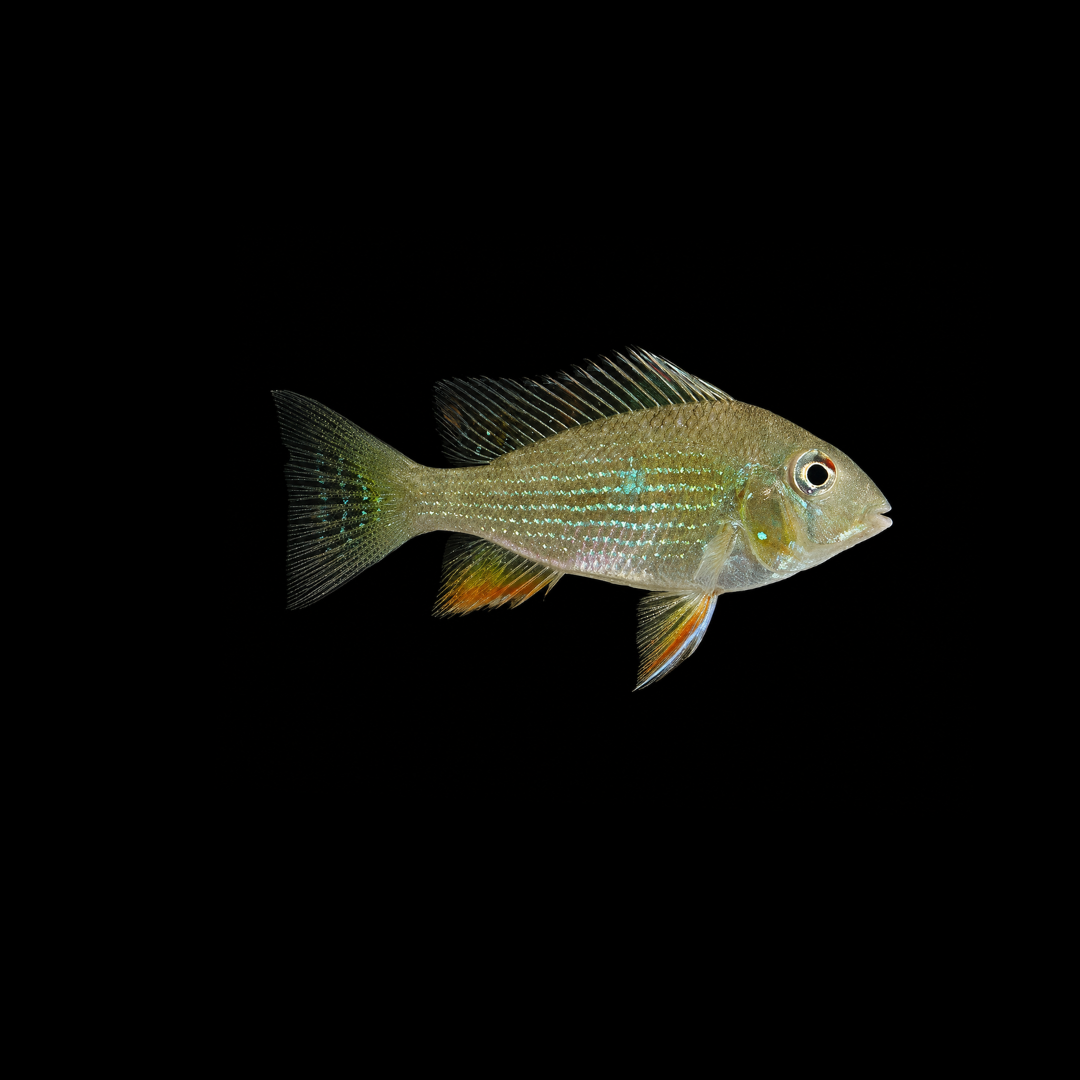
解説 / Description
アカリクティス・ヘッケリーは、南米のアマゾン川水系とエセキボ川水系に広く分布する中型のシクリッドです。体側に散る青や金色の光沢、眼の下を縦に走る黒い線、そして成熟すると背鰭後端から糸のように長く伸びる赤橙色の鰭条が大きな魅力で、英名の「スレッドフィン・アカラ」もこの特徴に由来します。底砂を口に含み、食べられるものを選り分けながら砂を鰓から排出する採餌行動も見どころの一つです。常に激しく争うタイプではありませんが、繁殖期には巣の周辺を強く守るため、成魚の体格に見合う底面積と逃げ場を確保することが長期飼育のポイントになります。日本ではノーマル個体のほか、ワイルド個体、アルビノ、ショートボディなども流通しています。 Acarichthys heckelii is a medium-sized South American cichlid widely distributed in the Amazon and Essequibo river systems. Its appeal comes from the blue and golden iridescence scattered across the flanks, the dark vertical mark below the eye, and the reddish-orange fin rays that become thread-like and greatly elongated at the rear of the dorsal fin as the fish matures. The English name “Threadfin Acara” refers directly to this feature. It frequently takes mouthfuls of sand, separates edible material, and expels the remaining substrate through the gills, making its feeding behavior especially interesting to observe. It is not constantly aggressive, but breeding fish defend the nest area strongly, so adequate floor space and retreats are important for long-term care. In Japan, normal, wild-caught, albino, and short-bodied forms can all be encountered in the aquarium trade.
基本情報 / Basic Information
| 学名 / Scientific Name | Acarichthys heckelii (Müller & Troschel, 1849) |
|---|---|
| 通称 / Common Name | アカリクティス・ヘッケリー、ヘッケリー、スレッドフィン・アカラThreadfin Acara, Heckel’s Thread-finned Acara |
| 分類 / Family | シクリッド目・シクリッド科・シクリナエ亜科・アカリクティス属。アカリクティス属は本種のみからなる単型属です。Order Cichliformes, family Cichlidae, subfamily Cichlinae, genus Acarichthys. Acarichthys is a monotypic genus containing this single living species. |
| 英名 / English Name | Threadfin Acara |
| 分布 / Distribution | 南米。ペルー、コロンビア、ブラジルにまたがるアマゾン川本流域と、プトゥマヨ川下流、トロンベタス川、ネグロ川、シングー川、トカンチンス川下流、カピン川、ブランコ川などの水系、さらにガイアナのエセキボ川水系に分布します。シンガポールでは移入個体群の野外繁殖が確認されています。South America. It occurs along the main Amazon system in Peru, Colombia, and Brazil, including lower sections or drainages such as the Putumayo, Trombetas, Negro, Xingu, lower Tocantins, Capim, and Branco rivers, as well as the Essequibo River system in Guyana. Established introduced populations have also been documented in Singapore. |
| 最大体長 / Max Size | 最大で標準体長約19.5cm、全長ではおおむね20cm前後。飼育下でも15〜20cmほどを想定して設備を用意します。Up to about 19.5 cm standard length, with total length around 20 cm. In aquaria, it is best to plan for an adult size of roughly 15–20 cm. |
| 寿命 / Lifespan | 本種について信頼できる種別の長期寿命データは乏しく、年数を一律の目安として示すのは困難です。長期飼育では、安定した水質、偏りのない食事、慢性的なストレスを避ける管理が重要です。Reliable species-specific longevity data are limited, so a single numerical lifespan should not be treated as established for this species. For long-term care, stable water quality, a balanced diet, and low chronic stress are important. |
飼育環境 / Aquarium Environment
| 水槽サイズ / Tank Size | 成魚の単独飼育は90cm規格水槽(約180L)以上を目安にします。ペア飼育や他の中型魚との混泳では、繁殖期の縄張りも考えて120cm規格水槽以上が扱いやすく、複数飼育ではさらに広い底面積が必要です。幼魚は60cm水槽でも管理できますが、終生飼育用としては底面積が不足しやすいため、成長に合わせて早めにサイズアップします。For a single adult, a 90 cm standard aquarium of roughly 180 L is a practical starting point. For a pair or a community with other medium-sized fish, a 120 cm standard aquarium or larger is easier to manage because breeding fish defend territories; groups require still more floor area. Juveniles can be raised temporarily in a 60 cm tank, but it usually lacks sufficient floor area for permanent adult housing. |
|---|---|
| 水温 / Temperature | 24〜28℃を中心に管理します。短期的にはやや高めの水温にも対応しますが、急激な温度変化を避け、季節を通して安定させることが重要です。 Maintain mainly at 24–28°C. The species can tolerate somewhat warmer conditions for limited periods, but sudden temperature changes should be avoided and year-round stability is important. |
| 水質 / Water Quality | 弱酸性〜中性を基本とし、pH6.0〜7.5程度の軟水〜中程度の硬度が扱いやすい範囲です。ワイルド個体では特に急変を避け、導入時はショップの水質から時間をかけて合わせます。ろ過能力を十分に確保し、硝酸塩などの老廃物を蓄積させないことが重要です。Slightly acidic to neutral water is preferred, with approximately pH 6.0–7.5 and soft to moderately hard conditions being practical for aquarium care. Wild-caught fish should be acclimated especially gradually to avoid abrupt changes. Strong biological filtration and regular maintenance are important to prevent the accumulation of nitrate and other wastes. |
| レイアウト / Layout | 細かく角のない砂を底床に使い、口に含んでふるえる環境を用意します。田砂や粒子の細かなボトムサンドなどが向きます。流木や石で視線を遮る場所を作りつつ、底面には十分な採餌スペースを残します。底床を頻繁に掘るため、植栽する場合はアヌビアス類やミクロソリウム類などを流木や石へ活着させる方法が扱いやすくなります。Use fine, smooth sand that can be safely taken into the mouth and sifted. Fine river sand or aquarium sand with rounded grains is suitable. Driftwood and rocks should provide visual barriers while leaving ample open bottom area for feeding. Because the fish regularly disturbs the substrate, plants are easiest to maintain when attached to wood or rock, such as Anubias or Java fern. |
| 注意点 / Precautions | 粗く尖った砂利は底砂をふるう行動に向かず、口や鰓を刺激するおそれがあるため、細かく角のない砂を選ぶのが無難です。過密飼育や餌の与えすぎを避け、定期的な換水で老廃物を蓄積させないようにします。換水量は週1回30〜50%程度を出発点とし、水槽の魚数や水質の推移に応じて調整してください。照明が強い環境では、個体が落ち着けるよう浮草や流木の陰など暗い場所も用意します。ショートボディ個体も、体長だけを基準に小型水槽へ収めず、体格と活動量に合った底面積を確保します。Coarse or sharp gravel is poorly suited to substrate sifting and may irritate the mouth or gills, so fine, smooth sand is the safer choice. Avoid overstocking and overfeeding, and use regular water changes to prevent waste from accumulating. About 30–50% weekly is a reasonable starting point, adjusted according to stocking level and water-quality trends. Under strong lighting, provide shaded areas where fish can settle. Short-bodied forms should still receive adequate floor space rather than being placed in undersized tanks simply because their body length is reduced. |
餌と給餌 / Feeding
| 餌の種類 / Diet | 主食は沈下性のシクリッド用ペレットや顆粒フードが使いやすく、補助的に冷凍赤虫、ブラインシュリンプ、イトミミズなどを与えられます。スピルリナや植物質を含む人工飼料も組み合わせ、動物性の餌だけに偏らないようにします。Sinking cichlid pellets or granules are convenient staple foods. Frozen bloodworms, brine shrimp, and tubifex can be offered as supplementary foods. Include prepared foods containing spirulina or other plant material so the diet does not become excessively animal-protein based. |
|---|---|
| 給餌のポイント / Feeding Tips | 自然界では底砂やデトリタスをふるい、底生無脊椎動物などを探して食べます。水槽でも底へ沈む餌を複数箇所に散らすと、本来の採餌行動を引き出しやすくなります。1回に大量に与えるより、短時間で食べ切れる量を1日1〜2回に分けるほうが水質を保ちやすく、肥満も防ぎやすくなります。アロワナなど他魚の食べ残しだけを頼りにする飼育は栄養が偏るため避けてください。In nature it sifts bottom material and detritus while searching for benthic invertebrates. In aquaria, distributing sinking food across several areas of the substrate helps encourage natural foraging. Rather than giving a large amount at once, offer portions that are consumed quickly once or twice daily to reduce waste and obesity. Do not rely on leftovers from larger tank mates such as arowanas as the fish’s main diet, because this can create nutritional imbalance. |
性格と混泳 / Temperament and Tank Mates
| 性格 / Temperament | 常時激しく争うタイプではありませんが、成熟個体では順位争いや縄張り争いが見られます。特に繁殖期には巣の周辺を強く防衛するため、複数飼育では逃げ場を作り、追われた個体が視界から外れられるレイアウトが重要です。It is not constantly aggressive, but mature fish can establish social rank and territories. During breeding, the nesting area may be defended vigorously, so when keeping several individuals, provide retreats and visual barriers so subordinate fish can move out of sight. |
|---|---|
| 混泳の相性 / Compatibility | 同程度の水質を好み、口に入らないサイズの比較的穏やかな中型魚が混泳候補になります。中・大型カラシン、シルバーダラー類、セベラムなどのシクリッド、十分なスペースがある場合の中型プレコ類などが候補です。小型魚は成長したヘッケリーに捕食される可能性があり、底層魚とは餌場と底面積の競合にも注意します。日本ではアジアアロワナのタンクメイトとして飼育される例もありますが、サイズ差、個体差、給餌競争があるため、相性が保証された組み合わせではありません。強く攻撃的な大型シクリッドとの混泳も、長い鰭を傷める原因になりやすいため避けるのが無難です。It generally mixes best with relatively calm medium-sized fish that prefer similar water conditions and are too large to be swallowed. Suitable candidates may include medium to large characins, silver dollars, cichlids such as severums, and medium-sized plecos when floor space is generous. Small fish may eventually be eaten, while bottom dwellers can compete for feeding areas and floor space. In Japan, A. heckelii is sometimes kept with Asian arowanas, but size differences, individual behavior, and feeding competition mean that compatibility is never guaranteed. Strongly aggressive large cichlids are also best avoided because they may damage the long fins. |
病気と対策 / Diseases and Prevention
| かかりやすい病気 / Common Diseases | 特定の病気だけに極端に弱い種ではありませんが、水質悪化や慢性的なストレスが続くと、白点病、細菌性の鰭や体表の炎症、頭部や側線付近のびらん・小孔状病変などが問題になることがあります。ワイルド個体では、導入直後に外部寄生虫や消化管寄生虫の症状が現れる可能性にも注意します。This species is not uniquely susceptible to one specific disease, but chronic poor water quality and stress can contribute to ich, bacterial fin or skin infections, and erosive or pit-like lesions around the head and lateral-line region. Wild-caught specimens may also reveal external or intestinal parasite problems after import and acclimation. |
|---|---|
| 対策と予防 / Prevention | 十分なろ過、底床に溜まった汚れの除去、定期換水、過密防止が基本です。頭部穴あき病と呼ばれる症状は原因が一つに限定できないため、薬だけに頼らず、水質、栄養、ストレス、寄生虫の有無を総合的に見直します。新規導入魚は可能であれば隔離水槽で観察し、食欲、糞、呼吸、体表の状態を確認してから本水槽へ移すとトラブルを減らせます。Prevention starts with adequate filtration, removal of accumulated debris, regular water changes, and avoiding overcrowding. Conditions commonly called hole-in-the-head disease are multifactorial, so treatment should not rely on medication alone; water quality, nutrition, stress, and possible parasites should all be assessed. Whenever possible, observe new fish in quarantine and check appetite, feces, breathing, and skin condition before introducing them to the main aquarium. |
増やし方(繁殖) / Breeding
| 雌雄の判別 / Sexing | 幼魚では外見だけでの判別は困難です。成熟するとオスはメスより大きくなる傾向があり、特に背鰭後端の伸長した鰭条が目立ちやすくなります。尾鰭の外側の鰭条も大型個体では伸びますが、雌雄判別の決め手にはなりません。体型や発色にも個体差が大きいため、外見だけで完全に判別するのは難しい魚です。Juveniles are difficult to sex reliably by appearance. Mature males tend to become larger, and the elongated rays at the rear of the dorsal fin are often more conspicuous. The outer caudal-fin rays also become extended in larger fish, but this is not a definitive sex character. Body shape and coloration vary considerably, so external sexing remains uncertain. |
|---|---|
| 繁殖形態 / Reproduction | 穴や洞窟を利用する基質産卵型で、マウスブリーダーではありません。自然下では巣穴や洞窟状の場所を産卵場所として利用し、メスが卵の近くで世話を行い、オスが周辺の縄張りを守る繁殖行動が知られています。本種では一夫多妻的な繁殖も報告されており、孵化後の仔魚は両親に守られます。つまり、口の中で卵や仔魚を保護するのではなく、安全な「巣」を確保して子育てをするタイプのシクリッドです。It is a substrate-spawning, burrow- or cave-nesting cichlid and is not a mouthbrooder. Natural-history reports describe the female tending the brood close to the nest while the male guards the surrounding territory. Harem polygyny has also been reported, and both parents protect the young after hatching. In practical terms, this species raises its brood around a secure nest rather than carrying eggs or fry in the mouth. |
| 繁殖のポイント / Breeding Tips | 自然の巣穴をそのまま再現する必要はありませんが、奥行きがあり、魚が落ち着いて守れる産卵場所を用意することが重要です。太めの筒や植木鉢などを利用し、洞窟状の隠れ場所を作る方法が実用的です。十分に成熟した健康な個体を偏りのない餌で整え、急変のない水質と定期的な換水を維持します。繁殖期には縄張り争いが強まるため、同居魚を退避できる予備水槽があると安心です。There is no need to reproduce a natural mud bank exactly, but the fish should be offered a deep, secure place that can function as a nest. A wide tube or flowerpot arranged as a cave is a practical option. Condition mature, healthy fish with a balanced diet while maintaining stable water conditions and regular water changes. Because territorial behavior increases around spawning, a spare aquarium for separating tank mates is highly useful. |
雑学と豆知識 / Trivia and Fun Facts
| 1. 1849年から続く名前の歴史 / 1. A Name with Roots in 1849 | 本種はミュラーとトロシェルによって1849年にAcara heckeliiとして記載され、1912年にアイゲンマンが設立したAcarichthys属へ移されました。古い観賞魚文献では1848年と表記される例もありますが、現在の主要な魚類データベースでは1849年が一般的に採用されています。種小名heckeliiは、19世紀にシクリッド類の分類研究へ大きく貢献したオーストリアの魚類学者ヨハン・ヤコブ・ヘッケルへの献名です。属名Acarichthysは、南米でシクリッド類を指す「acará」と、ギリシャ語で魚を意味する「ichthys」を組み合わせた名前とされています。The species was described by Müller and Troschel in 1849 as Acara heckelii and was later placed in the genus Acarichthys, established by Eigenmann in 1912. Some older aquarium literature gives 1848, but major modern fish databases generally use 1849. The species name heckelii honors Austrian ichthyologist Johann Jakob Heckel, an important nineteenth-century worker on cichlid classification. The genus name Acarichthys is generally explained as a combination of “acará,” a South American name used for cichlids, and the Greek “ichthys,” meaning fish. |
|---|---|
| 2. 1属1種という独特の立ち位置 / 2. A Genus of One | 現生のアカリクティス属はヘッケリー1種だけからなる単型属です。現在の主要な分類体系ではシクリナエ亜科に置かれ、その中のゲオファギニ族ではギアナカラ属とともにアカリクティナ亜族を構成する体系が用いられています。古い文献などで「ゲオファーガス亜科」と表記されることがあるのは、系統そのものが別物というより、分類階級の置き方が異なるためです。底砂をふるう姿がGeophagus属によく似ていても、分類上は独立したAcarichthys属として扱われます。The living genus Acarichthys is monotypic, containing only A. heckelii. In widely used modern classifications it is placed in the subfamily Cichlinae, with Acarichthys and Guianacara grouped in the geophagin subtribe Acarichthyina. Older literature may instead use the rank Geophaginae; this reflects a difference in taxonomic rank rather than a completely different view of the lineage. Despite its Geophagus-like sand-sifting behavior, it remains a distinct genus. |
| 3. 「砂をふるう魚」なのに、典型的な器官を持たない / 3. An Eartheater without the Typical Structure | Geophagus属などの底砂をふるうシクリッドでは、採餌に関係するとされる上鰓部の「エピブランキアル・ローブ」がよく発達しています。一方、アカリクティス・ヘッケリーは、この典型的なローブを持たないことが形態学的研究で示されています。それでも本種は底砂を口に含み、餌を選り分けて砂を排出します。つまり、よく似た採餌行動が、必ずしもまったく同じ解剖学的構造によって実現しているわけではないことを示す興味深い例です。In Geophagus and several other sediment-sifting cichlids, a well-developed structure in the upper gill region called the epibranchial lobe is associated with this feeding mode. Acarichthys heckelii has been described as lacking this characteristic lobe, yet it still takes in substrate, separates food, and expels sand. This makes it a useful example of how similar feeding behavior can be achieved without exactly the same anatomical arrangement. |
| 4. マウスブリーダーではなく「穴を使う」繁殖魚 / 4. A Burrow Spawner, Not a Mouthbrooder | 底砂をふるう南米シクリッドには口内保育を行う種類もいるため、ヘッケリーもマウスブリーダーと紹介されることがあります。しかし本種は、穴や洞窟を利用して産卵し、巣の周辺で子を守るタイプです。メスが卵の近くで世話をし、オスが周辺を防衛する行動が報告され、孵化後は両親が仔魚を守ります。水槽で筒や植木鉢を産卵場所として使うのは、こうした「安全な巣」を人工的に用意するためです。Because some South American substrate-sifting cichlids protect eggs or larvae in the mouth, A. heckelii is sometimes mistakenly described as a mouthbrooder. In fact, it uses holes or caves for spawning and guards the brood around the nest. The female tends the eggs close to the nesting site, the male defends the surrounding area, and both parents protect the young after hatching. Tubes or flowerpots used in aquaria are simply ways of providing a secure artificial nest. |
| 5. シンガポールで確認された野外繁殖 / 5. Established in Singapore | 本種は南米原産ですが、シンガポールではローワー・ピアース貯水池、アッパー・ピアース貯水池など複数の水域から成魚と幼魚が採集され、野外繁殖と定着が報告されています。ニー・スン湿地林でも個体が確認されており、在来淡水魚の生息地に移入魚が入り込むことへの懸念が示されました。導入経路は特定されておらず、2008年の報告では、単純な家庭水槽からの偶発的な放流だけでは当時の個体数を説明しにくい可能性が指摘されています。飼育魚を野外へ放さないことは、地域を問わず守るべき基本です。Although native to South America, A. heckelii has established introduced populations in Singapore. Adults and juveniles were collected from several water bodies, including Lower and Upper Peirce Reservoirs, and the species was also recorded in Nee Soon Swamp Forest. The route of introduction has not been identified; the 2008 report noted that simple random disposal from household aquaria might not fully explain the numbers observed at the time. For aquarium keepers everywhere, the essential rule remains the same: never release this fish into the wild. |
| 6. 日本ではワイルドから改良タイプまで幅広く流通 / 6. A Diverse Japanese Aquarium Market | 日本では南米由来のワイルド個体とブリード個体の両方が流通し、ノーマル体色に加えて、赤い眼と淡い体色を持つアルビノや、体が短く詰まったショートボディも販売例があります。流通量や価格は入荷時期、サイズ、産地表記、改良タイプによって変動するため、固定的な相場として考えないほうが適切です。ワイルド個体では産地名が注目されることもありますが、購入時には痩せ、呼吸、鰭の傷、餌食いなど個体そのものの状態を優先して確認します。In Japan, both wild-caught South American fish and captive-bred fish are available. Besides the normal form, current retail listings also include albinos with red eyes and pale coloration and short-bodied forms. Availability and price vary with shipment timing, size, locality labels, and morph, so a fixed market price is not especially meaningful. Locality labels may add collector interest to wild fish, but body condition, respiration, fin damage, and feeding response should take priority when selecting an individual. |
| 7. 長いフィラメントは成熟魚ならではの見どころ / 7. The Signature Thread-like Fins | 幼魚の段階では比較的落ち着いた印象ですが、成長すると体側の光沢が目立つようになり、背鰭後端の鰭条や尾鰭外側の鰭条が長く伸びて印象が大きく変わります。特に背鰭の伸長は成熟したオスで強く現れる傾向があります。この成長に伴う姿の変化は、幼魚から長く飼い込む楽しさの一つです。Juveniles can appear comparatively subdued, but their appearance changes markedly with age. Metallic sheen becomes more noticeable, and the rear dorsal-fin rays and outer caudal-fin rays elongate. The dorsal-fin extension is typically more strongly expressed in mature males. This gradual transformation is one of the rewards of raising the species from a young age. |
まとめ / Conclusion
アカリクティス・ヘッケリーは、南米シクリッドらしい存在感に、底砂をふるう採餌行動と、成熟後に伸びる優雅なフィラメントが重なる魚です。細かな砂、十分な底面積、安定した水質を整えることで、底床を探る本来の行動や成魚らしい姿を観察しやすくなります。単型属という分類上の個性に加え、口内保育ではなく安全な巣を利用して子を守る繁殖生態も、本種を理解するうえで大切な特徴です。 Acarichthys heckelii combines the presence of a substantial South American cichlid with distinctive sand-sifting behavior and elegant fin filaments that develop with maturity. Fine sand, generous floor space, and stable water conditions make it easier to observe its natural bottom-foraging behavior and mature form. Its status as the sole living species of its genus, together with a nesting strategy based on a secure hole or cave rather than mouthbrooding, are important parts of understanding the species.
成長とともに体色や鰭の印象が変わっていくため、ヘッケリーは時間をかけて飼い込む面白さがあります。無理な過密飼育を避け、個体同士の相性を見ながら混泳を組み、飼育を始めた個体は最後まで責任を持って管理することが大切です。ゆとりのある水槽で砂を静かにふるい、長い鰭をなびかせて泳ぐ成魚は、落ち着いた中にもはっきりとした存在感を見せてくれます。 The Threadfin Acara changes noticeably as it grows, making it especially rewarding to keep over the long term. Avoid crowding, choose tank mates according to individual behavior, and care for every fish responsibly for its full life without releasing it outdoors. In a spacious aquarium, a mature fish quietly sifting sand while trailing long fin rays develops a calm but unmistakable presence.

気になる道具や飼い方を見つけてみませんか?
 アイのアクアグッズ案内水草用ソイルの選び方|土・砂の違いとおすすめ商品道具の特徴や使い方、選ぶときのポイントをアイが紹介します。記事はコチラ →
 アイのアクアグッズ案内水槽のろ材の選び方|ウール・リング・活性炭の違いとおすすめ商品フィルターの中の綿や石は何をしている? アイとコタロウが、ウール・スポンジ・セラミック・焼結ガラス・活性炭・ゼオライトを比較。機種との相性、入れ方、洗い方と交換まで商品とともに紹介します。記事はコチラ →
 アイのアクアグッズ案内エーハイム、安いのと高いのは何が違う? コタロウと見比べる外部フィルター道具の特徴や使い方、選ぶときのポイントをアイが紹介します。記事はコチラ →
 アイのアクアグッズ案内ベタの一匹飼いを楽しむ|水槽・ヒーター・ふた・フィルターの選び方ベタの一匹飼いに向く水槽容量、ふたと空気層、ヒーターと水温計、弱い水流のフィルターを、コタロウとアイの会話で分かりやすく解説します。記事はコチラ →
さまざまな飼育テーマをご紹介。リンク先の記事には広告・商品紹介が含まれます。
案内・紹介記事一覧へ →分布マップ
アカリクティス・ヘッケリー(Acarichthys heckelii)は、ペルー・コロンビア・ブラジルにまたがるアマゾン川水系を中心に、プトゥマヨ川、トロンベタス川、ネグロ川、シングー川、トカンチンス川下流、カピン川、ブランコ川などの水系と、ガイアナのエセキボ川水系に分布します。シンガポールでは移入個体群の定着も報告されています。
※この地図は記事に記載された分布情報をもとに、南米の主要な自然分布域が見えるよう設定した概略表示です。マーカーはアマゾン川流域を示すための代表地点であり、実際の採集地点・観察地点を示すものではありません。シンガポールの移入個体群は地図範囲には含めていません。
参考文献・参照資料
-
分類・学名・分布
Fricke, R., Eschmeyer, W. N. & Van der Laan, R. (eds.). 2026. Eschmeyer's Catalog of Fishes: Acarichthys heckelii. California Academy of Sciences. オンライン版(2026年8月17日参照)。
https://researcharchive.calacademy.org/research/ichthyology/catalog/fishcatget.asp?spid=21290 -
分布・体長・水温・繁殖形態
Froese, R. & Pauly, D. (eds.). FishBase: Acarichthys heckelii (Müller & Troschel, 1849). FishBase. オンラインデータベース(2026年8月17日参照)。
https://www.fishbase.se/summary/acarichthys-heckelii.html -
分類・形態・南米での分布
Kullander, S. O. 1986. Cichlid Fishes of the Amazon River Drainage of Peru. Swedish Museum of Natural History, Stockholm, 1–431, pls. 1–38.
https://svenkullander.se/publications/Kullander_Peru_1986.pdf -
系統分類
Smith, W. L., Chakrabarty, P. & Sparks, J. S. 2008. Phylogeny, taxonomy, and evolution of Neotropical cichlids (Teleostei: Cichlidae: Cichlinae). Cladistics, 24(5): 625–641.
https://doi.org/10.1111/j.1096-0031.2008.00210.x -
生息水質・食性・繁殖・雌雄差
Tan, H. H. & Lim, K. K. P. 2008. Acarichthys heckelii (Müller & Troschel), an introduced cichlid fish in Singapore. Nature in Singapore, 1: 129–133.
https://lkcnhm.nus.edu.sg/app/uploads/2017/06/2008nis129-133.pdf -
生態・食性・繁殖・外来定着
Liew, J. H., Tan, H. H., Yi, Y. et al. 2014. Ecology and origin of the introduced cichlid Acarichthys heckelii in Singapore's fresh waters—first instance of establishment. Environmental Biology of Fishes, 97: 1109–1118.
https://doi.org/10.1007/s10641-013-0201-z -
飼育管理・水質・隔離
Petty, B. D., Francis-Floyd, R. & Yanong, R. P. E. Management of Aquarium Fish. Merck Veterinary Manual. 2022年レビュー、2024年9月更新(2026年8月17日参照)。
https://www.merckvetmanual.com/exotic-and-laboratory-animals/aquarium-fish/management-of-aquarium-fish -
寄生虫・シクリッドの疾病管理
Merck Veterinary Manual. Parasitic Diseases of Fish. Aquarium Fish / Exotic and Laboratory Animals(2026年8月17日参照)。
https://www.merckvetmanual.com/exotic-and-laboratory-animals/aquarium-fish/parasitic-diseases-of-fish -
頭部穴あき病・側線部病変
Amesberger-Freitag, A., Lewisch, E. & El-Matbouli, M. 2016. Fish hole-in-the-head disease – an overview. Wiener Tierärztliche Monatsschrift – Veterinary Medicine Austria, 103: 23–31.
https://vetdoc.vetmeduni.ac.at/vivo/display/publ_77302




コメント