

解説 / Description
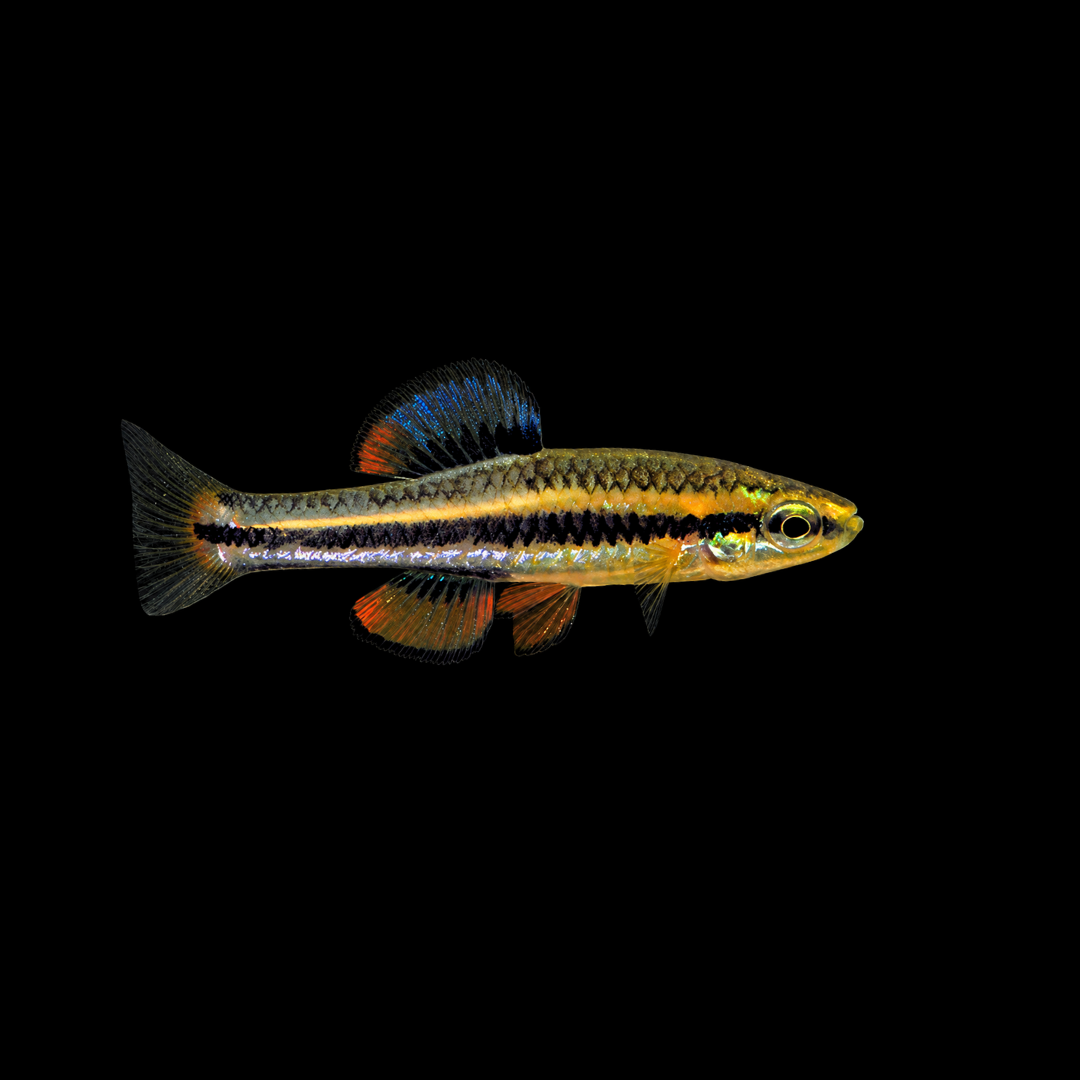
ルカニア・グッディは、フロリダを中心とする北米南東部に分布する小型の淡水魚です。日本の観賞魚市場では「卵生メダカ」の仲間として扱われますが、分類学的にはカダヤシ目フンドゥルス科のルカニア属に位置づけられます。細長い体と、口先から尾柄へ伸びる暗色の縦帯が基本模様で、成熟したオスでは背鰭や臀鰭などに青、赤、オレンジ、黄色の発色が見られます。とりわけ青色は金属光沢を帯び、水草の緑の中でもよく映えます。他種には比較的穏やかですが、繁殖期のオス同士は縄張りをめぐって競い合います。観賞魚としての美しさに加え、生息地の光環境と体色・視覚の関係や、生殖隔離の研究対象としても知られる魚です。 Lucania goodei is a small freshwater fish distributed mainly in Florida and other parts of the southeastern United States. In the Japanese aquarium trade it is commonly grouped with egg-laying killifish, while taxonomically it belongs to the genus Lucania in the family Fundulidae. Its slender body carries a dark horizontal stripe from the snout to the caudal peduncle. Mature males develop blue, red, orange, and yellow coloration on the fins, with the metallic blue especially conspicuous among aquatic plants. The species is generally peaceful toward other fishes, although breeding males compete for territories. Beyond its ornamental appeal, it is well known in research on the relationships among lighting environment, coloration, vision, and reproductive isolation.
基本情報 / Basic Information
| 学名 / Scientific Name | Lucania goodei |
|---|---|
| 通称 / Common Name | ルカニア・グッディ、ブルーフィン・キリーフィッシュBluefin killifish, Florida blue dace |
| 分類 / Family | カダヤシ目・フンドゥルス科・ルカニア属Order Cyprinodontiformes, family Fundulidae, genus Lucania |
| 英名 / English Name | Bluefin killifish |
| 分布 / Distribution | 原産地は北米南東部で、フロリダ州の広い範囲と、フロリダ北西部のチョクトーハッチー川水系、アラバマ州南東部のチポラ川水系などに分布します。大西洋岸ではサウスカロライナ州中部まで散発的な記録がありますが、一部は移入由来の可能性があります。原産域外ではノースカロライナ州、サウスカロライナ州、テキサス州、カリフォルニア州などで記録されています。Native to the southeastern United States, occurring widely in Florida, west in the Florida Panhandle to the Choctawhatchee River drainage, and locally in the Chipola River drainage of southeastern Alabama. Sporadic Atlantic-coast records extend to central South Carolina, although some may represent introductions. Records outside the native range include North Carolina, South Carolina, Texas, and California. |
| 最大体長 / Max Size | 最大記録は全長約6cmです。一般的には3cm前後で見られることが多い小型魚です。The maximum recorded total length is about 6 cm, while the species is commonly encountered at around 3 cm. |
| 寿命 / Lifespan | 報告されている寿命はおおむね2年程度です。飼育下の寿命は環境や個体差に左右されるため、一定の年数を断定するのは避けたほうがよいでしょう。Reported lifespan is around 2 years. Longevity in captivity can vary with conditions and individuals, so a longer fixed lifespan should not be assumed. |
飼育環境 / Aquarium Environment
| 水槽サイズ / Tank Size | ペアや少数飼育では45cm規格水槽(約40L)以上をひとつの目安にできます。複数のオスを含むグループでは縄張り行動が見られるため、60cm規格水槽(約60L)以上を選び、水草や流木で視線を遮れる場所を多く作ると管理しやすくなります。A standard Japanese 45 cm tank of about 40 L can serve as a practical starting point for a pair or a small group. Where several males are kept together, a standard 60 cm tank of about 60 L or larger is preferable, with plants and wood arranged to break lines of sight between territories. |
|---|---|
| 水温 / Temperature | 飼育水温の目安はおおむね12〜22℃です。日本の夏はこの範囲を大きく上回りやすいため、室温や水温を確認し、必要に応じて冷却ファン、水槽用クーラー、室内冷房などで高温が長く続かないように管理します。 A practical aquarium range is approximately 12–22°C. In warm summers, monitor both room and water temperature and use fans, an aquarium chiller, or air conditioning when necessary to prevent prolonged temperatures well above this range. |
| 水質 / Water Quality | 淡水飼育を基本とし、中性付近の安定した水質を目安にします。自然界では水質にある程度の幅をもって生息することが知られていますが、飼育では特定の数値を追い込むことより、急激なpHや硬度の変化を避け、清浄で安定した環境を維持することを優先します。Keep the species primarily in stable freshwater around neutral conditions. Wild populations occur across a range of water conditions, but in aquaria it is more important to avoid abrupt changes in pH or hardness and to maintain clean, stable water than to target an overly narrow value. |
| レイアウト / Layout | ウィローモス、マツモ、アナカリスなどの細かな葉を持つ水草や浮草を多めに使い、植物群落の隙間を泳げる環境を作ります。自然界でも水草が多く流れの弱い場所と結びつきが強いため、強い水流は避け、隠れ場所と開けた遊泳空間を両立させるのが基本です。底床は細かな砂やソイルを使いやすく、流木や落ち葉を組み合わせた落ち着いたレイアウトにもよくなじみます。Use dense stands of fine-leaved plants such as Java moss, hornwort, and waterweed, together with floating vegetation where appropriate. In nature the species is strongly associated with vegetated, slow or still waters, so avoid excessive current and combine cover with open swimming space. Fine sand or aquasoil works well, and driftwood or leaf litter can create a subdued natural setting. |
| 注意点 / Precautions | 最も注意したいのは夏の高水温です。強い水流や落ち着かない混泳相手は避け、水草の陰など逃げ込める場所を確保します。小型魚は驚いた際の飛び出し事故も起こり得るため、フタをしておくと安心です。冬に無加温で管理できるかどうかは室内環境によるため、水温が適温域を外れないことを実測して判断し、急激な温度変化を避けてください。High summer temperatures are the main husbandry concern. Avoid excessive current and overly boisterous tank mates, and provide planted cover for retreat. A lid is also sensible for preventing accidental jumping. Unheated winter keeping depends on the actual indoor environment, so base the decision on measured water temperature and avoid sudden temperature changes. |
餌と給餌 / Feeding
| 餌の種類 / Diet | 雑食性で、自然界では小型の無脊椎動物に加えて藻類や水生植物由来の物質も利用します。飼育下では口に入る大きさのフレークや細粒の人工飼料を基本に、ブラインシュリンプ、ミジンコ、細かくした冷凍餌などを補助的に組み合わせると、栄養を偏らせにくくなります。Omnivorous. In the wild it takes small invertebrates as well as algae and plant-derived material. In captivity, appropriately sized flakes or fine pellets can form the staple diet, supplemented with brine shrimp, daphnia, and finely chopped frozen foods for variety. |
|---|---|
| 給餌のポイント / Feeding Tips | 1日1〜2回、短時間で食べ切れる量を目安にします。導入直後に人工飼料への反応が弱い個体には、ブラインシュリンプやミジンコなど嗜好性の高い餌を併用し、食べ残しが出ない範囲で徐々に慣らします。オスの一部の色彩は体調や栄養状態とも関係するため、単一飼料に偏らない給餌が適しています。Feed once or twice daily in amounts that are consumed quickly. If newly introduced fish respond poorly to prepared food, highly palatable items such as brine shrimp or daphnia can be offered while they are gradually accustomed to the staple diet. Because some components of male coloration are associated with condition and nutrition, dietary variety is beneficial. |
性格と混泳 / Temperament and Tank Mates
| 性格 / Temperament | 他種に対しては比較的穏やかですが、繁殖期のオスは水草の周辺などに小さな縄張りを持ち、オス同士でヒレを広げたり、追い払ったりして優劣を競います。ディスプレイだけで終わる場合もある一方、個体密度やレイアウトによっては追尾や攻撃が続くこともあります。複数のオスを飼う場合は十分な空間を取り、水草や流木で互いの視線を遮れるようにします。The species is generally peaceful toward other fishes, but breeding males establish small territories around vegetation and compete by fin displays, chasing, and sometimes attacks. Some encounters remain largely ritualized, but persistent aggression can occur depending on stocking density and layout. When keeping several males, provide ample space and visual barriers made from plants or wood. |
|---|---|
| 混泳の相性 / Compatibility | 同程度の大きさで温和かつ、ルカニア・グッディと水温条件が合う小型魚との混泳が基本です。ヒレをかじる魚、活発に追い回す魚、適温が大きく異なる魚との組み合わせは避けます。繁殖を狙う場合は、卵や稚魚を確実に残すため、単種飼育または専用の繁殖環境に分けるほうが管理しやすくなります。Tank mates should be similarly sized, peaceful fishes whose temperature requirements overlap with those of Lucania goodei. Avoid fin nippers, highly boisterous species, and fishes requiring substantially warmer conditions. For breeding, a species-only or dedicated spawning setup makes it easier to preserve eggs and fry. |
病気と対策 / Diseases and Prevention
| かかりやすい病気 / Common Diseases | 飼育下でルカニア・グッディだけに特有とされる代表的な病気は、十分に整理されていません。野生個体では寄生虫感染が研究されていますが、それがそのまま水槽内で特に多発する病気を意味するわけではありません。入荷直後は、痩せ、ヒレの損傷や発色の急な低下、体表の異常、呼吸の乱れなど、一般的な体調変化を丁寧に観察します。There is no well-established list of diseases uniquely characteristic of Lucania goodei in captivity. Parasite infections have been studied in wild fish, but this does not mean that those parasites are especially common aquarium problems. Newly acquired fish should be watched for general signs of poor condition such as weight loss, fin damage, abrupt fading, skin abnormalities, or irregular breathing. |
|---|---|
| 対策と予防 / Prevention | 安定した適温、清潔な水質、過不足のない給餌を維持することが基本です。新規導入魚は可能であれば隔離して観察し、既存魚へ病原体を持ち込むリスクを抑えます。研究では一部のヒレの色彩と体調・寄生虫感染との相関が示されていますが、発色だけで病気を診断することはできません。普段の色合い、食欲、泳ぎ方を合わせて観察することが大切です。Prevention begins with stable temperatures, clean water, and appropriate nutrition. Newly acquired fish should ideally be quarantined and observed before introduction to an established aquarium. Research has found correlations between some fin colors, body condition, and parasite infection, but coloration alone cannot diagnose disease. Normal color, appetite, and swimming behavior should be considered together. |
増やし方(繁殖) / Breeding
| 雌雄の判別 / Sexing | 成熟すると判別は比較的容易です。オスは背鰭や臀鰭がよく発達し、青、赤、オレンジ、黄色などの鮮やかな発色を示します。メスは全体に地味で、ヒレはほぼ無色透明です。十分に育った個体では、オスのヒレの面積や鰭条の伸びも目立ちます。Sexes are relatively easy to distinguish once mature. Males develop enlarged dorsal and anal fins with vivid blue, red, orange, or yellow coloration, while females remain much plainer with largely transparent fins. Mature males also show greater fin area and more elongated fin rays. |
|---|---|
| 繁殖形態 / Reproduction | 親による保護を行わない卵散布型の魚です。メスはウィローモスなどの細かな水草や産卵モップに卵を産み付けます。自然界ではおおむね晩冬から初秋にかけて繁殖し、春から夏に産卵が活発になるとされています。個体群によってはより長い繁殖期を示し、飼育下でも光周期や水温などの条件が整えば長期間産卵することがあります。A non-guarding egg-scattering species. Females deposit eggs among fine plants such as Java moss or in spawning mops. In the wild, spawning generally extends from late winter into early autumn, with peak activity in spring and summer. Some populations have a longer reproductive season, and suitable photoperiod and temperature can also prolong spawning in captivity. |
| 繁殖のポイント / Breeding Tips | 親魚は卵や稚魚を保護しないため、確実に数を残したい場合は、卵が付着した水草や産卵モップを数日おきに別容器へ移します。卵は飼育条件によっておよそ12日から2週間ほどで孵化します。孵化直後の稚魚にはインフゾリアなどの微小な餌を用い、成長に合わせて孵化直後のブラインシュリンプ幼生へ切り替えます。成長するとオスのヒレに発色が現れ、数か月ほどで雌雄を判別しやすくなります。Because the adults provide no parental care, moving egg-covered plants or spawning mops to a separate container every few days is the more reliable approach when many fry are desired. Under aquarium conditions the eggs typically hatch in roughly 12 days to about two weeks. Newly hatched fry require very small foods such as infusoria, followed by newly hatched brine shrimp as they grow. Male fin coloration becomes clearer with development, making sexing easier within the first few months. |
雑学と豆知識 / Trivia and Fun Facts
| 1. 学名に残された魚類学者たちの足跡 / 1. A scientific name that preserves a piece of ichthyological history | ルカニア・グッディは1880年にアメリカの魚類学者デイビッド・スター・ジョーダンによって記載されました。種小名の「goodei」は、タイプ標本を採集した魚類学者ジョージ・ブラウン・グッドへの献名です。現在はLucania属に置かれていますが、過去にはChriopeops goodeiという組み合わせで扱われた歴史もあります。属名Lucaniaの語源については現代の資料でも説明が一致しておらず、地名由来とする資料もあれば別の語源を示す資料もあります。そのため、属名の由来はひとつの説に断定せず、種小名に残されたグッドへの献名を確実な由来として理解するのが適切です。Lucania goodei was described in 1880 by the American ichthyologist David Starr Jordan. The species name goodei honors George Brown Goode, the ichthyologist who collected the type specimen. The species has also appeared historically under the combination Chriopeops goodei. Modern references do not agree on the etymology of the genus name Lucania, with different sources proposing different origins. It is therefore best not to present any single explanation for Lucania as certain, while the dedication of goodei to George Brown Goode is well established. |
|---|---|
| 2. 「青い魚」なのに、青だけが正解ではない / 2. A “blue” fish for which blue is not the only successful color | 英名はブルーフィン・キリーフィッシュですが、野生のオスの臀鰭には青、赤、黄色の色彩多型が見られます。フロリダの個体群を比較した研究では、紫外線や青色光が通りにくいタンニン色の湿地で青い臀鰭のオスが多く、透明な湧水では赤いオスが多く、黄色いオスも見られる傾向が示されています。さらに、こうした環境の違いに対応して網膜の錐体細胞やオプシン遺伝子の発現にも個体群差があります。なぜ湿地で青色型が多いのかについては、単純な「明るさ」ではなく背景とのコントラストを高める可能性などが検討されています。つまり本種では、水中の光環境が「どの色が見えやすいか」と「どの色を持つオスが多いか」の両方に関係しているのです。Despite the common name Bluefin killifish, males show blue, red, and yellow polymorphism in the anal fin. Studies of Florida populations have found blue males to be common in tannin-stained swamps with low UV/blue transmission, whereas red males, and to a lesser extent yellow males, are more common in clear springs. Populations also differ in retinal cone composition and opsin expression in association with these lighting environments. Explanations for the abundance of blue males in swamps include the possibility that the signal increases contrast with the visual background rather than simply maximizing brightness. In other words, the underwater light environment is related both to how colors are perceived and to which male colors are common. |
| 3. ヒレの色は、同じ「色」でも材料が違う / 3. Different fin colors are built from different biological materials | オスのヒレを彩る青、赤、オレンジ、黒は、ひとつの色素で作られているわけではありません。尾鰭のオレンジ色には餌から取り込むカロテノイドが関わり、臀鰭の赤や黄色には体内で合成できるプテリン色素が関与します。青色は色素そのものではなく、微細な構造が光を反射することで見える構造色です。そしてヒレの縁を引き締める黒色にはメラニンが使われます。見た目には一枚のヒレの中で自然に溶け合っている色も、その成り立ちをたどると、食物、代謝、微細構造という異なる仕組みが組み合わさっているのです。The blue, red, orange, and black colors on male fins are not produced by a single pigment system. Orange coloration in the caudal fin involves dietary carotenoids, while red and yellow tones in the anal fin involve pterin pigments that can be synthesized by the fish. Blue is not a pigment color at all, but a structural color produced by microscopic tissues that reflect light. The dark fin margins are formed by melanin. A fin that appears visually unified therefore combines nutrition, metabolism, and optical microstructure into one signal. |
| 4. 鮮やかな色は「見た目」だけではなく情報でもある / 4. Bright coloration functions as information, not merely decoration | ルカニア・グッディのオスの発色は、単なる装飾ではなく、繁殖やオス同士の競争に関係する視覚的な情報でもあります。研究では、尾鰭のカロテノイド色が体の状態、寄生虫感染、産卵成功と相関し、臀鰭を縁取るメラニンの量は社会的優位性や産卵成功と関係していました。赤や黄色をつくるプテリン色素にも、寄生虫感染や産卵レベルとの関連が示されています。ここで大切なのは、色だけで健康や繁殖能力を断定できるという意味ではなく、異なる仕組みで作られた複数の色が、それぞれ別の情報と結びついている可能性があるということです。Male coloration in Lucania goodei is more than decoration; it is associated with reproduction and male–male competition. Studies found that carotenoid coloration in the caudal fin correlated with body condition, parasite infection, and spawning success, while the amount of melanin bordering the anal fin was associated with social dominance and spawning success. Pterin-based red and yellow coloration was also related to parasite infection and overall spawning levels. This does not mean that color alone can diagnose health or reproductive quality. Rather, different colors produced by different mechanisms may carry different kinds of biological information. |
| 5. 種分化を研究する魚として知られる理由 / 5. Why this species is important in studies of speciation | 本種は、近縁のレインウォーター・キリーフィッシュLucania parvaとの関係から、生殖隔離の研究でも重要な存在です。両種が同じ場所に生息する地域では、交雑による不利益を避ける方向に配偶者選択が強まり、自種を選びやすくなる「強化」が働くと考えられています。さらに研究では、その影響が同じL. goodeiの異なる地域個体群どうしの配偶行動にも及ぶ、カスケード強化と整合的な行動的隔離が示されました。これは「すでに別種になった」という意味ではありません。他種との交雑を避けるために進化した選択が、同種内にも生殖隔離を広げうることを示す例として、種分化の仕組みを考えるうえで注目されています。This species is important in studies of reproductive isolation because of its relationship with the closely related rainwater killifish, Lucania parva. Where the two occur together, selection against costly hybridization can strengthen mate discrimination, a process known as reinforcement. Research has also found behavioral isolation among populations of L. goodei consistent with cascade reinforcement, in which the effects of selection against interspecific mating extend into mating differences within a species. This does not mean that those populations have already become separate species; rather, the system provides a useful example of how reproductive isolation can spread and potentially contribute to speciation. |
| 6. 年魚ではない卵生メダカ / 6. An egg-laying killifish that is not an annual fish | 卵生メダカという言葉から、乾季を卵で越す「年魚」を思い浮かべる人もいますが、ルカニア・グッディは一年を通して水が残る環境に適応した非年魚です。休眠卵によって乾燥期を乗り切る生活史ではなく、水草の茂る淡水域で継続的に生活し、季節に応じて繁殖します。この違いは飼育にも直結しており、卵を乾燥保存するような特殊な繁殖管理は必要ありません。細かな水草や産卵モップを用意し、卵と稚魚を親魚から守るという、比較的理解しやすい方法で繁殖を楽しめます。The phrase egg-laying killifish often brings annual killifish to mind, species whose embryos survive a dry season inside dormant eggs. Lucania goodei follows a different strategy. It is a non-annual fish adapted to habitats that retain water throughout the year, living continuously among aquatic vegetation and reproducing seasonally rather than relying on drought-resistant eggs. This difference is important in captivity: there is no need for special dry-storage incubation. Breeding can be managed with fine plants or spawning mops and by protecting eggs and fry from the adults. |
まとめ / Conclusion
ルカニア・グッディは、最大でも約6cmの小さな体に、青、赤、黄色、オレンジの色彩を備えた北米産の卵生メダカです。水草の多い穏やかな水域に適応し、他種には比較的穏やかな一方、繁殖期のオスは縄張りをめぐる行動も見せます。低めの水温を好むため、とくに日本の夏は水温管理を意識することが安定飼育の大切なポイントになります。 Lucania goodei is a small North American egg-laying killifish, reaching no more than about 6 cm, with blue, red, yellow, and orange coloration. It is associated with calm, vegetated waters and is generally peaceful toward other species, although breeding males show territorial behavior. Because it favors relatively cool conditions, careful summer temperature management is an important part of stable long-term care.
オスがヒレを広げたときの金属光沢には、生息地の光環境、色の見え方、個体間の競争といった本種ならではの生物学が重なっています。日々の発色や行動を観察し、水草の間での暮らしや繁殖を見守るほど、見た目の美しさだけではない奥行きを感じられる魚です。 The metallic flash revealed when a male spreads his fins reflects more than ornamental beauty. It is connected with the species’ lighting environment, visual ecology, and social competition. Observing everyday coloration, behavior, and breeding among aquatic plants reveals a fish whose appeal extends well beyond its small size.

気になる道具や飼い方を見つけてみませんか?
 アイのアクアグッズ案内旅行中、お魚のごはんはどうする? 自動給餌器・使える餌・スマート水槽の選び方旅行中の魚の餌やりを助ける自動給餌器を、アイとコタロウが紹介。時間指定、おかわり給餌、対応するフレークや顆粒、設置台、スマホ管理、一体型水槽、留守番フードまで、使いどころと選び方を案内します。記事はコチラ →
 アイのアクアグッズ案内エビのおうち、食べちゃっていいの!? コタロウと探る、不思議なエビのごはん道具の特徴や使い方、選ぶときのポイントをアイが紹介します。記事はコチラ →
さまざまな飼育テーマをご紹介。リンク先の記事には広告・商品紹介が含まれます。
案内・紹介記事一覧へ →分布マップ
ルカニア・グッディ(Lucania goodei)は北米南東部を原産とし、フロリダ州を中心に、アラバマ州南東部やサウスカロライナ州方面まで分布記録があります。原産域外ではノースカロライナ州、テキサス州、カリフォルニア州などでも記録されています。
※この地図は記事中の分布情報をもとにした概略表示です。分布地域全体を見渡せるよう、広めの範囲を表示しています。マーカーは分布域を把握しやすくするためフロリダ州付近に置いた代表地点であり、実際の採集地点・標本産地・生息確認地点を示すものではありません。
参考文献
-
分類・学名・記載史Fricke, R., Eschmeyer, W. N. & Van der Laan, R. (eds.). 2026. Eschmeyer's Catalog of Fishes: Genera, Species, References. California Academy of Sciences. Lucania goodei の種記録
-
原産分布・移入記録U.S. Geological Survey. 2026. Bluefin Killifish (Lucania goodei) – Species Profile. Nonindigenous Aquatic Species Database. USGS NAS Species Profile
-
生息環境・繁殖期・産卵場所・寿命NatureServe. 2026. Lucania goodei. NatureServe Explorer. NatureServe Explorer
-
体長・寿命・生息環境・飼育水温・繁殖様式Froese, R. & Pauly, D. (eds.). 2026. Lucania goodei Jordan, 1880. FishBase. FishBase Species Summary
-
飼育条件の検討・塩分耐性・疾病情報U.S. Fish & Wildlife Service. 2018. Bluefin Killifish (Lucania goodei): Ecological Risk Screening Summary. U.S. Fish & Wildlife Service PDF
-
繁殖行動・オスの縄張り行動Fuller, R. C. 2001. Patterns in male breeding behaviors in the bluefin killifish, Lucania goodei: A field study (Cyprinodontiformes: Fundulidae). Copeia 2001(3): 823–828. DOI
-
卵・仔魚期の塩分耐性Fuller, R. C. 2008. A test for a trade-off in salinity tolerance in early life-history stages in Lucania goodei and L. parva. Copeia 2008(1): 154–157. DOI
-
寄生虫感染・体調とオスの色彩の関係Johnson, A. M. & Fuller, R. C. 2015. The meaning of melanin, carotenoid, and pterin pigments in the bluefin killifish, Lucania goodei. Behavioral Ecology 26(1): 158–167. DOI




コメント