

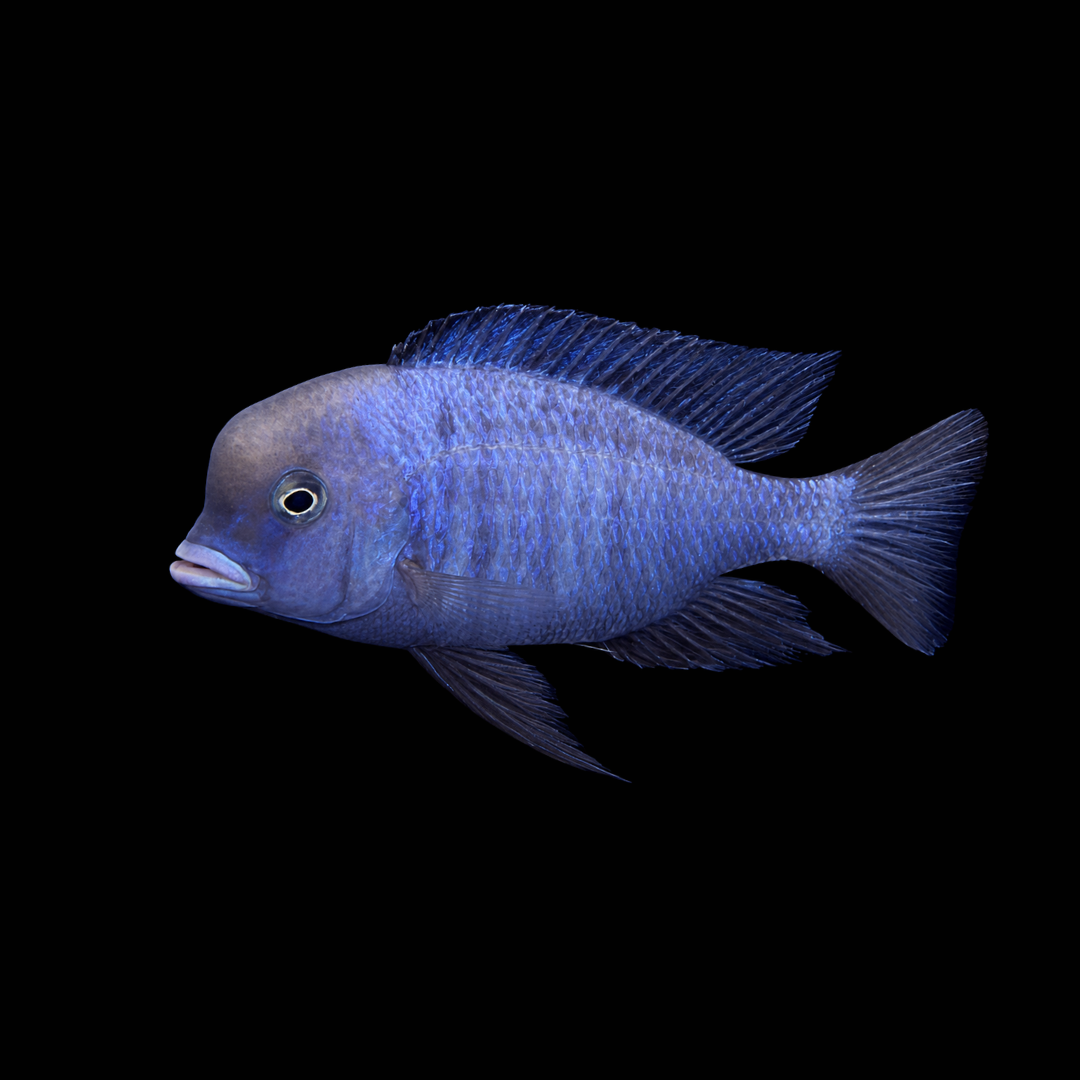
解説 / Description
キルトカラ・モーリーは、マラウイ湖の砂底域に広く分布する大型のアフリカンシクリッドです。成長した個体は青みを強め、額には丸く盛り上がる特徴的な隆起が現れます。その輪郭がイルカを思わせることから、ブルー・ドルフィン・シクリッドの名でも親しまれています。幼魚は灰青色で暗色斑が目立ちますが、成長とともに体色や体つきが変化するため、長い時間をかけて成熟していく姿を楽しめる魚です。 Cyrtocara moorii is a large African cichlid widely distributed over sandy habitats in Lake Malawi. As it matures, the body becomes increasingly blue and a rounded forehead hump develops. This dolphin-like profile has given rise to the common name Blue Dolphin Cichlid. Juveniles are grayish blue with dark markings, and their gradual transformation in color and body shape makes the species especially rewarding to raise over many years.
基本情報 / Basic Information
| 学名 / Scientific Name | Cyrtocara moorii (Boulenger, 1902) |
|---|---|
| 通称 / Common Name | キルトカラ・モーリー、ハプロクロミス・モーリー、ブルー・ドルフィンBlue Dolphin Cichlid, Malawi Blue Dolphin, Hump-head Cichlid |
| 分類 / Family | シクリッド目・シクリッド科・プセウドクレニラブルス亜科・ハプロクロミス族・キルトカラ属。キルトカラ属で現在認められている種は本種のみです。Order Cichliformes, family Cichlidae, subfamily Pseudocrenilabrinae, tribe Haplochromini, genus Cyrtocara. Cyrtocara currently contains this single recognized species. |
| 英名 / English Name | Blue Dolphin Cichlid |
| 分布 / Distribution | アフリカ東部のマラウイ湖に固有分布し、主に浅い砂底域で見られます。Endemic to Lake Malawi in East Africa, where it is mainly found over shallow sandy bottoms. |
| 最大体長 / Max Size | 野生個体について公表されている最大体長は全長約20cmです。飼育下では、特にオスが20cmを超える大きさに育つ例も知られています。The published maximum length for wild fish is about 20 cm total length. In aquariums, especially large males may grow beyond 20 cm. |
| 寿命 / Lifespan | 飼育下では10年前後をひとつの目安とする飼育情報が多く見られますが、信頼できる統一的な寿命データは限られています。実際の寿命は、水質、食事、飼育密度、病気の有無によって大きく左右されます。Aquarium sources often use roughly ten years as a practical lifespan estimate, but reliable standardized longevity data are limited. Actual lifespan varies greatly with water quality, diet, stocking density, and disease. |
飼育環境 / Aquarium Environment
| 水槽サイズ / Tank Size | 終生飼育には、最低でも180L前後の90cm規格水槽を目安にします。成魚を複数で飼育する場合や繁殖群を維持する場合は、300L以上の120cm規格水槽が望ましく、余裕を持たせるなら120cmワイド水槽以上が適しています。水槽の高さよりも、十分な遊泳距離と底面積を優先します。For lifelong care, use at least about 180 L, equivalent to a standard 90 cm aquarium in Japan. Adult groups and breeding harems are better housed in 300 L or more, such as a standard 120 cm aquarium, while a wide 120 cm tank or larger offers additional security. Prioritize horizontal swimming distance and floor area over height. |
|---|---|
| 水温 / Temperature | 24〜27℃を一般的な飼育範囲とします。急激な水温変化や長期間の高温を避け、夏季にはエアレーションを強めて溶存酸素を確保します。 A general aquarium range is 24–27°C. Avoid sudden changes and prolonged excessive heat, and increase aeration in summer to maintain dissolved oxygen. |
| 水質 / Water Quality | 弱アルカリ性で、ある程度の硬度を備えた水が適します。飼育上の目安はpH 7.5〜8.5ですが、硬度を含む適正値は地域の水道水や飼育設備によって変わります。日本の軟水地域では、サンゴ砂、石灰質の濾材、アフリカンシクリッド用の調整剤を利用できます。ただし、数値を急に変えず、測定しながら段階的に調整してください。アンモニアと亜硝酸は検出されない状態を保ち、硝酸塩の蓄積は定期換水で抑えます。Slightly alkaline water with some mineral hardness is appropriate. A practical pH target is about 7.5–8.5, although suitable hardness varies with local water and the aquarium system. In soft-water regions of Japan, coral sand, calcareous filter media, or African cichlid mineral products may be used. Make adjustments gradually while testing the water. Ammonia and nitrite should remain undetectable, and nitrate should be controlled through regular water changes. |
| レイアウト / Layout | 細かな砂を広く敷き、前面から中央には十分な遊泳空間を残します。背面や側面には、視線を遮る岩組みと、追われた個体が退避できる隠れ場所を設けます。岩は砂の上へ直接載せず、水槽底面または保護板の上に安定させてから砂を入れると、掘り返しによる崩落を防げます。水草は抜かれやすいため、導入する場合はアヌビアス類などの丈夫な活着性水草を岩へ固定します。Use fine sand and leave a broad open swimming area across the front and center. Place stable rockwork along the back and sides to break lines of sight and provide retreats for chased fish. Set rocks securely on the tank base or a protective board before adding sand to prevent collapse when fish dig. If plants are used, attach hardy epiphytes such as Anubias firmly to rocks. |
| 注意点 / Precautions | 幼魚の姿から想像する以上に大きくなり、成長とともに排泄量も増えます。ろ過能力と換水量には余裕を持たせ、成魚になる前に必要な水槽へ移行できる計画を立ててください。pHの維持をサンゴ砂だけに任せず、pH、硬度、アンモニア、亜硝酸、硝酸塩を定期的に測定します。オスの追尾を分散させるには、十分な空間、視線を遮る配置、複数の退避場所が必要です。This species grows larger and produces more waste than its juvenile appearance suggests. Provide generous filtration and water-change capacity, and plan the final aquarium before the fish mature. Do not rely on coral sand alone to maintain pH; regularly test pH, hardness, ammonia, nitrite, and nitrate. Sufficient space, visual barriers, and multiple retreats are essential for reducing persistent male chasing. |
餌と給餌 / Feeding
| 餌の種類 / Diet | 肉食傾向のある雑食性です。主食には、アフリカンシクリッド向けの良質な沈下性または緩沈下性ペレットを用います。冷凍ブラインシュリンプ、イサザアミ、昆虫由来原料を含む飼料などは補助的に与え、植物質を含む配合飼料も組み合わせて栄養の偏りを防ぎます。An omnivore with a strong carnivorous tendency. Use high-quality sinking or slow-sinking pellets formulated for African cichlids as the staple diet. Frozen brine shrimp, mysid shrimp, and feeds containing insect-derived ingredients may be offered as supplements, while some plant-based formulation helps prevent nutritional imbalance. |
|---|---|
| 給餌のポイント / Feeding Tips | 1日1〜2回、短時間で食べ切れる量を与えます。成長を急がせるような過剰給餌は、肥満や内臓への負担、水質悪化につながるため避けてください。腹部の張り、フン、食欲、泳ぎ方を日々観察し、体調や成長段階に合わせて量を調整します。牛肉や鶏肉など、陸生動物由来で脂肪の多い餌を常用するのは適しません。Feed once or twice daily, offering only what can be eaten within a short period. Excess feeding intended to accelerate growth can lead to obesity, internal strain, and deteriorating water quality. Observe abdominal shape, feces, appetite, and swimming behavior, and adjust the ration to the fish’s condition and growth stage. Foods rich in fat from terrestrial animals, such as beef or chicken, should not be used routinely. |
性格と混泳 / Temperament and Tank Mates
| 性格 / Temperament | 普段は比較的落ち着いて見えることがありますが、成熟したオスは同種や似た体形の魚に対して縄張り行動を示します。繁殖期には追尾や威嚇が強まり、狭い水槽では弱い個体が休めなくなることがあります。Although often relatively calm in ordinary conditions, mature males may show territorial behavior toward their own species and similarly shaped fish. Chasing and threats intensify during breeding, and weaker individuals may be unable to rest in cramped aquariums. |
|---|---|
| 混泳の相性 / Compatibility | 同程度の大きさで、弱アルカリ性の水を好み、攻撃性が極端に強くないマラウイ湖産シクリッドが候補になります。小型魚、長いヒレを持つ魚、極端に臆病な魚、軟水を必要とする魚との混泳には向きません。攻撃性の強いムブナ類との組み合わせは特に慎重に判断し、相性が崩れたときに隔離できる予備水槽を用意します。Suitable companions may include similarly sized Lake Malawi cichlids that prefer alkaline water and are not excessively aggressive. Small fish, long-finned species, highly timid fish, and soft-water species are unsuitable. Combinations with strongly aggressive mbuna require particular caution, and a spare aquarium should be available if compatibility breaks down. |
病気と対策 / Diseases and Prevention
| かかりやすい病気 / Common Diseases | 水質悪化、過密、急激な環境変化が続くと、白点病、細菌性の体表炎症、ヒレの損傷、食欲不振や異常なフンを伴う消化器症状などが現れることがあります。腹部の膨張、鱗の逆立ち、眼球突出は重い全身性疾患で見られる症状ですが、原因は細菌感染だけではありません。内臓障害、浸透圧調節の異常、寄生虫なども考えられるため、外見だけで病名を断定しないことが重要です。Poor water quality, crowding, and sudden environmental change may contribute to white spot disease, bacterial skin inflammation, fin damage, and digestive signs such as loss of appetite or abnormal feces. Abdominal swelling, raised scales, and protruding eyes can occur in severe systemic disease, but bacterial infection is not the only possible cause. Internal organ disease, osmoregulatory failure, and parasites must also be considered, so diagnosis should not be based on appearance alone. |
|---|---|
| 対策と予防 / Prevention | 予防の基本は、安定した水質、十分な酸素、適切な給餌、過密の回避、新規導入魚の検疫です。異常が見られた個体は早めに隔離し、水温、水質、外傷、フン、食欲の変化を確認します。魚病薬を使う場合は、病名を決めつけず、製品の対象魚、適応症、用法、用量を必ず確認してください。エルバージュエース、グリーンFゴールド顆粒、観パラDなどは、有効成分も対象となる症状も異なります。自己判断による併用や薬餌への転用は、薬害や過量投与を招くおそれがあります。塩水浴もすべての症状に有効な方法ではありません。症状が重い場合や原因を判断できない場合は、魚病に詳しい獣医師または信頼できる専門店へ相談します。Prevention depends on stable water conditions, high oxygen levels, appropriate feeding, avoidance of crowding, and quarantine of new fish. Isolate affected fish early and check temperature, water chemistry, injuries, feces, and appetite. Before using medication, confirm the product’s target species, indications, directions, and dosage rather than assuming a diagnosis. Japanese products such as Elbagin Ace, Green F Gold Granules, and Kanpara D contain different active ingredients and are intended for different conditions. Unapproved combinations or improvised medicated food may cause toxicity or overdose. Salt treatment is not appropriate for every condition. Severe or unclear cases should be discussed with a veterinarian familiar with fish or a trusted aquatic specialist. |
増やし方(繁殖) / Breeding
| 雌雄の判別 / Sexing | 成熟したオスは一般にメスより大きく、青色が濃く、前頭部の隆起も発達します。ただし、メスにも青みや隆起が現れることがあるため、幼魚の外見だけで確実に雌雄を判別することはできません。成熟個体では、体格、発色、求愛行動、生殖孔の形状を総合して判断します。Mature males are generally larger, more intensely blue, and develop a more prominent forehead hump. Females may also show blue coloration and a hump, so juveniles cannot be sexed reliably by appearance alone. In mature fish, body size, coloration, courtship behavior, and the genital papilla should be assessed together. |
|---|---|
| 繁殖形態 / Reproduction | メスが受精卵と稚魚を口内で保護する、母親型のマウスブルーダーです。オスは砂地や平らな場所へメスを誘い、産卵と受精が行われると、メスが卵を口に回収します。抱卵中のメスはほとんど餌を取らず、一般に2〜3週間ほど卵や稚魚を守ります。A maternal mouthbrooder in which the female protects fertilized eggs and fry in her mouth. The male guides the female to a sandy or flat spawning site; after spawning and fertilization, the female collects the eggs. She eats little or nothing while brooding and generally protects the eggs and fry for about two to three weeks. |
| 繁殖のポイント / Breeding Tips | オス1匹に対して複数のメスを組み合わせ、求愛や追尾が一個体へ集中しないようにします。抱卵中のメスが落ち着ける隠れ場所を用意し、不要な捕獲や大幅なレイアウト変更は避けてください。メスに自然放仔させる方法は、魚体への負担が比較的少ない選択です。口内の卵や稚魚を人工的に取り出す方法は、時期や手技を誤るとメスと稚魚の双方を傷つけるため、十分な経験がある場合に限ります。自由遊泳を始めた稚魚には、ふ化直後のブラインシュリンプ幼生や稚魚用の微粒子飼料を、少量ずつ複数回与えます。Keep one male with several females so that courtship and chasing are not concentrated on a single fish. Provide quiet retreats for brooding females and avoid unnecessary capture or major rearrangement. Allowing the female to release fry naturally is relatively gentle on the fish. Artificial removal of eggs or fry can injure both the female and young if the timing or technique is poor and should be attempted only by experienced breeders. Once free-swimming, feed newly hatched brine shrimp nauplii or fine fry food in several small meals each day. |
雑学と豆知識 / Trivia and Fun Facts
| 1. 名前に残された探検の歴史 / 1. An expedition remembered in its name | 本種は1902年、魚類学者ジョージ・アルバート・ブーレンジャーによって記載されました。種小名のmooriiは、ニアサ湖、現在のマラウイ湖の調査に携わったJ.E.S.ムーアにちなみます。鮮やかな青色だけを見ると改良品種のようにも映りますが、その学名には、20世紀初頭にアフリカ大湖沼の生物相を明らかにしようとした探検と分類研究の歴史が残されています。The species was described in 1902 by ichthyologist George Albert Boulenger. The specific name moorii honors J. E. S. Moore, who took part in investigations of Lake Nyasa, now Lake Malawi. Its vivid blue coloration may look almost like that of a modern ornamental strain, yet the scientific name preserves the history of early twentieth-century exploration and taxonomic work in the African Great Lakes. |
|---|---|
| 2. 一種だけで属を構成する魚 / 2. A genus of one species | 本種は、かつて広い意味で用いられていたハプロクロミス属に含められていましたが、現在はキルトカラ属の唯一の種として扱われています。属名Cyrtocaraは、丸く盛り上がった頭部を表すギリシャ語由来の語からつくられました。分類名そのものが、成魚に現れる独特の輪郭を伝えています。The species was once placed in the broadly defined genus Haplochromis but is now treated as the sole species of Cyrtocara. The generic name was formed from Greek-derived words referring to a curved or rounded head. The classification itself therefore points to the distinctive profile of mature fish. |
| 3. 他の魚が巻き上げた餌を利用する / 3. Feeding in the wake of other fish | 野生では、砂を掘って採餌する大型シクリッドの後方を追い、砂中から巻き上がった小動物を捕らえる行動が知られています。さらに、追従している相手へ競争相手が近づくと、それを追い払う行動も観察されています。自ら大量の砂を掘る代わりに、ほかの魚が生み出す採餌機会を利用し、その機会を守るのです。この独特な行動は、マラウイ湖のシクリッドが同じ砂底環境の中で、異なる方法によって餌資源を利用してきたことを物語ります。In the wild, this species follows large cichlids that dig into sand and captures small animals exposed by their feeding. Individuals have also been observed driving away competitors that approach the fish they are following. Rather than excavating large amounts of sand themselves, they exploit and defend feeding opportunities created by other fish. This behavior reveals how Lake Malawi cichlids have divided the same sandy habitat into highly specialized ways of obtaining food. |
| 4. 額の隆起をつくる遺伝子の働き / 4. Genes behind the forehead hump | 2019年に公表された遺伝子発現研究では、隆起が発達した若い成魚オスの頭部組織を、隆起が形成される前の幼魚や、隆起を持たない近縁種の組織と比較しました。その結果、細胞増殖、脂肪細胞の形成、頭蓋顔面の発生、成長シグナルの調節に関わる複数の遺伝子で、発現量の違いが確認されました。この研究は隆起の機能を確定したものではありませんが、目立つ形態が単一の遺伝子ではなく、複数の発生経路の組み合わせによって形成される可能性を示しています。A gene-expression study published in 2019 compared the nuchal tissue of young adult males with developed humps against tissue from juveniles before hump formation and from a closely related species without a hump. Differences were found in genes associated with cell proliferation, adipocyte development, craniofacial formation, and growth signaling. The study did not establish the hump’s exact function, but it suggests that the structure is produced through the interaction of several developmental pathways rather than a single gene. |
| 5. 大陸を越えて繰り返された似た形 / 5. Similar shapes evolving on different continents | 額の隆起は、アフリカのシクリッドだけでなく、中米を含む別系統のシクリッドにも独立して現れています。ただし、それぞれの系統が同じ遺伝的仕組みを再利用したかどうかは、まだ確定していません。離れた地域で似た形が繰り返し進化した事実は、シクリッドの頭部形態が高い発生上の柔軟性を備えていることを示す、興味深い例です。Forehead humps have appeared independently in several cichlid lineages, including fishes from Africa and Central America. It has not yet been established whether each lineage reused the same genetic mechanism. Even so, the repeated evolution of a similar form in distant regions is a striking example of the developmental flexibility of the cichlid head. |
| 6. 保全状況と流通個体の選び方 / 6. Conservation status and choosing aquarium fish | 本種はIUCNレッドリストで危急種と評価されています。ただし、日本で流通する個体の由来や、養殖個体が野生個体群へ与える影響を一律に判断することはできません。購入時には、可能な範囲で養殖個体かどうかや入荷経路を確認し、成魚の大きさに対応できる設備を整えてから迎えることが大切です。由来を意識して選び、終生飼育の責任を持つ姿勢が、野生個体への不要な需要を抑えることにつながります。The species is assessed as Vulnerable on the IUCN Red List. However, the origin of fish sold in Japan and the effect of captive breeding on wild populations cannot be judged uniformly. Whenever possible, ask whether a fish is captive-bred and how it entered the trade, and prepare an aquarium suitable for its adult size before purchase. Choosing fish with attention to origin and accepting responsibility for lifelong care can help reduce unnecessary demand for wild-caught individuals. |
まとめ / Conclusion
キルトカラ・モーリーは、深みのある青色、丸く盛り上がる額、砂底の上を悠然と泳ぐ姿が印象的なマラウイ湖のシクリッドです。幼魚の控えめな色彩が、成長とともに鮮明さと重厚感を増していくため、成熟までの変化そのものが大きな魅力になります。 Cyrtocara moorii is a memorable Lake Malawi cichlid, distinguished by deep blue coloration, a rounded forehead, and an unhurried presence over sandy ground. Its subdued juvenile colors gradually gain clarity and weight as the fish matures, making the transformation itself one of the species’ greatest attractions.
その魅力を長く引き出すには、成魚の大きさを受け止められる広い水槽、安定した弱アルカリ性の水、十分なろ過と酸素、過不足のない給餌が欠かせません。ゆとりのある環境で育った個体は、落ち着いた泳ぎと鮮やかな青色によって、水槽の中心に静かな存在感をもたらします。時間をかけて向き合うほど、力強さと穏やかさをあわせ持つ本種ならではの魅力が深まっていくでしょう。 To bring out that appeal over the long term, it needs a spacious aquarium capable of housing the adult fish, stable slightly alkaline water, strong filtration and oxygenation, and a balanced ration. In a generous environment, its calm swimming and vivid blue color create a quiet focal point in the aquarium. The longer it is kept with care, the more clearly its distinctive combination of strength and composure emerges.

気になる道具や飼い方を見つけてみませんか?
 アイのアクアグッズ案内カルキ抜き・水質調整剤の選び方|水換えと水槽の種類に合わせて選ぶ道具の特徴や使い方、選ぶときのポイントをアイが紹介します。記事はコチラ →
 アイのアクアグッズ案内プレコ飼育に必要なもの|餌・流木・ろ過・隠れ家・掃除用品道具の特徴や使い方、選ぶときのポイントをアイが紹介します。記事はコチラ →
 アイのアクアグッズ案内アフリカンシクリッドの飼育用品|水槽・ろ過・底砂・岩組み・餌の選び方道具の特徴や使い方、選ぶときのポイントをアイが紹介します。記事はコチラ →
 アイのアクアグッズ案内金魚を長く楽しむ飼育用品|水槽・フィルター・エアレーション・水換え道具の特徴や使い方、選ぶときのポイントをアイが紹介します。記事はコチラ →
さまざまな飼育テーマをご紹介。リンク先の記事には広告・商品紹介が含まれます。
案内・紹介記事一覧へ →分布マップ
キルトカラ・モーリーは、アフリカ東部のマラウイ湖に固有分布し、主に湖内の浅い砂底域で見られます。地図ではマラウイ湖全体を概略範囲として示し、湖中央部の代表地点にマーカーを置いています。
この地図は記事の分布情報をもとにした概略表示です。マーカーは実際の採集地点や厳密な生息地点を示すものではなく、着色範囲も正確な生息範囲、個体密度、確認地点の境界を示すものではありません。
参考文献
-
California Academy of Sciences. “Cyrtocara moorii Boulenger, 1902.” Eschmeyer’s Catalog of Fishes. Updated 7 July 2026.
分類上の有効名、原記載、タイプ産地、現在の分類学的位置づけ。
https://researcharchive.calacademy.org/research/ichthyology/catalog/fishcatget.asp?spid=21129 -
Eccles, D. H., and E. Trewavas. Malawian Cichlid Fishes: The Classification of Some Haplochromine Genera. Lake Fish Movies, 1989.
マラウイ湖産ハプロクロミス族の属分類とキルトカラ属の分類学的整理。
https://www.si.edu/object/siris_sil_435307 -
Froese, R., and D. Pauly, editors. “Cyrtocara moorii, Hump-head.” FishBase.
マラウイ湖固有という分布、浅い砂底域、水深、最大体長、母親型口内保育。
https://www.fishbase.se/summary/Cyrtocara-moorii -
Çelik, İ., P. Çelik, and B. R. Yalçın. “Larval Development of the Blue Dolphin Cichlid (Cyrtocara moorii Boulenger, 1902): Morphological Changes.” Mediterranean Fisheries and Aquaculture Research 7, no. 1 (2024): 32–40.
繁殖後の胚・仔魚発生、ふ化後の形態変化、初期育成段階。
https://dergipark.org.tr/en/pub/medfar/article/1459364 -
Kratochwil, C. F., M. Kuwalekar, J. Haege, and N. Karagic. “Building and Managing a Tropical Fish Facility: A Do-It-Yourself Guide.” bioRxiv (2023).
シクリッド類を含む熱帯魚の飼育設備、ろ過、水質監視、繁殖・稚魚育成を支える施設管理。
https://doi.org/10.1101/2023.09.01.555574 -
Francis-Floyd, R. “Introduction to Fish Health Management.” University of Florida IFAS Extension, Publication FA004.
病魚の評価、水温・pH・溶存酸素・アンモニア・亜硝酸などの確認、隔離と診断の基本。
https://ask.ifas.ufl.edu/publication/FA004 -
Yanong, R. P. E. “Use of Antibiotics in Ornamental Fish Aquaculture.” University of Florida IFAS Extension, Publication FA084.
観賞魚の細菌感染症に対する抗菌薬使用、診断、薬剤感受性、隔離治療、過量投与と耐性菌の防止。
https://ask.ifas.ufl.edu/publication/FA084 -
Hanson, L., and D. Grizzle. “Motile Aeromonas Septicemia (MAS) in Fish.” Southern Regional Aquaculture Center, Publication No. 478.
運動性エロモナス症の原因、ストレスや水質との関係、症状、診断、予防および管理。
https://srac.tamu.edu/fact-sheets/serve/126
最終閲覧日:2026年8月6日




コメント