

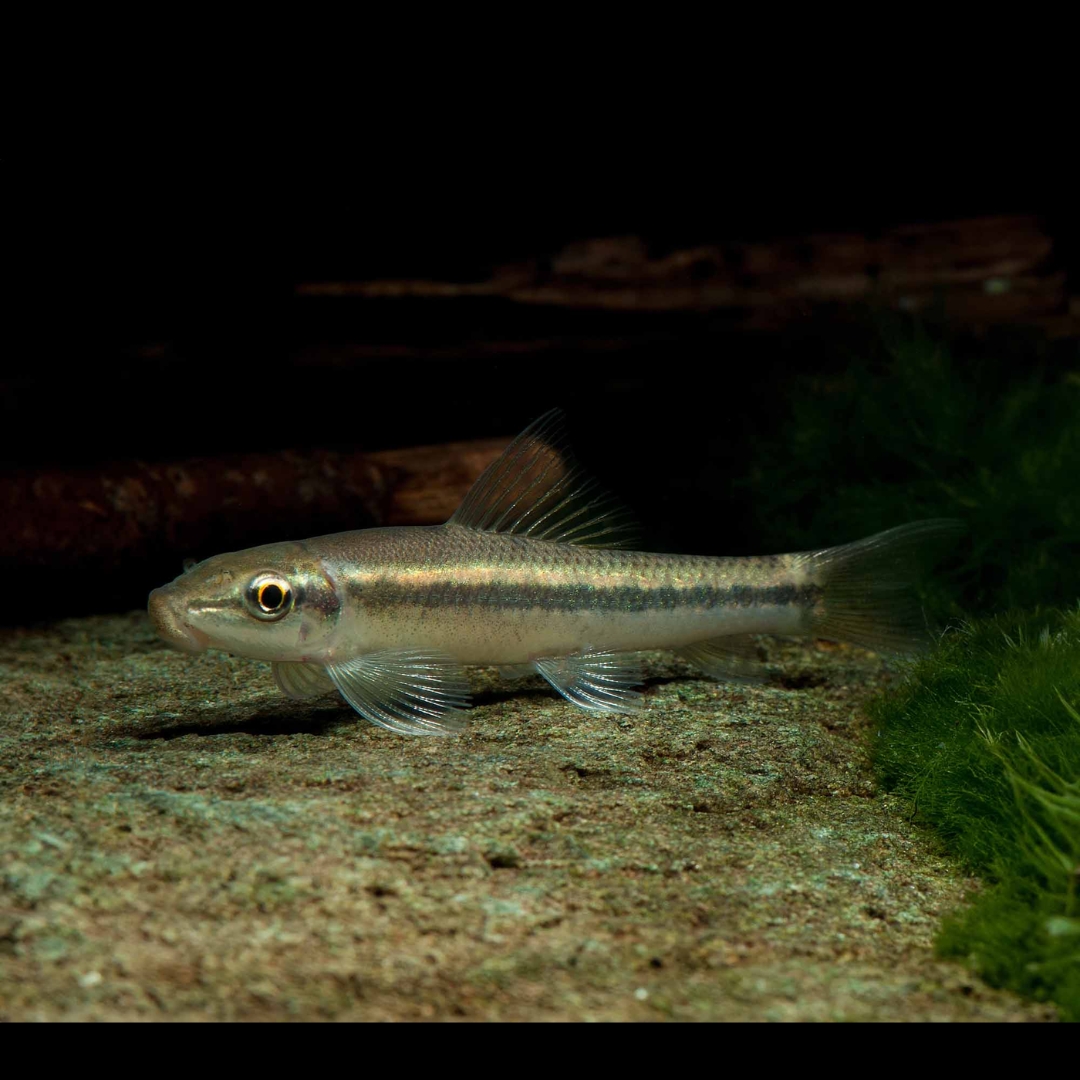
解説 / Description
アルジイーターは、東南アジアの河川に生息するギリノケイルス科の淡水魚です。日本のアクアリウムでは、水槽のガラス面や流木、石などに付いた茶ゴケや緑藻を削り取る「コケ取り生体」として流通してきました。吸盤状の口で物に張り付く姿はユニークで、幼魚期は水槽内をよく動き回りながら付着藻類やバイオフィルムを食べるため、実用性の高い魚として紹介されることがあります。 The Chinese algae eater is a freshwater fish of the family Gyrinocheilidae, native to river systems in Southeast Asia. In Japanese aquariums, it has been sold as an algae-eating fish that grazes on diatoms, green algae, and biofilm from glass, driftwood, and stones. Its sucker-like mouth and clinging behavior are distinctive, and juveniles are often valued for their active grazing in aquariums.
ただし、本種は「小さなコケ取り役」のまま一生を過ごす魚ではありません。成長すると水槽内でも10〜15cm前後、環境によってはそれ以上に育つことがあり、若いころほどコケを食べなくなります。さらに成熟に伴って縄張り意識が強まり、他魚の体表に吸い付くような問題行動を見せる場合もあります。そのため、導入前には最終的なサイズ、性格の変化、混泳リスクまで理解しておくことが大切です。 However, this species does not remain a small algae cleaner for life. In aquariums it often reaches around 10 to 15 cm, and may grow larger under suitable conditions. As it matures, it tends to eat less algae and can become territorial, sometimes rasping at the body surface of tank mates. Before keeping this fish, aquarists should understand its adult size, behavioral changes, and compatibility risks.
基本情報 / Basic Information
| 学名 / Scientific Name | Gyrinocheilus aymonieri |
|---|---|
| 通称 / Common Name | アルジイーター、チャイニーズアルジイーター、サッキングローチChinese algae eater, sucking loach, algae eater |
| 分類 / Family | コイ目 ギリノケイルス科Order Cypriniformes, family Gyrinocheilidae |
| 英名 / English Name | Chinese Algae Eater |
| 分布 / Distribution | メコン川流域、チャオプラヤ川流域、メークロン川流域、マレー半島北部など、東南アジア大陸部の河川水系に分布します。It is distributed in mainland Southeast Asian river systems, including the Mekong, Chao Phraya, Mae Klong, and northern Malay Peninsula basins. |
| 最大体長 / Max Size | 記録上は標準体長で約28cmに達するとされます。水槽内では10〜15cm前後で収まる個体も多いものの、飼育条件によってはさらに大きくなる可能性があるため、小型魚として扱うべきではありません。It is recorded as reaching about 28 cm standard length. In aquariums many individuals remain around 10 to 15 cm, but they may grow larger depending on conditions, so they should not be treated as small community fish. |
| 寿命 / Lifespan | 飼育環境が安定していれば5〜10年前後の長期飼育も見込めます。終生飼育を前提に、成魚期のサイズと性格を見越した環境を用意する必要があります。With stable care, it may live for around 5 to 10 years. Long-term planning is important because its adult size and temperament differ greatly from those of juveniles. |
飼育環境 / Aquarium Environment
| 水槽サイズ / Tank Size | 幼魚の一時飼育であれば45〜60cm水槽でも管理できますが、終生飼育では少なくとも60cm規格水槽以上、成魚まで余裕を持って飼うなら90cm規格水槽以上を推奨します。大型化した個体や混泳を考える場合は、120cm規格水槽クラスも視野に入ります。成長後は遊泳力と縄張り意識が強くなるため、小型水槽での長期飼育には向きません。Juveniles can be kept temporarily in a 45 to 60 cm tank, but at least a standard 60 cm tank is needed for long-term care, and a 90 cm tank or larger is preferable for adults. For large individuals or community setups, a 120 cm-class aquarium may be more appropriate. Adults are active and territorial, making small tanks unsuitable for lifelong keeping. |
|---|---|
| 水温 / Temperature | 25〜28℃前後を基本に管理します。短期的にはやや低めの水温に耐えることもありますが、熱帯性の魚として日本の冬季はヒーターで加温し、急な低温や大きな水温変化を避けることが大切です。 Maintain the water temperature at around 25 to 28°C. It may tolerate slightly cooler water for short periods, but as a tropical fish it should be heated during Japanese winters, and sudden temperature drops should be avoided. |
| 水質 / Water Quality | 弱酸性〜弱アルカリ性まで比較的幅広い水質に適応します。目安としてpH6.0〜8.0程度、硬度は極端に偏らない範囲で管理できますが、汚れた水に強いという意味ではありません。よく食べる魚なので、ろ過能力と定期的な換水を重視します。It adapts to a fairly wide range of water conditions, from slightly acidic to slightly alkaline water. A pH of about 6.0 to 8.0 is suitable, with hardness kept within a moderate range. This does not mean it tolerates poor water quality, so strong filtration and regular water changes are important. |
| レイアウト / Layout | 石、流木、丈夫な水草を使い、張り付ける面と隠れ家を用意します。急流域に適応した魚のため、適度な水流と高い溶存酸素量を意識すると調子を崩しにくくなります。飛び出し事故を防ぐため、フタは必ず設置してください。Provide rocks, driftwood, hardy plants, surfaces for grazing, and hiding places. As a fish adapted to flowing waters, it benefits from moderate current and well-oxygenated water. A secure lid is essential to prevent jumping. |
| 注意点 / Precautions | 幼魚期の姿だけを見て小型水槽に導入すると、成長後に持て余すことがあります。成熟した個体はコケ取り能力が落ち、他魚を追い回したり、体表を舐めるように吸い付いたりする場合があります。導入する場合は、将来的に単独飼育へ切り替えられる予備環境も考えておくと安心です。Buying this fish based only on its juvenile appearance can lead to problems later. Mature individuals often graze less algae and may chase or rasp at tank mates. It is wise to plan for the possibility of keeping it alone as it grows. |
餌と給餌 / Feeding
| 餌の種類 / Diet | 幼魚期は茶ゴケ、緑藻、石や流木表面のバイオフィルムをよく食べます。水槽内のコケだけでは栄養が偏るため、植物質を含む沈下性タブレット、プレコ用フード、スピルリナ配合飼料、ゆでた野菜を補助的に与えます。成長後は雑食性が強まり、沈下性の人工飼料、冷凍赤虫、イサザアミ、ブラインシュリンプなども食べます。Juveniles graze on diatoms, green algae, and biofilm on rocks and driftwood. Since aquarium algae alone is not a complete diet, provide sinking tablets, pleco foods, spirulina-based foods, and occasional blanched vegetables. Adults become more omnivorous and may accept sinking pellets, frozen bloodworms, mysis shrimp, and brine shrimp. |
|---|---|
| 給餌のポイント / Feeding Tips | 「コケを食べるから餌はいらない」と考えないことが重要です。空腹状態が続くと、他魚への追尾や体表舐めを誘発する可能性があります。底まで届く餌を与え、他の魚に先に食べ尽くされないようにします。成魚には植物質と動物質の両方を含むバランスのよい給餌が必要です。Do not assume that an algae eater does not need feeding. Hunger may encourage chasing and rasping behavior. Offer foods that reach the bottom and are not consumed by other fish first. Adults need a balanced diet that includes both plant and animal-based nutrition. |
性格と混泳 / Temperament and Tank Mates
| 性格 / Temperament | 幼魚期は比較的温和に見えますが、成長に伴って縄張り意識が強くなる傾向があります。特に成魚では、同種間の争いや、他魚への突進、体表への吸い付きが問題になることがあります。見た目の地味さに反して、性格面では注意が必要な魚です。Juveniles often appear relatively peaceful, but they tend to become more territorial as they mature. Adults may fight with their own kind, charge at tank mates, or attach to the bodies of other fish. Despite its modest appearance, its temperament requires caution. |
|---|---|
| 混泳の相性 / Compatibility | 一般的なコミュニティ水槽では、単独飼育または早めに隔離できる前提での飼育が安全です。混泳させる場合は、スマトラ、ダニオ類、中型ラスボラなど、遊泳力があり素早く逃げられる中層〜上層魚が候補になります。ディスカス、エンゼルフィッシュ、大型グラミー、金魚、コリドラス、動きの遅い魚、体表面積の広い魚との混泳は避けた方が無難です。同種を複数飼育する場合は十分な広さと隠れ家が必要ですが、家庭水槽では争いが出やすいため慎重に判断します。攻撃や吸い付きが確認された場合は、すぐに隔離してください。For ordinary community aquariums, single-specimen keeping or keeping it with a plan for quick separation is safest. If kept with other fish, fast-swimming mid- to upper-level species such as tiger barbs, danios, and medium rasboras are better candidates. Avoid discus, angelfish, large gouramis, goldfish, Corydoras, slow-moving fish, and broad-bodied fish. Groups require ample space and hiding places, but conflict is common in home aquariums. If chasing or body rasping is observed, separate the fish immediately. |
病気と対策 / Diseases and Prevention
| かかりやすい病気 / Common Diseases | 白点病、カラムナリス病、水カビ病、輸送直後のスレ傷や衰弱に注意します。比較的丈夫な魚ですが、輸入・流通時のストレス、急な水温変化、過密飼育、水質悪化が重なると発病しやすくなります。Watch for white spot disease, columnaris, fungal infections, abrasions, and weakness after transport. Although hardy, this species can become ill when stress from shipping, sudden temperature changes, overcrowding, or poor water quality accumulates. |
|---|---|
| 対策と予防 / Prevention | 購入直後は急な水合わせを避け、可能であればトリートメント水槽で状態を確認してから本水槽へ導入します。日常管理では、水温の安定、強すぎないが十分なろ過、定期換水、過密を避けた飼育が基本です。他魚を傷つける行動が出た場合は、被害魚の感染症予防のためにも早めの隔離が必要です。After purchase, acclimate it carefully and, if possible, observe it in a quarantine tank before adding it to the main aquarium. Stable temperature, adequate filtration, regular water changes, and avoiding overcrowding are key. If it injures tank mates, quick separation helps prevent secondary infections in the affected fish. |
増やし方(繁殖) / Breeding
| 雌雄の判別 / Sexing | 外見での雌雄判別は難しい魚です。成熟したオスでは吻部に追星のような突起が見られることがあり、メスは抱卵時に腹部がふっくらする場合があります。ただし、販売サイズの幼魚で確実に見分けることはほぼ困難です。Sexing is difficult by appearance alone. Mature males may develop tubercle-like projections on the snout, while gravid females may appear fuller in the abdomen. Reliable sexing of juveniles sold in shops is generally not practical. |
|---|---|
| 繁殖形態 / Reproduction | 卵生です。自然下では季節的な水位変動や移動、流れの変化などが繁殖に関係している可能性がありますが、家庭水槽での再現性のある繁殖方法は一般的に確立されていません。It is an egg-laying species. Seasonal water-level changes, movement, and changes in current may be related to spawning in nature, but a reliable breeding method for home aquariums is not generally established. |
| 繁殖のポイント / Breeding Tips | 一般家庭で狙って繁殖させる魚ではありません。観賞魚として流通する個体の多くは、東南アジアの商業養殖場で繁殖・生産されたものと考えられます。まれに大型でよく茂った水槽内で偶発的に稚魚が見つかる例はありますが、飼育者が安定して再現できる段階にはありません。This is not a species commonly bred intentionally in home aquariums. Most aquarium specimens are considered to be commercially produced in Southeast Asian farms. Accidental fry have occasionally been reported in large, heavily planted aquariums, but stable and repeatable home breeding is not established. |
雑学と豆知識 / Trivia and Fun Facts
| 1. 吸盤状の口と特殊な呼吸のしくみ / 1. Sucker Mouth and Specialized Breathing | アルジイーターの大きな特徴は、岩やガラス面にぴたりと張り付く吸盤状の口です。この口は、急流の中で流されないための固定具であり、同時に藻類やバイオフィルムを削り取るための道具でもあります。興味深いのは、口を張り付きと摂食に使っている間でも呼吸できるように、鰓ぶた付近から水を取り込む仕組みを備えている点です。つまり本種は、ただの「コケ取り役」ではなく、流れの速い川で生きるために体の構造そのものを特殊化させた魚といえます。One of the most distinctive features of the Chinese algae eater is its sucker-like mouth, which allows it to cling to rocks and glass. This mouth works both as an anchor in fast-flowing water and as a tool for scraping algae and biofilm. It also has a specialized way of taking in water near the gill cover, allowing it to breathe while the mouth is occupied with clinging and feeding. In other words, this fish is not merely an algae cleaner, but a species structurally adapted to life in flowing rivers. |
|---|---|
| 2. 幼魚と成魚で評価が大きく変わる魚 / 2. A Fish Whose Reputation Changes with Age | アルジイーターが初心者向けの売り場で見かけられる理由は、幼魚期の働きぶりにあります。小さなころは茶ゴケや緑藻を熱心に食べ、見た目も細身で扱いやすそうに見えます。しかし、成長するとコケへの関心は薄れ、沈下性の人工飼料や動物質の餌を好むようになり、同時に縄張り意識も強くなります。この変化を知らずに導入すると、便利な掃除係だと思っていた魚が、水槽内で最も扱いにくい存在になってしまうことがあります。The reason this fish is often sold to beginners lies in its usefulness as a juvenile. Young individuals actively eat diatoms and green algae, and their slender appearance makes them seem easy to manage. As they grow, however, their interest in algae declines, they begin to prefer sinking foods and animal-based nutrition, and their territorial behavior can intensify. Without understanding this change, a useful cleaner can eventually become the most troublesome fish in the aquarium. |
| 3. サイアミーズ・フライングフォックスとの違い / 3. How It Differs from the Siamese Algae Eater | 日本の観賞魚店では、アルジイーター、サイアミーズ・フライングフォックス、フライングフォックスが混同されることがあります。見分けるときは、口とヒゲ、黒いラインを見ると分かりやすくなります。アルジイーターは口が明確な吸盤状で、ヒゲはありません。一方、サイアミーズ・フライングフォックスは吸盤状の口ではなく、口元に短いヒゲがあり、黒いラインが尾びれの先まで伸びるのが特徴です。黒髭ゴケ対策を目的にするなら、アルジイーターではなくサイアミーズ・フライングフォックスが候補になります。In Japanese aquarium shops, the Chinese algae eater, Siamese algae eater, and flying fox are sometimes confused. The mouth, barbels, and black stripe are useful identification points. The Chinese algae eater has a clear sucker-like mouth and no barbels. The Siamese algae eater does not have a sucker mouth, has short barbels near the mouth, and usually has a black stripe extending into the tail fin. If the goal is to control black beard algae, the Siamese algae eater, not the Chinese algae eater, is usually the better candidate. |
| 4. 色彩変異は別名ではない / 4. Color Forms Are Not Synonyms | 黄色からオレンジ色の明るい体色をした個体は、流通上「ゴールデンアルジイーター」と呼ばれることがあります。ただし、これは本種そのものの別名というより、色彩変異または改良タイプを示す流通名として扱うのが自然です。原種色とは見た目の印象が大きく変わりますが、基本的な性質や成長後の注意点は同じです。明るい体色だから温和というわけではなく、成長すれば大型化し、縄張り意識や吸い付き行動が出る可能性もあります。Yellow to orange individuals are often sold as golden algae eaters. However, this name is best understood as a trade name for a color form or selectively bred type, rather than a synonym for the species itself. Although the appearance differs from the wild type, the basic temperament and adult care requirements remain the same. A brighter color does not mean a calmer fish, and adults may still become large, territorial, and prone to rasping behavior. |
| 5. 終生飼育と放流禁止の重要性 / 5. Lifelong Care and the Importance of Never Releasing It | アルジイーターは丈夫で環境適応力が高い魚です。この強さは飼育面では魅力ですが、自然環境に放たれた場合には、地域によって外来魚として記録される可能性があります。実際に原産地以外の地域では、観賞魚由来と考えられる記録も知られています。ただし、侵入先での影響は地域や環境によって評価が分かれるため、ここでは「影響が確定している」と言い切るよりも、放流しないことを徹底する姿勢が重要です。日本で飼育する場合も、成長して持て余したからといって川や池へ放すことは絶対に避けなければなりません。The Chinese algae eater is hardy and adaptable. This is useful in captivity, but if released into natural waters it may be recorded as a non-native fish depending on the region. Records outside its native range are known, including cases considered related to the aquarium trade. However, ecological impacts can vary by location and are not always fully evaluated, so the key point is to never release it. In Japan as well, it must not be released into rivers, ponds, or other natural environments simply because it has become too large or difficult to keep. |
まとめ / Conclusion
アルジイーターは、幼魚期には水槽内の茶ゴケや緑藻をよく食べる、実用性の高いコケ取り生体です。吸盤状の口で張り付く姿や、急流環境に適応した体のつくりも面白く、単なるメンテナンス要員としてだけでなく、生き物としての魅力も十分に持っています。 The Chinese algae eater is a useful algae-eating fish when young, especially for grazing on diatoms and green algae. Its sucker-like mouth and adaptations to flowing rivers make it fascinating not only as a maintenance fish, but also as a living animal with unique biological traits.
一方で、成長後は大型化し、コケを食べる量が減り、縄張り意識や他魚への吸い付きが問題になることがあります。導入する際は、最低でも60cm規格水槽以上、できれば90cm規格水槽以上の余裕ある環境を用意し、大きく育つ個体や混泳を想定する場合はさらに広い水槽も検討します。最後まで責任を持って飼える環境が整っていれば、アルジイーターはその力強さと個性的な行動で、水槽に独特の存在感を与えてくれる魚です。 On the other hand, adults can become large, eat less algae, develop territorial behavior, and sometimes rasp at tank mates. At least a standard 60 cm tank is needed, and a 90 cm tank or larger is preferable. Larger individuals or community setups may require even more space. With proper long-term planning and responsible care, this species can bring a strong and distinctive presence to the aquarium.

気になる道具や飼い方を見つけてみませんか?
 アイのアクアグッズ案内水槽ライトの選び方|魚の見え方・水草・海水で選ぶおすすめ照明道具の特徴や使い方、選ぶときのポイントをアイが紹介します。記事はコチラ →
 アイのアクアグッズ案内海水魚の底砂の選び方|サンゴ砂・ライブサンドとおすすめ商品道具の特徴や使い方、選ぶときのポイントをアイが紹介します。記事はコチラ →
さまざまな飼育テーマをご紹介。リンク先の記事には広告・商品紹介が含まれます。
案内・紹介記事一覧へ →参考文献
本記事は、アルジイーター(Gyrinocheilus aymonieri)の分類、分布、形態、生態、飼育上の注意点を整理するため、以下の文献・データベースを参考に作成しています。販売店・通販サイトなどの店舗系情報は参考文献から除外しています。
-
Froese, R. and Pauly, D. Editors. FishBase. Gyrinocheilus aymonieri (Tirant, 1883). FishBase species summary.
https://www.fishbase.se/summary/Gyrinocheilus-aymonieri
分類、分布、水温・水質、最大体長、食性、吸盤状の口、呼吸の特徴、飼育上の基本情報の確認に使用。 -
Fuller, P. U.S. Geological Survey. Gyrinocheilus aymonieri (Tirant, 1883): Chinese algae-eater. Nonindigenous Aquatic Species Database.
https://nas.er.usgs.gov/queries/FactSheet.aspx?SpeciesID=2640
非在来記録、原産地、識別形質、外来魚としての扱い、放流リスクに関する記述の確認に使用。 -
Fricke, R., Eschmeyer, W. N. and van der Laan, R. Editors. Eschmeyer’s Catalog of Fishes. California Academy of Sciences.
https://researcharchive.calacademy.org/research/ichthyology/catalog/fishcatmain.asp
学名、命名者、分類学的位置づけ、シノニムに関する確認に使用。 -
Kottelat, M. 2013. The fishes of the inland waters of Southeast Asia: a catalogue and core bibliography of the fishes known to occur in freshwaters, mangroves and estuaries. The Raffles Bulletin of Zoology, Supplement No. 27: 1–663.
https://lkcnhm.nus.edu.sg/app/uploads/2017/04/rbz_S27.pdf
東南アジア産淡水魚としての分類・分布背景、ギリノケイルス科の位置づけの確認に使用。 -
Rainboth, W. J. 1996. Fishes of the Cambodian Mekong. FAO Species Identification Field Guide for Fishery Purposes. FAO, Rome.
https://library.enaca.org/inland/fishes-cambodian-mekong.pdf
メコン流域における魚類相、原産地での生態・利用背景、現地水系に関する補助資料として使用。 -
Wang, C., Lu, Y., Fang, C., Gan, X., Yang, L. et al. 2025. Chromosome-level genome assembly of the Chinese algae eater Gyrinocheilus aymonieri. Scientific Data, 12, 1805.
https://www.nature.com/articles/s41597-025-06070-w
吸盤状の口、急流環境への適応、ギリノケイルス科の進化的背景に関する近年の補助資料として使用。




コメント