

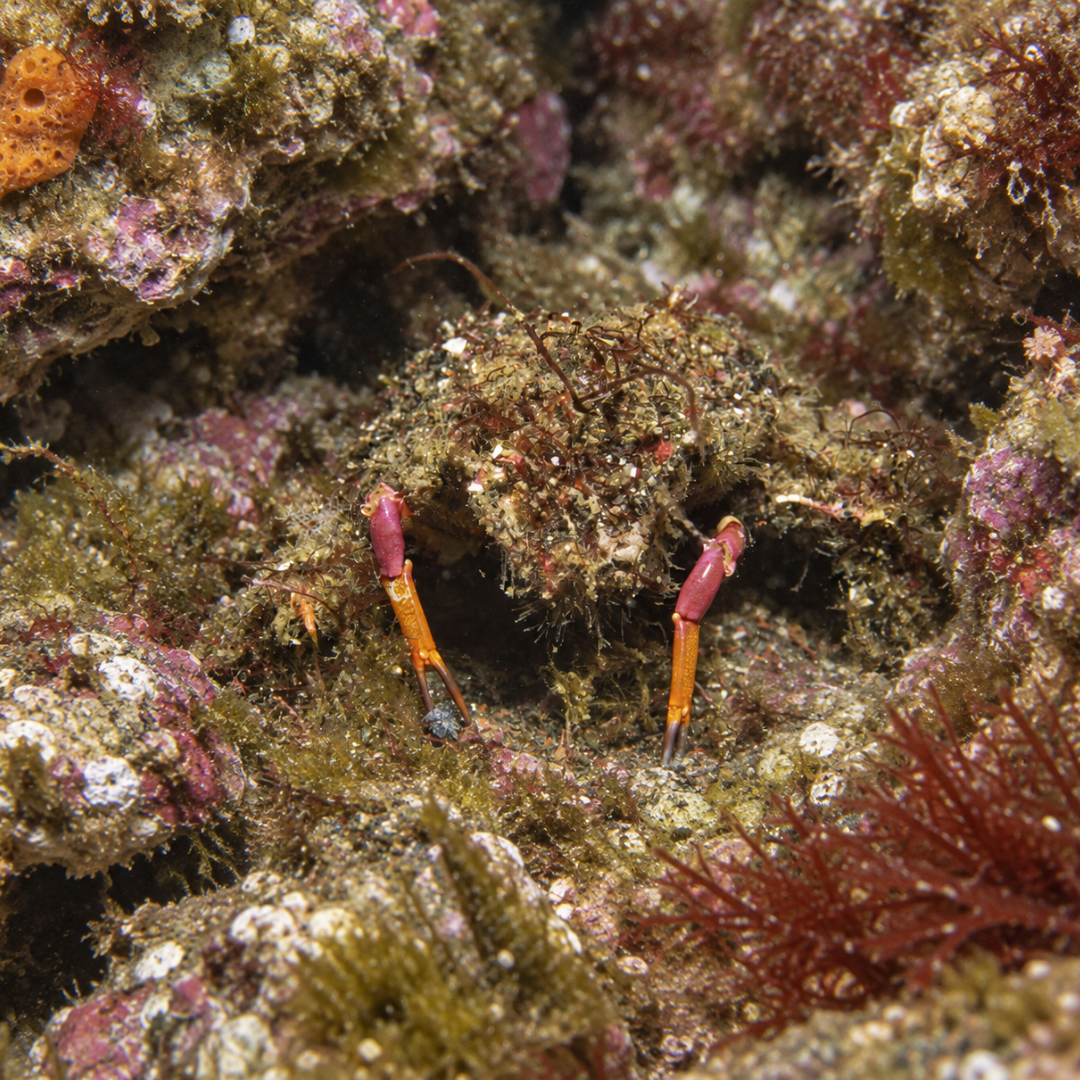
解説 / Description
コワタクズガニは、体表に海藻やヒドロ虫、コケムシ、カイメンなどの断片を取り付け、周囲に溶け込むような姿になる小型の海産カニです。甲羅や歩脚には先端が鉤状になった特殊な剛毛が密生しており、装飾物を保持するのに適した構造になっています。このように周囲の素材を体に付ける行動は「装飾行動」と呼ばれ、クモガニ上科の一部でよく知られています。コワタクズガニでは、下向きに大きく曲がった額角も特徴的で、装飾物をまとった姿だけでなく、その独特な体のつくりにも観察する面白さがあります。 Micippa philyra is a small marine crab that attaches fragments of algae, hydroids, bryozoans, sponges, and other materials to its body, helping it blend into its surroundings. Its carapace and walking legs are densely covered with specialized hooked setae that are well suited for holding these materials. This behavior is known as decorating behavior and is characteristic of a number of crabs within the superfamily Majoidea. Micippa philyra is also distinguished by its strongly downward-deflected rostrum, making both its behavior and body structure particularly interesting to observe.
基本情報 / Basic Information
| 学名 / Scientific Name | Micippa philyra (Herbst, 1803) |
|---|---|
| 通称 / Common Name | 装飾行動を行うことから、広い意味で「装飾ガニ(Decorator crab)」の一種として紹介されることがあります。Because of its decorating behavior, it may be broadly described as a type of decorator crab. |
| 分類 / Family | 節足動物門・甲殻亜門・軟甲綱・十脚目・短尾下目・クモガニ上科・ワタクズガニ属。科については分類体系によって扱いが異なり、Majidae(クモガニ科)に置く資料とMithracidaeに置くデータベースがあります。そのため、科名だけでなく学名まで確認する方が確実です。Phylum Arthropoda, Subphylum Crustacea, Class Malacostraca, Order Decapoda, Infraorder Brachyura, Superfamily Majoidea, Genus Micippa. Family-level placement differs among taxonomic systems, with some sources placing the genus in Majidae and others in Mithracidae. The scientific name therefore provides the most reliable reference for identification. |
| 英名 / English Name | Philyra Spider Crab / Decorator Crab |
| 分布 / Distribution | 西インド洋から西太平洋にかけて広く分布し、東アフリカ側の海域、インド洋、東南アジア、東アジア、インドネシア、オーストラリアなどから記録されています。日本でも東京湾、相模湾、伊豆半島、紀伊半島、土佐湾、九州、南西諸島など各地に記録があり、小笠原諸島からも標本が残されています。Widely distributed from the western Indian Ocean to the western Pacific, with records from waters off East Africa, the Indian Ocean, Southeast Asia, East Asia, Indonesia, and Australia. In Japan, records include Tokyo Bay, Sagami Bay, the Izu and Kii Peninsulas, Tosa Bay, Kyushu, and the Nansei Islands, with museum specimens also known from the Ogasawara Islands. |
| 最大体長 / Max Size | 小型のカニで、文献に掲載された標本では甲幅2〜3cm前後の個体が確認されています。ただし、これは種としての厳密な最大値を示すものではありません。カニ類では全長よりも甲長や甲幅で大きさを表すことが一般的です。A small crab, with published specimens commonly measuring around 2–3 cm in carapace width. These measurements should not be interpreted as a definitive maximum size for the species. Crab size is generally reported as carapace length or width rather than total body length. |
| 寿命 / Lifespan | 本種固有の寿命について、十分な根拠を伴う具体的な年数は確認されていません。飼育環境による寿命の数値は目安としても慎重に扱う必要があります。A well-supported species-specific lifespan has not been established. Numerical lifespan estimates for aquarium specimens should therefore be treated cautiously. |
飼育環境 / Aquarium Environment
| 水槽サイズ / Tank Size | 本種固有の最低水槽サイズを示す信頼できる基準は確認されていません。体そのものは小型ですが、極端に小さな容器では海水の水温や塩分、水質が変化しやすいため、体サイズだけで判断せず、安定した海水環境を維持できる容量を確保することが重要です。No well-established species-specific minimum aquarium size has been documented. Although the crab itself is small, very small containers are prone to rapid changes in temperature, salinity, and water quality, so aquarium volume should be chosen with environmental stability in mind rather than body size alone. |
|---|---|
| 水温 / Temperature | 本種について、観賞飼育用の最適水温として確立された狭い数値範囲は確認されていません。熱帯から温帯にかけて広い分布を持ちますが、自然分布域の水温をそのまま飼育適温とみなすことはできません。飼育では急激な温度変化を避け、安定した環境を維持することを優先します。 A narrow, species-specific optimum temperature range for aquarium care has not been established. Although the species has a broad tropical-to-temperate distribution, natural geographic range should not be directly interpreted as an aquarium temperature recommendation. Avoiding rapid temperature changes and maintaining stable conditions are the main priorities. |
| 水質 / Water Quality | 海産種のため海水環境で飼育します。本種だけを対象としたpH、硬度、カルシウム、マグネシウムなどの最適値は十分に確立されていません。特定の数値を追うことよりも、適切に立ち上げた海水水槽で塩分やpHを急変させず、水質を安定させることが重要です。As a marine species, it should be maintained in seawater. Species-specific optimum values for pH, alkalinity, calcium, magnesium, and related parameters have not been firmly established. Rather than relying on unusually precise target values, the priority should be a properly established marine aquarium with stable salinity, pH, and overall water quality. |
| レイアウト / Layout | 自然下では砂底や岩礁、サンゴ礁周辺などから記録されています。水槽では岩組みなどで落ち着ける場所を作り、装飾行動に利用できる海藻などの安全な素材があると、本種らしい行動を観察しやすくなります。レイアウトは崩れないよう安定させてください。The species has been recorded from sandy bottoms, rocky habitats, and reef-associated environments. In an aquarium, stable rockwork can provide secure resting places, while safe algae and similar materials may allow natural decorating behavior to be observed. All structures should be arranged securely. |
| 注意点 / Precautions | 装飾行動では海藻だけでなく、ヒドロ虫、コケムシ、カイメンなどの断片も利用することが知られています。そのため、さまざまな付着生物を維持するリーフタンクでは、すべての生体にまったく影響を与えないとは断言できません。導入後は何を装飾材料として利用しているかを観察し、問題がある場合はレイアウトや同居生体を見直します。Micippa crabs are known to use not only algae but also fragments of hydroids, bryozoans, and sponges as decorating material. It therefore cannot be assumed that the species will be completely harmless to every attached organism in a reef aquarium. After introduction, observe which materials the crab uses and adjust the aquarium setup or tank mates if necessary. |
餌と給餌 / Feeding
| 餌の種類 / Diet | コワタクズガニだけを対象とした詳細な食性研究は限られています。クモガニ上科では藻類、デトリタス、小型の無脊椎動物などを利用する種が知られており、近縁のワタクズガニ属では海藻を摂食する例も報告されています。飼育では沈降性の甲殻類用人工飼料などを中心に、実際に摂餌していることを確認しながら与えるのが安全です。Detailed dietary information specifically for Micippa philyra is limited. Members of Majoidea may consume algae, detritus, and small invertebrates, and algal feeding has been documented in related Micippa species. In captivity, sinking foods formulated for marine crustaceans can be used while confirming that the individual is actually feeding. |
|---|---|
| 給餌のポイント / Feeding Tips | 本種について、週何回といった標準的な給餌頻度は確立されていません。残餌だけで十分と決めつけず、個体の摂餌状況と体の状態を見ながら少量ずつ与えます。食べ残しが長時間残るほど多く与えると水質悪化につながるため、給餌量は水槽の状態に合わせて調整してください。A standard species-specific feeding frequency has not been established. Do not assume that aquarium leftovers alone will provide sufficient nutrition; instead, offer small portions while monitoring feeding response and body condition. Avoid excessive food that remains uneaten and degrades water quality. |
性格と混泳 / Temperament and Tank Mates
| 性格 / Temperament | 本種の活動時間や攻撃性について、飼育条件下で体系的にまとめられた情報は多くありません。一方、周囲の素材を体に取り付ける装飾行動は本属でよく知られています。水槽では「お掃除役」と決めつけるのではなく、ひとつの底生性甲殻類として行動と摂餌状態を観察しながら管理するのが適切です。Systematic information on activity patterns and aggression in captive Micippa philyra is limited. Its use of surrounding materials for decoration, however, is well documented within the genus. In an aquarium it is best managed as a benthic crustacean with its own behavioral and nutritional needs rather than assuming that it functions simply as a cleanup animal. |
|---|---|
| 混泳の相性 / Compatibility | 大型の肉食魚やカニを捕食する生物との組み合わせは避けた方が安全です。また、脱皮直後の甲殻類は外骨格が柔らかいため、ほかの生体から攻撃を受けない隠れ場所を確保します。サンゴやカイメンなどの付着生物については、装飾材料として利用される可能性を考慮し、「完全なリーフセーフ」と断定せずに観察する必要があります。Avoid keeping it with large predators or animals capable of preying on small crabs. Newly molted crustaceans have a soft exoskeleton, so secure hiding places should be available. Because attached organisms such as sponges may be used as decorating material, the species should not automatically be considered completely reef-safe. |
病気と対策 / Diseases and Prevention
| かかりやすい病気 / Common Diseases | コワタクズガニに特有で、観賞飼育下において頻発すると確認されている病気については、十分な情報がありません。甲殻類では病名だけでなく、脱皮不全、食欲低下、動きの変化なども重要な異常のサインになります。There is insufficient information to identify a disease that is specifically and commonly associated with captive Micippa philyra. In crustaceans, problems such as failed molting, reduced feeding, and abnormal behavior can be important signs of poor condition even when no specific disease can be identified. |
|---|---|
| 対策と予防 / Prevention | 予防の基本は、水温や塩分、pHなどを急変させず、水質と給餌を安定させることです。脱皮の前後には特に個体の状態を観察し、ほかの生体から干渉されにくい隠れ場所を確保します。異常が見られた場合は、まず水質と比重、餌の状態、同居生体からの攻撃の有無を確認します。Prevention centers on maintaining stable temperature, salinity, pH, water quality, and feeding conditions. Pay particular attention around molting and provide shelters where the crab is less likely to be disturbed by tank mates. If abnormal behavior occurs, first check water conditions, salinity, food availability, and possible aggression from other inhabitants. |
増やし方(繁殖) / Breeding
| 雌雄の判別 / Sexing | 成体では、雄のハサミ脚が太く発達するのに対し、雌のハサミ脚は比較的細く滑らかであることが形態記載で示されています。この違いは雌雄判別の参考になりますが、若い個体では差が分かりにくい場合があります。Morphological descriptions indicate that adult males develop robust chelipeds, whereas those of females are comparatively slender and smooth. This provides a useful guide for sex identification, although the difference may be less obvious in immature individuals. |
|---|---|
| 繁殖形態 / Reproduction | 雌は受精した卵を腹部の腹肢に抱えて保護し、孵化後は親とは大きく異なる浮遊幼生になります。本種では室内飼育による幼生発生が研究されており、第1ゾエア、第2ゾエアの2段階を経た後、メガロパへ移行することが確認されています。つまり、孵化した直後から小さなカニの姿になるのではなく、いったん海中を漂う幼生期を過ごしてから底生のカニへ変態します。Females carry fertilized eggs on the pleopods beneath the abdomen. After hatching, the larvae are planktonic and look very different from the adult. Laboratory studies have confirmed two zoeal stages, Zoea I and Zoea II, followed by the megalopa stage. In other words, newly hatched larvae do not immediately resemble tiny crabs; they first pass through a free-swimming larval phase before becoming benthic juveniles. |
| 繁殖のポイント / Breeding Tips | 幼生発生そのものは研究されていますが、一般家庭の水槽で安定して累代繁殖させるための標準的な手順が確立されているわけではありません。浮遊幼生は親ガニと同じ方法では管理できないため、繁殖を試みる場合は親と幼生を分け、海水環境を安定させたうえで、幼生の大きさに適した餌を確保する必要があります。研究室で得られた条件を、そのまま家庭水槽の絶対的な飼育条件として扱わないことも大切です。Although the larval development of the species has been studied, there is no widely established household protocol for reliably breeding successive generations in aquariums. Planktonic larvae cannot be managed in the same way as adult crabs, so breeding attempts require separate larval care, stable seawater conditions, and food of an appropriate size. Laboratory conditions should not automatically be treated as universal aquarium requirements. |
雑学と豆知識 / Trivia and Fun Facts
| 1. 装飾を支える「鉤状剛毛」 / 1. Hooked Setae Support the Decorations | コワタクズガニの甲羅を覆う素材は、単に偶然引っ掛かっているだけではありません。甲羅や歩脚には先端が曲がった鉤状剛毛が密生し、装飾物を保持しやすい構造になっています。ワタクズガニ属では、海藻、ヒドロ虫、コケムシ、カイメンなどの断片を身に付けることが知られています。水槽で姿を眺めるときも、何を身に付けているかだけでなく、その下にある特殊な体表構造を意識すると、装飾行動の仕組みがより分かりやすくなります。The material covering Micippa philyra is not simply debris caught on the body by chance. The carapace and walking legs bear dense hooked setae that are well suited to holding decorating materials. Micippa crabs are known to carry fragments of algae, hydroids, bryozoans, and sponges. Looking beyond the decorations themselves to the specialized body surface beneath them helps explain how this remarkable behavior is physically possible. |
|---|---|
| 2. 装飾行動は、まずカムフラージュとして考える / 2. Decoration Is Best Understood First as Camouflage | 装飾ガニの仲間では、体に周囲の素材を付けることによって姿を見つけにくくする効果があり、近縁の別種では装飾によって捕食を受けにくくなることも実験的に示されています。一方、「コワタクズガニが有毒な素材を意図的に選び、化学的な防御に利用する」とまで本種について断定できる十分な証拠は確認されていません。装飾材料の選択性は装飾ガニ類で研究されている興味深いテーマですが、本種で確認された事実と、ほかの装飾ガニから得られた知見は分けて考える必要があります。In decorator crabs, attaching surrounding materials to the body can make an individual more difficult for predators to detect, and experiments on other decorator crab species have shown that decoration can reduce predation. However, there is not sufficient evidence to state that Micippa philyra specifically selects toxic materials for chemical defense. Material selection is an important subject in decorator-crab research, but findings from other species should not automatically be attributed to this one. |
| 3. 脱皮後に装飾物を再利用するカニもいる / 3. Some Decorator Crabs Reuse Decorations After Molting | 装飾ガニの仲間には、脱皮した古い甲羅から装飾物を取り外し、新しい外骨格へ付け直す種類が知られています。これは装飾行動の面白さを象徴する習性のひとつです。ただし、こうした再利用行動がコワタクズガニで同じように確認されているとまでは断定できません。本種を飼育して脱皮に立ち会えたときは、古い甲羅だけでなく、その後にどのような装飾行動を見せるかを観察してみるとよいでしょう。Some decorator crab species are known to remove useful materials from a discarded exoskeleton and attach them to the new one after molting. This is one of the most fascinating behaviors known in decorator crabs. However, the same recycling behavior should not be assumed to have been specifically demonstrated in Micippa philyra. If a captive individual molts, observing how it decorates afterward can therefore be especially interesting. |
| 4. 額角は近縁種を見分ける重要な手掛かり / 4. The Rostrum Is an Important Identification Feature | コワタクズガニの額角はほぼ垂直に下向きへ曲がり、先端が4つの葉状部に分かれることが特徴です。そのうち中央の2葉が大きく、中央にはV字形の切れ込みがあり、外側の2葉は側方へ向きます。以前の記述で見られる「3葉構造」ではありません。また、甲羅の前側縁には複数の歯状突起があるため、「側縁に突起がない」とする説明も適切ではありません。近縁種との識別では、額角の形だけでなく、眼の周辺や甲羅側縁など複数の特徴を合わせて確認することが重要です。The rostrum of Micippa philyra is strongly deflected downward and terminates in four lobes. The two median lobes are larger and separated by a V-shaped notch, while the two lateral lobes project outward. It should therefore not be described as a three-lobed structure. The anterolateral carapace also bears several tooth-like projections, so the species should not be characterized as lacking marginal projections altogether. Reliable identification requires the rostrum to be considered together with other features around the orbit and carapace margins. |
| 5. 1803年から続く分類の歴史 / 5. A Taxonomic History Beginning in 1803 | 本種は1803年にヨハン・フリードリヒ・ヴィルヘルム・ヘルプストによって「Cancer philyra」として記載されました。その後、広いインド・西太平洋の各地から得られた個体にさまざまな名称が与えられ、「Micippa superciliosa」「Paramicippa asperimanus」「Micippa mascarenica」に関連する名称などが使われた時代があります。現在では、それらのうち複数がコワタクズガニのシノニムとして整理されています。ひとつの学名が定着するまでに多くの標本が比較されてきたことが分かる、分類学の歴史を感じさせる種類です。The species was described in 1803 by Johann Friedrich Wilhelm Herbst as Cancer philyra. Later, specimens from across the wide Indo-West Pacific range were given various names, including Micippa superciliosa, Paramicippa asperimanus, and names associated with Micippa mascarenica. Several of these have since been treated as synonyms of Micippa philyra. Its nomenclatural history illustrates how many specimens and regional records were compared before the modern concept of the species became established. |
| 6. 日本で残されてきた古い標本と研究記録 / 6. Historical Specimens and Records from Japan | コワタクズガニは、日本の甲殻類研究史にも古くから登場します。酒井恒による1930年代の研究では、館山湾、下田、紀伊半島、長崎などの標本をもとに形態や分布が詳しく記載され、その後の日本産カニ類研究でも扱われてきました。東京大学総合研究博物館には、1894年に小笠原諸島の父島で採集された標本や、1899年に薩摩甑島で採集された標本なども残されています。一方、『日本動物誌』に本種そのものが日本産標本として明確に収載されていたとする説明には注意が必要で、現存する標本記録の検討では、同書で本種が日本産材料として直接記載されていないことが指摘されています。Micippa philyra also has a long history in Japanese carcinological research. Tsune Sakai’s work in the 1930s described morphology and distribution using specimens from places such as Tateyama Bay, Shimoda, the Kii Peninsula, and Nagasaki, and the species continued to appear in later studies of Japanese crabs. The University Museum of the University of Tokyo preserves specimens collected from Chichijima in the Ogasawara Islands in 1894 and from Koshikijima in Satsuma in 1899. Claims that the species itself was clearly listed from Japanese material in Fauna Japonica require caution, as later examination of historical specimens notes that it was not directly recorded there as part of De Haan’s Japanese material. |
まとめ / Conclusion
コワタクズガニは、鉤状の剛毛を備えた体に周囲の素材を取り付け、自らの姿を環境に溶け込ませる装飾行動が印象的な小型の海産カニです。下向きに折れ曲がった4葉の額角をはじめ、体のつくりにも本種らしい特徴があり、形態と行動の両方を観察する楽しさがあります。 Micippa philyra is a small marine crab notable for its decorating behavior, using hooked setae to attach surrounding materials to its body and blend into the environment. Its distinctive morphology, including a strongly downward-deflected four-lobed rostrum, makes the species interesting to observe both behaviorally and anatomically.
一方、観賞飼育については、本種だけを対象として確立された水温、寿命、給餌頻度などの細かな基準が十分にそろっているわけではありません。根拠のない細かな数値に合わせるより、安定した海水環境を維持し、摂餌や脱皮、装飾行動を日々観察することが大切です。身近な素材を利用して少しずつ姿を変えていく様子は、海の底で生き物が周囲の環境を巧みに利用して暮らしていることを実感させてくれます。 At the same time, detailed species-specific aquarium standards for temperature, lifespan, feeding frequency, and similar parameters remain limited. Rather than relying on unsupported precision, successful care should emphasize a stable marine environment and close observation of feeding, molting, and decorating behavior. Watching the crab gradually alter its appearance with materials from its surroundings offers a vivid example of how marine animals make use of their environment.

気になる道具や飼い方を見つけてみませんか?
 アイのアクアグッズ案内水草用ライトの選び方|緑の絨毯と赤い水草を楽しむ照明・植栽用品道具の特徴や使い方、選ぶときのポイントをアイが紹介します。記事はコチラ →
 アイのアクアグッズ案内ベタの一匹飼いを楽しむ|水槽・ヒーター・ふた・フィルターの選び方ベタの一匹飼いに向く水槽容量、ふたと空気層、ヒーターと水温計、弱い水流のフィルターを、コタロウとアイの会話で分かりやすく解説します。記事はコチラ →
 アイのアクアグッズ案内グッピー・プラティ・モーリーを親子で楽しむ飼育用品|水槽・稚魚保護・ろ過・餌・水草道具の特徴や使い方、選ぶときのポイントをアイが紹介します。記事はコチラ →
 アイのアクアグッズ案内海水魚初心者の必需品|水槽・人工海水・比重計・水質検査道具の特徴や使い方、選ぶときのポイントをアイが紹介します。記事はコチラ →
さまざまな飼育テーマをご紹介。リンク先の記事には広告・商品紹介が含まれます。
案内・紹介記事一覧へ →分布マップ
コワタクズガニ(Micippa philyra)は、西インド洋から西太平洋にかけて広く分布し、東アフリカ側の海域、インド洋、東南アジア、東アジア、インドネシア、オーストラリアなどから記録されています。日本でも東京湾、相模湾、伊豆半島、紀伊半島、土佐湾、九州、南西諸島など各地に記録があり、小笠原諸島からも標本が知られています。
※この地図は分布地域を把握するための概略表示です。表示しているマーカーは分布域を見やすくするために設定した代表地点であり、実際の採集地点や標本記録地点を示すものではありません。
参考文献
-
DecaNet / World Register of Marine Species (WoRMS). Micippa philyra (Herbst, 1803).
学名、分類、受容名、シノニムの確認に参照。
World Register of Marine Species -
Ko, H.-S. & Lee, S.-H. (2015). Invertebrate Fauna of Korea, Vol. 21, No. 41: Crabs and Zoeas IV.
National Institute of Biological Resources, Ministry of Environment, Republic of Korea. コワタクズガニの形態、分布、生息環境、装飾行動、幼生形態の確認に参照。
National Institute of Biological Resources -
Sakai, T. (1976). Crabs of Japan and the Adjacent Seas.
Kodansha, Tokyo. 日本産個体の形態・分布に関する基礎文献として参照。
国立国会図書館サーチ -
Ko, H.-S. (1995). Larval Development of Micippa philyra (Herbst, 1803) Reared in the Laboratory (Decapoda, Brachyura, Majidae).
Crustaceana, 68(7), 864–872. 幼生発生と繁殖に関する記述の根拠として参照。
DOI: 10.1163/156854095X00999 -
Ocean Biodiversity Information System (OBIS). Micippa philyra (Herbst, 1803).
海産種としての分類情報と分布記録を確認するための生物多様性データベースとして参照。
Ocean Biodiversity Information System -
Ornamental Aquatic Trade Association (OATA). How to look after marine crustaceans.
海産甲殻類の一般的な水質管理、順化、脱皮時の管理など、飼育条件に関する基礎資料として参照。
Ornamental Aquatic Trade Association -
Yanong, R. P. E. Use of Copper in Marine Aquaculture and Aquarium Systems.
University of Florida IFAS Extension. 海産無脊椎動物に対する銅の毒性など、薬剤使用時の注意点の確認に参照。
UF/IFAS Extension -
Shields, J. D. (2012). The impact of pathogens on exploited populations of decapod crustaceans.
Journal of Invertebrate Pathology, 110(2), 211–224. 十脚甲殻類の疾病と、水質悪化や低酸素、温度ストレスなど環境要因との関係を確認するために参照。
DOI: 10.1016/j.jip.2012.03.011





コメント