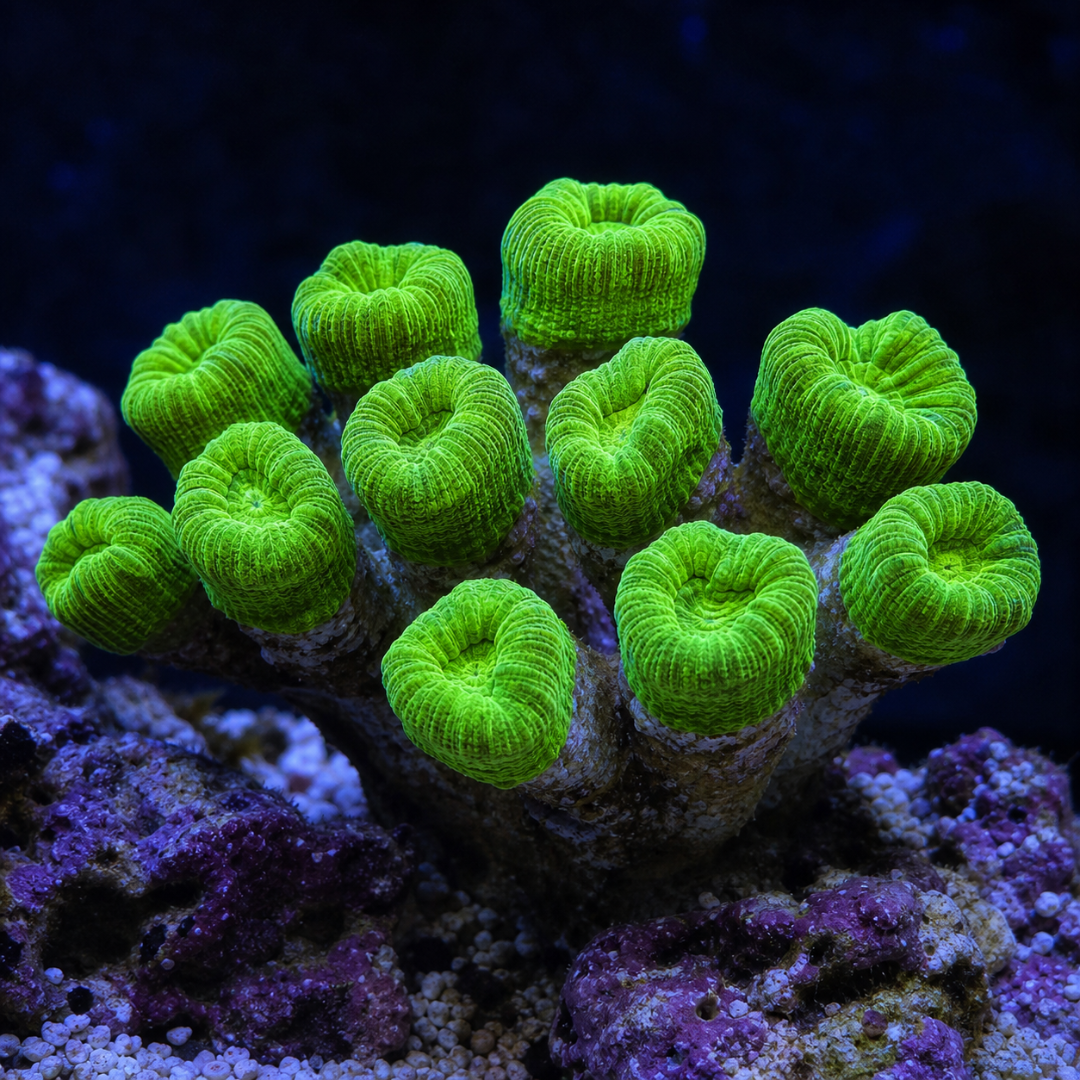
タバネサンゴは、枝分かれした石灰質の骨格の先端に、丸く肉厚なポリプを広げる大ポリプイシサンゴです。ポリプがキャンディーや小さなトランペットのように見えることから、英語圏ではキャンディーケイン・コーラル、トランペット・コーラルと呼ばれます。緑、青緑、褐色などの色彩を見せ、青色系の照明下では蛍光が鮮やかに浮かび上がります。比較的丈夫で飼育しやすいLPSとして親しまれていますが、長く状態を保つには、強い水流を直接当てないこと、水質を急変させないこと、ブラウンジェリー病の兆候を早く見つけることが重要です。Candy cane corals are large-polyp stony corals that develop rounded, fleshy polyps at the tips of branching calcium-carbonate skeletons. Their candy-like or trumpet-shaped polyps give rise to the common names “candy cane coral” and “trumpet coral.” They occur in green, blue-green, brown, and related color forms, and their fluorescence can appear especially vivid under blue-rich aquarium lighting. They are widely regarded as comparatively hardy LPS corals, but maintaining them in good condition over the long term still requires protection from harsh direct flow, stable water quality, and early recognition of brown jelly disease.
基本情報 / Basic Information
学名 / Scientific Name
Caulastraea spp.(広義。国内流通名「タバネサンゴ」には、分類再編によってAstraeosmilia属へ移された種が含まれる場合があります)Caulastraea spp. (in the broad aquarium-trade sense; the name may also include species transferred to the genus Astraeosmilia)
刺胞動物門、花虫綱、六放サンゴ亜綱、イシサンゴ目、サザナミサンゴ科、タバネサンゴ属。国内で同じ流通名が使われる個体の一部は、現在では近縁のAstraeosmilia属に分類されます。Phylum Cnidaria, Class Anthozoa, Subclass Hexacorallia, Order Scleractinia, Family Merulinidae, Genus Caulastraea. Some corals sold under the same Japanese trade name are now placed in the closely related genus Astraeosmilia.
分布 / Distribution
主にインド太平洋の熱帯・亜熱帯海域。サンゴ礁のほか、波浪の影響が比較的弱く、濁りや泥の堆積が見られる環境に生息する種類もあります。Primarily tropical and subtropical waters of the Indo-Pacific. In addition to coral reefs, some species occur in relatively sheltered, turbid habitats where fine sediment may accumulate.
最大サイズ / Maximum Size
個々の莢(骨格のくぼみ)の直径は通常10mm未満です。群体は出芽を繰り返して枝数を増やし、半球状または束状に広がります。群体全体の大きさは種類や生育条件によって大きく変わるため、明確な最大径は示しにくいといえます。Individual calices, the cup-like depressions in the skeleton, are generally less than about 10 mm across. Repeated budding increases the number of branches and produces a clustered or hemispherical colony. Because overall colony size varies greatly with species and growing conditions, a single definitive maximum diameter is difficult to give.
寿命 / Lifespan
自然下での正確な寿命は明らかではありません。群体は個虫の出芽によって更新され続けるため、安定した環境では長期維持が期待できます。Its exact natural lifespan is not well established. Because the colony continually renews itself through polyp budding, it can potentially be maintained for many years under stable conditions.
飼育環境 / Aquarium Environment
水槽サイズ / Tank Size
小型群体を中心に飼育するなら、60cm規格水槽(約57L)以上が管理しやすい目安です。複数のLPSと組み合わせ、接触を避ける余白を確保する場合は、90cm規格水槽(約180L)以上が扱いやすくなります。For a small colony, a standard 60 cm aquarium of about 57 L is a practical starting point. A standard 90 cm aquarium of about 180 L or larger provides more room when keeping multiple LPS corals and maintaining safe spacing between colonies.
水温・比重 / Temperature and Specific Gravity
水温24〜26℃を安定して維持します。比重は海水魚・サンゴ水槽の一般的な範囲である1.023〜1.026を目安とし、短時間で大きく変化させないことが重要です。Maintain a stable temperature of 24–26°C. A specific gravity of approximately 1.023–1.026 is a practical reef-aquarium target, with stability being more important than small day-to-day adjustments.
水質 / Water Quality
KH 7.5〜9.0dKH、カルシウム400〜450ppm、マグネシウム1250〜1350ppmを安定させます。pHはおおむね8.0〜8.4を目安とし、硝酸塩とリン酸塩は藻類が増えない範囲で低く保ちます。極端な貧栄養化よりも、数値の急変を避けることが大切です。Keep alkalinity at 7.5–9.0 dKH, calcium at 400–450 ppm, and magnesium at 1,250–1,350 ppm. A pH around 8.0–8.4 is a practical target. Nitrate and phosphate should remain low enough to avoid nuisance algae, but sudden shifts and extreme nutrient stripping should also be avoided.
光量 / Lighting
中程度の光が適し、PARはおよそ75〜150 µmol photons/m²/sが目安です。青色波長を含む照明で蛍光を楽しめますが、導入直後から強光に当てると光阻害や白化を招くため、低い位置や減光設定から徐々に光順応させます。Moderate light is suitable, with an approximate PAR range of 75–150 µmol photons/m²/s. Blue-rich lighting can reveal strong fluorescence, but newly introduced colonies should be acclimated gradually from a lower position or reduced intensity to prevent photoinhibition and bleaching.
水流 / Water Flow
ポリプ全体がゆっくり揺らめく程度の、弱〜中程度でランダムな水流が適します。強い一方向流を直接当てると、膨らんだ組織が鋭い骨格に押し付けられて裂け、感染症の入口になることがあります。Provide gentle to moderate, irregular flow that causes the polyps to sway softly. Strong, one-directional flow can force the inflated tissue against sharp skeletal edges, causing tears that may become entry points for infection.
レイアウト・配置 / Layout and Placement
水槽の中〜下段を出発点にし、群体の骨格基部をサンゴ用接着剤などで安定させます。ポリプが十分に膨らめる空間を確保し、周囲のサンゴとは5〜10cm程度を目安に離します。泥や砂を排出する能力はありますが、継続的に砂が降り積もる場所は避けます。Begin placement in the middle to lower part of the aquarium and secure the skeletal base with coral-safe adhesive. Leave enough room for full polyp expansion and, as a practical guide, keep the colony about 5–10 cm away from neighboring corals. Although the polyps can shed some sediment, avoid locations where sand continually settles on the colony.
注意点 / Precautions
導入時は水温と比重を丁寧に合わせ、照明と水流は弱めから始めます。転倒によって肉質部が岩に擦れると感染症につながるため、骨格を確実に固定してください。高水温、急な光量増加、KHの乱高下、強い直撃水流は特に避けます。Acclimate temperature and salinity carefully, then begin with reduced light and flow. A fall against rockwork can scrape the fleshy tissue and promote infection, so the skeleton should be secured firmly. Avoid overheating, sudden increases in light, unstable alkalinity, and direct high-velocity flow.
餌と給餌 / Feeding
栄養の得方・餌 / Nutrition and Diet
細胞内の共生褐虫藻がつくる光合成産物から多くのエネルギーを得る一方、触手で動物プランクトンや細かな有機物も捕らえます。飼育下では、LPS用の小粒フード、細かく刻んだエビや貝などの海産性の餌、イサザアミ、カイアシ類などが適します。The coral receives much of its energy from photosynthetic products supplied by symbiotic dinoflagellates, while also capturing zooplankton and fine organic particles with its tentacles. Suitable aquarium foods include small LPS pellets, finely chopped shrimp or shellfish, mysid shrimp, and copepods.
給餌のポイント / Feeding Tips
必須ではありませんが、週1〜2回の少量給餌はポリプの肥育、成長、組織修復を助けます。消灯後や捕食触手が伸びた時間帯に、スポイトで各ポリプへ少量ずつ与えます。給餌中は水流を一時的に弱め、取り込んだことを確認してから戻し、食べ残しは取り除きます。Feeding is not strictly essential, but a small meal once or twice a week can support polyp condition, growth, and tissue repair. Feed after lights-out or when feeding tentacles are extended, using a pipette to offer a small portion to each polyp. Temporarily reduce flow, restore it after the food is captured, and remove uneaten material.
性質と相性 / Characteristics and Compatibility
形態・成長 / Form and Growth
アラゴナイト質の骨格を持つ群体性サンゴで、円柱状の枝が束になったファセロイド型の群体をつくります。主に触手内出芽によって、ひとつのポリプ内で口が分かれ、やがて新しい個虫と枝へ分かれていきます。環境に応じて枝の密度や伸び方を変える表現型の柔軟さも見られます。This is a colonial coral with an aragonite skeleton, forming a phaceloid colony of separate cylindrical branches. Growth proceeds mainly through intratentacular budding, in which a mouth divides within an existing polyp and gradually gives rise to additional polyps and branches. Colony density and branch form can vary with environmental conditions.
攻撃性 / Aggression
LPSの中では比較的穏やかですが、刺胞を持つため、夜間に伸ばした触手や膨らんだ組織が接触すると、近くのサンゴを傷めることがあります。ポリプが最大まで膨らんだ状態を基準に、周囲へ余裕を持たせます。It is comparatively mild for an LPS coral, but it still possesses stinging cells. Tentacles extended at night and contact with inflated tissue can damage nearby corals. Space the colony according to its fully inflated size and leave a safety margin.
相性 / Compatibility
安定したサンゴ水槽で、同程度の光量と穏やかな水流を好むLPSやソフトコーラルと組み合わせやすい種類です。ただし、長い攻撃触手(スイーパー触手)を持つサンゴ、急速に覆い広がる種類、サンゴをつつく魚とは距離を取ります。クマノミが住みつこうとして繰り返し触れると、ポリプが開きにくくなる場合があります。It is generally compatible with LPS and soft corals that prefer similar moderate light and gentle flow in a stable reef aquarium. Keep it away from aggressive corals with long sweeper tentacles, fast-overgrowing species, and fish known to nip coral tissue. Repeated contact from clownfish attempting to use the colony as a host may prevent the polyps from opening fully.
病気と対策 / Diseases and Prevention
不調・病気・害虫 / Problems, Diseases, and Pests
高水温や急な強光では白化や色落ちが起こり、強い水流や転倒による擦れでは組織が裂けることがあります。特に注意したいのがブラウンジェリー病で、傷口やポリプ周辺に茶色〜黄褐色のゼリー状物質が現れ、短時間で隣接する個虫へ広がります。放置すると群体全体が壊死し、水流に乗った病変物質によって、ほかのLPSにも症状が広がるおそれがあります。Excess heat or a sudden increase in light can cause bleaching and color loss, while harsh flow or falling against rockwork may tear the tissue. The most serious acute problem is brown jelly disease, in which brown to yellow-brown gelatinous material appears around damaged tissue or polyps and can spread rapidly to neighboring heads. Without intervention, the colony may undergo extensive tissue loss, and affected material carried by the aquarium’s flow may spread the problem to other LPS corals.
対策と予防 / Prevention
予防の基本は、水温・KH・比重・光量を安定させ、組織を傷つけない水流と確実な固定を保つことです。ゼリー状物質を見つけた場合は、まず水流を止め、サイフォンで周囲の海水ごと慎重に吸い出してから、患部のある群体を隔離します。サンゴ用ディップ剤は製品の使用方法に従い、ポビドンヨードは濃度や薬浴時間を誤ると組織を傷めるため、慎重に扱います。いずれも本水槽へ直接添加しません。病変の進行が止まらない場合は、病変部から十分に離れた健康な枝を、清潔な器具で切り離す方法が現実的です。抗菌薬は耐性菌の発生や生物ろ過への影響があるため安易に使用せず、必要な場合も法令と専門家の助言に従い、隔離水槽だけで扱います。Prevention begins with stable temperature, alkalinity, salinity, and lighting, together with secure placement and flow that does not injure the tissue. If gelatinous material appears, first stop the circulation, carefully siphon it away with the surrounding water, and then isolate the affected colony. Use commercial coral dips exactly as directed. Povidone-iodine must be handled cautiously because an unsuitable concentration or exposure time can damage living tissue, and neither treatment should be added directly to the display aquarium. If the lesion continues to advance, cutting a healthy branch well beyond the affected area with disinfected tools may be the most practical rescue method. Antibiotics can promote resistance and disrupt biological filtration, so they should not be used casually; when necessary, they should be confined to a separate treatment system under appropriate legal and professional guidance.
増やし方(繁殖・株分け) / Reproduction and Propagation
無性生殖・株分け / Asexual Reproduction and Fragmentation
自然な増殖は主に触手内出芽で進み、ひとつのポリプが複数の口を持つ段階を経て新しい個虫へ分かれます。飼育下では、個虫ごとに枝が分かれたファセロイド型の骨格を利用し、健康な枝を骨格部分で切断するフラグ化が行えます。Natural asexual growth occurs mainly through intratentacular budding. A polyp may temporarily develop multiple mouths before separating into new heads. In aquariums, the phaceloid skeleton, with separate branches for individual polyps, allows healthy sections to be propagated by cutting only through exposed skeletal tissue.
有性生殖 / Sexual Reproduction
流通名「タバネサンゴ」には複数種が含まれるため、雌雄や放卵放精の時期・様式を一律には示せません。一般的な家庭水槽では、有性生殖で得た幼生を育てる方法は日常的な飼育技術として確立しておらず、増殖は主に出芽と株分けで行われます。Because the aquarium trade name covers more than one species, sex and spawning behavior cannot be described uniformly. In typical home aquariums, raising larvae produced through sexual reproduction is not an established routine technique, so propagation is usually achieved through budding and fragmentation.
増殖のポイント / Propagation Tips
十分に膨らみ、組織の退縮や感染がない親株を選びます。ポリプの肉を切らず、個虫間の露出した骨格を清潔なボーンカッターなどで切断し、切り口を飼育水ですすいでからサンゴ用接着剤で固定します。回復中は強光と強い水流を避け、水質を安定させ、給餌は開きが戻ってから少量ずつ再開します。Choose a well-inflated parent colony with no tissue recession or infection. Avoid cutting through living tissue; instead, divide exposed skeleton between heads with a clean bone cutter, rinse the cut surface in aquarium water, and secure the fragment with coral-safe adhesive. During recovery, avoid intense light and strong flow, maintain stable water chemistry, and resume light feeding only after normal expansion returns.
毒性と取り扱い / Toxicity and Handling
毒性 / Toxicity
刺胞動物として刺胞毒を持ち、粘液や触手が皮膚・目・傷口に触れると刺激を生じる可能性があります。パリトキシンを持つサンゴとして一般に扱われる種類ではありませんが、毒性がないと決めつけず、通常のサンゴ作業と同じ安全対策を取ります。As a cnidarian, it possesses stinging cells, and contact with mucus or tentacles may irritate the skin, eyes, or open wounds. It is not generally treated as a palytoxin-bearing coral, but it should not be assumed harmless; standard coral-handling precautions remain appropriate.
取り扱い上の注意 / Handling Precautions
ニトリル手袋と保護眼鏡を使用し、肉質部ではなく骨格基部を持ちます。切断作業では破片や海水の飛散を防ぎ、換気のよい場所で行います。目や傷口への接触を避け、作業後は器具と手を十分に洗浄してください。サンゴや付着物を加熱・煮沸しないことも基本です。Wear nitrile gloves and eye protection, and hold the colony by the skeletal base rather than the fleshy polyps. When cutting, work in a well-ventilated area and prevent splashes and skeletal fragments from reaching the face. Avoid contact with eyes and open wounds, wash hands and tools thoroughly afterward, and never heat or boil coral material or attached organisms.
雑学と豆知識 / Trivia and Fun Facts
19世紀に始まった属の歴史 / A Genus with a Nineteenth-Century History
Caulastraea属は、米国探検調査隊が集めた標本をもとに、動物学者ジェームズ・ドワイト・デーナが1846年に創設しました。模式種となったCaulastraea furcataの記載では、叢状に分かれる群体、円柱状の茎と莢、多数の隔壁などが詳しく記録されています。DNA解析が存在しなかった時代に残された骨格の観察記録が、今も分類を考える出発点として生き続けています。The genus Caulastraea was established in 1846 by zoologist James Dwight Dana from material collected by the United States Exploring Expedition. His description of the type species, Caulastraea furcata, documented the clustered branching colony, cylindrical stems and calices, and numerous septa. Recorded long before DNA sequencing existed, those careful skeletal observations still form part of the foundation for modern taxonomic work.
名前は同じでも属が違うことがある / One Trade Name, More Than One Genus
長くCaulastraea属として扱われてきた仲間は、分子系統と44の形態形質を組み合わせた統合的研究によって再検討されました。2021年の研究ではAstraeosmilia属が復活し、かつてCaulastraea tumida、C. curvata、C. connataと呼ばれた種が移されました。一方、C. furcataとC. echinulataはCaulastraea属に残っています。流通名は便利ですが、ひとつの名前の背後に分類学の変化が隠れている好例です。Corals historically grouped in Caulastraea were reassessed by combining molecular phylogeny with 44 skeletal characters. An integrative study published in 2021 revived the genus Astraeosmilia and transferred species formerly known as Caulastraea tumida, C. curvata, and C. connata. Caulastraea furcata and C. echinulata remained in Caulastraea. The familiar trade name is useful, but it also hides an evolving scientific classification.
枝先のポリプは増殖の単位 / Each Polyp Is a Modular Building Block
タバネサンゴの群体は、完成した形を一度につくるのではありません。ひとつのポリプの内部で口が分かれ、複数の口を持つ途中段階を経て、新しい個虫と枝が生まれます。このモジュール型の成長によって、水流、堆積物、周囲の空間に合わせて群体の形を変えられます。濁った環境では上向きの枝と膨らむポリプが泥を払い、限られた足場を立体的に使います。A candy cane coral does not build its final colony shape all at once. A mouth divides within an existing polyp, passes through a multi-mouthed stage, and eventually produces additional heads and branches. This modular growth allows the colony to adjust its form to flow, sediment, and available space. In turbid habitats, upright branches and expanding polyps help shed fine particles while making efficient use of limited hard substrate.
サンゴはひとつの生物だけではない / A Coral Is More Than One Organism
サンゴの組織内には褐虫藻が共生し、その周囲には細菌やウイルスを含む多様な微生物群も共存しています。宿主とこれらの共生者をひとまとまりの生命システムとして捉えたものがホロビオントであり、光合成産物の受け渡しや栄養循環、環境ストレスへの応答に関わっています。採集海域や水深が異なる個体では共生藻の組成が違う可能性があり、それが水温や照明への反応の個体差として現れると考えられています。Symbiotic dinoflagellates live within coral tissue alongside diverse bacteria, viruses, and other microorganisms. The host and its associated community are collectively described as a holobiont, a biological system involved in the transfer of photosynthetic products, nutrient cycling, and responses to environmental stress. Colonies from different depths or regions may host different symbiont communities, which may help explain individual differences in tolerance to heat and aquarium lighting.
蛍光色は見た目以上の機能を持つ / Fluorescence Is More Than Decoration
鮮やかな緑色蛍光タンパク質や非蛍光性の色素タンパク質は、観賞価値を高めるだけでなく、組織内の光環境を調節する働きがあると考えられています。強い光の下では一部の色素が過剰な光を遮り、光の乏しい環境では、蛍光による波長変換が組織内の光環境を変え、共生藻の光利用を助ける可能性があります。色鮮やかな個体が常に有利とは限らず、色素をつくるエネルギーコストとの釣り合いが、自然界の多彩な色彩を支えていると考えられています。Green fluorescent proteins and non-fluorescent chromoproteins do more than increase visual appeal; they are thought to regulate the light environment within coral tissue. Under intense light, some pigments can screen excess radiation, while in dim habitats fluorescence may alter the internal light field and help symbiotic algae use the available light. Strong coloration is not always an advantage, because pigment production has an energetic cost, and that trade-off may help maintain the variety of color forms seen in nature.
国際流通はワシントン条約の管理下 / International Trade Is Regulated by CITES
タバネサンゴを含むイシサンゴ類の国際取引は、ワシントン条約の附属書IIによって管理されています。商業取引そのものが全面禁止されているわけではありませんが、輸出国が発行する適正な許可書と、日本側の輸入手続き、税関での現物照合が欠かせません。書類不備による長い保留は、生体の酸欠や水質悪化を招くため、法令遵守は野生個体群の保全だけでなく、輸送中のサンゴを守ることにも直結します。International trade in stony corals, including candy cane corals, is regulated under Appendix II of CITES. Commercial trade is not completely prohibited, but it requires valid export documentation, appropriate Japanese import procedures, and inspection by customs. Delays caused by document errors can lead to oxygen depletion and poor water quality during transit, so regulatory compliance protects both wild populations and the living corals being transported.
まとめ / Conclusion
タバネサンゴは、丸く膨らむポリプと枝状の骨格がつくる親しみやすい姿の中に、褐虫藻との共生、色素タンパク質による光環境の調節、周囲の条件に合わせて群体の形を変える柔軟さを備えています。中程度の光と優しく揺らぐ水流を用意し、KH・カルシウム・マグネシウムを安定させることで、鮮やかな発色とふっくらしたポリプを長く楽しめます。Candy cane corals combine an approachable form of rounded polyps and branching skeletons with sophisticated biology: symbiosis with dinoflagellates, pigment-based regulation of the internal light environment, and flexible colony growth in response to surrounding conditions. With moderate lighting, gently variable flow, and stable alkalinity, calcium, and magnesium, they can maintain rich coloration and full, fleshy polyps for many years.
日々の観察では、ポリプの開き方、色、組織の張り、骨格との境目に目を向けると、不調の兆候を早く見つけられます。ひとつの口が二つに分かれ、やがて新しい枝へ育っていく変化は、環境が合っていることを実感させてくれます。時間とともに群体が少しずつ姿を変え、水槽の中で存在感と愛着を深めていくサンゴです。Daily observation of polyp expansion, color, tissue fullness, and the tissue-skeleton boundary makes it easier to recognize early signs of stress. Watching one mouth divide into two and gradually develop into a new branch provides a visible sign that the environment suits the colony. As its shape changes little by little over time, the coral develops an increasingly distinctive and rewarding presence in the aquarium.



 アイのアクアグッズ案内カルキ抜き・水質調整剤の選び方|水換えと水槽の種類に合わせて選ぶ道具の特徴や使い方、選ぶときのポイントをアイが紹介します。記事はコチラ →
 アイのアクアグッズ案内プレコ飼育に必要なもの|餌・流木・ろ過・隠れ家・掃除用品道具の特徴や使い方、選ぶときのポイントをアイが紹介します。記事はコチラ →
 アイのアクアグッズ案内コケを食べるコイの仲間に合わせる飼育用品|フライングフォックス・アルジイーター・ガラ道具の特徴や使い方、選ぶときのポイントをアイが紹介します。記事はコチラ →
 アイのアクアグッズ案内エーハイムはおもちゃから始まった? 小さな噴水から水槽へ、アイとコタロウの探訪道具の特徴や使い方、選ぶときのポイントをアイが紹介します。記事はコチラ →



コメント