
解説 / Description
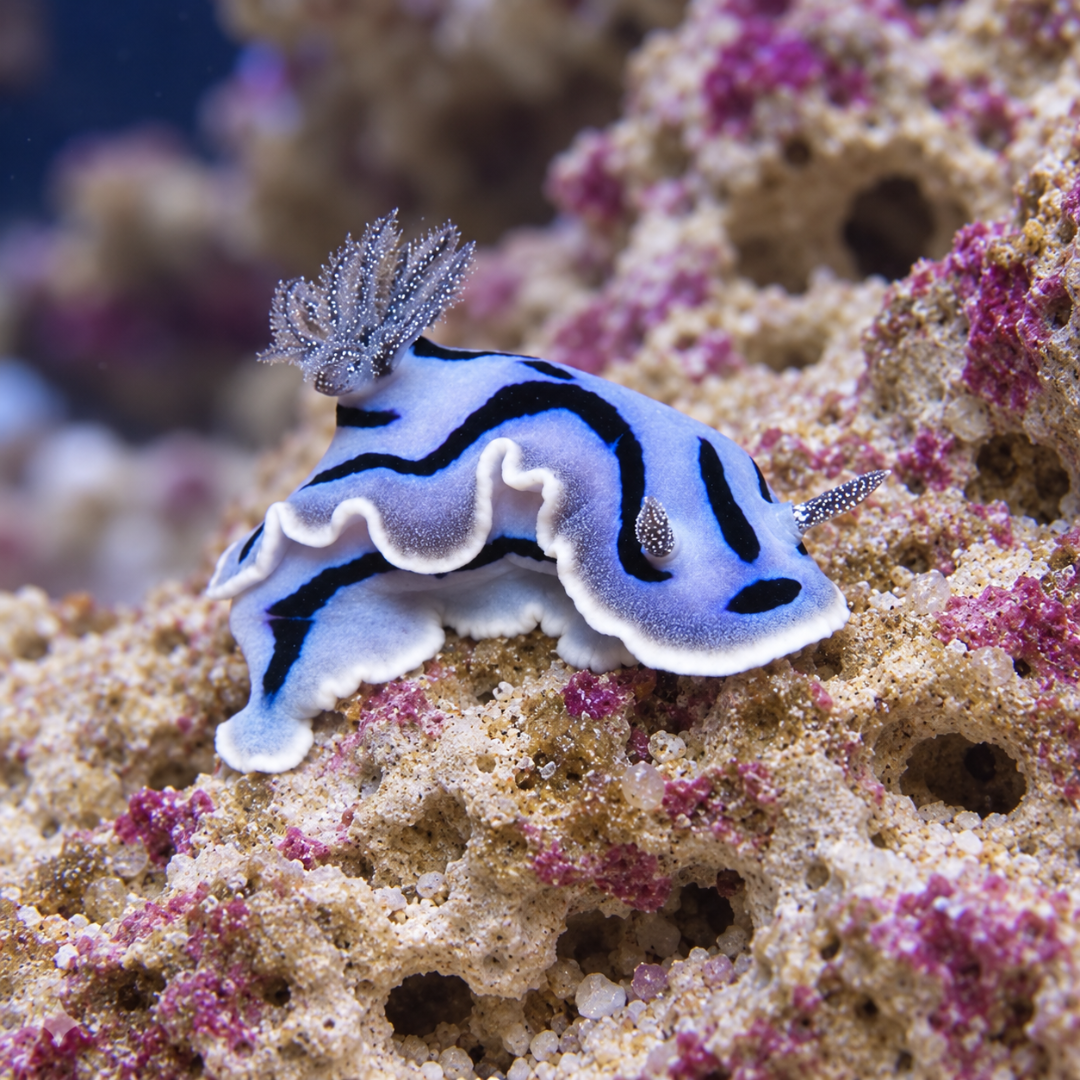
ミゾレウミウシは、淡い青白色の体に黒い縦線が走り、触角と二次鰓に白い細点が散るイロウミウシ科の一種です。西太平洋の熱帯から亜熱帯域に分布し、日本でも沖縄など南日本の海域で記録されています。外見は華やかですが、食性は海綿に強く依存しており、一般的な人工飼料で代用することはできません。そのため、水槽内で長く維持できるかどうかは、水質管理だけでなく、実際に摂食する海綿を継続して用意できるかに大きく左右されます。また、食べた海綿に由来する化合物を体内に蓄積し、防御に利用することも研究されており、生態と化学が密接に結びついた興味深いウミウシです。 Chromodoris willani is a chromodorid nudibranch with a pale blue to whitish body, dark longitudinal lines, and distinctive white speckles on the rhinophores and secondary gills. It is distributed in tropical to subtropical parts of the western Pacific and is also recorded from southern Japan, including Okinawa. Its feeding ecology depends strongly on sponges, and ordinary prepared aquarium foods are not suitable substitutes. Long-term maintenance therefore depends not only on stable seawater but also on whether an appropriate food sponge can be supplied continuously. The species is also studied for its ability to accumulate sponge-derived compounds and use them in chemical defense, linking its feeding ecology closely with its defensive biology.
基本情報 / Basic Information
| 学名 / Scientific Name | Chromodoris willani Rudman, 1982 |
|---|---|
| 通称 / Common Name | ミゾレウミウシWillan’s chromodoris, Willan’s nudibranch |
| 分類 / Family | 軟体動物門・腹足綱・裸鰓目・イロウミウシ科・コモンウミウシ属Phylum Mollusca, Class Gastropoda, Order Nudibranchia, Family Chromodorididae, Genus Chromodoris |
| 英名 / English Name | Willan’s chromodoris |
| 分布 / Distribution | 西太平洋の熱帯〜亜熱帯海域。東南アジアからバヌアツ、ニューカレドニア、フィジー、トンガ、オーストラリア周辺などで知られ、日本でも沖縄を含む南日本から記録があります。Tropical to subtropical western Pacific, with records from Southeast Asia through Vanuatu, New Caledonia, Fiji, Tonga, Australia, and southern Japan, including Okinawa. |
| 最大体長 / Max Size | 多くは3〜4cm程度で、調査標本では5cm前後の個体も記録されています。最大値は資料によって差があります。Many individuals are around 3–4 cm long, and research collections include specimens close to 5 cm. Reported maximum size varies among sources. |
| 寿命 / Lifespan | 野外での正確な寿命を示す確立したデータは乏しく、飼育下でも本来の寿命を評価できる例はほとんどありません。水槽では適切な海綿を確保できず、寿命を迎える前に餓死するケースが大きな問題になります。Reliable species-specific lifespan data are scarce in the wild, and true longevity is rarely measurable in captivity. In aquaria, starvation caused by the lack of a suitable food sponge is often a greater limitation than natural lifespan. |
飼育環境 / Aquarium Environment
| 水槽サイズ / Tank Size | 本種に固有の推奨水槽サイズは確立されていません。体そのものは小型ですが、小さな容器ほど比重や水質が変動しやすいため、安定した成熟海水を維持できる環境が必要です。長期飼育では、水槽の大きさ以上に、適合する餌海綿を継続して確保できるかが重要になります。No species-specific minimum aquarium size has been established. Although the animal itself is small, very small systems are more prone to rapid changes in salinity and water quality. For long-term maintenance, a stable mature marine system and a continuous supply of the appropriate food sponge matter more than tank dimensions alone. |
|---|---|
| 水温 / Temperature | 本種だけを対象にした標準的な飼育適温は確立されていません。熱帯〜亜熱帯の海域に生息する種であることを踏まえ、導入元の飼育水温を確認し、短時間で大きく変化させないことを優先します。 A species-specific aquarium temperature range has not been firmly established. As a tropical to subtropical species, it should be acclimated with attention to the temperature at which the specimen has been held, with sudden changes avoided. |
| 水質 / Water Quality | 本種固有の比重やpHの基準値は確立されていません。十分に立ち上がった清浄な海水を維持し、アンモニアや亜硝酸を蓄積させず、比重や水質を急変させないことが基本です。導入時は販売時の海水との差を確認し、慎重に水合わせします。Species-specific salinity and pH targets have not been established. The basic requirement is clean, mature seawater without accumulated ammonia or nitrite and without abrupt shifts in salinity or other water conditions. Acclimation should take account of the water in which the specimen was being held before introduction. |
| レイアウト / Layout | ライブロックなど、体を傷つけずに這い回れる足場を用意し、強い直線的な水流を避けます。オーバーフローや水流ポンプの吸水口には細かなガードやスポンジを装着し、軟らかな体が吸い込まれないようにします。レイアウト内に一般的な海綿が自然発生しても、それが本種の餌になるとは限りません。Provide live rock or other surfaces over which the animal can crawl without injury, and avoid strong direct flow. Overflows and pump intakes should be protected with fine guards or sponge covers so the soft body cannot be drawn in. Sponges that happen to grow in the aquarium should not be assumed to be suitable food for this species. |
| 注意点 / Precautions | 最大の注意点は食性の特殊さです。適合する海綿を確保できない場合、外見上は大きな異常がなくても徐々に痩せていくことがあります。また、本種を含むChromodoris属では食餌由来の生理活性物質を体内や粘液に蓄積することが研究で確認されています。ただし、それだけを根拠に、傷ついた個体が水槽全体へ致命的な毒性を及ぼすと断定することはできません。取り扱いは丁寧に行い、死亡個体は衛生面から速やかに取り除きます。銅を含む魚病薬など、無脊椎動物に有害な薬剤は使用しません。The main concern is the species’ specialized diet. If a suitable sponge cannot be supplied, an animal may gradually lose body mass even when no obvious problem is visible at first. Research on Chromodoris, including C. willani, has confirmed the storage of diet-derived bioactive compounds in the body and mucus. That evidence, however, does not by itself establish that an injured individual will fatally poison an entire aquarium. Handle the animal gently, remove dead specimens promptly for general aquarium hygiene, and avoid copper-based fish medications or other treatments harmful to invertebrates. |
餌と給餌 / Feeding
| 餌の種類 / Diet | 海綿を食べるウミウシで、野外ではSemitaspongia属の海綿やCacospongia mycofijiensisなどで摂食が報告されています。人工飼料や冷凍餌、貝肉、藻類、デトリタスで代用できることを示す確かな情報はありません。This nudibranch feeds on sponges. Field observations include feeding on Semitaspongia species and on Cacospongia mycofijiensis. There is no reliable evidence that pellets, frozen foods, shellfish meat, algae, or detritus can replace its natural sponge diet. |
|---|---|
| 給餌のポイント / Feeding Tips | 購入前に、その個体が実際にどの海綿を食べているかを確認できることが理想です。単に「ライブスポンジ」を入れるだけでは不十分で、種が適合しなければ摂食しません。食痕は海綿表面が白く削れたように見えることがあり、継続的に摂食しているかを判断する手がかりになります。適合する海綿を継続供給できない環境では、長期飼育はきわめて困難です。Ideally, identify the exact sponge on which the individual is actively feeding before purchase. Adding an arbitrary live sponge is not enough; the nudibranch may ignore it completely if the species is unsuitable. Feeding can leave pale scraped areas or depressions on the sponge surface, which may help confirm active grazing. Without a continuous supply of the correct sponge, long-term maintenance is exceptionally difficult. |
性格と混泳 / Temperament and Tank Mates
| 性格 / Temperament | 攻撃性はほとんどなく、ライブロックや海綿の表面をゆっくり這って生活します。他の生体を追い回したり縄張り争いをしたりするタイプではありません。一方で、移動中にサンゴの上を通過して一時的にポリプを閉じさせることはあります。It is essentially non-aggressive and spends its time slowly crawling over rockwork and sponge surfaces. It does not chase tank mates or defend a territory, although crawling directly over corals may cause temporary polyp retraction. |
|---|---|
| 混泳の相性 / Compatibility | つついたり捕食したりする魚や甲殻類との混泳は避けます。フグ類や大型のベラ類、捕食性のカニなど、軟体の無脊椎動物を攻撃する可能性が高い生体には特に注意が必要です。小型で温和な魚やサンゴ類と同居できる場合はありますが、混泳相手の選定以上に、本種が実際に食べられる海綿を確保できるかどうかが重要です。Avoid fishes and crustaceans that are likely to nip or prey on soft-bodied invertebrates, especially puffers, larger wrasses, predatory crabs, and similar tank mates. Peaceful small fishes and corals may coexist with it in some systems, but securing a sponge that the nudibranch actually eats is more important than the choice of tank mates. |
病気と対策 / Diseases and Prevention
| かかりやすい病気 / Common Diseases | ミゾレウミウシに特有の感染症や病名として、アクアリウムで一般化できる情報はほとんどありません。実際には、病気そのものよりも、適合餌不足による慢性的な餓死、水質や比重の急変、輸送ダメージ、ポンプへの吸い込み、他生体からの外傷といった飼育事故が大きな死亡要因になります。There is very little established aquarium information on species-specific infectious diseases of Chromodoris willani. In practice, the major causes of decline are more often chronic starvation from unsuitable food, abrupt water-quality or salinity changes, transport damage, pump-intake accidents, and physical injury from tank mates. |
|---|---|
| 対策と予防 / Prevention | 十分に成熟した水槽へ慎重に水合わせして導入し、吸水口を保護し、捕食性の生体を避けます。体が薄くなったり外套膜が縮んだ状態が続いたりする場合は、まず摂食できているかを疑います。薬剤治療の標準法は確立されておらず、銅や強い薬浴は危険です。異常時は水質確認と餌海綿の確認を優先し、必要なら無薬剤の隔離環境で観察します。Introduce the animal only to a mature aquarium after careful acclimation, protect all intakes, and avoid predatory tank mates. If the body becomes progressively thinner or the mantle remains contracted, first confirm whether it is actually feeding. There is no well-established medication protocol for this species, and copper or harsh chemical baths can be dangerous. When problems arise, check water quality and the food sponge first and use a medication-free isolation container when appropriate. |
増やし方(繁殖) / Breeding
| 雌雄の判別 / Sexing | 雌雄同体で、成熟個体は1匹の体内に雄性・雌性の両方の生殖器官を持つため、外見からオスとメスに分けることはできません。通常は別個体と交接して相互に精子を交換します。The species is a simultaneous hermaphrodite. Each mature individual possesses both male and female reproductive organs, so there is no external male-versus-female distinction. Mating normally occurs between two individuals that exchange sperm. |
|---|---|
| 繁殖形態 / Reproduction | 交接後、岩や海綿付近の基質に白色〜半透明のリボン状卵塊を渦巻き状に産み付けます。ミゾレウミウシを含む平面産卵型のChromodorisでは、卵塊が基質に対して平面的に広がるのが特徴です。飼育研究では、孵化までおよそ5〜7日を要し、孵化した幼生はプランクトンを摂食するベリジャー幼生として浮遊生活を送ることが確認されています。After mating, the animal lays a whitish to translucent ribbon-like egg mass in a spiral on rock or other firm substrate near its feeding habitat. Chromodoris willani belongs to the planar-spawning Chromodoris group, in which the egg ribbon lies relatively flat against the substrate. Captive reproductive studies have recorded hatching after about 5–7 days, producing planktotrophic veliger larvae that enter a free-swimming phase. |
| 繁殖のポイント / Breeding Tips | 水槽内で交接や産卵が起こること自体はありますが、幼生を成体まで育てる方法は一般的なアクアリウム飼育として確立されていません。本種の幼生はプランクトン栄養型であるため、浮遊期の餌環境を維持する必要があります。さらに、着底・変態後には本種が利用できる海綿を確保する必要があり、生活環全体を水槽内で再現することが大きな難関になります。Mating and egg laying can occur in aquaria, but a practical method for raising the larvae to adulthood has not been established for ordinary aquarium keeping. The larvae are planktotrophic, so their feeding environment must be maintained during the pelagic phase. After settlement and metamorphosis, an appropriate sponge must also be available, making reproduction difficult because the entire life cycle has to be supported. |
雑学と豆知識 / Trivia and Fun Facts
| 1. 名前に残る「霙」と研究者の名 / 1. Sleet in Japanese, a scientist in Latin | 和名「ミゾレウミウシ」は、触角と二次鰓に散る不透明な白い細点が、青灰色の空から落ちる霙を思わせることに由来するとされます。一方、学名の種小名willaniは軟体動物学者Richard C. Willanに献名されたものです。1982年にW. B. Rudmanが新種として記載した際、バヌアツ産の標本がタイプ標本として指定されました。日本語の名前は目で見た印象を、学名は分類学の歴史をそれぞれ保存しており、ひとつの小さなウミウシに二つの物語が重なっています。The Japanese name “Mizore-umiushi” refers to the opaque white speckles on the rhinophores and gills, which resemble sleet falling through a blue-gray sky. By contrast, the species name willani honors molluscan specialist Richard C. Willan. When W. B. Rudman described the species in 1982, a specimen from Vanuatu was designated as the holotype. Its Japanese name preserves a visual impression, while its scientific name preserves a chapter of taxonomic history. |
|---|---|
| 2. 似た青いウミウシを見分ける決め手 / 2. The clue that separates look-alike blue chromodorids | ミゾレウミウシは、コールマンウミウシやアンナウミウシなど、青い体に黒い線を持つ近縁種とよく似ています。とりわけコールマンウミウシとは同じ海綿の上で見つかることさえあります。そこで役立つのが、触角と二次鰓に散る白色細点です。この細点はミゾレウミウシを見分ける重要な特徴で、背面の線が途切れていたり体色が濃淡に変化していたりしても、同定の強い手がかりになります。色だけでなく「どの部分に、どんな点があるか」を見ると、ウミウシ観察は一段深くなります。Chromodoris willani closely resembles other blue, black-lined chromodorids such as C. lochi and C. annae, and C. willani and C. lochi may even occur on the same food sponge. The most useful external clue is the presence of opaque white speckles on the rhinophores and secondary gills. Even when the dorsal lines are interrupted or the overall body shade varies, those speckles remain an important identification character. Nudibranch identification becomes much more reliable when attention shifts from overall color to exactly where particular spots and markings occur. |
| 3. 分子系統学が整理した「本当のChromodoris」 / 3. Molecular phylogeny reshaped the genus Chromodoris | かつてChromodoris属には、外見が似た多数のイロウミウシがまとめられていました。しかしDNAを用いた系統解析が進むと、その集団は単一の祖先だけから成るまとまりではないことが明らかになり、多くの種がGoniobranchusなど別の属へ移されました。ミゾレウミウシはその再編後もChromodorisに残った種のひとつです。鮮やかな色彩は人の目には強い分類形質に見えますが、進化の歴史をたどるには外見だけでは足りないという、現代分類学を象徴する好例でもあります。Historically, Chromodoris contained many brightly colored species grouped largely by external appearance. Molecular phylogenetic studies later showed that the traditional assemblage did not represent a single evolutionary lineage, and many species were transferred to genera such as Goniobranchus. Chromodoris willani remained within the redefined Chromodoris lineage. It is a useful reminder that vivid color patterns may look taxonomically decisive to us, yet evolutionary relationships often require evidence that cannot be seen with the naked eye. |
| 4. 食べた海綿を「化学防具」に変える / 4. Turning sponge chemistry into defensive armor | 裸鰓類は貝殻を失った代わりに、さまざまな防御戦略を発達させました。Chromodorisの仲間では、海綿から取り込んだ二次代謝産物を選択的に体内へ蓄えることが知られています。ラトルンクリンAはその代表例で、アクチンという細胞骨格タンパク質に作用する強い生理活性物質です。研究では、この化合物が外套膜組織や外套膜真皮形成体に集積し、粘液からも検出されることが示されています。美しい青と黒の配色は、単なる装飾ではなく、食べるものと身を守る仕組みが結びついた化学生態の一部として理解すると、まったく違った意味を帯びて見えてきます。Nudibranchs lost the physical protection of a shell but evolved a remarkable variety of alternative defenses. Species of Chromodoris are known to selectively accumulate secondary metabolites obtained from their sponge prey. Latrunculin A is a notable example: it is a potent bioactive compound that targets actin, a core component of the cellular cytoskeleton. Research has shown that it can accumulate in mantle tissues and mantle dermal formations and can also be detected in mucus. Seen in that context, the vivid blue-and-black appearance is more than decoration; it forms part of an ecological story linking diet, chemistry, and defense. |
| 5. アクチンの違いがラトルンクリンA耐性の鍵と考えられている / 5. Actin differences may help explain resistance to latrunculin A | ラトルンクリンAはアクチンに結合し、その働きを妨げる強い生理活性物質です。Chromodoris属の複数種を調べた研究では、ラトルンクリンAとの相互作用に関わる位置を含むアクチンに特徴的なアミノ酸置換が見つかり、本種もその解析対象に含まれました。実験結果からは、こうしたアクチンの違いがラトルンクリンAへの抵抗性に関与する可能性が示されています。ただし、自家中毒を避ける仕組みの全体像まで確定したわけではありません。食べた海綿由来の物質を防御に利用できる背景には、分子レベルの適応が関わっていると考えられています。Latrunculin A is a potent bioactive compound that binds to actin and disrupts its normal function. Studies of several Chromodoris species, including C. willani, found characteristic amino-acid substitutions in actin at positions relevant to interactions with latrunculin A. Experimental results support the idea that these actin differences contribute to resistance to the compound. The complete mechanism that prevents self-intoxication is not yet fully resolved, however. The evidence therefore points to molecular adaptation as an important part of how these nudibranchs can use sponge-derived chemicals for defense. |
| 6. 沖縄産個体から見つかったデオキシマノアライド / 6. Deoxymanoalides discovered from Okinawan specimens | 沖縄で採集されたミゾレウミウシからは、デオキシマノアライドとデオキシセコマノアライドというセスタテルペンが単離されています。研究では、餌となる海綿に含まれるマノアライド類をウミウシが体内で変換している可能性が示され、得られた化合物には細菌に対する中程度の抗菌活性と、ヘビ毒由来ホスホリパーゼA2を阻害する作用が確認されました。水槽で見れば数センチの小さな生き物ですが、その体内では海綿由来の化学物質が取り込まれ、変換され、別の生理活性を持つ物質として現れることがあります。ミゾレウミウシが天然物化学の研究対象になる理由のひとつです。Specimens of Chromodoris willani collected in Okinawa yielded the sesterterpenes deoxymanoalide and deoxysecomanoalide. The study suggested that the nudibranch may transform related manoalide compounds obtained from its sponge food. The isolated compounds showed moderate antibacterial activity and inhibited snake-venom phospholipase A2 in laboratory assays. An animal only a few centimeters long can therefore take in sponge-derived chemistry, modify it, and contain compounds with measurable biological activity—one reason this species attracts interest in marine natural-product research. |
| 7. 卵から生まれるのは、小さなウミウシではない / 7. The hatchling is not a miniature adult nudibranch | 水槽のガラスや岩に渦巻き状の卵塊が付いていると、そこから小さなミゾレウミウシが直接出てくるように思えます。しかし本種はプランクトン栄養型で、孵化するのはベリジャー幼生です。幼生は面盤と呼ばれる繊毛器官を使って水中を漂い、微小な餌を取りながら成長します。そして適切な環境を感知して初めて海底へ降り、変態して私たちが知るウミウシの姿になります。この長い浮遊段階は分散に有利である一方、水槽内繁殖を非常に難しくする理由にもなっています。A spiral egg ribbon on aquarium glass may suggest that tiny adult-shaped nudibranchs will soon crawl out, but Chromodoris willani has planktotrophic development. It hatches as a veliger larva equipped with a ciliated velum and spends part of its early life suspended in the water, feeding on microscopic food. Only after detecting suitable conditions does it settle, metamorphose, and take on the familiar nudibranch form. This planktonic stage helps dispersal in nature, but it is also one of the major reasons captive breeding is so difficult. |
まとめ / Conclusion
ミゾレウミウシは、淡い青白色の体に黒い線が走り、触角と二次鰓に白い細点を散らす、印象的な姿をしたウミウシです。その暮らしは海綿との関係に強く結びついており、食べた海綿に由来する化合物を体内に蓄積して防御に利用することも知られています。色彩、食性、化学防御が互いに関係しているところに、この小さな生き物の奥深さがあります。 Chromodoris willani is an unmistakable nudibranch with a pale blue to whitish body, dark lines, and white speckles on the rhinophores and gills. Its way of life is closely tied to sponges, and it is known to accumulate sponge-derived compounds that contribute to chemical defense. The connection between color, feeding ecology, and chemical defense is a large part of what makes this small sea slug biologically remarkable.
水槽で維持する場合は、安定した海水環境だけでなく、実際に食べる海綿を継続して用意できるかが大きな課題になります。一般的な人工飼料に置き換えることはできないため、導入前に餌の確保まで考えておく必要があります。美しい姿を楽しむだけでなく、海綿に依存して暮らす本来の生態を理解することが、このウミウシと向き合ううえで欠かせません。 In an aquarium, stable seawater alone is not enough; the major challenge is whether a sponge the animal actually eats can be supplied continuously. Ordinary prepared foods are not a substitute, so food availability needs to be considered before the animal is acquired. Understanding how strongly this nudibranch depends on its sponge prey is essential to keeping its natural biology in view.
気になる道具や飼い方を見つけてみませんか?
 アイのアクアグッズ案内ベタの一匹飼いを楽しむ|水槽・ヒーター・ふた・フィルターの選び方ベタの一匹飼いに向く水槽容量、ふたと空気層、ヒーターと水温計、弱い水流のフィルターを、コタロウとアイの会話で分かりやすく解説します。記事はコチラ →
 アイのアクアグッズ案内水槽のエアーポンプの選び方|水深・音・泡で選ぶおすすめ用品道具の特徴や使い方、選ぶときのポイントをアイが紹介します。記事はコチラ →
 アイのアクアグッズ案内金魚を長く楽しむ飼育用品|水槽・フィルター・エアレーション・水換え道具の特徴や使い方、選ぶときのポイントをアイが紹介します。記事はコチラ →
 アイのアクアグッズ案内水槽のろ材の選び方|ウール・リング・活性炭の違いとおすすめ商品フィルターの中の綿や石は何をしている? アイとコタロウが、ウール・スポンジ・セラミック・焼結ガラス・活性炭・ゼオライトを比較。機種との相性、入れ方、洗い方と交換まで商品とともに紹介します。記事はコチラ →
さまざまな飼育テーマをご紹介。リンク先の記事には広告・商品紹介が含まれます。
案内・紹介記事一覧へ →分布マップ
ミゾレウミウシ(Chromodoris willani)は、西太平洋の熱帯〜亜熱帯海域に分布し、東南アジアからバヌアツ、ニューカレドニア、フィジー、トンガ、オーストラリア周辺、日本では沖縄を含む南日本から記録されています。
この地図は分布域を把握するための概略表示です。表示範囲は記事中の分布情報をもとに設定しており、地図上のマーカーは分布域を示すための代表地点で、実際の採集地点や特定個体の観察地点を示すものではありません。
参考文献
-
MolluscaBase eds. (2026). Chromodoris willani Rudman, 1982. World Register of Marine Species (WoRMS).
分類・有効学名・命名者・タイプ標本
https://www.marinespecies.org/aphia.php?p=taxdetails&id=558217 -
Rudman, W. B. (1982). The Chromodorididae (Opisthobranchia: Mollusca) of the Indo-West Pacific: Chromodoris quadricolor, C. lineolata and Hypselodoris nigrolineata colour groups. Zoological Journal of the Linnean Society, 76(3), 183–241. doi:10.1111/j.1096-3642.1982.tb02182.x
原記載・形態・識別形質・タイプ産地
https://doi.org/10.1111/j.1096-3642.1982.tb02182.x -
Johnson, R. F. & Gosliner, T. M. (2012). Traditional Taxonomic Groupings Mask Evolutionary History: A Molecular Phylogeny and New Classification of the Chromodorid Nudibranchs. PLoS ONE, 7(4), e33479. doi:10.1371/journal.pone.0033479
イロウミウシ科の分子系統・属分類の再編
https://doi.org/10.1371/journal.pone.0033479 -
海洋研究開発機構(JAMSTEC). Biological Information System for Marine Life(BISMaL): Chromodoris willani ミゾレウミウシ.
日本を含む出現記録・地理的分布・記録水深
https://www.godac.jamstec.go.jp/bismal/j/view/9020358 -
Rudman, W. B. & Bergquist, P. R. (2007). A review of feeding specificity in the sponge-feeding Chromodorididae (Nudibranchia: Mollusca). Molluscan Research, 27(2), 60–88. doi:10.11646/mr.27.2.2
海綿食性・餌海綿への選択性・飼育上の給餌制約
https://doi.org/10.11646/mr.27.2.2 -
Trickey, J. S., Vanner, J. & Wilson, N. G. (2013). Reproductive variance in planar spawning Chromodoris species (Mollusca: Nudibranchia). Molluscan Research, 33(4), 265–271. doi:10.1080/13235818.2013.801394
平面的な卵塊・胚発生期間・プランクトン栄養型ベリジャー幼生
https://doi.org/10.1080/13235818.2013.801394 -
Uddin, M. H., Otsuka, M., Muroi, T., Ono, A., Hanif, N., Matsuda, S., Higa, T. & Tanaka, J. (2009). Deoxymanoalides from the Nudibranch Chromodoris willani. Chemical and Pharmaceutical Bulletin, 57(8), 885–887. doi:10.1248/cpb.57.885
沖縄産個体・海綿由来化合物・デオキシマノアライド類
https://doi.org/10.1248/cpb.57.885 -
Cheney, K. L., White, A., Mudianta, I. W., Winters, A. E., Quezada, M., Capon, R. J., Mollo, E. & Garson, M. J. (2016). Choose Your Weaponry: Selective Storage of a Single Toxic Compound, Latrunculin A, by Closely Related Nudibranch Molluscs. PLoS ONE, 11(1), e0145134. doi:10.1371/journal.pone.0145134
ラトルンクリンAの選択的蓄積・外套膜における化学防御
https://doi.org/10.1371/journal.pone.0145134 -
Hertzer, C., Undap, N. I. J., Papu, A., Bhandari, D. R., Aatz, S., Kehraus, S., Kaligis, F., Bara, R., Schäberle, T. F., Wägele, H., König, G. M., et al. (2023). Is a Modified Actin the Key to Toxin Resistance in the Nudibranch Chromodoris? A Biochemical and Molecular Approach. Diversity, 15(2), 304. doi:10.3390/d15020304
ラトルンクリンAの体内分布・粘液中の検出・アクチン変異と耐性仮説
https://doi.org/10.3390/d15020304 -
Yanong, R. P. E. Use of Copper in Marine Aquaculture and Aquarium Systems. University of Florida IFAS Extension, FA165.
海水水槽における銅使用と無脊椎動物への毒性に関する一般的注意
https://ask.ifas.ufl.edu/publication/FA165
コメント