

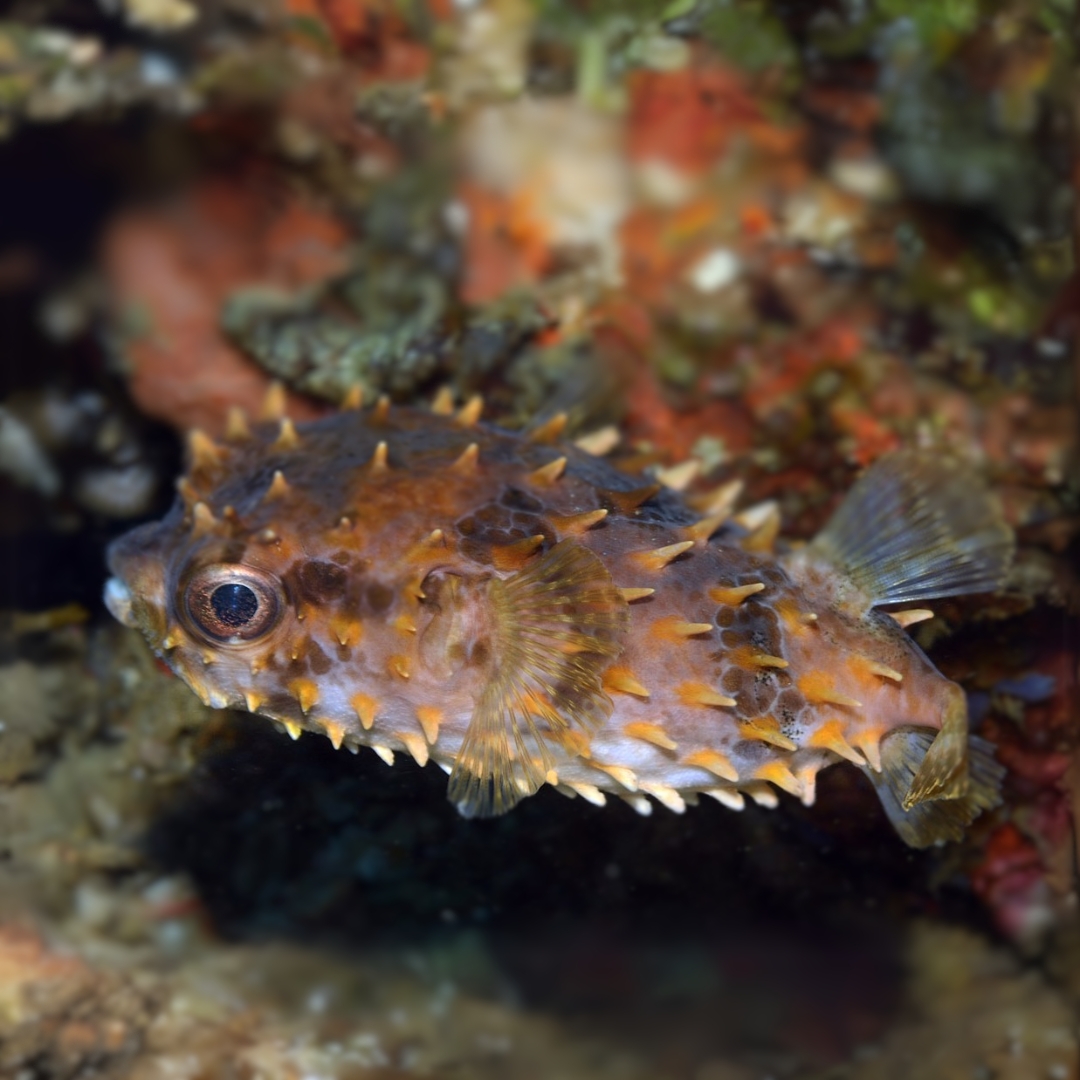
解説 / Description
メイタイシガキフグは、丸みを帯びた体と短く固定された棘、そしてつぶらな眼が印象的なハリセンボン科の海水魚です。見た目は愛嬌がありますが、自然界ではカニ、エビ、貝、ウニなどの硬い無脊椎動物を強力な嘴状の歯で砕く、底生環境のしっかりした捕食者です。観賞魚としては人に慣れやすく、餌をねだるように水槽前面へ寄ってくることもありますが、排泄量が多く、歯が伸び続ける性質もあるため、長期飼育には大型水槽、強いろ過、硬い餌を使った歯のケアが欠かせません。 The Birdbeak Burrfish is a marine porcupinefish relative known for its rounded body, short fixed spines, and expressive eyes. Although it looks charming, it is a capable benthic predator in nature, using strong beak-like dental plates to crush crabs, shrimp, mollusks, and sea urchins. In aquariums it often becomes personable and may approach the front glass for food, but long-term care requires a large marine system, strong filtration, and regular hard-shelled foods to help wear down its continuously growing teeth.
基本情報 / Basic Information
| 学名 / Scientific Name | Cyclichthys orbicularis |
|---|---|
| 通称 / Common Name | メイタイシガキフグ、バードビーク・バーフィッシュ、オービキュラー・バーフィッシュBirdbeak Burrfish, Orbicular Burrfish |
| 分類 / Family | フグ目 ハリセンボン科 メイタイシガキフグ属Order Tetraodontiformes, family Diodontidae, genus Cyclichthys |
| 英名 / English Name | Birdbeak Burrfish / Orbicular Burrfish |
| 分布 / Distribution | 紅海、東アフリカ沿岸、インド洋、西太平洋に広く分布し、日本南部、フィリピン、インドネシア、オーストラリア北部、ニューカレドニア周辺などで知られます。沿岸の砂泥底、瓦礫帯、海草藻場、サンゴ礁周辺に見られます。Widely distributed from the Red Sea and East African coast through the Indian Ocean to the western Pacific, including southern Japan, the Philippines, Indonesia, northern Australia, and New Caledonia. It occurs around sandy or muddy bottoms, rubble zones, seagrass beds, and reef-associated habitats. |
| 最大体長 / Max Size | 野生下では約30cm。観賞魚としては10cm前後で流通することが多く、飼育下では20cm前後まで成長する個体が一般的です。Up to about 30 cm in the wild. Aquarium specimens are often sold at around 10 cm and commonly reach about 20 cm in captivity. |
| 寿命 / Lifespan | 良好な環境では長寿で、10年前後生きる個体もいます。水質の安定、歯の管理、ストレスの少ない飼育が寿命を大きく左右します。It can be long-lived under good conditions, with some individuals living around 10 years. Stable water quality, dental care, and low-stress husbandry strongly influence longevity. |
飼育環境 / Aquarium Environment
| 水槽サイズ / Tank Size | 最低でも90cm規格水槽以上、できれば120cm規格水槽または120cmワイド水槽が望ましいです。肉食性で排泄量が多いため、水量を確保しやすく、プロテインスキマーを組み込みやすいオーバーフロー式が特に適しています。At least a standard 90 cm marine aquarium is recommended, with a standard or wide 120 cm aquarium preferred. Because this species is carnivorous and produces substantial waste, a sump-based overflow system with ample water volume and an efficient protein skimmer is especially suitable. |
|---|---|
| 水温 / Temperature | 24〜27℃を目安に安定させます。急な水温変化はストレスや海水白点病の誘因になりやすいため、ヒーターとクーラーを用いて日内変動を小さく保ちます。 Keep the temperature stable at about 24–27°C. Sudden temperature shifts can trigger stress and marine ich, so heaters and chillers should be used to minimize daily fluctuation. |
| 水質 / Water Quality | 比重1.020〜1.025、pH8.0〜8.4を目安にします。アンモニアと亜硝酸は検出されない状態を維持し、硝酸塩の蓄積を抑えるために強いろ過、定期的な換水、プロテインスキマーを組み合わせます。Aim for a specific gravity of 1.020–1.025 and pH 8.0–8.4. Ammonia and nitrite should remain undetectable, while nitrate accumulation should be controlled with strong filtration, regular water changes, and protein skimming. |
| レイアウト / Layout | 遊泳スペースを残しつつ、ライブロックで落ち着ける隠れ家を作ります。自然界では日中に岩陰や窪みに身を潜めることがあるため、暗がりや退避場所があると落ち着きやすくなります。サンゴや甲殻類、貝類は食害や薬剤管理の面から混在させない構成が無難です。Provide open swimming space along with live rock shelters where the fish can rest. In nature it often uses shaded spots or depressions during the day, so retreats help reduce stress. Corals, crustaceans, and mollusks are generally unsuitable because of predation risk and medication constraints. |
| 注意点 / Precautions | 強い歯でヒーター管、センサー、ポンプのコードを齧ることがあるため、ヒーターカバーや配線保護は必須です。また、驚かせて膨らませる行為は魚体に大きな負担をかけるため避けます。粘液や体内毒素のリスクも想定し、素手での不用意な接触や食用利用は絶対に避けてください。Its strong teeth may bite heater tubes, sensors, and pump cables, so heater guards and cable protection are essential. Do not intentionally frighten the fish to make it inflate, as inflation is physiologically stressful. Because mucus and tissues may carry toxin-related risks, avoid unnecessary bare-handed contact and never use this fish for food. |
餌と給餌 / Feeding
| 餌の種類 / Diet | アサリ、殻付きの冷凍エビ、イカの切り身、クリル、肉食魚用の人工飼料などを与えます。自然界では甲殻類、軟体動物、ウニなどの硬い無脊椎動物を食べるため、柔らかい餌だけに偏らせないことが大切です。Offer clams, shell-on frozen shrimp, squid pieces, krill, and carnivorous marine fish pellets. In nature it feeds on hard-shelled invertebrates such as crustaceans, mollusks, and sea urchins, so the diet should not consist only of soft foods. |
|---|---|
| 給餌のポイント / Feeding Tips | 1日1〜2回、食べ残しが出ない量を与えます。最大のポイントは歯の過長予防で、殻付きエビや殻付きアサリなどを定期的に噛ませ、伸び続ける歯板を自然に摩耗させます。人工飼料に餌付いていても、硬い餌を組み込む習慣を維持してください。Feed once or twice daily, only as much as the fish will consume cleanly. The key is preventing overgrown teeth: provide shell-on shrimp, clams, or similar hard foods regularly so the continuously growing dental plates are naturally worn down. Even pellet-trained individuals should receive hard foods as part of routine care. |
性格と混泳 / Temperament and Tank Mates
| 性格 / Temperament | 人に慣れやすく、飼育者を覚えて前面に出てくるような愛嬌があります。一方で、同種や似た体型の魚に対しては縄張り意識を示すことがあり、見た目に反して噛む力も強い魚です。It can become personable and may recognize its keeper, often coming to the front glass. However, it may show territorial behavior toward conspecifics or similarly shaped fish, and despite its cute appearance it has a very powerful bite. |
|---|---|
| 混泳の相性 / Compatibility | 基本的には単独飼育が最も安全です。混泳させる場合は、本種より小さい魚、エビ、カニ、貝類は捕食対象になります。大型ヤッコやハギ類など、ある程度大きく遊泳力のある海水魚が候補になりますが、個体差が大きいため慎重な観察が必要です。Single-specimen keeping is usually the safest approach. Smaller fish, shrimp, crabs, and snails may be eaten. Larger, active marine fish such as bigger angelfish or tangs may be possible tank mates, but compatibility varies by individual and requires close observation. |
病気と対策 / Diseases and Prevention
| かかりやすい病気 / Common Diseases | 導入直後や水温変化、輸送ストレスの後は海水白点病に注意します。擦れ傷、口先や棘の損傷、食欲不振、呼吸の荒さも状態悪化のサインです。鱗のある魚より薬剤に敏感な面があるため、治療は慎重に行います。Marine ich is a major concern after introduction, temperature swings, or transport stress. Abrasions, damage to the snout or spines, loss of appetite, and heavy breathing are also warning signs. Because this fish can be more sensitive to medications than scaled fish, treatment must be cautious. |
|---|---|
| 対策と予防 / Prevention | 購入時は痩せ、呼吸の荒さ、棘や口の傷を確認し、導入前に隔離観察を行うと安心です。白点病対策では水質と水温の安定、UV殺菌灯の活用、過密飼育の回避が有効です。銅イオン治療を行う場合は無脊椎動物やライブロックのない隔離水槽で、専用テスターを使い、濃度を急に上げないことが重要です。At purchase, check for emaciation, labored breathing, and damage to the spines or mouth, and quarantine observation is strongly recommended. Prevention centers on stable water quality and temperature, appropriate use of UV sterilization, and avoiding overcrowding. If copper treatment is used, it should be done only in a bare hospital tank without invertebrates or live rock, with copper test kits and gradual dosage control. |
増やし方(繁殖) / Breeding
| 雌雄の判別 / Sexing | 外見だけでの明確な雌雄判別は困難です。成熟個体の体形や行動に差が出る可能性はありますが、一般家庭の飼育環境で確実に見分ける方法は確立されていません。Reliable sexing by appearance alone is difficult. Mature individuals may show subtle differences in body shape or behavior, but no practical, dependable method is established for typical home aquariums. |
|---|---|
| 繁殖形態 / Reproduction | 分離浮性卵を産む海水魚です。親が卵を守るタイプではなく、卵は海中を漂いながら発生します。報告例では卵の直径は約2.2mmで、発生が非常に速く、産卵から約2日で孵化に至ったとされています。This species produces isolated floating pelagic eggs. The parents do not guard the eggs; instead, the eggs drift in the water column as they develop. In reported captive spawning, eggs were about 2.2 mm in diameter and hatched roughly two days after spawning. |
| 繁殖のポイント / Breeding Tips | 家庭水槽での繁殖は非常に難しい分野です。日本の水族館では飼育下での自然産卵と仔稚魚育成の研究成果が報告されており、孵化後の仔魚は極めて小さく、口や肛門が未発達な段階から繊細な初期飼育を必要とします。一般飼育では繁殖を目標にするより、健康な長期飼育を第一に考えるのが現実的です。Breeding in home aquariums is extremely difficult. A Japanese public aquarium has reported captive natural spawning and larval rearing research, but newly hatched larvae are tiny and require delicate early-stage care from a phase in which the mouth and anus are not yet functional. For most aquarists, long-term health should be the primary goal rather than breeding. |
雑学と豆知識 / Trivia and Fun Facts
| 1. 名前に重ねられた「丸い魚」という意味 / 1. A name that repeats the idea of a round fish | 学名のCyclichthysは、ギリシャ語で円や輪を意味する語と魚を意味する語から成り、種小名orbicularisもラテン語で円形を表します。つまりこの魚の学名は、まるで念を押すように「丸い、丸い魚」と語っているのです。膨らんだときの球体だけでなく、普段からどこかずんぐりとした体つきが、初期の研究者にも強く印象に残ったのでしょう。The genus name Cyclichthys comes from Greek roots meaning circle and fish, while the species name orbicularis also means circular in Latin. In effect, the scientific name emphasizes the idea of a round fish twice. It likely reflects not only the inflated form but also the naturally stout, rounded silhouette that impressed early naturalists. |
|---|---|
| 2. ハリセンボンとは違う「寝ない棘」 / 2. Fixed spines, unlike the classic porcupinefish | ハリセンボンの仲間というと、普段は寝ている長い棘が、体を膨らませたときに立ち上がる姿を思い浮かべがちです。しかしメイタイシガキフグ属の棘は短く、基本的に固定されたままです。頭部背面の棘には皮下に複数の根を張る構造があり、単なる飾りではなく、捕食者の顎に対抗する小さな装甲として機能します。この違いを知ると、水槽越しに見える一つ一つの棘が、進化の時間を背負った防具のように見えてきます。Many aquarists imagine porcupinefish spines lying flat until the fish inflates. In Cyclichthys, however, the spines are short and essentially fixed. The dorsal head spines have multiple subdermal roots, making them more than decorative projections: they form a compact armor against predators. Knowing this difference makes each visible spine look like a small piece of evolutionary equipment. |
| 3. 愛嬌のある顔と、油断できない歯 / 3. A charming face with serious teeth | メイタイシガキフグは大きな眼と丸い体で、飼育者から可愛いと言われやすい魚です。しかし口の中には上下1枚ずつの強い歯板があり、貝や甲殻類の殻を砕くために発達しています。Diodontidaeという科名も、2つの歯を意味する語に由来します。可愛らしさと破砕力が同居しているところに、この魚らしい魅力があります。With its large eyes and round body, this fish is often described as cute by keepers. Yet inside its small mouth are two strong dental plates, one above and one below, adapted for crushing shells and crustacean armor. The family name Diodontidae itself refers to two teeth. Much of this species’ appeal lies in that contrast between charm and crushing power. |
| 4. 毒を持たないと決めつけないこと / 4. Do not assume it is toxin-free | 観賞魚として長く人工飼料だけで育った個体では、食物連鎖を通じた毒素の蓄積が少ない可能性があります。しかし野生個体や輸入直後の個体について、無毒と断定するのは危険です。フグ類の毒は生息環境や餌生物に左右される面があり、皮膚の粘液や内臓に毒素が存在する可能性を想定して扱うべきです。観賞魚として楽しむ魚であり、食用にしてはいけません。Individuals kept long-term on non-toxic prepared foods may have reduced toxin accumulation, but it is unsafe to declare wild or newly imported specimens toxin-free. Puffer toxins can depend on habitat and food-chain exposure, and mucus or internal organs may still pose risks. This species should be enjoyed as an aquarium animal, never as food. |
| 5. 日本の水族館が明らかにした仔魚の姿 / 5. Larval secrets revealed by a Japanese aquarium | メイタイシガキフグの繁殖は長く謎の多い分野でしたが、日本の水族館で飼育下の自然産卵と仔稚魚育成に関する重要な研究が報告されています。孵化直後の仔魚はわずか数ミリで、体は水疱状の真皮嚢に包まれ、まだ成魚の面影はほとんどありません。やがて鰭の軟条が整い、棘が現れ、硬化していく過程は、あの丸く棘だらけの姿がどのように作られるのかを物語っています。Breeding biology of this species was long poorly known, but a Japanese aquarium reported important work on captive natural spawning and larval rearing. Newly hatched larvae are only a few millimeters long and are enclosed in a vesicular dermal sac, with little resemblance to the adult. As fin rays form and spines appear and harden, the young fish gradually reveals how the familiar spiny round body is built. |
まとめ / Conclusion
メイタイシガキフグは、可愛らしい見た目と人に慣れやすい性格で人気のある海水魚ですが、その本質は硬い殻を砕くための歯と、捕食者から身を守る固定棘を備えたたくましい底生捕食者です。長期飼育では、90cm規格水槽以上、できれば120cmクラスの水槽、安定した海水環境、強力なろ過、そして硬い餌による歯の摩耗管理が重要になります。 The Birdbeak Burrfish is popular for its charming appearance and keeper-responsive behavior, but at its core it is a robust benthic predator equipped with shell-crushing teeth and fixed defensive spines. Long-term care requires at least a standard 90 cm aquarium, preferably a 120 cm-class system, along with stable marine water quality, strong filtration, and hard foods for dental wear.
混泳や病気治療には慎重さが必要で、特に小型魚や甲殻類、貝類との同居は避けるべきです。また、毒性については無毒と決めつけず、食用利用を避け、メンテナンス時も不用意な接触を控える姿勢が大切です。正しい知識と設備で向き合えば、メイタイシガキフグは水槽の中で強い存在感と豊かな表情を見せてくれる、非常に魅力的な一匹になります。 Tank mates and disease treatment require caution, and small fish, crustaceans, and mollusks should generally be avoided. Its toxicity should not be dismissed, so it must never be used as food and should not be handled carelessly. With proper knowledge and equipment, this species can become a highly engaging aquarium resident with a remarkable presence and expressive behavior.
気になる道具や飼い方を見つけてみませんか?
 アイのアクアグッズ案内コリドラスのもふもふ時間を楽しむ|餌・底砂・お掃除用品の選び方コリドラスのもふもふする食事風景を楽しむために。沈む餌2種類の違い、口元に配慮した底砂、食べ残しを回収する道具を、アクアグッズナビゲーターのアイが紹介します。記事はコチラ →
 アイのアクアグッズ案内水草トリミングの道具とやり方|ハサミ・ピンセットを水草に合わせて選ぼう伸びすぎた水草は切っていい? 有茎草の差し戻し、前景草の絨毯、流木のモスを整える場面から、水草用ハサミ・ピンセット・ゴミ取りネットの選び方と片付けを紹介します。記事はコチラ →
 アイのアクアグッズ案内エーハイムはおもちゃから始まった? 小さな噴水から水槽へ、アイとコタロウの探訪道具の特徴や使い方、選ぶときのポイントをアイが紹介します。記事はコチラ →
 アイのアクアグッズ案内アフリカンシクリッドの飼育用品|水槽・ろ過・底砂・岩組み・餌の選び方道具の特徴や使い方、選ぶときのポイントをアイが紹介します。記事はコチラ →
さまざまな飼育テーマをご紹介。リンク先の記事には広告・商品紹介が含まれます。
案内・紹介記事一覧へ →参考文献・参照資料
この記事では、メイタイシガキフグの分類、分布、生息環境、形態、生態、繁殖、病気・安全上の注意を確認するため、店舗・通販サイト・個人ブログ・まとめサイトを除外し、学術データベース、公的機関、博物館系データベース、査読論文、専門書を中心に参照しました。
-
World Register of Marine Species. “Cyclichthys orbicularis (Bloch, 1785).”
分類、学名の有効性、原記載名、シノニム、海産種であること、和名・英名の確認に使用。
https://www.marinespecies.org/aphia.php?p=taxdetails&id=219968
“`
-
Froese, R. and Pauly, D. Editors. FishBase. “Cyclichthys orbicularis, Birdbeak burrfish.”
最大体長、分布、深度範囲、熱帯性海水魚であること、底質・リーフ環境、夜行性、硬い殻を持つ無脊椎動物を食べる生態の確認に使用。
https://www.fishbase.se/summary/Cyclichthys-orbicularis.html -
Bray, D. J. “Cyclichthys orbicularis.” Fishes of Australia, Museums Victoria / OzFishNet.
固定された棘、体色、オーストラリア周辺を含む分布、砂泥底・海綿・藻類のある保護的なリーフ環境、夜行性と食性の補強に使用。
https://fishesofaustralia.net.au/home/species/779 -
Leis, J. M. 2001. “Diodontidae. Porcupine fishes (burrfishes).” In Carpenter, K. E. and Niem, V. H. eds. The Living Marine Resources of the Western Central Pacific, Vol. 6. FAO Species Identification Guide for Fishery Purposes. FAO, Rome.
ハリセンボン科魚類の分類、形態、生息環境、分布域、食性を確認するための基礎資料として使用。 -
Matsuura, K. 2015. “Taxonomy and systematics of tetraodontiform fishes: a review focusing primarily on progress in the period from 1980 to 2014.” Ichthyological Research, 62, 72–113.
フグ目魚類の分類体系、ハリセンボン科を含む系統・分類上の位置づけを確認するための総説として使用。
https://doi.org/10.1007/s10228-014-0444-5 -
Doi, H., Ishibashi, T. and Sakai, H. 2015. “Spawning and rearing of a porcupine puffer Cyclichthys orbicularis (Diodontidae, Tetraodontiformes) in captivity.” Aquaculture Science, 63.
飼育下での産卵、卵径、孵化仔魚、初期発生、棘の形成過程など、繁殖セクションの根拠資料として使用。 -
Colorni, A. 1987. “Biology of Cryptocaryon irritans and strategies for its control.” Aquaculture, 67, 236–237.
海水白点病の原因生物であるCryptocaryon irritansの生活史と管理方針を確認するために使用。
https://doi.org/10.1016/0044-8486(87)90041-2 -
Noga, E. J. 2010. Fish Disease: Diagnosis and Treatment, 2nd ed. Wiley-Blackwell.
観賞魚・水産魚の疾病診断、寄生虫症、隔離治療、薬剤使用時の注意を整理するための専門書として使用。 -
Centers for Disease Control and Prevention / NIOSH. “Tetrodotoxin: Biotoxin.”
テトロドトキシンの毒性、神経・筋伝達への作用、摂食リスク、解毒剤がないことに関する安全上の注意の補強に使用。
https://www.cdc.gov/niosh/ershdb/emergencyresponsecard_29750019.html -
Randall, J. E., Allen, G. R. and Steene, R. C. 1990. Fishes of the Great Barrier Reef and Coral Sea. University of Hawaii Press.
インド・西太平洋域のリーフフィッシュとしての分布、生態、形態情報を補強するための専門図鑑資料として使用。
“`
注記:飼育条件は、上記の自然分布・生息水深・生息環境・食性・疾病資料をもとに、家庭水槽での安全側の管理値として整理しています。薬剤治療や食用可否に関わる判断は、獣医師・専門機関・各製品の指示を優先してください。




コメント