

解説 / Description
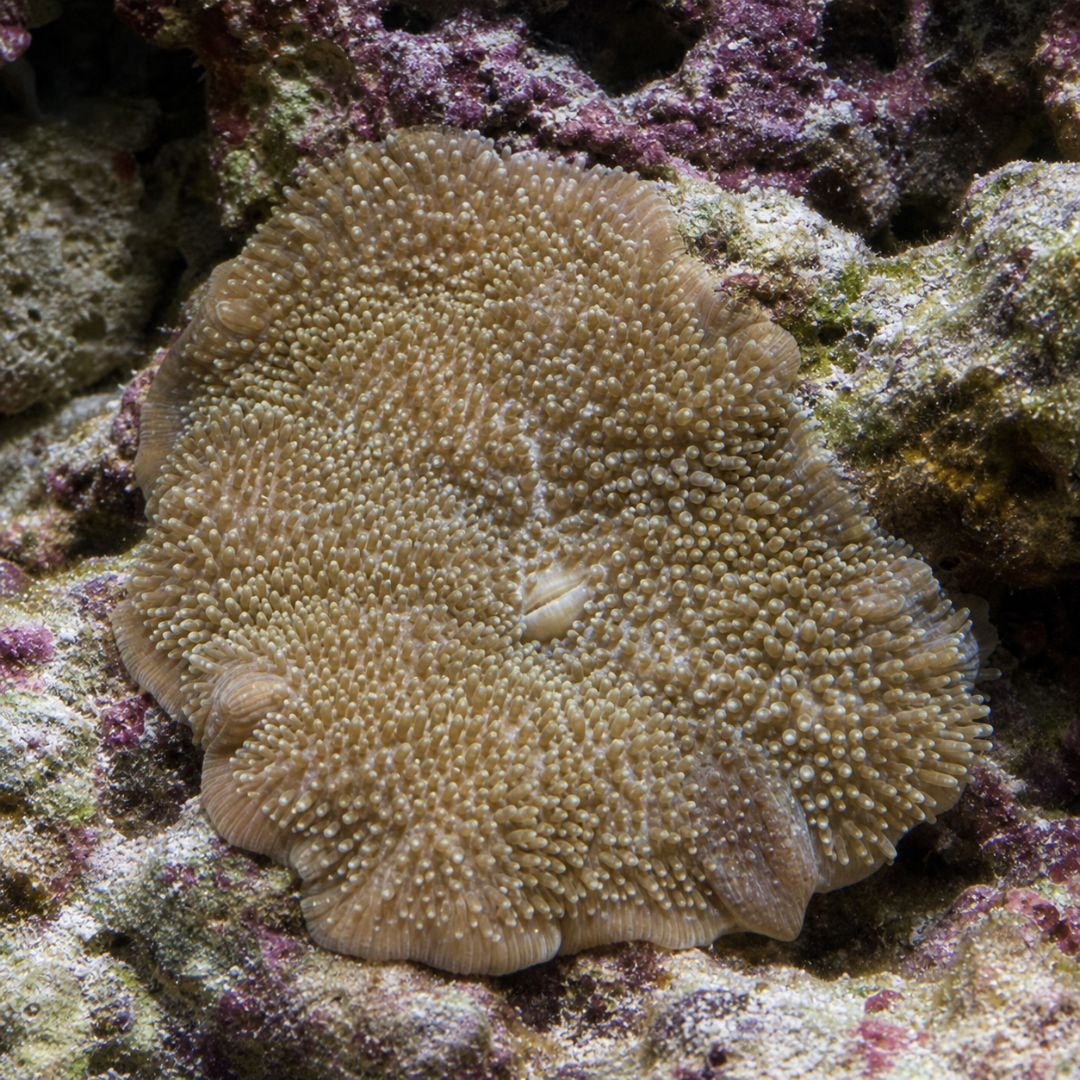
エレファントイヤーは、オオイソギンチャクモドキとも呼ばれる大型のイソギンチャクモドキです。真正のイソギンチャクでも、石灰質の骨格をつくる造礁サンゴでもなく、柔らかな円盤状の体を岩に広げて暮らします。成長した個体は口盤径が最大約45cmに達し、褐虫藻との共生による光合成に加えて、小魚や甲殻類を体盤ごと包み込んで捕食します。落ち着いた色彩と堂々とした姿は水槽内で強い存在感を放ちますが、その穏やかな外見からは想像しにくい捕食能力があるため、混泳相手と配置には十分な配慮が必要です。 The elephant ear corallimorph, also known as the giant cup mushroom coral, is a large corallimorpharian rather than a true sea anemone or a skeleton-building stony coral. It spreads a soft, disc-shaped body over rock and can reach about 45 cm across. In addition to receiving energy from symbiotic zooxanthellae, it can fold its entire oral disc around small fish and crustaceans. Its broad form creates a striking centerpiece, but its powerful feeding response makes careful placement and livestock selection essential.
基本情報 / Basic Information
| 学名 / Scientific Name | Amplexidiscus fenestrafer |
|---|---|
| 通称 / Common and English Names | エレファントイヤー、オオイソギンチャクモドキElephant Ear Anemone, Giant Cup Mushroom Coral, Giant Elephant Ear Mushroom |
| 分類 / Classification | 刺胞動物門・花虫綱・六放サンゴ亜綱・イソギンチャクモドキ目・ホネナシサンゴ科・オオイソギンチャクモドキ属Phylum Cnidaria, Class Anthozoa, Subclass Hexacorallia, Order Corallimorpharia, Family Discosomidae, Genus Amplexidiscus |
| 分布 / Distribution | インド太平洋の熱帯・亜熱帯海域。インドネシア、フィリピン、オーストラリア、マリアナ諸島、モルディブ、マダガスカル周辺などで記録され、水深およそ5〜25mの穏やかな礁湖、潮だまり、濁りのある浅海の岩礁域に見られます。Tropical and subtropical Indo-Pacific waters, including Indonesia, the Philippines, Australia, the Mariana Islands, the Maldives, and areas around Madagascar. It is recorded mainly at depths of about 5–25 m in calm lagoons, tide pools, and sheltered or turbid reef habitats. |
| 最大サイズ / Maximum Size | 口盤径は最大約45cm。イソギンチャクモドキ目の中でも最大級で、飼育下でも十分な空間があると30cmを超えることがあります。Up to about 45 cm across the oral disc. It is among the largest corallimorpharians and may exceed 30 cm in spacious aquaria. |
| 寿命 / Lifespan | 詳細な寿命は不明です。安定した環境では長期飼育が可能とされますが、個体差や飼育条件による影響が大きく、年数を一律に示せる資料は限られています。The precise lifespan is not well documented. Long-term maintenance is possible under stable conditions, but reliable species-wide longevity data are limited. |
飼育環境 / Aquarium Environment
| 水槽サイズ / Tank Size | 統一された最低水量の基準はありませんが、最大45cmに達すること、周囲に接触防止の空間が必要なことから、長期飼育では120cm規格水槽(約240L)以上を目安にすると管理しやすくなります。幼体でも将来の大型化を見越し、できれば専用水槽または広い低層スペースを確保してください。There is no universally established minimum volume. Because the animal may reach 45 cm and requires a broad safety zone, a 120 cm standard aquarium of roughly 240 L or larger is a practical long-term target. Even juveniles should be placed with their eventual size in mind, preferably in a dedicated system or an open lower section of a large reef tank. |
|---|---|
| 水温・比重 / Temperature and Specific Gravity | 水温22〜28℃、比重1.023〜1.026を目安にします。急変を避け、日内の水温変化はできるだけ小さく保ちます。蒸発による比重上昇を抑えるため、自動給水器があると安定しやすくなります。Maintain 22–28°C and a specific gravity of 1.023–1.026. Avoid abrupt changes and keep daily temperature fluctuation small. Automatic top-off is helpful for preventing salinity rises caused by evaporation. |
| 水質 / Water Quality | pH8.0〜8.4、アルカリ度8〜12dKH、カルシウム380〜450ppm、マグネシウム1250〜1350ppmが目安です。骨格を形成しないためSPSほどカルシウム消費に敏感ではありませんが、数値の安定は重要です。硝酸塩は1〜30ppm、リン酸塩は0.01〜0.05ppm程度の、栄養塩が完全には枯渇しない環境が適します。Suggested ranges are pH 8.0–8.4, alkalinity 8–12 dKH, calcium 380–450 ppm, and magnesium 1250–1350 ppm. Although it does not build a calcium carbonate skeleton, stability remains important. A moderately nutrient-available system, with nitrate around 1–30 ppm and phosphate around 0.01–0.05 ppm, is preferable to complete nutrient depletion. |
| 光量 / Lighting | 弱光〜中程度の光を好み、PAR50〜150程度が目安です。特に50〜100PARの穏やかな光で管理しやすく、水槽下部や岩陰に近い位置が向きます。導入直後は低い位置から始め、数週間かけて光に慣らしてください。強光下で縮む、白っぽくなる、口を開き続ける場合は光量を見直します。Low to moderate light is preferred, with approximately 50–150 PAR as a working range. Many specimens are easiest to maintain around 50–100 PAR in the lower aquarium or near partial shade. Begin new specimens in subdued light and acclimate gradually over several weeks. Persistent shrinking, paling, or a gaping mouth under strong light suggests that intensity should be reduced. |
| 水流 / Water Flow | 極めて弱い、穏やかな間接水流が適します。体盤が軽く揺れる程度を目安にし、ポンプの直線的な水流を当てないでください。強い水流は体盤のめくれ、足盤の剥離、漂流を招きます。Use very gentle, indirect flow, just enough to move the disc slightly. Do not aim a pump directly at the animal. Strong flow can lift the disc, detach the foot, or send the specimen drifting through the aquarium. |
| レイアウト・配置 / Layout and Placement | 底層の安定した独立岩や、周囲に広い空間を確保できる場所に配置します。岩へ自然に足盤を定着させ、移動や膨張を妨げないようにしてください。成長後の体盤が他のサンゴを覆わないよう、最初から十分な余白を設けます。Place it on a stable isolated rock in the lower aquarium with ample open space. Allow the foot to attach naturally and avoid constraining expansion or movement. Leave enough clearance from the beginning so that the enlarged disc cannot shade or contact neighboring corals. |
| 注意点 / Precautions | 水合わせは時間をかけ、温度、比重、光、水流の急変を避けます。剥がれた個体が水流ポンプへ吸い込まれると、組織損傷と水質悪化を招くため、ポンプにはガードやスポンジを装着してください。小魚、エビ、カニなどを捕食する可能性があり、クマノミがイソギンチャクと誤認して接触すると包み込まれる危険があります。Acclimate slowly and avoid sudden changes in temperature, salinity, light, or flow. A detached specimen can be drawn into a circulation pump, causing severe tissue damage and rapid water-quality deterioration, so fit pump guards or protective foam. Small fish, shrimp, and crabs may be eaten, and clownfish that mistake it for a host anemone can be enveloped. |
餌と給餌 / Feeding
| 栄養の得方・餌 / Nutrition and Diet | 体内の褐虫藻による光合成、水中の溶存栄養、有機懸濁物、動物性の餌から栄養を得る混合栄養性です。給餌にはイサザアミ、ブラインシュリンプ、細かく刻んだアサリやエビ、海水魚用の小さな肉質フード、サンゴ用微粒子フードなどが使えます。水槽内では小魚や観賞用エビも獲物になり得ます。It is mixotrophic, receiving nutrition from symbiotic zooxanthellae, dissolved and suspended organic matter, and captured animal prey. Suitable foods include mysid shrimp, brine shrimp, finely chopped clam or shrimp, small marine meaty foods, and fine coral foods. Small aquarium fish and ornamental shrimp may also become prey. |
|---|---|
| 給餌のポイント / Feeding Tips | 健康維持だけなら必須ではありませんが、月1回〜週1回程度の少量給餌で成長と肉厚の維持を助けられます。餌は口盤中央付近へそっと置き、必要に応じて数分だけ水流を弱めます。大きすぎる餌や過剰給餌は消化不良と水質悪化の原因になるため、食べ切れる量にとどめ、残餌は取り除きます。反応が極端に鈍い場合は、給餌を増やす前に水質、光、水流、足盤の状態を確認してください。Target feeding is not essential for basic survival, but a small meal from monthly to weekly can support growth and tissue condition. Place food gently near the center of the oral disc and reduce flow for a few minutes if necessary. Oversized food and overfeeding can lead to poor digestion and declining water quality, so offer only what can be consumed and remove leftovers. A weak feeding response should prompt a check of water quality, light, flow, and attachment before increasing food. |
性質と相性 / Characteristics and Compatibility
| 形態・成長 / Form and Growth | 石灰質の骨格を持たない単体性のポリプで、肉厚の円盤状体盤を広げます。通常は岩に足盤を定着させますが、光や水流、接触などが合わないと移動または剥離することがあります。状態が良いと成長は比較的速く、自然分裂や足盤裂断によって複数個体になる場合があります。It is a solitary, skeleton-free polyp with a thick, broad oral disc. The foot usually attaches to rock, but the animal may move or detach when light, flow, or neighboring contact is unsuitable. Growth can be relatively rapid under favorable conditions, and natural fission or pedal laceration may produce additional individuals. |
|---|---|
| 攻撃性 / Aggression | 接触した他のサンゴへ強い組織障害を与えることがあり、体盤による被覆と遮光も問題になります。さらに、口盤上の獲物を数秒で包み込む捕食性を持ちます。周囲には成長後の直径を見込んだ広い間隔を設け、SPS、LPS、ソフトコーラルのいずれとも直接触れさせないでください。It can cause serious tissue damage to neighboring corals, while its broad disc may also smother and shade them. It is additionally capable of enveloping prey within seconds. Provide a wide clearance based on its adult diameter and prevent direct contact with stony corals, soft corals, and other cnidarians. |
| 相性 / Compatibility | 小型魚、底生魚、クマノミ、エビや小型カニとの混泳には高い捕食リスクがあります。特に夜間、弱った個体、餌を探して口盤に乗る生体は危険です。他のサンゴとは隔離し、専用水槽が最も安全です。大型魚でも体盤をつつく種類や、エレファントイヤーを傷つける生体とは組み合わせないでください。There is a substantial predation risk for small fish, bottom-dwelling fish, clownfish, shrimp, and small crabs, especially at night or when an animal rests or searches for food on the disc. Isolation from other corals and a dedicated aquarium are the safest choices. Even large fish are unsuitable if they nip or damage the corallimorph. |
病気と対策 / Diseases and Prevention
| 不調・病気・害虫 / Problems, Diseases, and Pests | 強光、急激な水温変化、水質悪化による白化や色落ち、強い水流による縮みや剥離、細菌感染や損傷後の組織溶解が主なトラブルです。褐色のゼリー状物を伴って組織が崩れる場合は進行が速いことがあります。ヒラムシやウミウシ類が体表や足盤を食害する可能性もあります。Common problems include bleaching or color loss from excessive light, temperature swings, or poor water quality; shrinking or detachment from strong flow; and rapidly progressing tissue decay after injury or bacterial infection. Brown, jelly-like material accompanying tissue breakdown can indicate a serious condition. Flatworms and nudibranchs may also damage the disc or foot. |
|---|---|
| 対策と予防 / Prevention | 新規個体は隔離して観察し、必要に応じて対象生体に適合する市販のサンゴ用ディップ剤を製品説明どおりに使用します。白化時は光を弱め、水温と水質を安定させます。溶解が始まった個体は早めに隔離し、健全部まで進行する場合は清潔な器具で患部を切除します。薬浴や切除後は弱光・弱水流で養生し、ディップ剤を本水槽へ混入させないでください。Quarantine and observe new specimens, and when appropriate use a commercial coral dip that is compatible with corallimorpharians, strictly following the product instructions. For bleaching, reduce light and stabilize temperature and water chemistry. Isolate specimens showing tissue decay; if deterioration advances, remove affected tissue with sterile tools. After dipping or surgery, recover the specimen under low light and gentle flow, and never introduce dip solution into the display aquarium. |
増やし方(繁殖・株分け) / Reproduction and Propagation
| 無性生殖・株分け / Asexual Reproduction and Fragmentation | 自然には、口を中心に体盤が二つへ分かれる分裂と、移動時に岩へ残した足盤片から新個体が育つ足盤裂断で増殖します。人為的なフラグ化では、健康な親株を清潔で鋭利なメスやカミソリで切り分けます。資料上は各片に口の組織を含める方法が、再生を安定させる手順として示されています。Natural asexual reproduction occurs through fission across the oral disc and through pedal laceration, in which tissue left behind during movement develops into a new individual. For deliberate fragmentation, a healthy parent is divided with a clean, sharp scalpel or razor. Including part of the mouth in each fragment is described as the more reliable approach for regeneration. |
|---|---|
| 有性生殖 / Sexual Reproduction | 有性生殖として産卵することは知られていますが、雌雄の詳細、放卵放精の時期、幼生の育成条件など、飼育下で再現できる実用的な情報は十分に整理されていません。一般的な家庭水槽では、無性生殖やフラグ化が現実的な増殖方法です。Spawning is known to occur, but practical information on sex, timing, fertilization, larval development, and reliable captive rearing is insufficient. In home aquaria, asexual reproduction and fragmentation are the realistic propagation methods. |
| 増殖のポイント / Propagation Tips | 前日は給餌を控え、消毒した器具、手袋、保護眼鏡、隔離容器を準備します。空気中への露出を短くし、切断後は大量の粘液を飼育水とは別の容器で洗い流します。瞬間接着剤では固定しにくいため、サンゴ砂や小石を敷いた弱水流の隔離ケースへ置き、自然に活着させます。回復中はPAR50〜100程度の弱光と弱水流で1〜2週間を目安に観察し、組織が閉じてから徐々に通常環境へ戻します。Withhold food the day before and prepare disinfected tools, gloves, eye protection, and a separate recovery container. Keep air exposure brief and rinse heavy mucus in discarded aquarium water rather than in the display. Cyanoacrylate often adheres poorly to the slimy tissue, so place fragments in a low-flow box containing coral rubble or coarse substrate and allow natural attachment. Recover them for roughly one to two weeks under 50–100 PAR and gentle flow, then gradually return them to normal conditions after the cut edges have closed. |
毒性と取り扱い / Toxicity and Handling
| 毒性 / Toxicity | 獲物を閉じ込めた後に分泌される粘液や消化器官付近の刺胞には、魚類や小型無脊椎動物へ作用する生理活性物質が含まれると考えられています。人への毒性の程度を一律に示す情報は限られますが、粘液や体液が目、口、傷口へ入ると痛み、炎症、アレルギー反応を起こす可能性があります。パリトキシンそのものを持つ生体として扱う根拠は示されていませんが、接触曝露は避けてください。Mucus released during feeding and nematocysts near the digestive tissues are considered to contain bioactive substances that affect fish and small invertebrates. The severity of human toxicity is not fully characterized, but contact with the eyes, mouth, or broken skin may cause pain, inflammation, or an allergic reaction. It should not be presented as a confirmed palytoxin-bearing animal, but direct exposure to mucus and body fluids should still be avoided. |
|---|---|
| 取り扱い上の注意 / Handling Precautions | 移動、清掃、株分けでは厚手の耐水手袋と保護眼鏡を着用し、顔を近づけないでください。傷のある手では触れず、作業後は器具と手を石けんで十分に洗います。噴き出した体液や切断時の粘液が目に入った場合は、こすらず大量の清浄な水で洗い流し、強い痛み、腫れ、息苦しさなどがあれば速やかに医療機関へ相談してください。使用した海水や薬液は本水槽へ戻しません。Wear heavy waterproof gloves and protective eyewear when moving, cleaning around, or fragmenting the animal, and keep your face away from it. Do not handle it with cuts on your hands, and wash tools and skin thoroughly with soap afterward. If expelled fluid or mucus enters the eyes, rinse immediately with plenty of clean water without rubbing. Seek medical care promptly for severe pain, swelling, breathing difficulty, or other significant symptoms. Never return used rinse water or dip solution to the aquarium. |
雑学と豆知識 / Trivia and Fun Facts
| 名前に刻まれた「包む円盤」と「窓」 / A Name Describing an Enfolding Disc and a Window | 属名Amplexidiscusは「包み込む円盤」という意味に結び付けられ、獲物を体盤で袋状に閉じ込める習性をよく表しています。種小名fenestraferは「窓を持つもの」を意味し、口盤の周縁近くに見られる、触手が少なく半透明に見える帯状部分に由来します。この無触手帯は、よく似たディスクコーラル類を見分ける重要な手掛かりです。The genus name Amplexidiscus is associated with the idea of an “enfolding disc,” an apt reference to the animal’s ability to close around prey like a living bag. The specific name fenestrafer means “window-bearing” and refers to a smoother, partly translucent band near the edge of the oral disc. This tentacle-free zone is an important feature for distinguishing it from similar mushroom corals. |
|---|---|
| わずか数秒で完成する捕食の袋 / A Feeding Pouch Formed in Seconds | 獲物が中央付近へ触れると、口盤中央が引き下げられ、縁が持ち上がり、最後に環状の筋肉が巾着袋のように閉じます。この一連の変形は3秒以内に完了すると報告され、最大約4Lの海水とともに獲物を閉じ込めます。最初から口で丸のみするのではなく、先に逃げ場のない空間をつくってから中央の口を開く点が、この生物ならではの巧妙さです。When prey touches the central disc, the middle is pulled downward, the rim rises, and circular muscles close the animal like a drawstring pouch. This transformation has been reported to finish in under three seconds, trapping prey together with as much as about four liters of seawater. Rather than swallowing immediately, it first creates an escape-proof chamber and only then opens the central mouth. |
| 骨格を持たないサンゴの進化 / The Evolution of a Skeleton-Free Coral Relative | イソギンチャクモドキ目は、石灰質の骨格がない一方で、体内構造の多くが造礁サンゴに似ています。分子系統学では、造礁サンゴとの近い関係を示す結果が得られ、「裸のサンゴ」と呼ばれる進化仮説が議論されてきました。エレファントイヤーの柔らかな巨大体盤は、骨格をつくらない系統がどのように別の生存戦略を発達させたのかを想像させます。Corallimorpharians lack a calcareous skeleton, yet many aspects of their internal anatomy resemble those of stony corals. Molecular studies have supported a close evolutionary relationship, contributing to the debated “naked coral” hypothesis. The huge, soft disc of Amplexidiscus offers a vivid example of how a skeleton-free lineage may invest in other survival strategies. |
| 体表に溶け込む小さな共生者 / A Tiny Associate Hidden in Plain Sight | 野生個体の体盤上では、カクレエビの一種Pliopontonia furtivaが見つかることがあります。エビは宿主の色や模様に溶け込むように擬態し、広い体盤を外敵から身を守る場所として利用します。小さなエビが巨大な捕食者の上で暮らす姿は、サンゴ礁の生物関係が単純な食う・食われるだけではないことを物語ります。A small shrimp, Pliopontonia furtiva, has been observed living on wild elephant ear corallimorphs. Its coloration blends into the host, allowing it to use the broad disc as shelter from predators. A tiny shrimp living on a formidable ambush predator is a reminder that reef relationships extend far beyond simple predator-and-prey roles. |
| クマノミにとっては安全な宿主ではない / Not a Safe Host for Clownfish | 外見がイソギンチャクに似ているため、クマノミが体を擦り付けようとすることがあります。しかし、エレファントイヤーはクマノミを守る宿主ではありません。口盤へ乗ったクマノミを獲物として包み込むことがあるため、「似ているから相性がよい」と判断しないことが大切です。Because it resembles a sea anemone, a clownfish may attempt to rub against it. The elephant ear is not a protective host, however, and may envelop the clownfish as prey. Visual similarity should never be taken as evidence of compatibility. |
まとめ / Conclusion
エレファントイヤーは、柔らかな巨大体盤、穏やかな色合い、そして数秒で獲物を包み込む捕食行動を併せ持つ、非常に個性的なイソギンチャクモドキです。飼育の要点は、弱光から中程度の光、極めて穏やかな間接水流、栄養塩を枯渇させない安定した水質、そして成長後を見越した広い空間です。小魚や甲殻類を守るため、混泳を安易に考えず、他のサンゴとも十分に隔離する必要があります。 The elephant ear corallimorph combines a massive soft disc, subdued coloration, and the remarkable ability to envelop prey within seconds. Successful care depends on low to moderate light, extremely gentle indirect flow, stable water with detectable nutrients, and generous space for adult growth. Its predatory nature demands conservative livestock choices and clear separation from neighboring corals.
環境が合うと、ゆっくり体盤を広げ、給餌時には生きた巾着のように姿を変え、時には分裂や足盤裂断によって新しい個体を残します。強健さだけを頼りにせず、その捕食性と大きさを理解して向き合うことで、水槽の中にサンゴ礁の不思議な一面を長く感じさせてくれる存在になります。 When conditions are suitable, it expands steadily, transforms into a living pouch at feeding time, and may eventually reproduce by fission or pedal laceration. By respecting its size and predatory behavior rather than relying only on its hardiness, the aquarist can enjoy one of the reef’s most unusual life forms for years.

気になる道具や飼い方を見つけてみませんか?
 アイのアクアグッズ案内コケを食べるコイの仲間に合わせる飼育用品|フライングフォックス・アルジイーター・ガラ道具の特徴や使い方、選ぶときのポイントをアイが紹介します。記事はコチラ →
 アイのアクアグッズ案内ダニオの仲間に合わせる飼育用品|ゼブラダニオから超小型種まで水槽・ろ過・餌を選ぶ道具の特徴や使い方、選ぶときのポイントをアイが紹介します。記事はコチラ →
 アイのアクアグッズ案内テトラミンって、こんなにあるの? アイとコタロウのごはん探究旅道具の特徴や使い方、選ぶときのポイントをアイが紹介します。記事はコチラ →
 アイのアクアグッズ案内エーハイムはおもちゃから始まった? 小さな噴水から水槽へ、アイとコタロウの探訪道具の特徴や使い方、選ぶときのポイントをアイが紹介します。記事はコチラ →
さまざまな飼育テーマをご紹介。リンク先の記事には広告・商品紹介が含まれます。
案内・紹介記事一覧へ →分布マップ
エレファントイヤー(Amplexidiscus fenestrafer)は、インドネシア、フィリピン、オーストラリア、マリアナ諸島、モルディブ、マダガスカル周辺を含む、熱帯・亜熱帯のインド太平洋に広く分布します。色付き範囲は記事の記述をもとにした概略で、マーカーは分布域を見渡すための代表地点です。
この地図は分布記述を視覚化した概略表示です。色付き範囲と代表マーカーは、実際の採集地点、個体の確認地点、厳密な生息範囲、連続した分布を示すものではありません。
参考文献
エレファントイヤーの分類・生態に関する資料と、関連する飼育管理の参考資料です。
分類・系統関係
-
World Register of Marine Species(WoRMS).
Amplexidiscus fenestrafer Dunn & Hamner, 1980.
WoRMSの本種の分類情報 -
Lin, M.-F. et al. (2016).
Corallimorpharians are not “naked corals”: insights into relationships between Scleractinia and Corallimorpharia from phylogenomic analyses.
PeerJ, 4, e2463.
ホネナシサンゴ類全体の系統関係を扱う資料です。
https://doi.org/10.7717/peerj.2463
本種の形態・生息環境・捕食行動
- Dunn, D. F. & Hamner, W. M. (1980). Amplexidiscus fenestrafer n. gen., n. sp. (Coelenterata: Anthozoa), a Tropical Indo-Pacific Corallimorpharian. Micronesica, 16(1), 29–36.
本種の原記載。形態、最大口盤径、生息環境、採集記録を扱う資料です。
グアム大学公開PDF - Hamner, W. M. & Dunn, D. F. (1980). Tropical Corallimorpharia (Coelenterata: Anthozoa): Feeding by Envelopment. Micronesica, 16(1), 37–41.
本種を含むホネナシサンゴ類の包み込み捕食を記録した研究。本種による魚・甲殻類の捕食や、水槽内でのクマノミの捕食例を扱います。
グアム大学公開PDF
以下は、ホネナシサンゴ類・近縁種や一般的なサンゴ飼育を扱う関連資料です。本種を対象とした研究とは区別して参照してください。安全資料にはスナギンチャク類など別群の報告も含み、本種の毒性を直接示すものではありません。
分布・生息環境・生理生態
-
Oh, R. M., Neo, M. L., Yap, N. W. L., Jain, S. S., Tan, R., Chen, C. A. & Huang, D. (2019).
Citizen science meets integrated taxonomy to uncover the diversity and distribution of Corallimorpharia in Singapore.
Raffles Bulletin of Zoology, 67, 306–321.
https://doi.org/10.26107/RBZ-2019-0022 -
Kuguru, B., Chadwick, N. E., Achituv, Y., Zandbank, K. & Tchernov, D. (2008).
Mechanisms of habitat segregation between corallimorpharians: photosynthetic parameters and Symbiodinium types.
Marine Ecology Progress Series, 369, 115–129.
https://doi.org/10.3354/meps07651 -
Kuguru, B., Winters, G., Beer, S., Santos, S. R. & Chadwick, N. E. (2007).
Adaptation strategies of the corallimorpharian Rhodactis rhodostoma to irradiance and temperature.
Marine Biology, 151, 1287–1298.
https://doi.org/10.1007/s00227-006-0589-5
飼育管理・繁殖・他種との関係
-
Langmead, O. & Chadwick-Furman, N. E. (1999).
Marginal tentacles of the corallimorpharian Rhodactis rhodostoma. 2. Induced development and long-term effects on coral competitors.
Marine Biology, 134, 491–500.
https://doi.org/10.1007/s002270050565 -
Leewis, R. J. & Janse, M.(eds.)(2008).
Advances in Coral Husbandry in Public Aquariums.
Public Aquarium Husbandry Series, Volume 2. Burgers’ Zoo.
ISBN 978-90-813805-1-5.
書誌情報 -
Leal, M. C., Ferrier-Pagès, C., Petersen, D. & Osinga, R. (2016).
Coral aquaculture: applying scientific knowledge to ex situ production.
Reviews in Aquaculture, 8(2), 136–153.
https://doi.org/10.1111/raq.12087 -
Chen, C.-L. A., Chen, C.-P. & Chen, I.-M. (1995).
Sexual and asexual reproduction of the tropical corallimorpharian Rhodactis (= Discosoma) indosinensis (Cnidaria: Corallimorpharia) in Taiwan.
Zoological Studies, 34(1), 29–40.
論文PDF
病気・害虫・安全な取り扱い
-
Institut Océanographique de Monaco / European Union of Aquarium Curators (2026).
Coral Pathology: Identification and Management in Aquaria.
専門ハンドブックPDF -
Sweet, M., Craggs, J., Robson, J. & Bythell, J. (2013).
Assessment of the microbial communities associated with white syndrome and brown jelly syndrome in aquarium corals.
Journal of Zoo and Aquarium Research, 1(1), 20–27.
https://doi.org/10.19227/jzar.v1i1.21 -
Maggioni, G. et al. (2022).
The association of Waminoa with reef corals in Singapore and its impact on putative immune- and stress-response genes.
Diversity, 14(4), 300.
https://doi.org/10.3390/d14040300 -
Hamade, A. K. et al. / U.S. Centers for Disease Control and Prevention (2015).
Suspected Palytoxin Inhalation Exposures Associated with Zoanthid Corals in Aquarium Shops and Homes — Alaska, 2012–2014.
MMWR, 64(31), 852–855.
CDC報告 -
Government of South Australia, SA Health.
Coral handling safety tips for aquarium owners.
安全資料PDF




コメント