

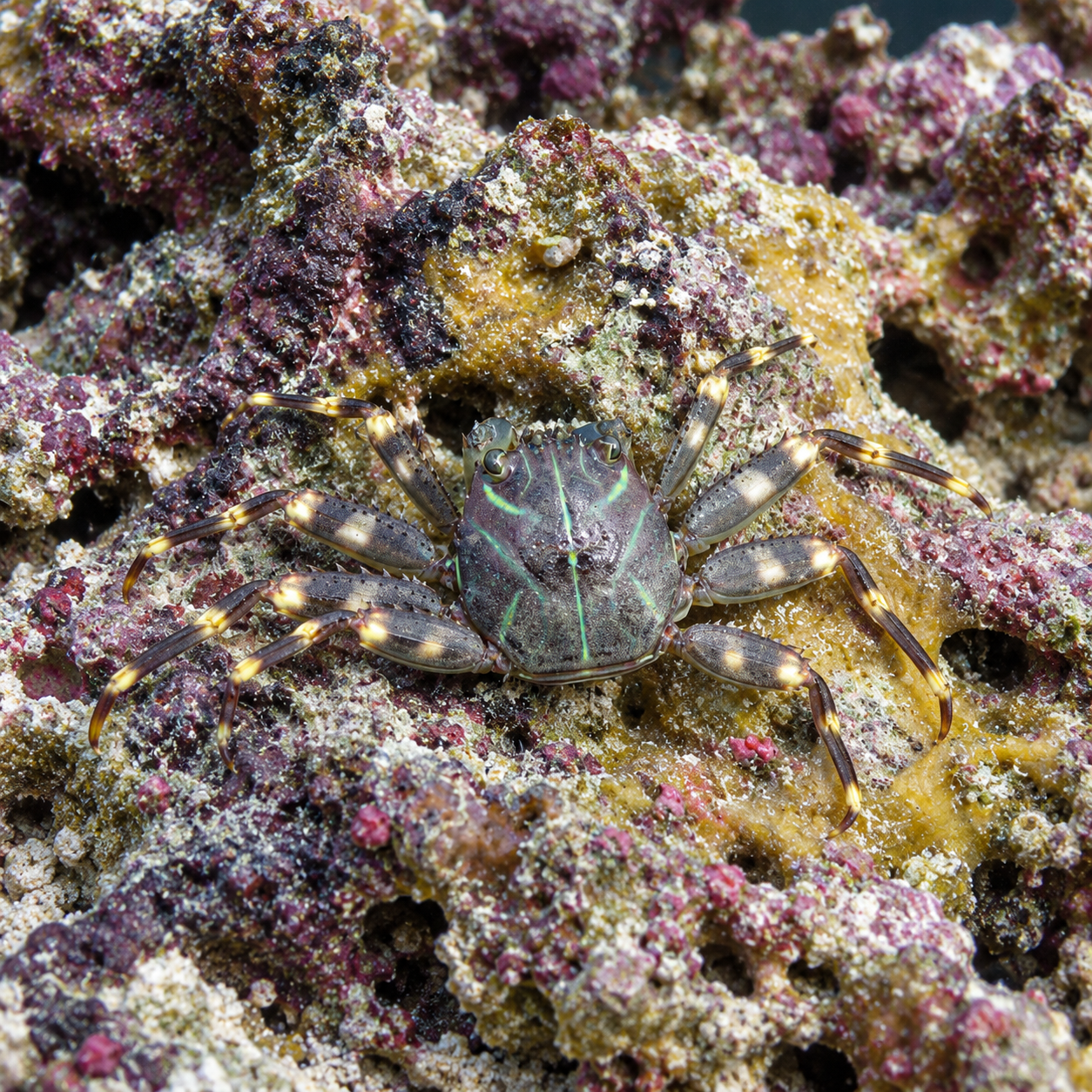
解説 / Description
トゲアシガニは、インド洋から太平洋にかけて広く分布する海産のカニです。甲は上下に薄く扁平で、細長い歩脚には棘が並びます。岩の表面を非常に素早く移動し、驚くと狭い隙間へ滑り込むように身を隠します。こうした体型と行動は、波の影響を受ける潮間帯や浅い岩礁で暮らす本種の生活によく適しています。 Percnon planissimum is a marine crab widely distributed throughout the Indo-Pacific. Its carapace is thin and strongly flattened, and its long walking legs bear numerous spines. It moves exceptionally quickly across rocky surfaces and can slip into narrow crevices almost instantly when disturbed. These features are well suited to life in intertidal and shallow rocky habitats exposed to moving water.
アクアリウムでは、ライブロックなどに生える藻類をついばむコケ取り生体として扱われています。ただし、藻類だけを食べる完全な草食性ではなく、飼育下では残餌や動物質の餌も口にします。小型の無脊椎動物などへの干渉がみられる可能性もあるため、サンゴ水槽を含む混泳環境では個体の行動を観察しながら飼育することが大切です。また、甲殻類であるため、急激な比重変化や銅を含む魚病薬にも注意が必要です。 In aquariums, this crab is commonly kept as a cleanup animal that grazes algae from live rock and other surfaces. It is not, however, a strict herbivore and may also consume leftover food and animal-based foods in captivity. Because some individuals may interfere with small invertebrates or other vulnerable tank inhabitants, their behavior should be monitored carefully in community and reef aquariums. As a crustacean, the species also requires care with sudden salinity changes and copper-based medications.
基本情報 / Basic Information
| 学名 / Scientific Name | Percnon planissimum (Herbst, 1804) |
|---|---|
| 通称 / Common Name | トゲアシガニFlat rock crab |
| 分類 / Family | 節足動物門・軟甲綱・十脚目・短尾下目・イワガニ上科・トゲアシガニ科・トゲアシガニ属Phylum Arthropoda, Class Malacostraca, Order Decapoda, Infraorder Brachyura, Superfamily Grapsoidea, Family Percnidae, Genus Percnon |
| 英名 / English Name | Flat rock crab |
| 分布 / Distribution | インド洋から西太平洋を中心とするインド・太平洋域に広く分布します。日本では房総半島以南の太平洋岸から南西諸島など、温暖な沿岸の岩礁域で知られています。Widely distributed through the Indo-Pacific, particularly the Indian Ocean and western Pacific. In Japan, it is known mainly from warm rocky coasts from the Boso Peninsula southward to the Nansei Islands. |
| 最大体長 / Max Size | 甲幅はおよそ4cmになるカニです。細長い脚を大きく広げるため、実際の甲幅よりも大きく見えます。The carapace reaches roughly 4 cm in width. Its long legs spread well beyond the carapace, making the animal appear considerably larger. |
| 寿命 / Lifespan | 飼育下での標準的な寿命を示す明確な情報はありません。A well-established standard lifespan in captivity is not available. |
飼育環境 / Aquarium Environment
| 水槽サイズ / Tank Size | 100L前後以上をひとつの目安とし、日本の規格水槽では60cmワイド水槽から75〜90cmクラスの水槽が扱いやすいでしょう。非常に活動的なため、水量だけでなく、ライブロックの周囲を移動できる底面積と隠れ場所を確保することが重要です。Around 100 L or more can be used as a practical guideline. In Japanese standard tank sizes, a 60 cm wide tank or a tank in the 75–90 cm class provides more usable space. Because this is a very active crab, accessible rocky surfaces and hiding places are as important as total water volume. |
|---|---|
| 水温 / Temperature | 飼育では22〜26℃程度を目安に、急激に変化させないよう安定させます。 For aquarium care, approximately 22–26°C is a practical target, with stability more important than rapid changes. |
| 水質 / Water Quality | 一般的な海水水槽と同様に、比重1.023〜1.025、pH8.1〜8.4程度を目安とし、アンモニアと亜硝酸が検出されない安定した環境を維持します。甲殻類は急激な浸透圧変化の影響を受けやすいため、蒸発分の足し水などを適切に行い、比重を急変させないことが重要です。As in a typical marine aquarium, a specific gravity of about 1.023–1.025 and a pH around 8.1–8.4 provide practical targets, while ammonia and nitrite should remain undetectable. Crustaceans can be sensitive to sudden osmotic changes, so evaporated water should be replaced appropriately to prevent rapid shifts in salinity. |
| レイアウト / Layout | ライブロックを組み、身体を隠せる亀裂や岩陰を複数用意します。本種は自然下では波の影響を受ける岩礁域にも生息するため、水槽内でも十分な水の動きを確保します。ただし、脱皮直後は外骨格が柔らかく無防備になるため、強い水流から逃れられ、他の生体にも干渉されにくい隠れ場所が必要です。Arrange live rock to provide several crevices and sheltered spaces where the crab can hide completely. The species occurs naturally on rocky shores exposed to moving water, so good circulation is appropriate. Recently molted individuals, however, have a soft exoskeleton and should also have access to protected areas away from strong flow and other animals. |
| 注意点 / Precautions | 導入時は水温や比重の差を小さくするため、時間をかけて水合わせを行います。また、銅を含む魚病薬は甲殻類に有害なため、本種を収容している水槽では使用しないでください。脱皮後はしばらく岩陰に隠れることがあり、抜け殻を死骸と見間違えることもあります。頻繁に姿を探して岩組みを動かすと負担になるため、脱皮前後は特に静かに観察します。New specimens should be acclimated gradually to minimize differences in temperature and salinity. Copper-based fish medications are harmful to crustaceans and should not be used in a tank containing this crab. Recently molted animals may remain hidden for a while, and an empty exoskeleton can easily be mistaken for a dead crab. Avoid repeatedly disturbing rockwork simply to locate a hidden animal. |
餌と給餌 / Feeding
| 餌の種類 / Diet | 藻類をよく食べる雑食性で、水槽内ではライブロックなどの表面に生える糸状藻や付着藻類、デトリタス、残餌などを食べます。補助食として乾燥海苔などの植物質の餌を与え、必要に応じてクリルやイサザアミなどの動物質の餌も少量与えます。This is an omnivorous crab with a strong tendency to graze algae. In aquariums it feeds on filamentous and attached algae, detritus, and leftover food on live rock and other surfaces. Dried nori can be offered as supplemental plant matter, with small amounts of animal-based foods such as krill or mysid shrimp when needed. |
|---|---|
| 給餌のポイント / Feeding Tips | コケ取り目的で導入した場合でも、水槽内の藻類だけに餌を依存させないことが大切です。藻類が少なくなったら補助食を与え、他の生体への干渉が増えていないかも観察します。隠れて餌を取りに出てこない場合は、消灯前後に岩陰の近くへ少量の餌を置くと給餌しやすくなります。Even when introduced mainly for algae control, the crab should not be expected to survive entirely on naturally occurring aquarium algae. Once algae becomes scarce, offer supplemental food and watch for increased interference with other tank inhabitants. If a shy individual does not emerge readily to feed, a small amount of food can be placed near its shelter around lights-out. |
性格と混泳 / Temperament and Tank Mates
| 性格 / Temperament | 警戒心が強く、非常に俊敏です。岩陰に身を寄せながら活動し、危険を感じると素早く隙間へ逃げ込みます。藻類をよく食べますが完全な草食性ではなく、飼育下では動物質の餌にも反応します。個体差があるため、他の生体に対する行動も含めて日頃から観察することが重要です。This is an alert and exceptionally fast-moving crab. It tends to remain close to rocky shelter and quickly retreats into crevices when threatened. Although it readily grazes algae, it is not strictly herbivorous and also accepts animal-based foods in captivity. Individual behavior varies, so interactions with other tank inhabitants should be observed regularly. |
|---|---|
| 混泳の相性 / Compatibility | 大きく活発な魚とは比較的同居させやすい一方、小型のエビや巻貝、岩陰や底付近で休む小型魚などは注意が必要です。飼育例では、成長した個体が小型生体へ干渉したとする報告もあります。サンゴそのものを常に食害する生体とはいえませんが、サンゴ水槽でも完全に安全と断定せず、導入後の行動を確認しながら飼育するのが適切です。Larger, active fish are generally easier to keep with this crab, while small shrimps, snails, and small fish that rest close to the bottom or among rocks require greater caution. Aquarium reports include cases of larger individuals interfering with small tank inhabitants. The species is not generally regarded as a dedicated coral predator, but it should not be assumed to be completely harmless in every reef aquarium, and individual behavior should be monitored. |
病気と対策 / Diseases and Prevention
| かかりやすい病気 / Common Diseases | トゲアシガニに特有の代表的な病気について、飼育者向けに確立された情報は多くありません。飼育下では、病気そのものだけでなく、水質悪化、アンモニア、急激な比重変化、栄養不足などによる衰弱や脱皮不全にも注意が必要です。脚を失った場合でも、状態が良ければその後の脱皮に伴って再生していくことがあります。There is limited well-established aquarium information on diseases specific to Percnon planissimum. In captivity, problems related to deteriorating water quality, ammonia exposure, sudden salinity changes, poor nutrition, and unsuccessful molting may be as important as infectious disease. Lost limbs may gradually regenerate during subsequent molts if the crab otherwise remains healthy. |
|---|---|
| 対策と予防 / Prevention | 十分に立ち上がったろ過環境を維持し、アンモニアや亜硝酸を蓄積させないことが基本です。比重や水温の急変を避け、輸送直後の個体は特に丁寧に水合わせを行います。銅系薬剤を使用せず、十分な餌と安心して脱皮できる隠れ場所を用意することも重要です。Maintain mature biological filtration and prevent the accumulation of ammonia and nitrite. Avoid abrupt changes in salinity and temperature, and acclimate recently transported animals especially carefully. Copper-based medications should not be used, and the crab should have adequate food and secure shelter in which to molt. |
増やし方(繁殖) / Breeding
| 雌雄の判別 / Sexing | オスでは腹部が細く三角形に近く、メスでは腹部がより幅広く丸みを帯びます。また、オスはメスより鋏脚が発達する傾向があります。小型個体では違いが分かりにくいことがあります。The male abdomen is relatively narrow and triangular, while the female abdomen is broader and more rounded. Males also tend to develop larger chelae than females. These differences may be less obvious in small individuals. |
|---|---|
| 繁殖形態 / Reproduction | メスは受精した卵を腹部に抱えて保護し、ふ化した幼生は成体とは異なる浮遊生活を送ります。発生の途中にはゾエア期やメガロパ期があり、その後に海底へ着底して稚ガニへ移行します。一般的な家庭水槽での繁殖方法については、確立された情報が十分ではありません。Females carry fertilized eggs beneath the abdomen. After hatching, the larvae live planktonically rather than on the bottom like adults. Development includes zoeal and megalopal stages before settlement and transformation into the first crab stage. Reliable breeding methods for ordinary home aquariums are not well established. |
| 繁殖のポイント / Breeding Tips | 家庭水槽で計画的に繁殖させるための確立された手法については情報が不足しています。浮遊幼生を育てるには、成体用水槽とは異なる幼生管理や微小な餌が必要になるため、通常の海水水槽で成体を飼育するだけで安定して繁殖させられる生体ではありません。Information on an established home-aquarium breeding protocol is limited. Rearing planktonic larvae requires management and very small foods different from those used for adults, so this is not a species that can be expected to reproduce reliably simply by maintaining adults in a normal marine aquarium. |
雑学と豆知識 / Trivia and Fun Facts
| 1. 名前どおり「とても平ら」なカニ / 1. A Remarkably Flat Crab | トゲアシガニの甲は上下方向に著しく薄く、岩肌に張り付くような姿をしています。種小名の「planissimum」も、その扁平な姿を表す名前です。波の影響を受ける岩礁では、身体を低く保つことで水流を受けにくくなります。細長い脚に並ぶ棘とあわせて、岩場で素早く移動する暮らしに適した姿といえるでしょう。The carapace of Percnon planissimum is remarkably thin and flattened, allowing the crab to stay close to rocky surfaces. Its specific name, “planissimum,” also refers to this notably flat form. A low profile reduces exposure to moving water on wave-washed shores, while the long, spiny legs help the crab move rapidly across rocks. |
|---|---|
| 2. 現在はトゲアシガニ科に分類される / 2. Now Classified in the Family Percnidae | トゲアシガニ属は、古い文献ではイワガニ科やショウジンガニ科に含められていることがあります。分類体系が見直された結果、現在ではトゲアシガニ科Percnidaeとして扱う体系が広く用いられています。古い資料と新しい資料で科名が異なる場合があるのは、この分類上の変遷によるものです。Older literature may place the genus Percnon in Grapsidae or Plagusiidae. Following revisions to grapsoid crab classification, Percnon is now widely treated in the family Percnidae. This taxonomic history explains why different family names may appear in older and newer references. |
| 3. 日本でも古くから記録されてきた / 3. A Long History of Records from Japan | トゲアシガニは、近年になってアクアリウムで知られるようになっただけの生き物ではありません。日本産の甲殻類を扱った古い研究にも登場し、幼生についても1960年代には相模湾沿岸などから得られた個体を用いた研究が行われています。現在の研究と過去の記録を見比べることで、分類や分布に関する理解がどのように変わってきたのかも見えてきます。Percnon planissimum did not become known in Japan only through the modern aquarium trade. It appears in older studies of Japanese crustaceans, and research on its larval stages was already being conducted in the 1960s using specimens collected from areas including Sagami Bay. Comparing historical records with modern studies also shows how understanding of the genus has changed over time. |
| 4. 脚を失っても再生できる / 4. Lost Legs Can Regenerate | カニ類には、敵に脚を掴まれたときなどに関節部分から脚を切り離して逃れる「自切」という防御行動があります。失った脚はそのまま一度に元どおりになるのではなく、その後の脱皮に伴って再生し、脱皮を重ねながら大きさを取り戻していきます。飼育個体が脚を失った場合は、無理に触らず、安定した水質と十分な餌を維持することが大切です。Crabs can escape from predators by deliberately shedding a limb at a joint, a defensive process known as autotomy. A lost limb does not return to full size immediately; instead, it regenerates through subsequent molts and gradually increases in size. If a captive crab loses a leg, stable water conditions and adequate nutrition are more useful than unnecessary handling. |
| 5. 毒を注入するカニではないが、食用にはしない / 5. It Does Not Inject Venom, but It Should Not Be Eaten | トゲアシガニは、人を刺して毒を注入する毒針や毒腺を持つカニではありません。しかし、沖縄のサンゴ礁で採集されたカニ類を調べた研究では、トゲアシガニから麻痺性貝毒が検出された例があります。これは「すべての個体が常に同じ毒性を持つ」という意味ではありませんが、食用として安全性を判断できる生物ではありません。観賞用として飼育した個体はもちろん、野外で採集した個体も食べないようにします。Percnon planissimum does not possess a stinger or venom gland used to inject toxins into people. However, research on crabs collected from Okinawan coral reefs has detected paralytic shellfish toxins in this species. This does not mean that every individual always contains the same amount of toxin, but the species should not be regarded as safe for human consumption. Aquarium specimens and wild-collected individuals should therefore not be eaten. |
| 6. 北海道で見つかったのは「トゲアシガニ属」の幼生 / 6. A Percnon Larva Was Recorded in Hokkaido | 2024年10月、北海道釧路町の昆布森漁港で、暖海性のカニ類とともにトゲアシガニ属Percnonのメガロパ幼生が採集されました。重要なのは、この個体がトゲアシガニPercnon planissimumと種まで同定されたわけではない点です。日本には複数のトゲアシガニ属が分布し、それらのメガロパ幼生は形態がよく似ているため、報告ではPercnon sp.として属までの同定にとどめられています。当時の釧路沖では黒潮から切り離された暖水渦が確認されており、南方から流れ藻などとともに運ばれてきた可能性が考えられています。この記録は北海道への到達を示すものですが、トゲアシガニが北海道で繁殖・定着していることを示す記録ではありません。In October 2024, a megalopa larva belonging to the genus Percnon was collected at Konbumori fishing port in Kushiro, Hokkaido, together with larvae of other warm-water crabs. Importantly, the specimen was not identified specifically as Percnon planissimum. Several Percnon species are now known from Japan, and their megalopae are sufficiently similar that the published record retained the identification as Percnon sp. A warm-water eddy separated from the Kuroshio was present off Kushiro at the time, and transport from southern waters together with drifting seaweed was considered possible. The record demonstrates arrival in Hokkaido, not the establishment of a reproducing P. planissimum population there. |
| 7. 地中海で分布を広げた近縁種がいる / 7. A Related Species Has Spread Through the Mediterranean | トゲアシガニと同じ属には、大西洋原産のPercnon gibbesiがいます。この種は1999年に地中海で報告され、その後、地中海の広い範囲へ急速に分布を拡大しました。これはトゲアシガニP. planissimumそのものが地中海へ侵入したという話ではありません。また、P. gibbesiが地中海の海草などに与える影響については現在も研究と議論が続いており、単純に大きな生態系被害が確定していると表現することはできません。いずれの海産生物も、飼育個体を自然の海へ放さないことが基本です。The genus Percnon also includes the Atlantic species Percnon gibbesi. After being reported in the Mediterranean in 1999, that species spread rapidly through much of the region. This should not be confused with an invasion by P. planissimum itself. The ecological effects of P. gibbesi in the Mediterranean, including its interactions with seagrass, remain subjects of ongoing research and debate, so broad claims of established severe ecosystem damage require caution. As with any marine aquarium animal, captive individuals should never be released into natural waters. |
| 8. 長距離輸送では袋の中の水質が変化する / 8. Water Chemistry Changes During Long-Distance Shipping | 長時間の輸送では、生体の呼吸や排泄によって袋の中の水質が変化します。二酸化炭素が蓄積するとpHが低下し、袋を開けて二酸化炭素が抜けるとpHが上昇するため、輸送水にアンモニア由来の窒素が蓄積している場合には、その毒性にも注意が必要です。そのため、長距離輸送直後の個体は古い輸送水の中に必要以上に長く置かず、購入店の案内や水質差を確認しながら適切に水合わせを行うことが大切です。During prolonged transport, respiration and waste production alter the chemistry of the water inside the shipping bag. Accumulated carbon dioxide lowers pH, while opening the bag allows carbon dioxide to escape and pH to rise. If ammonia-derived nitrogen has accumulated during transport, this change can affect its toxicity. Recently shipped animals should therefore not remain unnecessarily in old shipping water, and acclimation should take account of the water conditions and the seller’s handling guidance. |
まとめ / Conclusion
トゲアシガニは、岩肌に沿うような扁平な身体と細長い脚、非常に素早い動きを持つ個性的な海産甲殻類です。ライブロックなどに生える藻類をよく食べるためコケ取り役として期待できますが、完全な草食性ではありません。水槽内の藻類だけに頼らず適切に給餌し、安定した水質と十分な隠れ場所を用意することが長期飼育の基本となります。 Percnon planissimum is a distinctive marine crustacean with a strongly flattened body, long legs, and exceptionally rapid movement. Its willingness to graze algae from live rock can make it useful as part of an aquarium cleanup crew, but it is not strictly herbivorous. Long-term care depends on appropriate supplemental feeding, stable water conditions, and sufficient shelter rather than relying on aquarium algae alone.
混泳では、小型の生体への干渉がないか個体ごとに観察し、脱皮時には静かに身を隠せる環境を保つことが大切です。急激な比重変化や銅を含む薬剤にも注意が必要です。必要な環境を整えれば、岩陰から現れて長い脚で水槽内を駆け回り、器用に藻類をついばむ姿を観察でき、魚とは異なる動きと存在感を海水水槽に加えてくれるでしょう。 Tank mates should be monitored for unwanted interactions, especially when small animals are present, and the crab should have a quiet refuge during molting. Sudden salinity changes and copper-containing medications also require particular caution. With suitable conditions, its rapid movement across the rockwork and skillful grazing behavior provide a form of activity and character quite different from that of fish.

気になる道具や飼い方を見つけてみませんか?
 アイのアクアグッズ案内水換え・底砂掃除の道具の選び方|砂利・砂・ソイルに合うクリーナーとポンプ道具の特徴や使い方、選ぶときのポイントをアイが紹介します。記事はコチラ →
 アイのアクアグッズ案内アフリカンシクリッドの飼育用品|水槽・ろ過・底砂・岩組み・餌の選び方道具の特徴や使い方、選ぶときのポイントをアイが紹介します。記事はコチラ →
 アイのアクアグッズ案内テトラミンって、こんなにあるの? アイとコタロウのごはん探究旅道具の特徴や使い方、選ぶときのポイントをアイが紹介します。記事はコチラ →
 アイのアクアグッズ案内アカヒレの仲間に合わせる飼育用品|無加温・混泳・繁殖の水槽とろ過道具の特徴や使い方、選ぶときのポイントをアイが紹介します。記事はコチラ →
さまざまな飼育テーマをご紹介。リンク先の記事には広告・商品紹介が含まれます。
案内・紹介記事一覧へ →分布マップ
トゲアシガニ(Percnon planissimum)は、インド洋から西太平洋を中心とするインド・太平洋域に広く分布し、日本では房総半島以南の太平洋岸から南西諸島などの温暖な沿岸で知られています。
この地図は分布地域全体を把握しやすくするための概略表示です。表示しているマーカーは分布域を代表する便宜上の地点であり、実際の採集地点や特定個体の確認地点を示すものではありません。
参考文献
- Schubart, C. D. & Cuesta, J. A. (2010). “Phylogenetic relationships of the Plagusiidae Dana, 1851 (Brachyura), with description of a new genus and recognition of Percnidae Števčić, 2005, as an independent family.” Crustaceana Monographs, 11, 279–300. DOI 分類・系統:トゲアシガニ属を含むPercnidaeの独立科としての位置づけ。
- Ocean Biodiversity Information System (OBIS). “Percnon planissimum (Herbst, 1804).” OBIS Taxon 207574 分類・分布:現在の学名、分類階級、海域別の出現記録の確認。
- Tweedie, M. W. F. (1950). “The fauna of the Cocos-Keeling Islands, Brachyura and Stomatopoda.” Bulletin of the Raffles Museum, 22, 102–148. PDF 分布・生息環境:インド太平洋域の記録と、外洋側の礁・転石下での生息記録。
- 施習德・邱郁文・張凱・吳欣儒・許智惟・李坤瑄 (2023). 『蘭嶼海洋無脊椎動物100種 / 100 Species of Marine Invertebrates in Lanyu』海洋委員會海洋保育署. 海洋保育署PDF 生息環境・食性:岩礁性潮間帯での生息、岩面の藻類を摂食する行動、俊敏な退避行動。
- 村岡健作 (1967). 「イワガニ科トゲアシガニ Percnon planissimum (Herbst) の後期幼生について」 『甲殻類の研究』3, 61–67. DOI 繁殖・発生:メガロパ幼生から稚ガニ期に至る後期幼生形態と変態。
- 安元健・大島泰克・田尻正博・小瀧裕一 (1983). 「まひ性貝毒による既知有毒種以外のカニの毒化」 『日本水産学会誌』49(4), 633–636. DOI 注意点:沖縄のサンゴ礁で採集されたトゲアシガニから麻痺性貝毒が検出された一次報告。
- 佐々木潤・本間隆之 (2025). 「北海道東部太平洋海域で初めて採集された暖海性カニ類3種のメガロパ幼生(モクズガニ科、ショウジンガニ科、トゲアシガニ科:短尾下目:十脚目)」 Niche Life, 13, 200–205. J-STAGE PDF 分布・幼生:北海道で得られたPercnon属メガロパの記録と、種まで同定できないことを含む分布上の扱い。
- Chen, H. et al. (2025). “Copper Homeostasis and Its Impact on Innate Immunity in Crustaceans.” Reviews in Aquaculture, 17(1), e12963. DOI 飼育上の注意:甲殻類一般における銅の生理作用と、過剰な銅曝露による毒性。
- Romano, N. & Zeng, C. (2010). “Survival, osmoregulation and ammonia-N excretion of blue swimmer crab, Portunus pelagicus, juveniles exposed to different ammonia-N and salinity combinations.” Comparative Biochemistry and Physiology Part C: Toxicology & Pharmacology, 151(2), 222–228. DOI 飼育条件・水質管理:カニ類における塩分条件、浸透圧調節、アンモニア毒性の関係を扱った実験研究。




コメント