

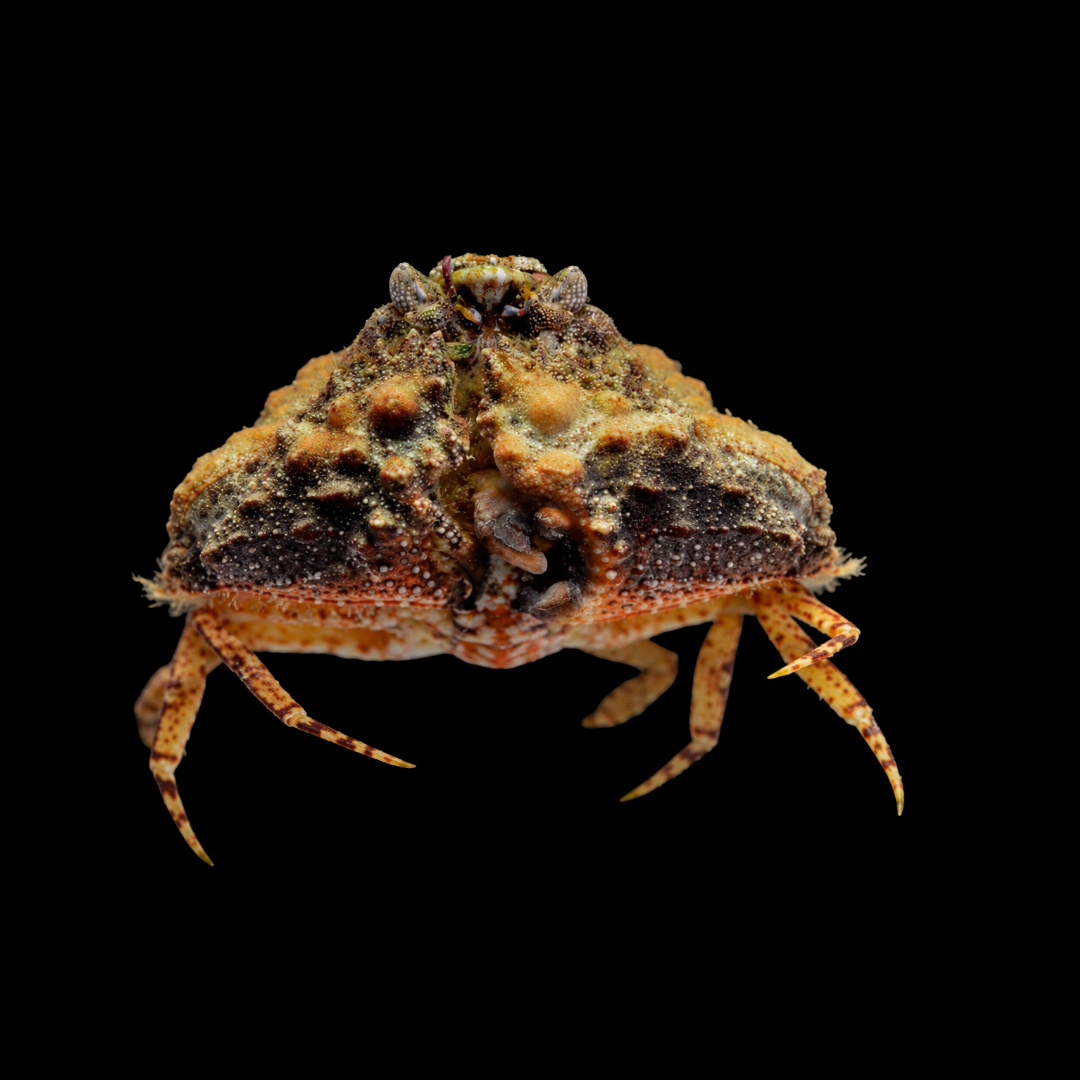
解説 / Description
コブカラッパは、カラッパ科カラッパ属に分類される海産のカニです。丸く盛り上がった背甲と、その表面を覆うコブ状の突起、そして顔を覆い隠すように折り畳まれる巨大なハサミ脚が大きな特徴です。砂底に潜って眼だけを外に出す姿や、巻貝の殻を特殊なハサミで少しずつ剥ぎ取って食べる行動から、観賞生物としても非常に個性的な存在です。左右のハサミは形と役割が異なり、右側は硬い貝殻を壊す作業に適した頑丈な構造、左側は露出した軟体部をつまみ出す作業に適した比較的細い構造を持ちます。黄色、褐色、橙色、赤紫色、白色などが混じる変化に富んだ体色と凹凸の多い背甲は、砂礫やサンゴ片の多い海底で輪郭を目立たなくするのにも役立つと考えられています。 Calappa gallus is a marine crab belonging to the family Calappidae. It is characterized by a rounded, strongly convex carapace covered with prominent tubercles and by its enormous flattened claws, which can be folded tightly in front of the face. Its habit of burying itself in sand with only the eyes exposed, together with its specialized method of peeling open gastropod shells, makes it a particularly distinctive aquarium animal. The two claws differ in shape and function: the robust right claw is specialized for breaking and peeling hard shells, while the relatively slender left claw is better suited to extracting exposed soft tissues. Its variable mixture of yellow, brown, orange, reddish purple and white, combined with the irregular surface of the carapace, is thought to help obscure its outline among sand, shell fragments and coral rubble.
基本情報 / Basic Information
| 学名 / Scientific Name | Calappa gallus (Herbst, 1803) |
|---|---|
| 通称 / Common Name | コブカラッパ。地域によってはハワイで「poki poki」と呼ばれることがあります。Kobukarappa in Japanese; locally known as “poki poki” in Hawaii. |
| 分類 / Family | 動物界・節足動物門・甲殻亜門・軟甲綱・十脚目・短尾下目・カラッパ上科・カラッパ科・カラッパ属Kingdom Animalia, Phylum Arthropoda, Subphylum Crustacea, Class Malacostraca, Order Decapoda, Infraorder Brachyura, Superfamily Calappoidea, Family Calappidae, Genus Calappa |
| 英名 / English Name | Rough box crab, Lumpy box crab, Shame-faced crab |
| 分布 / Distribution | 熱帯から亜熱帯域に広く分布するとされ、西部大西洋では北米南東部からカリブ海、南米沿岸、東部・中央大西洋ではカーボベルデ、アンゴラ、セントヘレナ島、アセンション島周辺、インド・太平洋では紅海、インド洋、日本、台湾、フィリピン、インドネシア、オーストラリアなどから知られています。日本では相模湾、紀伊半島、土佐湾、沖縄周辺などの温暖な海域で確認されています。Reported from a broad range of tropical and subtropical seas. Records include the western Atlantic from the southeastern United States through the Caribbean and northern South America, the eastern and central Atlantic around Cape Verde, Angola, Saint Helena and Ascension Island, and the Indo-Pacific from the Red Sea and Indian Ocean to Japan, Taiwan, the Philippines, Indonesia and Australia. In Japan it has been recorded from warm-water regions including Sagami Bay, the Kii Peninsula, Tosa Bay and Okinawa. |
| 最大体長 / Max Size | 甲幅で最大約15cm程度。成体ではおおむね6〜15cm程度の甲幅になるとされています。Up to approximately 15 cm in carapace width, with adults generally reported in the range of about 6–15 cm. |
| 寿命 / Lifespan | 野生・飼育下ともに、本種の平均寿命を明確に示す資料は乏しく、確立した年数は不明です。長期飼育では安定した水質、適切な給餌、脱皮を安全に行える環境の維持が重要になります。Reliable species-specific data on average lifespan in the wild or in captivity are limited, and no firmly established lifespan is available. Long-term maintenance depends heavily on stable water quality, appropriate feeding and providing conditions in which molting can occur safely. |
飼育環境 / Aquarium Environment
| 水槽サイズ / Tank Size | 流通の多い甲幅4〜5cm程度の若い個体であれば45cm規格水槽でも管理できますが、底面積と将来の成長を考えると60cm規格水槽以上を推奨します。大型個体では90cm規格水槽など、より底面積に余裕のある水槽が安心です。水量だけでなく、十分な厚さの砂を敷いて潜れる面積を確保することが重要です。Young specimens around 4–5 cm in carapace width, which are commonly seen in the aquarium trade, can be maintained in a standard 45 cm aquarium, but a standard 60 cm aquarium or larger is recommended when floor space and future growth are considered. Large adults benefit from a standard 90 cm aquarium or another tank with generous bottom area. More important than water volume alone is providing enough open substrate for the crab to bury itself. |
|---|---|
| 水温 / Temperature | 23〜26℃を目安に安定させます。急激な温度変化を避け、夏季は必要に応じて水槽用クーラー、冬季はヒーターを使用します。 Maintain a stable temperature of approximately 23–26°C. Avoid sudden temperature changes, using an aquarium chiller in hot weather and a heater during colder periods when necessary. |
| 水質 / Water Quality | 海水比重は1.023〜1.025、pHは8.1〜8.4程度を目安とし、アンモニアと亜硝酸は検出されない状態を維持します。硝酸塩はできるだけ低く保ち、10ppm以下を一つの目安とします。餌の残りや排泄物による水質悪化を防ぐため、十分に成熟した生物ろ過とプロテインスキマーを用い、定期換水を行います。脱皮と外骨格形成を支えるため、人工海水の主要成分が安定していることも重要です。A specific gravity of 1.023–1.025 and a pH of about 8.1–8.4 are suitable targets. Ammonia and nitrite should remain undetectable, while nitrate should be kept as low as practical, with below 10 ppm serving as a useful target. Because uneaten food and waste can quickly degrade water quality, use a mature biological filter, adequate protein skimming and regular water changes. Stable major seawater ions are also important for successful molting and formation of the new exoskeleton. |
| レイアウト / Layout | 砂に潜る習性を十分に発揮できるよう、細かいサンゴ砂やパウダー状の海水用底砂を厚く敷きます。目安として10cm前後、または少なくとも個体の体高を十分に覆える深さを確保すると行動を観察しやすくなります。粗く鋭い砂利は避け、潜行時に体を傷つけにくい底床を選びます。岩やサンゴ骨格を配置する場合は、カニが砂を掘っても崩れないよう、水槽底面に安定させて設置してください。Provide a deep bed of fine coral sand or other fine marine substrate so the crab can perform its natural burying behavior. Around 10 cm is a useful target, or at minimum enough depth to cover the crab’s body comfortably. Avoid coarse, sharp gravel that may cause injury while burrowing. Rocks and coral skeletons should be positioned securely on the tank bottom so that digging beneath them cannot cause a collapse. |
| 注意点 / Precautions | 潜砂行動を妨げないことが最重要です。餌をよく食べる一方で残餌も水を汚しやすいため、給餌後の確認と清掃を行います。脱皮前後は砂中や物陰に長時間こもることがあり、無理に掘り出してはいけません。ハサミは貝殻を破壊できるほど強力なので、メンテナンス時は素手でつかまず、個体との距離を保って作業してください。脱走を防ぐため、水槽上部にも隙間を作らないよう注意します。Allowing natural burrowing behavior is one of the most important husbandry requirements. These crabs can feed heavily, and uneaten food can quickly pollute the aquarium, so leftovers should be checked and removed. Before and after molting the crab may remain buried or hidden for extended periods and should never be forcibly dug out. The claws are powerful enough to damage hard shells, so avoid handling the animal directly with bare hands. A secure aquarium cover is also recommended to prevent escape. |
餌と給餌 / Feeding
| 餌の種類 / Diet | 自然下では巻貝や二枚貝など、硬い殻を持つ底生動物を捕食することに高度に適応しています。飼育下では殻付きのアサリ、小型の巻貝、エビ、イカなどの海産肉質餌を中心に与えます。個体によっては沈下性の甲殻類用・肉食魚用人工飼料にも餌付きます。単一の餌に偏らせず、複数の海産餌を組み合わせると管理しやすくなります。In nature this species is highly adapted to feeding on hard-shelled benthic animals such as gastropods and bivalves. In captivity, suitable foods include shell-on clams, small marine snails, shrimp and squid. Some individuals will also accept sinking prepared foods intended for crustaceans or carnivorous marine fish. A varied diet is preferable to relying on a single food item. |
|---|---|
| 給餌のポイント / Feeding Tips | 夜行性の傾向があるため、消灯前後など活動を始める時間帯に与えると食べる様子を確認しやすくなります。ピンセットなどを使って個体の近くに沈め、食べ切れる量を与えます。殻付きの貝を時折与えると、本種特有の右ハサミを使った殻剥き行動を引き出しやすく、自然な採餌行動を発揮させる環境エンリッチメントにもなります。ただし、生きた貝類を使用する場合は採集地や衛生状態に注意し、水槽へ病原体や有害生物を持ち込まないようにしてください。Because the species tends to be nocturnal, feeding around lights-out can make natural activity easier to observe. Place food close to the crab with feeding tongs and provide only an amount that can be consumed without leaving excessive waste. Offering an appropriately sized shell-on mollusk from time to time can encourage use of the specialized right claw and serve as behavioral enrichment. If live mollusks are used, their origin and health status should be considered carefully to reduce the risk of introducing pathogens or unwanted organisms. |
性格と混泳 / Temperament and Tank Mates
| 性格 / Temperament | 昼間は砂に潜って静かに過ごし、夜間に活動する傾向があります。普段は臆病に見えることもありますが、捕食時には非常に力強く、硬い貝殻を特殊なハサミで破壊できる捕食者です。危険を感じると大型のハサミを顔の前で合わせ、体の柔らかい部分を守る特徴的な防御姿勢を取ります。The crab often remains quietly buried during the day and becomes more active at night. Although it can appear shy while resting, it is a powerful predator capable of breaking open hard mollusk shells. When threatened, it folds its large claws together in front of the face, creating the characteristic defensive posture that protects softer parts of the body. |
|---|---|
| 混泳の相性 / Compatibility | 基本的には単独飼育が安全です。巻貝、二枚貝、ヤドカリ、小型のエビやカニなどは本来の食性と重なるため、捕食される可能性があります。砂を大きく掘り返すため、底床に固定されていないサンゴや小型の岩組みとも相性が良くありません。特にフグ類など甲殻類をかじる力の強い魚との混泳は避けます。脱皮直後の柔らかいカニが攻撃される危険がある一方、本種の強力なハサミが休息中の魚を傷つける可能性もあります。一般的なリーフ水槽の掃除役として導入される貝類やヤドカリを維持したい場合、本種との同居には向きません。A species-only aquarium is the safest approach. Snails, bivalves, hermit crabs and small shrimp or crabs overlap strongly with its natural prey and may be attacked. Heavy digging can also destabilize unsecured corals and small rock structures. Avoid keeping it with powerful crustacean-biting fishes such as puffers. A freshly molted crab is highly vulnerable to attack, while the crab’s own strong claws may injure resting fish. It is therefore unsuitable for reef aquariums in which snails, hermit crabs and other clean-up invertebrates are intended to remain permanent residents. |
病気と対策 / Diseases and Prevention
| かかりやすい病気 / Common Diseases | コブカラッパに特有の飼育疾病について体系的な情報は多くありません。飼育上問題になりやすいのは、アンモニアや亜硝酸による水質障害、脱皮不全、外傷後の細菌感染、長期間の不適切な底床環境による体表や鰓への負担などです。脱皮直後は外骨格が柔らかく、防御力が著しく低下するため、外傷や他生物からの攻撃にも特に弱くなります。Systematic information on diseases specific to Calappa gallus in captivity is limited. More common husbandry problems include ammonia or nitrite toxicity, failed molts, secondary bacterial infection following injury, and stress to the body surface or gills caused by unsuitable substrate conditions. Immediately after molting, the exoskeleton is soft and the crab is especially vulnerable to injury and attack. |
|---|---|
| 対策と予防 / Prevention | 十分に立ち上がった海水水槽へ導入し、アンモニアと亜硝酸を常に検出されない状態に保つことが基本です。高品質な人工海水を使用し、定期換水によってカルシウム、マグネシウム、アルカリ度などの主要成分を安定させます。微量元素やヨウ素などを添加する場合は過剰投与を避け、使用する製品の指示や実測値を重視してください。砂を清潔に保ちつつ、カニが安心して潜れる環境を維持し、脱皮前後は刺激や水質変化をできるだけ減らします。The foundation of prevention is introducing the crab only to a fully cycled marine aquarium and keeping ammonia and nitrite consistently undetectable. Use a reliable salt mix and regular water changes to maintain stable calcium, magnesium, alkalinity and other major seawater components. If trace elements or iodine are supplemented, avoid excessive dosing and follow product instructions and measured values whenever possible. Keep the substrate clean while preserving a secure burrowing environment, and minimize disturbance and sudden water-quality changes around the molting period. |
増やし方(繁殖) / Breeding
| 雌雄の判別 / Sexing | 短尾類では一般に腹部の形が雌雄判別の重要な手掛かりになり、オスでは腹部が比較的細く、メスでは抱卵に適した幅広い形になります。確実な判定には腹部や生殖肢などを観察しますが、小型個体では見分けにくいことがあります。As in many true crabs, the shape of the abdomen is an important clue for sexing. Males generally have a relatively narrow abdomen, while females have a broader abdomen suited to carrying eggs. Examination of the abdomen and reproductive appendages can provide a more reliable identification, although small juveniles may be difficult to sex visually. |
|---|---|
| 繁殖形態 / Reproduction | 交尾後、メスは腹部に卵を抱え、孵化した幼生を海中へ放出します。本種では4期のゾエア幼生期を経た後、底生生活への移行段階となるメガロッパ幼生へ変態することが報告されています。第1期ゾエアは非常に小さく、長い額棘や背棘、側棘を持つプランクトン性の形態を示します。その後、脱皮を繰り返しながら形態を変化させ、適切な底質へ着底して稚ガニへ移行します。After mating, the female carries eggs beneath the abdomen and releases newly hatched larvae into the water. The species has been reported to pass through four zoeal stages before transforming into a megalopa, the transitional stage preceding benthic life. The first zoea is extremely small and planktonic, with prominent rostral, dorsal and lateral spines. Through successive molts the larva changes form, eventually settling on suitable substrate and transforming into a juvenile crab. |
| 繁殖のポイント / Breeding Tips | 一般家庭の海水水槽で幼生を稚ガニまで育てる難易度は非常に高いと考えられます。孵化直後の幼生は成体とは異なり浮遊生活を送り、微細な餌、生育段階に応じた餌サイズ、安定した水温と塩分、水流管理、幼生同士やろ過装置による物理的損失への対策が必要になります。成体の通常飼育設備だけで自然に繁殖が成立することは期待しにくく、幼生専用の育成容器と段階的な餌管理が必要です。Raising larvae through settlement to the juvenile stage is considered extremely difficult in a typical home marine aquarium. Newly hatched larvae are planktonic and require very small foods, prey sizes matched to developmental stage, stable temperature and salinity, carefully controlled water movement, and protection from mechanical losses caused by filtration or inappropriate flow. Successful captive propagation therefore requires dedicated larval rearing containers and stage-specific feeding rather than relying on a standard adult aquarium. |
雑学と豆知識 / Trivia and Fun Facts
| 1. 名前の歴史は200年以上 / 1. A Scientific Name with More Than Two Centuries of History | コブカラッパは1803年、ドイツの博物学者ヨハン・フリードリヒ・ヴィルヘルム・ヘルプストによってCancer gallusとして記載され、その後カラッパ属へ移されました。現在の学名に付く「(Herbst, 1803)」という括弧は、最初に記載されたときとは異なる属へ移されたことを示しています。古くから知られてきたカニですが、近代的な分類研究ではカラッパ属の近縁種との識別形質が改めて整理され、背甲や額、生殖肢などの形態が重要な判定材料として扱われています。Calappa gallus was described in 1803 by the German naturalist Johann Friedrich Wilhelm Herbst under the name Cancer gallus and was later transferred to the genus Calappa. The parentheses around “Herbst, 1803” in the modern scientific name indicate that the species is now placed in a different genus from the one in which it was originally described. Although known to science for more than two centuries, modern taxonomic work has refined the characters used to distinguish it from related box crabs, including features of the carapace, frontal region and reproductive structures. |
|---|---|
| 2. Calappaは「ココナッツ」に由来する名前 / 2. The Name Calappa Is Linked to the Coconut | カラッパ属のCalappaという名称は、マレー語でココナッツを意味する「kelapa」に関連するとされます。丸く膨らんだ背甲と、巨大なハサミを前方へきっちり折り畳んだ姿を眺めると、硬い殻に包まれたヤシの実を連想させるという説明にも納得できます。英語の「box crab」も、ハサミと甲羅を合わせて体を箱のように閉じる姿をよく表した呼び名です。The genus name Calappa is generally associated with “kelapa,” the Malay word for coconut. When the crab folds its enormous claws tightly against its rounded carapace, the compact, enclosed outline makes the comparison with a hard-shelled coconut easy to understand. The English term “box crab” likewise reflects the way the claws and carapace combine to shield the body almost like a closed box. |
| 3. 「恥ずかしがり屋のカニ」と呼ばれる理由 / 3. Why It Is Called a Shame-Faced Crab | 大型のハサミを顔の前で合わせる防御姿勢は、人が両手で顔を隠しているようにも見えます。この印象的な姿から英語では「Shame-faced crab」と呼ばれ、フランス語圏でも「恥ずかしがっているカニ」を思わせる名称が使われてきました。しかし実際には照れているわけではなく、ハサミを盾のように利用して口器や腹側などの守りにくい部分を覆う、合理的な防御行動です。When the crab brings its large claws together in front of its face, the posture resembles a person hiding behind both hands. This appearance gave rise to the English name “shame-faced crab,” with similarly humorous names appearing in other languages. The behavior is not shyness, of course: the claws function as shields that protect vulnerable mouthparts and the underside of the body. |
| 4. 右手は缶切り、左手はピンセット / 4. A Can Opener on the Right and Tweezers on the Left | コブカラッパを特徴づけるのが、左右で異なる仕事を担当する非対称のハサミです。頑丈な右ハサミには、巻貝の殻口の縁へ力を集中させる特殊な歯状構造があり、殻を一度に粉砕するのではなく、縁から少しずつ剥ぎ取るように壊していきます。これはしばしば「缶切り」に例えられる仕組みです。殻の内部が露出すると、比較的細い左ハサミが軟体部をつまみ出す役割を担います。一対のハサミを同じ形にせず、破壊と取り出しという異なる作業へ分業させた点に、このカニの高度な食性特化が表れています。One of the most remarkable features of Calappa gallus is the functional asymmetry of its claws. The heavy right claw bears specialized tooth-like structures that concentrate force on the lip of a gastropod shell. Instead of simply crushing the whole shell at once, the crab can progressively peel fragments from the edge, a mechanism often compared with a can opener. Once the soft body of the prey becomes accessible, the more slender left claw is better suited to picking the tissue out. The division of labor between shell-breaking and extraction is a striking example of feeding specialization. |
| 5. 貝との進化的な軍拡競争 / 5. An Evolutionary Arms Race with Mollusks | カラッパ類の特殊なハサミは、単なる奇抜な形ではありません。新生代の海では、カニなどの捕食者が巻貝へ強い捕食圧を与える一方、巻貝側では殻口の肥厚、棘、畝など、殻を壊されにくくする構造が発達してきたと考えられています。捕食者が殻を破る能力を高め、被食者がさらに強固な殻を発達させるという相互作用は、海洋生物の進化を考える上で重要なテーマです。コブカラッパの「殻を剥く」ハサミは、その長い歴史の中で洗練されてきた捕食道具の一例と見ることができます。The unusual claws of box crabs are more than a curious shape. Through the Cenozoic, shell-breaking predators such as crabs exerted strong predation pressure on gastropods, while mollusks evolved thicker apertural lips, ribs, spines and other structures that made shells more difficult to open. The reciprocal escalation between improved predatory tools and stronger defensive shells is an important theme in marine evolutionary biology. The shell-peeling claw of Calappa gallus can be viewed as one highly specialized outcome of this long predator–prey interaction. |
| 6. 砂に潜ったまま呼吸できる仕組み / 6. Breathing While Buried Beneath the Sand | コブカラッパは、体の大部分を砂に埋めながら眼の周辺を外へ出して潜むことがあります。この生活を可能にしているのが、甲羅と折り畳んだハサミの間に形成される水の通り道です。呼吸に使う海水を一定の経路へ導き、周辺に生えた毛状構造が砂粒などの侵入を抑えます。大きなハサミは貝を割る道具であるだけでなく、防御と潜砂生活を支える構造の一部でもあるのです。Calappa gallus can remain largely buried while leaving the eye region exposed above the substrate. This lifestyle is supported by controlled respiratory water pathways formed around the carapace and the folded claws. Water is directed toward the gill chambers, while setae around the passages help reduce the entry of sediment. The enlarged claws therefore function not only as feeding tools and shields but also as part of the crab’s specialized buried lifestyle. |
| 7. 幼生時代はまったく別の姿 / 7. The Larvae Look Completely Different from the Adult Crab | 丸い甲羅を持つ成体からは想像しにくいものの、孵化直後のコブカラッパは水中を漂う小さなゾエア幼生です。第1期ゾエアは全長約1.35mmとされ、長い額棘や背棘を持つ細長い姿をしています。本種では4期のゾエアを経てメガロッパへ変態し、そこから底生生活へ移っていきます。この浮遊幼生期は、親ガニが歩いて移動できる範囲をはるかに越えて個体群を分散させる仕組みでもあります。Despite the rounded form of the adult, newly hatched Calappa gallus are tiny planktonic zoeae. The first zoeal stage has been reported at about 1.35 mm in total length and carries conspicuous rostral and dorsal spines. The species passes through four zoeal stages before transforming into a megalopa and eventually settling into benthic life. This planktonic period also allows dispersal across distances far greater than an adult crab could ever travel by walking. |
| 8. 日本では輸入個体と国内採集個体の両方が見られる / 8. Both Imported and Japanese-Collected Specimens May Enter the Aquarium Trade | 日本の観賞用海水生物市場では、東南アジア方面から輸入される個体に加え、温暖な日本沿岸の漁業で混獲された個体が流通することがあります。販売されるのは甲幅4〜5cm前後の若い個体が中心となることがあり、小型水槽でも飼えそうに見えます。しかし成長すればより大きくなり、砂を掘る範囲も広がります。購入時のサイズだけで水槽を決めず、成長後まで見据えた底面積とろ過能力を準備することが大切です。In the Japanese marine aquarium trade, specimens may arrive both through imports from Southeast Asia and as bycatch from fisheries in warmer Japanese coastal waters. Juveniles around 4–5 cm in carapace width may appear in shops and can seem suitable for very small aquariums. However, they grow larger and disturb an increasing area of substrate as they mature, so tank size and filtration capacity should be planned for the adult rather than only for the size at purchase. |
| 9. 潜砂は見えなくなるための行動だけではない / 9. Burrowing Is More Than a Way to Disappear | 砂へ潜る行動は、捕食者から身を守るだけでなく、獲物を待つことや日中の休息にも役立つと考えられます。また、カニが繰り返し底質を掘り返すことで、堆積物の表面が物理的に動かされます。自然界ではこのような底生動物による活動は生物撹乱と呼ばれ、海底堆積物の構造や物質循環に影響を与える重要な生態作用の一つです。水槽では同じ行動がレイアウトを大きく変えるため、固定していない岩やサンゴを置かないことが安全管理につながります。Burrowing serves more purposes than simply hiding from predators. It may also support ambush feeding and daytime resting behavior. Repeated digging physically disturbs the surface layers of sediment, an ecological process known as bioturbation. In natural habitats, such activity by benthic animals can influence sediment structure and nutrient cycling. In an aquarium, however, the same behavior can dramatically rearrange the substrate, which is why unsecured rocks and corals should be avoided. |
まとめ / Conclusion
コブカラッパは、丸みを帯びた独特の甲羅、顔を覆う巨大なハサミ、砂の中へ巧みに姿を消す行動によって、海水水槽でもひときわ強い存在感を放つカニです。とりわけ左右で役割の異なるハサミを使い、巻貝の殻を少しずつ剥がして食べる姿は、長い進化の過程で獲得された食性への適応を目の前で観察できる貴重な機会になります。 Calappa gallus is an exceptionally distinctive marine crab, combining a rounded sculptured carapace, enormous face-covering claws and a remarkable ability to disappear beneath the sand. Watching the two differently specialized claws work together to peel open a mollusk shell offers a rare opportunity to observe an evolutionary feeding adaptation directly within the aquarium.
一方で、その魅力を十分に引き出すには、見た目のかわいらしさだけで飼育を始めないことも大切です。十分な厚さの細かい砂、安定した海水環境、脱皮を妨げない管理、貝類を中心とした適切な餌、そして強力なハサミと捕食性を考慮した単独飼育が長期維持の基本になります。砂の中から眼だけをのぞかせ、夜になると活動を始める姿をじっくり観察できる環境を整えれば、コブカラッパならではの形態と行動の奥深さを長く楽しむことができます。 At the same time, successful long-term care requires more than being attracted by its unusual appearance. A deep layer of fine sand, stable marine water conditions, careful management around molting, an appropriate mollusk-based diet and a species-only setup that respects its predatory nature and powerful claws are the foundations of good husbandry. In a properly prepared aquarium, the sight of its eyes emerging from the sand and its nocturnal feeding behavior reveals the remarkable connection between form, behavior and ecology that makes this crab so fascinating.

気になる道具や飼い方を見つけてみませんか?
 アイのアクアグッズ案内そのごはん、泳いでる! 卵から始めるブラインシュリンプの孵化と道具選び道具の特徴や使い方、選ぶときのポイントをアイが紹介します。記事はコチラ →
 アイのアクアグッズ案内水草水槽のCO₂添加|3つの方式の選び方とおすすめ用品道具の特徴や使い方、選ぶときのポイントをアイが紹介します。記事はコチラ →
 アイのアクアグッズ案内アフリカンシクリッドの飼育用品|水槽・ろ過・底砂・岩組み・餌の選び方道具の特徴や使い方、選ぶときのポイントをアイが紹介します。記事はコチラ →
 アイのアクアグッズ案内アカヒレの仲間に合わせる飼育用品|無加温・混泳・繁殖の水槽とろ過道具の特徴や使い方、選ぶときのポイントをアイが紹介します。記事はコチラ →
さまざまな飼育テーマをご紹介。リンク先の記事には広告・商品紹介が含まれます。
案内・紹介記事一覧へ →分布マップ
コブカラッパ(Calappa gallus)は、紅海やインド洋西部から東南アジア、日本、ハワイ、南太平洋にかけてのインド・西太平洋の温暖な海域に広く分布しています。日本では相模湾、紀伊半島、琉球列島などの温暖な沿岸で記録されています。
この地図は文献上の分布地域をもとにした概略表示であり、分布境界や個々の生息地点を正確に示すものではありません。マーカーは分布域を把握しやすくするために設定した代表地点で、実際の採集地点を示すものではありません。
参考文献
-
World Register of Marine Species (WoRMS). Calappa gallus (Herbst, 1803).
学名、分類、異名などの現行分類情報。
https://www.marinespecies.org/aphia.php?p=taxdetails&id=209502 -
Galil, B. S. (1997). Crustacea Decapoda: A revision of the Indo-Pacific species of the genus Calappa Weber, 1795 (Calappidae).
Mémoires du Muséum national d’Histoire naturelle, 176, 271–335.
インド・西太平洋産カラッパ属の分類、形態、分布、生息深度を扱う主要な分類学的再検討。
https://www.biodiversitylibrary.org/part/289604 -
JAMSTEC 国際海洋環境情報センター. Biological Information System for Marine Life (BISMaL): Calappa gallus コブカラッパ.
日本語名を含む分類体系と国内文献への参照。
https://www.godac.jamstec.go.jp/bismal/j/view/9004903 -
Bellwood, O. (2002). The occurrence, mechanics and significance of burying behaviour in crabs (Crustacea: Brachyura).
Journal of Natural History, 36(10), 1223–1238.
カニ類の潜砂行動、その力学、生態的意義を扱う研究。カラッパ類の潜砂習性を理解する基礎資料。
https://doi.org/10.1080/00222930110048891 -
Shoup, J. B. (1968). Shell opening by crabs of the genus Calappa.
Science, 160(3830), 887–888.
右鉗脚の特殊な歯状構造を用いて巻貝などの殻を開く、カラッパ属特有の採餌機構を示した基礎研究。
https://doi.org/10.1126/science.160.3830.887 -
Taishaku, H. & Konishi, K. (1995). Zoeas of Calappa species with special reference to larval characters of the family Calappidae (Crustacea, Brachyura).
Zoological Science, 12(5), 649–654.
コブカラッパとヤマトカラッパの孵化直後の第1期ゾエアを記載した、繁殖・幼生形態に関する直接資料。
https://doi.org/10.2108/zsj.12.649 -
Ahearn, G. A., Mandal, P. K. & Mandal, A. (2004). Calcium regulation in crustaceans during the molt cycle: a review and update.
Comparative Biochemistry and Physiology Part A, 137(2), 247–257.
甲殻類の脱皮周期に伴うカルシウム移動と外骨格再石灰化の生理学的背景をまとめた総説。
https://doi.org/10.1016/j.cbpb.2003.10.012 -
Lewbart, G. A. & Zachariah, T. T. (2023). Aquatic and Terrestrial Invertebrate Welfare.
Animals, 13(21), 3375.
飼育下の甲殻類における水質、栄養、隠れ場所、健康管理などの基本的な飼育上の考え方を扱う総説。
https://doi.org/10.3390/ani13213375 -
Rowley, A. F. & Coates, C. J. (2023). Shell disease syndromes of decapod crustaceans.
Environmental Microbiology, 25(5), 931–947.
カニを含む十脚甲殻類の外骨格障害、微生物の関与、環境・生理条件との関係を整理した総説。
https://doi.org/10.1111/1462-2920.16344




コメント