

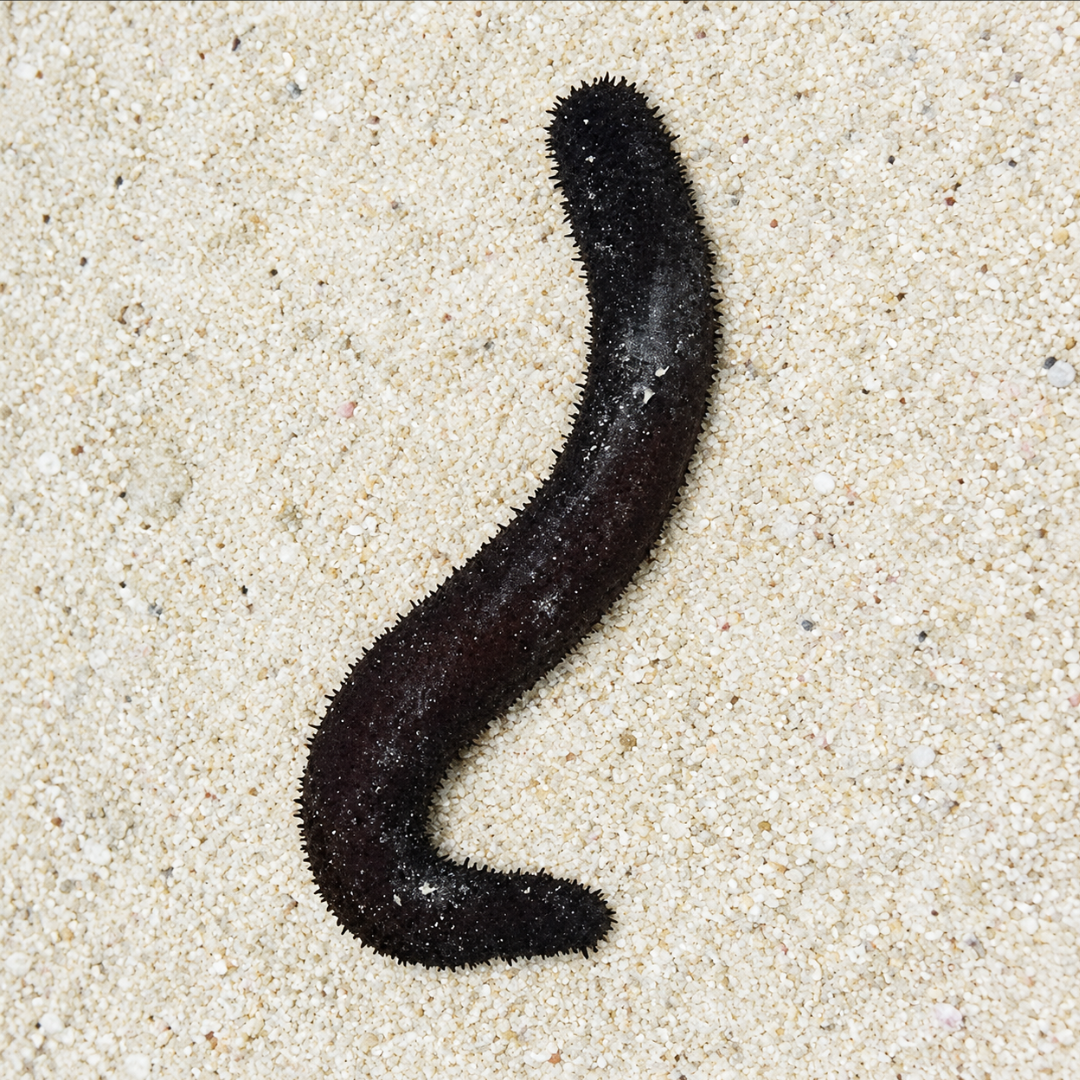
解説 / Description
クロナマコは、熱帯・亜熱帯のインド太平洋に広く分布し、浅いサンゴ礁の砂地や礁池、海草藻場などで見られるナマコです。黒く滑らかな体で海底をゆっくり移動し、砂や堆積物を取り込みながら、その中の微細藻類や細菌、有機物を利用します。この摂餌行動は海底の堆積物をかき混ぜ、物質循環に関わる「生物攪拌」の一部を担います。水槽では成熟した砂床を広く使って採餌するため、単に残餌を片づける「掃除役」と考えるのは適切ではありません。また、強い刺激や損傷を受けると魚類に有害なサポニン類を含む分泌物や組織が水中へ出る可能性があるため、ポンプへの巻き込みなどを防げる環境で慎重に飼育する必要があります。 Holothuria atra is a sea cucumber widely distributed across tropical and subtropical parts of the Indo-Pacific, where it occurs on sandy reef flats, in lagoons, and in seagrass habitats. Its smooth black body moves slowly across the seafloor while taking in sand and sediment and using the microalgae, bacteria, and organic material they contain. This feeding activity contributes to bioturbation, the continual reworking of seafloor sediment that forms part of benthic nutrient cycling. In an aquarium it needs access to a broad, mature substrate for feeding, so it should not be regarded simply as an animal that “cleans up” leftover food. Severe irritation or injury can also release secretions or tissues containing saponins that are harmful to fish, making protection from pumps and other sources of physical damage especially important.
基本情報 / Basic Information
| 学名 / Scientific Name | Holothuria atra Jaeger, 1833 |
|---|---|
| 通称 / Common Name | クロナマコLollyfish; Black sea cucumber |
| 分類 / Family | 棘皮動物門・ナマコ綱・クロナマコ目・クロナマコ科・Holothuria属(Halodeima亜属)Phylum Echinodermata, Class Holothuroidea, Order Holothuriida, Family Holothuriidae, Genus Holothuria, subgenus Halodeima |
| 英名 / English Name | Black sea cucumber, Lollyfish |
| 分布 / Distribution | インド太平洋の熱帯・亜熱帯域に広く分布し、紅海・東アフリカから東南アジア、オーストラリア、太平洋諸島まで見られます。日本では沖縄県のサンゴ礁域などで生息が確認されています。Widespread in tropical and subtropical Indo-Pacific waters, from the Red Sea and East Africa through Southeast Asia and Australia to Pacific islands. In Japan, the species has been recorded from coral-reef habitats in Okinawa and other warm southern waters. |
| 最大体長 / Max Size | 一般的な体長は20cm前後とされ、最大体長は資料により約45〜60cmと幅があります。ナマコ類は体を大きく伸縮させるため、測定時の姿勢によって見かけの体長も変わります。Common length is around 20 cm, while reported maximum length varies among references from about 45 to 60 cm. Sea cucumbers can extend and contract their bodies considerably, so apparent length also varies with posture. |
| 寿命 / Lifespan | 本種に限定した野生下・飼育下の確立した寿命データは乏しく、明確な年数は不明です。Reliable species-specific lifespan data for both wild and captive Holothuria atra are limited, and a well-established lifespan in years is not currently available. |
飼育環境 / Aquarium Environment
| 水槽サイズ / Tank Size | 本種について標準化された最小水槽サイズは確認されていません。大型化し、広い砂床を連続して利用するため、小型水槽には不向きです。実用上は120cm規格水槽(約240L)級以上をひとつの目安とし、個体の大きさに応じて、より底面積と水量に余裕のある水槽を選びます。No standardized species-specific minimum aquarium size has been established. Because this sea cucumber can become large and continually uses a broad area of substrate for feeding, small aquaria are unsuitable. As a practical husbandry target, a 120 cm standard aquarium of roughly 240 L or larger provides a more appropriate starting point, with additional floor area and water volume desirable for larger individuals. |
|---|---|
| 水温 / Temperature | 24〜28℃程度を飼育上の目安とし、急激な変化を避けて安定させます。野外では約39℃の浅い潮だまりで活動が確認された例もありますが、これは高温が最適であることを示すものではありません。家庭水槽では過度な高温を避け、十分な酸素供給を確保します。 A stable 24–28°C is a practical aquarium target. Wild individuals have been observed remaining active in shallow pools approaching 39°C, but that observation does not mean such high temperatures are optimal in captivity. Avoid excessive heat in aquaria and maintain good oxygenation. |
| 水質 / Water Quality | 比重1.023〜1.026前後、pH 8.0〜8.3程度の一般的な海水水槽の範囲を目安にし、数値そのものより急変を避けて安定させることを重視します。アンモニアと亜硝酸は検出されない状態を維持し、硝酸塩や溶存有機物の過度な蓄積も抑えます。適切な水流、プロテインスキマー、十分なガス交換を確保してください。Aim for stable, normal marine-aquarium conditions around specific gravity 1.023–1.026 and pH 8.0–8.3, with stability more important than chasing exact numbers. Ammonia and nitrite should remain undetectable, and excessive accumulation of nitrate and dissolved organics should be avoided. Provide suitable flow, protein skimming, and effective gas exchange. |
| レイアウト / Layout | 広い砂床を主体にし、ライブロックは採餌できる砂面を塞ぎすぎないよう配置します。自然下では細砂だけでなく砂泥やサンゴ礫を含む場所にも生息しますが、水槽では体表を傷つけにくい底床と、十分な採餌面積を優先します。循環ポンプ、オーバーフロー、吸水口には必ずガードを設け、巻き込みを防いでください。立ち上げ直後よりも、生物膜や微細藻類が育った成熟水槽が適しています。Base the aquascape around a broad substrate area and arrange live rock so it does not cover too much feeding surface. In nature the species occurs on several sediment types, including sand, sandy mud, and coral rubble, but in an aquarium the priority is a substrate unlikely to abrade the body and a large area available for feeding. Fit guards to circulation pumps, overflows, and intakes to prevent entrapment. A mature aquarium with established biofilm and microalgae is preferable to a newly established system. |
| 注意点 / Precautions | 強くこすられるなどの刺激を受けると赤色の有毒な分泌液を出すことが知られ、強いストレスでは内臓吐出が起こることもあります。家庭の海水水槽では、循環ポンプに巻き込まれて損傷したクロナマコが魚の一斉死亡原因と推定された症例も報告されています。ポンプへの巻き込みは特に避けるべき事故です。大きな損傷が起きた場合は生体を可能な範囲で隔離し、一般的な緊急対応として換水、活性炭、エアレーション、プロテインスキマーの強化を行い、水槽内の魚の状態を注意深く観察します。When strongly rubbed or otherwise irritated, Holothuria atra is known to release a toxic reddish secretion, and severe stress can also be associated with evisceration. A published home-aquarium case reported mass fish mortality after an H. atra was macerated in a circulation pump, with holothurin toxicosis considered the likely cause. Pump entrapment is therefore a particularly important accident to prevent. If major injury occurs, isolate the animal when practical and use general emergency measures such as water changes, fresh activated carbon, increased aeration, and efficient protein skimming while closely monitoring the fish. |
餌と給餌 / Feeding
| 餌の種類 / Diet | 主な餌は、砂や堆積物に含まれる微細藻類、底生性の微生物、有機デトリタスなどです。水槽では成熟した砂床そのものが主要な餌場になります。成体の観賞飼育で補助給餌の標準法は確立されていないため、人工餌を主食の代わりと考えず、必要に応じて微細藻類や海藻系の微粒子餌料を少量補う程度にします。Its main food consists of microalgae, benthic microorganisms, and organic detritus associated with sand and sediment. In an aquarium, the mature substrate itself is the primary feeding ground. There is no well-established standard supplemental-feeding protocol for adult ornamental specimens, so prepared food should not be treated as a substitute for a productive substrate; if supplementation is used, finely powdered microalgal or seaweed-based foods should be offered sparingly. |
|---|---|
| 給餌のポイント / Feeding Tips | 補助餌を使う場合は一点に盛らず、底床の広い範囲へごく薄く行き渡らせます。摂餌を続けているか、糞が排出されているか、体の張りが保たれているかを観察し、餌場となる砂床の状態を確認してください。人工餌を増やしすぎると水質悪化につながるため、追加量は少量ずつ調整します。If supplemental food is used, do not pile it in one place; spread only a very thin amount across a broad area of substrate. Watch whether the animal continues feeding, produces feces, and maintains normal body condition, and assess the condition of the substrate that serves as its feeding ground. Excess prepared food can degrade water quality, so increase any supplementation only in small increments. |
性格と混泳 / Temperament and Tank Mates
| 性格 / Temperament | 温和な堆積物食者で、他の魚やサンゴを追い回して捕食する生態ではありません。主に底面をゆっくり移動しながら砂や堆積物を取り込み、採餌を続けます。水槽内ではレイアウトの陰や機器の近くまで移動することがあるため、移動経路に危険な吸水口や狭い隙間を作らないことが重要です。A peaceful deposit feeder, it does not normally chase or prey on fish or corals. It spends most of its time moving slowly across the bottom while taking in sand and sediment. Because it may wander into shaded areas and close to aquarium equipment, avoid creating hazardous intakes or narrow spaces along its possible routes. |
|---|---|
| 混泳の相性 / Compatibility | サンゴを積極的に捕食する生態ではありませんが、損傷時の化学的リスクがあるため、一般的な「リーフセーフ生体」と同じ感覚で扱うのは適切ではありません。体表をつつく、かじる、挟むなどして傷つける可能性のある魚や甲殻類との同居は避けます。穏やかな魚やサンゴとの同居は可能ですが、魚を多く収容した小型水槽では、万一の損傷時に影響が広がりやすいため特に注意が必要です。It does not normally feed on corals, but the chemical risk associated with serious injury means it should not be treated in exactly the same way as an ordinary risk-free “reef-safe” invertebrate. Avoid fish or crustaceans likely to peck, bite, pinch, or otherwise damage the body. Peaceful fish and corals may coexist with it, but a small, heavily stocked fish aquarium leaves less margin for error if the sea cucumber is seriously injured. |
病気と対策 / Diseases and Prevention
| かかりやすい病気 / Common Diseases | クロナマコに特有の「かかりやすい病気」として整理された観賞飼育データは多くありません。飼育上は、ポンプや岩による裂傷、体表組織の崩れ、水質悪化に伴う活動低下、内臓吐出などの異常を早く見つけることが重要です。内臓吐出は病名ではなく、強いストレスや防御反応として起こる現象です。There is little ornamental-aquarium literature defining species-specific “common diseases” of Holothuria atra. In practice, early recognition of problems such as pump or rock injuries, breakdown of body-surface tissue, reduced activity associated with poor water conditions, and evisceration is more important. Evisceration is not a disease name; it is a response that can occur under severe stress or as part of defense. |
|---|---|
| 対策と予防 / Prevention | 水温・比重・pHを急変させず、アンモニアと亜硝酸を発生させない成熟した濾過環境を維持します。ポンプ類への巻き込み防止を徹底し、体を傷つける可能性のある生体との同居を避けてください。棘皮動物では薬剤への感受性が問題になることがあり、本種で安全性が確立していない銅系薬剤などを本水槽へ安易に使用しない方が安全です。組織の崩れが進む個体は早めに隔離し、本水槽では水質と酸素供給の維持を優先します。Maintain stable temperature, salinity, and pH and a mature filtration system that prevents detectable ammonia and nitrite. Fully protect pumps and intakes and avoid tank mates likely to damage the body. Medication sensitivity can be a concern in echinoderms, so copper-based treatments and other drugs without established safety for this species should not be used casually in the display aquarium. If tissue breakdown progresses, isolate the animal early and prioritize water quality and oxygenation in the main system. |
増やし方(繁殖) / Breeding
| 雌雄の判別 / Sexing | 雌雄異体ですが、通常の外見だけでオスとメスを確実に見分けることはできません。生殖腺の観察などを行わない限り、一般的な飼育下での雌雄判別は実質的に困難です。The species has separate sexes, but males and females cannot be reliably distinguished by ordinary external appearance. Without examining the gonads or using comparable methods, practical sexing in a home aquarium is essentially impossible. |
|---|---|
| 繁殖形態 / Reproduction | 有性生殖では放卵放精型で、卵と精子を水中へ放出して体外受精します。性成熟サイズは地域や個体群によって差がありますが、約15.5〜16.5cm前後で成熟した個体が確認された研究があります。また本種は、体を横方向に二分し、それぞれが欠けた器官を再生する「横分裂」による無性生殖も行います。Sexual reproduction is by broadcast spawning, with eggs and sperm released into the water for external fertilization. Size at first maturity varies among populations, but studies have reported mature individuals at roughly 15.5–16.5 cm. The species also reproduces asexually by transverse fission, in which the body divides and each portion regenerates the missing structures. |
| 繁殖のポイント / Breeding Tips | 家庭水槽で計画的に繁殖させる難度は高めです。種苗生産の研究では水温変化などを利用した産卵誘発が行われていますが、条件や反応は研究ごとに異なり、観賞水槽で意図的な温度ショックを与える方法は推奨できません。受精後はアウリクラリア、ドリオラリア、ペンタクツラといった幼生・着底段階を経るため、段階ごとに餌や着底基質を管理する必要があります。横分裂も自然に起こりますが、人為的に切断して増殖させる方法は家庭飼育では行わないでください。Planned breeding in a home aquarium is difficult. Hatchery studies have induced spawning with changes in water temperature and related methods, but protocols and responses vary, and deliberate thermal shock is not recommended in a display aquarium. After fertilization, development proceeds through auricularia, doliolaria, and pentactula or settlement stages, each requiring different feeding and settlement management. Natural transverse fission can also occur, but intentionally cutting animals to force asexual propagation should not be attempted in home aquaria. |
雑学と豆知識 / Trivia and Fun Facts
| 1. 砂をまとう仕組みと、その意味 / 1. How the sandy coat forms and what it means | クロナマコの体表が砂に覆われる現象はよく知られています。2021年の顕微鏡研究では、背側の表皮にある分泌細胞が砂の付着に関わると考えられています。砂をまとう機能については、周囲に溶け込む効果がしばしば説明される一方、野外実験では日射下で砂をまとった個体の体温が、砂のない個体よりわずかに低くなることも示されています。つまり、体表の砂は単なる汚れではなく、クロナマコ自身の体表のしくみによって保たれる被覆であり、浅い砂地で暮らす生態と深く結びついています。The sandy coating commonly seen on Holothuria atra is a genuine biological feature rather than random dirt. A 2021 microscopic study found secretory cells in the dorsal epidermis that are thought to help sand adhere to the body. Camouflage is often proposed as one benefit of the coating, while field experiments have also shown that sand-covered individuals can maintain a slightly lower body temperature under direct sunlight than uncovered ones. The sandy coat is therefore closely tied to the species’ life on exposed shallow substrates and is actively maintained by features of its body surface. |
|---|---|
| 2. 1日に何十グラムもの海底を「食べて耕す」 / 2. Reworking tens of grams of sediment each day | グレートバリアリーフのリザード島で行われた研究では、クロナマコ1個体が1日に平均約67g(乾燥重量)の堆積物を摂食・排泄したと報告されています。同じ海域でクロナマコと別種のナマコが混在する個体群をモデル化すると、1,000平方メートルあたり年間約4.6トンの堆積物を動かし得る計算になりました。この4.6トンという値はクロナマコ単独の量ではありませんが、砂を口から取り込んで排出する日常的な摂餌が、海底を継続的にかき混ぜる「生物攪拌」につながることをよく示しています。A study at Lizard Island on the Great Barrier Reef reported that one Holothuria atra ingested and expelled an average of about 67 g dry weight of sediment per day. Modeling a mixed population of H. atra and another sediment-feeding sea cucumber in the same reef-flat system suggested that about 4.6 tonnes of sediment per 1,000 square meters could be reworked each year. That 4.6-tonne figure is not attributable to H. atra alone, but it clearly illustrates how routine deposit feeding contributes to continual bioturbation of the seafloor. |
| 3. 体が二つに分かれ、それぞれが再生する / 3. One body can divide and both parts regenerate | クロナマコは有性生殖だけでなく、体を横方向に分裂させる無性生殖でも個体数を増やします。分裂直後は前後それぞれの断片に不足する器官がありますが、時間をかけて欠けた構造を再生し、それぞれが独立した個体になります。ただし、横分裂の頻度は地域や個体群で大きく異なり、常に高頻度で起こるわけではありません。強い再生能力を、野外での個体群維持にも利用していることが本種の大きな特徴です。Holothuria atra can increase its numbers not only through sexual reproduction but also through transverse fission. Immediately after division, each portion lacks some structures, but over time both regenerate what is missing and become independent complete individuals. The frequency of fission differs greatly among locations and populations, so it should not be assumed to occur frequently everywhere. Even so, the use of regenerative ability as a normal population-maintenance strategy is one of the species’ most distinctive biological traits. |
| 4. キュビエ器官を持たないのに、化学防御を備える / 4. Chemical defense without Cuvierian tubules | 一部のナマコ類は、外敵に襲われると「キュビエ器官」と呼ばれる粘着性の糸状組織を放出します。クロナマコにはこの器官がありませんが、無防備ではありません。強い刺激を受けると赤色の有毒な分泌液を出すことがあり、体壁にはホロスリン類を含むサポニンが存在します。水槽では、この化学防御そのものよりも、ポンプ事故などで組織が大きく損傷し、成分が水中へ広がる状況を作らないことが重要です。Some sea cucumbers defend themselves by ejecting sticky thread-like Cuvierian tubules. Holothuria atra lacks these organs, but it is not defenseless. Strong irritation can cause the release of a toxic reddish secretion, and the body wall contains saponins including holothurin-related compounds. In an aquarium, the practical concern is not the mere existence of this chemical defense but preventing major tissue damage, such as pump injury, that could disperse these compounds through the water. |
| 5. 体壁に含まれる多様なサポニン / 5. Diverse saponins in the body wall | クロナマコでは、キュビエ器官がない一方で、体壁からさまざまなトリテルペングリコシドが確認されています。2023年に報告された化学分析では、デスホロツリンBに加え、新規のエピマーである12-epi-desholothurin Bが単離・構造決定されました。同じ研究では抽出画分が試験管内でα-グルコシダーゼ阻害活性を示しましたが、これは人での治療効果が確立したことを意味しません。クロナマコの体壁は、防御化学と天然物研究の両面から現在も研究対象になっています。Although Holothuria atra lacks Cuvierian tubules, a variety of triterpene glycosides have been identified from its body wall. A chemical study published in 2023 isolated and characterized desholothurin B together with a newly identified epimer, 12-epi-desholothurin B. Extract fractions in the same study showed alpha-glucosidase inhibitory activity in laboratory assays, but that does not establish a therapeutic effect in humans. The body wall of H. atra therefore remains an active subject of research in both chemical defense and marine natural-products chemistry. |
まとめ / Conclusion
クロナマコは、黒い体で砂の上をゆっくり移動し、堆積物を取り込みながら海底をかき混ぜるナマコです。派手な動きはありませんが、砂をまとった姿や絶え間ない摂餌行動には、サンゴ礁の浅い海底で暮らす底生動物らしい特徴がよく表れています。水槽でも、十分に成熟した広い砂床を確保できれば、その独特の生活様式を観察できます。 Holothuria atra is a black sea cucumber that moves slowly over the substrate, taking in sediment and continually reworking the seafloor as it feeds. It is not a visually dramatic animal, but its sandy coating and steady deposit-feeding behavior clearly reflect the life of a benthic species adapted to shallow reef environments. In an aquarium with a broad, mature substrate, this distinctive way of life can be observed at close range.
一方で、飼育では「砂をきれいにする生体」という役割だけを期待せず、成長後の大きさ、継続して採餌できる砂床、安定した海水環境を用意する必要があります。特に、ポンプへの巻き込みなどによる大きな損傷は同居魚にも影響を及ぼし得るため、傷つけない設備設計が重要です。条件を整えた水槽では、海底の堆積物を利用しながら静かに暮らすクロナマコ本来の姿が、長く観察するほど印象に残る存在になります。 At the same time, successful care requires more than expecting the animal to “clean” the sand. Its eventual size, continuous need for a productive substrate, and requirement for stable seawater conditions all need to be accommodated. Major injuries, especially from circulation pumps, can also affect fish sharing the system, so equipment must be arranged to prevent physical damage. In a suitable aquarium, the quiet way this sea cucumber lives from the resources within the seafloor becomes more distinctive the longer it is observed.

気になる道具や飼い方を見つけてみませんか?
 アイのアクアグッズ案内コリドラスのもふもふ時間を楽しむ|餌・底砂・お掃除用品の選び方コリドラスのもふもふする食事風景を楽しむために。沈む餌2種類の違い、口元に配慮した底砂、食べ残しを回収する道具を、アクアグッズナビゲーターのアイが紹介します。記事はコチラ →
 アイのアクアグッズ案内金魚を長く楽しむ飼育用品|水槽・フィルター・エアレーション・水換え道具の特徴や使い方、選ぶときのポイントをアイが紹介します。記事はコチラ →
 アイのアクアグッズ案内水草用ライトの選び方|緑の絨毯と赤い水草を楽しむ照明・植栽用品道具の特徴や使い方、選ぶときのポイントをアイが紹介します。記事はコチラ →
 アイのアクアグッズ案内エンゼルフィッシュの飼育用品|高さのある水槽・ろ過・水草・餌の選び方道具の特徴や使い方、選ぶときのポイントをアイが紹介します。記事はコチラ →
さまざまな飼育テーマをご紹介。リンク先の記事には広告・商品紹介が含まれます。
案内・紹介記事一覧へ →分布マップ
クロナマコ(Holothuria atra)は、インド太平洋の熱帯・亜熱帯域に広く分布し、紅海・東アフリカから東南アジア、オーストラリア、太平洋諸島まで見られます。日本では沖縄県のサンゴ礁域などで生息が確認されています。
この地図は分布域を把握するための概略表示です。表示範囲は既知の分布地域を大まかに示したもので、すべての地点で生息していることを意味しません。マーカーは分布を確認しやすくするため沖縄周辺に設定した代表地点であり、実際の採集地点や個体の確認地点を示すものではありません。
参考文献
-
World Register of Marine Species (WoRMS).
Holothuria atra Jaeger, 1833.
分類・学名
https://www.marinespecies.org/aphia.php?p=taxlist&tName=Holothuria%20atra -
Conand, C. (1998).
Holothurians (Sea cucumbers, Class Holothuroidea). In K.E. Carpenter & V.H. Niem (eds.), The Living Marine Resources of the Western Central Pacific, Vol. 2. FAO Species Identification Guide for Fishery Purposes, pp. 1157–1191.
分布・生息環境・形態・体長・生態
https://www.fao.org/4/w7192e/w7192e35.pdf -
Nishihama, S. & Tanita, I. (2021).
Holothurian assemblages before the harvest-boom era in inner reefs of Ishigaki Island, focusing on population dynamics of lollyfish Holothuria atra Jäger, 1833. Plankton and Benthos Research, 16(3), 165–178.
日本での分布・砂地と海草藻場の利用・個体群動態・横分裂
https://doi.org/10.3800/pbr.16.165 -
Uthicke, S. (1999).
Sediment bioturbation and impact of feeding activity of Holothuria (Halodeima) atra and Stichopus chloronotus, two sediment feeding holothurians, at Lizard Island, Great Barrier Reef. Bulletin of Marine Science, 64(1), 129–141.
堆積物食・摂餌量・生物攪拌・底床利用
https://hero.epa.gov/reference/7879576/ -
AbouElmaaty, E.E., Ahmed, N.H.E.M., Abu-Elfath, H.S., Radwan, N.A. & Zaghloul, G.Y. (2023).
Response of cultured Holothuria atra to thermal and salinity stressors: growth, survival rates, and physiochemical studies. Egyptian Journal of Aquatic Biology & Fisheries, 27(4), 1201–1219.
飼育下の水温・塩分変化への反応・環境ストレス・内臓吐出
https://doi.org/10.21608/ejabf.2023.315292 -
Conand, C. (1993).
Reproductive biology of the holothurians from the major communities of the New Caledonian Lagoon. Marine Biology, 116, 439–450.
有性生殖・生殖腺周期・成熟・産卵
https://doi.org/10.1007/BF00350061 -
Chao, S.-M., Chen, C.-P. & Alexander, P.S. (1993).
Fission and its effect on population structure of Holothuria atra (Echinodermata: Holothuroidea) in Taiwan. Marine Biology, 116(1), 109–115.
横分裂による無性生殖・再生・個体群への影響
https://doi.org/10.1007/BF00350738 -
Ramofafia, C., Gervis, M. & Bell, J. (1995).
Spawning and early larval rearing of Holothuria atra. SPC Bêche-de-mer Information Bulletin, 7, 2–6.
飼育下での産卵誘発・受精・初期幼生飼育
https://hdl.handle.net/20.500.12348/2819 -
Bogan, J.E., Garner, M.M. & LaDouceur, E.E.B. (2021).
Apparent holothurin toxicosis in a home aquarium. Journal of Exotic Pet Medicine, 38, 32–34.
ポンプ巻き込み事故・ホロスリン中毒・同居魚へのリスク
https://doi.org/10.1053/j.jepm.2021.04.007




コメント