

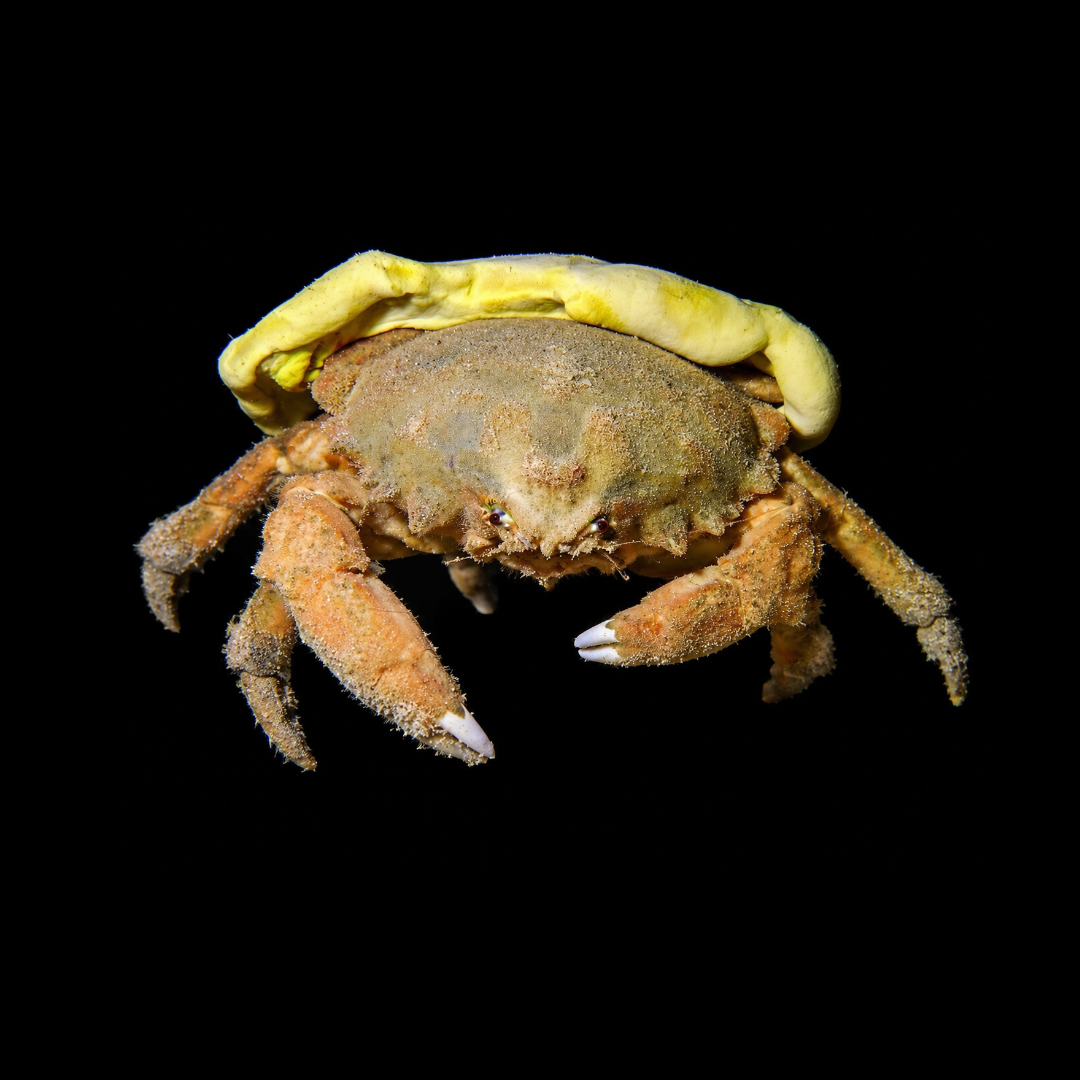
解説 / Description
カイカムリ属は、海綿(カイメン)や群体ホヤなどを背負って暮らす海産のカニの仲間です。丸く盛り上がった甲羅と毛に覆われた体を持ち、後ろの2対の脚で背中の「帽子」を支えます。日本でカイカムリと呼ばれる Lauridromia dehaani は、褐色の体とピンク色を帯びたハサミの先端も特徴的です。素材をハサミで切り、背中に合うくぼみを作る行動には、独特の体のつくりを生かした暮らしぶりが表れています。主に夜間に活動するため、飼育では日中も安心して休める隠れ家が大切です。なお、Lauridromia sp. は、この属の仲間であることは分かっていても、種までは確定していないことを示す表記です。種が未同定の個体については、L. dehaani と大きさや飼育条件が同じとは限りません。 Lauridromia sponge crabs are marine crabs that carry sponges or colonial ascidians over their backs. Their rounded, hairy bodies have two specialized rear pairs of legs that hold this “cap” in place. Lauridromia dehaani, known as kaikamuri in Japan, also has a brown body and distinctive pinkish claw tips. Its ability to trim material and excavate a cavity for its back reveals how its anatomy supports its way of life. These crabs are mainly nocturnal, so a secure daytime shelter is important in an aquarium. The name Lauridromia sp. means that an animal has been identified to genus but not to species. An unidentified specimen should not automatically be assumed to share the adult size or husbandry requirements of L. dehaani.
基本情報 / Basic Information
| 学名 / Scientific Name |
Lauridromia sp. 日本でカイカムリと呼ばれる種は Lauridromia dehaani (Rathbun, 1923)。同属には Lauridromia intermedia (Laurie, 1906) も含まれます。属までしか同定されていない個体を、外見の印象だけで L. dehaani と判断しないようにします。 The species called kaikamuri in Japan is Lauridromia dehaani (Rathbun, 1923). The genus also includes Lauridromia intermedia (Laurie, 1906). A specimen identified only to genus should not be assigned to L. dehaani solely on the basis of its general appearance. |
|---|---|
| 通称 / Common Name | カイカムリ、カイカムリ属の一種。「カイカムリ」という販売名だけでは種を判断できない場合があるため、学名と採集地も確認します。 Kaikamuri, sponge crab, or an unidentified Lauridromia species. A trade name alone may not establish the species, so check the scientific identification and collection locality as well. |
| 分類 / Family | 節足動物門・甲殻亜門・軟甲綱・十脚目・短尾下目・カイカムリ科・カイカムリ属。亜科は Dromiinae。 Phylum Arthropoda; subphylum Crustacea; class Malacostraca; order Decapoda; infraorder Brachyura; family Dromiidae; subfamily Dromiinae; genus Lauridromia. |
| 英名 / English Name | Sponge crab; Japanese sponge crab(Lauridromia dehaani) |
| 分布 / Distribution | 日本を含むインド西太平洋。L. dehaani は日本、台湾、インド、紅海、南アフリカなどから知られます。L. intermedia は日本、台湾、フィリピン、オーストラリア、ニューカレドニアなどに分布します。沿岸の浅い海から大陸棚にかけて見られ、深い場所だけに暮らすカニではありません。 The Indo-West Pacific, including Japan. L. dehaani is known from Japan, Taiwan, India, the Red Sea, and South Africa, among other localities. L. intermedia occurs in Japan, Taiwan, the Philippines, Australia, and New Caledonia, among other areas. These crabs occur from coastal shallows into continental-shelf habitats and are not exclusively deep-water animals. |
| 最大体長 / Max Size | L. dehaani は、甲幅10cm前後に達する大型種です。甲幅とは甲羅の横幅で、脚や背負った素材は含みません。飼育スペースを考える際は、それらを含めた大きさと、歩行や方向転換に必要な余裕も考慮します。種が未同定の個体では、成長後の大きさを判断するためにも種の確認が必要です。 L. dehaani is a relatively large sponge crab, reaching roughly 10 cm in carapace width. This measurement is the width of the shell and excludes the legs and carried material. Aquarium space must accommodate these as well as walking and turning. Identifying an unknown specimen is also important when estimating its eventual adult size. |
| 寿命 / Lifespan | 家庭飼育での標準的な寿命は、はっきりしていません。自然採集個体では入手時の年齢も分からないことが多いため、残りの寿命を見積もることは困難です。飼育開始日とともに、摂餌、活動、脱皮の経過を記録しておくと、個体の変化を把握するのに役立ちます。 A typical lifespan in home aquaria is not well established. The age of a wild-collected animal is often unknown, making its remaining lifespan difficult to estimate. Recording the acquisition date, feeding, activity, and molts helps track changes in the individual. |
飼育環境 / Aquarium Environment
| 水槽サイズ / Tank Size | 飼育計画の目安として、小型個体1匹でも60cm規格水槽(約60L)以上を検討します。甲幅10cm前後の大型個体には、90cm規格水槽(約150~180L)など、より広い底面積を持つ水槽が候補になります。ただし、水槽の寸法だけで十分かどうかを判断することはできません。背負った素材が岩やガラスに引っかからず、隠れ家の中でも無理なく方向転換できる配置が重要です。複数飼育では脱皮前後に個体を分ける場所も必要になるため、まずは単独飼育から始める方が管理しやすいでしょう。 As a practical planning reference, consider a standard 60 cm aquarium of approximately 60 L or larger even for one small specimen. For an animal approaching 10 cm in carapace width, a standard 90 cm aquarium of roughly 150–180 L, or another setup with a larger footprint, is worth considering. Dimensions alone do not determine suitability: the crab must be able to turn and use its shelter without its cap becoming trapped against rockwork or glass. Multiple animals also require options for separation around molts, so keeping one crab is the simpler starting arrangement. |
|---|---|
| 水温 / Temperature | 本属全体に共通する最適水温として、一律の数値を示すことはできません。国内の販売店には、冬季13~17℃、夏季20~27℃前後という管理例がありますが、これは季節によって変わる保管環境の一例です。長期飼育に最適な範囲や、耐えられる水温の限界を示すものではありません。採集地、採集水深、季節、販売店での管理水温を確認し、急激な温度変化を避けます。夏の室温上昇も考慮し、必要に応じて水槽用クーラーやヒーターで温度を管理します。 A single optimum temperature cannot be specified for every species in the genus. A Japanese retailer gives seasonal holding examples of approximately 13–17°C in winter and 20–27°C in summer. These describe one seasonally changing holding environment, not an established optimum for long-term care or guaranteed tolerance limits. Check the collection locality, depth, season, and the retailer’s holding temperature, and avoid abrupt temperature changes. Account for summer room temperatures and use a chiller or heater as needed. |
| 水質 / Water Quality |
海水で飼育し、比重1.024~1.026を一般的な海水水槽の管理目安とします。この範囲を本属に固有の最適値と考えず、導入前の管理条件も確認してください。比重を測る際は、測定温度と器具の校正条件にも注意します。ろ過が安定した水槽を用い、アンモニアの蓄積、酸素不足、急な塩分変化を避けることが基本です。 カルシウム、アルカリ度、マグネシウムについては、サンゴ水槽向けの数値をそのまま脱皮の必須条件に当てはめないようにします。まずは適切に調製した海水による定期換水を基本とし、添加剤は測定で不足や継続的な消費を確認してから検討します。カニを飼うという理由だけで、自動添加設備などが必要になるわけではありません。数値を急いで補正するよりも、水質を安定させることを優先します。 Keep the crab in seawater, using a specific gravity of 1.024–1.026 as a general marine-aquarium reference rather than a species-specific optimum. Check the conditions in which the animal was previously held, and account for measurement temperature and instrument calibration. An established filtration system, adequate oxygenation, and avoidance of ammonia accumulation and abrupt salinity changes are fundamental. Calcium, alkalinity, and magnesium targets used for coral aquaria should not automatically be treated as essential requirements for successful molting in these crabs. Begin with regular water changes using properly prepared seawater. Consider supplements only when measurements indicate a deficiency or continuing consumption. Keeping a crab does not in itself require automated dosing equipment. Prioritize stable conditions over rapid corrections made simply to reach a target number. |
| レイアウト / Layout | 岩陰や張り出した岩の下など、体全体を隠せる場所と、夜間に歩き回れる開けた底面を用意します。ライブロックは崩れないように固定し、通路には背負った素材まで含めて通れる幅を確保します。隠れ家の内部まで強く照らさず、照明の点灯・消灯で昼夜の区別を保ちましょう。天然の海綿も生き物なので、カイカムリとは別に、その海綿に適した環境への配慮が必要です。人工素材を使う場合は、海水水槽で使用できると確認されたものを選びます。洗剤、抗菌剤、香料などを含む家庭用品は使用せず、材質や成分が分からないものも避けます。 Provide a full-body shelter beneath securely positioned rockwork and open floor space for nighttime movement. Passages should accommodate the cap as well as the crab. Keep the shelter shaded and maintain a regular day–night lighting cycle. A natural sponge is also a living animal and has environmental requirements of its own. Use artificial materials only when their suitability for a marine aquarium has been established. Avoid household products containing detergents, antibacterial agents, fragrances, or unknown materials and additives. |
| 注意点 / Precautions | 脱皮前後には、隠れる時間が長くなったり、餌を食べなくなったりすることがあります。無理に引き出したり、背負ったものや脚を引っ張ったりせず、落ち着いて過ごせる環境を保ちます。銅を含む魚病薬は、カイカムリを収容した水槽では使用しません。また、脱皮を促そうとして、ヨウ素や各種ミネラルを測定や必要性の確認なしに追加することも避けます。ふたや配管まわり、吸水口を点検し、脱走や挟まり事故、素材の切れ端による機器の詰まりを防ぎましょう。 The crab may spend more time hidden and stop feeding around a molt. Do not pull it from its shelter or tug at its legs or carried material. Maintain a quiet environment. Do not use copper-based fish medications in an aquarium containing the crab, and do not add iodine or minerals merely to induce molting without checking measurements and establishing a need. Inspect lids, pipe openings, and pump intakes to reduce the risks of escape, entrapment, and blockage by fragments of carried material. |
餌と給餌 / Feeding
| 餌の種類 / Diet | 飼育下では雑食性として扱われ、人工飼料、貝類、冷凍餌などを利用できます。海水生物用の沈下性人工飼料に、アサリのむき身、冷凍アミ、小さく切ったエビや魚肉などを組み合わせ、実際の食べ方を見ながら与えます。海綿を背負っていても、給餌が不要になるわけではありません。ほかの生体の食べ残しだけに頼らず、カイカムリ自身が餌を取れているかを確認します。 In captivity, these crabs are treated as omnivores and can be offered prepared foods, shellfish, and frozen foods. Combine sinking marine foods with small portions of clam flesh, frozen mysids, shrimp, or fish, adjusting the selection according to what the individual actually eats. Carrying a sponge does not remove the need for feeding. Do not rely solely on leftovers from other animals; confirm that the crab receives food itself. |
|---|---|
| 給餌のポイント / Feeding Tips | 消灯の前後に隠れ家の近くへ少量ずつ与えると、摂餌を確認しやすくなります。餌はハサミで扱いやすい大きさに切り、食べる量に合わせて調整します。大きな塊をいくつも入れず、食べ残しは回収してください。食欲が急に落ちた場合は、脱皮前の変化だけでなく、水温や水質、混泳相手からの干渉も確認します。食べないからと餌を追加し続けると、水を汚す原因になります。 Offer small portions near the shelter around lights-out, when feeding may be easier to observe. Cut food into pieces the crab can handle and adjust the amount to its actual consumption. Avoid adding several large chunks, and remove leftovers. If appetite suddenly declines, consider an approaching molt but also check temperature, water quality, and disturbance from tank mates. Continually adding food to an animal that is not eating can foul the water. |
性格と混泳 / Temperament and Tank Mates
| 性格 / Temperament | 昼間は物陰で過ごし、夜に活動することが多いカニです。丸い姿からおとなしく見えても、小さな生き物に対して無害とは限りません。また、背負う素材の選び方や加工の仕方には個体差があり、用意したものをすぐに使わない場合もあります。特定の素材を背負わせようとして繰り返し干渉せず、自分で選んで行動できるようにしておきます。 These crabs tend to remain sheltered by day and become active at night. Their rounded appearance should not be taken as a guarantee of harmlessness toward small animals. Material choice and processing also vary between individuals, and a crab may not immediately use an item that is offered. Avoid repeatedly disturbing it to make it carry a particular material; allow it to choose and act on its own. |
|---|---|
| 混泳の相性 / Compatibility | 行動の観察と脱皮前後の安全を重視するなら、単独飼育が基本です。混泳を検討する場合も、相手がおとなしいという理由だけでは判断せず、互いに捕食や接触の危険がないかを考えます。小型のエビ、巻貝、底で休む小魚との同居は避けた方が無難です。反対に、甲殻類を捕食する大型のベラ、モンガラカワハギ、フグなどは、カイカムリにとって危険な相手になります。サンゴとの相性も一律には判断できません。サンゴの小片を固定しただけで安全と考えず、同居させる場合は接触や破損がないかを確認し、問題があれば分けて飼育します。 Keeping the crab alone is the safest starting point for behavioral observation and protection around molts. A tank mate’s peaceful reputation is not sufficient to establish compatibility; consider predation and physical contact in both directions. Avoid housing the crab with small shrimp, snails, or bottom-resting fish. Conversely, large wrasses, triggerfish, puffers, and other animals that prey on crustaceans can threaten the crab. Compatibility with corals also cannot be assumed. Securing coral fragments does not by itself establish safety; monitor contact and damage and separate the animals if problems occur. |
病気と対策 / Diseases and Prevention
| かかりやすい病気 / Common Diseases | 本属について、家庭飼育で多く見られる病気やその発生頻度を示す情報は限られています。飼育中は、脱皮がうまく進まない、脚やハサミが傷つく、餌を食べなくなるといった変化に注意します。ただし、こうした状態だけで原因を特定することはできません。脱皮の異常をすぐにカルシウム不足と判断せず、栄養状態、水温や塩分の変化、外傷なども確認します。殻の変色や欠損についても、それだけで感染症と決めつけず、変化の経過を記録します。 Information on the diseases most frequently encountered in home-kept Lauridromia and their incidence is limited. Watch for unsuccessful molts, injured limbs or claws, and loss of appetite, but do not assume these signs identify a particular cause. A molting problem should not immediately be attributed to calcium deficiency; also review nutrition, changes in temperature or salinity, and injury. Discoloration or shell damage alone does not establish an infection, so record how the condition develops. |
|---|---|
| 対策と予防 / Prevention | 安定した水温と塩分、十分に酸素が行き渡る清潔な海水、隠れ家、偏りの少ない給餌を基本にします。導入直後は落ち着いた環境で摂餌や脚の動きを観察し、ほかの生体から干渉を受ける場合は分けて管理します。脱皮中の殻を引きはがしたり、魚用の薬や濃い添加液を個体に直接かけたりしてはいけません。状態が悪化する場合は、水温、比重、水質検査値、症状の経過と写真をそろえ、水生無脊椎動物の飼育経験がある専門店や、診療に対応する獣医師へ相談します。 Prioritize stable temperature and salinity, clean and well-oxygenated seawater, shelter, and a varied diet. Observe feeding and limb movement in a quiet environment after introduction, separating the crab if other animals interfere with it. Never peel away the shell during a molt or apply fish medication or concentrated supplements directly to the animal. If its condition worsens, seek advice from an experienced aquatic-invertebrate specialist or a veterinarian who treats aquatic animals, providing measured water conditions, a history of the symptoms, and photographs. |
増やし方(繁殖) / Breeding
| 雌雄の判別 / Sexing | カニ類では一般に、体の下面へ折りたたまれた腹部がオスでは比較的細く、成熟したメスでは卵を抱えるために幅広くなることが判別の目安です。ただし、幼体や未成熟個体では分かりにくく、甲羅の色や体の大きさだけで確実に区別することはできません。確認が必要な場合は、観察に慣れた専門店などへ相談します。腹部を無理に開いたり、長時間裏返したままにしたりすることは避けます。 In crabs generally, males have a relatively narrow folded abdomen, while mature females have a broader abdomen associated with carrying eggs. This distinction can be difficult to assess in juveniles or immature animals, and shell color or body size alone is unreliable. Consult an experienced specialist when identification is needed. Do not force the abdomen open or keep the crab inverted for a prolonged period. |
|---|---|
| 繁殖形態 / Reproduction | 卵生で、メスが腹側に卵を抱えます。カイカムリ L. dehaani は、孵化後にゾエアと呼ばれる浮遊幼生の段階を経て、メガロパへと姿を変え、その後に稚ガニになります。つまり、成体に似た小さなカニが、そのまま卵から出てくるわけではありません。孵化までの日数や幼生期の長さは、種や飼育条件を区別せずに一律の値として扱わないことが大切です。 Females carry eggs beneath the abdomen. In L. dehaani, the hatchlings pass through planktonic zoeal stages, transform into a megalopa, and subsequently become juvenile crabs. They therefore do not hatch directly as miniature adults. Incubation time and the duration of larval development should not be assigned universal values without distinguishing the species and rearing conditions. |
| 繁殖のポイント / Breeding Tips | 親ガニを健康に飼育することと、孵化した幼生を稚ガニまで育てることは、別の課題です。繁殖を目指す場合は、抱卵個体を落ち着いて管理できる場所に加え、幼生を吸い込まない設備、幼生に適した餌、こまめな水質管理が必要になります。成体用の人工飼料だけで育つとは考えず、対象種の幼生飼育に関する情報を確認します。家庭水槽で簡単に増やせる生体としてではなく、孵化や脱皮、摂餌の経過を記録しながら取り組む対象です。 Maintaining healthy adults and rearing hatchlings to the juvenile stage are separate challenges. A breeding attempt requires suitable accommodation for the egg-bearing female, equipment that does not draw larvae into filters, appropriate larval food, and close water-quality management. Do not assume that prepared adult foods will be sufficient. Consult rearing information for the species and approach breeding as a carefully documented project rather than an easy way to increase aquarium stock. |
雑学と豆知識 / Trivia and Fun Facts
| 1. 歩く脚と、帽子を支える脚 / 1. Legs for Walking and Legs for Carrying | カイカムリを正面から見ると、脚が少ないカニのように感じるかもしれません。しかし、脚がなくなったのではなく、後ろの2対が背中側へ向いているのです。ハサミを持つ脚を1対目として数えると、4対目と5対目が背負うための脚に当たります。その先端は、鉤状の部分と向かい合う棘で素材を挟めるつくりになっています。背負う役割をこの2対が担い、前方の2対の歩脚で移動することで、海綿を背中に載せたまま海底を歩けるのです。 Viewed from the front, a sponge crab may seem to have fewer legs than expected. The rear two pairs are not missing; they point upward over the back. Counting the claw-bearing pair as the first, the fourth and fifth pairs are the carrying legs. A hooked terminal part works against opposing spines to grip the material. With these two pairs holding the cap and the two forward pairs of walking legs handling locomotion, the crab can move across the seabed while carrying a sponge. |
|---|---|
| 2. 帽子づくりにも個体差がある / 2. Individual Differences in Cap Making | カイカムリは、与えられた素材をそのまま背負うだけでなく、余分な部分を切り取ったり、内側にくぼみを作ったりします。白浜水族館で L. dehaani を対象に行われた研究では、人工スポンジの選び方や切り取る量に、体の大きさだけでは説明できない個体差が示されました。つまり、同じくらいの大きさのカニでも、素材の選択や加工の仕方が一律ではないということです。ただし、この結果だけで、人間のように完成形を思い描いて作業しているとまではいえません。目の前の加工行動と、その行動を生み出す認知の仕組みは、分けて考える必要があります。 A sponge crab may do more than carry an offered object unchanged: it can trim excess material and excavate a cavity. Research on L. dehaani at Shirahama Aquarium found individual differences in artificial-sponge selection and the amount trimmed that were not explained by body size alone. In other words, similarly sized crabs do not necessarily choose or process material in the same way. This result does not, by itself, demonstrate that they imagine a finished cap and plan their work as humans might. The observed behavior and the cognitive processes behind it remain separate questions. |
| 3. 海綿は、ただの飾りではない / 3. More Than an Ornament | 海綿や群体ホヤを背負うと、カニの体の輪郭が隠れ、周囲の付着生物に紛れやすくなります。自然の素材は大きさも形もさまざまですが、カイカムリはそれを持ち上げたり加工したりして、背中を覆うものとして利用します。見た目には帽子のようでも、カニにとっては身を隠すための覆いなのです。ただし、背負っていればどんな捕食者からも安全になるわけではありません。水槽でも、海綿を背負っていることを理由に、カニを捕食する生き物と同居させるのは避けます。 A sponge or colonial ascidian conceals the crab’s outline and helps it blend with attached organisms around it. Natural materials come in different sizes and shapes, yet the crab can lift or modify them into a covering. What looks like a hat is therefore part of its camouflage rather than an ornament. A cap does not guarantee protection from every predator, however, and should not be used as a reason to house the crab with animals that prey on crustaceans. |
| 4. 「貝被」という名前と、日本につながる学名 / 4. A Japanese Name and a Link to Natural History | カイカムリは漢字で「貝被」と書きますが、実際に背負うものは貝殻だけではなく、海綿やホヤなども含まれます。一方、dehaani という種小名は、日本の甲殻類を研究したデ・ハーンにちなんだものです。1923年には Dromia dehaani として記載され、その後、1993年に設立された Lauridromia 属に移されました。また、かつて同属に含まれた Lauridromia indica は、現在は Dromidiopsis indica として扱われています。古い研究や飼育記録を読む際は、現在と学名が異なる場合があることに注意すると、同じ生き物の情報をたどりやすくなります。 The Japanese name kaikamuri is written with characters suggesting a shell covering, although these crabs also carry sponges and ascidians. The species name dehaani honors De Haan, who studied Japanese crustaceans. The species was described as Dromia dehaani in 1923 and subsequently assigned to Lauridromia, a genus established in 1993. The former Lauridromia indica is now treated as Dromidiopsis indica. Recognizing these changes helps connect older research and husbandry records with the names used today. |
| 5. 色よりも、甲羅や脚の細部に注目 / 5. Identification Beyond Color | 似たカイカムリを見分けるときは、体の色だけでなく、甲羅や脚の形を確認します。L. dehaani には、両眼の間に3つの歯状突起があり、甲羅の前側縁にも4つの歯が並びます。同属の L. intermedia とは、額の中央の歯の見え方や脚の棘など、細かな特徴を比較して区別します。さらに、オオカイカムリ Tumidodromia dormia は別属のカニで、古い資料では Dromia dormia と記されています。大きな個体だからといって、単に「よく育ったカイカムリ」とは限りません。背面、正面、脚の特徴が分かる写真をそろえると、同定や飼育記録に役立ちます。 Identification requires attention to the carapace and legs, not just body color. L. dehaani has three frontal teeth between the eyes and four anterolateral carapace teeth. Distinguishing it from L. intermedia involves details such as the visibility of the central frontal tooth and the spines on the legs. The larger sponge crab Tumidodromia dormia belongs to a different genus and appears in older publications as Dromia dormia. A large animal is therefore not necessarily an exceptionally well-grown L. dehaani. Clear photographs of the dorsal surface, front, and legs assist identification and record keeping. |
| 6. 祖先的な特徴と、独自の進化 / 6. Ancestral Features and Specialized Evolution | カイカムリ類は、カニの進化を考えるうえで重要な祖先的形質を残す仲間として研究されてきました。生殖に関わる器官や、折りたたんだ腹部を体の下面に留める仕組みなどに、多くの身近なカニとは異なる特徴があります。ここでいう「祖先的」とは、祖先から受け継いだ特徴を残しているという意味で、進化が止まっているということではありません。背中側へ向いた脚や、素材を加工して背負う行動は、この仲間ならではの特殊化です。受け継いだ特徴と独自の適応が、一つの体の中に共存しています。 Sponge crabs have long interested researchers because they retain ancestral features relevant to crab evolution. Their reproductive anatomy and mechanisms for holding the folded abdomen beneath the body differ from those of many familiar crabs. “Ancestral” means that a feature has been retained from ancestors, not that evolution has stopped. Their upward-directed legs and material-processing behavior are distinctive specializations. Retained traits and their own adaptations coexist in the same animal. |
| 7. 体を守る物質は、研究の入り口にもなる / 7. Natural Defenses as a Research Starting Point | カイカムリでは、体の中にある物質も研究されています。旧学名の Dromia dehaani を用いた2018年の研究では、血液に相当する体液である血リンパから、抗菌ペプチド「Dromidin」が報告されました。ペプチドはアミノ酸がつながった物質で、この研究は、その中に微生物に対する抗菌作用を示すものがあることを調べたものです。ただし、実験で抗菌作用が見つかることと、人の治療に使える薬になることは別の段階です。また、この発見だけでは、海綿を背負う習性が抗菌物質の進化を促したとは判断できません。薬としての有効性や安全性まで確立したものではなく、生体の防御に関わる物質を調べる研究として捉えることが大切です。 Substances within the crab’s body are also subjects of research. A 2018 study using the former name Dromia dehaani reported an antimicrobial peptide called Dromidin from its hemolymph, the circulating body fluid that serves a role comparable to blood. Peptides are molecules made of linked amino acids, and the study investigated antimicrobial activity in material isolated from this fluid. Laboratory antimicrobial activity is not equivalent to a medicine proven useful for people. Nor does this finding establish that sponge carrying drove the evolution of the antimicrobial substance. It is a contribution to research on biological defenses, not evidence of an established treatment. |
| 8. 日本の海から迎える一匹との付き合い方 / 8. Welcoming a Crab from Japanese Waters | 国内では、近海産の生物を扱う専門店などでカイカムリの販売例があります。漁網を使った採集記録がある一方、販売店には手作業で採集した生体を扱うと案内する例もあり、来歴は一様ではありません。自然から迎える個体だからこそ、珍しさだけで選ばず、採集地、管理水温、摂餌の様子、脚の状態を確認することが大切です。特に、背負うための脚がそろっているかどうかは、この仲間らしい行動を観察するうえでも確認したい点です。迎えた個体を最後まで飼育し、飼育後に海へ放さないことも、身近な海の生き物と付き合う際の基本になります。 Sponge crabs have been offered by Japanese specialists in locally collected marine life. There are records of net collection, while some retailers advertise hand-collected animals, so provenance is not uniform. Before acquiring a wild-collected crab, check its locality, holding temperature, feeding response, and limb condition rather than choosing solely for novelty. The condition of the carrying legs is particularly relevant when observing its characteristic behavior. Responsible care also means keeping the animal for the rest of its life and not releasing an aquarium-kept crab into the sea. |
まとめ / Conclusion
カイカムリは、海綿などを背負うために特殊化した脚を持ち、素材を切ったり、くぼみを作ったりするカニです。丸い体だけでなく、背負うものの選び方や加工の仕方にも観察の楽しみがあります。こうした行動には個体差があり、同じ種類でも一匹ごとに異なる様子が見られます。 Sponge crabs have specialized carrying legs and can trim material or excavate a cavity before holding it over their backs. Their appeal lies not only in their rounded appearance but also in how they select and process a covering. Individual differences mean that animals of the same species do not always behave in the same way.
飼育では、個体の大きさや来歴に合った海水環境を整え、歩き回れる底面と安心して休める隠れ家を確保することが基本です。水温や水質を安定させ、摂餌と脱皮の経過を見ながら管理することが、長期飼育の土台になります。落ち着いた環境で見られる夜間の歩行や素材の加工が、カイカムリならではの観察の魅力です。 Care begins with a marine environment suited to the animal’s size and provenance, enough floor space for movement, and a secure shelter. Stable water conditions and observation of feeding and molts provide the foundation for long-term husbandry. In a settled aquarium, nighttime movement and the handling of carrying material offer the distinctive pleasures of observing a sponge crab.
気になる道具や飼い方を見つけてみませんか?
 アイのアクアグッズ案内テトラミンって、こんなにあるの? アイとコタロウのごはん探究旅道具の特徴や使い方、選ぶときのポイントをアイが紹介します。記事はコチラ →
 アイのアクアグッズ案内グッピー・プラティ・モーリーを親子で楽しむ飼育用品|水槽・稚魚保護・ろ過・餌・水草道具の特徴や使い方、選ぶときのポイントをアイが紹介します。記事はコチラ →
 アイのアクアグッズ案内水槽用浄水器の選び方|水換えを楽にするタイプとROの違い道具の特徴や使い方、選ぶときのポイントをアイが紹介します。記事はコチラ →
 アイのアクアグッズ案内水槽の底砂の選び方|砂・砂利の違いとおすすめ商品道具の特徴や使い方、選ぶときのポイントをアイが紹介します。記事はコチラ →
さまざまな飼育テーマをご紹介。リンク先の記事には広告・商品紹介が含まれます。
案内・紹介記事一覧へ →分布マップ
カイカムリ属(Lauridromia sp.)は、日本を含むインド西太平洋に分布します。 L. dehaani は日本・台湾・インド・紅海・南アフリカなど、 L. intermedia は日本・台湾・フィリピン・オーストラリア・ニューカレドニアなどから知られます。
※この地図は、上記2種の分布地域の位置関係を示す概略表示です。 表示範囲全域での生息や、正確な分布境界を示すものではなく、種ごとの分布も異なります。 マーカーとGoogle Earthのリンク先は、表示用に設定した代表地点(緯度0°・東経95°)であり、 実際の採集地点や生息が確認された地点を示すものではありません。
参考文献・出典
-
分類・学名
World Register of Marine Species(WoRMS).
Lauridromia 属の分類一覧 / Tumidodromia dormia (Linnaeus, 1763)カイカムリ属の有効名と異名、および比較対象であるオオカイカムリの現行学名を確認できる分類データベース。
-
分類・形態・分布・生息環境
Ahyong, S. T., Naruse, T., Tan, S. H. & Ng, P. K. L.(2009).
Crustacean Fauna of Taiwan: Brachyuran Crabs, Volume I — Carcinology in Taiwan and Dromiacea, Raninoida, Cyclodorippoida(PDF)
国立台湾海洋大学。第II部、pp. 48–52。カイカムリ属と L. dehaani・L. intermedia の識別形質、体サイズ、分布、生息水深や底質を記載した分類学資料。
-
分布・形態
Naturalis Biodiversity Center.
Crabs of Japan: Lauridromia dehaaniカイカムリの形態と、日本各地、紅海、南アフリカなどの分布記録を、関連文献とともに掲載した種解説。
-
行動・研究時の飼育方法
Harada, K., Hayashi, N. & Kagaya, K.(2020).
Individual behavioral type captured by a Bayesian model comparison of cap making by sponge crabs
PeerJ, 8, e9036.カイカムリ L. dehaani の素材選択・加工行動と個体差を調べた実験論文。実験時の飼育環境と方法も記載。
-
繁殖・幼生飼育・脱皮
ニフレル(2021年8月11日).
カイカムリ祝1歳!~ヒストリー編~
ニフレル公式キュレーターブログ。抱卵個体から孵化した幼生の飼育記録。ゾエア、メガロパ、稚ガニへの成長、給餌、共食いや闘争を避けるための隔離を紹介。
-
脱皮時の管理・給餌(甲殻類一般)
すさみ町立エビとカニの水族館.
伝言ノート「2016年5月~8月分」
参照箇所:2016年6月21日の回答。甲殻類を健康に保つために水族館で行っている、共食いを避ける隔離と栄養に配慮した給餌についての回答。
-
飼育設備・水質管理(一般資料)
Francis-Floyd, R., Yanong, R. P. E. & Petty, B. D.
Aquatic Life Support System Components
Merck Veterinary Manual(2024年9月更新)。循環式の飼育設備における生物ろ過・物理ろ過・化学ろ過の役割と、残餌や排泄物を含む水槽内の汚れの管理を解説。
-
病気・環境変化への注意(一般資料)
Francis-Floyd, R., Yanong, R. P. E. & Petty, B. D.
Environmental Diseases of Aquatic Animals in Aquatic Systems
Merck Veterinary Manual(2026年6月更新)。水質や水温の変化に関わる健康障害と、水温、塩分、溶存酸素、アンモニアなどの点検について解説した獣医学資料。
-
銅を含む薬剤への注意
Yanong, R. P. E.
Use of Copper in Marine Aquaculture and Aquarium Systems
University of Florida, IFAS Extension. FA165(2024年2月改訂)。海水飼育における銅の作用と、魚の治療に使われる銅濃度が無脊椎動物に及ぼす毒性を解説した大学の技術資料。




コメント