

解説 / Description
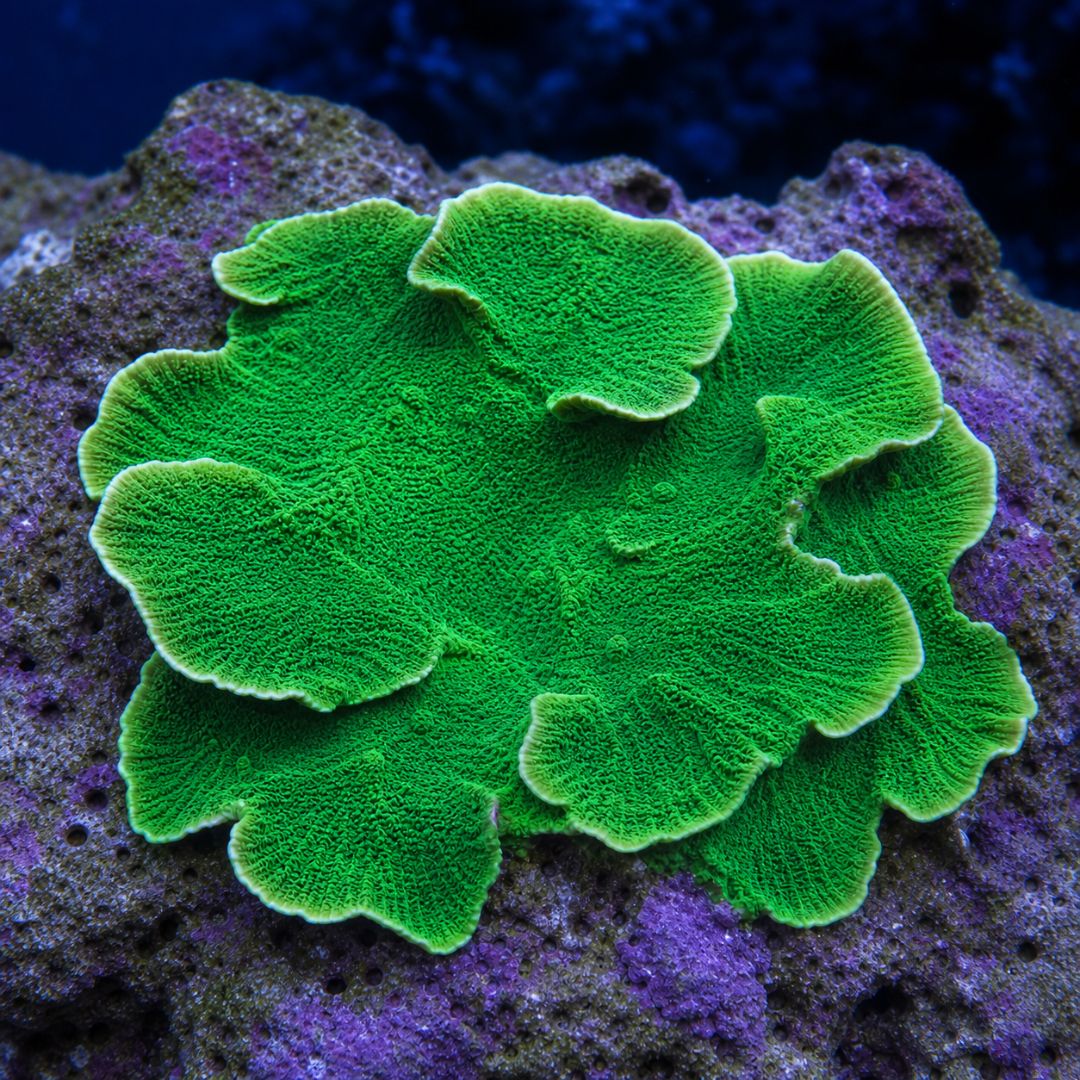
ウスコモンサンゴは、薄い葉を幾重にも重ねたような骨格をつくる、ミドリイシ科コモンサンゴ属の造礁サンゴです。成長すると円盤状、渦巻き状、あるいは薔薇の花びらを思わせる階層的な群体となり、赤、緑、紫などの鮮やかな色彩を見せます。表面には成長端へ向かって連続する細い共肉の隆起が走り、その間に非常に小さなポリプが並びます。比較的丈夫なSPSコーラルとして知られますが、美しい立体形と発色を維持するには、安定した水質、十分な光、堆積物を残さないランダムな水流が重要です。 Montipora foliosa is a reef-building coral in the family Acroporidae, recognized by its exceptionally thin, leaf-like plates. As it grows, the colony may form broad discs, layered whorls, or rose-like tiers in vivid shades of red, green, and purple. Fine, continuous coenosteum ridges run toward the growing edge, with minute polyps arranged between them. It is regarded as a comparatively hardy SPS coral, but stable water chemistry, adequate lighting, and random flow that prevents sediment accumulation are essential for maintaining its best form and coloration.
基本情報 / Basic Information
| 学名 / Scientific Name | Montipora foliosa |
|---|---|
| 通称 / Common and English Names | ウスコモンサンゴ。流通上は、色彩や産地名を付した商品名で扱われることもあります。Montipora foliosa; it is also commonly sold as a plating or foliose Montipora, sometimes under trade names based on color or origin. |
| 分類 / Classification | 刺胞動物門、花虫綱、六放サンゴ亜綱、イシサンゴ目、ミドリイシ科、コモンサンゴ属。Phylum Cnidaria, Class Anthozoa, Subclass Hexacorallia, Order Scleractinia, Family Acroporidae, Genus Montipora. |
| 分布 / Distribution | 紅海からインド洋、コーラルトライアングル、オーストラリア、日本南部を含むインド太平洋域に分布します。波の直撃を受けにくい礁湖や、保護されたサンゴ礁の上部斜面にある浅海域を主な生息場所とし、大西洋には分布しません。It is distributed throughout the Indo-Pacific, from the Red Sea and Indian Ocean to the Coral Triangle, Australia, and southern Japan. It primarily inhabits shallow lagoons and sheltered upper reef slopes with good light and indirect water movement, and it does not occur in the Atlantic. |
| 最大サイズ / Maximum Size | 群体は横方向へ広く成長し、自然下では広い面積を覆うことがあります。本種では、厳密な最大群体径を一つの数値で示すことが難しく、水槽内では設置空間と定期的なトリミングによって大きさを管理します。Colonies can spread widely across the substrate in nature. Because a single definitive maximum colony diameter is difficult to specify, aquarium size is usually managed through available space and regular trimming. |
| 寿命 / Lifespan | 正確な寿命は不明です。群体性サンゴは成長と部分的な再生を繰り返すため、環境が安定していれば長期維持が可能です。The exact lifespan is unknown. As a colonial coral capable of continued growth and partial regeneration, it may be maintained for many years under stable conditions. |
飼育環境 / Aquarium Environment
| 水槽サイズ / Tank Size | 厳密な最小水量は定めにくいものの、成長後の広がりと水質の安定性を考えると、60cm規格水槽(約57L)以上が飼育の目安です。長期的に自然なプレート形を育てる場合は、90cm規格水槽(約150L前後)以上を選ぶと、配置とトリミングに余裕を持たせやすくなります。There is no rigid minimum volume, but a standard 60 cm aquarium of about 57 L is a practical guideline when future spread and water stability are considered. For long-term development of natural plating forms, a standard 90 cm aquarium of roughly 150 L or more provides more room for placement and trimming. |
|---|---|
| 水温・比重 / Temperature and Specific Gravity | 水温24〜27℃、比重1.024〜1.026を目安にします。数値そのもの以上に急変を避けることが重要で、水温の日内変動はできるだけ小さく保ちます。Maintain 24–27°C and a specific gravity of 1.024–1.026. Avoiding rapid change is more important than chasing a single exact value, and daily temperature fluctuation should be kept minimal. |
| 水質 / Water Quality | アルカリ度7.0〜12.0 dKH、カルシウム400〜450 ppm、マグネシウム1,250〜1,350 ppm、硝酸塩2〜10 ppm、リン酸塩0.01〜0.05 ppmを目安にします。特にアルカリ度は急変させず、7〜8 dKH付近を安定して維持する管理が適しています。微量元素を添加する場合は、測定結果と換水計画に合わせ、過剰添加を避けます。Suggested targets are alkalinity 7.0–12.0 dKH, calcium 400–450 ppm, magnesium 1,250–1,350 ppm, nitrate 2–10 ppm, and phosphate 0.01–0.05 ppm. Alkalinity stability is especially important, and many systems perform well when held consistently near 7–8 dKH. When trace elements are added, dosing should be aligned with test results and the water-change schedule to avoid excess. |
| 光量 / Lighting | 中〜強光が適し、PAR 150〜300程度が目安です。導入直後は100〜150 PAR程度から始め、2〜4週間かけて徐々に照明出力または設置位置を調整します。光量が不足すると褐色化し、平面的に広がりやすくなります。一方、十分な光が得られる環境では、立体的なカップ状や階層状に育ちやすくなります。Moderate to strong light is suitable, with approximately 150–300 PAR as a working range. Newly introduced colonies should begin around 100–150 PAR and be acclimated over two to four weeks by gradually adjusting output or placement. Insufficient light may promote browning and flatter growth. By contrast, adequate light encourages layered, cup-shaped development. |
| 水流 / Water Flow | 中〜強程度の幅広くランダムな間接流が適します。葉状部の上にデトリタスが残らず、ポリプが穏やかに揺れる流れを目指します。ポンプの直撃による一方向の強流は、組織を傷めるおそれがあります。Use moderate to strong, broad, random indirect flow. The goal is to keep detritus from settling on the plates while allowing the polyps to move gently. Avoid a concentrated one-direction jet that may damage tissue. |
| レイアウト・配置 / Layout and Placement | 水槽の中層から上層に固定し、将来プレートが横へ広がる空間を確保します。下方のサンゴを陰にしやすいため、成長後の影と水流の抜け方まで見越して配置します。フラグはサンゴ用ジェル接着剤やエポキシパテで岩へ確実に固定します。Secure it in the middle to upper part of the aquarium with ample horizontal space for future plating growth. Because it can shade corals below, plan for the colony’s future shadow and water-flow pathways. Attach fragments firmly to rock using coral-safe cyanoacrylate gel or epoxy putty. |
| 注意点 / Precautions | 急な高光量、アルカリ度や塩分の変動、葉状部への堆積物、転倒を避けます。導入個体は裏面や基部まで観察し、コモンサンゴ食害ウミウシや卵塊の持ち込みを警戒します。成長が速いため、周囲のサンゴとの間隔と定期的な剪定も必要です。Avoid sudden increases in light, rapid changes in alkalinity or salinity, sediment buildup on the plates, and unstable placement. Inspect the underside and base of new specimens for Montipora-eating nudibranchs and egg masses. Fast growth also requires adequate spacing and periodic pruning. |
餌と給餌 / Feeding
| 栄養の得方・餌 / Nutrition and Diet | 体内の共生褐虫藻が行う光合成から多くのエネルギーを得ます。加えて、水中の微細な有機物やプランクトン性粒子も取り込むと考えられます。補助的に与える場合は、SPS向けの微粒子フードや細かなプランクトンフードが適します。It obtains much of its energy from photosynthesis performed by symbiotic dinoflagellates in its tissues. It is also thought to capture fine suspended organic matter and planktonic particles. If supplemental feeding is used, choose very fine SPS or plankton-based foods. |
|---|---|
| 給餌のポイント / Feeding Tips | 直接給餌は必須ではなく、安定した照明と適度な栄養塩の維持が基本です。補助給餌を行う場合は、微粒子フードをごく少量から試し、ポリプに届くよう給餌中だけ水流を弱めます。食べ残しによるリン酸塩や硝酸塩の上昇を避けるため、過剰給餌は控えます。Direct feeding is not essential; stable lighting and balanced nutrient levels remain the foundation. When supplemental feeding is used, begin with a very small amount of fine food and briefly reduce flow so particles can reach the polyps. Avoid overfeeding, which can raise phosphate and nitrate. |
性質と相性 / Characteristics and Compatibility
| 形態・成長 / Form and Growth | 極めて薄い葉状骨格を形成する群体性サンゴです。プレートは渦巻き状や階層状に重なり、年間3〜6cm程度の成長が目安とされます。少ない骨格形成で広い受光面積を確保する成長戦略を持ち、水槽内でも比較的速く周囲へ広がります。This colonial coral forms exceptionally thin foliose plates that overlap into whorls or tiers. Annual growth is often estimated at roughly 3–6 cm. By creating a broad light-receiving surface with relatively little skeletal material, it can spread quickly through the surrounding aquarium space. |
|---|---|
| 攻撃性 / Aggression | スイーパー触手による積極的な攻撃性は比較的弱いとされます。ただし、接触部では組織障害が起こり得るほか、旺盛な成長によって隣接サンゴを覆い、光と水流を奪うことがあります。接触しない余裕を取り、成長端を定期的に管理します。Direct aggression through long sweeper tentacles is considered relatively weak. However, tissue damage may occur at contact points, and rapid growth can overtop neighboring corals, depriving them of light and flow. Leave adequate spacing and manage the growing edge regularly. |
| 相性 / Compatibility | 一般的なリーフセーフの魚や無脊椎動物と同居できます。サンゴをつつく魚、転倒させる大型甲殻類、コモンサンゴを食害する生物には注意が必要です。他のSPSやLPSとは接触を避け、イソギンチャクが移動して触れない位置に配置します。クマノミとの特別な共生関係はありません。It is compatible with most reef-safe fishes and invertebrates. Avoid coral-nipping fish, large crustaceans that may dislodge it, and organisms known to feed on Montipora. Prevent contact with other SPS or LPS corals, and place it away from wandering anemones. It has no special symbiotic relationship with clownfish. |
病気と対策 / Diseases and Prevention
| 不調・病気・害虫 / Problems, Diseases, and Pests | 代表的な問題は、急な高水温や光量変化による白化、光不足や高栄養塩による褐色化、アルカリ度の急変に伴うRTNやSTN、堆積物が原因となる局所的な組織後退です。害虫ではコモンサンゴ食害ウミウシや小型の無腸類ヒラムシが特に危険で、裏面や基部からまだら状に共肉を食害します。Common problems include bleaching from sudden heat or lighting changes, browning under insufficient light or excessive nutrients, rapid or slow tissue necrosis associated with abrupt alkalinity shifts, and localized tissue recession caused by trapped sediment. Major pests include Montipora-eating nudibranchs and small acoel flatworms, which often feed from the underside or base and leave patchy exposed skeleton. |
|---|---|
| 対策と予防 / Prevention | 水温、比重、アルカリ度を定期的に測定し、急変を避けます。導入時は隔離して観察し、必要に応じてサンゴ用ディップ剤を製品の使用方法に従って使用します。薬浴で除去できない卵塊は柔らかいブラシなどで物理的に取り除き、必要に応じて1週間間隔で3〜4回処置します。壊死が進行する場合は、健康な部分を患部から十分に離して切り出し、新しい台座へ固定します。Test temperature, specific gravity, and alkalinity regularly, and avoid abrupt changes. Quarantine and inspect new specimens, using any coral dip strictly according to the product instructions. Because egg masses may survive dipping, remove them physically with a soft brush and, when needed, repeat treatment weekly for three to four rounds. If tissue loss progresses, cut healthy tissue well away from the affected area and remount it on a clean plug. |
増やし方(繁殖・株分け) / Reproduction and Propagation
| 無性生殖・株分け / Asexual Reproduction and Fragmentation | 骨格が薄いためフラグ化しやすく、ボーンカッターやサンゴ用ペンチで健康な成長端を切り分けられます。断片はサンゴ用ジェル接着剤やエポキシパテでプラグまたはライブロックへ固定すると、切断面から共肉を広げて活着します。Its thin skeleton makes fragmentation straightforward. Healthy growing edges can be cut with coral bone cutters or pliers. Secure each fragment to a plug or live rock with coral-safe cyanoacrylate gel or epoxy, and it will extend tissue from the cut edge as it attaches. |
|---|---|
| 有性生殖 / Sexual Reproduction | 雌雄同体で、卵と精子を含むバンドルを水中へ一斉に放出する放卵放精型です。卵には親由来の褐虫藻が取り込まれており、共生藻を垂直伝播することが特徴です。家庭水槽で有性生殖から育成することは非常に難しく、通常は株分けで増殖します。It is hermaphroditic and reproduces by broadcast spawning, releasing bundles that contain both eggs and sperm. The eggs already contain symbiotic algae inherited from the parent, a form of vertical transmission. Raising offspring from sexual reproduction is very difficult in home aquariums, so propagation is normally achieved by fragmentation. |
| 増殖のポイント / Propagation Tips | 十分に健康で発色とポリプ展開が安定した親株を使用し、器具は作業前後に洗浄します。フラグを水平に寝かせるだけでなく、切断面をやや上向きに斜め固定すると、周囲へ巻くような立体的成長を促しやすくなります。作業後は強い直射水流を避け、安定した中程度の光と清潔な水流で回復させます。Use a healthy parent colony with stable coloration and polyp extension, and clean tools before and after use. Instead of mounting every fragment flat, fixing it at a slight angle with the cut edge raised can encourage more three-dimensional, radiating growth. After cutting, avoid harsh direct flow and allow recovery under stable moderate light and clean circulation. |
毒性と取り扱い / Toxicity and Handling
| 毒性 / Toxicity | 刺胞動物であるため刺胞を備えますが、人への影響に関する詳しい情報は限られています。一般的な取り扱いで強い刺激が問題になることは多くありませんが、粘液が傷口や粘膜に触れると刺激を感じる可能性があります。As a cnidarian, it possesses stinging cells, although detailed information about effects on humans is limited. Strong irritation is not commonly reported during ordinary handling, but mucus contacting an open wound or mucous membrane may cause discomfort. |
|---|---|
| 取り扱い上の注意 / Handling Precautions | 株分けや薬浴の際はニトリル手袋と保護眼鏡を使用し、粘液や海水が目、口、傷口へ入らないようにします。作業後は手と器具を十分に洗浄し、サンゴ片や付着物を家庭内で加熱・煮沸することは避けます。骨格の鋭い縁による切り傷にも注意が必要です。Wear nitrile gloves and eye protection during fragmentation or dipping, and prevent mucus or aquarium water from contacting the eyes, mouth, or open wounds. Wash hands and tools thoroughly afterward, and avoid heating or boiling coral fragments or attached organisms in the home. The sharp skeletal edges can also cause cuts. |
雑学と豆知識 / Trivia and Fun Facts
| 名前に刻まれた「葉」の形 / A Name Shaped Like a Leaf | 種小名のfoliosaは「葉の多い」「葉状の」という意味を持ち、その名の通り、薄い骨格を幾重にも広げる姿を表しています。1766年にPallasがMadrepora foliosaとして記載して以来、分類上の所属は変遷しましたが、葉を思わせる姿は一貫して本種を象徴してきました。The species name foliosa means “leafy” or “leaf-like,” a direct reference to its layered, thin skeletal plates. Since Pallas first described it as Madrepora foliosa in 1766, its taxonomic placement has changed, but its leaf-like form has remained the defining image of the species. |
|---|---|
| 似ている種は表面の模様で見分ける / Identifying Look-Alikes by Surface Texture | 葉状に広がるコモンサンゴは外形だけでは見分けにくく、ウスコモンサンゴでは成長端へ向かって連続するライン状の共肉隆起が重要な手掛かりになります。チヂミウスコモンサンゴでは線ではなく細かな乳頭状突起が目立ち、キャプリコーニスでは顕著な隆起や突起が少なく比較的単調な表面に見えるなど、同定には骨格表面の観察が欠かせません。Plating Montipora species can be difficult to separate by colony outline alone. In M. foliosa, continuous ridge-like lines running toward the growing edge are an important clue. Related species may instead show small papillae or a comparatively plain surface with few prominent ridges or projections, making close examination of skeletal texture essential. |
| 蛍光色は光を操るための仕組み / Fluorescence as a Light-Management System | 鮮やかな赤や緑、紫は単なる装飾ではありません。宿主がつくる蛍光タンパク質や非蛍光性の色素タンパク質は、強すぎる光を和らげたり、限られた短波長光を別の波長へ変換したりして、共生褐虫藻の光合成環境を調整します。色彩は、サンゴが自らの組織内の光を管理していることを示す、生理機能の表れでもあります。Its red, green, and purple colors are more than decoration. Fluorescent proteins and non-fluorescent chromoproteins produced by the coral host can reduce excessive light or transform short-wavelength light into other wavelengths, helping regulate conditions for its symbiotic algae. Color is therefore also an outward sign of internal light management. |
| 白くならず鮮やかになる白化 / Bleaching That Becomes More Colorful | 褐虫藻が減少する途中で、組織内へ届く青色光が増えると、防御色素の発現が強まり、白化中にもかかわらずネオン色や濃い紫へ見えることがあります。このカラー・ブリーチングは美しい発色とは異なり、回復を助ける防御反応と考えられています。急な色の変化を単純な色揚がりと判断せず、水温、光量、栄養塩の状態を確認することが大切です。As symbiotic algae decline, more blue light can penetrate the tissues, stimulating stronger production of protective pigments. The coral may therefore appear neon-bright or deep purple even while bleaching. This “colorful bleaching” is considered a protective recovery response rather than ordinary improved coloration, so sudden color change should prompt checks of temperature, lighting, and nutrients. |
| 薄さは弱さではなく効率の形 / Thinness as an Efficient Strategy | 薄いプレートは壊れやすく見えますが、少ない炭酸カルシウムで大きな受光面をつくれる合理的な構造です。横へ広がることで光を効率よく確保し、重なったプレートの間には小型生物の隠れ場所も生まれます。水槽内で見せる薔薇のような姿は、装飾的な形であると同時に、光を巡る生存戦略そのものです。The thin plates may appear fragile, yet they are an efficient design that creates a broad light-catching surface with relatively little calcium carbonate. As the colony spreads, spaces between overlapping plates also provide shelter for small reef organisms. Its rose-like aquarium form is therefore both ornamental and a direct expression of its strategy for securing light. |
まとめ / Conclusion
ウスコモンサンゴは、薄いプレートを幾重にも重ねながら光を受け、水槽内に大きな立体感を生み出す魅力的なSPSコーラルです。比較的丈夫で株分けもしやすい一方、安定したアルカリ度、適切な光順応、デトリタスを残さないランダムな水流が、美しい発色と健やかな成長を支えます。 Montipora foliosa is an appealing SPS coral that receives light across its layered plates and adds strong three-dimensional structure to a reef aquarium. Although comparatively hardy and easy to fragment, its best coloration and healthy growth depend on stable alkalinity, careful light acclimation, and random flow that prevents detritus from settling.
小さなフラグが岩に活着し、やがて渦を巻く花のような群体へ育っていく過程は、長期飼育ならではの楽しみです。色合いや成長端、ポリプの開き方を日々観察していくと、ウスコモンサンゴは水槽環境の変化を伝える頼もしい存在にもなります。 Watching a small fragment attach to rock and gradually grow into a whorled, flower-like colony is one of the rewards of long-term care. By observing its color, growing edge, and polyp extension each day, the aquarist can also use it as a valuable indicator of changing aquarium conditions.

気になる道具や飼い方を見つけてみませんか?
 アイのアクアグッズ案内水換え・底砂掃除の道具の選び方|砂利・砂・ソイルに合うクリーナーとポンプ道具の特徴や使い方、選ぶときのポイントをアイが紹介します。記事はコチラ →
 アイのアクアグッズ案内水槽ライトの選び方|魚の見え方・水草・海水で選ぶおすすめ照明道具の特徴や使い方、選ぶときのポイントをアイが紹介します。記事はコチラ →
 アイのアクアグッズ案内そのごはん、泳いでる! 卵から始めるブラインシュリンプの孵化と道具選び道具の特徴や使い方、選ぶときのポイントをアイが紹介します。記事はコチラ →
 アイのアクアグッズ案内水槽のエアーポンプの選び方|水深・音・泡で選ぶおすすめ用品道具の特徴や使い方、選ぶときのポイントをアイが紹介します。記事はコチラ →
さまざまな飼育テーマをご紹介。リンク先の記事には広告・商品紹介が含まれます。
案内・紹介記事一覧へ →分布マップ
ウスコモンサンゴは、紅海からインド洋、コーラルトライアングル、オーストラリア、日本南部にかけてのインド太平洋域に広く分布します。地図の範囲と代表点は分布の全体像を示すための概略であり、実際の採集地点や厳密な生息範囲を示すものではありません。
この地図は文献的な分布説明を視覚化した概略表示です。色付き範囲とマーカーは実際の採集地点、個体の確認地点、厳密な分布境界を示すものではありません。
参考文献
分類・形態・分布・生息環境
-
WoRMS Editorial Board. “Montipora foliosa (Pallas, 1766).” World Register of Marine Species.
https://www.marinespecies.org/aphia.php?p=taxdetails&id=207182 -
Veron, J. E. N., Stafford-Smith, M. G., Turak, E., and DeVantier, L. M. “Montipora foliosa.” Corals of the World.
形態・生息環境 / 分布情報 -
Todd, P. A. 2008. “Morphological Plasticity in Scleractinian Corals.” Biological Reviews, 83(3): 315–337.
https://doi.org/10.1111/j.1469-185X.2008.00045.x
繁殖・共生藻の伝播
-
Babcock, R. C., Bull, G. D., Harrison, P. L., Heyward, A. J., Oliver, J. K., Wallace, C. C., and Willis, B. L. 1986. “Synchronous Spawnings of 105 Scleractinian Coral Species on the Great Barrier Reef.” Marine Biology, 90: 379–394.
https://doi.org/10.1007/BF00428562 -
Baird, A. H., Guest, J. R., and Willis, B. L. 2009. “Systematic and Biogeographical Patterns in the Reproductive Biology of Scleractinian Corals.” Annual Review of Ecology, Evolution, and Systematics, 40: 551–571.
https://doi.org/10.1146/annurev.ecolsys.110308.120220 -
van Oppen, M. J. H., Koolmees, E. M., and Veron, J. E. N. 2004. “Mode of Zooxanthella Transmission Does Not Affect Zooxanthella Diversity in Acroporid Corals.” Marine Biology, 144(1): 1–7.
https://doi.org/10.1007/s00227-003-1187-4
飼育環境・水質・光・水流・給餌・株分け
-
Leal, M. C., Ferrier-Pagès, C., Petersen, D., and Osinga, R. 2016. “Coral Aquaculture: Applying Scientific Knowledge to Ex Situ Production.” Reviews in Aquaculture, 8(2): 136–153.
https://doi.org/10.1111/raq.12087 -
Houlbrèque, F., and Ferrier-Pagès, C. 2009. “Heterotrophy in Tropical Scleractinian Corals.” Biological Reviews, 84(1): 1–17.
https://doi.org/10.1111/j.1469-185X.2008.00058.x -
Salih, A., Larkum, A., Cox, G., Kühl, M., and Hoegh-Guldberg, O. 2000. “Fluorescent Pigments in Corals Are Photoprotective.” Nature, 408: 850–853.
https://doi.org/10.1038/35048564 -
Smith, E. G., D’Angelo, C., Sharon, Y., Tchernov, D., and Wiedenmann, J. 2017. “Acclimatization of Symbiotic Corals to Mesophotic Light Environments through Wavelength Transformation by Fluorescent Protein Pigments.” Proceedings of the Royal Society B, 284: 20170320.
https://doi.org/10.1098/rspb.2017.0320 -
Wiedenmann, J., D’Angelo, C., Smith, E. G., Hunt, A. N., Legiret, F. E., Postle, A. D., and Achterberg, E. P. 2013. “Nutrient Enrichment Can Increase the Susceptibility of Reef Corals to Bleaching.” Nature Climate Change, 3: 160–164.
https://doi.org/10.1038/nclimate1661
白化・色彩変化・堆積物による組織障害
-
Bollati, E., D’Angelo, C., Alderdice, R., Pratchett, M., Ziegler, M., and Wiedenmann, J. 2020. “Optical Feedback Loop Involving Dinoflagellate Symbiont and Scleractinian Host Drives Colorful Coral Bleaching.” Current Biology, 30(13): 2433–2445.e3.
https://doi.org/10.1016/j.cub.2020.04.055 -
Weber, M., de Beer, D., Lott, C., Polerecky, L., Kohls, K., Abed, R. M. M., Ferdelman, T. G., and Fabricius, K. E. 2012. “Mechanisms of Damage to Corals Exposed to Sedimentation.” Proceedings of the National Academy of Sciences, 109(24): E1558–E1567.
https://doi.org/10.1073/pnas.1100715109
病気・害虫・予防管理
-
Wang, A., Conti-Jerpe, I. E., Richards, J. L., and Baker, D. M. 2020. “Phestilla subodiosus sp. nov. (Nudibranchia, Trinchesiidae), a Corallivorous Pest Species in the Aquarium Trade.” ZooKeys, 909: 1–24.
https://doi.org/10.3897/zookeys.909.35278 -
Ushijima, B., Smith, A., Aeby, G. S., and Callahan, S. M. 2012. “Vibrio owensii Induces the Tissue Loss Disease Montipora White Syndrome in the Hawaiian Reef Coral Montipora capitata.” PLOS ONE, 7(10): e46717.
https://doi.org/10.1371/journal.pone.0046717 -
Raymundo, L. J., Couch, C. S., Bruckner, A. W., and Harvell, C. D., editors. 2008. Coral Disease Handbook: Guidelines for Assessment, Monitoring and Management. Coral Reef Targeted Research and Capacity Building for Management Program.
U.S. Geological Survey 書誌情報
文献・データベース確認日:2026年8月2日





コメント