

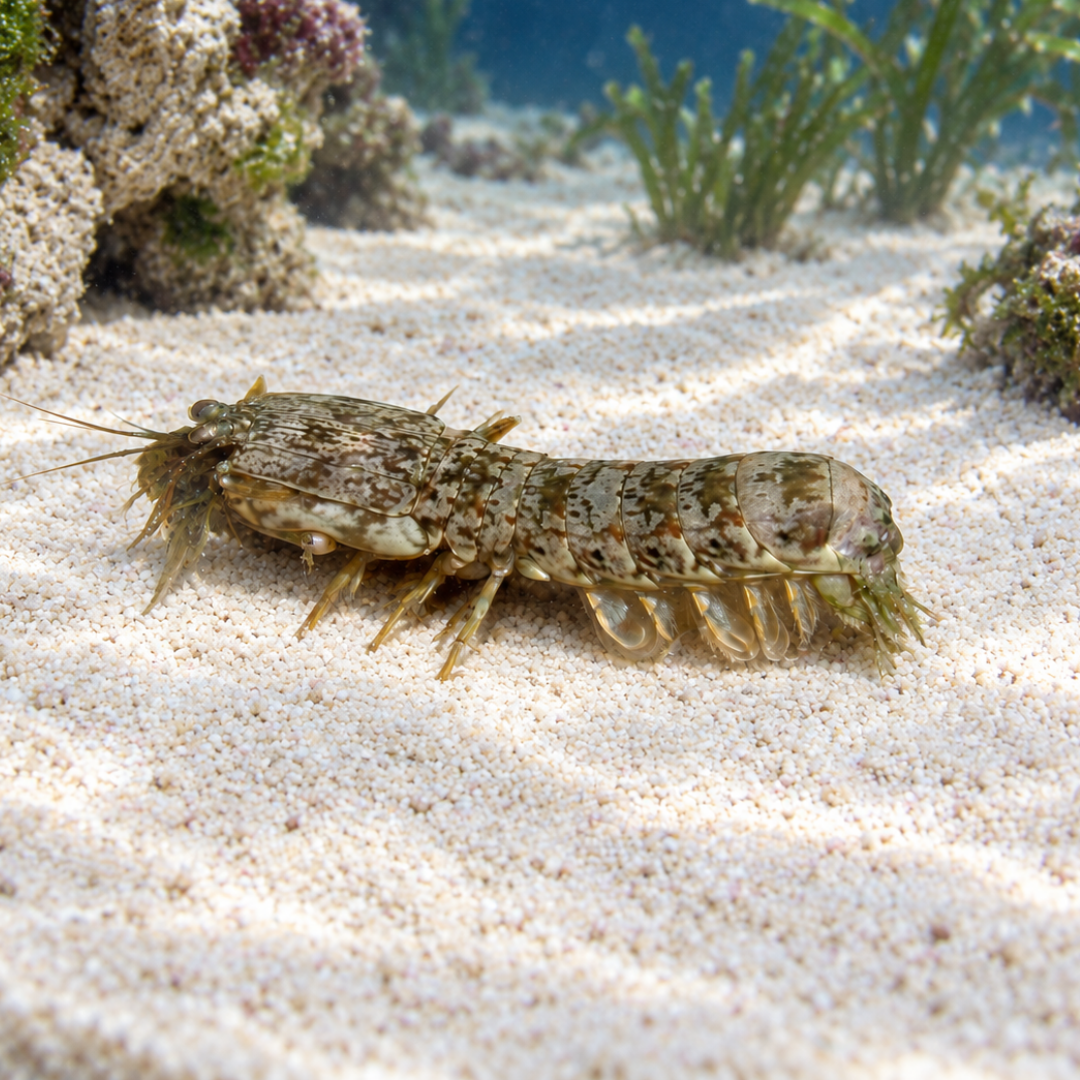
解説 / Description
フトユビシャコは、インド太平洋の浅い岩礁やサンゴ礁に広く分布するフトユビシャコ科の口脚類です。最大体長は約10.5cmで、巻き貝などの硬い獲物を捕らえる「打撃型(スマッシャー)」の代表的な種類です。大きな特徴は、筋肉の力を捕脚内部の弾性構造へいったん蓄え、そのエネルギーを瞬間的に解放して高速の打撃を生み出す仕組みにあります。筋肉だけで捕脚を直接振り抜くのではなく、いわばバネをためてから一気に放つことで、非常に素早い動きを実現しています。 Gonodactylus chiragra is a stomatopod of the family Gonodactylidae widely distributed in shallow rocky and coral reef habitats of the Indo-Pacific. Reaching about 10.5 cm in maximum total length, it is a representative “smasher” mantis shrimp adapted for attacking hard-shelled prey such as gastropods. One of its defining features is a power-amplified raptorial system that first stores muscular energy in elastic structures and then releases that energy rapidly. Rather than relying on direct muscle contraction alone, the appendage operates much like a spring that is loaded before being released.
一方で、フトユビシャコの特徴は打撃力だけではありません。眼柄の先にある複眼は自由度の高い動きを示し、中央には特殊な個眼が並ぶ赤道帯があります。本種では直線偏光を高感度で捉える光受容細胞が確認されており、人間とは異なる光の情報を利用しています。また、自然界では岩やサンゴの既存の空洞を生活の拠点とし、捕食、休息、脱皮、繁殖など多くの行動をその周囲で行います。飼育下でもこうした性質が見られるため、十分な隠れ家と安定した海水環境を整えることで、本種ならではの行動を観察できます。 Its remarkable biology extends beyond striking power. The stalked compound eyes are highly mobile, and each eye contains a specialized mid-band formed by modified ommatidia. In this species, photoreceptors with high sensitivity to linear polarization have been demonstrated, allowing it to use optical information that humans do not normally perceive. In nature, G. chiragra typically uses existing cavities in rock or coral as the center of its activities, including feeding, resting, molting and reproduction. These tendencies remain apparent in captivity, making secure shelter and stable marine conditions important for observing its natural behavior.
基本情報 / Basic Information
| 学名 / Scientific Name | Gonodactylus chiragra (Fabricius, 1781) |
|---|---|
| 通称 / Common Name | フトユビシャコClubfoot mantis shrimp |
| 分類 / Family | 節足動物門・軟甲綱・トゲエビ亜綱・口脚目・フトユビシャコ科・フトユビシャコ属Phylum Arthropoda, Class Malacostraca, Subclass Hoplocarida, Order Stomatopoda, Family Gonodactylidae, Genus Gonodactylus |
| 英名 / English Name | Clubfoot Mantis Shrimp |
| 分布 / Distribution | インド洋西部から東南アジア、日本、オーストラリア、ニューカレドニア、フランス領ポリネシアなどにかけてのインド太平洋域に広く分布します。主に潮間帯から浅い潮下帯の岩礁、礁原、サンゴや岩の隙間などで見られます。Widely distributed across the Indo-Pacific, from the western Indian Ocean through Southeast Asia and Japan to Australia, New Caledonia and French Polynesia. It is mainly found from the intertidal zone to shallow subtidal habitats on reef flats, rocky areas and within coral or rock crevices. |
| 最大体長 / Max Size | 約10.5cmApproximately 10.5 cm total length |
| 寿命 / Lifespan | 本種の寿命を一律の年数で示せる資料は限られています。飼育下で複数年維持された例はありますが、5~6年以上といった年数を本種の標準的な寿命として断定することは避けたほうが適切です。Reliable information defining a standard lifespan for this species is limited. Individuals have been maintained in captivity for multiple years, but a fixed figure such as five to six years should not be treated as an established typical lifespan for G. chiragra. |
飼育環境 / Aquarium Environment
| 水槽サイズ / Tank Size | 体格に応じて十分な底面積を確保し、成体では40L前後をひとつの目安として考えると管理しやすくなります。余裕を持たせる場合は、底面積を確保しやすい60cm規格水槽(約60L)が扱いやすいでしょう。ただし、本種について科学的に定められた「最低水量」があるわけではないため、水量だけでなく、巣穴を設置できる底面積や水質の安定性も重視します。Provide sufficient floor space for the size of the individual. Around 40 liters can serve as a practical reference for an adult, while a standard 60 cm aquarium of roughly 60 liters offers more room for shelter placement and maintenance. There is no scientifically established minimum tank volume for this species, so floor space, shelter design and water stability should be considered together rather than judging suitability by volume alone. |
|---|---|
| 水温 / Temperature | 23~26℃を目安に、急激な水温変化を避けて安定させます。 Maintain approximately 23–26°C and avoid sudden temperature fluctuations. |
| 水質 / Water Quality | 一般的な熱帯性海水生物を飼育できる安定した海水環境を維持します。目安としてpH8.2~8.4、比重1.023~1.025程度とし、アンモニアと亜硝酸塩を検出されない状態に保ちます。十分に立ち上がったろ過設備を使用し、残餌の除去と定期的な換水によって水質の悪化を防ぎます。Maintain stable marine conditions suitable for tropical marine invertebrates. As a practical reference, keep the water around pH 8.2–8.4 and a specific gravity of approximately 1.023–1.025, with ammonia and nitrite kept undetectable. Mature filtration, prompt removal of uneaten food and regular water changes help prevent deterioration in water quality. |
| レイアウト / Layout | ライブロックやサンゴ石、塩ビパイプなどを利用し、全身を隠せる暗く狭い巣穴を用意します。自然界では砂底を深く掘って巣穴を一から作るというより、岩やサンゴにある既存の空洞を利用し、その内部を捕脚で削るなどして調整します。そのため、飼育下でも安定した構造の隠れ家を用意することが重要です。巣穴の周囲にサンゴ礫や小石、貝殻片などを置くと、材料を動かして入り口を整える行動も観察できます。Use live rock, coral rock or PVC pipe to provide a dark, narrow shelter large enough to conceal the entire animal. In nature, this species generally occupies existing cavities in rock or coral rather than excavating a deep burrow from loose sediment, although it can chip and modify the cavity. A stable shelter is therefore an important part of the aquarium. Coral rubble, small stones and shell fragments placed nearby can also be used by the animal when modifying the entrance. |
| 注意点 / Precautions | 強力な捕脚を持つため、素手で個体を追い込んだり、手で直接つかんだりしないようにします。大型個体では硬い面を繰り返し打撃する可能性もあるため、水槽の材質や厚み、岩組みの安定性には十分な余裕を持たせます。アクリル水槽は衝撃による破損リスクを抑えたい場合の選択肢になりますが、「ガラス水槽は必ず割れる」「アクリルでなければ飼育できない」とまでは言えません。また、脱皮前後は巣穴にこもりやすく、脱皮直後は外骨格が柔らかいため、巣穴を動かしたり無理に姿を確認したりせず静かに管理します。Because of its powerful raptorial appendages, never corner the animal with bare hands or attempt to grasp it directly. Larger individuals may repeatedly strike hard surfaces, so aquarium construction, wall thickness and the stability of rockwork deserve careful consideration. Acrylic is one option when additional resistance to impact damage is desired, but it is not accurate to state that every glass aquarium will be broken or that acrylic is mandatory in all cases. Around molting, the shrimp often remains hidden and its new exoskeleton is soft immediately after ecdysis, so avoid disturbing the shelter or forcing the animal into view. |
餌と給餌 / Feeding
| 餌の種類 / Diet | 肉食性で、自然界では巻き貝をはじめとする硬い殻を持つ小動物を捕食します。飼育下ではクリル、イカ、アサリ、白身魚などの海産性の餌を利用できます。状態を見ながら適切な大きさの殻付きの貝などを与えると、本来の打撃行動を観察する機会にもなります。This carnivorous species naturally preys on small animals with hard external coverings, including gastropods. In captivity it can be offered marine foods such as krill, squid, clam and pieces of white fish. Appropriately sized shelled prey may also provide opportunities to observe its natural smashing behavior. |
|---|---|
| 給餌のポイント / Feeding Tips | 一度に大量の餌を与えるよりも、個体の食欲を確認しながら食べ切れる量を与えます。食べ残しは水質悪化の原因になるため、早めに取り除きます。食欲が落ち、巣穴にこもる時間が長くなった場合は脱皮が近い可能性もあります。脱皮中や脱皮直後は無理に餌を与えず、外骨格が硬化して自発的に活動を再開するまで刺激を控えます。柔らかい餌だけを与えると捕脚が正常に形成されなくなる、といった因果関係は確認が十分ではないため、餌の種類は栄養面と自然な採餌行動の両方を考えて選びます。Offer an amount that the animal can consume rather than providing excessive food at one time, and remove leftovers promptly to protect water quality. Reduced appetite and prolonged hiding may occur before a molt. Do not force feeding during or immediately after molting; allow the animal to resume activity on its own after the new exoskeleton has hardened. Claims that a soft-food diet by itself causes abnormal development of the raptorial appendages are not sufficiently established, so food choices are better based on nutrition and opportunities for natural feeding behavior. |
性格と混泳 / Temperament and Tank Mates
| 性格 / Temperament | 縄張り性があり、適した巣穴を生活の中心として利用します。自然界では利用できる空洞が重要な資源となるため、巣穴をめぐって同種や他のシャコ類と争うことがあります。本種は昼間に活動する傾向が知られており、環境に慣れると巣穴の入り口から周囲を観察したり、餌に反応して外へ出たりする姿を見せます。夜間には小石や破片などで巣穴の入り口をふさぐ行動も報告されています。This species is territorial and uses a suitable cavity as the center of its activities. Because appropriate shelters are valuable resources in nature, conflicts can occur with conspecifics and other stomatopods. G. chiragra is known to be primarily active during the day, and settled individuals may watch their surroundings from the shelter entrance or emerge in response to food. Individuals have also been observed closing the entrance at night with small stones or debris. |
|---|---|
| 混泳の相性 / Compatibility | 観賞飼育では単独飼育を基本とするのが安全です。貝類や甲殻類などは捕食対象になり、魚も種類や大きさ、行動によっては攻撃を受ける可能性があります。同種同士でも巣穴をめぐる闘争が起こり得るため、日常的な飼育で安易に同居させるのは避けます。特に脱皮直後の個体は無防備になるため、複数飼育では事故の危険が高まります。Solitary housing is the safer default for display aquaria. Mollusks and crustaceans can become prey, while fish may also be attacked depending on their size and behavior. Conspecifics can fight over shelters, so routine cohabitation should not be attempted casually. The risk is particularly high when one animal has recently molted and is temporarily vulnerable. |
病気と対策 / Diseases and Prevention
| かかりやすい病気 / Common Diseases | フトユビシャコについて、家庭での観賞飼育を前提とした特定疾病の情報は限られています。そのため、特定の病名を「かかりやすい病気」として挙げるよりも、水質悪化や急激な環境変化による衰弱、外傷、脱皮時のトラブルなどに注意するほうが実用的です。食欲低下や巣ごもりは脱皮前にも見られるため、それだけで病気と判断しないようにします。Information on specific diseases of G. chiragra in home aquaria is limited. Rather than assigning particular diseases as characteristically common, practical care should focus on problems associated with deteriorating water quality, abrupt environmental change, physical injury and complications around molting. Reduced appetite and prolonged hiding can also occur before a normal molt, so these signs alone do not demonstrate disease. |
|---|---|
| 対策と予防 / Prevention | 水温と比重を安定させ、アンモニアや亜硝酸塩を蓄積させないことが基本です。残餌を放置せず、十分に機能したろ過設備と定期的な換水によって清浄な海水を維持します。脱皮の兆候があるときはレイアウト変更や過度な観察を避け、個体が巣穴の中で落ち着いて過ごせる環境を保ちます。Prevention begins with stable temperature and salinity and with preventing the accumulation of ammonia and nitrite. Remove uneaten food promptly and maintain clean marine water through mature filtration and regular water changes. When a molt appears imminent, avoid rearranging the aquarium or repeatedly disturbing the animal, and allow it to remain undisturbed within its shelter. |
増やし方(繁殖) / Breeding
| 雌雄の判別 / Sexing | 本種には性的二形があり、体色にも雌雄差が見られます。オスは褐色を帯びた暗緑色系、メスは灰緑色から白っぽい色合いを示す傾向があります。ただし、体色には個体差があるため、色だけを絶対的な判別基準とするのは避けます。The species is sexually dimorphic, and males and females often differ in coloration. Males tend toward brownish to dark green coloration, whereas females are generally gray-green to whitish. Individual variation occurs, so coloration alone should not be treated as an infallible method of sex determination. |
|---|---|
| 繁殖形態 / Reproduction | 雌雄のある有性生殖を行います。シャコ類では巣穴が交尾や産卵後の卵の保護にも重要な場所となり、フトユビシャコも生活の多くを巣穴の周囲で行います。成体には縄張り性があるため、繁殖を目的とする場合でも雌雄を常時同じ水槽に入れておけばよいという種類ではありません。G. chiragra reproduces sexually with separate males and females. In stomatopods, the shelter is also an important location for mating and the protection of eggs, and G. chiragra conducts much of its life around such cavities. Because adults are territorial, breeding cannot be approached simply by keeping a male and female together permanently. |
| 繁殖のポイント / Breeding Tips | 一般家庭の水槽で本種を安定して繁殖させるための実用的な情報は限られており、繁殖難易度は高いと考えられます。成体同士を接触させる際には闘争の危険があり、さらにふ化後には浮遊生活を送る幼生期があります。親個体の飼育だけでなく幼生まで管理する必要があるため、通常の単独飼育より専門的な設備と管理が必要です。Practical information for reliably breeding this species in a typical home aquarium is limited, and captive propagation is difficult. Contact between adults carries a risk of aggression, and the life cycle also includes a planktonic larval stage after hatching. Successful propagation therefore requires management not only of the adults but also of the larvae, making it considerably more specialized than ordinary solitary maintenance. |
雑学と豆知識 / Trivia and Fun Facts
| 1. 18世紀から続く分類の歴史 / 1. A Taxonomic History Dating Back to the 18th Century | フトユビシャコは1781年にSquilla chiragraとして記載され、現在はGonodactylus chiragraとして扱われています。Gonodactylus属そのものは1827年に設けられました。過去には外見の似た複数のシャコ類がG. chiragraの変種などとして扱われたことがあり、その後の分類学的な再検討によって別種や別属へ整理された例が数多くあります。現在でも学名の後ろに命名者名が括弧付きで表記されるのは、最初に記載されたときとは異なる属に置かれていることを示しています。The species was originally described in 1781 as Squilla chiragra and is now accepted as Gonodactylus chiragra. The genus Gonodactylus itself was established in 1827. Historically, several similar-looking stomatopods were treated as varieties or forms associated with G. chiragra, but later taxonomic revisions transferred many of them to distinct species or genera. The parentheses around the authority in the modern scientific name indicate that the species is no longer placed in the genus in which it was originally described. |
|---|---|
| 2. 筋力だけでは生み出せない高速打撃 / 2. A Strike Too Fast for Muscle Alone | フトユビシャコの捕脚は、筋肉がそのまま高速で腕を振り抜く仕組みではありません。筋肉の収縮によって捕脚内部の弾性構造にエネルギーを蓄え、ラッチとして働く構造で動きを一時的に抑えたあと、それを解放します。つまり、筋肉は瞬間的な打撃を直接生み出すというより、事前に「バネをためる」役割を担っています。この仕組みが、筋肉だけでは難しい高速運動を可能にしています。The raptorial appendage does not achieve its extreme speed simply by contracting a muscle as rapidly as possible. Muscular contraction first loads elastic structures within the appendage while latch-like elements temporarily prevent forward rotation. Releasing the system then converts the stored elastic energy into rapid movement. In other words, the muscles largely act to load the biological spring before the strike rather than directly producing the entire burst of power at the moment of impact. |
| 3. 打撃型シャコの高速運動とキャビテーション / 3. High-Speed Smashing and Cavitation | 打撃型シャコの非常に高速な打撃では、捕脚の周囲で水圧が急激に低下し、キャビテーションと呼ばれる気泡が生じることが知られています。気泡は短時間で崩壊し、周囲に圧力変化を生じさせます。フトユビシャコも同じ打撃型の高速捕脚システムを持ちますが、本種について紹介する際には、打撃型シャコで確認されている現象をすべて本種固有の測定結果として扱わないことが大切です。重要なのは、彼らの捕脚が単なる筋力による「パンチ」ではなく、弾性エネルギーと水中での高速運動が関わる特殊な仕組みだという点です。Extremely rapid strikes in smashing mantis shrimps are known to produce sharp pressure drops in the surrounding water, which can create cavitation bubbles. Their rapid collapse produces additional pressure changes. G. chiragra possesses the same general type of power-amplified smashing system, but phenomena demonstrated in smashing stomatopods should not automatically be presented as measurements made specifically on this species. The important point is that its strike is a specialized mechanical system involving stored elastic energy and extremely rapid movement through water, rather than a simple muscle-powered punch. |
| 4. 一つの眼の中に三つの視野領域を持つ / 4. Three Viewing Regions Within a Single Eye | シャコ類の複眼は、上下の半球部と中央の赤道帯という三つの領域に分かれています。これらの領域の視野は一部重なっており、一つの眼だけでも同じ狭い空間を複数の方向から捉えられる独特の構造になっています。口脚類では単眼でも距離を判断できる能力が報告されてきましたが、その詳しい仕組みには未解明な点も残っています。つまり、人間のように左右二つの眼だけを組み合わせる視覚とは異なり、一つの複眼そのものが非常に複雑な情報取得装置になっているのです。A stomatopod eye is divided into three major regions: the dorsal hemisphere, the ventral hemisphere and the central mid-band. Their fields of view overlap, allowing different regions within a single eye to examine the same narrow part of space. Stomatopods have long been reported to possess monocular distance-judging ability, although the exact mechanism remains incompletely understood. The important distinction is that each compound eye is itself a highly complex visual instrument rather than functioning simply as one half of a conventional two-eye system. |
| 5. 人間にはそのまま見えない直線偏光を捉える / 5. Detecting Linear Polarization Invisible to Humans | フトユビシャコでは、複眼中央の赤道帯に並ぶ個眼のうち、特定の光受容細胞が直線偏光に高い感度を示すことが電気生理学的な研究で確認されています。特に赤道帯の第5列と第6列では、異なる向きの偏光を捉えられるように光受容構造が配置されています。これは単に「色をたくさん見分ける」という話ではなく、光がどの方向に振動しているかという、人間の裸眼では直接感じられない性質まで視覚情報として利用できることを意味します。Electrophysiological studies of G. chiragra have demonstrated high sensitivity to linear polarization in particular photoreceptors of the eye’s mid-band. In rows five and six, receptor structures are arranged to respond to different orientations of polarized light. This is not simply a matter of distinguishing additional colors: the animal can use information about the orientation of light waves, a property that unaided human vision does not directly perceive. |
| 6. 尾節は争いの中で身を守る重要な構造 / 6. The Telson Is an Important Defensive Structure | シャコ類の尾端にある尾節は分類上の重要な特徴であるだけでなく、同種間の争いでは防御にも使われます。打撃型シャコは相手の攻撃に対して体を丸め、尾節を相手側へ向けることがあります。強力な捕脚を持つ動物同士が争う以上、攻撃する能力だけでなく、攻撃を受けたときに重要な部分を守る構造も生存に関わります。フトユビシャコを見るときは、捕脚だけでなく尾端の頑丈な形にも注目すると、この動物の攻撃と防御の両面が見えてきます。The telson at the rear of a stomatopod is important not only for taxonomy but also for defense during interactions with other individuals. Smashing stomatopods can curl the body and present the telson toward an opponent during conflict. In animals equipped with powerful striking appendages, survival depends not only on the ability to attack but also on protecting vulnerable parts of the body from similar blows. Looking beyond the raptorial appendages to the robust tail region therefore reveals another side of the animal’s defensive biology. |
| 7. 巣穴は単なる隠れ家ではない / 7. A Shelter Is More Than a Hiding Place | フトユビシャコにとって岩穴は、外敵から逃れるだけの場所ではありません。捕食の拠点となり、餌を処理する場所や脱皮時の避難所としても利用され、繁殖に関わる行動もその周囲で行われます。本種は既存の岩やサンゴの空洞を利用し、必要に応じて内部を削ったり、周囲の小石や破片を動かしたりします。飼育下で塩ビパイプや岩穴の周囲を盛んに作り変える姿は、単なる「いたずら」ではなく、自然界で生活空間を整えてきた行動の延長と考えると理解しやすくなります。For G. chiragra, a rocky cavity is much more than a place to escape predators. It functions as a base for feeding, a place in which prey can be processed, a refuge during molting and a site associated with reproductive behavior. The species occupies existing cavities in rock or coral and can modify them by chipping the interior or moving nearby stones and debris. When an aquarium specimen repeatedly rearranges material around a PVC pipe or rocky shelter, the behavior is better understood as an extension of its natural management of living space rather than simple random disturbance. |
| 8. 損傷した付属肢は脱皮を通して再生できる / 8. Damaged Appendages Can Regenerate Through Molting | 甲殻類であるフトユビシャコは、損傷した付属肢を脱皮を重ねながら再生する能力を持っています。捕脚のように生活上重要な器官を失った場合でも再生は可能ですが、すぐに元の大きさと機能へ戻るわけではありません。脱皮は単に成長するための現象ではなく、外骨格や付属肢を更新する機会でもあります。そのため、飼育下では脱皮前後に水質を急変させたり、巣穴を壊したりしないことが特に重要です。As a crustacean, G. chiragra can regenerate damaged appendages over successive molts. Even an important structure such as a raptorial appendage can regenerate, although it does not instantly return to full size and function. Molting is therefore not merely a process of growth; it also provides an opportunity to renew the exoskeleton and damaged appendages. This is one reason sudden changes in water conditions or disturbance of the shelter should be avoided around the molt cycle. |
| 9. 高度な偏光視覚を持つのに、偏光模様は目立たない / 9. Sophisticated Polarization Vision Without Polarized Body Signals | フトユビシャコは直線偏光を高感度で捉えられる一方、偏光を利用した目立つ体表のシグナルを持たないことが研究で指摘されています。研究者は、岩穴という限られた資源をめぐる競争が激しい本種では、視覚的なディスプレイよりも実際の闘争に使える強力な武器が重要になった可能性を一つの進化的解釈として示しています。ただし、これは「武器と模様のどちらか一方しか進化できない」と証明されたという意味ではありません。高度な偏光視覚の用途が、同種間の体表シグナルだけに限られていないことを考えるうえで興味深い例です。G. chiragra has highly sensitive linear polarization vision, yet research has noted that it lacks the conspicuous polarized body markings found in a number of other stomatopods. Researchers have proposed, as one evolutionary interpretation, that intense competition for restricted cavity habitats may have favored powerful weapons used in direct conflict rather than elaborate body signals. This does not demonstrate a simple either-or evolutionary trade-off between weapons and markings. Instead, it highlights that sophisticated polarization vision can have functions beyond reading conspicuous signals from members of the same species. |
まとめ / Conclusion
フトユビシャコは、弾性エネルギーを利用する高速の捕脚と、直線偏光を捉える特異な複眼を備えた海洋性甲殻類です。岩やサンゴの空洞を生活の中心として利用し、周囲の材料を動かしながら自分の居場所を整える姿にも、本種の生態がよく表れています。目立つのは強力な打撃ですが、その背景には捕食、防御、感覚、巣穴での生活が互いに結び付いた独特の体の仕組みと行動があります。 Gonodactylus chiragra is a marine crustacean characterized by a high-speed, elastically powered raptorial system and unusual compound eyes capable of detecting linear polarization. Its biology is also closely tied to cavities in rock and coral, which it uses as the center of its activities while rearranging surrounding material to maintain its living space. Although its powerful strike attracts the most attention, the species is equally notable for the way feeding, defense, sensory biology and shelter use are integrated into its way of life.
飼育では、単独飼育を基本とし、全身を隠せる安定した巣穴と清浄で変化の少ない海水環境を用意することが大切です。特に脱皮前後は刺激を抑え、個体自身のペースを崩さないように管理します。環境が安定すると、巣穴から周囲をうかがう姿や、小石や貝殻を運んで生活空間を整える行動、餌に素早く反応する様子など、フトユビシャコが本来持つ多様な行動をじっくり観察できます。 In captivity, solitary housing, a stable shelter large enough to conceal the entire animal and consistently clean marine water form the foundation of care. Disturbance should be minimized around molting so that the animal can proceed at its own pace. Under stable conditions, keepers can observe a wide range of characteristic behaviors, from watching the surroundings at the shelter entrance to moving stones and shell fragments and responding rapidly to food.

気になる道具や飼い方を見つけてみませんか?
 アイのアクアグッズ案内マジックリーフ物語|一枚の葉がアクアリウム用品になるまで道具の特徴や使い方、選ぶときのポイントをアイが紹介します。記事はコチラ →
 アイのアクアグッズ案内アフリカンシクリッドの飼育用品|水槽・ろ過・底砂・岩組み・餌の選び方道具の特徴や使い方、選ぶときのポイントをアイが紹介します。記事はコチラ →
 アイのアクアグッズ案内お魚を撮ったのに、ボクが写ってる! スマホで楽しむ水槽撮影と便利な道具道具の特徴や使い方、選ぶときのポイントをアイが紹介します。記事はコチラ →
 アイのアクアグッズ案内水槽用浄水器の選び方|水換えを楽にするタイプとROの違い道具の特徴や使い方、選ぶときのポイントをアイが紹介します。記事はコチラ →
さまざまな飼育テーマをご紹介。リンク先の記事には広告・商品紹介が含まれます。
案内・紹介記事一覧へ →分布マップ
フトユビシャコ(Gonodactylus chiragra)は、インド洋西部から東南アジア、日本、オーストラリア、ニューカレドニア、フランス領ポリネシアなどにかけてのインド太平洋域に広く分布します。
この地図は分布地域を把握するための概略表示です。マーカーは分布域のおおよその中心を示す代表地点であり、実際の採集地点や個体の確認地点を示すものではありません。
参考文献
- WoRMS Editorial Board. Gonodactylus chiragra (Fabricius, 1781). World Register of Marine Species. WoRMSで確認 対応:有効学名、命名者、分類、異名・旧分類の整理
- Ahyong, S. T. (2001). Revision of the Australian Stomatopod Crustacea. Records of the Australian Museum, Supplement, 26, 1–326. DOI: 10.3853/j.0812-7387.26.2001.1333. Australian Museum 対応:分類、形態、最大体長、性的二形、分布、生息環境
- Ahyong, S. T. & Moosa, M. K. (2004). Stomatopod Crustacea from Anambas and Natuna Islands, South China Sea, Indonesia. The Raffles Bulletin of Zoology, Supplement 11, 61–66. Lee Kong Chian Natural History Museum 対応:インド太平洋域での記録、浅海域、サンゴ礁・岩礁周辺での生息
- 東京大学総合研究博物館 動物部門. シャコ類標本データベース:フトユビシャコ Gonodactylus chiragra (Fabricius, 1781). 東京大学総合研究博物館 対応:和名、分類、日本国内の標本記録、沖縄・伊豆諸島などでの記録
- Reaka, M. L. & Manning, R. B. (1981). The Behavior of Stomatopod Crustacea, and Its Relationship to Rates of Evolution. Journal of Crustacean Biology, 1(3), 309–327. DOI: 10.2307/1547964. Oxford Academic 対応:岩穴利用、縄張り・攻撃行動、交尾、卵保護、脱皮時の巣穴利用、単独飼育上の注意の生態学的背景
- Reaka, M. L. (1979). Patterns of Molting Frequencies in Coral-Dwelling Stomatopod Crustacea. The Biological Bulletin, 156(3), 328–342. DOI: 10.2307/1540921. The Biological Bulletin 対応:フトユビシャコを含むサンゴ礁性シャコ類の脱皮、生体サイズと脱皮頻度、脱皮管理に関する基礎情報
- Marshall, N. J., Land, M. F. & Cronin, T. W. (2014). Shrimps that pay attention: saccadic eye movements in stomatopod crustaceans. Philosophical Transactions of the Royal Society B, 369(1636), 20130042. DOI: 10.1098/rstb.2013.0042. PubMed 対応:飼育下での海水環境、25℃での維持、PVC製シェルターの使用例
- Ahyong, S. T., Caldwell, R. L. & Erdmann, M. V. (2017). Collecting and processing stomatopods. Journal of Crustacean Biology, 37(1), 109–114. DOI: 10.1093/jcbiol/ruw005. Oxford Academic 対応:シャコ類の生息場所、攻撃性、活体を扱う際の注意、安全な取り扱いの基礎




コメント