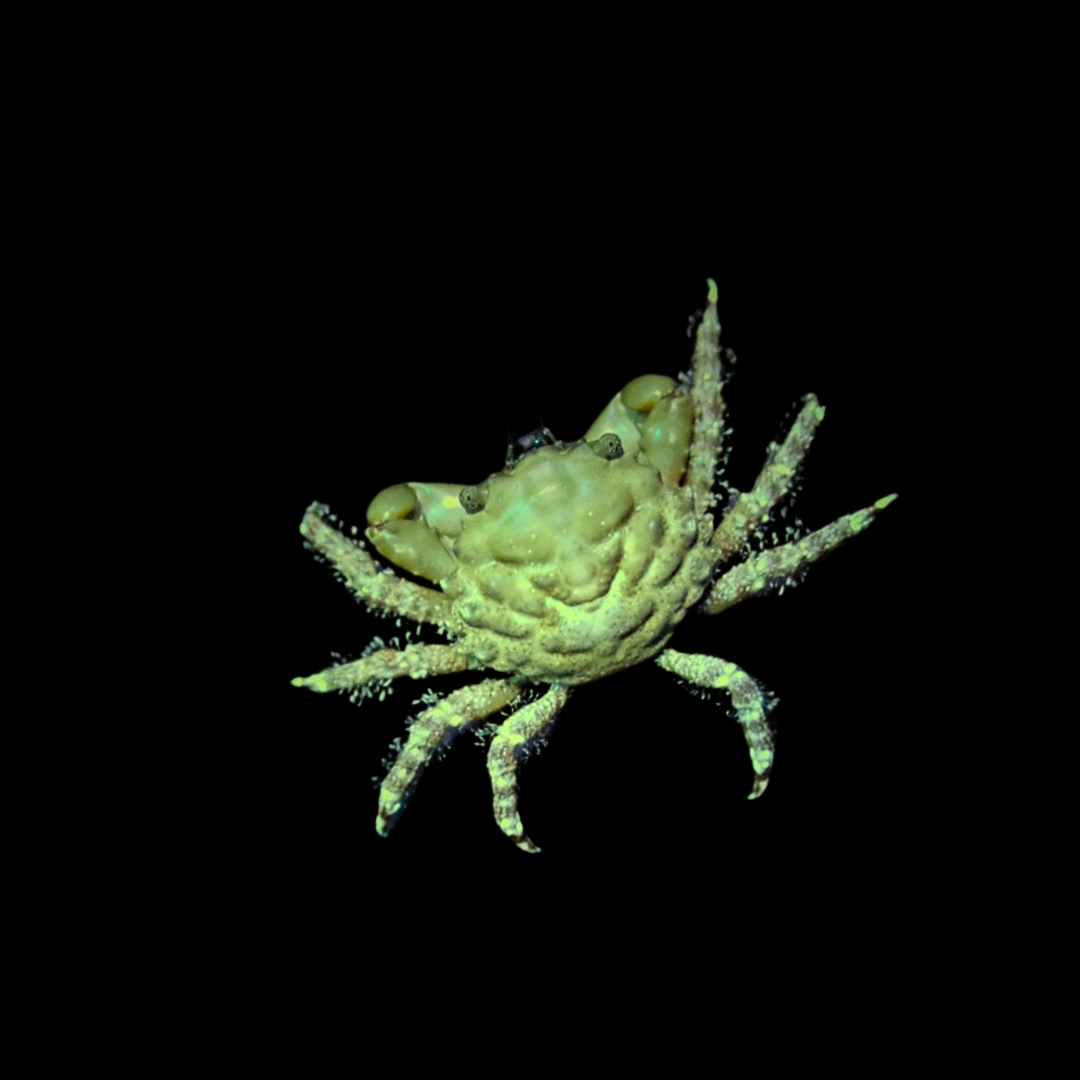
エメラルドグリーンクラブは、カリブ海やメキシコ湾周辺の浅い岩礁・サンゴ礁に生息する小型の海産カニです。鮮やかな緑色の体色と、岩肌の藻類をつまみ取るように使う白い先端のハサミが特徴で、リーフアクアリウムでは「クリーナー生体」として親しまれています。特にバブルアルジーを食べることがあるため人気がありますが、万能の駆除役ではなく、残餌や動物質の餌を優先する場面もあります。水槽内では、藻類管理を任せきりにするのではなく、水質管理・給餌量の調整・隠れ家づくりと組み合わせて飼育することが大切です。The emerald crab is a small marine crab native to shallow rocky and reef habitats around the Caribbean Sea and Gulf of Mexico. It is known for its vivid green coloration and pale-tipped claws, which are used to pick and scrape algae from hard surfaces. In reef aquaria, it is valued as part of a cleanup crew, especially because it may feed on bubble algae. However, it is not a guaranteed algae-removal solution; it may prefer leftover food or meaty foods when these are available. Successful care depends on combining its grazing behavior with stable water quality, careful feeding, and plenty of secure hiding places.
基本情報 / Basic Information
学名 / Scientific Name
Mithraculus sculptus
通称 / Common Name
エメラルドグリーンクラブ、エメラルドクラブEmerald crab, green clinging crab
分類 / Family
節足動物門 甲殻亜門 軟甲綱 十脚目 短尾下目 クモガニ上科 モガニ科Phylum Arthropoda, Subphylum Crustacea, Class Malacostraca, Order Decapoda, Infraorder Brachyura, Superfamily Majoidea, Family Mithracidae
英名 / English Name
Emerald crab / Green clinging crab
分布 / Distribution
カリブ海、メキシコ湾、バハマ、フロリダ南部からブラジル北部にかけての熱帯西部大西洋。浅場の岩礁、サンゴ礁、硬い底質の環境で見られます。Tropical western Atlantic, including the Caribbean Sea, Gulf of Mexico, Bahamas, southern Florida, and southward to northern Brazil. It occurs in shallow hard-bottom, rocky, and reef habitats.
最大体長 / Max Size
おおむね4cm前後。販売個体はより小さな若い個体で流通することが多く、個体差があります。Around 4 cm in general references. Aquarium specimens are often sold at smaller sizes, and individual variation occurs.
寿命 / Lifespan
飼育下では環境により大きく変わります。安定した水質と十分な隠れ家、脱皮に必要なミネラル管理ができていれば、複数年の飼育が期待されます。Lifespan in captivity varies greatly with conditions. With stable water quality, secure shelters, and proper mineral balance for molting, multi-year care may be possible.
飼育環境 / Aquarium Environment
水槽サイズ / Tank Size
単独飼育の目安は30L以上、できれば45cm規格水槽程度からが扱いやすいです。複数匹を入れる場合は縄張り争いを避けるため、45cm規格水槽から60cm規格水槽以上を目安にし、ライブロックで隠れ場所を分散させます。For a single specimen, 30 L or larger can work, while a standard 45 cm aquarium or larger is easier to manage. For multiple individuals, use at least a standard 45 to 60 cm aquarium and distribute live rock shelters to reduce territorial conflict.
水温 / Temperature
24〜26℃前後を目安に安定させます。短時間の変化よりも、日々の急変を避けることが重要です。Keep the temperature stable at around 24–26°C. Avoid sudden daily swings rather than chasing a single exact number.
水質 / Water Quality
比重1.023〜1.025、pH 8.0〜8.4前後を目安に、アンモニアと亜硝酸が検出されない安定した海水環境で飼育します。硝酸塩やリン酸塩が高い状態は藻類の増殖にもつながるため、換水、プロテインスキマー、吸着材などで管理します。無脊椎動物のため銅を含む魚病薬は使用できません。Maintain stable marine conditions, roughly specific gravity 1.023–1.025 and pH around 8.0–8.4, with no detectable ammonia or nitrite. Elevated nitrate and phosphate can also fuel algae growth, so use water changes, skimming, and adsorption media as needed. Copper-based medications must not be used with marine invertebrates.
レイアウト / Layout
ライブロックを組み、日中や脱皮直後に隠れられる狭い割れ目や洞窟を複数作ります。力が強く、小さなサンゴ片や不安定な岩を動かすことがあるため、レイアウトは崩れにくく固定しておくと安心です。Provide live rock with multiple narrow crevices and caves where the crab can hide during the day and immediately after molting. Because it can move small coral fragments or unstable rocks, arrange the aquascape securely.
注意点 / Precautions
導入時は水温・比重・pHの急変に弱いため、点滴法などでゆっくり水合わせを行います。脱皮直後は非常に無防備になるため、抜け殻を死骸と誤認しないよう観察し、過度に干渉しないことも大切です。Acclimate slowly, preferably by drip acclimation, because sudden changes in temperature, salinity, or pH can be stressful. After molting, the crab is very vulnerable; avoid mistaking the molt for a dead crab and do not disturb it unnecessarily.
餌と給餌 / Feeding
餌の種類 / Diet
藻類、バブルアルジー、残餌、デトリタスなどをついばむ雑食性の強いクリーナー生体です。コケが少ない水槽では、沈下性の海水魚用フード、植物質を含むペレット、海藻シートの小片、冷凍イサザアミなどを少量補助します。It is a cleanup-crew omnivore that picks at algae, bubble algae, leftover foods, and detritus. In tanks with limited algae, supplement sparingly with sinking marine foods, vegetable-based pellets, small pieces of dried seaweed, or frozen mysids.
給餌のポイント / Feeding Tips
バブルアルジー対策として導入する場合でも、人工飼料や残餌が多いとそちらを優先することがあります。魚への給餌量を増やしすぎず、栄養塩を抑え、カニが飢えすぎない程度に補助給餌するのがコツです。完全な藻類根絶を期待するのではなく、成長を抑える補助役として考えると失敗が少なくなります。Even when introduced for bubble algae control, it may prefer leftover foods or prepared diets if those are abundant. Avoid overfeeding fish, keep nutrients low, and supplement just enough to prevent the crab from becoming overly hungry. Treat it as a helper that suppresses algae growth, not as a guaranteed eradication tool.
性格と混泳 / Temperament and Tank Mates
性格 / Temperament
基本的には夜行性で、日中は岩陰に隠れ、夜間に餌を探して歩き回ります。小型個体は比較的おとなしいことが多い一方、空腹時や大型化した個体では、巻貝、弱った小型魚、サンゴのポリプなどにちょっかいを出す可能性があります。It is mainly nocturnal, hiding among rocks by day and foraging at night. Small individuals are often relatively peaceful, but hungry or larger specimens may bother snails, weakened small fish, or coral polyps.
混泳の相性 / Compatibility
一般的なリーフタンクの魚やサンゴと合わせられることが多いですが、絶対に無害とは言い切れません。ベラ類や大型甲殻類など、カニを捕食・攻撃する生体との混泳には注意します。同種を複数入れる場合は、水槽サイズ、餌、隠れ家の数を十分に確保してください。It is often kept in reef aquaria with common marine fish and corals, but it should not be considered completely risk-free. Use caution with wrasses or larger crustaceans that may attack or eat it. When keeping more than one, provide sufficient tank space, food, and hiding places.
病気と対策 / Diseases and Prevention
かかりやすい病気 / Common Diseases
魚のような白点病そのものを問題にする生体ではありませんが、水質悪化、急な比重変化、脱皮不全、輸送ストレスによる衰弱が主なトラブルになります。特に脱皮前後は動きが鈍くなり、隠れる時間が増えることがあります。It is not managed like fish diseases such as marine ich, but poor water quality, rapid salinity changes, molting failure, and shipping stress are common problems. Around molting, it may become less active and spend more time hidden.
対策と予防 / Prevention
水合わせを丁寧に行い、アンモニア・亜硝酸を出さない安定した水槽へ導入します。カルシウム、マグネシウム、KHなどを大きく崩さず、必要に応じてヨウ素を含む微量元素を過剰添加にならない範囲で補います。魚病薬、特に銅を含む薬品は無脊椎動物に危険です。Acclimate carefully and introduce only to a stable aquarium with no ammonia or nitrite. Keep calcium, magnesium, and alkalinity reasonably stable, and supplement trace elements including iodine only within safe limits. Fish medications, especially copper-based treatments, are dangerous to invertebrates.
増やし方(繁殖) / Breeding
雌雄の判別 / Sexing
腹部の形で見分けます。一般にメスは抱卵のため腹部が幅広く、オスは細く尖った形になりやすいです。ただし小型個体では判別が難しい場合があります。Sexing is usually based on the shape of the abdominal flap. Females tend to have a broader abdomen for carrying eggs, while males usually have a narrower, more pointed abdomen. Small specimens can be difficult to sex reliably.
繁殖形態 / Reproduction
メスは腹部に卵を抱え、孵化した幼生はゾエア期、メガロパ期を経て稚ガニへ変態します。成体とは異なる浮遊幼生の期間があるため、一般的なリーフタンク内で自然に増えることはまれです。Females carry eggs under the abdomen. After hatching, larvae pass through zoeal and megalopal stages before becoming juvenile crabs. Because the larvae are planktonic and very different from the adults, spontaneous population growth in a normal reef tank is rare.
繁殖のポイント / Breeding Tips
家庭水槽で抱卵個体を見ることはありますが、稚ガニまで育てるには幼生専用の隔離容器、微細な餌、清潔な水質、吸い込まれにくい弱い通水などが必要です。研究例では近縁種との比較で本種の幼生生残率が低いことが示されており、商業的な安定繁殖は難しい部類と考えられます。Egg-bearing females may appear in home aquaria, but rearing larvae to juvenile crabs requires a dedicated larval system, tiny foods, very clean water, and gentle circulation that does not trap larvae. Research examples comparing related species indicate relatively low larval survival in this species, so stable commercial-scale breeding is considered challenging.
雑学と豆知識 / Trivia and Fun Facts
1. 緑色は飾りではなく、隠れるための色 / 1. The green color is more than decoration
エメラルドグリーンクラブの緑色は、観賞魚店で目を引くためだけの特徴ではありません。自然界では海藻や海草、岩に付着した生物の間に紛れ込み、捕食者から見つかりにくくなる助けになると考えられます。日中にライブロックの影へ入り込む姿は、サンゴ礁での暮らしをそのまま水槽へ持ち込んだような行動です。The emerald coloration is not just an attractive aquarium trait. In nature, it likely helps the crab blend among algae, seagrass, and encrusted hard surfaces, making it less visible to predators. Its habit of hiding in live rock during the day mirrors the way it lives on reefs.
2. バブルアルジー対策は「魔法」ではなく「補助」 / 2. Bubble algae control is help, not magic
本種はバブルアルジーを食べることで知られていますが、ペレットや残餌が豊富な水槽では、より食べやすい餌に流れることがあります。そのため、カニを入れるだけでバブルアルジーが完全になくなると考えるより、栄養塩管理や手作業での除去と組み合わせ、再成長を抑える役として活用する方が現実的です。This crab is known for eating bubble algae, but in aquaria rich in pellets or leftovers it may choose easier foods first. Rather than expecting it to eliminate bubble algae by itself, it is more realistic to combine the crab with nutrient control and careful manual removal, using it as a helper that suppresses regrowth.
3. ハサミは藻類をつまみ取るための道具 / 3. Its claws are tools for picking and scraping
白く見えるハサミの先端は、獲物を大きく切り裂くためというより、岩の表面や隙間にある藻類、バイオフィルム、残餌を細かくつまむために役立ちます。小さな体でライブロックを歩き回り、表面を少しずつ掃除する様子は、このカニが「クリーナー生体」と呼ばれる理由をよく示しています。The pale tips of the claws are useful not so much for tearing large prey, but for picking and scraping algae, biofilm, and leftovers from rocks and crevices. Watching it move across live rock and clean tiny surfaces shows why it is considered a cleanup-crew animal.
4. 脱皮の抜け殻はすぐ捨てない / 4. Do not remove the molt too quickly
水槽内で突然、透明がかったカニの形をしたものを見つけると、死骸だと思ってしまいがちです。しかし、それは脱皮後の抜け殻であることが多く、本体は岩陰で新しい殻が硬くなるのを待っています。抜け殻はミネラル回収のために食べられることもあるため、水質を悪化させていない限り、しばらく残して観察してもよいでしょう。A pale crab-shaped shell in the tank is often a molt rather than a dead crab. The actual crab is usually hiding while its new shell hardens. Because the molt may be eaten to recover minerals, it can be left in the tank for a while unless it is clearly causing water-quality issues.
5. 野生採集に依存しやすい生体としての一面 / 5. A species still often tied to wild collection
エメラルドグリーンクラブは流通量のある生体ですが、幼生期の育成が難しいため、観賞用としては野生採集個体に依存しやすい面があります。だからこそ、購入後は「消耗品の掃除役」ではなく、一匹の甲殻類として丁寧に水合わせし、長く働いてもらえる環境を整えることが大切です。Although commonly available in the aquarium trade, emerald crabs can be difficult to rear through their larval stages, so aquarium supply often depends on wild-collected animals. For that reason, each specimen should be treated not as a disposable cleaner but as a living crustacean that deserves careful acclimation and long-term care.
まとめ / Conclusion
エメラルドグリーンクラブは、リーフタンクの藻類や残餌をついばむ頼もしい小型甲殻類です。分布や形態、夜行性の行動から見ても、ライブロックを多く組んだ安定した海水水槽と相性がよく、バブルアルジー対策の一員としても役立つ可能性があります。The emerald crab is a useful small crustacean that grazes on algae and leftover foods in reef aquaria. Its distribution, form, and nocturnal behavior make it well suited to stable marine tanks with plenty of live rock, and it may help as part of a bubble algae management plan.
一方で、完全な草食性ではなく、空腹時にはサンゴや小型生体に干渉する場合があります。導入時の水合わせ、脱皮時の隠れ家、銅を含む薬品を避けること、そして過信しない藻類管理を意識すれば、長く観察を楽しめる魅力的なクリーナー生体になります。At the same time, it is not a strict herbivore and may bother corals or small animals when hungry. With slow acclimation, safe molting shelters, avoidance of copper medications, and realistic algae-control expectations, it can be a fascinating and helpful cleanup-crew species to observe over the long term.
DecaNet eds. (2025). Mithraculus sculptus (Lamarck, 1818). World Register of Marine Species (WoRMS). 分類上の受理名、シノニム、上位分類、海産種であること、浅海性・硬底環境の情報を確認するための基礎資料。 WoRMS taxon details
Windsor, A. M. & Felder, D. L. (2014). Molecular phylogenetics and taxonomic reanalysis of the family Mithracidae MacLeay (Decapoda: Brachyura: Majoidea). Invertebrate Systematics, 28(2), 145-173. モガニ科および近縁群の分子系統・分類再検討に関する主要文献。分類学的背景や、Mithraculus属を含む系統関係の説明に対応。 DOI: 10.1071/IS13011
Felder, D. L., Álvarez, F., Goy, J. W. & Lemaitre, R. (2009). Decapoda (Crustacea) of the Gulf of Mexico, with comments on the Amphionidacea. In: Felder, D. L. & Camp, D. K. (eds.), Gulf of Mexico: Origins, Waters, and Biota. Volume 1: Biodiversity. Texas A&M University Press. メキシコ湾周辺の十脚甲殻類相を扱う基礎文献。分布域の裏付けとして使用。 PDF / BioGoMx
Colin, P. L. (1978). Marine Invertebrates and Plants of the Living Reef. T.F.H. Publications. カリブ海・西部大西洋のリーフ性無脊椎動物と海藻類を扱う専門フィールド資料。形態、体サイズ、自然下での生息環境、行動の補助資料。
Rhyne, A. L., Fujita, Y. & Calado, R. (2006). Larval development and first crab of Mithraculus sculptus (Decapoda: Brachyura: Majoidea: Mithracidae) described from laboratory-reared material. Journal of the Marine Biological Association of the United Kingdom, 86, 1133-1147. ゾエア期、メガロパ期、第一カニ期など、繁殖・幼生発生の記述を支える主要論文。 DOI: 10.1017/S0025315406014111
Calado, R., Lin, J. D., Rhyne, A. L., Araújo, R. & Narciso, L. (2003). Marine ornamental decapods: popular, pricey, and poorly studied. Journal of Crustacean Biology, 23(4), 963-973. 観賞用十脚甲殻類の研究不足、流通、養殖課題を整理した論文。商業的繁殖が容易ではないという記事内の文脈を補強。 DOI: 10.1651/C-2409
Spotte, S. (1992). Captive Seawater Fishes: Science and Technology. Wiley-Interscience. 閉鎖海水飼育システム、水質維持、塩分、pH、窒素化合物管理など、海水水槽の基礎的な飼育条件を支える専門書。無脊椎動物を含む海水飼育環境の説明に利用。
Eisler, R. (1998). Copper Hazards to Fish, Wildlife, and Invertebrates: A Synoptic Review. U.S. Geological Survey, Biological Science Report USGS/BRD/BSR-1997-0002. 銅が魚類・野生生物・無脊椎動物に与える影響を整理した公的レビュー。銅系薬剤を無脊椎動物水槽で避ける注意点の補助根拠。

 アイのアクアグッズ案内アカヒレの仲間に合わせる飼育用品|無加温・混泳・繁殖の水槽とろ過道具の特徴や使い方、選ぶときのポイントをアイが紹介します。記事はコチラ →
 アイのアクアグッズ案内小型カラシンの群れを楽しむ|餌と水換えから考える飼育用品ガイド小型カラシンの群れを眺める時間を、もっと楽しく。泳ぐ余白、餌の食べ方、続けやすい水換えを軸に、日本で揃えやすい用品の選び方を紹介します。記事はコチラ →
 アイのアクアグッズ案内カルキ抜き・水質調整剤の選び方|水換えと水槽の種類に合わせて選ぶ道具の特徴や使い方、選ぶときのポイントをアイが紹介します。記事はコチラ →
 アイのアクアグッズ案内おとひめ物語|養殖生まれの餌を、わが家の魚に合う一粒へ道具の特徴や使い方、選ぶときのポイントをアイが紹介します。記事はコチラ →
コメント