

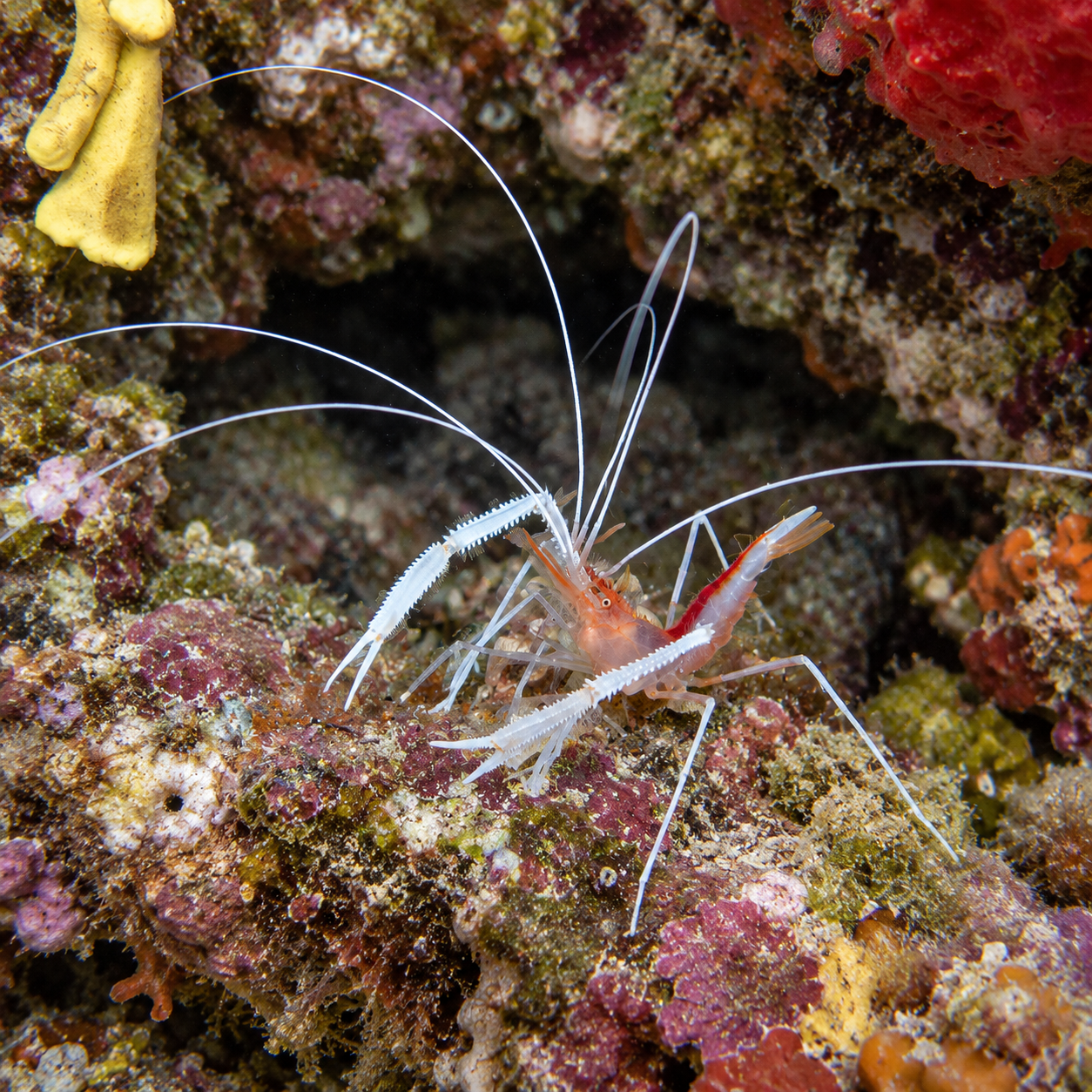
解説 / Description
クメジマオトヒメエビは、白色を基調とした体と、腹部背面の中央を走る太い赤色の縦帯が印象的な海産甲殻類です。学名は Stenopus pyrsonotus。長く白い触角と発達した鋏脚を持ち、赤・白・半透明の色彩が組み合わさった独特の姿をしています。自然界ではサンゴ礁の岩の亀裂や洞窟、岩棚の下などに身を潜めて暮らす、隠蔽性の高い種類です。 Stenopus pyrsonotus is a distinctive marine crustacean with a predominantly whitish body and a broad red longitudinal stripe running along the middle of the dorsal abdomen. Its long white antennae and enlarged chelipeds give it a characteristic appearance combining red, white, and translucent tones. In nature, it is a cryptic benthic species that shelters in reef crevices, caves, and beneath ledges.
日本では、久米島で採集された標本をもとに2003年に日本初記録として報告され、その際に「クメジマオトヒメエビ」という和名が提唱されました。その後、宮古諸島からも標本に基づく記録があります。観賞用として国内で販売されることもありますが、一般的なオトヒメエビほど頻繁に見かける種類ではありません。飼育では、安定した海水環境と十分な隠れ家を用意し、急激な水質変化や脱皮時のトラブルを避けることが重要です。 In Japan, the species was first formally recorded in 2003 from specimens collected at Kume Island, when the Japanese name “Kumejima otohime-ebi” was proposed. Specimen-based records have since also been reported from the Miyako Islands. The species occasionally appears in the Japanese marine aquarium trade, although it is much less commonly encountered than the familiar banded coral shrimp. Captive care centers on stable seawater conditions, secure shelters, and minimizing abrupt environmental changes, particularly around molting.
基本情報 / Basic Information
| 学名 / Scientific Name | Stenopus pyrsonotus Goy & Devaney, 1980 |
|---|---|
| 通称 / Common Name | クメジマオトヒメエビFlameback coral shrimp, Ghost boxer shrimp, Cave shrimp |
| 分類 / Family | 節足動物門・甲殻亜門・軟甲綱・十脚目・オトヒメエビ下目・オトヒメエビ科・オトヒメエビ属Phylum Arthropoda, Subphylum Crustacea, Class Malacostraca, Order Decapoda, Infraorder Stenopodidea, Family Stenopodidae, Genus Stenopus |
| 英名 / English Name | Flameback coral shrimp / Ghost boxer shrimp / Cave shrimp |
| 分布 / Distribution | インド・西太平洋域に分布し、ハワイ諸島、モーリシャス、フランス領ポリネシアなどから記録されています。日本では久米島や宮古諸島など、琉球列島から確認されています。Distributed in the Indo-West Pacific, with records from areas including the Hawaiian Islands, Mauritius, and French Polynesia. In Japan, confirmed records are known from the Ryukyu Islands, including Kume Island and the Miyako Islands. |
| 最大体長 / Max Size | 原記載で調べられた標本は全長約28~73mmで、最大の標本は73mmでした。より大型とする資料もありますが、測定方法が統一されていないため、明確な最大値としては扱わない方が安全です。長い触角や鋏脚を含めると、体長以上に大きく見えます。The specimens examined in the original species description ranged from approximately 28 to 73 mm in total length, with the largest measuring 73 mm. Larger figures appear in some secondary sources, but measurement methods are not always consistent, so they should not be treated as a definitive maximum. The long antennae and chelipeds make the animal appear considerably larger than its body length alone suggests. |
| 寿命 / Lifespan | 本種に限定した信頼できる飼育下寿命の情報は十分にありません。Reliable information establishing the captive lifespan of this species specifically is currently insufficient. |
飼育環境 / Aquarium Environment
| 水槽サイズ / Tank Size | 本種について、科学的に確立された最小水槽サイズや特定の規格水槽サイズはありません。体そのものより長い触角と鋏脚を十分に広げられ、岩組みの中に複数の隠れ場所を確保できる水槽を選びます。混泳する場合は、他の生体との距離を取れる底面積も必要です。There is no scientifically established minimum tank size or specific standard aquarium size for this species. Choose an aquarium that provides enough room for its antennae and chelipeds and allows several secure retreats to be formed within the rockwork. Additional floor space is advisable when tank mates are present. |
|---|---|
| 水温 / Temperature | 飼育上は23~27℃前後を目安にし、短時間で大きく変動させないことを重視します。夏季に水温がこの範囲を超えて上昇する環境では、水槽用クーラーや室温管理などで安定させます。 Approximately 23–27°C can be used as a practical aquarium range, with stability being more important than short-term fluctuations. Where summer temperatures rise above this range, aquarium cooling or room-temperature control may be required. |
| 水質 / Water Quality | 比重1.023~1.025、pH8.0~8.4程度を飼育上の目安とし、一般的な海水無脊椎動物を安定して維持できる清浄な環境を保ちます。特定の数値を細かく追うこと以上に、比重やpH、水温を急変させないことが重要です。硝酸塩やリン酸塩などの蓄積も抑えます。A specific gravity around 1.023–1.025 and pH around 8.0–8.4 can be used as practical aquarium targets. Maintain clean, stable seawater suitable for marine invertebrates. Avoiding sudden changes in salinity, pH, and temperature is more important than pursuing excessive numerical precision, and accumulation of nutrients such as nitrate and phosphate should be minimized. |
| レイアウト / Layout | ライブロックなどを組み、岩の亀裂、洞窟、オーバーハングを思わせる暗い隠れ家を用意します。自然界でもこのような遮蔽された場所から多く記録されているため、照明の強弱そのものより、個体が必要に応じて明るい場所を避けられる構造にすることが大切です。Arrange live rock to form shaded retreats resembling crevices, caves, and overhangs. Because the species is frequently recorded from such concealed habitats in the wild, the important point is not simply reducing overall lighting but ensuring that the shrimp can retreat from illuminated areas whenever it chooses. |
| 注意点 / Precautions | 導入時は販売水と水槽水の水温や比重の差を確認し、急激な変化を避けて慎重に順化します。脱皮直後は外骨格が柔らかく、外敵や同居生物の干渉を受けやすいため、体を完全に隠せる場所が欠かせません。また、銅を含む魚病薬は甲殻類に有害となるため、本種を収容した水槽では使用しないようにします。During introduction, compare the temperature and salinity of the transport water with the aquarium and acclimate the shrimp without abrupt changes. Immediately after molting, the new exoskeleton is soft and the animal is particularly vulnerable to disturbance or predation, so a retreat that conceals the entire shrimp is essential. Copper-containing fish medications are harmful to crustaceans and should not be used in an aquarium housing this species. |
餌と給餌 / Feeding
| 餌の種類 / Diet | 飼育下では動物質の餌を中心に、冷凍ブラインシュリンプ、イサザアミ、細かく刻んだイカやアサリなどの海産物、甲殻類向けの沈下性人工飼料などを利用できます。特定の餌だけに偏らせず、食べられる大きさに調整して与えます。In captivity, it can be offered a range of animal-based foods such as frozen brine shrimp, mysid shrimp, finely chopped squid or clam, and sinking prepared foods for marine crustaceans. Avoid relying on a single food and provide pieces of an appropriate size. |
|---|---|
| 給餌のポイント / Feeding Tips | 個体の食欲や水槽内で得られる餌の量を見ながら、食べ残しが出ない程度に与えます。隠れ家から出てこない場合は、スポイトやピンセットを使って入口付近へ餌を届けると確認しやすくなります。残餌を口にすることはありますが、「掃除役」として残飯だけに依存させず、状態を見ながら十分な餌を与えます。Adjust feeding according to the shrimp’s appetite and the amount of food already available in the aquarium, avoiding uneaten excess. If the shrimp remains inside its shelter, food can be placed near the entrance with a feeding pipette or forceps. Although it may scavenge leftovers, it should not be expected to live solely as a cleanup animal and should receive adequate food directly. |
性格と混泳 / Temperament and Tank Mates
| 性格 / Temperament | 岩穴や亀裂を拠点に暮らす定住性の高いエビです。同種がペアで観察される例がある一方、すべての個体を無条件に同居させられるわけではありません。狭い環境では甲殻類同士の接触が増えるため、個体間の反応をよく観察します。This is a strongly site-attached shrimp that typically lives around a crevice or cave. Pairs have been observed in the wild, but this does not mean that unfamiliar individuals can always be placed together safely. In confined aquaria, interactions between crustaceans become more frequent, so their behavior should be monitored carefully. |
|---|---|
| 混泳の相性 / Compatibility | サンゴを積極的に食害する種類としては一般に扱われておらず、リーフタンクで飼育されることもあります。ただし、同種や他のエビ・カニ類との相性には注意が必要です。小型で動きの遅い生体との組み合わせも慎重に観察し、本種を捕食できる大型魚との混泳は避けます。確実な組み合わせが分からない場合は、単独飼育が管理しやすい方法です。The species is not generally regarded as an active coral predator and may be kept in reef aquaria. However, caution is required with conspecifics and other shrimps or crabs. Small or slow-moving tank mates should also be observed carefully, while large fishes capable of preying on the shrimp should be avoided. When compatibility is uncertain, solitary housing is the easier arrangement to manage. |
病気と対策 / Diseases and Prevention
| かかりやすい病気 / Common Diseases | 本種に特有で、飼育下で頻発することが確認された疾病については十分な情報がありません。実際の飼育では、病気そのものよりも、急激な水質変化や輸送による衰弱、脱皮が正常に完了しないといったトラブルに注意します。脱皮は甲殻類にとって正常な成長過程ですが、その前後は特に環境変化の影響を受けやすい時期です。There is insufficient information identifying diseases that are specifically common in captive Stenopus pyrsonotus. In practical husbandry, concerns are more often associated with abrupt changes in water conditions, transport stress, and unsuccessful molts. Molting is a normal part of crustacean growth, but the periods immediately before and after a molt are particularly sensitive. |
|---|---|
| 対策と予防 / Prevention | 基本となるのは、水温、比重、pHを安定させ、適切な人工海水を用いた定期的な換水と、偏りの少ない給餌を続けることです。ヨウ素などの微量元素について、本種の脱皮成功のために追加投与が絶対に必要だとする十分な根拠は確認されていません。添加剤を使用する場合は過剰添加を避け、製品の用法を守ります。脱皮前後には刺激を減らし、安全な隠れ家を確保します。Prevention centers on stable temperature, salinity, and pH, regular water changes with an appropriate marine salt mix, and a balanced diet. There is insufficient evidence to state that supplemental dosing of trace elements such as iodine is absolutely required for successful molting in this species. If supplements are used, avoid overdosing and follow the manufacturer’s instructions. Disturbance should also be minimized around molting, with secure shelter always available. |
増やし方(繁殖) / Breeding
| 雌雄の判別 / Sexing | 本種について、一般の飼育者が外見だけで確実に雌雄を判別できる簡便な方法は十分に確立されていません。抱卵中であれば、メスが腹部の腹肢に卵を保持するため判別できます。野外では大きさの異なる雌雄のペアが確認された例もあります。A simple and reliable external method for sexing this species has not been well established for ordinary aquarium use. An ovigerous female can be recognized by the eggs carried beneath the abdomen on the pleopods. Wild pairs with distinctly different body sizes have also been recorded. |
|---|---|
| 繁殖形態 / Reproduction | メスは受精卵を腹部に抱え、孵化後の幼生は浮遊生活を送ります。オトヒメエビ下目では、孵化後にゾエアなど複数の幼生段階を経て、底生生活へ移る複雑な発生過程が知られています。ただし、クメジマオトヒメエビそのものについて、各幼生段階や期間が十分に解明されているわけではありません。Females brood fertilized eggs beneath the abdomen, and the larvae enter a planktonic phase after hatching. Stenopodidean shrimps are known for complex development involving multiple larval stages, including zoeae, before transitioning to a benthic juvenile form. However, the complete sequence and duration of larval development have not been sufficiently documented specifically for Stenopus pyrsonotus. |
| 繁殖のポイント / Breeding Tips | 水槽内で抱卵に至ったとしても、孵化幼生を稚エビまで育てることは容易ではありません。近縁のオトヒメエビ Stenopus hispidus では、9~11段階に及ぶ幼生発生や、約120~253日という非常に長い浮遊幼生期間が報告されており、オトヒメエビ類の種苗生産が難しい理由の一つになっています。ただし、この日数をクメジマオトヒメエビの幼生期間としてそのまま当てはめることはできません。本種については繁殖技術に関する情報が限られているため、家庭水槽での繁殖は高度な課題と考えた方がよいでしょう。Even if spawning occurs in captivity, raising the larvae through settlement is not straightforward. In the related banded coral shrimp Stenopus hispidus, 9–11 larval instars and an exceptionally long planktonic duration of approximately 120–253 days have been reported, helping explain why propagation of Stenopus species can be difficult. These figures, however, should not be presented as the documented larval duration of Stenopus pyrsonotus itself. Because species-specific breeding information remains limited, captive propagation should be regarded as an advanced challenge. |
雑学と豆知識 / Trivia and Fun Facts
| 1. 「赤い背中」を意味する学名 / 1. A Scientific Name Meaning “Red-Backed” | クメジマオトヒメエビは、Joseph W. GoyとDennis M. Devaneyによって1980年に新種として記載されました。種小名 pyrsonotus は、原記載によればギリシャ語の「pyrsonotos」に由来し、「red-backed」、つまり「赤い背中」を意味します。名前の由来となったのは、白い腹部の背面中央を第1腹節から第6腹節まで走る深い赤色の帯です。英名として正式に用いられる「Flameback coral shrimp」という呼び方も、この特徴的な色彩をよく表しています。Stenopus pyrsonotus was described as a new species in 1980 by Joseph W. Goy and Dennis M. Devaney. According to the original description, the species name pyrsonotus derives from the Greek “pyrsonotos,” meaning “red-backed.” It refers to the distinctive deep-red stripe extending along the dorsal midline of the otherwise pale abdomen from the first to the sixth abdominal segment. The established English common name “Flameback coral shrimp” reflects the same striking coloration. |
|---|---|
| 2. 和名は久米島から生まれた / 2. Its Japanese Name Originated with the Kume Island Record | 日本では、久米島で採集された標本をもとに2003年に東アジア海域から初めて正式に報告され、その論文で「クメジマオトヒメエビ」という新しい和名が付けられました。その後は沖縄各地から水中写真による観察例が知られるようになり、2018年には下地島の通り池で採集された標本によって宮古諸島からの分布も裏付けられました。単に久米島でよく見られるという意味ではなく、日本での分類学的な記録の歴史そのものが和名に刻まれています。In Japan, specimens collected at Kume Island formed the basis of the first formal East Asian record published in 2003, in which the new Japanese name “Kumejima otohime-ebi” was proposed. Underwater observations were subsequently reported from other parts of Okinawa, and a specimen collected at Toriike on Shimoji Island later provided specimen-based confirmation from the Miyako Islands. The Japanese name therefore reflects an important part of the species’ taxonomic history in Japan rather than merely indicating a place where it happens to occur. |
| 3. 洞窟から100mを超える深場まで / 3. From Reef Caves to More Than 100 Meters Deep | 原記載では、ハワイやモーリシャスの標本の多くが、サンゴ礁の亀裂や洞窟、岩棚の下から採集されています。さらにマルキーズ諸島では、20~35mほどの洞窟で見られる種類とされる一方、遠隔操作無人探査機によって129mで撮影された記録があり、85~87mから採集された標本も確認されています。暗い場所を好むという特徴は共通していますが、「浅い洞窟だけに生息するエビ」というわけではありません。In the original description, many specimens from Hawaii and Mauritius were collected from reef crevices, caves, or beneath ledges. In the Marquesas Islands, the species has been described as common in caves at about 20–35 m, yet it was also photographed by a remotely operated vehicle at 129 m, with another specimen collected at 85–87 m. Its association with concealed habitats is consistent, but it is not restricted to shallow reef caves. |
| 4. ウツボとの観察から考えられたクリーニング共生 / 4. A Possible Cleaning Relationship Suggested by Moray Observations | クメジマオトヒメエビはしばしば「クリーナーシュリンプ」として紹介されますが、本種については少し慎重に表現する必要があります。1980年の原記載では、ヘリゴイシウツボ Gymnothorax flavimarginatus と一緒にいた個体が少なくとも2例観察されました。著者らは、この事実と目立つ白い触角を根拠に、オトヒメエビ Stenopus hispidus と同じようなクリーニング共生を行う可能性を示唆しています。つまり、ウツボとの関係は興味深い生態的手掛かりですが、本種のクリーニング行動が詳細に実証されたという意味ではありません。Stenopus pyrsonotus is sometimes described as a cleaner shrimp, but the evidence for this species should be stated carefully. In the original 1980 description, individuals were observed together with the yellow-edged moray Gymnothorax flavimarginatus on at least two occasions. Based on these observations and the shrimp’s conspicuous white antennae, the authors suggested that it may participate in a cleaning symbiosis similar to that of Stenopus hispidus. The association with morays is therefore an intriguing ecological clue, rather than proof of a thoroughly documented cleaning system in this species. |
| 5. 「ゴースト・ボクサー」というもう一つの呼び名 / 5. The Name “Ghost Boxer Shrimp” | 英語圏では「Ghost boxer shrimp」という通称も使われます。淡い体色と長く白い付属肢を持ち、暗い岩穴から姿を見せる本種の外観は「Ghost」という言葉によく似合います。また、オトヒメエビ類は大きな第3歩脚の鋏を左右に伸ばした独特の姿をしており、「boxer shrimp」という呼び名でも知られています。正式な学名とは別に、姿の印象をそのまま言葉にしたような名前が複数存在するのも、このエビの面白さの一つです。The common name “Ghost boxer shrimp” is also used for this species. Its pale coloration and long white appendages emerging from dark reef shelters make the word “ghost” an understandable description of its appearance. Stenopodidean shrimps are also widely known as boxer shrimps because of the conspicuous enlarged chelipeds of the third pair of walking legs. These descriptive common names add another layer of character beyond the formal scientific name. |
| 6. 見た目だけでは分からない複雑な系統関係 / 6. Evolutionary Relationships More Complex Than Appearance Suggests | オトヒメエビ下目では、形態に基づいて長く使われてきた分類と、DNAから推定される進化関係が必ずしも一致しないことが分かってきました。複数のミトコンドリア遺伝子と核遺伝子を用いた分子系統解析では、従来のオトヒメエビ科とドウケツエビ類のまとまりが単純な一系統として支持されず、Stenopus 属についても解析上は側系統的なまとまりとなりました。簡単にいえば、「外見上の特徴から同じ仲間としてまとめられてきた種類が、進化の系図では必ずしも一つの枝に収まらない」ということです。ただし、現在もクメジマオトヒメエビの有効な学名は Stenopus pyrsonotus であり、将来の分類変更を既定の事実として扱うことはできません。Molecular research on the infraorder Stenopodidea has shown that classifications traditionally based on morphology do not always match evolutionary relationships inferred from DNA. Analyses using multiple mitochondrial and nuclear genes have failed to support some traditional family groupings as simple monophyletic lineages, and Stenopus was recovered as a paraphyletic assemblage in the analysis. In simpler terms, species grouped together because they look structurally similar do not necessarily all fall on one branch of the evolutionary tree. However, Stenopus pyrsonotus remains the currently accepted name, and any future taxonomic change should not be treated as predetermined. |
| 7. 「120~253日」は本種ではなく近縁種の記録 / 7. The 120–253 Day Larval Period Belongs to a Related Species | オトヒメエビ類の繁殖を語る際、「幼生期間が120~253日」と紹介されることがあります。この数字が研究によって示されているのは、一般的なオトヒメエビ Stenopus hispidus です。同種では9~11段階の幼生発生と非常に長い浮遊期間が知られており、飼育下での種苗生産を難しくする大きな要因になっています。クメジマオトヒメエビも同じ属に属しますが、本種の幼生期間が同じ日数になることを直接示した研究結果ではありません。近縁種から繁殖の難しさを考える手掛かりにはなりますが、種固有のデータとは区別して理解する必要があります。A larval duration of “120–253 days” is sometimes mentioned when discussing Stenopus breeding. That figure comes from research on the common banded coral shrimp Stenopus hispidus, in which 9–11 larval instars and an exceptionally prolonged planktonic phase have been documented. These characteristics are a major obstacle to captive propagation. Stenopus pyrsonotus belongs to the same genus, but the published duration for S. hispidus is not direct evidence that S. pyrsonotus develops for exactly the same length of time. It is useful comparative information, but it should not be confused with species-specific data. |
| 8. 日本でも販売例はあるが、流通は限定的 / 8. Present in the Japanese Trade, but Not Commonly Available | クメジマオトヒメエビは日本国内の海水魚店でも販売例が確認できる一方、一般的なオトヒメエビのように常時大量に流通する種類ではありません。入荷時期や個体サイズ、産地などによって販売価格は変わるため、特定の価格帯を恒常的な相場として扱うのは適切ではありません。購入時には価格だけでなく、触角、鋏脚、歩脚の状態や反応を確認し、落ち着いている個体を選ぶことが大切です。Stenopus pyrsonotus does appear for sale in Japanese marine aquarium shops, but it is not a species that is continuously available in large numbers like the common banded coral shrimp. Retail prices vary with shipment timing, body size, locality, and availability, so a single price range should not be treated as a permanent market value. When purchasing a specimen, its antennae, chelipeds, walking legs, responsiveness, and general condition are more useful indicators than price alone. |
| 9. 脚や鋏は脱皮を通して再生することがある / 9. Lost Appendages May Regenerate Through Molting | 十脚目甲殻類には、失った歩脚や鋏脚をその後の脱皮を通して再生する能力があります。そのため、輸送中などに一部の付属肢を失ったからといって、必ずしも回復できないわけではありません。ただし、再生には複数回の脱皮を要することがあり、欠損個体は採餌や防御の能力が低下している場合もあります。再生能力があることを前提に扱いを粗雑にするのではなく、安定した環境で次の脱皮を迎えられるようにすることが大切です。Decapod crustaceans are capable of regenerating lost walking legs and chelipeds over subsequent molts. A specimen that loses an appendage during transport is therefore not necessarily incapable of recovery. Regeneration may require several molts, however, and an injured shrimp may temporarily have reduced feeding or defensive ability. The capacity for regeneration should never be treated as a reason to accept rough handling; stable conditions for future molts remain essential. |
まとめ / Conclusion
クメジマオトヒメエビは、白い体に走る深紅の背帯と長い触角、岩穴の奥でひっそりと暮らす生態が印象的なオトヒメエビです。久米島から日本初記録が報告された歴史や、100mを超える深度からの記録、ウツボとの観察から示唆されたクリーニング共生など、外見だけでは語り尽くせない興味深さを持っています。 Stenopus pyrsonotus is a memorable stenopodidean shrimp distinguished by its deep-red dorsal stripe, long white antennae, and secretive life in reef shelters. Its history as a species first formally recorded in Japan from Kume Island, records from depths exceeding 100 m, and observations suggesting a possible cleaning association with moray eels all add biological interest beyond its appearance alone.
水槽では、特別な添加剤に頼ることよりも、安定した水温と比重、清浄な海水、十分な隠れ家、適切な給餌を継続することが基本になります。暗い岩組みの奥から長い触角を伸ばし、やがてゆっくりと姿を現す様子は、このエビが自然界で送る隠蔽的な暮らしを感じさせてくれます。珍しさだけを追うのではなく、その生態に合った環境を整えてじっくり付き合いたい海水性甲殻類です。 In the aquarium, successful husbandry depends less on special additives than on stable temperature and salinity, clean seawater, secure retreats, and appropriate feeding. Watching its long antennae emerge from the rockwork before the shrimp slowly appears offers a glimpse of the cryptic lifestyle it follows in nature. Rather than keeping it for rarity alone, it is a species best appreciated in an aquarium designed around its natural behavior.

気になる道具や飼い方を見つけてみませんか?
 アイのアクアグッズ案内水換え・底砂掃除の道具の選び方|砂利・砂・ソイルに合うクリーナーとポンプ道具の特徴や使い方、選ぶときのポイントをアイが紹介します。記事はコチラ →
 アイのアクアグッズ案内そのごはん、泳いでる! 卵から始めるブラインシュリンプの孵化と道具選び道具の特徴や使い方、選ぶときのポイントをアイが紹介します。記事はコチラ →
 アイのアクアグッズ案内カルキ抜き・水質調整剤の選び方|水換えと水槽の種類に合わせて選ぶ道具の特徴や使い方、選ぶときのポイントをアイが紹介します。記事はコチラ →
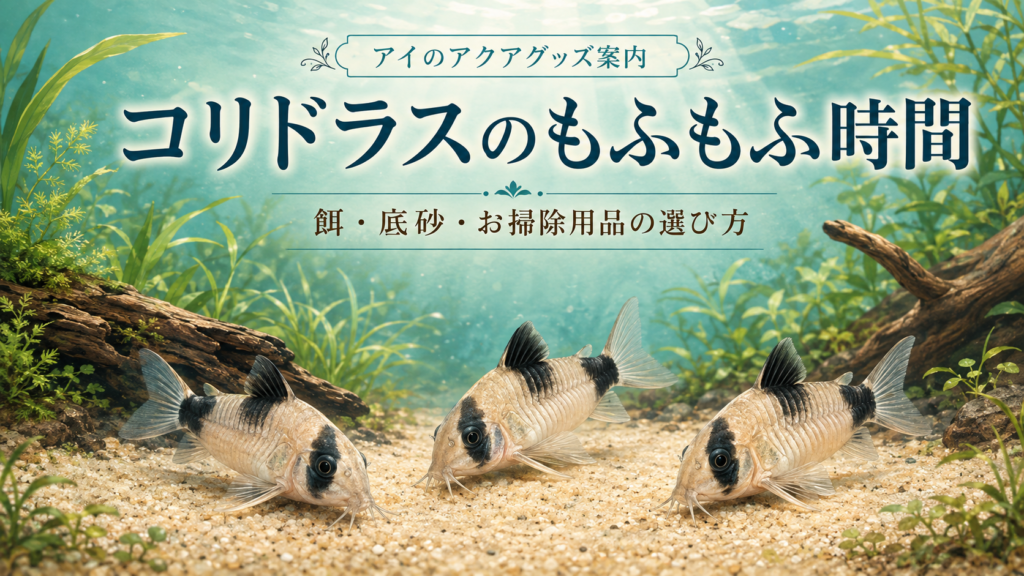 アイのアクアグッズ案内コリドラスのもふもふ時間を楽しむ|餌・底砂・お掃除用品の選び方コリドラスのもふもふする食事風景を楽しむために。沈む餌2種類の違い、口元に配慮した底砂、食べ残しを回収する道具を、アクアグッズナビゲーターのアイが紹介します。記事はコチラ →
さまざまな飼育テーマをご紹介。リンク先の記事には広告・商品紹介が含まれます。
案内・紹介記事一覧へ →分布マップ
クメジマオトヒメエビ(Stenopus pyrsonotus)は、インド・西太平洋域を中心に広く記録されており、ハワイ諸島、モーリシャス、フランス領ポリネシア、日本の琉球列島などから確認されています。
※この地図は分布地域を把握するための概略表示です。赤いマーカーは広い分布域を示すために設定した代表地点であり、実際の採集地点や特定の生息地点を示すものではありません。
参考文献
-
World Register of Marine Species (WoRMS). Stenopus pyrsonotus Goy & Devaney, 1980. AphiaID: 210367.
対応:現在の有効学名、属・科を含む分類学的位置。
https://www.marinespecies.org/aphia.php?id=210367&p=taxdetails -
Goy, J. W. & Devaney, D. M. (1980). Stenopus pyrsonotus, a new species of stenopodidean shrimp from the Indo-West Pacific region (Crustacea: Decapoda). Proceedings of the Biological Society of Washington, 93(3), 781–796.
対応:原記載、形態、体色、学名の由来、ハワイ・モーリシャスの分布、生息場所、ウツボとの同所観察。
https://www.biodiversitylibrary.org/part/45609 -
Okuno, J., Saito, T., Kawamoto, T., Hirayama, S. & Nomura, K. (2003). Record of a boxer shrimp, Stenopus pyrsonotus Goy & Devaney, 1980 (Crustacea: Decapoda: Stenopodidae) from East Asian waters, with notes on intraspecific variations. Journal of the Natural History Museum and Institute, Chiba, 7(2), 79–84.
対応:久米島標本に基づく東アジア・日本からの記録、和名、種内変異。
https://research.nhm.org/publications/referenceinfo.html?refid=26330 -
藤田喜久 (2018). 標本を基にした宮古諸島の十脚甲殻類記録. 宮古島市総合博物館紀要, 22, 77–92.
対応:下地島・通り池の標本に基づくクメジマオトヒメエビの宮古諸島記録。
https://www.city.miyakojima.lg.jp/soshiki/kyouiku/syougaigakusyu/hakubutsukan/files/2018fujita2.pdf -
Poupin, J., Corbari, L., Pérez, T. & Chevaldonné, P. (2012). Deep-water decapod crustaceans studied with a remotely operated vehicle (ROV) in the Marquesas Islands, French Polynesia (Crustacea: Decapoda). Zootaxa, 3550(1), 43–60. https://doi.org/10.11646/zootaxa.3550.1.3
対応:マルキーズ諸島における洞窟性の生息環境、85–87mの採集記録、129mのROV観察記録。
https://doi.org/10.11646/zootaxa.3550.1.3 -
Chen, C.-L., Goy, J. W., Bracken-Grissom, H. D., Felder, D. L., Tsang, L. M. & Chan, T.-Y. (2016). Phylogeny of Stenopodidea (Crustacea: Decapoda) shrimps inferred from nuclear and mitochondrial genes reveals non-monophyly of the families Spongicolidae and Stenopodidae and most of their composite genera. Invertebrate Systematics, 30(5), 479–490. https://doi.org/10.1071/IS16024
対応:オトヒメエビ下目の分子系統、従来の科・属分類と分子系統の不一致。
https://doi.org/10.1071/IS16024 -
Gregati, R. A., Fransozo, V., López-Greco, L. S. & Negreiros-Fransozo, M. L. (2010). Reproductive cycle and ovarian development of the marine ornamental shrimp Stenopus hispidus in captivity. Aquaculture, 306(1–4), 185–190. https://doi.org/10.1016/j.aquaculture.2010.05.009
対応:近縁種 S. hispidus の飼育下における水温・塩分条件、脱皮、交尾、産卵、抱卵・孵化を含む繁殖周期。
https://doi.org/10.1016/j.aquaculture.2010.05.009 -
Dudoit, ‘Ale‘alani, Iacchei, M., Coleman, R. R., Gaither, M. R., Browne, W. E., Bowen, B. W. & Toonen, R. J. (2018). The little shrimp that could: phylogeography of the circumtropical Stenopus hispidus (Crustacea: Decapoda), reveals divergent Atlantic and Pacific lineages. PeerJ, 6, e4409. https://doi.org/10.7717/peerj.4409
対応:近縁種 S. hispidus の約120–253日に及ぶ長い浮遊幼生期間と、大西洋・インド太平洋系統の遺伝的分化。
https://doi.org/10.7717/peerj.4409 -
Calado, R., Lin, J., Lecaillon, G. & Rhyne, A. L. (2017). Shrimp. In R. Calado, I. Olivotto, M. Planas & G. J. Holt (Eds.), Marine Ornamental Species Aquaculture. Wiley-Blackwell. https://doi.org/10.1002/9781119169147.ch22a
対応:海産観賞エビの飼育・親個体管理・幼生飼育・給餌・種苗生産上の課題、Stenopus 属を含む繁殖技術の概説。
https://doi.org/10.1002/9781119169147.ch22a -
Holroyd, S. C., Spicer, J. I., Ellis, R. P. & Turner, L. M. (2026). An ecophysiological approach to improving health outcomes of ornamental shrimp during aquarium trade and transportation. Conservation Physiology, 14(1), coag046. https://doi.org/10.1093/conphys/coag046
対応:観賞エビにおける水温、塩分、炭酸系、水中酸素、窒素性老廃物などの環境条件と健康管理、輸送・順化時の生理的ストレス。
https://doi.org/10.1093/conphys/coag046 -
Banaee, M., Zeidi, A., Mikušková, N. & Faggio, C. (2024). Assessing Metal Toxicity on Crustaceans in Aquatic Ecosystems: A Comprehensive Review. Biological Trace Element Research, 202, 5743–5761. https://doi.org/10.1007/s12011-024-04122-7
対応:甲殻類に対する銅を含む金属類の毒性と、飼育時に金属曝露を避ける必要性。
https://doi.org/10.1007/s12011-024-04122-7




コメント