

解説 / Description
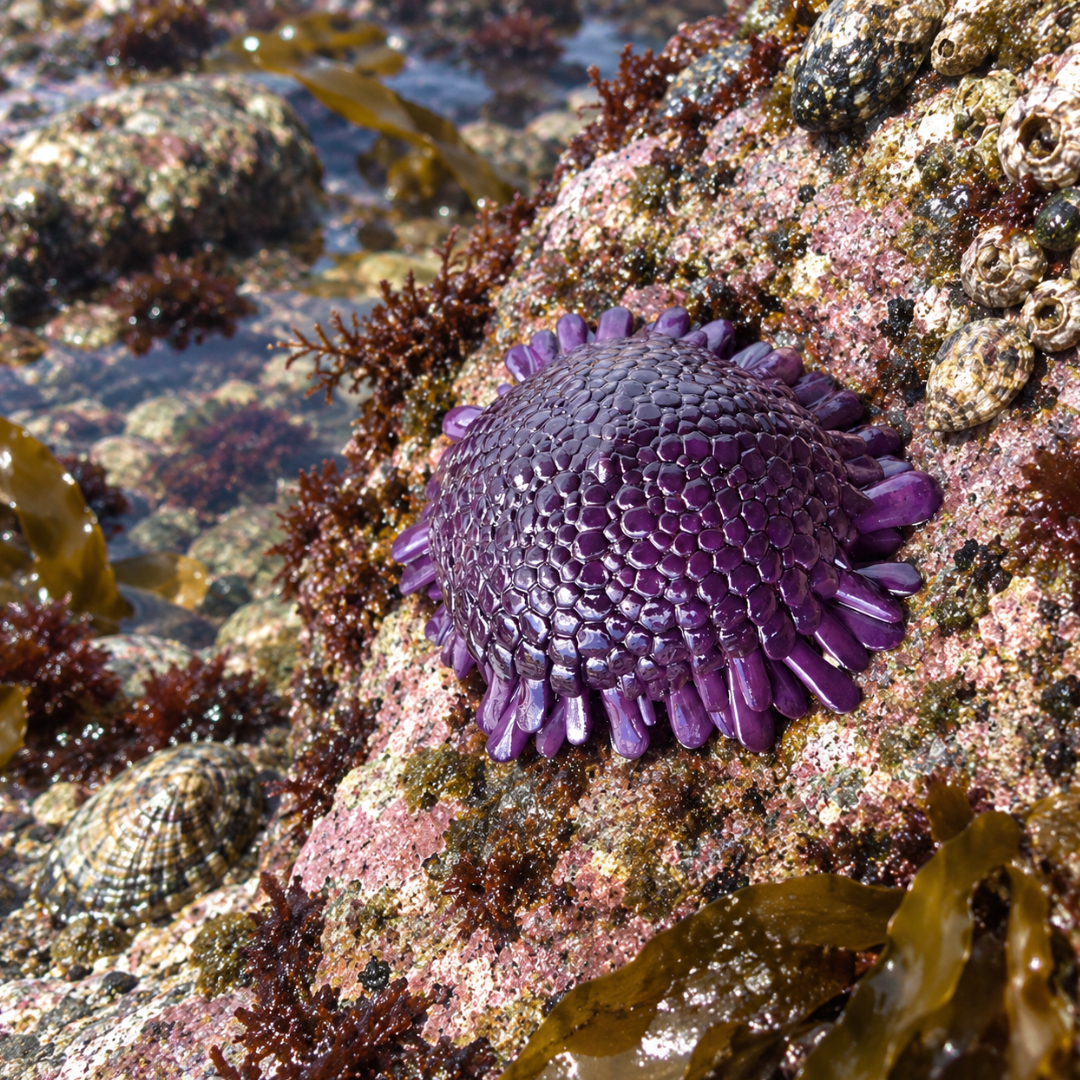
ミナミジンガサウニは、荒波が直接打ちつけるインド太平洋の熱帯域の岩礁潮間帯に適応した、きわめて独特なウニです。一般的なウニのように長い棘を並べるのではなく、背面の棘が短く平たい多角形へ変化し、屋根板を敷き詰めたような滑らかな外観をつくります。腹面には多数の管足があり、波にさらされる岩盤へ強固に付着します。こうした形態は、流体力学や付着の仕組み、棘の微細構造など、複数の分野から研究されてきました。飼育下の標準的な管理条件は十分に確立されていないため、単なる「コケ取り用のウニ」と考えず、成熟した摂食面を確保し、水質を安定させ、波当たりの強い潮間帯に暮らす生態を踏まえて十分な水流とガス交換を保つことが重要です。 The shingle urchin is a highly specialized sea urchin adapted to wave-battered rocky intertidal habitats in the tropical Indo-Pacific. Instead of bearing long projecting spines like a typical sea urchin, its aboral spines are shortened and flattened into polygonal, tile-like plates that create a smooth, low-profile surface. Numerous tube feet on the underside provide strong attachment to exposed rock. These features have been studied from the perspectives of hydrodynamics, attachment biology, and spine microstructure. Because standardized long-term husbandry conditions for this species are not well established, it should not be treated simply as an algae-cleaning urchin. Captive care should prioritize mature grazing surfaces, stable water quality, adequate circulation, and gas exchange while taking its wave-exposed intertidal ecology into account.
基本情報 / Basic Information
| 学名 / Scientific Name | Colobocentrotus (Podophora) atratus (Linnaeus, 1758) 多くの文献や国内流通では Colobocentrotus atratus と表記されます。Many publications and aquarium-trade records use the shorter form Colobocentrotus atratus. |
|---|---|
| 通称 / Common Name | ミナミジンガサウニ、ハアウケウケ(ハワイ語)Shingle urchin, helmet urchin, hā‘uke‘uke |
| 分類 / Family | 棘皮動物門・ウニ綱・ホンウニ目・ナガウニ科・ジンガサウニ属Phylum Echinodermata, Class Echinoidea, Order Camarodonta, Family Echinometridae, Genus Colobocentrotus |
| 英名 / English Name | Shingle Urchin / Helmet Urchin |
| 分布 / Distribution | インド太平洋の熱帯域に広く分布し、特に波当たりの強い岩礁潮間帯で見られます。ハワイ諸島、インドネシア、インド洋の島嶼部などから記録があります。日本で「ジンガサウニ」と呼ばれる Colobocentrotus mertensii とは別種で、外観がよく似るため、学名と産地を併せて確認することが重要です。Widely distributed in the tropical Indo-Pacific, especially on highly wave-exposed rocky intertidal shores, with records from the Hawaiian Islands, Indonesia, and islands of the Indian Ocean. It should not be confused with Colobocentrotus mertensii, the closely similar congener known from Japanese waters; scientific name and collection locality are useful for distinguishing them. |
| 最大体長 / Max Size | 殻径は7〜8cmほどに達する記録があります。最大値は資料や個体群によって差があるため、10cmと断定できる十分な根拠は確認されていません。Recorded test diameters reach roughly 7–8 cm. Reported maxima vary among sources and populations, and a firm species maximum of 10 cm is not sufficiently supported. |
| 寿命 / Lifespan | 野外・飼育下ともに、本種の寿命を年数で明確に示す信頼できる資料は限られており、情報不足です。Reliable species-specific data giving a clear lifespan in years are limited for both wild and captive individuals. |
飼育環境 / Aquarium Environment
| 水槽サイズ / Tank Size | 本種について、90cm規格水槽(約180L)のような規格水槽単位の標準的な推奨サイズを裏付ける資料は確認できません。固定した水量よりも、成熟した岩面を十分に確保でき、水質・水流・ガス交換を安定して維持できる環境であることを優先します。No reliable species-specific source was found to support a standard recommendation such as a 90 cm aquarium of about 180 L. Rather than relying on a fixed volume, prioritize enough mature rock surface for grazing and a system in which water quality, circulation, and gas exchange can be kept stable. |
|---|---|
| 水温 / Temperature | 本種固有の長期飼育適温は十分に確立されていません。ハワイ産個体を用いた研究では25〜37℃の範囲で水没時の温度と酸素条件が調べられ、高温条件では酸素を増やすことで生存率が改善しました。ただし、この結果は「24〜25℃が最適」という意味ではありません。飼育では急激な高温化を避け、とくに高水温時に低酸素状態をつくらないことが重要です。 A species-specific long-term captive temperature optimum has not been well established. In a study of Hawaiian animals tested while submerged from 25 to 37°C, supplemental oxygen improved survival at stressful high temperatures. This does not demonstrate that 24–25°C is an optimum. In captivity, avoid abrupt warming and pay particular attention to preventing low-oxygen conditions as temperature rises. |
| 水質 / Water Quality | 本種固有の最適な比重や各水質項目の数値は十分に示されていません。一般的な海水無脊椎動物の飼育と同様に、アンモニアや亜硝酸が蓄積しない清浄な海水を保ち、塩分やpHを急変させないことを優先します。餌資源となる石灰藻を維持する場合も、海水水槽としてカルシウムやアルカリ度などを安定させることが大切です。Species-specific optimum values for salinity and other water parameters have not been sufficiently established. As with marine invertebrates generally, prioritize clean seawater without ammonia or nitrite accumulation and avoid abrupt changes in salinity or pH. If coralline algae are being maintained as a grazing resource, stable calcium and alkalinity appropriate for a marine aquarium are also useful. |
| レイアウト / Layout | 石灰藻や微細藻類のバイオフィルムが育った岩面を十分に確保します。自然下では強い波にさらされる種ですが、飼育下で「極端に強い乱流」が必要だとする標準的な飼育データは確認できません。よどみを避けた十分な循環とガス交換を確保し、ポンプの吸水口など、管足や体表を傷める可能性のある場所には接触防止策をとります。Provide ample mature rock surfaces carrying coralline algae and microalgal biofilm. Although the species naturally lives under intense wave action, there is no well-established captive evidence that extremely turbulent flow is required. Maintain good circulation and gas exchange without stagnant areas, and prevent contact with pump intakes or other equipment that could damage tube feet or the body surface. |
| 注意点 / Precautions | 管足の付着は非常に強いため、岩やガラスから無理に引き剥がさないでください。移動が必要な場合は、個体が自ら管足を離すよう時間をかけて誘導します。また、見た目に藻類がある水槽でも、本種が継続して食べられる薄い藻膜や石灰藻が不足すると長期的に痩せる可能性があります。導入初期は付着力、移動、摂食痕を毎日確認してください。Its tube feet adhere extremely strongly, so never forcibly pull the animal from glass or rock. If it must be moved, allow time for the feet to release naturally. Even a tank that looks “algae rich” may fail to provide enough continuous film or coralline growth for long-term grazing, so monitor attachment, movement, and visible grazing marks closely after introduction. |
餌と給餌 / Feeding
| 餌の種類 / Diet | 自然下では岩盤表面の微細藻類や藻類マット、石灰藻などを削り取って食べます。飼育では成熟した岩面を主要な摂食場所として確保します。無添加の板海苔や海藻系人工飼料を補助的に試す方法はありますが、本種での受容性や長期的な栄養価を示す確かな飼育データは乏しいため、人工餌だけに依存しないほうが安全です。In nature it grazes microalgae, algal mats, and coralline algae from rock surfaces. In captivity, mature rock should provide the main grazing surface. Unsalted nori or algae-based prepared foods may be tested as supplements, but species-specific evidence for consistent acceptance or long-term nutritional adequacy is limited, so prepared foods should not be treated as a proven sole diet. |
|---|---|
| 給餌のポイント / Feeding Tips | 水槽に藻類が見えていても、それだけで十分な餌量があるとは限りません。岩面に新しい摂食痕が見られるか、個体が継続して移動しているかを確認します。補助餌を試す場合は少量から始め、実際に摂食するかを観察し、食べ残しは水質を悪化させないよう回収します。Visible algae do not necessarily mean that an adequate food supply is available. Check for fresh grazing marks on rock and for continued normal movement. If supplemental foods are offered, start with small amounts, confirm that the individual actually feeds on them, and remove leftovers before they impair water quality. |
性格と混泳 / Temperament and Tank Mates
| 性格 / Temperament | 他の生体を追い回すような攻撃性はなく、岩面に密着しながらゆっくり移動して藻類を削り取る穏やかな底生生物です。一方で、摂食時には石灰藻を含む付着藻類を強く削るため、水槽内の景観は変化します。It is non-aggressive and spends most of its time firmly attached to rock while slowly moving and grazing. Its feeding activity can substantially scrape encrusting algae, including coralline algae, so the appearance of rockwork may change over time. |
|---|---|
| 混泳の相性 / Compatibility | 本種の混泳について体系的な飼育データは多くありません。少なくとも、ウニを捕食する生体や管足を傷つける可能性のある魚との同居は避けます。また、岩面を削りながら移動するため、付着生物や固定の甘いサンゴ片などには物理的な影響が出る可能性があります。レイアウトは安定させてください。Systematic captive compatibility data for this species are limited. At minimum, avoid animals that prey on sea urchins or may damage the tube feet. Because the urchin moves while scraping rock surfaces, it can also physically disturb encrusting organisms or loosely secured coral fragments, so rockwork should be stable. |
病気と対策 / Diseases and Prevention
| かかりやすい病気 / Common Diseases | 本種に特有の飼育下疾病については情報が少なく、一般的な観賞魚のように病名と治療法が整理されているわけではありません。付着力の急な低下、長時間ほとんど動かない状態、管足や体表の損傷、組織の変色や崩れは状態悪化のサインになり得ますが、症状だけから原因を特定することはできません。Species-specific captive disease information is limited, and there is no well-established set of aquarium diagnoses and treatments comparable to that available for many fishes. A sudden loss of attachment, prolonged inactivity, damaged tube feet or body surface, discoloration, or tissue deterioration can indicate declining condition, but these signs alone do not identify a specific cause. |
|---|---|
| 対策と予防 / Prevention | 水温、塩分、pHなどを急変させず、水質とガス交換を安定させることを基本とします。導入時は水温を合わせたうえで、輸送水と飼育水の差を急に変えないよう慎重に水合わせを行います。また、本種そのものの薬剤耐性データではありませんが、ウニ類は銅への感受性が高いことが報告されているため、銅を含む魚病薬を同じ水槽で使用するのは避けます。Prevention should focus on stable temperature, salinity, pH, water quality, and gas exchange. During introduction, match temperature and avoid abrupt changes between shipping water and aquarium water. Although this is not a species-specific medication study, sea urchins are known to be sensitive to copper exposure, so copper-based fish medications should not be used in the same system. |
増やし方(繁殖) / Breeding
| 雌雄の判別 / Sexing | 雌雄異体ですが、通常は外見だけで性別を判別することはできません。The sexes are separate, but males and females generally cannot be distinguished reliably by external appearance. |
|---|---|
| 繁殖形態 / Reproduction | 精子と卵を海中へ放出して体外受精する放卵放精型です。受精後はプランクトン生活を送るエキノプルテウス幼生を経て、適切な基質へ着底し、稚ウニへ変態します。Reproduction occurs by broadcast spawning, with eggs and sperm released into the water for external fertilization. Development includes a planktonic echinopluteus larval stage before settlement on a suitable substrate and metamorphosis into a juvenile urchin. |
| 繁殖のポイント / Breeding Tips | 家庭水槽での本種の計画繁殖について、確立した一般向け手法は確認されていません。放卵放精後に浮遊幼生を育て、着底・変態まで管理する必要があるため、通常の展示水槽だけで継代するのは難しいと考えられます。幼生育成に微細藻類餌料や専用の培養環境を用いる方法はウニ類では一般的ですが、本種にそのまま適用できる条件が確立しているわけではありません。No established hobbyist protocol for planned breeding of this species was found. After spawning, planktonic larvae must be reared through settlement and metamorphosis, making propagation difficult in an ordinary display aquarium. Microalgal feeds and dedicated larval-culture systems are commonly used for sea urchins in general, but species-specific conditions for C. atratus are not well established. |
雑学と豆知識 / Trivia and Fun Facts
| 1. 「棘をなくした」のではなく、棘を鎧へ作り替えた / 1. The spines were transformed into armor rather than simply lost | ミナミジンガサウニを初めて見ると、棘のないウニのように感じられます。ところが背面を覆う滑らかなタイルは、本来の棘が短く平たく変形したものです。普通のウニでは細長い棘が捕食者への防御や移動に役立ちますが、砕ける波が絶えず体を叩く場所では、長い棘そのものが大きな負荷を受けます。本種は棘を小さな多角形の装甲へ変えることで、波にさらされる岩盤という、他のウニが長時間とどまりにくい場所を生活圏にしています。At first glance the shingle urchin appears almost spineless. In reality, the smooth tiles covering its upper surface are highly modified spines that have become short, broad, and flattened. Long spines are useful to many sea urchins for defense and movement, but in the surf zone they also present large surfaces to violent water motion. By transforming its spines into a low-profile protective covering, this species can occupy exposed rock surfaces that are extremely demanding habitats for a typical spiny urchin. |
|---|---|
| 2. 流線型の秘密は「抗力」だけではない / 2. Streamlining is not simply about reducing drag | 扁平な体は「水の抵抗を減らすため」と説明されがちですが、流体力学的な測定ではもう少し複雑な姿が見えてきます。ミナミジンガサウニは近縁のナガウニより抗力を減らす一方、上向きに持ち上げる揚力は増えることが示されました。それでも砕波帯で有利なのは、波が急激に加速するときに生じる力を大きく抑えられるためです。見た目の「流線型」は、単に水を受け流す形ではなく、瞬間的で激しい波の加速度に耐えるための形でもあるのです。Its flattened body is often described simply as a way to “reduce water resistance,” but hydrodynamic measurements tell a more nuanced story. Compared with a typical spiny Echinometra, the shingle urchin experiences less drag but more lift. The important advantage appears to be a major reduction in forces generated when water accelerates rapidly during breaking waves. Its streamlined shape is therefore not just about slipping through moving water; it is also an adaptation to the violent accelerations characteristic of the surf zone. |
| 3. 0.54MPaを記録した強力な管足 / 3. Tube feet measured at 0.54 MPa of tenacity | 岩にしがみつく仕組みでは、平たい体だけでなく管足が重要です。単一の管足を調べた研究では、付着力は0.54MPaに達し、比較されたナガウニ、パイプウニ、クロウニの0.21〜0.25MPaのおよそ2倍でした。一方、個体全体で測った付着強度は4種でおおむね同程度でした。ミナミジンガサウニが非常に速い水流にも耐えられると推定された大きな理由は、1本の管足だけが強いからではなく、腹面に非常に多くの管足を備え、それらを使って付着できる点にあります。つまり「強い吸盤を持つ」というより、強い管足を多数動員できることが重要なのです。Tube feet are as important as the flattened body in keeping this urchin attached to rock. In tests of individual tube feet, tenacity reached 0.54 MPa, about twice the 0.21–0.25 MPa measured in the three comparison species. However, whole-animal attachment strength was broadly similar among the four species. The key reason C. atratus was predicted to withstand very high water velocities is not simply that each foot is stronger, but that it possesses and can deploy a very large number of tube feet on the underside. In practical terms, its attachment advantage comes from combining strong individual feet with exceptional numbers. |
| 4. 小さな装甲は材料工学の研究対象にもなる / 4. Its tiny armor has attracted materials-science research | 平たく変形した棘を拡大すると、内部はマグネシウムを含む方解石の多孔質ネットワークでできています。しかも密度や孔の構造は一様ではなく、場所によって性質が変わる傾斜構造を持ちます。こうした構造は、衝撃が加わったときに表面側で変形を受け止め、関節部や内部へ損傷が集中しにくい仕組みとして研究されてきました。波打ち際で生き延びるために進化した数ミリの棘が、軽くて強い人工材料を考えるヒントにもなっている点は、本種の面白さを象徴しています。Under magnification, the flattened spines reveal a porous network of magnesium-bearing calcite. The density and geometry of this internal structure vary through the spine rather than remaining uniform, producing a graded architecture. Researchers have investigated how this design can absorb deformation near the surface and reduce damaging concentrations of stress deeper in the structure or near the joint. A spine only millimeters across, shaped by life in pounding surf, has therefore become a natural model for thinking about lightweight impact-resistant materials. |
| 5. ハワイでは「hā‘uke‘uke」と呼ばれる身近な海の生き物 / 5. In Hawaiʻi it is known as hā‘uke‘uke | ハワイでは本種は hā‘uke‘uke と呼ばれ、単なる珍しいウニではなく、沿岸の暮らしや食文化と結びついてきた生物です。研究文献でも、ネイティブ・ハワイアンにとって価値のある伝統的な食資源であることが記されています。激しい波の岩場に密着する姿は、その土地の海を知る人々には古くからよく知られた存在でした。生物学的には極端な環境への適応例でありながら、同時に人間の文化史の中にも居場所を持つところに、本種ならではの奥行きがあります。In Hawaiʻi the species is known as hā‘uke‘uke and has long been more than an unusual sea urchin. Scientific literature notes its value as a traditional food resource for Native Hawaiian communities. Its habit of clinging to wave-battered rock would have made it a familiar animal to people with detailed knowledge of the shoreline. It is therefore remarkable not only as an example of extreme biological adaptation, but also as an organism embedded in human cultural history. |
| 6. 日本の「ジンガサウニ」とは別種 / 6. It is distinct from the Japanese shingle urchin | 日本では八丈島、紀伊半島、九州南部、小笠原諸島などにジンガサウニ Colobocentrotus mertensii が知られています。両種は同じ属に属し、長い棘を持たない平たい外観もよく似ていますが、分類上は別種です。海外写真や流通名だけで判断すると取り違えやすいため、産地と学名を併せて確認することが重要です。ミナミジンガサウニという名前を使うときほど、「どの Colobocentrotus なのか」を意識すると、図鑑情報や飼育記録をより正確に読み解けます。Japan is home to the closely related Colobocentrotus mertensii, recorded from places including Hachijō-jima, the Kii Peninsula, southern Kyushu, and the Ogasawara Islands. The two species belong to the same genus and share the same low-profile, reduced-spine appearance, but they are taxonomically distinct. Photographs and trade names alone can therefore be misleading, making collection locality and scientific name especially important when identifying or documenting a specimen. |
まとめ / Conclusion
ミナミジンガサウニは、荒波という過酷な環境に合わせて体の形、棘、管足のすべてを独特の方向へ発達させたウニです。丸く尖った「普通のウニ」とはまったく異なる姿でありながら、その一つひとつの特徴には、波の衝撃を受け流し、岩から離れず、限られた岩面の藻類を食べて生きるという明確な意味があります。 The shingle urchin is a sea urchin whose body form, spines, and tube feet have all been shaped by life in one of the ocean’s most physically demanding habitats. Although it looks very different from a typical round, spiny urchin, each feature has a clear ecological role: reducing the consequences of violent wave motion, maintaining a secure grip on rock, and grazing the thin algal resources of exposed surfaces.
飼育では、荒波に耐える姿だけを見て「丈夫なウニ」と考えないことが大切です。本種については長期飼育の標準条件が十分に整理されていないため、固定的な数値に頼るより、安定した海水、十分なガス交換、継続して利用できる摂食面を保ち、付着や移動、摂食の変化を丁寧に観察することが重要です。自然下の生態を理解しながら向き合うことで、独特な体のつくりと行動を落ち着いて楽しめる生体です。 In captivity, its ability to withstand pounding surf should not be mistaken for general hardiness. Because standardized long-term husbandry conditions are not well established for this species, care should focus less on rigid numerical prescriptions and more on stable seawater, adequate gas exchange, a continuing supply of grazing surfaces, and careful observation of attachment, movement, and feeding. Understanding its natural ecology makes it easier to appreciate the distinctive form and behavior of this unusual sea urchin.

気になる道具や飼い方を見つけてみませんか?
 アイのアクアグッズ案内水槽のコケ掃除|道具の選び方とお掃除生体の得意・不得意道具の特徴や使い方、選ぶときのポイントをアイが紹介します。記事はコチラ →
 アイのアクアグッズ案内コケを食べるコイの仲間に合わせる飼育用品|フライングフォックス・アルジイーター・ガラ道具の特徴や使い方、選ぶときのポイントをアイが紹介します。記事はコチラ →
 アイのアクアグッズ案内金魚を長く楽しむ飼育用品|水槽・フィルター・エアレーション・水換え道具の特徴や使い方、選ぶときのポイントをアイが紹介します。記事はコチラ →
 アイのアクアグッズ案内水槽の底砂の選び方|砂・砂利の違いとおすすめ商品道具の特徴や使い方、選ぶときのポイントをアイが紹介します。記事はコチラ →
さまざまな飼育テーマをご紹介。リンク先の記事には広告・商品紹介が含まれます。
案内・紹介記事一覧へ →分布マップ
ミナミジンガサウニはインド太平洋の熱帯域に広く分布し、特に波当たりの強い岩礁潮間帯で見られます。ハワイ諸島、インドネシア、インド洋の島嶼部などから記録があります。
この地図は分布域を把握するための概略表示です。マーカーは分布域を示すために設定した代表地点であり、実際の採集地点や特定個体の確認地点を示すものではありません。
参考文献
-
WoRMS Editorial Board. Colobocentrotus (Podophora) atratus (Linnaeus, 1758). World Register of Marine Species.
分類・受容学名の確認。
World Register of Marine Species -
Denny, M. & Gaylord, B. (1996). Why the Urchin Lost Its Spines: Hydrodynamic Forces and Survivorship in Three Echinoids. Journal of Experimental Biology, 199(3), 717–729. DOI: 10.1242/jeb.199.3.717.
波当たりの強い潮間帯への適応、抗力・揚力・水流加速度に関する形態学的背景。
Journal of Experimental Biology -
Santos, R. & Flammang, P. (2008). Estimation of the attachment strength of the shingle sea urchin, Colobocentrotus atratus, and comparison with three sympatric echinoids. Marine Biology, 154, 37–49. DOI: 10.1007/s00227-007-0895-6.
管足の付着力、個体全体の付着強度、強い水流への適応と飼育時の取り扱い上の注意。
Marine Biology 論文PDF -
Wilbur, S. L. & Moran, A. L. (2018). Oxygen-limited performance of the intertidal sea urchin Colobocentrotus atratus when submerged. Journal of Experimental Marine Biology and Ecology, 509, 16–23. DOI: 10.1016/j.jembe.2018.08.012.
熱帯インド太平洋とハワイの分布、波にさらされる岩礁潮間帯という生息環境、高温時の酸素制限と付着力低下。
ScienceDirect -
State of Hawaiʻi, Department of Health, Hazard Evaluation and Emergency Response Office. Helmet urchin (Colobocentrotus atratus). Technical Guidance Manual, Appendix 21-A.
ハワイでの分布、潮間帯・高波浪環境、藻類食性などの生態情報。
Hawaiʻi Department of Health -
Thomas, F. I. M. (1994). Physical Properties of Gametes in Three Sea Urchin Species. Journal of Experimental Biology, 194(1), 263–284. DOI: 10.1242/jeb.194.1.263.
本種の放卵放精と配偶子の性質を含む繁殖生態。
Journal of Experimental Biology -
Hodin, J., Ferner, M. C. & Gaylord, B. (2020). Choosing the right home: settlement responses by larvae of six sea urchin species align with hydrodynamic traits of their contrasting adult habitats. Zoological Journal of the Linnean Society, 190(2), 737–756. DOI: 10.1093/zoolinnean/zlz149.
本種を含むウニ類の浮遊幼生、着底、変態と水流環境との関係。
Oxford Academic -
Bielmyer, G. K., Brix, K. V., Capo, T. R. & Grosell, M. (2005). The effects of metals on embryo-larval and adult life stages of the sea urchin, Diadema antillarum. Aquatic Toxicology, 74(3), 254–263. DOI: 10.1016/j.aquatox.2005.05.016.
ウニ類に対する銅の毒性を示す資料。本種固有の薬剤試験ではないため、銅を含む魚病薬を避けるという一般的な注意点の根拠として参照。
PubMed




コメント