

解説 / Description
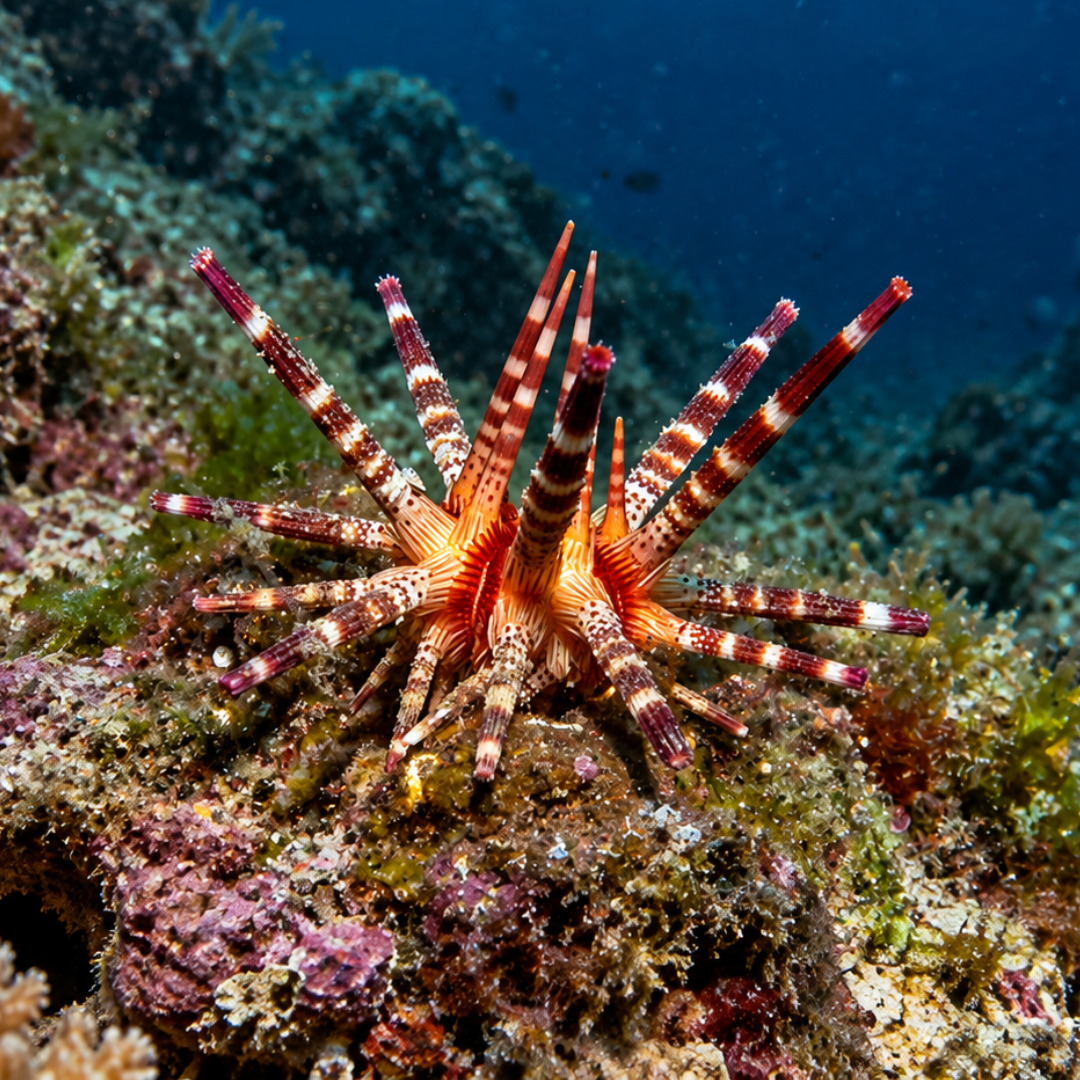
ノコギリウニは、太く長い大棘に鋸の歯を思わせる突起が並ぶ、特徴的な海産ウニです。オウサマウニ科に属し、現生ウニの中では早い段階で分岐した系統の特徴を知るうえでも重要なグループに含まれます。成熟した大棘では表皮が失われ、露出した骨格表面に海綿、コケムシ、有孔虫、石灰藻などの付着生物が定着することがあります。そのため野生個体では、大棘そのものが小さな付着生物の生息場所になっていることも珍しくありません。一方で、幅広いものを食べ、岩組みを動かすほどの力もあるため、一般的なリーフタンクの「お掃除役」として気軽に導入できる種類ではありません。十分な底面積を持つ大型の海水水槽で、摂餌と行動を観察しながら飼育するのが適しています。 The crown-spined pencil urchin is a distinctive marine urchin with thick, elongated primary spines bearing saw-like projections. It belongs to the family Cidaridae, part of an early-diverging lineage of living sea urchins that is important for understanding echinoid evolution. In mature primary spines the epidermis is lost, leaving an exposed skeletal surface on which sponges, bryozoans, foraminiferans, coralline algae, and other epibionts may settle. In the wild, the spines can therefore become small habitats in their own right. The species is also a broad omnivore and physically strong enough to shift unsecured rockwork, so it should not be treated as a simple reef-tank cleanup animal. A spacious marine aquarium that allows its feeding and movement to be monitored is the more appropriate setting.
基本情報 / Basic Information
| 学名 / Scientific Name | Prionocidaris baculosa |
|---|---|
| 通称 / Common Name | ノコギリウニCrown-spined pencil urchin |
| 分類 / Family | 棘皮動物門・ウニ綱・オウサマウニ目・オウサマウニ科・ノコギリウニ属Phylum Echinodermata, Class Echinoidea, Order Cidaroida, Family Cidaridae, Genus Prionocidaris |
| 英名 / English Name | Crown-spined Pencil Urchin |
| 分布 / Distribution | 熱帯から亜熱帯のインド太平洋に広く分布し、紅海、東アフリカ、南アジア、東南アジア、フィリピン、インドネシア、オーストラリア西岸、日本などから記録されています。日本では相模湾を含む本州中部以南の暖海域で知られています。生息水深は浅い岩礁域から200m前後まで幅があり、30〜140mほどのやや深い岩礁・サンゴ礁域からの記録が多い一方、地域によってはかなり浅い場所でも観察されます。Widely distributed through tropical and subtropical Indo-Pacific waters, with records from the Red Sea, East Africa, South and Southeast Asia, the Philippines, Indonesia, western Australia, and Japan. In Japan it is known from warm waters including Sagami Bay and areas farther south. Records range from shallow rocky habitats to around 200 m depth, with many observations from deeper rocky and coral-reef environments at roughly 30–140 m, although substantially shallower occurrences are also known in some regions. |
| 最大体長 / Max Size | 殻径は約8cmに達します。大棘は個体や生える位置によって長さが異なり、10cm前後に達することがあります。The test reaches about 8 cm in diameter. Primary spine length varies with the individual and position on the body, and can reach around 10 cm or more. |
| 寿命 / Lifespan | 本種の寿命について、信頼できる種固有の数値は確認できません。飼育では短期的な維持だけを前提にせず、安定した環境を継続できる設備を用意します。A reliable species-specific lifespan has not been established. In captivity, it is therefore better to provide a stable system suitable for continued care rather than plan around a specific lifespan figure. |
飼育環境 / Aquarium Environment
| 水槽サイズ / Tank Size | 200L以上を一つの目安とし、日本の規格水槽では120cm規格水槽以上の底面積を確保すると管理しやすくなります。水量だけでなく、長い大棘を傷めずに移動できる通路と、岩組みを避けて動ける底面の余裕を重視してください。A volume of 200 L or more is a useful husbandry reference. In common Japanese aquarium sizes, a 120 cm standard tank or larger provides a more manageable footprint. More important than volume alone is sufficient floor space for movement without damaging the long primary spines or becoming trapped by rockwork. |
|---|---|
| 水温 / Temperature | 22〜28℃。適応幅はありますが、急変を避け、ヒーターやクーラーで安定させます。 22–28°C. The species tolerates a relatively broad range, but sudden changes should be avoided and temperature should be kept stable with appropriate heating or cooling. |
| 水質 / Water Quality | 比重1.023〜1.025、pH 8.0〜8.4を目安に、安定した海水環境を維持します。急な塩分変化は避け、導入時は時間をかけて水合わせを行います。大棘を含む骨格は炭酸カルシウムでできているため、特別な補給法に頼るよりも、海水水槽としてカルシウム、アルカリ度、pHを安定させることが重要です。Maintain a stable marine system at a specific gravity of about 1.023–1.025 and pH 8.0–8.4. Avoid abrupt salinity changes and acclimate the animal gradually. The skeleton, including the primary spines, is made of calcium carbonate, so the priority is stable calcium, alkalinity, and pH appropriate for a marine aquarium rather than relying on any special calcium-feeding method. |
| レイアウト / Layout | 昼間に身を隠せる岩陰や洞窟状のスペースを用意しつつ、夜間に移動できる広い通路を確保します。ライブロックや装飾物は崩されないよう確実に固定してください。接着されていないサンゴ片や不安定な岩組みは倒されやすく、サンゴ中心のリーフタンクよりも魚主体の水槽のほうが管理しやすい種類です。Provide shaded overhangs or cave-like shelters for daytime resting while leaving broad open routes for nighttime movement. Live rock and decorations should be secured so they cannot be toppled. Unattached coral fragments and unstable rockwork are easily displaced, making a fish-focused aquarium easier to manage than a coral-dominated reef tank. |
| 注意点 / Precautions | 力が強く、レイアウトを押し動かすため、落石やガラス面への圧迫が起こらないよう設置物を安定させます。無脊椎動物を捕食する可能性があり、リーフセーフとは考えないほうが安全です。また、日本ではウニ類が第一種共同漁業権の対象になることがありますが、対象種や区域は地域ごとの漁業権内容によって異なります。自己採集は現地の規則を確認し、飼育個体は出所の明確な正規流通品を選んでください。This is a powerful animal capable of shifting aquarium structures, so rockwork must be stabilized to prevent collapses or pressure against the glass. It may prey on other invertebrates and should not be assumed to be reef-safe. In Japan, sea urchins can be covered by Type 1 common fishery rights, but the protected species and areas vary by local fishery-right designation. Check local rules before any collection and obtain aquarium specimens through clearly legitimate commercial channels. |
餌と給餌 / Feeding
| 餌の種類 / Diet | 雑食性で、藻類、海綿、デトリタス、付着性の無脊椎動物などを幅広く食べます。飼育下でほかの棘皮動物を攻撃した観察例もあるため、動物質も利用する強い雑食性として考えるのが適切です。水槽では魚介類の小片と海藻類を組み合わせ、摂餌の様子を見ながら与えます。Omnivorous, feeding on a broad range of material including algae, sponges, detritus, and attached invertebrates. Aquarium observations have also documented attacks on other echinoderms, so it is best regarded as a strong omnivore that readily uses animal food. In captivity, offer small portions of marine animal food together with marine algae and adjust according to observed feeding. |
|---|---|
| 給餌のポイント / Feeding Tips | 岩陰から出て活動している時間に、少量ずつ個別給餌すると摂餌の有無を確認しやすくなります。給餌頻度は個体の大きさ、水槽内で得られる自然餌、実際の摂餌量に応じて調整し、水槽内の藻類やデトリタスだけに頼り切らないようにします。食べ残しは水質悪化につながるため回収してください。Target feeding small portions while the urchin is out and active makes it easier to confirm whether food is actually being eaten. Adjust feeding frequency to the animal’s size, the amount of natural food available in the aquarium, and observed intake rather than relying on a fixed schedule. Do not depend entirely on incidental algae and detritus, and remove uneaten food promptly. |
性格と混泳 / Temperament and Tank Mates
| 性格 / Temperament | 岩陰や暗所にいることが多く、夜間に摂餌する記載がありますが、自然下では昼間に採餌している観察例もあります。活動時間を完全な夜行性と決めつけるより、環境によって行動が変わる種類として見るほうが適切です。遊泳魚を積極的に追い回すタイプではない一方、強い雑食性を示し、ほかのウニを含む無脊椎動物を攻撃することがあります。It is often found beneath ledges or in darker shelter, and nocturnal feeding has been reported, but daytime foraging has also been observed in the wild. It is therefore better not to treat the species as strictly nocturnal in all settings. It does not typically pursue healthy free-swimming fish, but it is a strong omnivore and may attack invertebrates, including other sea urchins. |
|---|---|
| 混泳の相性 / Compatibility | 健康な遊泳魚との混泳は比較的行いやすい一方、貝類、ケヤリムシ類、観賞用巻貝などの無脊椎動物は食害を受ける可能性があります。モンガラカワハギ類や大型ベラ類など、ウニを捕食する魚との組み合わせは避けます。サンゴや固定していないフラグを中心とする水槽では、摂食だけでなく転倒や押し動かしによる被害にも注意が必要です。Compatibility with healthy free-swimming fish is generally better than with invertebrates. Bivalves, feather-duster worms, ornamental snails, and other invertebrates may be grazed on or eaten. Avoid fishes known to prey on sea urchins, such as triggerfishes and large wrasses. In coral displays, damage can result not only from feeding but also from corals and unsecured frags being pushed or toppled. |
病気と対策 / Diseases and Prevention
| かかりやすい病気 / Common Diseases | 本種に特有の代表的な感染症として広く確立された情報は確認できません。飼育では、急な塩分変化や水質悪化、物理的な接触による損傷など、環境由来の問題をまず切り分けます。棘の損傷や脱落だけで特定の病気と断定しないことが大切です。No widely established, characteristic infectious disease specific to this species could be confirmed. In aquarium care, first consider environmental causes such as abrupt salinity changes, deteriorating water quality, or physical damage. Broken or lost spines alone should not be treated as proof of a particular disease. |
|---|---|
| 対策と予防 / Prevention | 導入時はゆっくり水合わせを行い、水温、比重、pHを急変させないことが基本です。十分なろ過と定期的な換水で水質を安定させ、食べ残しを残さない給餌を続けます。棘には再生能力があるため、損傷時は無理に触ったり処置したりせず、まず物理的な原因と飼育環境を確認します。Acclimate the animal gradually and avoid abrupt changes in temperature, salinity, or pH. Maintain stable water quality with adequate filtration and regular water changes, and prevent uneaten food from accumulating. Sea urchin spines can regenerate, so after damage avoid unnecessary handling and first check for physical causes and environmental problems. |
増やし方(繁殖) / Breeding
| 雌雄の判別 / Sexing | 雌雄異体ですが、外観から確実に雌雄を見分ける方法は資料内では示されていません。一般的な飼育環境では、外見だけを頼りに性別を判定するのは難しいと考えたほうがよいでしょう。The sexes are separate, but the available material does not provide a reliable external method for distinguishing males from females. In ordinary aquarium conditions, visual sexing should therefore be considered difficult. |
|---|---|
| 繁殖形態 / Reproduction | 卵と精子を海中へ放出して体外受精する放卵放精型です。受精後はエキノプルテウス幼生となって浮遊生活を送り、成長後に適切な海底基質を感知して着底し、五放射相称の稚ウニへ変態します。A broadcast spawner that releases eggs and sperm into the water for external fertilization. After fertilization, the young develop into free-swimming echinopluteus larvae. Once sufficiently developed, the larvae detect suitable seafloor substrate, settle, and metamorphose into juvenile sea urchins with pentaradial symmetry. |
| 繁殖のポイント / Breeding Tips | 家庭水槽での繁殖には、親個体の放卵放精だけでなく、浮遊幼生を維持するための清浄な飼育水、微細餌料、着底までを見据えた専用管理が必要です。なお、1938年には本種で1個の受精卵から複数の胚が生じる多胚形成が報告されましたが、後年の研究では本種の通常の発生現象かどうかは不明とされており、一般的な繁殖特性として扱うべきではありません。Captive breeding requires more than obtaining a spawn: the planktonic larvae need dedicated clean culture water, microscopic food, and management through settlement. A 1938 report described polyembryony in this species, with more than one embryo arising from a single fertilized egg, but later work has emphasized that it is unclear whether this is a normal feature of development. It should therefore not be presented as a routine breeding characteristic. |
雑学と豆知識 / Trivia and Fun Facts
| 1. 名前の由来は「鋸の歯」のような大棘 / 1. A name inspired by saw-like spines | ノコギリウニという和名の印象を決定づけているのは、太く長い大棘の表面に並ぶ鋭い突起です。大棘には赤紫色の斑点や縞模様が見られ、ただ長いだけではなく、表面そのものが荒々しい造形を持っています。岩陰からこの棘だけがのぞいている姿は、一般的な丸いウニのイメージとは大きく異なります。The Japanese name refers to the striking rows of sharp projections along the thick primary spines, which resemble the teeth of a saw. These spines may also show reddish-purple spots and bands. When only the spines protrude from beneath a rocky ledge, the animal looks very different from the familiar image of a compact, uniformly spiny sea urchin. |
|---|---|
| 2. 大棘そのものが「小さな生息場所」になる / 2. The spines can become miniature habitats | オウサマウニ科の大棘では、成長とともに表面の生きた組織が失われ、炭酸カルシウムの骨格が露出することがあります。すると、その表面は海綿やコケムシ、有孔虫、石灰藻、小型巻貝などにとって付着可能な基質になります。つまり、ノコギリウニは自分の体を守る棘を持ちながら、その棘の上にさらに別の生物を乗せて歩いていることがあります。自然下の古い個体ほど、単独の動物というより「移動する小さな底生群集」のように見える理由です。In cidaroid sea urchins, the living tissue covering mature primary spines can be lost as the spines age, exposing the calcium-carbonate skeleton. That exposed surface becomes a substrate for organisms such as sponges, bryozoans, foraminiferans, coralline algae, and small snails. In other words, the urchin may carry other organisms on the very spines that protect its own body, making older wild individuals resemble mobile miniature benthic communities. |
| 3. 進化を考える手がかりになるオウサマウニ類 / 3. Cidaroids as a window into echinoid evolution | ノコギリウニが属するオウサマウニ類は、現生ウニの中でも基底的な系統として扱われ、進化史を考えるうえで重要な存在です。古い系統だからといって「進化していない」という意味ではありません。むしろ、長い地質時代を生き延びながら、太い大棘や独特の骨格構造といった基本設計を保ち続けてきたこと自体が、この体のつくりが海底生活に有効だったことを物語っています。Cidaroids, the group to which this species belongs, are regarded as a basal lineage among living sea urchins and are important for understanding echinoid evolution. Calling the lineage ancient does not mean that it has “failed to evolve.” Rather, the persistence of features such as thick primary spines and a distinctive skeletal architecture across geological time suggests that this basic body plan has remained effective for life on the seafloor. |
| 4. 五本の歯を動かす「アリストテレスの提灯」 / 4. Aristotle’s lantern and its five teeth | 口には「アリストテレスの提灯」と呼ばれる複雑な咀嚼器があり、5本の歯を使って硬い餌を削り取ります。ノコギリウニでは、この装置によって海綿や貝類、付着物だけでなく、条件によってはほかのウニの殻や棘まで傷つけることができます。水槽で石灰藻を削ることがあるのも、この強力な摂餌装置があってこそです。静かに見える姿の内側に、非常に実用的で強靭な「海底用の工具」が組み込まれています。The mouth contains a complex feeding apparatus known as Aristotle’s lantern, which uses five teeth to scrape and process hard food. In this species, the apparatus can handle sponges, mollusks, attached organisms, and under some conditions even the tests and spines of other sea urchins. Its ability to scrape coralline algae in aquaria is part of the same powerful feeding system. Beneath its slow-moving appearance is an exceptionally practical seafloor tool. |
| 5. 1個の受精卵から2つの胚が生じるという記録 / 5. A historical record of twin embryos from one egg | 発生学の文献には、ノコギリウニをめぐる興味深い古い記録があります。1938年、1個の受精卵から複数の胚が生じる多胚形成が報告されました。ただし、その後の検討では、これが本種に通常みられる発生様式なのかは明らかではなく、日本産個体を用いた後年の発生研究でも多胚形成は特に報告されていません。珍しい観察記録としては重要ですが、「ノコギリウニは普通に双子になる」と理解するのは正確ではありません。Developmental literature contains an intriguing historical observation for this species. In 1938, polyembryony—more than one embryo arising from a single fertilized egg—was reported. Later discussion, however, concluded that it remains unclear whether this is a normal developmental feature of the species, and later studies using Japanese material did not specifically report polyembryony. It is an important unusual observation, but it should not be interpreted to mean that crown-spined pencil urchins routinely produce twins. |
| 6. 「ステレオム」と材料科学の接点 / 6. Stereom and its connection to materials science | ノコギリウニの大棘は中身が詰まった棒ではなく、マグネシウムを含む方解石からなる三次元の多孔質骨格「ステレオム」でできています。本種では、大棘の皮層がどのように形成されるかや、骨格がどの速度で成長するかについて研究が行われています。一方、ウニの棘が段階的に損傷してエネルギーを吸収する「優雅な破壊」と呼ばれる力学的性質を直接調べた代表的な研究は、主に別のウニ種を対象としたものです。材料科学とのつながりは本種だけの特性としてではなく、ウニ類に共通する多孔質骨格の設計を考える文脈で捉えるのが適切です。The primary spines of this species are not solid rods but are built from stereom, a three-dimensional porous skeleton of magnesium-bearing calcite. Research on Prionocidaris baculosa has examined how the cortical layer of the spine forms and how its skeleton grows. By contrast, the best-known mechanical studies demonstrating progressive energy-absorbing “graceful failure” have mainly used other sea urchin species. The connection to materials science is therefore best understood in the broader context of porous sea urchin skeletal design rather than as a mechanical property uniquely demonstrated for this species. |
| 7. 相模湾の海洋生物学史にも登場するウニ / 7. A place in the natural history of Sagami Bay | ノコギリウニは、日本の海洋生物学史ともつながりがあります。相模湾で集められたウニ類をまとめた1986年の『相模湾産海胆類』には、本種が収録されており、日本近海における分布記録としてだけでなく、相模湾の豊かな海洋相を伝える歴史的資料の一部になっています。現在の水槽でこのウニを眺めるとき、その背後にはインド太平洋の広大な分布だけでなく、日本で積み重ねられてきた海洋生物研究の歴史も重なっています。This species is also connected to the history of marine biology in Japan. It appears in the 1986 volume on the sea urchins of Sagami Bay, making it part not only of the faunal record of Japanese waters but also of the historical documentation of Sagami Bay’s rich marine life. Seen in an aquarium today, the animal carries a story that links its broad Indo-Pacific distribution with a long tradition of marine biological study in Japan. |
まとめ / Conclusion
ノコギリウニは、重厚な大棘と強い雑食性を持ち、オウサマウニ類ならではの骨格や行動を観察できる海産無脊椎動物です。広い底面積、安定した海水、崩れない岩組み、実際の摂餌量に合わせた給餌を整えることで、そのゆっくりした動きの中にある力強い生活ぶりをじっくり観察できます。 The crown-spined pencil urchin is a marine invertebrate with massive primary spines, a strong omnivorous feeding style, and skeletal and behavioral features characteristic of cidaroid sea urchins. With ample floor space, stable seawater, secure rockwork, and feeding adjusted to actual intake, its slow movements reveal a remarkably robust way of life on the seafloor.
サンゴ水槽の補助的な生体としてではなく、ノコギリウニそのものの姿と行動を楽しむ飼育が向いています。野生では付着生物をまとった大棘が見られることもあり、その独特な外見とゆっくりした動きは、遊泳魚とは異なる海底生物ならではの存在感を見せてくれます。 Rather than treating it as a supporting cleanup animal in a coral display, it is better kept for the animal’s own form and behavior. In the wild, its primary spines may carry communities of epibionts, and its distinctive appearance and deliberate movement give it a presence very different from that of free-swimming fishes.
気になる道具や飼い方を見つけてみませんか?
 アイのアクアグッズ案内水槽ライトの選び方|魚の見え方・水草・海水で選ぶおすすめ照明道具の特徴や使い方、選ぶときのポイントをアイが紹介します。記事はコチラ →
 アイのアクアグッズ案内アフリカンシクリッドの飼育用品|水槽・ろ過・底砂・岩組み・餌の選び方道具の特徴や使い方、選ぶときのポイントをアイが紹介します。記事はコチラ →
 アイのアクアグッズ案内水槽用ヒーターの選び方|固定式・温度調節式と、水量に合うW数の考え方水槽の魚は冬に寒くない? アイとコタロウが水温計から固定式・温度調節式・分離式ヒーターまで比較。水量と室温に合うW数、設置場所、水換えや交換の注意点を、国内メーカーの商品とともに紹介します。記事はコチラ →
 アイのアクアグッズ案内海水魚の底砂の選び方|サンゴ砂・ライブサンドとおすすめ商品道具の特徴や使い方、選ぶときのポイントをアイが紹介します。記事はコチラ →
さまざまな飼育テーマをご紹介。リンク先の記事には広告・商品紹介が含まれます。
案内・紹介記事一覧へ →分布マップ
ノコギリウニ(Prionocidaris baculosa)は、熱帯から亜熱帯のインド太平洋に広く分布し、紅海、東アフリカ、南アジア、東南アジア、フィリピン、インドネシア、オーストラリア西岸、日本などから記録されています。日本では相模湾を含む本州中部以南の暖海域で知られています。
この地図は、記事中の分布情報をもとにインド太平洋の主な分布地域が見渡せるよう設定した概略表示です。表示範囲内のすべての海域に均一に生息することを示すものではありません。また、マーカーは広い分布域を把握しやすくするために設定した便宜上の代表地点であり、実際の採集地点・標本記録地点を示すものではありません。
参考文献
-
World Register of Marine Species (WoRMS). “Prionocidaris baculosa (Lamarck, 1816).”
WoRMS
主な対応項目:学名、分類、現在の分類学的位置づけ
-
海洋研究開発機構(JAMSTEC)Biological Information System for Marine Life(BISMaL). 「Prionocidaris baculosa ノコギリウニ」.
BISMaL
主な対応項目:日本語分類、国内を含む出現記録、水深記録、相模湾産標本に関する文献情報
-
Lane, D. J. W., Marsh, L. M., Spiegel, D. V. & Rowe, F. W. E. (2000). Echinoderm fauna of the South China Sea: an inventory and analysis of distribution patterns. The Raffles Bulletin of Zoology, Supplement 8, 459–493.
PDF
主な対応項目:インド太平洋域の分布、生息水深
-
Yiu, S. K. F. & Mah, C. L. (2024). New Ecological Observations and Occurrence for Asteroidea and Echinoidea in Hong Kong. Zootaxa, 5526(1), 1–69. doi:10.11646/zootaxa.5526.1.1.
Zootaxa
主な対応項目:岩礁域での生息、分布・水深、棘への付着生物、飼育下での捕食行動
-
Gorzelak, P., Dery, A., Dubois, P. & Stolarski, J. (2017). Sea urchin growth dynamics at microstructural length scale revealed by Mn-labeling and cathodoluminescence imaging. Frontiers in Zoology, 14, 42. doi:10.1186/s12983-017-0227-8.
Frontiers in Zoology
主な対応項目:ノコギリウニの飼育下での水温・塩分・pH条件の実例、棘を含む骨格の成長・再生に関する知見
-
Environment Canada, Science and Technology Branch (2011). Biological Test Method: Fertilization Assay Using Echinoids (Sea Urchins and Sand Dollars). Environmental Protection Series, EPS 1/RM/27, Second Edition.
Government of Canada
主な対応項目:ウニ類一般の水合わせ、水温・塩分・pHの急変回避、水質管理、給餌、疾病・死亡個体の監視
-
Pearse, J. S. (1969). Reproductive periodicities of Indo-Pacific invertebrates in the Gulf of Suez. I. The echinoids Prionocidaris baculosa (Lamarck) and Lovenia elongata (Gray). Bulletin of Marine Science, 19(2), 323–350.
VLIZ / IMIS
主な対応項目:雌雄異体の生殖腺、生殖周期、放卵放精を伴う繁殖
-
Yamazaki, A., Kidachi, Y. & Minokawa, T. (2012). “Micromere” formation and expression of endomesoderm regulatory genes during embryogenesis of the primitive echinoid Prionocidaris baculosa. Development, Growth & Differentiation, 54(5), 566–578. doi:10.1111/j.1440-169X.2012.01360.x.
PubMed
主な対応項目:本種の受精後の初期発生、幼生発生に関する種固有の研究
-
Tajima, K., da Silva, J. R. M. C. & Lawrence, J. M. (2007). Disease in sea urchins. In J. M. Lawrence (Ed.), Edible Sea Urchins: Biology and Ecology, Developments in Aquaculture and Fisheries Science, Vol. 37, pp. 167–182. Elsevier. doi:10.1016/S0167-9309(07)80073-1.
ScienceDirect
主な対応項目:ウニ類で知られる疾病、棘の脱落などの症状、飼育時に病気と環境要因を切り分けるための基礎資料




コメント