

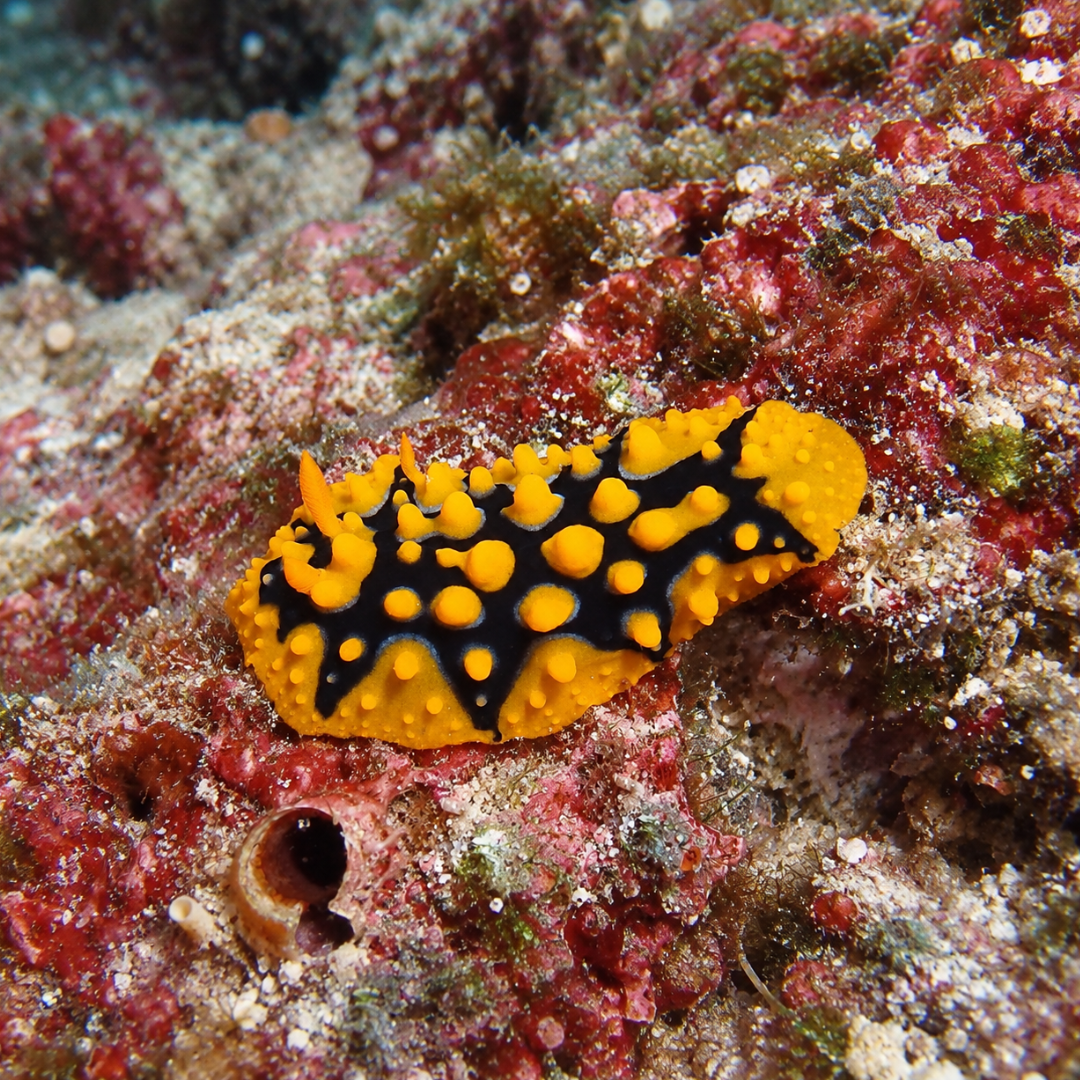
解説 / Description
フィリディア・ムルティトゥベルクラタは、イボウミウシ科フィリディア属に分類される、成体では貝殻を持たない海産腹足類です。背面は硬く、多数の丸みを帯びたイボ状突起に覆われ、橙色と黒色を基調とする目立つ体色を示します。一般的なドーリス型のウミウシに見られる背面後方の花状の二次鰓はなく、外套膜の縁の下面に並ぶ鰓で呼吸するのもイボウミウシ科の特徴です。また、歯舌と顎板を持たず、海綿の組織を吸い取るように摂食します。鮮やかな姿が目を引く一方、海綿食という特殊な食性のため餌の安定供給が難しく、イボウミウシ科に知られる化学防御も考慮する必要があります。そのため、一般家庭の観賞水槽で長期飼育する生体としては適していません。 Phyllidia multituberculata is a marine gastropod in the family Phyllidiidae that lacks an adult shell. Its firm mantle is covered with numerous rounded tubercles, and its coloration is dominated by conspicuous orange and black. Unlike many dorid nudibranchs, it has no flower-like dorsal gill plume; instead, gill leaflets lie beneath the mantle margin. Phyllidiids also lack both a radula and jaws and feed on sponge tissue by suction. Although visually striking, this specialized sponge diet makes reliable feeding difficult in captivity, and the chemical defenses known from the family also require caution. For these reasons, the species is not considered suitable for long-term maintenance in an ordinary home aquarium.
基本情報 / Basic Information
| 学名 / Scientific Name | Phyllidia multituberculata C. R. Boettger, 1915 |
|---|---|
| 通称 / Common Name | フィリディア・ムルティトゥベルクラタ。日本で広く定着した標準和名は確認できません。Phyllidia multituberculata |
| 分類 / Family | 軟体動物門・腹足綱・異鰓類・裸鰓類・イボウミウシ科(Phyllidiidae)・フィリディア属(Phyllidia)Phylum Mollusca, Class Gastropoda, Heterobranchia, Nudibranchia, Family Phyllidiidae, Genus Phyllidia |
| 英名 / English Name | 広く定着した英名は確認できません。No widely established English common name was confirmed. |
| 分布 / Distribution | 原記載地はインドネシアのアル諸島です。その後、モーリシャス、セーシェル、チャゴス諸島、モルディブ、ソコトラ島、スリランカなどインド洋域から報告されています。ただし、キイロイボウミウシ(Phyllidia ocellata)には本種とよく似た色彩型があるため、外見だけに基づく分布記録は慎重に扱う必要があります。The type locality is in the Aru Islands, Indonesia. The species has subsequently been reported from Indian Ocean localities including Mauritius, the Seychelles, the Chagos Archipelago, the Maldives, Socotra, and Sri Lanka. However, Phyllidia ocellata can show a very similar color form, so distribution records based only on external appearance should be treated cautiously. |
| 最大体長 / Max Size | 確認できた記録では20〜30mm台の個体が報告され、35mmの観察例もあります。明確な最大体長は確認できないため、約3cm前後はあくまで目安として扱うのが適切です。Available records include individuals in the 20–30 mm range, and an observation of 35 mm has also been reported. Because a well-established maximum is not available, about 3 cm should be treated only as a practical size reference. |
| 寿命 / Lifespan | 野外・飼育下ともに本種の寿命を特定できる十分な資料はありません。一般家庭での長期飼育例が乏しいため、年単位の寿命を断定することはできません。No sufficiently reliable species-specific lifespan is available from either the wild or captivity. Because long-term aquarium records are scarce, a lifespan in years cannot be stated with confidence. |
飼育環境 / Aquarium Environment
| 水槽サイズ / Tank Size | 長期飼育に適した規格水槽サイズは確立されていません。一般家庭での長期維持自体が難しいため、特定の「○cm規格水槽」を推奨できる根拠はありません。やむを得ず一時収容する場合は、他の生体と分けた専用の隔離環境を用意し、水量には余裕を持たせます。No standard aquarium size has been established for long-term maintenance. Because keeping this species successfully over the long term is itself problematic, there is no evidence-based basis for recommending a particular standard tank size. If temporary holding is unavoidable, use a dedicated isolation system with ample water volume and no other animals. |
|---|---|
| 水温 / Temperature | 本種について、飼育上の最適水温を定めた種特異的な資料は確認できません。熱帯域からの記録が中心であるため、一時収容では採集・輸送時の水温から急変させず、安定した海水温を保つことを優先します。 No species-specific optimum aquarium temperature has been established. Because records are mainly from tropical waters, temporary holding should prioritize temperature stability and avoid abrupt changes from the conditions in which the animal was collected or transported. |
| 水質 / Water Quality | 本種に固有の推奨比重やpHなどは確立されていません。清浄で安定した海水環境を維持し、急激な水質変化を避けることが基本です。ただし、水質を良好に保つだけでは長期飼育は成立せず、餌となる海綿を継続して確保できるかどうかが大きな制約になります。Species-specific target values for salinity, pH, and other aquarium parameters have not been established. The basic requirement is clean, stable seawater without abrupt changes. Good water quality alone, however, does not make long-term maintenance practical; the continuing availability of suitable sponge food remains a major limitation. |
| レイアウト / Layout | 自然下ではサンゴ礁や岩礁、ガレ場を這って生活します。一時収容では安定したライブロックなどの足場を用意し、強い吸い込み口やむき出しのポンプに接触しない構造にします。餌候補の海綿が付着していても、それが本種の利用できる種類とは限らないため、ライブロックだけを餌源として期待することはできません。In nature it crawls over reefs, rocky substrates, and rubble. For temporary holding, provide stable rockwork and protect the animal from exposed pump intakes or strong suction points. Even if sponges grow on live rock, there is no guarantee that they are suitable prey for this species, so live rock cannot be relied upon as a food source. |
| 注意点 / Precautions | 最大の問題は、海綿を食べる特殊な食性と、イボウミウシ科に知られる化学防御です。人工飼料、冷凍餌、アサリやエビの切り身などで代替できることを示す資料は確認できません。イボウミウシ科では海綿由来のイソシアノテルペン類などを防御に利用する例が知られ、粘液が魚類や甲殻類に有害だった研究例もあります。ただし、本種について閉鎖水槽内での放出量や他生体への影響を定量化した資料は確認できません。損傷や著しい衰弱が見られた場合は他生体から隔離し、安全側の対応として換水や活性炭の交換などを検討します。The main concerns are its specialized sponge diet and the chemical defenses known from the family Phyllidiidae. No reliable evidence was found that prepared foods, frozen foods, clam, or shrimp can substitute for its natural diet. Phyllidiids are known to use sponge-derived isocyanoterpenoids and related compounds in defense, and defensive mucus has been shown in some species to be harmful to fish and crustaceans. However, aquarium-scale release and effects have not been quantified for this species. If an individual is damaged or severely deteriorates, isolation from other animals and precautionary measures such as water changes and fresh activated carbon are reasonable conservative responses. |
餌と給餌 / Feeding
| 餌の種類 / Diet | 海綿食です。イボウミウシ科では海綿との強い食物関係が知られていますが、本種について家庭水槽で利用できる代替餌は確立されていません。一般的な人工飼料や魚介類の切り身を与えて維持できる生体ではありません。This species feeds on sponges. Strong dietary relationships with sponges are well documented in phyllidiids, but no substitute diet suitable for routine aquarium use has been established for this species. It should not be expected to survive on ordinary prepared foods or pieces of seafood. |
|---|---|
| 給餌のポイント / Feeding Tips | 長期維持には、実際に摂食する海綿を把握し、その海綿を継続して供給できることが必要です。外見だけでは摂食量や栄養状態を判断しにくいため、体が継続的に縮小する場合は栄養状態の悪化を疑う必要があります。一般的な海水魚のように、複数の代替餌を試しながら餌付けする方法には向きません。Long-term maintenance would require identifying a sponge that the animal actually consumes and supplying it continuously. Feeding status can be difficult to judge from appearance alone, so persistent body shrinkage should raise concern about declining nutritional condition. The usual aquarium practice of trying a series of substitute foods until one is accepted is not appropriate for this species. |
性格と混泳 / Temperament and Tank Mates
| 性格 / Temperament | 魚や移動性の無脊椎動物を捕食する種類ではなく、岩や海綿の表面をゆっくり移動します。日中にも目立つ姿で観察されるイボウミウシ科の一員ですが、行動が穏やかであることと飼育の安全性は別問題です。特殊な食性と化学防御を考えると、管理難易度は非常に高い生き物です。It is not a predator of fish or mobile invertebrates and moves slowly over rock and sponge surfaces. Like other conspicuous phyllidiids, it may be seen exposed during the day. This calm behavior should not be confused with ease or safety in captivity, because its specialized diet and chemical defenses create major husbandry difficulties. |
|---|---|
| 混泳の相性 / Compatibility | 一般的な海水魚や甲殻類との混泳について、安全性を裏付ける種特異的な飼育資料は確認できません。攻撃性よりも、衰弱・損傷時の化学的影響を本種について十分に評価できていないことが問題です。やむを得ず収容する場合は、他生体と分けた専用環境の方が安全です。No species-specific husbandry evidence was found that establishes safe community keeping with ordinary marine fish or crustaceans. The main concern is not aggression but the lack of quantified information on chemical effects if this species is damaged or severely stressed. If it must be held, a separate dedicated system is the safer option. |
病気と対策 / Diseases and Prevention
| かかりやすい病気 / Common Diseases | 本種に特有の飼育下疾病について、一般的な観賞魚のように整理された資料はほとんどありません。飼育時には、餌不足による栄養状態の悪化、輸送ストレス、ポンプへの吸い込みや岩組みによる外傷、水質急変に伴う衰弱などをまず警戒する必要があります。There is little species-specific information describing aquarium diseases in the way common fish diseases are documented. In captivity, the main problems to watch for are declining nutritional condition, shipping stress, mechanical injury from pumps or rockwork, and deterioration following sudden water-quality changes. |
|---|---|
| 対策と予防 / Prevention | 最も重要な予防は、適合する海綿を確保できない状態で安易に導入しないことです。一時収容では水温・比重の急変を避け、ポンプ吸水口をスポンジカバーなどで保護し、毎日体の張り、縮小、傷、異常な粘液、動きの低下を観察します。異常が見られた個体を他生体と同じ水槽に放置しないことも重要です。The most important preventive measure is simply not to acquire the animal unless an appropriate living sponge food source can be secured. During temporary holding, avoid abrupt changes in temperature and salinity, shield pump intakes, and inspect the animal daily for shrinkage, wounds, abnormal mucus, or reduced movement. A deteriorating individual should not be left in a community aquarium. |
増やし方(繁殖) / Breeding
| 雌雄の判別 / Sexing | 裸鰓類は雌雄同体で、本種も1個体が雄機能と雌機能の両方を持ちます。そのため、外見から個体をオスとメスに分けて判別することはできません。Nudibranchs are hermaphroditic, and each individual of this species has both male and female reproductive functions. Individuals therefore cannot be separated into external males and females. |
|---|---|
| 繁殖形態 / Reproduction | 卵生の裸鰓類ですが、本種について産卵から幼生期までを詳しく追った種特異的な飼育記録は十分に確認できません。裸鰓類では卵塊を産み、多くの種がベリジャー幼生を経ますが、卵塊の形状や幼生期間などを近縁種の情報からそのまま本種へ当てはめることは避けるべきです。This is an egg-laying nudibranch, but sufficiently detailed species-specific records covering spawning through larval development were not confirmed. Nudibranchs lay egg masses and many species pass through a veliger stage, but details such as egg-mass form and larval duration should not be transferred directly from related species to P. multituberculata without evidence. |
| 繁殖のポイント / Breeding Tips | 家庭水槽での繁殖方法は確立されていません。親個体を長期維持するだけでも餌となる海綿の継続確保が難しく、本種の幼生飼育条件についても十分な資料がありません。そのため、現時点では一般的な飼育環境で繁殖を目指せる種類とはいえません。No established captive-breeding method is available. Even long-term maintenance of adults is difficult because suitable sponge food must be supplied continuously, and species-specific larval culture requirements are not well documented. At present, this is not a species for which breeding can realistically be planned in a conventional home aquarium. |
雑学と豆知識 / Trivia and Fun Facts
| 1. 学名が語る「イボだらけ」の姿 / 1. A Name That Describes Its Tubercles | 種小名のmultituberculataは、「多い」を意味するmultiと、「小さな隆起・イボ」を意味するtuberculum系の語に由来し、背面を埋め尽くす多数の結節をそのまま名前にしたものです。見た目の装飾に思える突起ですが、イボウミウシ科の外套膜には多数の骨片が組み込まれ、殻を失った体を支える硬い構造の一部になっています。華やかな色彩と、触れると意外なほどしっかりした体つきは、同じ「ウミウシ」と呼ばれる仲間の中でも独特です。The specific name multituberculata is built from Latin roots meaning “many” and “tubercles,” directly describing the numerous rounded projections covering the dorsum. These projections are more than decoration: phyllidiid mantles contain abundant spicules that contribute to a remarkably firm body despite the complete loss of an adult shell. The combination of vivid coloration and a surprisingly robust mantle makes the group distinctive even among nudibranchs. |
|---|---|
| 2. 「1915」と「1918」が並ぶ命名年の謎 / 2. Why the Authority Year Appears as 1915 or 1918 | 本種の命名年は、資料によって1915年と1918年の両方が見られます。現在のWorld Register of Marine Speciesでは、原記載文献を1915年刊行として整理し、受理名をPhyllidia multituberculata C. R. Boettger, 1915としています。一方、古い文献や現在も更新の異なるデータベースには1918年表記が残っています。分類情報を参照するときは、この表記差があることを知っておくと同じ種の資料を見失いにくくなります。The authority year appears as both 1915 and 1918 in the literature. The current World Register of Marine Species treats the original description as published in 1915 and accepts the name Phyllidia multituberculata C. R. Boettger, 1915, while 1918 remains in older literature and in databases with different update histories. Knowing that both dates occur helps avoid mistaking the records for different species. |
| 3. キイロイボウミウシとの「そっくり問題」 / 3. The Long-Running Look-Alike Problem with Phyllidia ocellata | 本種は長くキイロイボウミウシPhyllidia ocellataとの区別が問題になってきました。一時期はP. ocellataの同物異名として扱われましたが、その後、咽頭部の内部形態などを根拠に独立種として再評価され、現在も受理種とされています。ただし、2023年の分子研究では、本種の黒色型に似た外見を持つインド産個体が実際にはP. ocellataだったことが示されました。つまり、「黒い地色に橙色のイボ」という色彩だけでは本種と断定できません。見た目の華やかさとは裏腹に、正確な同定には内部形態や分子情報が重要になる場合があります。This species has a long history of confusion with Phyllidia ocellata. It was once treated as a synonym of P. ocellata, but was later re-evaluated as a distinct species using internal pharyngeal morphology and is currently accepted as such. A 2023 molecular study, however, showed that an Indian specimen resembling the black form of P. multituberculata was actually P. ocellata. In other words, a black background with orange tubercles is not sufficient for identification; internal anatomy or molecular data may be needed for certainty. |
| 4. 歯がないのに海綿を食べる / 4. A Sponge Eater Without a Radula | 多くの巻貝やウミウシは、歯が並んだリボン状の器官である歯舌を使って餌を削り取ります。しかしイボウミウシ科は歯舌と顎板を失い、筋肉質の口腔部を使って海綿組織を吸い込む方向へ特殊化しました。つまり、同じ腹足類でも「削る」という典型的な食べ方から離れ、専用のポンプのような摂食様式へ進化したことになります。この特殊化が自然界では強みになる一方、水槽では代替餌が利かない大きな弱点になります。Most snails and many nudibranchs use a ribbon-like radula armed with teeth to scrape food. Phyllidiids, however, have lost both the radula and jaws and evolved a muscular oral apparatus specialized for suction feeding on sponge tissue. In evolutionary terms, they moved away from the typical gastropod strategy of scraping and toward a highly specialized feeding mechanism. That specialization is successful in nature but becomes a severe disadvantage in captivity because ordinary substitute foods are ineffective. |
| 5. 背中に鰓が見えない理由 / 5. Why There Is No Visible Gill Plume on the Back | 一般に「ウミウシらしい姿」として思い浮かべる、背中の後方に咲く花のような二次鰓は、本種にはありません。その代わり、外套膜の縁の下、腹足との間に薄い鰓葉が列状に並びます。上から眺めると鰓が見えないため、丸いイボと触角だけが強調され、まるで小さな装甲生物のような輪郭になります。呼吸器官の配置そのものが、イボウミウシ科を見分ける重要な解剖学的特徴の一つです。The flower-like posterior gill plume commonly associated with nudibranchs is absent in this species. Instead, thin gill leaflets are arranged beneath the mantle margin between the mantle and the foot. Because the gills are hidden from above, the animal’s tubercles and rhinophores dominate its silhouette, giving it an almost armored appearance. The position of the respiratory organs is one of the key anatomical traits of the family Phyllidiidae. |
| 6. 海綿の化学物質を「防具」に変える仲間たち / 6. Turning Sponge Chemistry into Defense | イボウミウシ科では、餌の海綿に由来するイソシアノテルペン類などの二次代謝産物を体内に取り込み、防御に利用する例が知られています。代表例の9-イソシアノププケアナンは同属のPhyllidia varicosaから研究され、1979年にはE. J. Coreyらによる全合成が報告されるほど有機化学でも注目されました。ただし、この化合物を本種Phyllidia multituberculataが持つと確認した資料は見当たりません。つまり、本種を「9-イソシアノププケアナンを持つ毒性ウミウシ」と説明するのは正確ではなく、イボウミウシ科全体に見られる海綿食と化学防御の関係として理解するのが適切です。Phyllidiids are known to sequester sponge-derived secondary metabolites, including isocyanoterpenoids, for chemical defense. A well-known example, 9-isocyanopupukeanane, was studied from the congener Phyllidia varicosa and became important enough in marine natural-products chemistry that E. J. Corey and colleagues reported a total synthesis in 1979. No reliable source was found confirming that P. multituberculata itself contains this compound. It is therefore more accurate to understand the example as evidence of the broader relationship among sponge feeding, chemical sequestration, and defense within Phyllidiidae rather than as a species-specific toxin record. |
まとめ / Conclusion
フィリディア・ムルティトゥベルクラタは、鮮やかな体色、硬い外套膜、背面から見えにくい鰓、歯舌と顎板を持たない海綿食という、イボウミウシ科の特徴をよく示す生き物です。一方、キイロイボウミウシにはよく似た色彩型があり、見た目だけでは確実に同定できない場合があります。 Phyllidia multituberculata displays several characteristic features of phyllidiid nudibranchs: conspicuous coloration, a firm mantle, gills hidden beneath the mantle margin, and sponge feeding without a radula or jaws. At the same time, very similar color forms occur in Phyllidia ocellata, so appearance alone may not always provide a secure identification.
飼育では、海綿を継続して用意する難しさが最大の壁になります。さらに、イボウミウシ科に知られる化学防御についても、本種の水槽内での影響が十分に検証されていない以上、混泳を前提に扱うのは適切ではありません。目立つ外見だけでなく、海綿との強い結び付きや分類上の奥深さまで含めて知ることで、このウミウシならではの魅力がよりはっきり見えてきます。 In captivity, the continuing supply of suitable sponge food is the greatest practical obstacle. In addition, because aquarium-scale effects of its chemical defenses have not been adequately tested for this species, it should not be treated as an ordinary community-tank animal. Its appeal lies not only in its appearance, but also in the close ecological relationship with sponges and the taxonomic complexity behind its identification.

気になる道具や飼い方を見つけてみませんか?
 アイのアクアグッズ案内水草用ソイルの選び方|土・砂の違いとおすすめ商品道具の特徴や使い方、選ぶときのポイントをアイが紹介します。記事はコチラ →
 アイのアクアグッズ案内水槽のろ材の選び方|ウール・リング・活性炭の違いとおすすめ商品フィルターの中の綿や石は何をしている? アイとコタロウが、ウール・スポンジ・セラミック・焼結ガラス・活性炭・ゼオライトを比較。機種との相性、入れ方、洗い方と交換まで商品とともに紹介します。記事はコチラ →
 アイのアクアグッズ案内コリドラスのもふもふ時間を楽しむ|餌・底砂・お掃除用品の選び方コリドラスのもふもふする食事風景を楽しむために。沈む餌2種類の違い、口元に配慮した底砂、食べ残しを回収する道具を、アクアグッズナビゲーターのアイが紹介します。記事はコチラ →
 アイのアクアグッズ案内ラスボラ・ボララスの群泳を楽しむ飼育用品|水槽・ろ過・ヒーター・餌・水草道具の特徴や使い方、選ぶときのポイントをアイが紹介します。記事はコチラ →
さまざまな飼育テーマをご紹介。リンク先の記事には広告・商品紹介が含まれます。
案内・紹介記事一覧へ →分布マップ
フィリディア・ムルティトゥベルクラタ(Phyllidia multituberculata)は、原記載地であるインドネシアのアル諸島のほか、モーリシャス、セーシェル、チャゴス諸島、モルディブ、ソコトラ島、スリランカなどのインド洋域から報告されています。ただし、近縁のキイロイボウミウシとよく似た色彩を示すことがあるため、外見だけに基づく分布記録には注意が必要です。
この地図は記事に記載された分布地域を把握しやすくするための概略表示です。表示範囲は厳密な生息域の境界を示すものではありません。マーカーは分布域を見やすくするために設定した代表地点であり、実際の採集地点や観察地点を示すものではありません。
参考文献
- MolluscaBase eds. (2026). Phyllidia multituberculata C. R. Boettger, 1915. World Register of Marine Species. https://www.marinespecies.org/aphia.php?p=taxdetails&id=536625
- Yonow, N. (1996). Systematic revision of the family Phyllidiidae in the Indian Ocean Province: Part 1 (Opisthobranchia: Nudibranchia: Doridoidea). Journal of Conchology, 35, 483–516. https://doi.org/10.5962/p.408000
- Yonow, N., Anderson, R. C., & Buttress, S. G. (2002). Opisthobranch molluscs from the Chagos Archipelago, Central Indian Ocean. Journal of Natural History, 36(7), 831–882. https://doi.org/10.1080/00222930110039161
- Yonow, N. (2012). Opisthobranchs from the western Indian Ocean, with descriptions of two new species and ten new records (Mollusca, Gastropoda). ZooKeys, 197, 1–129. https://doi.org/10.3897/zookeys.197.1728
- Brunckhorst, D. J. (1993). The systematics and phylogeny of phyllidiid nudibranchs (Doridoidea). Records of the Australian Museum, Supplement, 16, 1–107. https://doi.org/10.3853/j.0812-7387.16.1993.79
- van Alphen, J., de Voogd, N. J., & Hoeksema, B. W. (2011). Differential feeding strategies in phyllidiid nudibranchs on coral reefs at Halmahera, northern Moluccas. Coral Reefs, 30, 59. https://doi.org/10.1007/s00338-010-0698-y
- Papu, A., Bogdanov, A., Bara, R., Kehraus, S., König, G. M., Yonow, N., & Wägele, H. (2022). Phyllidiidae (Nudibranchia, Heterobranchia, Gastropoda): an integrative taxonomic approach including chemical analyses. Organisms Diversity & Evolution, 22, 585–629. https://doi.org/10.1007/s13127-021-00535-7
- Dixit, S., Yonow, N., Venugopal, V. K., Manjebrayakath, H., & Saravanane, N. (2023). The curious case of Phyllidia ocellata and the first molecular data of three phyllidiid species from India (Gastropoda, Heterobranchia, Phyllidiidae). Molluscan Research, 43(1), 34–49. https://doi.org/10.1080/13235818.2023.2191154
- Johannes, R. E. (1963). A poison-secreting nudibranch (Mollusca: Opisthobranchia). The Veliger, 5(3), 104–105. https://www.biodiversitylibrary.org/part/93413




コメント