

解説 / Description
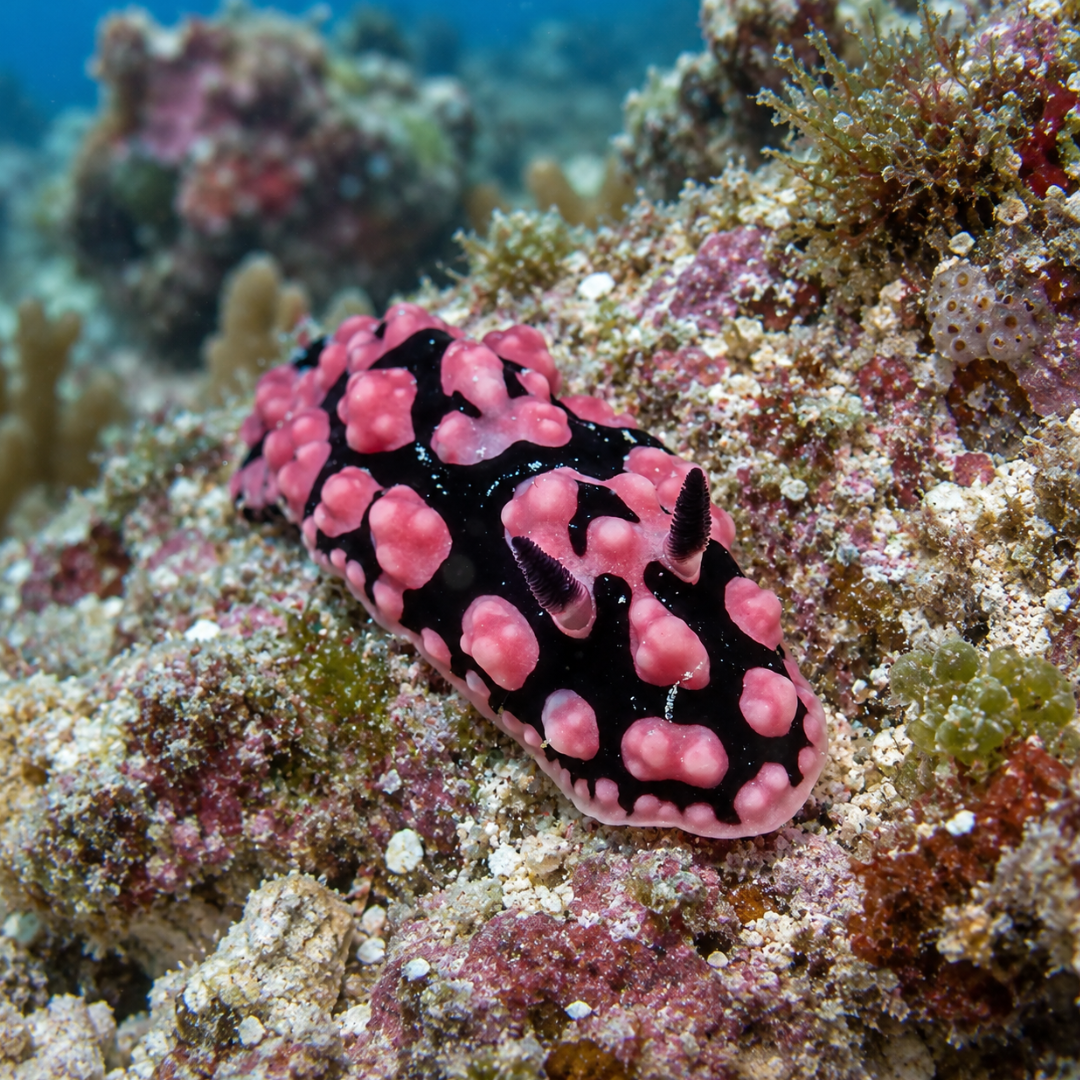
コイボウミウシは、黒い背面にピンク色から灰色のいぼ状突起をもつ、インド太平洋のサンゴ礁域でよく知られるイボウミウシ科の一種です。背面に花びら状の鰓が見えない独特の体つきをもち、呼吸に使う二次鰓は外套膜の裏側に並びます。海綿動物を餌とし、摂食した海綿に由来する二次代謝産物の一部を体内に取り込んで防御に利用することが確認されています。一方、家庭水槽では個体に適した海綿を継続して確保することが難しく、長期飼育の難易度は非常に高い生き物です。 Phyllidiella pustulosa is a well-known phyllidiid nudibranch of Indo-Pacific reef habitats, recognized by a black dorsum bearing pink to grayish wart-like tubercles. Unlike many dorid nudibranchs, it has no conspicuous flower-like gill plume on the back; its secondary gills lie beneath the mantle margin. It feeds on sponges, and studies have demonstrated that some secondary metabolites obtained from its prey are incorporated into its defensive chemistry. In home aquaria, however, maintaining a continuous supply of the appropriate living sponge prey is extremely difficult, making long-term care highly challenging.
基本情報 / Basic Information
| 学名 / Scientific Name | Phyllidiella pustulosa (Cuvier, 1804) |
|---|---|
| 通称 / Common Name | コイボウミウシPustular phyllidia, pustule nudibranch, pustulose wart slug |
| 分類 / Family | 軟体動物門・腹足綱・裸鰓目・ドーリス亜目・イボウミウシ科・コイボウミウシ属Phylum Mollusca, Class Gastropoda, Order Nudibranchia, Suborder Doridina, Family Phyllidiidae, Genus Phyllidiella |
| 英名 / English Name | Pustulose phyllidiella |
| 分布 / Distribution | 従来は、紅海から東アフリカ、東南アジア、オーストラリア、太平洋島嶼域、日本にかけての熱帯・暖温帯インド太平洋に広く分布するとされてきました。日本では琉球列島をはじめ、黒潮の影響を受ける海域でも記録されています。主な生息場所は浅いサンゴ礁や岩礁、ガレ場です。ただし、現在コイボウミウシとされる個体群には複数の遺伝的系統が含まれる可能性があり、従来の広い分布記録のすべてが同一種を示すとは限りません。Traditionally, Phyllidiella pustulosa has been reported widely across the tropical and warm-temperate Indo-Pacific, from the Red Sea and East Africa through Southeast Asia and Australia to Pacific islands and Japan. In Japan it is recorded from the Ryukyu Islands and other waters influenced by the Kuroshio Current. It typically inhabits shallow coral reefs, rocky reefs, and rubble zones. However, genetic studies indicate that animals identified under this name may include several distinct lineages, so not every historical record across this broad range necessarily represents the same biological species. |
| 最大体長 / Max Size | 多くは3〜6cm前後で、確認された資料では最大約7cm程度に達します。個体群や同定範囲の違いもあるため、極端に大きな記録は慎重に扱う必要があります。Many individuals are around 3–6 cm long, and well-documented sources report a maximum of roughly 7 cm. Exceptionally large records should be treated cautiously because populations assigned to this name may not all represent the same lineage. |
| 寿命 / Lifespan | 野外・飼育下ともに、信頼できる寿命の年数データは十分に確立されていません。家庭水槽では食性の特殊さから本来の寿命よりはるかに短期間で衰弱する例が多いため、飼育日数を自然寿命の目安にすることはできません。A reliable species-specific lifespan has not been firmly established in either the wild or captivity. Aquarium survival is often shortened by the difficulty of providing the correct sponge diet, so captive longevity should not be treated as an estimate of natural lifespan. |
飼育環境 / Aquarium Environment
| 水槽サイズ / Tank Size | 本種について、60cm規格水槽や90cm規格水槽といった特定の水槽サイズを最低条件として示せる信頼性の高い根拠は確認されていません。長期飼育を試みる場合は、規格サイズや水量だけで判断せず、十分に成熟した専用海水水槽で、餌となる海綿の継続供給、水質の安定、ろ過能力、緊急時の隔離体制を確保することが重要です。一般的な観賞目的の家庭飼育には向きません。No reliable species-specific evidence establishes a particular standard tank size, such as a 60 cm or 90 cm aquarium, as a minimum requirement. Any attempt at long-term maintenance should therefore be based not on tank dimensions alone but on a mature dedicated marine system with continuous access to suitable sponge prey, stable water quality, adequate filtration, and a plan for immediate isolation if problems occur. This species is not well suited to ordinary home display aquaria. |
|---|---|
| 水温 / Temperature | 本種固有の至適水温は十分に確立されていません。熱帯性個体を管理する際の実務上の目安として24〜26℃程度が用いられますが、数値そのものよりも、採集・導入時の環境との差を小さくし、急激な変化を避けて安定させることが重要です。 A species-specific optimum temperature has not been firmly established. Around 24–26°C is commonly used as a practical range for tropical specimens, but stability and avoiding rapid changes from the animal’s previous conditions are more important than treating this range as an experimentally proven optimum. |
| 水質 / Water Quality | 本種だけを対象に確立された水質の至適値はありません。飼育を試みる場合は、一般的な熱帯サンゴ礁水槽の安定域として比重1.023〜1.025、pH8.1〜8.4程度を管理の目安とし、アンモニアと亜硝酸は検出されない状態、硝酸塩は低い状態を維持します。数値を追うこと以上に、蒸発や換水による急な比重・水質変化を避けることが重要です。Species-specific optimum water parameters have not been established. If maintenance is attempted, a stable tropical reef-aquarium range of roughly 1.023–1.025 specific gravity and pH 8.1–8.4 can be used as a practical management reference, with ammonia and nitrite kept undetectable and nitrate kept low. Avoiding sudden salinity and water-quality changes is more important than treating these values as experimentally defined requirements for the species. |
| レイアウト / Layout | 十分に熟成したライブロックを主体とし、餌候補となる海綿を維持しやすく、個体の移動や摂食を観察できる構成にします。水流は停滞を避けつつ、個体が流されない穏やかな範囲から調整し、ポンプ吸入口には巻き込み防止カバーを付けます。機器の狭い隙間へ入り込まないよう、点検しやすいレイアウトが適しています。Build the system around well-matured live rock and arrange it so that potential sponge prey can be maintained and the animal’s movement and feeding can be observed. Provide enough circulation to avoid stagnant areas without creating flow strong enough to dislodge the nudibranch, and screen pump intakes to prevent injury. A simple, inspectable layout is preferable because roaming individuals can enter narrow equipment gaps. |
| 注意点 / Precautions | 最大の問題は餌となる適合海綿を長期に確保しにくいことです。また、本種は海綿由来の防御物質を体内に保持し、強い刺激を受けると分泌物を放出することがあります。閉鎖水槽では同居生物に悪影響を及ぼす可能性があるため、基本は専用水槽での単独管理とし、活性炭、新しい人工海水、隔離容器をすぐ使える状態にしておく必要があります。素手で不用意に触れないことも大切です。The greatest challenge is maintaining a long-term supply of compatible living sponges. The animal also retains defensive compounds obtained from its sponge prey and may release secretions when severely stressed. In a closed aquarium these substances can potentially affect tank mates, so dedicated single-species housing is the safer approach. Keep activated carbon, freshly prepared seawater, and an isolation container ready for emergencies, and avoid unnecessary bare-hand contact. |
餌と給餌 / Feeding
| 餌の種類 / Diet | 海綿動物を食べることは確かですが、コイボウミウシとして扱われる個体群では複数の海綿との摂食関係が報告されており、利用する餌は地域や遺伝的系統によって異なる可能性があります。Acanthella cavernosaとの関係は実験的にも確認されています。一般的な人工飼料、冷凍餌、貝肉などで代替できるという確かな根拠はありません。Sponge feeding is well established, but populations identified as Phyllidiella pustulosa have been associated with more than one sponge prey, and diet may differ among regions or genetic lineages. The relationship with Acanthella cavernosa has been demonstrated experimentally. There is no reliable evidence that standard prepared foods, frozen foods, or shellfish meat can serve as substitutes. |
|---|---|
| 給餌のポイント / Feeding Tips | 入手した個体が実際に摂食していた海綿を確認できる場合は、その海綿を生きた状態で継続供給できることが理想です。海綿が付着したライブロックを用意しても、目的の餌が含まれているとは限りません。体の縮みや活動低下が見られても原因を飢餓だけに決めつけず、摂食の有無と水質、外傷などを合わせて確認します。If the sponge on which an individual was actually feeding can be identified, maintaining a continuing supply of that living prey is ideal. Live rock bearing miscellaneous sponges does not guarantee that the required food is present. If the animal shrinks or becomes less active, do not assume starvation is the only cause; assess feeding, water quality, and possible injury together. |
性格と混泳 / Temperament and Tank Mates
| 性格 / Temperament | 他の生物を追い回すような攻撃性はなく、基本的には海底や岩の表面をゆっくり移動します。一方で、捕食者への対抗手段として化学防衛を備えているため、性格が温和であることと混泳が安全であることは同義ではありません。It is not behaviorally aggressive and generally crawls slowly over the substrate and rockwork. However, its chemical defenses mean that a non-aggressive temperament does not automatically make it a safe community-tank animal. |
|---|---|
| 混泳の相性 / Compatibility | 原則として専用水槽での単独管理が安全です。体をつついたり傷つけたりする可能性のある生物との同居は避けます。強い刺激を受けた個体が防御分泌物を放出した場合、閉鎖水槽では同居生物への影響を予測しにくいため、混泳を前提とする一般的なリーフタンクへの導入には向きません。Dedicated single-species housing is the safer approach. Avoid tank mates that may peck at or injure the nudibranch. If a strongly disturbed individual releases defensive secretions, their effects on other organisms in a closed aquarium are difficult to predict, so this species is poorly suited to a conventional mixed reef aquarium. |
病気と対策 / Diseases and Prevention
| かかりやすい病気 / Common Diseases | 観賞飼育下で本種に特有の感染症は十分に整理されていません。実際には、病原体よりも餌不足による慢性的な飢餓、比重や水温の急変、水質悪化、溶存酸素不足、ポンプへの巻き込みや他生物による外傷が大きな問題になります。Species-specific infectious diseases in aquarium-kept Phyllidiella pustulosa are not well documented. In practice, chronic starvation, sudden salinity or temperature changes, deteriorating water quality, low dissolved oxygen, pump injuries, and physical damage from tank mates are more prominent health risks. |
|---|---|
| 対策と予防 / Prevention | 成熟した水槽にのみ導入し、水合わせは比重と温度を急変させないよう慎重に行います。定期的に体の張り、移動量、触角の状態を観察し、異常があれば早めに隔離します。化学薬品を使う治療は本種への安全性が確立していないものが多いため、安易な薬浴よりも原因となる環境要因の除去と水質改善を優先します。Introduce the animal only to a mature system and acclimate it carefully to avoid rapid changes in salinity or temperature. Regularly observe body firmness, activity, and rhinophore condition, and isolate the animal promptly if abnormalities appear. The safety of many aquarium medications has not been established for this nudibranch, so correcting environmental causes and improving water quality should generally take priority over indiscriminate chemical treatment. |
増やし方(繁殖) / Breeding
| 雌雄の判別 / Sexing | 同時的雌雄同体で、一個体が雄と雌の生殖機能を併せ持つため、外見からオス・メスに分けて判別することはできません。交尾時には互いの右側を寄せ、生殖孔を近づけて精子を交換します。The species is a simultaneous hermaphrodite, with each individual possessing both male and female reproductive functions, so there are no separate males and females to identify externally. During mating, two individuals align their right sides and exchange sperm through the genital openings. |
|---|---|
| 繁殖形態 / Reproduction | 交尾後、岩やサンゴ骨格などの基盤に、ゼラチン質に包まれた多数の卵をリボン状の卵塊として産み付けます。コイボウミウシでは平たい渦巻き状の卵塊が知られています。自然下では孵化後の幼生期を経て成長すると考えられますが、家庭水槽で幼生から成体まで育て上げた安定した繁殖手法は確立していません。After mating, numerous eggs are deposited in a gelatinous ribbon attached to rock, dead coral skeleton, or another firm surface. Phyllidiella pustulosa is known for laying a flat spiral egg mass. Development proceeds through a larval stage, but no reliable household-aquarium method for raising the offspring from larvae to adults has been established. |
| 繁殖のポイント / Breeding Tips | 成体を産卵させるだけでなく、孵化後の幼生を育て、その後の幼体へ適切な餌海綿を供給する必要があるため、家庭での累代繁殖は非常に難しいと考えられます。導入後に卵塊や卵状の物質が見られても、それだけで受精や繁殖成功を示すとは限りません。産卵の確認と、孵化・幼生育成の成功は分けて判断する必要があります。Successful breeding requires more than getting adults to lay eggs: the larvae must be reared successfully and suitable sponge prey must later be provided to juveniles. Multigenerational home breeding is therefore exceptionally difficult. The appearance of an egg ribbon or egg-like material after introduction does not by itself demonstrate fertilization or successful reproduction; egg laying and successful larval rearing should be evaluated separately. |
雑学と豆知識 / Trivia and Fun Facts
| 1. 1804年に記載された、200年以上の歴史をもつ名前 / 1. A name with more than two centuries of taxonomic history | コイボウミウシは1804年、フランスの博物学者ジョルジュ・キュヴィエによってPhyllidia pustulosaとして記載されました。Phyllidiella属自体は19世紀に設けられ、その後も外部形態の変異によって多くの異名が生じました。1993年のイボウミウシ科の包括的な再検討などを経て、現在はPhyllidiella pustulosaが有効名として扱われています。色彩や突起の形だけでは種の境界を見誤りやすいことを示す、分類学史上も興味深い例です。The species was described by the French naturalist Georges Cuvier in 1804 as Phyllidia pustulosa. The genus Phyllidiella itself was established in the nineteenth century, while variation in external appearance led to numerous names being applied over time. Following major systematic revisions of the family, including the comprehensive 1993 treatment, Phyllidiella pustulosa is the accepted name today. Its history shows how easily species boundaries can be obscured when identification relies too heavily on color and tubercle shape. |
|---|---|
| 2. 同じ姿でも遺伝的には一枚岩ではない可能性 / 2. Similar-looking animals may not all be genetically identical | 近年の分子系統研究では、広いインド太平洋に分布するコイボウミウシが、地域ごとに遺伝的な差をもつ複数の系統を含む可能性が示されています。外見がよく似ていても、DNAを調べると深い分化が見つかることがあり、将来的な研究によって種の境界がさらに整理される可能性があります。水槽で目にする一匹の背後にも、まだ確定していない進化史が隠れているのです。Recent molecular studies indicate that the broadly distributed animals currently identified as Phyllidiella pustulosa may include strongly differentiated regional lineages. Individuals can look very similar while showing deep genetic separation, so future research may refine the species boundaries further. A single animal in an aquarium can therefore represent part of an evolutionary history that is still being resolved. |
| 3. 背中に鰓が見えない理由 / 3. Why no gill plume is visible on the back | 多くのドーリス型ウミウシでは、背面後方に花びらのような二次鰓が見えます。ところがイボウミウシ科では、その目立つ鰓冠がありません。代わりに、外套膜の裏側と腹足の間に細かな二次鰓が並び、体の縁に沿って呼吸を行います。上から見ると重厚で滑らかな「装甲」のように見える体型は、こうした独特の解剖学によって生まれています。Many dorid nudibranchs display a flower-like secondary gill plume near the rear of the dorsum. Phyllidiids do not. Instead, numerous secondary gill leaflets lie beneath the mantle margin between the mantle and the foot, allowing gas exchange around the sides of the body. This unusual anatomy contributes to the solid, almost armored appearance seen from above. |
| 4. 毒を自作するのではなく、餌から「借りる」化学防衛 / 4. Chemical defenses borrowed from food rather than made from scratch | コイボウミウシの生態で特に興味深いのが、海綿由来の化合物を体内へ取り込み、防御に利用する仕組みです。研究では、標識した海綿由来のイソシアニド系化合物が摂食後のコイボウミウシから検出され、餌からの移行が実験的に示されています。殻を失った裸鰓類が、食べ物の化学成分を自分の盾へ作り替えるという、サンゴ礁ならではの化学的な食物連鎖です。One of the most fascinating aspects of this species is its ability to acquire defensive compounds from sponge prey. Experiments using labeled sponge metabolites have demonstrated that isocyanide-related compounds can be transferred into Phyllidiella pustulosa after feeding. For a shell-less nudibranch, food chemistry becomes part of its defense, creating a remarkable chemical link between predator and prey on coral reefs. |
| 5. 黒とピンクは目立つための色でもある / 5. Black and pink may function as a conspicuous warning | 黒地に鮮やかな突起という配色は、化学防衛と結びついた警告色として解釈されています。イボウミウシ科では、視覚的な目立ちやすさと忌避される化学成分が組み合わさることで、捕食者に避けられる仕組みが研究されています。ただし、コイボウミウシでは地域個体群によって抽出物の忌避効果に差が報告されているため、どの個体も同じ強さの防御をもつと考えるのは適切ではありません。The black background and vivid tubercles are interpreted as warning coloration associated with chemical defense. In phyllidiid nudibranchs, studies have examined how conspicuous visual signals and deterrent chemistry can work together to reduce predation. However, extracts from different Phyllidiella pustulosa populations have not shown identical deterrent effects, so it is not appropriate to assume that every individual has the same level of chemical defense. |
| 6. そっくりなヒラムシがいる / 6. A flatworm has evolved a remarkably similar appearance | 海洋ヒラムシのPseudoceros imitatusは、コイボウミウシとよく似た色彩と模様をもつことで知られ、1994年の記載時から擬態の例として論じられてきました。厚みのあるコイボウミウシが腹足で這うのに対し、ヒラムシは薄い体の縁を波打たせて泳ぐことができます。まったく異なる動物群が同じような見た目へ近づいた背景には、サンゴ礁の捕食者が色と形をどのように学習するかという進化上の駆け引きがあります。The marine flatworm Pseudoceros imitatus is famous for closely resembling Phyllidiella pustulosa in color and pattern, and it has been discussed as a case of mimicry since its formal description in 1994. The nudibranch is relatively thick-bodied and crawls on a muscular foot, whereas the flatworm is extremely thin and can swim by undulating its body margin. Their resemblance shows how unrelated reef animals can converge on similar visual signals under predator-driven selection. |
| 7. 海洋天然物化学の研究対象としても注目される / 7. A subject of marine natural-products research | コイボウミウシやその餌海綿からは、イソシアニドを含むテルペン類など多様な二次代謝産物が研究されてきました。一部の化合物は培養細胞や病原体を用いた基礎研究で細胞毒性や抗マラリア活性などを示しており、創薬候補となり得る化学骨格を探す研究の対象になっています。ただし、基礎研究で活性が見つかったことと、医薬品として安全かつ有効に使えることは別問題であり、実用化には長い検証が必要です。A wide range of secondary metabolites, including isocyanide-containing terpenoids, has been studied from Phyllidiella pustulosa and its sponge prey. Some compounds have shown cytotoxic or antimalarial activity in laboratory assays, making them interesting starting points for natural-products and drug-discovery research. Laboratory activity, however, is not the same as a safe and effective medicine; extensive testing would be required before any practical medical use. |
まとめ / Conclusion
コイボウミウシは、黒とピンクを基調とした鮮やかな姿に加え、海綿を食べ、餌由来の化学物質を防御に利用することや、外套膜の下に呼吸器官をもつことなど、独特の生態と体の仕組みを備えています。現在ひとつの種名で扱われている個体群にも遺伝的な多様性が示されており、見た目だけでは捉えきれない奥深さをもつ生き物です。 Phyllidiella pustulosa is notable not only for its vivid black-and-pink appearance but also for its sponge-feeding ecology, its use of prey-derived compounds in defense, and its unusual respiratory structures beneath the mantle. Genetic studies also indicate substantial diversity among populations currently placed under this single name, giving the animal a biological complexity that cannot be understood from appearance alone.
飼育では、一般的な人工飼料で代替できるという確かな根拠がなく、個体に適した海綿を継続して確保することが最大の課題になります。さらに、強い刺激を受けた際の防御分泌物にも配慮が必要です。観賞しやすい姿だけで飼いやすさを判断せず、自然下で餌生物と深く結びついて暮らす生態まで理解することが、コイボウミウシと向き合ううえで大切です。 In captivity, the central difficulty is that there is no reliable evidence that ordinary prepared foods can replace the animal’s natural sponge diet, making a continuing supply of suitable prey the major challenge. Defensive secretions released under strong disturbance also require caution. Its conspicuous appearance should not be mistaken for ease of care; appreciating how closely it is tied to its prey and reef habitat is essential to understanding this nudibranch.

気になる道具や飼い方を見つけてみませんか?
 アイのアクアグッズ案内マジックリーフ物語|一枚の葉がアクアリウム用品になるまで道具の特徴や使い方、選ぶときのポイントをアイが紹介します。記事はコチラ →
 アイのアクアグッズ案内海水魚の底砂の選び方|サンゴ砂・ライブサンドとおすすめ商品道具の特徴や使い方、選ぶときのポイントをアイが紹介します。記事はコチラ →
 アイのアクアグッズ案内アフリカンシクリッドの飼育用品|水槽・ろ過・底砂・岩組み・餌の選び方道具の特徴や使い方、選ぶときのポイントをアイが紹介します。記事はコチラ →
 アイのアクアグッズ案内コリドラスのもふもふ時間を楽しむ|餌・底砂・お掃除用品の選び方コリドラスのもふもふする食事風景を楽しむために。沈む餌2種類の違い、口元に配慮した底砂、食べ残しを回収する道具を、アクアグッズナビゲーターのアイが紹介します。記事はコチラ →
さまざまな飼育テーマをご紹介。リンク先の記事には広告・商品紹介が含まれます。
案内・紹介記事一覧へ →分布マップ
コイボウミウシ(Phyllidiella pustulosa)は、従来、紅海・東アフリカから東南アジア、オーストラリア、太平洋島嶼域、日本にかけての熱帯・暖温帯インド太平洋に広く分布するとされてきました。日本では琉球列島をはじめ、黒潮の影響を受ける海域でも記録されています。なお、現在この学名で扱われている個体群には複数の遺伝的系統が含まれる可能性があり、過去の広い分布記録のすべてが同一の生物学的種を示すとは限りません。
この地図は、文献上知られている広い分布域を把握しやすくするための概略表示です。マーカーは分布域内の位置関係を示すために設定した代表地点であり、実際の採集地点や特定個体の観察地点を示すものではありません。
参考文献
- MolluscaBase editors. (2026). Phyllidiella pustulosa (Cuvier, 1804). World Register of Marine Species (WoRMS). 主な対応項目:学名、分類、原記載名、シノニム。 https://www.marinespecies.org/aphia.php?p=taxdetails&id=536574
- Brunckhorst, D. J. (1993). The systematics and phylogeny of phyllidiid nudibranchs (Doridoidea). Records of the Australian Museum, Supplement, 16, 1–107. 主な対応項目:分類、形態、分布、生態、摂食器官、繁殖・産卵。 https://doi.org/10.3853/j.0812-7387.16.1993.79
- Stoffels, B. E. M. W., van der Meij, S. E. T., Hoeksema, B. W., van Alphen, J., van Alen, T., Meyers-Muñoz, M. A., de Voogd, N. J., Tuti, Y., & van der Velde, G. (2016). Phylogenetic relationships within the Phyllidiidae (Opisthobranchia, Nudibranchia). ZooKeys, 605, 1–35. 主な対応項目:分子系統、コイボウミウシに複数の遺伝的系統が含まれる可能性。 https://doi.org/10.3897/zookeys.605.7136
- Mehrotra, R., Caballer Gutiérrez, M. A., Scott, C. M., Arnold, S., Monchanin, C., Viyakarn, V., & Chavanich, S. (2021). An updated inventory of sea slugs from Koh Tao, Thailand, with notes on their ecology and a dramatic biodiversity increase for Thai waters. ZooKeys, 1042, 73–188. 主な対応項目:インド太平洋での分布記録、サンゴ礁での生息、観察水深、種複合体に関する注意。 https://doi.org/10.3897/zookeys.1042.64474
- van Alphen, J., de Voogd, N. J., & Hoeksema, B. W. (2011). Differential feeding strategies in phyllidiid nudibranchs on coral reefs at Halmahera, northern Moluccas. Coral Reefs, 30, 59. 主な対応項目:海綿食、吸引型の摂食器官、コイボウミウシの海綿への摂食行動。 https://doi.org/10.1007/s00338-010-0698-y
- Dumdei, E. J., Flowers, A. E., Garson, M. J., & Moore, C. J. (1997). The biosynthesis of sesquiterpene isocyanides and isothiocyanates in the marine sponge Acanthella cavernosa (Dendy); evidence for dietary transfer to the dorid nudibranch Phyllidiella pustulosa. Comparative Biochemistry and Physiology Part A: Physiology, 118(4), 1385–1392. 主な対応項目:Acanthella cavernosaの摂食、海綿由来二次代謝産物の取り込み、化学防衛の基礎。 https://doi.org/10.1016/S0300-9629(97)00051-0
- Ritson-Williams, R., & Paul, V. J. (2007). Marine benthic invertebrates use multimodal cues for defense against reef fish. Marine Ecology Progress Series, 340, 29–39. 主な対応項目:コイボウミウシの化学防衛、警告色との組み合わせ、地域による防御効果の違い。 https://doi.org/10.3354/meps340029
- Alqudah, A., Saad, S., Susanti, D., Hadry, N. F., Khodzori, M. F. A., Yusof, M. H., & Rani, M. H. (2016). Observations on nudibranch behaviour patterns under laboratory conditions. Jurnal Teknologi, 78(11), 167–171. 主な対応項目:交尾行動、産卵、飼育下で観察された防御性分泌や水面へ移動する異常行動。 https://doi.org/10.11113/.v78.6639
- Henry, J. Q., Lesoway, M. P., & Perry, K. J. (2020). An automated aquatic rack system for rearing marine invertebrates. BMC Biology, 18, 46. 主な対応項目:海産無脊椎動物を閉鎖系で維持する際の水質安定、塩分・pH管理、窒素化合物管理、活性炭利用に関する一般的な飼育管理。コイボウミウシ固有の至適値を示す資料ではありません。 https://doi.org/10.1186/s12915-020-00772-w




コメント