

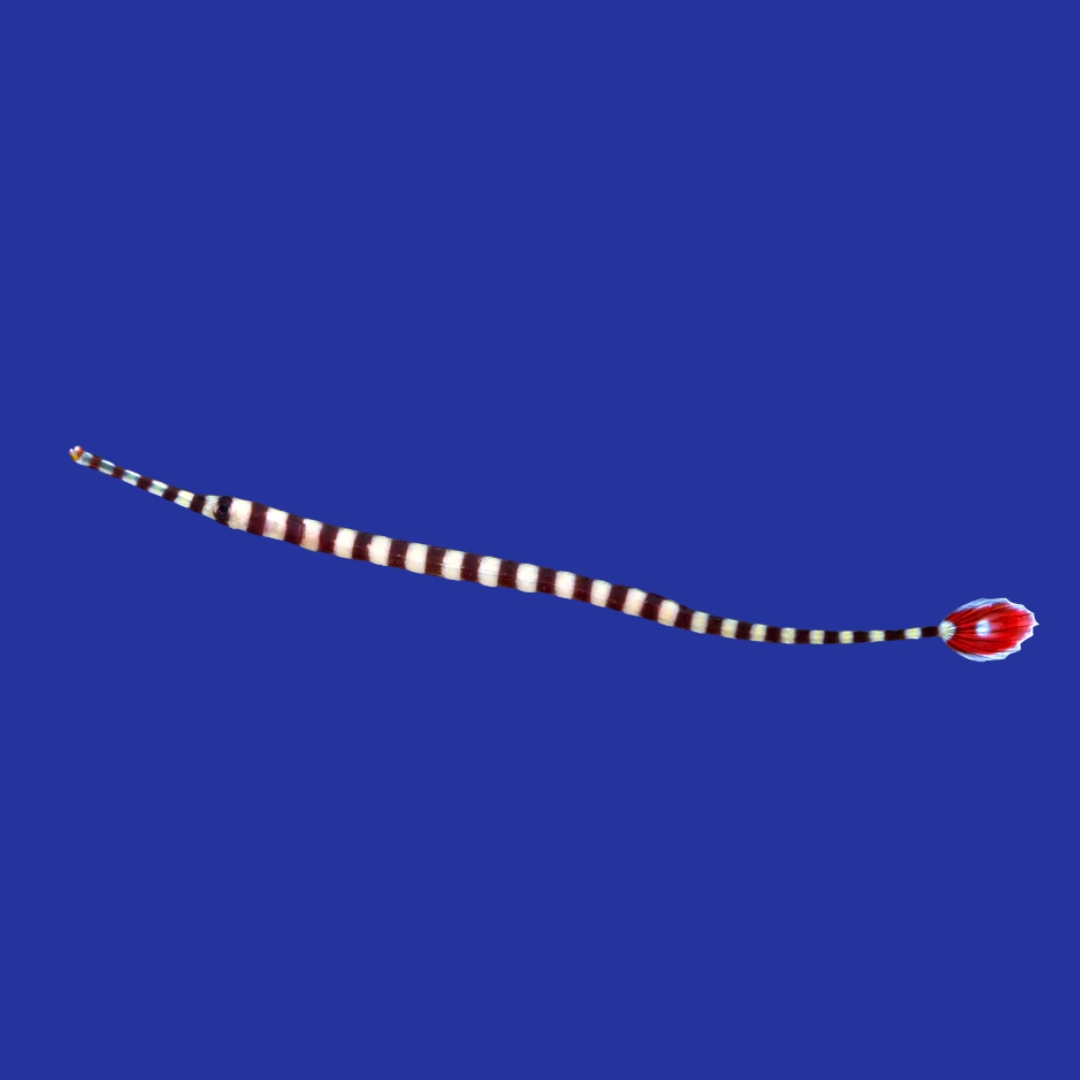
解説 / Description
オイランヨウジは、紅白の横帯模様と扇のように広がる赤い尾鰭が印象的な、海水性のヨウジウオの仲間です。細長い体と管状の口を持ち、サンゴ礁や岩礁の暗がりをゆっくり漂いながら、小さな甲殻類や動物プランクトンを吸い込むように捕食します。見た目の美しさから観賞魚として流通しますが、餌付け、給餌回数、水流、混泳相手、薬品への感受性に注意が必要で、海水魚飼育に慣れた中級者以上向けの繊細な魚です。 The Banded Pipefish is a marine syngnathid known for its red-and-white bands and fan-like red caudal fin. With its slender body and tubular snout, it drifts slowly through shaded reef crevices and rocky overhangs while feeding on tiny crustaceans and zooplankton by suction. Although it is valued as an ornamental marine fish, it requires careful feeding, gentle water movement, suitable tank mates, and special caution with medications, making it best suited to experienced marine aquarists.
基本情報 / Basic Information
| 学名 / Scientific Name | Dunckerocampus dactyliophorus |
|---|---|
| 通称 / Common Name | オイランヨウジ。旧学名またはシノニムとして Doryrhamphus dactyliophorus と表記されることがあります。Banded pipefish. It may also be seen under the former name or synonym Doryrhamphus dactyliophorus. |
| 分類 / Family | 条鰭綱、ヨウジウオ目、ヨウジウオ科、ヨウジウオ亜科、オイランヨウジ属。Class Actinopterygii, order Syngnathiformes, family Syngnathidae, subfamily Syngnathinae, genus Dunckerocampus. |
| 英名 / English Name | Banded Pipefish, Ringed Pipefish |
| 分布 / Distribution | 紅海、東アフリカ沿岸、インド洋、西部太平洋、サモア、仏領ポリネシア、日本の琉球列島周辺、オーストラリア北部、ニューカレドニアなど、インド太平洋の熱帯から亜熱帯海域に広く分布します。Widely distributed across tropical and subtropical Indo-Pacific waters, including the Red Sea, East Africa, the Indian Ocean, the western Pacific, Samoa, French Polynesia, the Ryukyu Islands of Japan, northern Australia, and New Caledonia. |
| 最大体長 / Max Size | およそ15cm前後、最大で19cm程度。Usually around 15 cm, with a maximum of about 19 cm. |
| 寿命 / Lifespan | 一般に2年から5年程度とされます。水槽内では、安定した水質、十分な給餌、ストレスの少ない環境を維持できるかどうかが寿命を大きく左右します。Generally considered to be about 2 to 5 years. In aquariums, lifespan depends greatly on stable water quality, adequate feeding, and a low-stress environment. |
飼育環境 / Aquarium Environment
| 水槽サイズ / Tank Size | 単独またはペアなら最低でも約76Lから80L、目安として45cmワイド水槽から60cm規格水槽以上が望ましいです。水質の安定性や隠れ家の確保を重視するなら、90cm規格水槽以上、余裕を持つなら120cmクラスの水槽がより安心です。For a single fish or pair, at least about 76 to 80 L is recommended, roughly equivalent to a wide 45 cm tank or a standard 60 cm tank or larger. For greater stability and more hiding places, a standard 90 cm tank or larger is preferable, and a 120 cm class setup offers even more safety. |
|---|---|
| 水温 / Temperature | 23℃から26℃が目安です。高水温に弱いため、夏場は水槽用クーラーや冷却ファンで急な上昇を防ぎます。 Aim for 23 to 26°C. This species is sensitive to high temperatures, so an aquarium chiller or cooling fan is useful in summer to prevent sudden increases. |
| 水質 / Water Quality | 比重1.020から1.025、pH8.1から8.4、アンモニアと亜硝酸は0ppmを維持します。硝酸塩は10ppm以下を目標にし、リン酸塩も低く保ちます。塩分濃度の急変を避けるため、自動給水器を使うと管理しやすくなります。Maintain a specific gravity of 1.020 to 1.025, pH 8.1 to 8.4, and 0 ppm ammonia and nitrite. Nitrate should ideally be kept below 10 ppm, and phosphate should remain low. An auto top-off system helps prevent sudden salinity changes. |
| レイアウト / Layout | ライブロックを複雑に組み、岩穴、オーバーハング、薄暗い隠れ家を多く作ります。自然下では強い光を避ける傾向があるため、明るい開放空間だけでなく、安心して留まれる陰を用意することが大切です。Arrange live rock to create caves, overhangs, and shaded retreats. Because this species often avoids strong light in the wild, the aquarium should include secure dim areas rather than only bright open swimming space. |
| 注意点 / Precautions | 遊泳力は強くないため、強すぎる水流や乱れた水流は避け、ゆるやかな水流を作ります。導入時は照明を落とし、温度合わせと水合わせを丁寧に行います。輸送水は水槽に入れず、魚だけをやさしく移すと安全です。Avoid strong or chaotic flow, as this species is not a powerful swimmer. During introduction, dim the lights and acclimate temperature and water chemistry carefully. Discard the shipping water and gently transfer only the fish into the aquarium. |
餌と給餌 / Feeding
| 餌の種類 / Diet | 生きたコペポーダ、孵化直後のブラインシュリンプ、イサザアミ、冷凍コペポーダ、細かく刻んだ冷凍イサザアミ、小型の冷凍ベビーブラインシュリンプなどを与えます。導入直後の野生採集個体は冷凍餌に反応しないことが多いため、最初は生き餌を用意できる環境が理想です。Offer live copepods, newly hatched brine shrimp, mysids, frozen copepods, finely chopped frozen mysids, and small frozen baby brine shrimp. Newly imported wild-caught individuals often ignore frozen foods at first, so having live food available is ideal. |
|---|---|
| 給餌のポイント / Feeding Tips | 胃が小さく代謝も早いため、1日3回から6回の少量頻回給餌が基本です。給餌時はポンプを一時的に弱め、スポイトで頭上から餌をゆっくり落とすと反応を引き出しやすくなります。リフジウムを連結して微小生物を継続供給できる環境を作ると、餌切れのリスクを大きく下げられます。Because the stomach is small and metabolism is rapid, feed small amounts 3 to 6 times per day. Temporarily reduce pump flow and use a pipette to let food fall slowly from above the fish. A refugium that continuously supplies tiny live organisms can greatly reduce the risk of starvation. |
性格と混泳 / Temperament and Tank Mates
| 性格 / Temperament | おとなしく、ペアや小さな群れで暗がりに落ち着くことが多い魚です。動きはゆっくりで、餌を探す時も激しく泳ぎ回るのではなく、漂うように移動します。環境に慣れるまでは臆病になりやすいので、静かな水槽環境が向いています。A peaceful species that often settles in shaded areas as a pair or small group. It moves slowly and drifts rather than rushing through the tank. It can be shy until settled, so a calm aquarium is best. |
|---|---|
| 混泳の相性 / Compatibility | 専用水槽が最も安全です。混泳させる場合は、小型のハゼ類やマンダリンフィッシュのように温和で遊泳層が重なりにくい魚が候補になります。スズメダイ、大型のハギ、活発なベラなど素早く餌を取る魚、縄張り意識の強い底棲魚、大型甲殻類、肉食性のエビやカニとの同居は避けます。刺胞毒の強いサンゴやイソギンチャクにも接触リスクがあります。A species-dedicated tank is safest. If kept with other animals, peaceful species that occupy different areas, such as small gobies or mandarinfish, are better candidates. Avoid fast-feeding damselfish, large tangs, active wrasses, territorial bottom dwellers, large crustaceans, and predatory shrimp or crabs. Strongly stinging corals and anemones also pose a contact risk. |
病気と対策 / Diseases and Prevention
| かかりやすい病気 / Common Diseases | 海水白点病、ウーディニウム病、体表寄生虫、ビブリオ菌などによる細菌感染、真菌感染などに注意します。通常の魚のような厚い鱗や粘液層に乏しいため、外部寄生虫や水質悪化によるダメージを受けやすい面があります。Watch for marine ich, velvet disease, external parasites, bacterial infections such as Vibrio-related problems, and fungal infections. Because this fish lacks the heavy scales and thick mucus coat seen in many other fish, it can be vulnerable to external parasites and poor water conditions. |
|---|---|
| 対策と予防 / Prevention | 最も重要なのは、導入前の検疫、安定した水質、餌切れを起こさない給餌、強すぎる水流や攻撃的な混泳相手を避けることです。ヨウジウオ科は銅イオンに弱いとされるため、硫酸銅系薬品の使用は避けるのが安全です。白点病対策では、薬品を使わず清浄な水槽へ定期的に移す水槽移動法が有力な選択肢になります。必要に応じてホルマリン短時間浴、メチレンブルー浴、pHを合わせた淡水浴などが検討されますが、実施は隔離水槽で慎重に行います。The best prevention is quarantine before introduction, stable water quality, reliable feeding, gentle flow, and avoiding aggressive tank mates. Syngnathids are considered sensitive to copper, so copper sulfate medications are best avoided. For marine ich, the tank transfer method is a strong option because it breaks the parasite cycle without copper. Formalin dips, methylene blue baths, or pH-adjusted freshwater dips may be considered when appropriate, but they should be performed carefully in a separate quarantine tank. |
増やし方(繁殖) / Breeding
| 雌雄の判別 / Sexing | 外見だけでの判別はやや難しいですが、成熟した雄は腹部から尾部寄りに卵を保持するためのブロードパッチを持ち、抱卵中はオレンジ色から黄色の卵が腹側に付着して見えます。ペア形成後の行動観察が、実用上最も分かりやすい判断材料になります。Sexing by appearance can be difficult, but mature males have a brood patch on the lower body near the tail. When brooding, orange to yellow eggs are visible attached to the underside. Observing pair behavior is often the most practical way to identify sexes. |
|---|---|
| 繁殖形態 / Reproduction | タツノオトシゴのように雄が卵を保護しますが、完全な袋状の育児嚢ではなく、腹部のブロードパッチに卵を付着させる形です。雌はゼラチン質に包まれた卵塊を雄の腹部に産み付け、雄が孵化まで保持します。Like seahorses, the male protects the eggs, but instead of a fully enclosed pouch, the eggs are attached to a brood patch on the underside. The female deposits a gelatinous egg mass onto the male, and he carries it until hatching. |
| 繁殖のポイント / Breeding Tips | 卵は水温などの条件にもよりますが、およそ10日から12日で孵化します。稚魚は約6mmと非常に小さく、初期餌料としてシオミズツボワムシ、ブラインシュリンプ幼生、成長段階に合った微小なアミ類幼生などを切らさず用意する必要があります。長期育成では、孵化後しばらくしてからの餌サイズの切り替えが大きな難所になります。Depending on temperature and other conditions, eggs hatch in about 10 to 12 days. The fry are extremely small, around 6 mm, and require a constant supply of suitable early foods such as rotifers, brine shrimp nauplii, and tiny mysid larvae matched to their growth stage. The transition to larger food after the early stage is one of the biggest challenges in long-term rearing. |
雑学と豆知識 / Trivia and Fun Facts
| 1. 「花魁」の名を持つ海の細工物 / 1. A reef fish named after an oiran | 標準和名のオイランは、江戸時代の高位の遊女である花魁に由来します。吻から尾まで続く紅白の縞模様と、広げると団扇のように見える赤い尾鰭が、豪華な衣装をまとった花魁を思わせることから名づけられたと考えられます。単に細長い魚というだけでなく、日本語らしい文化的な比喩が込められた名前です。The Japanese name Oiran-yōji refers to the oiran, a high-ranking courtesan of Edo-period Japan. Its red-and-white bands and fan-like red tail evoke the image of elaborate traditional dress, giving the name a distinctly Japanese cultural nuance rather than simply describing a slender fish. |
|---|---|
| 2. 管状の口で水ごと吸い込む捕食者 / 2. A suction feeder with a tubular snout | オイランヨウジは長い吻の先に小さな口を持ち、獲物を追い回すのではなく、頭部を素早く動かして水ごと吸い込むように捕食します。このピボットフィーディングと呼ばれる仕組みは、サンゴ礁の隙間や暗がりで小さな甲殻類を狙う生活に適した、ヨウジウオ科らしい高度な特殊化です。The Banded Pipefish has a small mouth at the tip of a long snout. Rather than chasing prey, it rapidly moves its head and sucks in tiny animals with the surrounding water. This pivot-feeding mechanism is a highly specialized adaptation for capturing small crustaceans in reef crevices and shaded areas. |
| 3. 雄が卵を背負うように守る魚 / 3. A male that carries the eggs | ヨウジウオ科の大きな魅力は、雄が繁殖の中心的な役割を担うことです。オイランヨウジの雄は袋状の育児嚢ではなく、腹側のブロードパッチに卵を付着させて守ります。抱卵中に体を回転させる行動が見られることもあり、観察者には卵を背中側に背負っているように見える瞬間があります。One of the most fascinating traits of syngnathids is the male’s central role in reproduction. In this species, the male protects eggs on a brood patch rather than in a fully enclosed pouch. When a brooding male rotates his body, the eggs may momentarily appear to be carried on his back. |
| 4. 似た魚との見分け方 / 4. How to distinguish it from similar species | 日本近海には、カスミオイランヨウジというよく似た種類も知られています。見分ける時は体の地色と尾鰭の模様に注目します。オイランヨウジは白からクリーム色の体に赤い帯が入り、尾鰭の中央に白色斑が見られるのに対し、カスミオイランヨウジではその白色斑が目立ちません。流通名だけで判断せず、尾鰭を確認することが大切です。A similar species, Dunckerocampus naia, is also known from Japanese waters. The body ground color and caudal fin pattern are key. D. dactyliophorus has a white to cream body with red bands and a clear white spot in the center of the tail, while D. naia lacks that prominent central white spot. Checking the tail is important rather than relying only on trade names. |
| 5. ブリード個体への期待 / 5. The promise of captive-bred individuals | 本種は天然採集個体の流通が中心ですが、人工繁殖への取り組みも進められています。特に稚魚期の餌の切り替えは難しく、成長段階に合った微小な餌を安定して供給できるかどうかが育成成功の鍵になります。将来的に国内ブリード個体が安定供給されれば、餌付きがよく、水槽生活に慣れた個体を選びやすくなることが期待されます。Most individuals in the trade are wild-caught, but captive-breeding work has advanced. A major challenge is transitioning fry to appropriately sized foods as they grow. If captive-bred individuals become more widely available, aquarists may have access to fish that feed more readily and adapt better to aquarium life. |
まとめ / Conclusion
オイランヨウジは、華やかな色彩とユニークな繁殖生態を持つ、非常に魅力的な海水魚です。一方で、ゆっくり餌を食べる性質、微小な餌を頻繁に必要とする点、強い水流や攻撃的な混泳相手に弱い点から、一般的な海水魚と同じ感覚では長期飼育が難しい種類です。 The Banded Pipefish is a highly attractive marine fish with vivid coloration and unique reproductive behavior. At the same time, its slow feeding style, need for frequent tiny foods, and sensitivity to strong flow and aggressive tank mates make it difficult to maintain long-term if treated like a typical marine fish.
飼育するなら、専用水槽に近い落ち着いた環境、豊富な隠れ家、安定した水質、リフジウムやスポイト給餌を活用した餌の確保が重要です。銅系薬品を避け、検疫と予防を徹底することで、この繊細で美しいヨウジウオの自然な姿を水槽内でじっくり観察できます。 For successful care, provide a calm setup close to a species-dedicated aquarium, abundant hiding places, stable water quality, and reliable feeding through a refugium or pipette feeding. By avoiding copper medications and emphasizing quarantine and prevention, aquarists can observe the natural behavior of this delicate and beautiful pipefish in the aquarium.

気になる道具や飼い方を見つけてみませんか?
 アイのアクアグッズ案内ラスボラ・ボララスの群泳を楽しむ飼育用品|水槽・ろ過・ヒーター・餌・水草道具の特徴や使い方、選ぶときのポイントをアイが紹介します。記事はコチラ →
 アイのアクアグッズ案内コリドラスのもふもふ時間を楽しむ|餌・底砂・お掃除用品の選び方コリドラスのもふもふする食事風景を楽しむために。沈む餌2種類の違い、口元に配慮した底砂、食べ残しを回収する道具を、アクアグッズナビゲーターのアイが紹介します。記事はコチラ →
さまざまな飼育テーマをご紹介。リンク先の記事には広告・商品紹介が含まれます。
案内・紹介記事一覧へ →参考文献・参照資料
この記事では、分類、分布、生息環境、繁殖、疾病・検疫上の注意点を確認するため、学術データベース、公的・準公的な生物情報データベース、査読論文、専門書を中心に参照しました。店舗・通販ページ、個人ブログ、まとめサイトは参考文献から除外しています。
資料選定の考え方: 学名・分類は分類学データベース、分布・体長・自然下の生息環境は魚類データベースとフィールドガイド、繁殖はヨウジウオ科の繁殖様式を扱う文献、病気や薬品管理は魚病学・水産疾病文献を優先しました。飼育条件については、本種固有の実験値が限られるため、自然環境情報と海水魚飼育・魚病管理の標準的資料を組み合わせて、安全側の目安として扱っています。
-
WoRMS Editorial Board. “Dunckerocampus dactyliophorus (Bleeker, 1853).” World Register of Marine Species.
https://www.marinespecies.org/aphia.php?p=taxdetails&id=218005
用途:現在有効とされる学名、分類階級、シノニム、海産種であることの確認。分類表記の最優先資料。 -
Froese, R. and Pauly, D. (eds.). “Dunckerocampus dactyliophorus, Ringed pipefish.” FishBase.
https://www.fishbase.se/summary/Dunckerocampus-dactyliophorus.html
用途:分布、最大体長、礁域性、深度、生息環境、食性、雄による卵保護、観賞魚としての扱いの確認。 -
Fricke, R., Eschmeyer, W. N. and Van der Laan, R. (eds.). “Eschmeyer’s Catalog of Fishes.” California Academy of Sciences.
https://researcharchive.calacademy.org/research/ichthyology/catalog/fishcatmain.asp
用途:魚類の学名、原記載、分類上の扱いを確認するための補助資料。WoRMS・FishBaseとの照合に使用。 -
Myers, R. F. (1991). Micronesian Reef Fishes, 2nd ed. Coral Graphics.
用途:インド太平洋域の礁性魚類としての分布・生息環境・洞窟やオーバーハングを利用する生態を補強するフィールドガイド。FishBase上でも主要参照文献として扱われています。 -
Kuiter, R. H. (2000/2009). Seahorses, Pipefishes and Their Relatives: A Comprehensive Guide to Syngnathiformes. TMC Publishing.
用途:ヨウジウオ科・オイランヨウジ属の形態、尾鰭の特徴、近縁種との識別、自然下の行動を確認するための専門図鑑。 -
Breder, C. M. and Rosen, D. E. (1966). Modes of Reproduction in Fishes. T.F.H. Publications.
用途:魚類全般の繁殖様式、ヨウジウオ科に見られる雄の卵保護・育児構造の理解を支える基礎文献。 -
Colorni, A. (1987). “Biology of Cryptocaryon irritans and strategies for its control.” Aquaculture, 67, 236–237.
用途:海水白点病の原因生物である Cryptocaryon irritans の生活環と管理上の考え方を確認するための査読文献。 -
Noga, E. J. (2010). Fish Disease: Diagnosis and Treatment, 2nd ed. Wiley-Blackwell.
用途:海水魚の外部寄生虫、細菌感染、薬浴、検疫、薬剤使用時の注意を確認するための魚病学の標準的専門書。 -
Paperna, I. (1984). “Chemical control of Amyloodinium ocellatum infections: in vitro tests and treatment trials with infected fishes.” Aquaculture, 38, 1–18.
用途:ウーディニウム病の原因生物 Amyloodinium ocellatum と薬剤・淡水浴などの管理法を確認するための査読文献。 -
Francis-Floyd, R. and Floyd, M. R. (2011). “Amyloodinium ocellatum, an Important Parasite of Cultured Marine Fish.” Southern Regional Aquaculture Center.
用途:養殖・飼育下の海水魚におけるウーディニウム病の重要性、予防、診断、管理の補助資料。
参照日:2026年6月7日。リンクのない文献は、専門書または印刷・論文媒体として参照候補に含めています。




コメント