

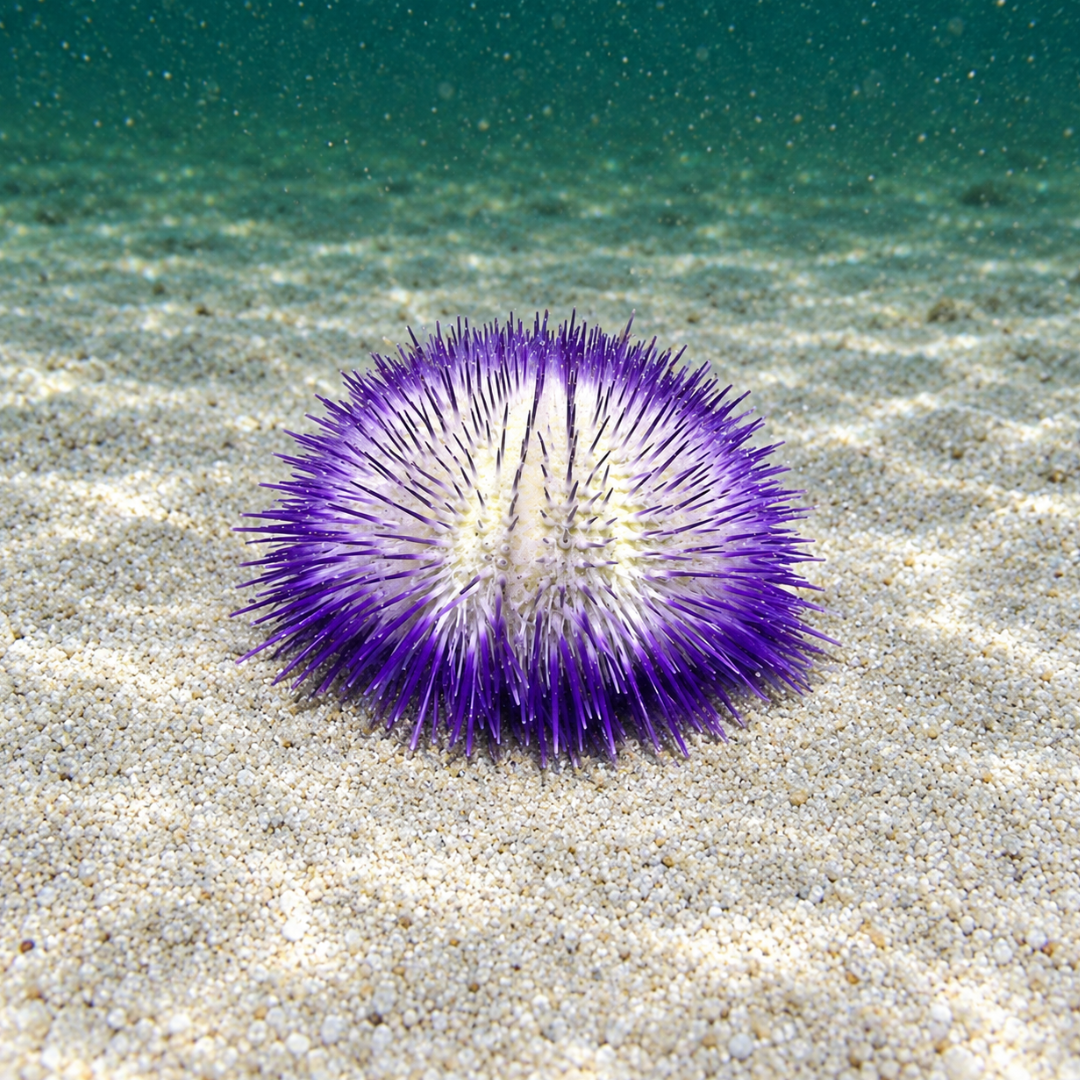
解説 / Description
Salmacis virgulataは、インド太平洋の熱帯から亜熱帯に分布するサンショウウニ科の海産ウニです。反口側の主棘は白っぽい基部を持つ紫色系で、同属の一部に見られる明瞭な帯模様を欠くことが識別上の特徴です。管足と棘を使い、貝殻や小石、海草片などを体の上に載せる「カバリング行動」でも知られています。自然界では藻類や付着生物、デトリタスなどを利用しながら海底を移動します。飼育情報はまだ十分に蓄積されていないため、水槽では一般的な熱帯性ウニと同様に、安定した海水環境、十分な底面積、継続的な給餌、崩れにくいレイアウトを重視して管理します。 Salmacis virgulata is a marine sea urchin in the family Temnopleuridae, distributed across tropical to subtropical parts of the Indo-Pacific. Its aboral primary spines are typically purplish with pale bases and lack the conspicuous banding seen in some related species, an important identification feature. It is also known for “covering” behavior, using its tube feet and spines to place shells, pebbles, seagrass fragments, and other objects over its body. In nature it moves across the benthos while feeding on algae, attached material, detritus, and other available food. Because long-term aquarium information for this species remains limited, husbandry should emphasize stable seawater conditions, ample floor area, regular supplementary feeding, and a securely constructed aquascape.
基本情報 / Basic Information
| 学名 / Scientific Name | Salmacis virgulata L. Agassiz in L. Agassiz & Desor, 1846 |
|---|---|
| 通称 / Common Name | サルマキス・ヴィルグラータ、パッション・サルマキス・アーチン(海外流通名)Passion Salmacis Urchin |
| 分類 / Family | 棘皮動物門・ウニ綱・カマロドント目・サンショウウニ科・サンショウウニ属Phylum Echinodermata, Class Echinoidea, Order Camarodonta, Family Temnopleuridae, Genus Salmacis |
| 英名 / English Name | Passion Salmacis Urchin |
| 分布 / Distribution | インド太平洋の熱帯から亜熱帯。インド、スリランカ、東南アジア、フィリピン、中国南部、日本南部などから記録があります。主に浅海域に生息し、スリランカでは水深9〜12mの観察例と59mの過去記録があり、海草藻場やサンゴ礁の瓦礫底、砂質・砂泥質の海底などで見られます。Tropical to subtropical Indo-Pacific, with records from India, Sri Lanka, Southeast Asia, the Philippines, southern China, and southern Japan. It is primarily a shallow-water species. In Sri Lanka it has been recorded at 9–12 m in recent surveys and at 59 m in earlier records, occurring in seagrass beds, coral rubble, and sandy or sandy-muddy bottoms. |
| 最大体長 / Max Size | 殻径はおよそ5〜8cm程度がひとつの目安です。研究では平均殻径8.5cmの個体を用いた例もあり、明確な最大値は確認されていません。A test diameter of roughly 5–8 cm is a practical reference range. Research has also used specimens averaging 8.5 cm in test diameter, so a definitive maximum size is not well established. |
| 寿命 / Lifespan | 長期飼育下での寿命を示す確立した情報はありません。A well-established lifespan under long-term aquarium conditions is not available. |
飼育環境 / Aquarium Environment
| 水槽サイズ / Tank Size | 飼育の目安は200L以上です。日本の規格水槽では、90cmワイド水槽など、実際に200L前後以上の水量と十分な底面積を確保できる水槽が扱いやすいでしょう。ただし、本種は長期飼育データが少なく、200Lが種固有の最低水量として確立されているわけではありません。A practical husbandry target is at least about 200 L. In Japanese standard sizing, a wide 90 cm-class aquarium or a larger tank that provides roughly 200 L or more together with ample floor area is easier to manage. Long-term husbandry data remain limited, so 200 L should not be regarded as a scientifically established species-specific minimum. |
|---|---|
| 水温 / Temperature | 23〜28℃が飼育の目安です。26〜28℃が成長や繁殖に最適な温度帯として確立されているわけではありません。上限を追うよりも、急変を避けて安定した水温を保つことを優先します。 23–28°C is a commonly cited husbandry range. There is not enough evidence to state that 26–28°C is an established optimum for growth or reproduction in this species. Stability is more important than maintaining the water near the upper end of the range. |
| 水質 / Water Quality | 海水で飼育し、塩分濃度は30ppt前後から低30ppt台、比重はおおむね1.022〜1.025を安定させます。pHは一般的な海水水槽の安定域である8.1〜8.4を目安とし、急激な低下を避けてください。本種を用いた実験では、pH8.2の対照区に比べ、7.8〜7.6の低pH条件で石灰化や生理状態、生殖組織への悪影響が確認されています。Keep the animal in full-strength marine water, with salinity around 30 to the low-30s ppt and specific gravity roughly 1.022–1.025 kept stable. A pH of about 8.1–8.4 is a practical marine-aquarium target, with particular attention to avoiding sharp declines. In experiments on this species, pH 7.8–7.6 produced adverse effects on biomineralization, physiology, and ovarian tissue compared with a control near pH 8.2. |
| レイアウト / Layout | 十分な底面積を取り、ライブロックは崩れないよう確実に固定します。カバリング行動で小石、貝殻、サンゴ片などを持ち上げることがあるため、小型の装飾物や不安定なサンゴ片は避けるか、しっかり固定してください。自然な行動を観察するなら、移動できる空間と付着藻類が育つ面を確保するとよいでしょう。Provide generous floor area and secure live rock firmly to prevent collapse. Because this species may pick up pebbles, shells, or coral fragments during covering behavior, avoid loose decorations and unstable coral pieces or fix them securely. Open movement space and surfaces that can support natural algal growth help encourage natural behavior. |
| 注意点 / Precautions | 本種の毒性は明確に確立されておらず、強い毒性や筋麻痺を起こすウニとして扱う根拠は乏しい状態です。有毒種と同一視する必要はありませんが、棘や叉棘で皮膚を傷つけるおそれはあるため、素手でつかまず、水中で無理のない方法で扱います。レイアウトの転倒、餌不足、水温・比重・pHの急変にも注意してください。The toxicity of this species is not clearly established, and it should not be treated as a sea urchin known to cause severe venom effects or muscular paralysis. Even so, the spines and pedicellariae can cause mechanical injury, so avoid grasping the animal with bare hands and handle it gently underwater. Also prevent aquascape collapse, food shortages, and abrupt changes in temperature, salinity, or pH. |
餌と給餌 / Feeding
| 餌の種類 / Diet | ライブロック上の微細藻類やサンゴモ、底砂上のデトリタスを利用します。補助餌として、添加物のない乾燥海苔やワカメ、草食性海水魚用ペレット、沈下性の人工飼料などが適します。自然界では藻類だけでなく、有機物や軟体性生物の死骸なども利用する雑食性です。It grazes microalgae and coralline growth on live rock and consumes detritus from the substrate. Suitable supplementary foods include plain dried nori or wakame, herbivore marine-fish pellets, and sinking prepared diets. In nature it is omnivorous and also makes use of organic matter and remains of soft-bodied organisms. |
|---|---|
| 給餌のポイント / Feeding Tips | 水槽内の付着藻類だけに頼ると餌が枯渇することがあるため、継続的な補助給餌が必要です。餌は進行方向または体の上側へそっと置くと、管足を使って口元へ運ぶ行動を観察できます。食べ残しによる水質悪化を避けながら、痩せや摂食低下が出ない量を調整してください。Natural algal growth in an aquarium can be depleted, so regular supplementary feeding is important. Food can be placed gently in front of the animal or on the upper surface, where the tube feet may transfer it toward the mouth. Adjust the amount to prevent both starvation and deterioration of water quality from uneaten food. |
性格と混泳 / Temperament and Tank Mates
| 性格 / Temperament | 魚を追い回すような攻撃性を示す生き物ではありません。採餌やカバリング行動をしながら水槽内を移動し、周囲の小物や固定の甘いレイアウトを動かすことがあります。活動の強さには個体差や環境差があるため、行動を決めつけず、水槽内での移動範囲を観察して管理します。It is not typically aggressive toward fishes. As it moves through the aquarium while grazing and covering itself, it may shift loose objects or poorly secured aquascaping. Activity can vary with the individual and environment, so husbandry should be based on observing how the animal actually moves within the tank rather than assuming a fixed daily pattern. |
|---|---|
| 混泳の相性 / Compatibility | 温和な海水魚とは比較的同居させやすい一方、リーフタンクでは慎重な管理が必要です。本種はサンゴを常に食害する種として確立されているわけではありませんが、付着藻類やサンゴモを削って採餌し、カバリング行動でサンゴ片や小さな物を動かす可能性があります。モンガラカワハギ類など、ウニを捕食する魚や大型無脊椎動物との混泳は避けてください。It can generally be considered for aquaria with peaceful marine fishes, but reef tanks require caution. This species is not established as a routine consumer of living corals; however, it grazes attached algae and coralline growth and may move coral fragments or other small objects during covering behavior. Avoid triggerfishes and other fishes or large invertebrates known to prey on sea urchins. |
病気と対策 / Diseases and Prevention
| かかりやすい病気 / Common Diseases | 本種に特有の感染症については、飼育下での情報が十分ではありません。一方、低pHによる石灰化障害や生理状態の悪化、餌不足、急激な温度・比重変化、物理的な損傷は飼育上の主要なリスクです。Species-specific infectious diseases are not well characterized in aquarium husbandry. Major risks instead include impaired calcification and physiological stress under low pH, food shortage, rapid temperature or salinity changes, and physical injury. |
|---|---|
| 対策と予防 / Prevention | pH 8.1〜8.4、安定した塩分濃度と水温を維持し、蒸発分は淡水で適切に補います。給餌不足を避け、レイアウトを固定して転倒や挟まりを防ぎます。状態の変化を早く把握するため、活動性、摂食、棘の状態を日常的に観察することが大切です。Maintain pH at 8.1–8.4 with stable salinity and temperature, replacing evaporated water appropriately with fresh water. Prevent food shortages and secure the aquascape to reduce falls or entrapment. Routine observation of activity, feeding response, and spine condition helps detect deterioration early. |
増やし方(繁殖) / Breeding
| 雌雄の判別 / Sexing | 雌雄異体ですが、外見だけで安定して雌雄を判別する方法は確立されていません。The species is dioecious, but no reliable external method for distinguishing males from females is established. |
|---|---|
| 繁殖形態 / Reproduction | 雌雄異体で、卵と精子を海中へ放出する放卵・放精型の体外受精を行います。受精後はウニ類に典型的なプルテウス幼生期を経ます。本種について、家庭水槽での浮遊幼生の維持期間や着底条件までを再現性よく示した飼育手法は確立されていません。The species is dioecious and reproduces by broadcast spawning, releasing eggs and sperm into the water for external fertilization. Development proceeds through a pluteus larval stage typical of sea urchins. For this species, a reproducible home-aquarium protocol covering the duration of planktonic culture and reliable settlement conditions has not been established. |
| 繁殖のポイント / Breeding Tips | 家庭水槽で再現性のある繁殖方法は確立されていません。インド・マンナール湾の調査では生殖腺指数に季節変化がみられ、S. virgulataでは2014年9月に高い値が記録されていますが、これは特定地域・調査期間の結果であり、特定の月を普遍的な繁殖期とみなすことはできません。繁殖を目指す場合は、まず成体を長期に安定飼育できる環境を整えることが前提です。No reproducible home-aquarium breeding method has been established. A Gulf of Mannar study found seasonal variation in gonad index, with a high value for S. virgulata recorded in September 2014, but this result comes from a particular region and study period and should not be treated as a universal breeding calendar. Any breeding attempt should begin with consistently stable long-term adult husbandry. |
雑学と豆知識 / Trivia and Fun Facts
| 1. 学名は「virgulatus」ではなく「virgulata」 / 1. Why the Name Is virgulata, Not virgulatus | 古い文献ではSalmacis virgulatusという表記が見つかりますが、現在受け入れられている学名はSalmacis virgulataです。現在の著者表記は「L. Agassiz in L. Agassiz & Desor, 1846」とされ、AgassizとDesorによる1846年の著作の中でL. Agassizが命名したことを示します。Salmacis virgulata typicaも、現在は独立した亜種ではなくS. virgulataのシノニムとして扱われています。学名の短い表記の中にも、命名史の整理が反映されています。Older literature uses the spelling Salmacis virgulatus, but the accepted name is Salmacis virgulata. The current authorship is written “L. Agassiz in L. Agassiz & Desor, 1846,” indicating that L. Agassiz named the species in the 1846 work produced with Desor. Salmacis virgulata typica is likewise treated today as a synonym of S. virgulata rather than as a separate subspecies. These small differences in citation preserve the history of zoological nomenclature. |
|---|---|
| 2. 属名Salmacisとギリシャ神話 / 2. The Genus Name Salmacis and Greek Mythology | Salmacisという名は、ギリシャ神話に登場する泉の精霊サルマキスに由来します。物語では、サルマキスはヘルマプロディートスに恋をし、二人が永遠に離れないよう願った結果、ひとつの身体へ融合したと語られます。この神話がなぜウニの属名に選ばれたのか、その直接的な理由は明らかではありません。それでも、古代の物語が19世紀の分類学を通じて現代の海洋生物学に残り続けていることは、学名そのものが科学史の小さなタイムカプセルであることを感じさせます。The name Salmacis comes from the fountain nymph Salmacis of Greek mythology. In the myth, Salmacis falls in love with Hermaphroditus and asks that they never be separated, after which the two are described as merging into a single body. The exact reason this mythological name was chosen for the sea-urchin genus is uncertain. Even so, the survival of an ancient story within nineteenth-century taxonomy shows how a scientific name can act as a small time capsule of cultural and scientific history. |
| 3. 「アリストテレスの提灯」という2000年以上の言葉 / 3. “Aristotle’s Lantern,” a Name with More Than Two Millennia of History | ウニの口には、5本の歯と複雑な骨格・筋肉からなる咀嚼器官があり、現在は「アリストテレスの提灯」と呼ばれています。この名称はアリストテレスのウニに関する記述に由来しますが、古典文献のどの部分を「提灯」にたとえたのかについては、顎器官そのものを指したとする解釈と、殻を含むウニの姿を念頭に置いたとする解釈があり、科学史上の議論が続いてきました。現在では当たり前に使われる解剖学用語にも、2000年以上にわたる観察と解釈の歴史が重なっています。Sea urchins possess a complex feeding apparatus of five teeth supported by skeletal elements and muscles, now called “Aristotle’s lantern.” The name is linked to Aristotle’s description of sea urchins, but historians have long debated exactly what his lantern comparison referred to: the jaw apparatus itself or the broader appearance of the urchin and its test. A familiar anatomical term therefore carries more than two millennia of observation and interpretation. |
| 4. 背中に物を載せる「カバリング行動」 / 4. Covering Behavior: Carrying Objects on the Body | Salmacis virgulataが、貝殻やサンゴ片などを体の上に載せるカバリング行動は実際に記録されています。ウニ類全体では、こうした行動に光や紫外線を避ける働き、捕食者から身を隠す働き、水流への安定性を高める働きなどが提案されています。ただし、それぞれの効果がS. virgulataで同じ程度に働くことまで個別に実証されているわけではありません。水槽では、物を持ち上げるという行動そのものが、レイアウトを安定させる必要性につながります。Salmacis virgulata has been directly recorded carrying shell and coral fragments on its body. Across sea urchins more broadly, covering behavior has been proposed to reduce light or UV exposure, provide camouflage or protection from predators, and improve stability in moving water. Not every one of these functions has been demonstrated specifically and to the same degree in S. virgulata. In an aquarium, the behavior itself is enough reason to keep the aquascape secure. |
| 5. 紫色を生む棘の中には生理活性物質もある / 5. Pigments in the Spines Also Have Biological Activity | ウニの殻には、スピノクロム類を含むポリヒドロキシル化ナフトキノン系色素が知られています。Salmacis virgulataの殻をメタノールで抽出した研究では、試験管内で抗菌活性と抗酸化活性が報告されています。ただし、抽出物の活性と、特定の色素成分がその作用を担うことは同じ意味ではなく、医薬品としての効果が確認されたわけでもありません。観賞上の色彩とは別に、殻の化学成分が研究対象になっているという事実そのものが、本種の興味深い一面です。Sea urchin tests are known to contain polyhydroxylated naphthoquinone pigments, including spinochrome-type compounds. A study using methanolic extracts of Salmacis virgulata test material reported antimicrobial and antioxidant activity in vitro. This does not establish that a particular pigment is solely responsible for those effects, nor does it demonstrate a medical benefit. The relevant point is that the chemistry of the test has attracted research interest independently of the animal’s ornamental coloration. |
| 6. 紫色でも「ムラサキウニ」とは別の仲間 / 6. Purple Color Does Not Make It a “Purple Sea Urchin” | 紫色の棘は目を引きますが、色だけでSalmacis virgulataを同定することはできません。本種の重要な特徴は、白っぽい基部を持つ紫色系の主棘が基本的に明瞭な帯模様を欠くことです。さらにサンショウウニ科では、殻の縫合部に見られる窪みなど、棘を外した殻の特徴も分類に使われます。水中写真の印象だけではなく、複数の形態形質を組み合わせて判断することが、近縁種との取り違えを避ける基本です。The purple spines are conspicuous, but color alone is not sufficient for identifying Salmacis virgulata. A key feature is that the purplish primary spines, with their pale bases, generally lack conspicuous bands. In temnopleurids, features of the test itself, including pits along plate sutures, are also useful in identification. Reliable identification therefore depends on combining several morphological characters rather than relying on the impression of a photograph alone. |
| 7. 観賞だけでなく、水産研究でも注目されるウニ / 7. A Sea Urchin of Interest Beyond the Aquarium Trade | Salmacis virgulataは観賞価値だけでなく、水産学の対象としても研究されています。生殖腺は食用資源としての可能性が検討され、インドなどでは養殖候補として成長や摂食に関する試験が進められてきました。一方で、海洋酸性化による低pH環境では石灰化や細胞の恒常性、生殖機能、摂食行動への悪影響が示されており、将来の海洋環境変化を考える上でも重要な研究対象です。丈夫そうな殻を持つウニであっても、水の化学的な変化には決して無関係ではありません。Salmacis virgulata has attracted research interest not only as an ornamental species but also in fisheries and aquaculture science. Its gonads have been examined as a potential food resource, and studies in India and elsewhere have explored growth and feeding performance for possible echinoculture. At the same time, experiments under lower-pH conditions associated with ocean acidification have reported adverse effects on calcification, cellular homeostasis, reproduction, and feeding behavior. Despite its apparently robust calcareous body, this urchin remains closely tied to the chemistry of the seawater around it. |
まとめ / Conclusion
Salmacis virgulataは、紫紅色の棘と、身の回りの物を背負うカバリング行動によって強い存在感を見せる海産ウニです。見た目の華やかさだけでなく、五放射相称の体、アリストテレスの提灯、叉棘、管足といった棘皮動物ならではの仕組みを間近で観察できることも大きな魅力です。 Salmacis virgulata is a striking marine urchin, combining maroon-purple spines with the memorable behavior of carrying surrounding objects over its body. Beyond its appearance, it offers a close view of classic echinoderm features such as pentaradial symmetry, Aristotle’s lantern, pedicellariae, and tube feet.
長く観察するためには、安定した海水環境、十分な底面積、継続的な餌、崩れにくいレイアウトを用意し、急な水質変化を避けることが大切です。長期飼育や繁殖について未解明な点が残る生き物だからこそ、状態を決めつけず、日々の移動や摂食をよく観察しながら管理する姿勢が向いています。環境が合えば、藻類を食べるだけの存在ではなく、ウニならではの体の仕組みと行動を身近に見せてくれる魅力的な一員になります。 Long-term observation depends on stable seawater conditions, ample floor area, regular feeding, a secure aquascape, and avoidance of abrupt environmental changes. Because important aspects of long-term husbandry and breeding remain unresolved, this is a species best managed through careful observation of feeding, movement, and overall condition rather than rigid assumptions. In suitable conditions, it is more than an algae grazer: it offers a close view of the distinctive anatomy and behavior of sea urchins.

気になる道具や飼い方を見つけてみませんか?
 アイのアクアグッズ案内マジックリーフ物語|一枚の葉がアクアリウム用品になるまで道具の特徴や使い方、選ぶときのポイントをアイが紹介します。記事はコチラ →
 アイのアクアグッズ案内水草の肥料の選び方|底床用・液肥・メネデールの使い分け道具の特徴や使い方、選ぶときのポイントをアイが紹介します。記事はコチラ →
 アイのアクアグッズ案内水槽用ヒーターの選び方|固定式・温度調節式と、水量に合うW数の考え方水槽の魚は冬に寒くない? アイとコタロウが水温計から固定式・温度調節式・分離式ヒーターまで比較。水量と室温に合うW数、設置場所、水換えや交換の注意点を、国内メーカーの商品とともに紹介します。記事はコチラ →
 アイのアクアグッズ案内水槽のエアーポンプの選び方|水深・音・泡で選ぶおすすめ用品道具の特徴や使い方、選ぶときのポイントをアイが紹介します。記事はコチラ →
さまざまな飼育テーマをご紹介。リンク先の記事には広告・商品紹介が含まれます。
案内・紹介記事一覧へ →分布マップ
Salmacis virgulataは、インド太平洋の熱帯から亜熱帯に分布し、インド、スリランカ、東南アジア、フィリピン、中国南部、日本南部などから記録されています。下の地図では、これらの地域を含むおおよその分布範囲を表示しています。
この地図は文献上の分布地域をもとにした概略表示です。マーカーは分布域を把握しやすくするために設定した代表地点であり、実際の採集地点や個体の確認地点を示すものではありません。
参考文献
- World Register of Marine Species (WoRMS). Salmacis virgulata L. Agassiz in L. Agassiz & Desor, 1846. 学名、命名者表記、現在受け入れられている分類名とシノニムの確認。 World Register of Marine Species
- Clark, A. M. & Rowe, F. W. E. (1971). Monograph of Shallow-water Indo-West Pacific Echinoderms. British Museum (Natural History), London. インド西太平洋におけるウニ類の分類と広域分布の基礎資料。 Smithsonian Libraries and Archives
- Arachchige, G. M., Jayakody, S., Mooi, R. & Kroh, A. (2019). An annotated species list of regular echinoids from Sri Lanka with notes on some rarely seen temnopleurids. Zootaxa, 4571(1), 35–57. Salmacis virgulataの形態、スリランカでの分布、水深、生息環境の確認。 doi:10.11646/zootaxa.4571.1.3
- Saravanan, R. & Jawahar, P. (2022). Multiple-choice feeding preference assay on two sea urchin species from the Gulf of Mannar, South East coast of India. Indian Journal of Geo-Marine Sciences, 51(3), 255–262. Salmacis virgulataの海藻・海草に対する摂食選択性と食性の確認。 doi:10.56042/ijms.v51i03.33474
- Anand, M., Rangesh, K., Maruthupandy, M., Jayanthi, G., Rajeswari, B. & Priya, R. J. (2021). Effect of CO2 driven ocean acidification on calcification, physiology and ovarian cells of tropical sea urchin Salmacis virgulata – A microcosm approach. Heliyon, 7(1), e05970. 低pH条件が殻・棘の石灰化、生理状態、生殖組織へ及ぼす影響と、実験時の海水条件の確認。 doi:10.1016/j.heliyon.2021.e05970
- Saravanan, R., Jawahar, P., Francis, T., Ahilan, B., Santhakumar, R. & Gopakumar, G. (2018). Ehinoid landings at Mandapam, south-east coast of India with a note on gonadal maturity of two species of sea urchins. Indian Journal of Fisheries, 64, Special Issue. 雌雄比、生殖腺指数の季節変化、2014年9月の高値、および飼育下繁殖研究の必要性の確認。 doi:10.21077/ijf.2017.64.special-issue.76265-28
- Schmidt, L.-M., Anderson Benaim, G. & Bronstein, O. (2026). Unravelling echinoid mass mortalities: a global overview of mechanisms, spatio-temporal trends, and taxonomic insights. Biological Reviews, 101(1), 221–236. ウニ類全般における病原体、極端な水温、環境ストレスなどの疾病・死亡要因を整理した総説。 doi:10.1111/brv.70078




コメント