

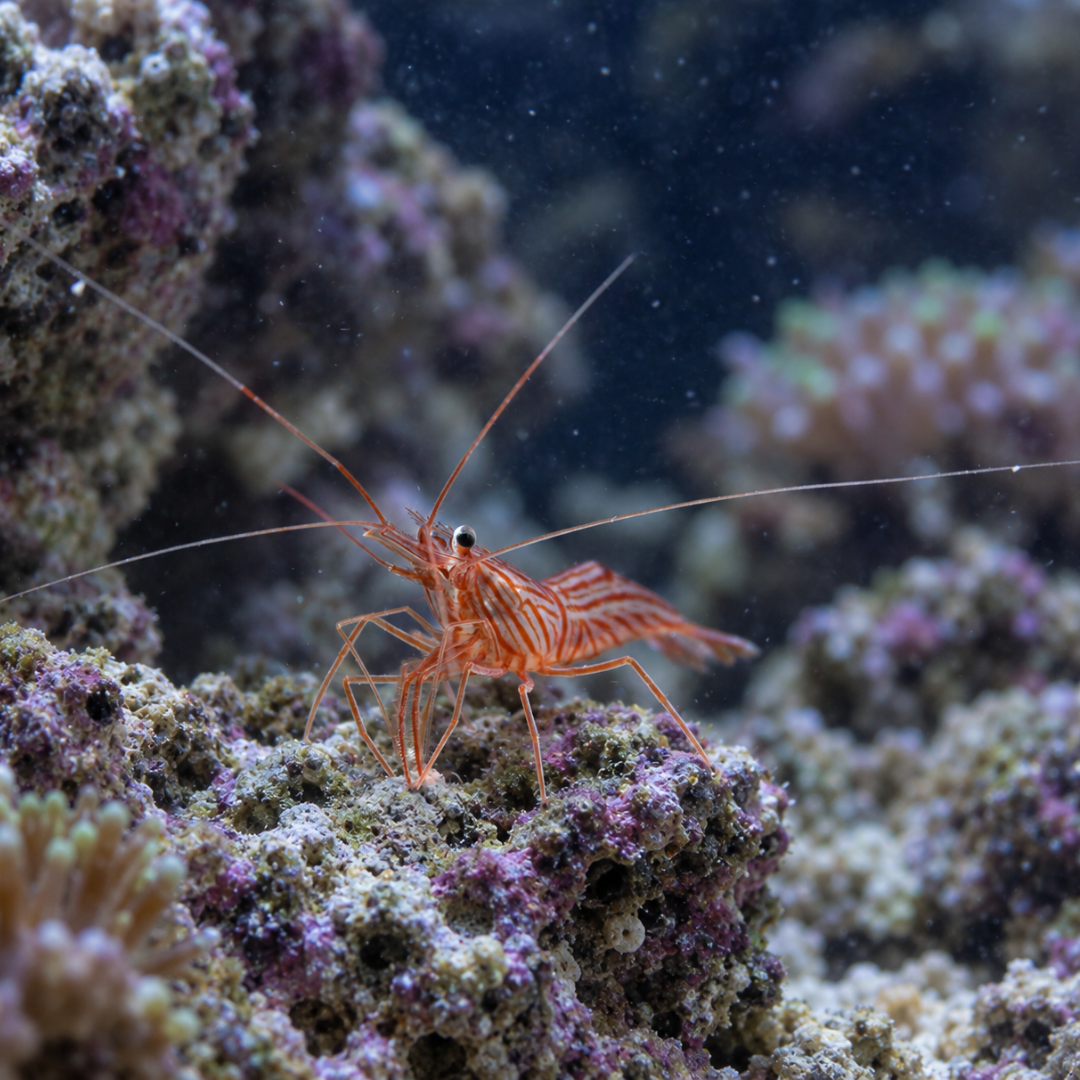
解説 / Description
ペパーミントシュリンプは、半透明の体に赤い縞模様を持つLysmata属の海水性エビに使われる流通名です。リーフアクアリウムでは美しい観賞用エビとしてだけでなく、セイタカイソギンチャク類、いわゆる「カーリー」を捕食する生物的な対策役として知られています。ただし、この名称はひとつの学名と完全に対応するものではありません。歴史的にLysmata wurdemanniとして扱われてきたよく似たエビの中には複数の別種が含まれており、観賞魚市場ではLysmata boggessiが重要な流通種であることも明らかになっています。そのため、カーリー対策を目的に導入する場合は、「ペパーミントシュリンプ」という商品名だけで能力や生態を一律に判断しないことが大切です。飼育では安定した海水環境と脱皮時に身を隠せる場所を整え、個体の行動を観察しながら管理します。 Peppermint shrimp is a trade name applied to several red-striped marine shrimps in the genus Lysmata. In reef aquariums they are valued both as ornamental animals and as biological controls for pest anemones of the genus Aiptasia. However, the common name does not correspond neatly to a single scientific species. Several visually similar species were historically grouped under Lysmata wurdemanni, and Lysmata boggessi has since been shown to be an important species in the ornamental trade. For this reason, shrimp sold simply as “peppermint shrimp” should not automatically be assumed to have identical behavior or effectiveness against Aiptasia. Stable marine water conditions, secure molting shelters, and continued observation are the foundations of successful husbandry.
基本情報 / Basic Information
| 学名 / Scientific Name | Lysmata spp.(流通名として複数種を含み、代表例に Lysmata boggessi、Lysmata wurdemanni などがあります) |
|---|---|
| 通称 / Common Name | ペパーミントシュリンプPeppermint shrimp |
| 分類 / Family | 十脚目・コエビ下目・Lysmatidae・Lysmata属Order Decapoda, Infraorder Caridea, Family Lysmatidae, Genus Lysmata |
| 英名 / English Name | Peppermint Shrimp |
| 分布 / Distribution | 「ペパーミントシュリンプ」と呼ばれる主要なLysmata属の種は、西部大西洋やメキシコ湾などに分布します。ただし、実際の分布域は種によって異なります。たとえばLysmata boggessiはメキシコ湾東部に分布する種として知られています。Major Lysmata species commonly traded as peppermint shrimp occur in areas including the western Atlantic and Gulf of Mexico, although the precise distribution differs among species. Lysmata boggessi, for example, is associated with the eastern Gulf of Mexico. |
| 最大体長 / Max Size | 流通名に複数種が含まれるため、一律の最大体長として示せる信頼性の高い数値はありません。Because the trade name includes several species, there is no single reliable maximum size that applies to every peppermint shrimp. |
| 寿命 / Lifespan | Lysmata wurdemanniでは約1年という短い寿命が報告されていますが、Lysmata boggessiを含め、種ごとの寿命については十分に解明されていない部分があります。飼育下の寿命も環境によって変化します。A relatively short lifespan of about one year has been reported for Lysmata wurdemanni, but species-specific longevity remains incompletely understood for peppermint shrimps including Lysmata boggessi. Lifespan in captivity also varies with husbandry conditions. |
飼育環境 / Aquarium Environment
| 水槽サイズ / Tank Size | ペパーミントシュリンプについて、種固有の最低水槽容量として確立した基準はありません。水槽の大きさそのものよりも、水温や塩分を安定させられる十分な水量、隠れ家、混泳相手との距離を確保できることを優先します。複数匹を飼育する場合は、餌や隠れ家をめぐる競合が過度にならないよう余裕を持たせます。There is no well-established species-specific minimum aquarium volume for peppermint shrimp. Rather than relying on a single tank-size figure, priority should be given to sufficient water volume for stable temperature and salinity, adequate shelter, and enough space to limit excessive competition among tank mates. Additional room is advisable when keeping several shrimp together. |
|---|---|
| 水温 / Temperature | 一般的なリーフアクアリウムでは22~26℃程度を目安にし、急激な温度変化を避けます。この範囲は飼育上の目安であり、「ペパーミントシュリンプ」と呼ばれるすべての種の厳密な耐容温度を示すものではありません。 In a typical reef aquarium, approximately 22–26°C can be used as a practical husbandry range while avoiding abrupt temperature changes. This is an aquarium guideline rather than a precisely established tolerance range for every species sold as peppermint shrimp. |
| 水質 / Water Quality | 比重1.023~1.025、pH8.1~8.4程度の一般的なリーフタンク環境を目安にし、数値そのものより急変を避けることを重視します。蒸発による比重上昇にも注意してください。脱皮を理由にヨウ素を必須添加剤として扱う十分な根拠はないため、測定や必要性の確認をせずに追加するのではなく、まず安定した水質と適切な栄養状態を維持することが基本です。A typical reef-aquarium environment around a specific gravity of 1.023–1.025 and pH 8.1–8.4 is a practical target, with stability being more important than chasing exact numbers. Salinity increases caused by evaporation should also be monitored. Iodine should not be treated as an automatically required additive for successful molting; stable water quality and appropriate nutrition are the more appropriate foundations of husbandry. |
| レイアウト / Layout | ライブロックなどを利用して、体全体を隠せる岩穴や隙間を複数用意します。ペパーミントシュリンプの仲間には暗い時間帯に活発になる種が多く、脱皮直後は外骨格がまだ柔らかいため、魚などから身を守れる隠れ家が特に重要です。Provide several caves and crevices using live rock or similar structures. Many peppermint-type Lysmata become more active during darker periods, and secure shelters are particularly important immediately after molting while the new exoskeleton remains soft. |
| 注意点 / Precautions | 導入時は、水温や塩分などの差による急激な環境変化を避けます。一方で、長時間輸送された袋の水ではアンモニアや二酸化炭素などが蓄積している場合があるため、「必ず数時間かけて点滴する」といった固定的な方法が常に安全とは限りません。輸送水と水槽水の状態を確認し、古い輸送水に必要以上に長く留めないよう配慮しながら慎重に移します。また、銅を含む魚病薬をはじめ、甲殻類への使用が認められていない薬剤をエビのいる水槽へ安易に使用しないことが重要です。During introduction, avoid abrupt changes in temperature, salinity, and other water parameters. However, water from long-distance shipping may contain accumulated ammonia, carbon dioxide, and other waste products, so a rigid rule requiring several hours of drip acclimation is not necessarily appropriate in every case. Assess the condition of both shipping and aquarium water and acclimate carefully without keeping the shrimp unnecessarily long in deteriorated transport water. Copper-containing fish medications and other treatments not intended for crustaceans should not be used casually in a shrimp aquarium. |
餌と給餌 / Feeding
| 餌の種類 / Diet | 雑食性・日和見的な採食を行い、水槽内の残餌や小さな有機物などを利用します。Lysmata boggessiを含む一部のペパーミントシュリンプでは、カーリーを捕食することが実験的にも確認されています。補助的な餌として、沈下性の甲殻類・海水魚用飼料や冷凍イサザアミなどを与えられます。Peppermint shrimp are opportunistic omnivorous foragers that consume leftover foods and small organic material in the aquarium. Predation on Aiptasia has also been experimentally demonstrated in peppermint shrimp including Lysmata boggessi. Sinking foods suitable for marine crustaceans or fishes and frozen mysis can be offered as supplementary foods. |
|---|---|
| 給餌のポイント / Feeding Tips | カーリーを目的に導入した場合でも、それだけを唯一の餌として考えないことが大切です。カーリーが減った後や、ほかの生体への給餌量が少ない水槽では、消灯後などエビが活動する時間帯に少量の餌を与えます。食べ残しが水質を悪化させないよう、短時間で食べ切れる量を基本にします。Even when introduced for Aiptasia control, peppermint shrimp should not be expected to rely on pest anemones as their only food. Once Aiptasia decline, or in aquariums with little leftover food, offer small supplementary feedings during periods when the shrimp are active. Feed only amounts that can be consumed promptly to avoid unnecessary deterioration of water quality. |
性格と混泳 / Temperament and Tank Mates
| 性格 / Temperament | 岩陰などに身を潜めながら過ごし、暗い時間帯に活動が目立つことの多いエビです。餌に対しては日和見的で、水槽内で利用できるさまざまな有機物をついばみます。Lysmata属には魚類を掃除することで知られる種もいますが、ペパーミントシュリンプの仲間は、スカンクシュリンプなどの専門的なクリーナーほど魚のクリーニングに特化しているわけではありません。These shrimp commonly shelter among rocks and often become more conspicuous during darker periods. They are opportunistic foragers and pick at a variety of available organic material. Although the genus Lysmata includes well-known fish-cleaning species, peppermint shrimp are generally less specialized for cleaning behavior than dedicated cleaner species such as the scarlet cleaner shrimp. |
|---|---|
| 混泳の相性 / Compatibility | エビを捕食しない穏やかな海水魚との混泳が基本です。大型のベラ類やゴンベ類、ハタ類、フグ類など、甲殻類を餌として認識しやすい魚との組み合わせには注意します。サンゴへの食害については飼育例で報告されることがある一方、ペパーミントシュリンプ全体が健康なサンゴを常習的に捕食すると一般化できる十分な根拠はありません。ただし、サンゴに与えた餌を奪ったり、組織をついばんだりする個体が現れる可能性はあるため、リーフタンクでは実際の行動を観察してください。They are best housed with peaceful marine fishes that do not regard shrimp as prey. Caution is appropriate with larger wrasses, hawkfishes, groupers, puffers, and other crustacean-eating fishes. Coral picking has been reported in aquariums, but there is insufficient evidence to generalize habitual predation on healthy corals to all peppermint shrimp. Individual shrimp may nevertheless steal food from corals or pick at tissue, so behavior should be monitored in reef systems. |
病気と対策 / Diseases and Prevention
| かかりやすい病気 / Common Diseases | 観賞用のペパーミントシュリンプに特有の「かかりやすい病気」として、一般飼育にそのまま当てはめられる情報は十分に整理されていません。実際の飼育では、急激な水温・塩分変化、輸送によるストレス、水質悪化、脱皮時のトラブルなど、環境に由来する不調にも注意する必要があります。There is limited evidence for a clearly defined set of diseases uniquely common to aquarium peppermint shrimp. In practical husbandry, abrupt temperature or salinity changes, transport stress, deteriorating water quality, and molting-related problems are also important causes of poor condition. |
|---|---|
| 対策と予防 / Prevention | 水温、塩分、pHなどをできるだけ安定させ、脱皮直後に安全に隠れられる場所を確保します。新しい個体は輸送状態を確認しながら慎重に水槽へ移し、輸送水は本水槽へ入れないようにします。薬剤を使用する必要がある場合は、甲殻類に使用可能かを製品表示などで必ず確認してください。Keep temperature, salinity, pH, and overall water quality as stable as possible and provide secure hiding places for the vulnerable post-molt period. Newly arrived shrimp should be transferred carefully according to their shipping condition, without adding shipping water to the display aquarium. If medication is required, confirm that the product is explicitly suitable for crustaceans before use. |
増やし方(繁殖) / Breeding
| 雌雄の判別 / Sexing | Lysmata属では、一般的な雌雄異体のエビのように、生涯を通して個体が固定された「オス」と「メス」に分かれるわけではありません。若い個体はまず機能的な雄として成熟し、成長すると雄としての生殖能力を残したまま雌としても繁殖できる段階へ移行します。そのため、成熟個体を外見だけで単純にオスとメスへ二分する考え方は適していません。Lysmata do not remain permanently divided into conventional males and females throughout life. Young individuals first mature as functional males and later develop female reproductive function while retaining the ability to function as males. Mature animals therefore cannot be interpreted simply as permanently male or permanently female. |
|---|---|
| 繁殖形態 / Reproduction | 「雄性先熟同時的雌雄同体」と呼ばれる独特な繁殖システムを持ちます。成長した個体は雄役にも雌役にもなれますが、自己受精は行わず、受精卵を得るには別の個体との交尾が必要です。雌役としての交尾は脱皮に伴って行われ、卵は腹部で抱えられます。Lysmata boggessiでは胚発生に10~12日程度を要する研究例がありますが、孵化までの期間は水温などによって変化します。幼生はゾエアとして孵化し、複数の浮遊幼生期を経てから着底します。These shrimp possess an unusual reproductive system known as protandric simultaneous hermaphroditism. Mature individuals can function in either reproductive role, but they do not self-fertilize and require another shrimp to produce fertilized eggs. Mating in the female role is associated with molting, after which the eggs are carried beneath the abdomen. Studies of Lysmata boggessi have reported embryonic development of roughly 10–12 days under particular conditions, although hatching time varies with factors such as temperature. The larvae hatch as zoeae and pass through multiple planktonic larval stages before settlement. |
| 繁殖のポイント / Breeding Tips | 抱卵や孵化までは水槽内でも観察できますが、浮遊幼生を着底まで育てる段階で難易度が大きく上がります。幼生は強い吸い込みや壁面への接触の影響を受けやすいため、緩やかに循環する水流を作れる幼生育成槽が利用されます。餌にはアルテミア幼生などが用いられ、研究では餌の種類や組み合わせによって生残率や幼生期間が変わることが示されています。したがって、特定の給餌密度や単一の餌をすべての飼育環境に当てはめるのではなく、幼生が十分に摂餌できる状態と良好な水質を両立させることが重要です。Egg carrying and hatching may occur readily in captivity, but raising the planktonic larvae through settlement is considerably more demanding. Larvae are vulnerable to strong suction and contact with tank surfaces, so rearing systems that maintain gentle circulating flow are often used. Artemia nauplii and other larval foods have been used successfully, and experimental work shows that diet and feeding regime can affect survival and larval duration. Rather than applying one feeding density or food type universally, the aim should be to provide adequate prey while maintaining good water quality. |
雑学と豆知識 / Trivia and Fun Facts
| 1. 「ペパーミントシュリンプ」は一種類ではない / 1. “Peppermint Shrimp” Is Not a Single Species | 西部大西洋に生息する赤い縞模様のLysmata属は、長い間Lysmata wurdemanniを中心にまとめて扱われてきました。2006年の分類学的再検討では、形態、生時の色彩、交雑実験などを組み合わせて調査した結果、Lysmata ankeri、L. bahia、L. boggessi、L. pederseniという4種が新たに記載され、それまでの同定に多くの混同があったことが示されました。その後、米国南東部の観賞魚市場を2014~2016年に調査した研究では、調べられた販売個体がL. wurdemanniではなくL. boggessiだったことも確認されています。つまり「ペパーミントシュリンプ」という名前は便利な流通名ではあっても、それだけで学名まで決めることはできません。Red-striped Lysmata from the western Atlantic were historically grouped largely around the name Lysmata wurdemanni. A major taxonomic revision published in 2006 combined morphology, live coloration, and breeding experiments and described four new species: Lysmata ankeri, L. bahia, L. boggessi, and L. pederseni. The work demonstrated how frequently these similar shrimp had previously been confused. A later survey of the southeastern U.S. ornamental market conducted from 2014 to 2016 found that the sampled animals being sold as peppermint shrimp were L. boggessi rather than L. wurdemanni. The familiar aquarium name is therefore useful as a trade name, but it cannot by itself establish a scientific identification. |
|---|---|
| 2. 名前は赤い縞模様から / 2. The Name Comes from the Striped Appearance | 「ペパーミントシュリンプ」という英名は、半透明の体に走る赤い縞が、赤と白のペパーミントキャンディを思わせることから付いた名称として広く説明されています。香りがミントに似ているという意味ではありません。抱卵した個体では腹部の卵もよく目立ち、成長する胚の様子を外から観察できることがあります。The English name “peppermint shrimp” is commonly explained as a reference to the red striping across the translucent body, reminiscent of red-and-white peppermint candy. It does not refer to a mint-like scent. Egg-carrying individuals can also be striking, with the developing brood visible beneath the abdomen. |
| 3. オスとして成熟し、その後は両方の役割を持つ / 3. They Mature as Males Before Gaining Both Reproductive Roles | Lysmata属の繁殖生態で特に興味深いのが、雄性先熟同時的雌雄同体です。個体はまず雄として成熟し、その後は卵を作る能力を発達させながら、雄として他個体を受精させる能力も維持します。ただし「1匹だけで繁殖できる」という意味ではありません。自己受精は行わないため、繁殖には別の個体が必要です。一般的な「途中で完全にオスからメスへ変わる性転換」とは異なり、成長後も雄としての機能が残るところが、この仲間の大きな特徴です。One of the most remarkable features of Lysmata biology is protandric simultaneous hermaphroditism. Individuals first mature as males and later develop the ability to produce eggs while retaining the capacity to fertilize another shrimp. This does not mean that one animal can reproduce alone: self-fertilization does not occur, so another individual is required. Unlike a simple male-to-female sex change, mature Lysmata retain functional male reproductive ability. |
| 4. 交尾のタイミングは脱皮と深く結び付いている / 4. Mating Is Closely Linked to Molting | 雌役として交尾できる時間は脱皮と密接に関係しています。そのため、Lysmata属では相手の繁殖状態を判断するための化学的な情報が重要になります。水中の化学シグナルや相手との接触を手掛かりに繁殖可能な個体を見つけ、脱皮後の限られた時間に交尾します。水槽内で成熟した2匹を飼育していると、それぞれの脱皮周期に応じて繁殖の役割が入れ替わることがあります。The opportunity to mate in the female role is closely associated with molting, making chemical information important for reproductive coordination in Lysmata. Chemical cues in the water and direct contact help shrimp recognize a receptive partner, with mating taking place during a limited period after molting. When two mature individuals are housed together, their reproductive roles can alternate according to their respective molt cycles. |
| 5. カーリー対策には実験的な裏付けがある / 5. Aiptasia Control Has Experimental Support | ペパーミントシュリンプによるカーリー対策は、単なるアクアリストの口コミだけから生まれたものではありません。Lysmata属のペパーミントシュリンプを用いた実験では、カーリーの一種であるAiptasia pallidaを実際に捕食することが確認されています。とくにフロリダ湾岸型として研究された個体群は、後の分類学的整理によってLysmata boggessiと関係の深い流通群として扱われるようになりました。一方、捕食量は個体の大きさや飼育条件などにも左右されるため、「入れれば必ずすべてのカーリーが消える」と考えるのは適切ではありません。The use of peppermint shrimp against Aiptasia is not based solely on aquarium anecdotes. Experimental studies using peppermint-type Lysmata demonstrated predation on the pest anemone Aiptasia pallida. The Florida Gulf Coast form studied historically is closely associated with the shrimp later recognized in the trade as Lysmata boggessi. Predation rates nevertheless vary with factors such as shrimp size and husbandry conditions, so adding a peppermint shrimp does not guarantee complete removal of every Aiptasia. |
| 6. 「リーフセーフ」は絶対条件ではない / 6. “Reef-Safe” Is Not an Absolute Guarantee | ペパーミントシュリンプはリーフタンクで広く利用されていますが、「どの個体もサンゴには一切触れない」と保証できる生体ではありません。もともと利用できる餌を幅広く食べる日和見的な採食者なので、サンゴへ与えた餌を横取りしたり、組織をついばんだりする個体が見られる場合があります。ただし、こうした行動を種群全体の恒常的なサンゴ捕食と同一視するのも適切ではありません。カーリーが減った後も給餌と観察を続け、実際の個体の行動で判断することが大切です。Peppermint shrimp are widely used in reef aquariums, but “reef-safe” should not be interpreted as a guarantee that every individual will ignore every coral. As opportunistic foragers, some shrimp may steal food from corals or occasionally pick at tissue. At the same time, these observations should not be generalized into a claim that the entire group habitually preys on healthy coral. Continued feeding and observation after Aiptasia decline are therefore important. |
| 7. 抱卵よりも難しいのは孵化後 / 7. The Difficult Stage Begins After Hatching | 成熟個体が卵を抱えるところまでは水槽でも比較的観察しやすい一方、幼生を着底まで育てるには専用の管理が必要です。孵化した幼生は親と同じ姿の小さなエビではなく、水中を漂うゾエア幼生として生活します。古い飼育資料にはLysmata wurdemanniとして複数の異なる幼生段階数が記録されており、さらに現在では当時の「L. wurdemanni」に別種が含まれていた可能性も考慮する必要があります。そのため、ペパーミントシュリンプ全体を「必ず9段階」といったひとつの数字で説明するのは適切ではありません。幼生期間が長く、水流、餌、水質の管理が連続して必要になることこそ、繁殖の難しさの中心です。Adults may carry eggs readily in aquariums, but successfully raising the larvae through settlement requires much more specialized management. Newly hatched larvae are planktonic zoeae rather than miniature bottom-dwelling shrimp. Older culture reports identified as Lysmata wurdemanni describe differing numbers of larval stages, and the historical taxonomic confusion surrounding the peppermint-shrimp complex further complicates direct comparisons. It is therefore inappropriate to state that all peppermint shrimp invariably pass through one fixed number such as nine zoeal stages. Their prolonged planktonic development and continuous requirements for suitable flow, food, and water quality are the real challenges of captive breeding. |
| 8. 性の仕組みを研究するモデルにもなっている / 8. They Are Models for Research on Sexual Biology | Lysmata属は、甲殻類では珍しい繁殖システムを持つことから、性決定や内分泌の研究でも注目されています。Lysmata wurdemanniでは、雄性の分化に関係するIAGと呼ばれる因子の発現が、雄期と雌雄同体期で異なることも研究されています。こうした研究は、「なぜ雄として成熟した個体が、雄の能力を失わずに雌としても機能できるようになるのか」という仕組みを解明する手掛かりになっています。カーリーを食べる小さな観賞用エビであると同時に、甲殻類の繁殖生物学を理解するうえでも興味深い存在です。Because of their unusual reproductive system, Lysmata are also important subjects in research on crustacean sex determination and endocrinology. In Lysmata wurdemanni, studies of the insulin-like androgenic gland factor, or IAG, have found different expression levels between the male and hermaphroditic phases. Such work helps researchers investigate how an animal can develop female reproductive function while retaining functional male capacity. These shrimp are therefore biologically interesting well beyond their familiar aquarium role as Aiptasia predators. |
| 9. 日本への輸入では「エビはすべて同じ規制」ではない / 9. Japanese Import Rules Do Not Treat Every Shrimp Identically | 生きた甲殻類の輸入では水産防疫制度を確認する必要がありますが、水産資源保護法による輸入許可が必要なのは、輸入防疫対象として指定された水産動物です。2026年6月9日に更新された農林水産省の対象表では、クルマエビ科やテナガエビ科など複数の甲殻類が指定されている一方、Lysmata属が属するLysmatidaeは対象として列挙されていません。そのため、ペパーミントシュリンプについて「観賞用であっても水産資源保護法の輸入許可が一律に必要」と説明するのは正確ではありません。実際に輸入する場合は、法令改正の可能性も含め、輸入時点の最新の対象種、外来生物法、税関その他の関係制度を個別に確認する必要があります。Japan’s aquatic-animal quarantine rules do not apply identically to every live crustacean. Import permission under the Act on the Protection of Fishery Resources is required for aquatic animals specifically designated as targets of import quarantine. In the Ministry of Agriculture, Forestry and Fisheries list updated on June 9, 2026, several crustacean groups including penaeid and palaemonid shrimps are listed, whereas the family Lysmatidae, which contains Lysmata, is not listed as a target group. It is therefore inaccurate to state that every ornamental peppermint shrimp automatically requires import permission under this particular law. Commercial importers should still check the current species lists and all other applicable regulations, including invasive-species and customs requirements, at the time of import. |
まとめ / Conclusion
ペパーミントシュリンプは、透明感のある体に走る赤い縞と、カーリーを捕食する性質によって広く親しまれている海水性エビです。一方、その名前は単一種を示すものではなく、Lysmata boggessiやLysmata wurdemanniなど、よく似た複数のLysmata属が関わる流通名として理解する必要があります。見た目が似ていても、種や個体によって行動には違いがあるため、カーリー対策の効果やサンゴとの相性を名前だけで決めつけないことが大切です。 Peppermint shrimp are familiar marine aquarium animals, appreciated for their translucent red-striped appearance and their ability to prey on Aiptasia. Their common name, however, does not identify a single species and is better understood as a trade name encompassing similar members of Lysmata, including Lysmata boggessi and Lysmata wurdemanni. Because behavior can differ among species and individuals, neither Aiptasia-control performance nor compatibility with corals should be assumed from the common name alone.
飼育では、安定した海水環境、脱皮時に安心して隠れられる場所、適切な給餌を整え、個体の様子を継続して観察することが基本です。さらに、雄として成熟した後に雄と雌の両方の生殖機能を持つという独特な繁殖生態も、このエビの大きな魅力です。岩陰から長い触角を伸ばし、夜の水槽を歩き回る姿には、害生物対策という役割だけでは終わらない、Lysmata属ならではの生態の面白さがあります。 Successful husbandry rests on stable marine water conditions, secure shelter during molting, appropriate feeding, and continued observation of individual behavior. Their reproductive biology adds another dimension to their appeal: after first maturing as males, they later retain male function while also gaining female reproductive capacity. Watching these long-antennaed shrimp emerge from the rockwork and explore the aquarium reveals an animal whose interest extends far beyond its practical role in pest control.

気になる道具や飼い方を見つけてみませんか?
 アイのアクアグッズ案内海水魚の底砂の選び方|サンゴ砂・ライブサンドとおすすめ商品道具の特徴や使い方、選ぶときのポイントをアイが紹介します。記事はコチラ →
 アイのアクアグッズ案内旅行中、お魚のごはんはどうする? 自動給餌器・使える餌・スマート水槽の選び方旅行中の魚の餌やりを助ける自動給餌器を、アイとコタロウが紹介。時間指定、おかわり給餌、対応するフレークや顆粒、設置台、スマホ管理、一体型水槽、留守番フードまで、使いどころと選び方を案内します。記事はコチラ →
 アイのアクアグッズ案内エンゼルフィッシュの飼育用品|高さのある水槽・ろ過・水草・餌の選び方道具の特徴や使い方、選ぶときのポイントをアイが紹介します。記事はコチラ →
 アイのアクアグッズ案内アカヒレの仲間に合わせる飼育用品|無加温・混泳・繁殖の水槽とろ過道具の特徴や使い方、選ぶときのポイントをアイが紹介します。記事はコチラ →
さまざまな飼育テーマをご紹介。リンク先の記事には広告・商品紹介が含まれます。
案内・紹介記事一覧へ →分布マップ
ペパーミントシュリンプの名称で流通する主なLysmata属のエビは、西部大西洋からメキシコ湾周辺に分布します。実際の分布域は種によって異なり、Lysmata boggessiはメキシコ湾東部に分布する種として知られています。
※この地図は、西部大西洋からメキシコ湾周辺という分布情報をもとにした概略表示です。「ペパーミントシュリンプ」は複数のLysmata属の種を含む流通名であり、種ごとの実際の分布範囲とは異なる場合があります。マーカーは分布域を把握しやすくするために設定した代表地点で、実際の採集地点を示すものではありません。
参考文献
ペパーミントシュリンプの分類・分布・生息環境・飼育・繁殖・カーリー捕食・輸送時の注意点・水産防疫に関して、記事内容の確認に対応する主要な学術資料・公的資料です。
-
分類・分布
Rhyne, A. L. & Lin, J. (2006). A western Atlantic peppermint shrimp complex: redescription of Lysmata wurdemanni, description of four new species, and remarks on Lysmata rathbunae (Crustacea: Decapoda: Hippolytidae). Bulletin of Marine Science, 79(1), 165–204.
Smithsonian Research Online
記事内の対応:Lysmata wurdemanniを中心とする西部大西洋産ペパーミントシュリンプの再分類、L. boggessiなど近縁種の記載、形態・色彩・分布の整理。 -
現在の分類
DecaNet editors. Lysmata wurdemanni (Gibbes, 1850). World Register of Marine Species (WoRMS).
World Register of Marine Species
記事内の対応:Lysmata wurdemanniの現在の有効名、海産種としての分類学的位置づけ。 -
流通種・分布
Baeza, J. A. & Behringer, D. C. (2017). Integrative taxonomy of the ornamental ‘peppermint’ shrimp public market and population genetics of Lysmata boggessi, the most heavily traded species worldwide. PeerJ, 5, e3786.
https://doi.org/10.7717/peerj.3786
記事内の対応:米国南東部の観賞魚市場で流通するペパーミントシュリンプの同定、L. boggessiの主要流通種としての位置づけ、メキシコ湾東部における分布と個体群。 -
生息環境・生活史
Dickson, M. D., Behringer, D. C. & Baeza, J. A. (2020). Life history traits and reproductive performance of the caridean shrimp Lysmata boggessi, a heavily traded invertebrate in the marine aquarium industry. PeerJ, 8, e8231.
https://doi.org/10.7717/peerj.8231
記事内の対応:フロリダ西岸の浅い亜潮間帯、海草・粗砂・低起伏の硬質底、生息場所の隙間利用、夜行性・隠蔽性、L. boggessiの生活史と繁殖特性。 -
繁殖システム
Bauer, R. T. & Holt, G. J. (1998). Simultaneous hermaphroditism in the marine shrimp Lysmata wurdemanni (Caridea: Hippolytidae): an undescribed sexual system in the decapod Crustacea. Marine Biology, 132, 223–235.
https://doi.org/10.1007/s002270050388
記事内の対応:雄期から雌雄同体期へ移行する雄性先熟同時的雌雄同体、成熟個体が雄・雌双方の役割を持つこと、自己受精を行わないこと。 -
繁殖・個体群
Baeza, J. A., Behringer, D. C., Hart, R. J., Dickson, M. D. & Anderson, J. R. (2014). Reproductive biology of the marine ornamental shrimp Lysmata boggessi in the south-eastern Gulf of Mexico. Journal of the Marine Biological Association of the United Kingdom, 94(1), 141–149.
https://doi.org/10.1017/S0025315413001185
記事内の対応:L. boggessiの抱卵、繁殖出力、性段階、個体群構造などの繁殖生態。 -
飼育・幼生の餌と水温
Zhang, D., Lin, J. & Creswell, R. L. (1998). Effects of Food and Temperature on Survival and Development in the Peppermint Shrimp Lysmata wurdemanni. Journal of the World Aquaculture Society, 29(4), 471–476.
https://doi.org/10.1111/j.1749-7345.1998.tb00671.x
記事内の対応:L. wurdemanni幼生の餌としてのアルテミア幼生・ワムシ、水温が幼生発生速度に与える影響、飼育下での幼生育成条件。 -
幼生育成
Calado, R., Narciso, L., Morais, S., Rhyne, A. L. & Lin, J. (2003). A rearing system for the culture of ornamental decapod crustacean larvae. Aquaculture, 218(1–4), 329–339.
https://doi.org/10.1016/S0044-8486(02)00583-5
記事内の対応:Lysmataを含む観賞用十脚甲殻類の幼生を緩やかな循環水流で育成するクライゼル型システム、機械的損傷を抑えながら幼生を浮遊させる育成方法。 -
カーリー捕食
Rhyne, A. L., Lin, J. & Deal, K. J. (2004). Biological control of aquarium pest anemone Aiptasia pallida Verrill by peppermint shrimp Lysmata Risso. Journal of Shellfish Research, 23(1), 227–230.
記事内の対応:ペパーミントシュリンプによるAiptasia pallidaの捕食を定量的に検証した実験研究。個体サイズや系統によって捕食量が異なることも示されています。 -
輸送・導入時の注意
Conway Holroyd, S., Spicer, J. I., Ellis, R. P. & Turner, L. M. (2026). An ecophysiological approach to improving health outcomes of ornamental shrimp during aquarium trade and transportation. Conservation Physiology, 14(1), coag046.
https://doi.org/10.1093/conphys/coag046
記事内の対応:観賞用エビの輸送中に生じる水質・環境ストレス、輸送条件と健康への影響、種ごとの知見不足を踏まえた慎重な導入管理。 -
金属・薬剤への注意
Frías-Espericueta, M. G., Bautista-Covarrubias, J. C., Osuna-Martínez, C. C., Delgado-Alvarez, C., Bojórquez, C., Aguilar-Juárez, M., Roos-Muñoz, S., Osuna-López, I. & Páez-Osuna, F. (2022). Metals and oxidative stress in aquatic decapod crustaceans: A review with special reference to shrimp and crabs. Aquatic Toxicology, 242, 106024.
https://doi.org/10.1016/j.aquatox.2021.106024
記事内の対応:エビ・カニを含む十脚甲殻類に対する金属曝露の生理学的影響。銅などの金属を含む薬剤を甲殻類水槽で安易に使用しないという注意点の背景資料。 -
日本の水産防疫
農林水産省. 水産輸入防疫制度について(2026年6月9日更新).
農林水産省「水産輸入防疫制度について」
記事内の対応:日本の水産資源保護法に基づく輸入防疫対象疾病・対象水産動物と輸入許可制度。甲殻類すべてが一律に同じ対象となるわけではないことを確認するための公的資料。




コメント