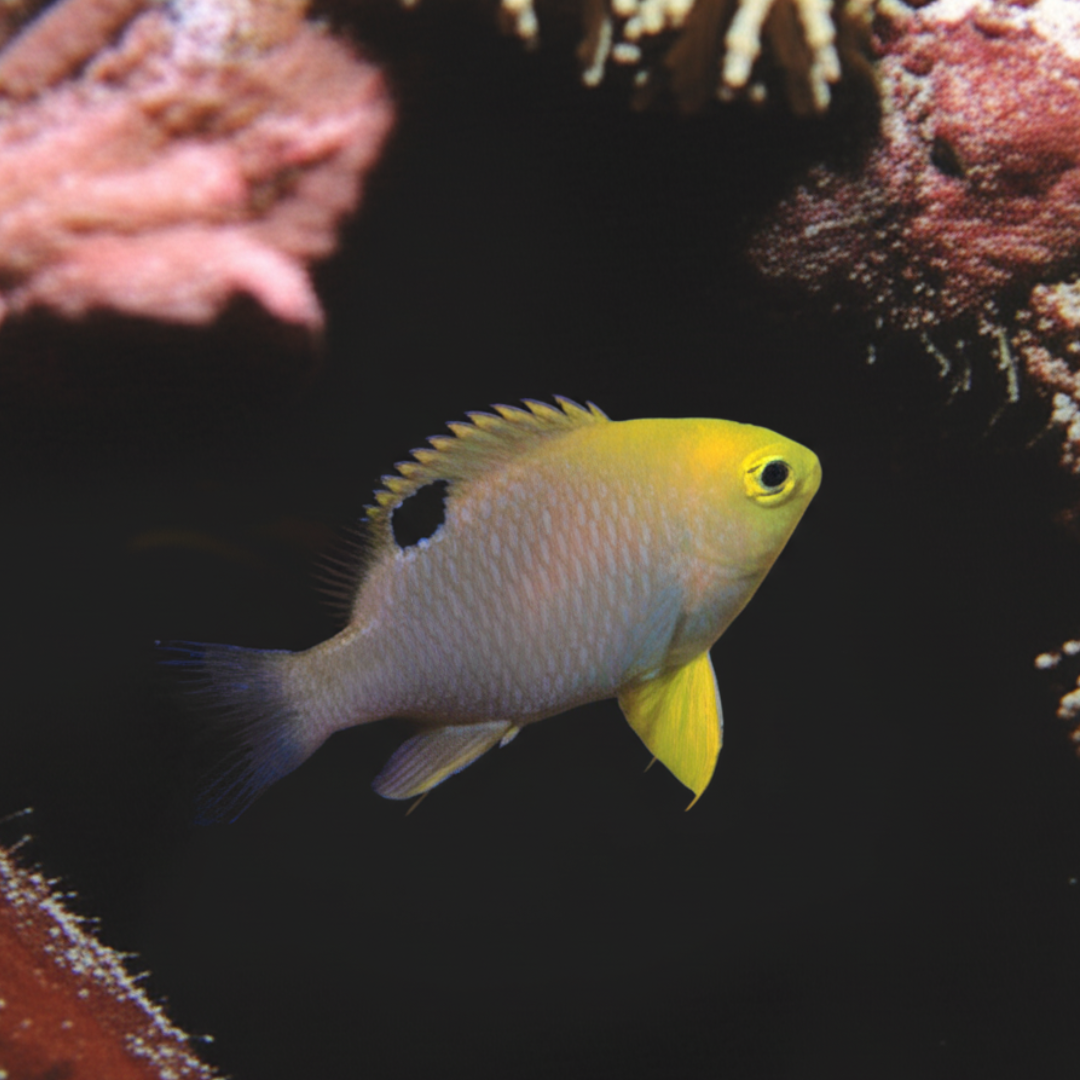
トールボッツダムセルは、ルリスズメダイ属の中でも特に繊細で美しい色彩を持つ海水魚です。淡い藤色やパステルピンクを基調とした体色に、頭部の鮮やかなイエローが際立つコントラストは、観賞魚として非常に高い人気を誇ります。その可憐な外見とは裏腹に、スズメダイ特有の非常に強健な性質を持っており、環境変化にも強いため、海水魚飼育の入門種としても広く親しまれています。サンゴ礁のガレ場や斜面に生息し、複雑な地形を隠れ家として利用する性質があるため、水槽内でもライブロックの間を活発に泳ぎ回る姿を楽しむことができます。Talbot’s Damselfish is a marine fish known for its particularly delicate and beautiful coloration within the genus Chrysiptera. The contrast between its pale mauve or pastel pink body and its bright yellow head is highly striking and popular among aquarists. Despite its dainty appearance, it possesses the robust nature characteristic of damselfish, making it a well-known choice for beginners due to its resilience to environmental changes. Inhabiting coral rubble and reef slopes, it utilizes complex terrains as hiding spots, so you can enjoy watching it actively swim among live rocks in an aquarium.
スズキ目 スズメダイ科 ルリスズメダイ属Order Perciformes, Family Pomacentridae, Genus Chrysiptera
英名 / English Name
Talbot’s damselfish
分布 / Distribution
インド洋東部、西太平洋(アンダマン海からフィジー、オーストラリア北部まで)Eastern Indian Ocean and Western Pacific (from the Andaman Sea to Fiji and Northern Australia).
最大体長 / Max Size
約 6.0 cmApprox. 6.0 cm (2.4 inches)
寿命 / Lifespan
約 3 〜 5 年(飼育環境による)Approx. 3 to 5 years (depending on the aquarium environment).
飼育環境 / Aquarium Environment
水槽サイズ / Tank Size
60cm規格水槽(約60リットル)以上。複数種の混泳や安定した維持には90cm規格水槽以上が推奨されます。Minimum 60cm standard tank (approx. 60L). A 90cm standard tank or larger is recommended for stable maintenance and community setups.
水温 / Temperature
23.0 〜 27.0 ℃(25℃前後が理想的)23.0 to 27.0 degrees Celsius (Ideally around 25 degrees Celsius).
水質 / Water Quality
pH 8.1 〜 8.4、比重 1.020 〜 1.025。純度の高い人工海水を使用し、硝酸塩濃度を低く保つことが望ましい。pH 8.1 to 8.4, Specific Gravity 1.020 to 1.025. It is desirable to use high-purity artificial sea salt and keep nitrate levels low.
レイアウト / Layout
ライブロックで多くの隠れ家(洞窟や岩の隙間)を作ってください。強い水流を好むため、ウェーブメーカーなどで潮流を再現すると活発になります。Provide plenty of hiding spots (caves and crevices) using live rock. They prefer strong currents, so recreating water flow with wave makers will make them more active.
注意点 / Precautions
非常に丈夫ですが、導入初期のストレスには注意が必要です。また、水槽からの飛び出し事故を防ぐため、フタをしっかり閉めるようにしてください。While very hardy, caution is needed regarding stress during the initial introduction. Also, ensure the lid is tightly closed to prevent accidental jumping.
餌と給餌 / Feeding
餌の種類 / Diet
雑食性。人工飼料(顆粒・フレーク)によく餌付きます。色揚げを意識して、スピルリナ入りの植物性飼料や、冷凍のイサザアミ、コペポーダなども併用してください。Omnivorous. They easily accept artificial feeds (pellets and flakes). For better coloration, supplement with plant-based feeds containing spirulina, as well as frozen mysis shrimp and copepods.
給餌のポイント / Feeding Tips
1日数回、数分で食べ切れる量を与えます。活発に泳ぐため代謝が良く、痩せやすいため、こまめな給餌が健康維持のコツです。Feed small amounts several times a day that they can consume within a few minutes. Due to their active swimming and high metabolism, regular feeding is key to maintaining their health.
性格と混泳 / Temperament and Tank Mates
性格 / Temperament
縄張り意識が強く、同種や似た体形の魚に対しては攻撃的になることがあります。単独での飼育、または十分な広さのある水槽での混泳が基本です。Highly territorial; they can be aggressive towards the same species or fish with similar body shapes. They are best kept alone or in a sufficiently large tank for community settings.
混泳の相性 / Compatibility
体格の大きなヤッコ、ハギ、ベラなどとは比較的良好に混泳できます。本種の導入は、他の大人しい魚が環境に慣れた後の最終段階に行うのが成功の秘訣です。Compatibility is relatively good with larger angelfish, tangs, and wrasses. The secret to success is introducing this species at the final stage, after other docile fish have settled into the environment.
病気と対策 / Diseases and Prevention
かかりやすい病気 / Common Diseases
白点病、ウーディニウム病。基本的には病気に強い種ですが、水質の急変や新規導入時のストレスで発症することがあります。Marine Ich and Velvet disease. While generally a hardy species, these may occur due to sudden changes in water quality or stress during introduction.
対策と予防 / Prevention
水温の安定と殺菌灯の設置が効果的です。発症した場合は、銅イオンによる治療や低比重療法が検討されますが、早期発見・早期対応が肝要です。Maintaining stable water temperatures and installing UV sterilizers are effective. If a disease occurs, treatments like copper ions or hyposalinity therapy may be considered, but early detection and response are vital.
増やし方(繁殖) / Breeding
雌雄の判別 / Sexing
外見での判別は困難ですが、成魚のオスの方がメスよりもわずかに大きくなる傾向があります。繁殖期にはオスの体色がより暗く変化し、求愛行動を見せます。Difficult to distinguish by appearance, but adult males tend to be slightly larger than females. During the breeding season, the male’s coloration darkens, and he displays courtship behavior.
繁殖形態 / Reproduction
底生卵保護型。岩の表面などに産卵し、孵化するまでオスが献身的に卵を守り、新鮮な水を送る世話(エアレーション)を行います。Demersal egg layers. They lay eggs on rock surfaces, and the male dedicatedly guards and fans the eggs (aeration) until they hatch.
繁殖のポイント / Breeding Tips
本種は雄性先熟型の性転換を行うと考えられており、小さな個体はオスとして機能し、大きく成長するとメスへ転換する戦略をとります。飼育下での産卵は可能ですが、浮遊幼生期の餌の確保が非常に難しく、稚魚の育成には専門的な設備と知識が必要です。This species is believed to exhibit protandrous sequential hermaphroditism, where smaller individuals function as males and transition to females as they grow larger. Spawning in captivity is possible, but securing food for the pelagic larval stage is very difficult, requiring specialized equipment and knowledge.
雑学と豆知識 / Trivia and Fun Facts
1. 名高い海洋学者フランク・タルボット博士への献名 / 1. Dedicated to the Renowned Marine Biologist, Dr. Frank Talbot
この魚の学名「talboti」は、海洋科学界の巨人であるフランク・H・タルボット博士への敬意を表して名付けられました。博士はグレートバリアリーフの有名なリザード島研究施設を設立した人物であり、シドニーのオーストラリア博物館やスミソニアン国立自然史博物館の館長を歴任しました。この小さなスズメダイは、博士が1969年に自ら採集した標本を元に記載されたものであり、その名前には海洋探索の黄金時代の歴史が刻まれています。The scientific name “talboti” was given in honor of Dr. Frank H. Talbot, a titan in the field of marine science. He founded the famous Lizard Island Research Station on the Great Barrier Reef and served as director of both the Australian Museum in Sydney and the Smithsonian National Museum of Natural History. This small damselfish was described based on specimens Dr. Talbot himself collected in 1969, embedding a piece of the golden age of ocean exploration into its name.
2. フィジー産「ブラック・バリアント」の神秘 / 2. The Mystery of the “Fiji Black Variant”
通常、トールボッツダムセルは淡いピンク色をしていますが、フィジー諸島周辺には「ブラック・バリアント」と呼ばれる極めて珍しい色彩個体が存在します。この個体は体全体が漆黒、または濃いグレーに染まっていますが、頭部の黄色と背鰭の黒い眼状紋(目玉模様)はしっかりと残っています。日本国内では「フィジー便」として稀に入荷し、その希少性と独特の美しさから、ベテランのアクアリストたちの間で羨望の的となっています。While Talbot’s Damselfish usually sport a pale pink color, an extremely rare color morph known as the “Black Variant” exists around the Fiji Islands. This variant has a jet-black or dark gray body, yet retains the yellow head and the black ocellus (eyespot) on its dorsal fin. In Japan, they are occasionally imported as part of “Fiji shipments” and are highly coveted by veteran aquarists for their rarity and unique beauty.
3. 囮(おとり)として機能する「背鰭の目玉模様」 / 3. The Dorsal Fins’ Eyespot Acting as a Decoy
背鰭の後方にある大きな黒い斑点は「眼状紋」と呼ばれ、自然界での生存戦略において重要な役割を果たしています。捕食者に対して、こちらが頭部であると誤認させることで、急所への攻撃を回避し、最悪の場合でも鰭の一部を失うだけで逃げ延びるチャンスを作ります。また、幼魚期にはこの模様がより鮮明であり、最も脆弱な時期を生き抜くための進化の知恵と言えるでしょう。The large black spot on the back of the dorsal fin is called an “ocellus” and plays a crucial role in survival strategy. By tricking predators into thinking this is the head, the fish avoids attacks on vital organs, creating a chance to escape even if it loses part of its fin. This pattern is often more vivid in juveniles, representing an evolutionary adaptation to survive their most vulnerable stage.
4. 未来を拓く「人工繁殖(ブリード)」個体の流通 / 4. Paving the Future: The Distribution of Captive-Bred Individuals
近年、サンゴ礁の環境保護への意識が高まる中、アメリカのORA社などがトールボッツダムセルの完全人工繁殖に成功しました。人工繁殖された「ブリード個体」は、野生採取個体に比べて最初から人工飼料に慣れており、水槽環境への適応能力が格段に高いという利点があります。日本国内でも徐々に流通が始まっており、自然界への負荷を減らしつつ、より健康な個体を迎えることができる、サステナブルなアクアリウムの象徴となっています。In recent years, with increasing awareness of coral reef conservation, companies like ORA in the USA have succeeded in the complete captive breeding of Talbot’s Damselfish. These “captive-bred” individuals have the advantage of being accustomed to artificial food from the start and possess a much higher adaptability to aquarium environments compared to wild-caught ones. Their distribution is gradually beginning in Japan, serving as a symbol of sustainable aquarium keeping that reduces the impact on nature.
まとめ / Conclusion
トールボッツダムセルは、そのパステル調の色彩と強健な性質を併せ持つ、海水魚飼育の楽しみを凝縮したような存在です。初心者の方には飼育の基本を教えてくれる良きパートナーとなり、熟練者の方にはリーフタンクを華やかに彩る名脇役として、世代を超えて愛され続けています。Talbot’s Damselfish is a perfect embodiment of the joys of marine fishkeeping, combining pastel colors with a robust nature. It serves as an excellent partner for beginners to learn the basics of fishkeeping and as a brilliant supporting character for veterans to brighten up reef tanks, continuing to be loved across generations.
彼らの縄張り意識や混泳のルールを正しく理解し、適切な隠れ家を用意してあげることで、水槽内には平和で美しいサンゴ礁の一角が再現されることでしょう。タルボット博士が愛したこの小さな魚を、ぜひあなたの水槽でも大切に育ててみてください。By correctly understanding their territorial instincts and social rules, and providing appropriate hiding spots, you can recreate a peaceful and beautiful corner of a coral reef in your tank. We hope you cherish and raise this small fish, which Dr. Talbot so loved, in your own aquarium.
【学術論文・原記載】
Allen, G. R. (1975). “A revision of the damselfish genus Pomacentrus with the description of eight new species from the Indo-Australian Archipelago.” Proceedings of the Linnean Society of New South Wales, 99(2), 47-80. (Chrysiptera talbotiの原記載)
【人物・歴史背景】
Australian Museum. (2024). “Obituary: Dr Frank Hamilton Talbot, 1930–2024.” (フランク・タルボット博士の功績と標本収集の記録)
【生態学研究】
Allen, G. R., & Erdmann, M. V. (2012). “Reef Fishes of the East Indies.” Tropical Reef Research. (分布域および生息深度勾配に関する知見)
【飼育・養殖技術】
ORA (Oceans, Reefs & Aquariums). (2020). “Species Profile: Captive Bred Talbot’s Damselfish.” Global Pet Expo 2020 Exhibition Records. (人工繁殖の商業的成功と飼育特性)
【色彩変異・流通情報】
Reef Builders. (2018). “Black Talbot’s Damselfish from Fiji are a stunning regional variant.” (フィジー産ブラック・バリアントの色彩特性と希少性)



 アイのアクアグッズ案内水槽用浄水器の選び方|水換えを楽にするタイプとROの違い道具の特徴や使い方、選ぶときのポイントをアイが紹介します。記事はコチラ →
 アイのアクアグッズ案内ラスボラ・ボララスの群泳を楽しむ飼育用品|水槽・ろ過・ヒーター・餌・水草道具の特徴や使い方、選ぶときのポイントをアイが紹介します。記事はコチラ →
 アイのアクアグッズ案内水槽のエアーポンプの選び方|水深・音・泡で選ぶおすすめ用品道具の特徴や使い方、選ぶときのポイントをアイが紹介します。記事はコチラ →
 アイのアクアグッズ案内エーハイム、安いのと高いのは何が違う? コタロウと見比べる外部フィルター道具の特徴や使い方、選ぶときのポイントをアイが紹介します。記事はコチラ →



コメント