

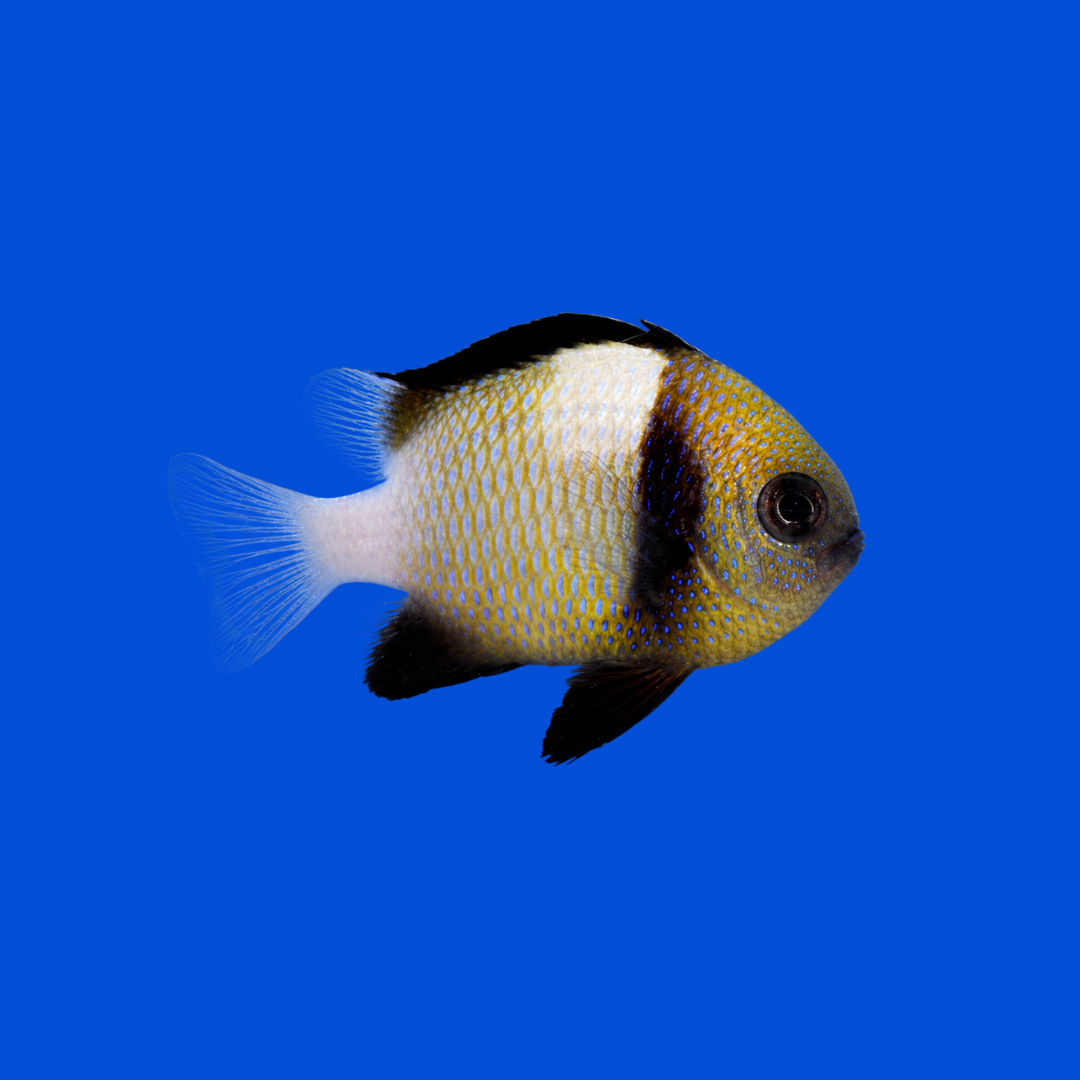
解説 / Description
インディアンダッシラスは、インド洋のサンゴ礁に分布する小型のスズメダイです。真珠のような白い体に黒い横帯が入り、頭部から胸部にかけて細かな青い斑点が散る姿が特徴です。よく似た太平洋産のフタスジリュウキュウスズメダイとは、頭部の青い斑点や尾柄部周辺の模様で見分けやすく、インド洋産らしい落ち着いた美しさがあります。 The Indian Dascyllus is a small damselfish found on coral reefs of the Indian Ocean. It is characterized by a pearly white body, a black vertical band, and fine blue spots scattered around the head and breast. It resembles the Pacific reticulated dascyllus, but the blue spots on the head and the pattern around the caudal peduncle make it easier to identify. Its calm, refined appearance is one of the attractions of this Indian Ocean species.
水槽内では丈夫で人工飼料にも慣れやすく、サンゴを直接食害しにくいリーフタンク向きの魚として扱われます。ただし、成長すると縄張り意識が強くなるため、長期飼育では隠れ家を多く用意し、混泳相手と水槽サイズを慎重に選ぶことが大切です。 In aquariums, it is hardy, usually adapts well to prepared foods, and is generally suitable for reef tanks because it does not normally damage corals. However, adults can become territorial, so long-term care requires plenty of hiding places and careful selection of both tank size and tank mates.
基本情報 / Basic Information
| 学名 / Scientific Name | Dascyllus carneus Fischer, 1885 |
|---|---|
| 通称 / Common Name | インディアンダッシラス、クラウディダッシラス、クラウディダムセルIndian Dascyllus, Cloudy Dascyllus, Cloudy Damsel |
| 分類 / Family | スズメダイ科 ミスジリュウキュウスズメダイ属Family Pomacentridae, genus Dascyllus |
| 英名 / English Name | Cloudy Dascyllus, Cloudy Damsel, Indian Dascyllus |
| 分布 / Distribution | アフリカ東岸からモザンビーク周辺、モーリシャス、レユニオン、コモロ、セーシェル、チャゴス諸島、モルディブ、スリランカ、アンダマン海、ジャワ海周辺など、インド洋のサンゴ礁域に広く分布します。It is widely distributed on Indian Ocean reefs, including the East African coast and Mozambique region, Mauritius, Réunion, the Comoros, Seychelles, the Chagos Archipelago, the Maldives, Sri Lanka, the Andaman Sea, and areas around the Java Sea. |
| 最大体長 / Max Size | 全長約7cm。水槽内では販売サイズから成長しても小型に収まる魚です。About 7 cm in total length. Even after growing from typical aquarium trade sizes, it remains a small marine fish. |
| 寿命 / Lifespan | 本種単独の飼育寿命を示す確実な資料は多くありませんが、安定した海水環境では数年単位の長期飼育が期待できます。Reliable aquarium lifespan data specific to this species are limited, but with stable marine conditions it can be expected to live for several years. |
飼育環境 / Aquarium Environment
| 水槽サイズ / Tank Size | 単独飼育でも長期的には60cm規格水槽以上を目安にします。混泳を前提にする場合は90cm規格水槽以上、複数飼育やハレム状の群れを狙う場合は120cm水槽以上の広さが望ましいです。For long-term single-specimen care, a standard 60 cm aquarium or larger is a practical guide. For community setups, a standard 90 cm tank or larger is preferable, and a 120 cm or larger aquarium is recommended for groups or harem-style keeping. |
|---|---|
| 水温 / Temperature | 24〜26℃を中心に安定させます。許容範囲内でも急な上下はストレスになるため、ヒーターとクーラーで季節変動を抑えます。 Keep the temperature stable, ideally around 24–26°C. Even within an acceptable range, sudden changes can be stressful, so heaters and chillers should be used to reduce seasonal fluctuations. |
| 水質 / Water Quality | pH 8.1〜8.4、比重1.023〜1.025、炭酸塩硬度7〜11dKH前後を目安にします。丈夫な魚ですが、ろ過が安定した清浄な海水環境を維持することが、発色と体調を保つ基本になります。Aim for pH 8.1–8.4, specific gravity 1.023–1.025, and carbonate hardness around 7–11 dKH. Although it is hardy, stable filtration and clean seawater are the basis for maintaining good color and condition. |
| レイアウト / Layout | ライブロックを組んで、隙間、洞窟、オーバーハングを複数作ります。自然下では水深5〜40mほどの礁域で枝状サンゴと関わりが深いため、ミドリイシ類やハナヤサイサンゴ類のような枝状の構造があると落ち着きやすく、自然に近い行動も観察しやすくなります。Arrange live rock to create several crevices, caves, and overhangs. In nature, the species is associated with branching corals on reefs at roughly 5–40 m depth, so branching structures such as Acropora or Pocillopora can help it settle and display more natural behavior. |
| 注意点 / Precautions | 強健な魚ですが、立ち上げ直後の不安定な水槽に長く入れる管理は避けます。幼魚期は群れで泳ぐことがありますが、成長後は縄張りを持つため、小型水槽での同種複数飼育は弱い個体が追い込まれやすくなります。大型のハタ類、カサゴ類、ウツボ類など、本種を飲み込める肉食魚との混泳も避けてください。It is hardy, but it should not be kept for long in a newly set up and unstable aquarium. Juveniles may school, but adults establish territories, so keeping multiple individuals in a small tank can result in weaker fish being harassed. Avoid large predatory fishes such as groupers, scorpionfishes, and morays that could swallow it. |
餌と給餌 / Feeding
| 餌の種類 / Diet | 自然下では主に動物プランクトンを食べます。飼育下では、海水魚用の人工飼料、フレークフード、顆粒フード、冷凍イサザアミ、ブラインシュリンプなどをよく食べます。栄養の偏りを防ぐため、スピルリナなど植物質を含む餌も組み合わせるとよいでしょう。In the wild, it feeds mainly on zooplankton. In aquariums it usually accepts marine fish pellets, flakes, granules, frozen mysid-type foods, and brine shrimp. To avoid nutritional imbalance, foods containing plant matter such as spirulina can also be included. |
|---|---|
| 給餌のポイント / Feeding Tips | 活発に泳ぐ小型魚なので、1日1〜2回を基本に、可能であれば少量を複数回与えます。食べ残しは水質悪化につながるため、数分で食べ切れる量に調整します。混泳水槽では、気の弱い魚にも餌が回っているかを同時に確認してください。As an active small fish, it does well with one or two feedings per day, or several smaller feedings when possible. Adjust the amount so it is eaten within a few minutes, because leftovers can reduce water quality. In community tanks, also check that more timid fish are getting enough food. |
性格と混泳 / Temperament and Tank Mates
| 性格 / Temperament | 物おじしにくく、環境に慣れると前面にもよく出てくる魚です。一方で、スズメダイらしく成長とともに縄張り意識が強まり、拠点にしたライブロックやサンゴの周囲に近づく魚を追い払うことがあります。It is bold and often comes out to the front once settled. At the same time, like many damselfishes, it becomes more territorial as it matures and may chase fish that come close to its chosen live rock or coral area. |
|---|---|
| 混泳の相性 / Compatibility | テンジクダイ類、小型ハゼ類、遊泳力の弱いおとなしい魚とは相性に注意が必要です。混泳相手には、ある程度自己主張できる中型ヤッコ類、ニセスズメ類、大きめのクマノミ類、ハギ類などが候補になります。混泳水槽では、本種を後から導入する、隠れ家を複数作る、視線を遮るレイアウトにする、といった工夫が有効です。Use caution with cardinalfishes, small gobies, and timid or weak-swimming fishes. Possible tank mates include moderately assertive fishes such as medium-sized angelfishes, dottybacks, larger clownfishes, and tangs. In community tanks, it helps to add this species later, provide multiple shelters, and create a layout that breaks lines of sight. |
病気と対策 / Diseases and Prevention
| かかりやすい病気 / Common Diseases | 本種だけに特有の病気が目立つ魚ではありませんが、導入直後のストレス、水質悪化、混泳によるスレやけががあると、海水魚の白点病、ウーディニウム症、細菌性の二次感染などに注意が必要です。No disease is especially unique to this species, but stress after introduction, poor water quality, or injuries from tank mate aggression can make it vulnerable to marine ich, velvet disease, and secondary bacterial infections. |
|---|---|
| 対策と予防 / Prevention | 購入時は、痩せ、白点、ヒレの欠け、体表の白濁、呼吸の速さを確認します。可能であれば隔離水槽で状態を見てから本水槽へ移すと安心です。リーフタンクでは銅を含む薬剤をサンゴや無脊椎動物のいる水槽に使えないため、治療が必要な場合は別水槽で行います。安定した比重と水温、十分な隠れ家、無理のない混泳が予防の中心です。At purchase, check for thinness, white spots, damaged fins, cloudy patches on the body, and rapid breathing. Quarantine before adding it to the display tank when possible. Copper-based medications cannot be used in reef tanks with corals or invertebrates, so treatment should be done in a separate tank. Stable salinity, stable temperature, sufficient hiding places, and sensible stocking are the foundation of prevention. |
増やし方(繁殖) / Breeding
| 雌雄の判別 / Sexing | 外見だけで雌雄を判別するのは難しい魚です。本種では社会的順位と体サイズが繁殖上の役割に関係し、優位な大きな個体がオスとして機能します。ミスジリュウキュウスズメダイ属では雌性先熟が知られており、群れの中で優位なメスがオスへ性転換することがあります。Sexing by appearance alone is difficult. In this species, social rank and body size are linked to reproductive roles, and a dominant large individual functions as the male. Protogyny is known in Dascyllus, and a dominant female in a group may change sex and become male. |
|---|---|
| 繁殖形態 / Reproduction | 基質産卵型です。メスが岩面や素焼き鉢などの表面に粘着卵を産み付け、オスが孵化まで卵を守り、新鮮な海水を送ります。人工繁殖の研究では、野生採集の親魚が飼育開始から約4か月で産卵し、1回に約6,500〜10,500個の卵を産み、孵化率は90.6〜98.81%と報告されています。It is a substrate spawner. The female lays adhesive eggs on surfaces such as rock or terracotta pots, and the male guards and aerates the eggs until hatching. In a captive-breeding study, wild-caught broodstock began spawning after about four months, laid about 6,500–10,500 eggs per spawning, and achieved a reported hatching rate of 90.6–98.81%. |
| 繁殖のポイント / Breeding Tips | 家庭水槽での繁殖は上級者向けです。最大の課題は、孵化直後の仔魚が非常に小さく、初期餌料のサイズが限られることです。研究では、初期餌料としてパルボカラヌスなど極小のカイアシ類ノープリウス幼生が用いられ、25日目前後からアルテミア幼生を併用し、50日目前後に人工飼料へ移行できたとされています。親魚を産卵させること以上に、微小餌料を安定して培養・供給できるかが成功を左右します。Breeding in a home aquarium is best considered an advanced project. The main challenge is that newly hatched larvae are extremely small and require very small first foods. In research, tiny copepod nauplii such as Parvocalanus were used as the first feed, Artemia nauplii were added from around 25 days post-hatch, and weaning onto prepared feed was possible at around 50 days post-hatch. Success depends less on getting the adults to spawn and more on reliably culturing and supplying suitable microfoods. |
雑学と豆知識 / Trivia and Fun Facts
| 1. 学名に残る淡い体色の印象 / 1. A pale body color reflected in the scientific name | 種小名のcarneusは、ラテン語で肉色や肌色を意味する言葉に由来します。インディアンダッシラスの体は、鮮やかな赤や黄色ではなく、真珠のような白から淡い肌色を思わせる色合いです。黒い帯と青い斑点に目が向きがちですが、命名の背景には、サンゴ礁の光の中で柔らかく見える白い体への印象があったと考えられています。The species name carneus comes from a Latin word meaning flesh-colored. The body of the Indian Dascyllus is not bright red or yellow, but pearly white to pale flesh-toned. Although the black band and blue spots tend to draw attention, the name is thought to reflect the soft impression of its pale body under reef light. |
|---|---|
| 2. 近縁種との見分け方は「頭」と「尾柄部」 / 2. Identification focuses on the head and caudal peduncle | 太平洋に分布するフタスジリュウキュウスズメダイとは近縁で、体型もよく似ています。インディアンダッシラスでは頭部や項部に暗色で縁取られた小さな青い斑点があり、尾柄部付近が白く抜ける印象になります。よく似た魚を比べるときは、体全体の雰囲気だけでなく、頭部の斑点と体後方の黒帯の出方を見ると判断しやすくなります。It is closely related to the Pacific reticulated dascyllus and has a similar body shape. The Indian Dascyllus has small dark-rimmed blue spots on the head and nape, and the area around the caudal peduncle appears pale. When comparing similar fishes, checking the head spots and the pattern of the rear black band is more reliable than judging by general appearance alone. |
| 3. 枝状サンゴとの関係 / 3. Its relationship with branching corals | 自然下では小さな群れを作り、枝状サンゴの上でホバリングしながら動物プランクトンを食べます。危険を感じると枝の間へ素早く逃げ込めるため、サンゴは重要な隠れ家になります。一方で、サンゴの間に魚が暮らすことで、不要な藻類の除去や排泄物による栄養供給が起こり、サンゴ側にも利点があると考えられています。水槽内で枝状サンゴやライブロックの近くに落ち着く姿は、このサンゴ礁での暮らし方を反映した行動です。In the wild, it forms small schools and hovers above branching corals while feeding on zooplankton. The branches provide an important refuge, allowing the fish to retreat quickly when threatened. At the same time, resident fish may benefit the coral by removing unwanted algae and supplying nutrients through waste. When this fish settles near branching corals or live rock in an aquarium, it is expressing a behavior shaped by reef life. |
| 4. 小さな魚が持つ複雑な社会 / 4. A small fish with a complex social life | ミスジリュウキュウスズメダイ属の仲間は、単に群れているだけの魚ではありません。優位なオスが枝状サンゴの周辺を防衛し、メスや若い個体を含む小さな社会を作ります。さらに、スズメダイ科では顎の動きに関わる構造を使って音を出す行動も知られており、縄張り争いや求愛の場面で音が重要な合図になると考えられています。水槽内の小さな追い払い行動にも、見た目以上に細かな社会的意味が含まれているかもしれません。Members of the genus Dascyllus are not simply schooling fishes. A dominant male defends the area around branching coral and maintains a small social group that includes females and younger individuals. Damselfishes are also known for producing sounds through jaw-related structures, and these sounds are thought to play important roles in territorial and courtship behavior. Even small chasing interactions in an aquarium may carry more social meaning than they first appear to. |
| 5. 人工繁殖が持つ意味 / 5. Why captive breeding matters | 本種は国際的な保全評価では低リスクとされますが、海水観賞魚の多くは野外採集に支えられてきました。インドの研究機関によって、野生採集親魚からの産卵、仔魚育成、人工飼料への切り替えまでの流れが報告されたことは、観賞魚としての流通をより持続的にするうえで重要な一歩です。とくに、ワムシではなく微小なカイアシ類を初期餌料にする点は、小さな仔魚を育てる難しさと、海水魚繁殖技術の奥深さをよく示しています。The species is assessed as low risk at the global conservation level, but many marine ornamental fishes have historically depended on wild collection. Reports from an Indian research institute describing spawning from wild-caught broodstock, larval rearing, and weaning onto prepared feed are an important step toward more sustainable aquarium trade. The need for tiny copepods rather than standard rotifers as first food clearly shows both the difficulty of rearing small larvae and the sophistication of marine fish breeding technology. |
まとめ / Conclusion
インディアンダッシラスは、インド洋の枝状サンゴに寄り添って暮らす小型のスズメダイです。白い体、黒い横帯、青い斑点が作る端正な模様は、水槽の中でも落ち着いた存在感を放ちます。丈夫で餌付きやすい一方、成長後の縄張り意識を見越して、隠れ家と遊泳スペースを十分に確保することが長期飼育の鍵になります。 The Indian Dascyllus is a small damselfish that lives closely with branching corals in the Indian Ocean. Its white body, black band, and blue spots give it a refined presence in the aquarium. It is hardy and usually feeds readily, but successful long-term care depends on preparing enough shelter and swimming space while anticipating its adult territorial nature.
サンゴ礁で育まれた行動、近縁種との繊細な違い、そして人工繁殖研究が示す小さな命の難しさまで、本種には観察するほどに深まる魅力があります。安定した海水環境と無理のない混泳を整えれば、枝状サンゴやライブロックの周囲をきびきびと泳ぐ姿が、海水水槽に自然な奥行きを添えてくれます。 From its reef-shaped behavior and subtle differences from related species to the challenges revealed by captive-breeding research, this fish becomes more interesting the more closely it is observed. With stable seawater conditions and carefully chosen tank mates, its lively movement around branching corals and live rock adds a natural sense of depth to a marine aquarium.

気になる道具や飼い方を見つけてみませんか?
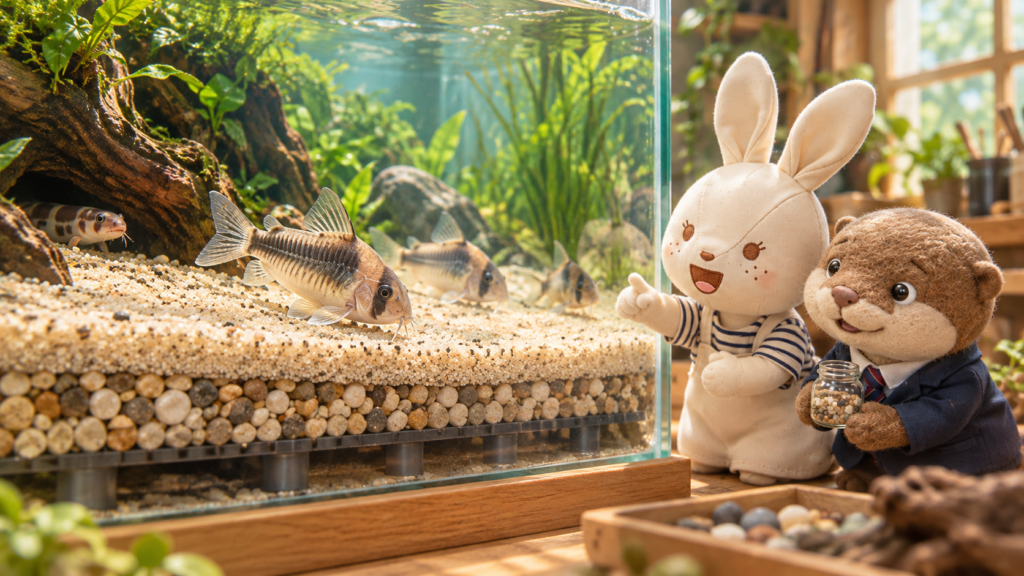 アイのアクアグッズ案内水槽の底砂の選び方|砂・砂利の違いとおすすめ商品道具の特徴や使い方、選ぶときのポイントをアイが紹介します。記事はコチラ →
 アイのアクアグッズ案内小型カラシンの群れを楽しむ|餌と水換えから考える飼育用品ガイド小型カラシンの群れを眺める時間を、もっと楽しく。泳ぐ余白、餌の食べ方、続けやすい水換えを軸に、日本で揃えやすい用品の選び方を紹介します。記事はコチラ →
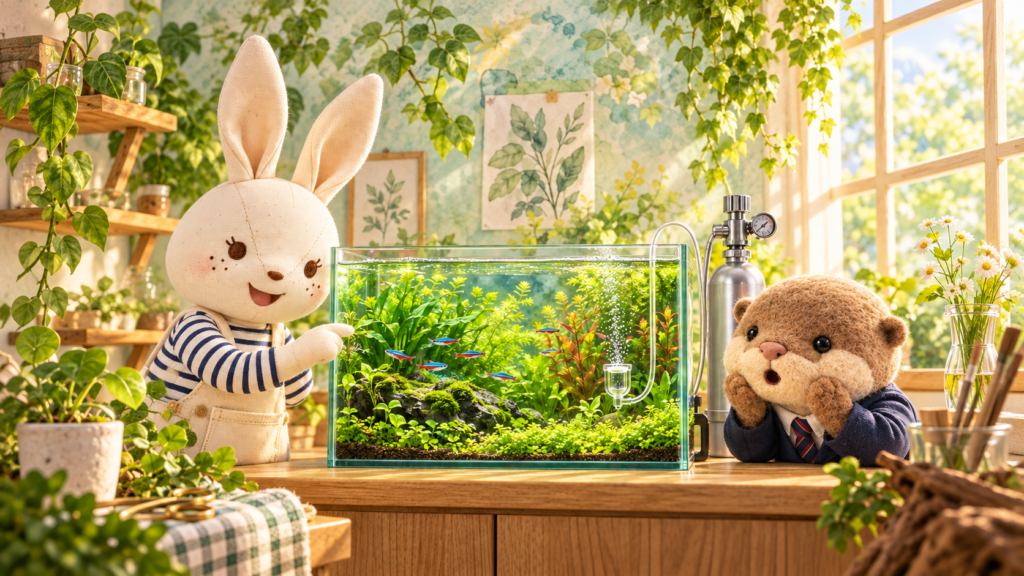 アイのアクアグッズ案内水草水槽のCO₂添加|3つの方式の選び方とおすすめ用品道具の特徴や使い方、選ぶときのポイントをアイが紹介します。記事はコチラ →
 アイのアクアグッズ案内ショップで見かけるカラフルなバケツ。いったい何が入ってる?道具の特徴や使い方、選ぶときのポイントをアイが紹介します。記事はコチラ →
さまざまな飼育テーマをご紹介。リンク先の記事には広告・商品紹介が含まれます。
案内・紹介記事一覧へ →分布マップ
インディアンダッシラスは、アフリカ東岸からモザンビーク周辺、モーリシャス、レユニオン、コモロ、セーシェル、チャゴス諸島、モルディブ、スリランカ、アンダマン海、ジャワ海周辺など、インド洋のサンゴ礁域に広く分布します。地図では、その分布イメージをインド洋中部を中心とした概略範囲として示しています。
この地図は、記事内の分布欄をもとにした分布イメージ用の概略表示です。実際の採集地点や厳密な生息範囲を示すものではありません。
参考文献・参照資料
本項目では、インディアンダッシラスの分類、分布、生息環境、飼育条件、繁殖、病気や導入時の注意点を確認するために、魚類データベース、博物館・国際機関系データベース、査読論文、獣医・水産系の解説資料を中心に参照しています。店舗、通販ページ、個人ブログ、一般的なまとめサイトは参考文献から除外しました。
-
Eschmeyer’s Catalog of Fishes, California Academy of Sciences. Dascyllus carneus Fischer, 1885.
学名の有効性、原記載、タイプ産地、タイプ標本情報、Pomacentridae: Chrominae での扱いを確認するための分類学的基礎資料です。
https://researcharchive.calacademy.org/research/ichthyology/catalog/fishcatget.asp?spid=39148 -
Randall, H. A. & Allen, G. R. 1977. A revision of the damselfish genus Dascyllus (Pomacentridae) with the description of a new species. Records of The Australian Museum 31(9): 349–385.
ミスジリュウキュウスズメダイ属の分類整理、近縁種との識別、形態形質を支える査読済みの基礎文献です。
https://doi.org/10.3853/j.0067-1975.31.1977.217 -
Froese, R. & Pauly, D. (eds). FishBase. Dascyllus carneus, Cloudy dascyllus.
分類、分布、水深5〜40m、最大体長7cm、枝状サンゴとの関係、群れでの行動、プランクトン食、卵生・沈性粘着卵・雄による保護行動、推定適水温の確認に使用しています。
https://www.fishbase.se/summary/SpeciesSummary.php?id=7798 -
Bray, D. J. 2025. Dascyllus carneus in Fishes of Australia.
体色、青い斑点、黒帯、鰭の色彩、東インド洋からインド洋にかけての分布、枝状サンゴとの関係、動物プランクトン食、雌性先熟、雄による卵保護、フタスジリュウキュウスズメダイとの識別点を確認するための資料です。
https://fishesofaustralia.net.au/home/species/5548 -
Asoh, K. & Yoshikawa, T. 2003. Gonadal development and an indication of functional protogyny in the Indian damselfish (Dascyllus carneus). Journal of Zoology 260: 23–39.
本種の性分化、雌性先熟、社会構造に関する記述を支える査読論文です。記事内で性転換について述べる場合の主要根拠として扱います。
https://doi.org/10.1017/S0952836903003418 -
Anzeer, F. M., Aneesh, K. S., Abraham, M. V., Darsana, S., Santhosh, B., Anil, M. K., Gopalakrishnan, A., Udayakumar, A., Kingsly, H. J., Unnikrishnan, C. & Yoyak, G. 2019. Breeding, early development and larval rearing of cloudy damsel, Dascyllus carneus Fischer, 1885. Aquaculture 505: 374–385.
親魚の産卵、卵数、孵化率、孵化仔魚のサイズ、カイアシ類 Parvocalanus crassirostris を用いた初期餌料、着底、人工飼料への切り替えなど、繁殖・仔魚育成の中核資料です。
https://doi.org/10.1016/j.aquaculture.2019.03.001
https://eprints.cmfri.org.in/13450/ -
Ornamental Aquatic Trade Association (OATA). How to test for water quality in a marine tank / aquarium.
海水水槽における水質安定、塩分、温度、pH、アンモニア、亜硝酸、硝酸塩、リン酸塩、RO水、急変を避ける管理方針を確認するための飼育条件資料です。獣医専門家による確認済み資料として使用しています。
https://ornamentalfish.org/what-we-do/advice-information/care-sheets/caresheets-marine-fish/how-to-test-for-water-quality-in-a-marine-tank-aquarium/ -
Merck Veterinary Manual. Parasitic Diseases of Fish.
海水魚を含む観賞魚の外部寄生虫、白点症状、呼吸異常、こすりつけ行動、診断、過密や衛生状態の悪化と寄生虫リスクの関係を確認するための獣医資料です。
https://www.merckvetmanual.com/exotic-and-laboratory-animals/aquarium-fish/parasitic-diseases-of-fish -
Yanong, R. P. E. 2021. Cryptocaryon irritans Infections (Marine White Spot Disease) in Fish. University of Florida IFAS Extension, FA164.
海水魚の白点病に関する症状、鰓感染時には白点が見えにくいこと、急速な被害拡大、生活環、早期対応の重要性を確認するための水産・獣医系資料です。
https://ask.ifas.ufl.edu/publication/FA164
飼育条件の補足:水槽サイズや混泳の目安は、自然下の生息環境、成魚の大きさ、縄張り性を踏まえた実用上の提案です。特定の水槽での混泳成功を保証するものではないため、魚同士の距離や給餌時の様子を見て調整してください。




コメント