

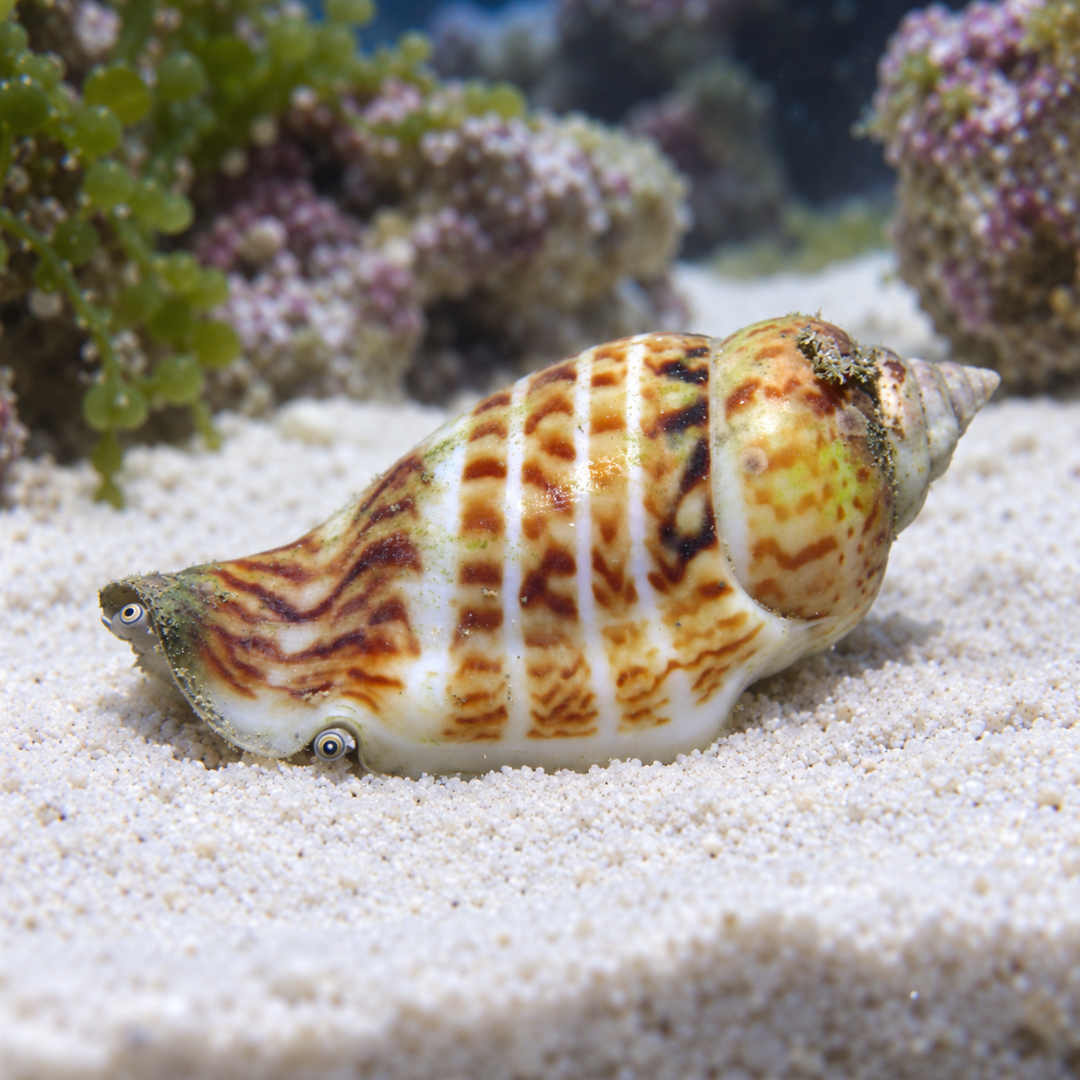
解説 / Description
ネジマガキは、ソデボラ科ネジマガキ属に分類される熱帯性の海産巻貝です。白色からクリーム色を基調とする殻には褐色や紫色、橙色系の模様が現れ、個体によって色彩や模様に大きな変化があります。自然下ではサンゴ礁周辺の浅い砂地や砂礫底、海草が生える場所などで見られ、藻類被膜を摂食します。ソデボラ科らしい長い眼柄と独特な蓋を持ち、一般的な巻貝とは異なる動きも大きな特徴です。海水水槽では砂底を移動しながら付着藻類を食べる生体として飼育できますが、単なる「掃除役」と考えず、安定した海水環境、砂底、十分な餌を用意することが大切です。 Gibberulus gibbosus is a tropical marine gastropod belonging to the family Strombidae. Its cream to white shell shows considerable variation in brown, violet, and orange patterning. In nature it occurs in shallow coral-reef habitats, sandy or gravelly bottoms, and seagrass areas, where it grazes on algal films. Like other strombids, it has conspicuous eyestalks and a specialized operculum that gives it an unusual style of locomotion. In marine aquariums it can graze on attached algae while moving across the substrate, but it should be maintained as a living animal with its own needs rather than treated simply as a disposable clean-up organism.
基本情報 / Basic Information
| 学名 / Scientific Name | Gibberulus gibbosus (Röding, 1798) |
|---|---|
| 通称 / Common Name | ネジマガキ。資料によっては「ネジマガキガイ」の和名も用いられます。過去にはGibberulus gibberulus gibbosusなどの学名で扱われていました。Nejimakaki or Nejimakaki-gai in Japanese references. Older literature may list the species as Gibberulus gibberulus gibbosus. |
| 分類 / Family | 軟体動物門・腹足綱・タマキビ型目・ソデボラ科・ネジマガキ属Phylum Mollusca, Class Gastropoda, Order Littorinimorpha, Family Strombidae, Genus Gibberulus |
| 英名 / English Name | Gibbose Conch |
| 分布 / Distribution | フィリピンから東部インドネシアを中心とする西部太平洋域に分布し、東側ではパプアニューギニア周辺まで記録されています。日本では沖縄・琉球列島から記録があり、国内の貝類資料では奄美大島以南に分布するとされています。主に浅海の砂地や砂礫底で見られます。The species is centered around the Philippines and eastern Indonesia in the western Pacific, with records extending eastward toward northeastern Papua New Guinea and nearby islands. In Japan it has been recorded from Okinawa and the Ryukyu Islands, and Japanese shell references describe its range as extending from the Amami Islands southward. It mainly inhabits shallow sandy or gravelly bottoms. |
| 最大体長 / Max Size | 2021年の分類学的再検討で調べられた標本では、殻高約19〜66mmの範囲が示されています。飼育個体では数cm程度の巻貝として扱われます。A 2021 taxonomic revision reported examined shells ranging from approximately 19 to 66 mm in height. In aquariums it is therefore a gastropod of several centimeters in shell length. |
| 寿命 / Lifespan | 本種について、家庭水槽での標準的な寿命を示す十分な資料は確認されていません。長期飼育では、安定した水質と餌の確保を優先します。A well-established standard lifespan for this species in home aquariums is not available. Stable water conditions and a reliable food supply should be prioritized for long-term maintenance. |
飼育環境 / Aquarium Environment
| 水槽サイズ / Tank Size | 本種だけを対象とした明確な最低水量は定まっていません。飼育では水量だけでなく、安定した海水環境と十分な砂底面積を確保することが重要です。実用上は45cm規格水槽程度以上の余裕がある環境のほうが管理しやすく、複数個体やほかの生体と組み合わせる場合は60cm規格水槽以上が扱いやすくなります。No species-specific minimum aquarium volume has been firmly established. Stable seawater conditions and adequate sandy bottom area are more important than volume alone. As a practical aquarium guideline, a standard 45 cm tank or larger is easier to manage, while a standard 60 cm tank or larger provides more room when several animals or other tank inhabitants are kept together. |
|---|---|
| 水温 / Temperature | 熱帯性の海産巻貝として、一般的なリーフタンクと同様に24〜27℃程度を飼育上の目安とします。ただし、この数値は本種固有の至適水温を実験的に決定したものではありません。高温限界を試す研究結果を日常飼育の推奨温度として解釈せず、急激な温度変化を避けて安定させることを優先します。 As a tropical marine gastropod, approximately 24–27°C is a practical husbandry range comparable to that used in many reef aquariums. This should not be interpreted as an experimentally determined species-specific optimum. Experimental studies of thermal limits should not be used as routine aquarium temperature recommendations; stability is more important. |
| 水質 / Water Quality | 一般的な海水・リーフ水槽の安定した水質を維持します。飼育上の目安として比重1.023〜1.025、pH8.1〜8.4程度の範囲が利用できますが、本種だけに固有の必須値ではありません。アンモニアや亜硝酸塩を蓄積させず、特に塩分、温度、pHを急変させないことが重要です。Maintain stable conditions typical of a marine or reef aquarium. A specific gravity around 1.023–1.025 and pH around 8.1–8.4 are practical husbandry guidelines rather than species-specific mandatory values. Avoid ammonia and nitrite accumulation and, above all, sudden changes in salinity, temperature, or pH. |
| レイアウト / Layout | 自然下では砂地や砂礫底に暮らすため、水槽にも細目のサンゴ砂やアラゴナイトサンドなどを敷き、移動できる開けた砂地を確保します。ライブロックを配置する場合も、底面全体を岩で埋めず、砂地を残しておくと本来の行動を観察しやすくなります。Because the species naturally inhabits sandy and gravelly bottoms, provide fine coral sand or aragonite and leave open areas of substrate for movement. When live rock is used, leaving part of the bottom unobstructed makes it easier for the animal to display its natural behavior. |
| 注意点 / Precautions | 導入時は輸送水と水槽水の温度や比重を確認し、急激な環境変化を避けながら徐々に水合わせを行います。以前の記事で示していた「1秒に1〜2滴」「1〜1.5時間」といった固定的な点滴速度や時間は、輸送水と飼育水の差によって適切な条件が変わるため必須条件とはしません。状態を確認しながら、水温と塩分差を無理なく縮めることを優先します。When introducing the animal, compare the temperature and salinity of the shipping water with those of the aquarium and acclimate gradually to avoid abrupt change. Fixed instructions such as a specific number of drops per second or a universal acclimation duration are not mandatory because appropriate procedures depend on the actual difference between shipping and aquarium water. The priority is to reduce temperature and salinity differences without sudden shifts. |
餌と給餌 / Feeding
| 餌の種類 / Diet | 草食性で、飼育実験では水槽面に発生した藻類被膜を摂食することが確認されています。水槽内では底砂や岩の表面に付着した微細藻類などが主な餌になります。自然発生する餌が少ない場合は、海産草食生体向けの藻類系沈下性フードなどを補助的に利用します。The species is herbivorous, and aquarium experiments have documented grazing on algal films growing on tank surfaces. In home aquariums, naturally occurring microalgae on sand and rock can form an important part of the diet. When natural growth is limited, algae-based sinking foods intended for herbivorous marine animals can be offered as a supplement. |
|---|---|
| 給餌のポイント / Feeding Tips | 付着藻類を食べるからといって、無給餌で長期間維持できるとは限りません。立ち上げ直後や藻類の少ない水槽では餌が不足しやすいため、活動量と餌場の状態を観察します。補助給餌を行う場合も、食べ残しによる水質悪化を避けるため少量から始めます。以前の記事にあった魚肉やアサリなどの給餌は、草食性として確認されている本種の標準的な餌として十分な根拠を確認できないため推奨から外します。The fact that this snail grazes on algae does not mean that it can necessarily be maintained indefinitely without feeding. Newly established or very clean aquariums may provide insufficient natural growth, so observe both the animal’s activity and the availability of grazing surfaces. If supplemental food is used, begin with small quantities to avoid deteriorating water quality. Meat-based foods previously suggested are not retained as standard recommendations because the species is documented as herbivorous. |
性格と混泳 / Temperament and Tank Mates
| 性格 / Temperament | ほかの生体を積極的に追い回すような巻貝ではなく、基本的には底面を移動しながら藻類を食べて過ごします。ソデボラ科では蓋を底面に当てて体を動かす特徴的な移動方法が知られており、一般的な巻貝の滑るような移動とは異なる動きを見せます。This is not an aggressive gastropod that actively pursues other aquarium animals. It mainly moves across the substrate while grazing. Strombids are notable for using the operculum against the bottom during locomotion, producing movements that differ markedly from the smooth gliding of many familiar snails. |
|---|---|
| 混泳の相性 / Compatibility | 草食性であり、サンゴを餌として積極的に捕食する性質は知られていないため、一般的なリーフ水槽とは組み合わせやすい生体です。一方、貝類を捕食するフグ類、モンガラカワハギ類、大型ベラ類などとの混泳には注意が必要です。ヤドカリ類も巻貝を襲う場合があるため、同居させる場合は双方の行動を観察します。Its herbivorous diet makes it generally compatible with reef-style aquariums, and active predation on corals is not characteristic of the species. However, care is needed with mollusk-eating fishes such as puffers, triggerfish, and large wrasses. Hermit crabs may also attack living snails under some circumstances, so interactions should be monitored. |
病気と対策 / Diseases and Prevention
| かかりやすい病気 / Common Diseases | 本種について、家庭水槽で特に多発する固有の感染症は十分に整理されていません。実際の飼育では、急激な塩分や水温の変化、輸送によるダメージ、餌不足、水質悪化などの環境要因に注意します。普段と比べて長時間まったく動かない、眼柄などの軟体部をほとんど出さない状態が続く場合は、水質や餌の状態を確認します。No well-defined species-specific infectious disease is established as a common problem in home aquariums. In practice, husbandry factors such as abrupt salinity or temperature changes, transport damage, insufficient food, and poor water quality deserve greater attention. Prolonged inactivity or persistent failure to extend the soft body and eyestalks should prompt a check of water conditions and food availability. |
|---|---|
| 対策と予防 / Prevention | 安定した水温と比重を保ち、導入時の急変を避け、十分な餌場を確保することが基本です。死亡した巻貝を放置すると腐敗して水質を悪化させるため、死亡が確認された場合は速やかに取り出します。また、輸送水は本水槽へできるだけ持ち込まず、生体だけを移す方法が管理上扱いやすくなります。The basic preventive measures are stable temperature and salinity, careful introduction without abrupt change, and adequate food availability. A dead gastropod can decompose and degrade water quality, so confirmed dead individuals should be removed promptly. It is also practical to transfer the animal without adding unnecessary shipping water to the display aquarium. |
増やし方(繁殖) / Breeding
| 雌雄の判別 / Sexing | 雌雄異体です。成熟した雄では交尾器を確認できるため、軟体部を観察すれば判別できますが、殻の大きさだけから確実に雌雄を判断することはできません。以前の記事に記載していた特定の殻高による判別基準は、現在のG. gibbosusにそのまま適用できる根拠を十分に確認できないため削除しています。The sexes are separate. Mature males can be identified by the reproductive organ when the soft parts are visible, but sex cannot be determined reliably from shell size alone. Specific shell-length thresholds previously given are omitted because they cannot be confidently applied to the currently defined G. gibbosus. |
|---|---|
| 繁殖形態 / Reproduction | 雌雄が分かれ、交尾を経て雌が産卵します。ただし、現在のG. gibbosusについて、家庭水槽での繁殖過程を詳細に追った情報は限られています。近縁種や旧分類下の個体群で得られた繁殖情報を、本種固有の性質として断定しないことが重要です。Males and females are separate and reproduction involves mating followed by egg laying by the female. Detailed information on completing the breeding cycle of the currently defined G. gibbosus in home aquariums is limited, so reproductive observations from related species or populations studied under older taxonomy should not automatically be treated as species-specific facts. |
| 繁殖のポイント / Breeding Tips | 一般家庭の海水水槽で、産卵から次世代の育成までを安定して再現する方法は確立された飼育手順として示されていません。繁殖を試みる場合は、複数の成熟個体を安定した海水環境で維持し、交尾や産卵が見られた場合に記録しながら観察することになります。A standardized home-aquarium method for reliably completing the life cycle from spawning to the next generation has not been established. Breeding attempts therefore require maintaining multiple mature individuals under stable marine conditions and carefully documenting any mating or egg-laying behavior that occurs. |
雑学と豆知識 / Trivia and Fun Facts
| 1. かつての「亜種」が独立種になった / 1. A Former Subspecies Now Treated as a Species | ネジマガキは、長い間Gibberulus gibberulusの亜種G. gibberulus gibbosusとして扱われることがありました。2021年にネジマガキ属の殻形態や分布が再検討され、gibbosusは独立したGibberulus gibbosusとして整理されました。現在の主要な海洋生物分類データベースでも、この独立種としての扱いが採用されています。そのため、古い資料と新しい資料では同じ生物に異なる学名が書かれている場合があります。For many years this snail was often treated as the subspecies Gibberulus gibberulus gibbosus. A 2021 reassessment of shell morphology and geographic distribution recognized gibbosus as the separate species Gibberulus gibbosus, a treatment now reflected in major marine taxonomic databases. As a result, older and newer publications may use different scientific names for animals that were historically grouped together. |
|---|---|
| 2. 殻の大きさにはかなり幅がある / 2. Considerable Variation in Shell Size | 2021年の再検討で確認されたG. gibbosusの標本は、殻高19.2mmから66.2mmまでと幅がありました。数値だけを見るとかなり差がありますが、これは本種の殻形や大きさに個体差があることを示しています。水槽で目にする個体の大きさだけから、別種や雌雄を判断するのは避けたほうがよいでしょう。Specimens examined in the 2021 revision ranged from 19.2 to 66.2 mm in shell height. This broad range illustrates substantial variation in the species, and shell size by itself should not be used to decide whether an aquarium specimen represents another species or a particular sex. |
| 3. 紫色型と橙色型が知られている / 3. Purple and Orange Color Forms | G. gibbosusの殻には大きな色彩変異があります。2021年の再検討では、紫系の模様を持ち殻口内部が深い紫色になる型と、橙色系の殻に白い殻口を持つ型が記載されています。ジグザグ模様、斑点、まとまった色斑など模様そのものにも変化があり、同じ種でも印象が大きく異なります。G. gibbosus displays considerable shell-color variation. The 2021 revision described a purple-patterned form with deep violet coloration inside the aperture and an orange form with a predominantly white aperture. Zigzags, blotches, spots, and more solid areas of color add further individual variation. |
| 4. 大きな眼はソデボラ科の特徴 / 4. Prominent Eyes Are a Strombid Characteristic | ソデボラ科の巻貝は、長い眼柄の先に目立つ眼を持っています。殻口の外唇には「ストロンボイドノッチ」と呼ばれる切れ込みがあり、軟体部の多くを殻の内側に保ちながら眼柄を外へ出せる構造になっています。水槽では、砂の上から左右の眼を伸ばして周囲をうかがう姿を観察できることがあります。Strombids are well known for their conspicuous eyes at the ends of long eyestalks. A notch in the outer lip, known as the stromboid notch, allows an eyestalk to extend while much of the soft body remains protected by the shell. In an aquarium the animal may sometimes be seen surveying its surroundings with both eyes extended above the substrate. |
| 5. 「普通の巻貝」とは違う移動方法 / 5. Locomotion Unlike That of a Typical Snail | ソデボラ科では、蓋を底面に引っ掛けるように使って体を前へ動かす独特の運動が知られています。このため、腹足全体でなめらかに這う一般的な巻貝とはかなり異なる動きに見えます。捕食者に対する素早い逃避運動もネジマガキ属で研究されてきましたが、その研究結果を読む際には後述する分類上の注意が必要です。Strombids use the operculum against the substrate during locomotion, producing a movement quite different from the smooth gliding commonly associated with snails. Rapid predator-escape behavior has also been studied in Gibberulus, although the taxonomic history of the experimental populations requires careful interpretation. |
| 6. 群れで見つかることがある / 6. Gibberulus Can Form Dense Aggregations | ネジマガキ属の仲間は、野外で多数の個体がまとまって見つかることがあります。2021年の分類研究でも、この属について大きな群れを作る性質が紹介されています。ただし、過去の個体群研究には現在では別種として区別される地域集団も含まれるため、昔の地域別データをすべて現在のG. gibbosusの性質として読み替えることはできません。Members of Gibberulus may occur in dense natural aggregations. The 2021 taxonomic review also notes the gregarious nature of the genus. However, older population studies included regional forms that are now separated taxonomically, so historical population data should not automatically be reassigned to the present definition of G. gibbosus. |
| 7. 有名な高温実験は「現在のG. gibbosus」とは区別して読む / 7. The Well-Known Warming Experiment Requires a Taxonomic Caution | 2015年には、当時Gibberulus gibberulus gibbosusと同定されていた巻貝を使い、捕食者の匂いに反応した跳躍と酸素消費量を調べる研究が発表されました。跳躍時には酸素消費量が安静時の約4〜6倍に増え、実験では高温条件でも一定の好気的能力が維持されました。つまり「激しい逃避運動を支えるだけの代謝能力を持つ」という興味深い結果です。ただし、実験個体はオーストラリアのグレートバリアリーフで採集されており、2021年の分類再検討ではこの地域のネジマガキ属個体群がG. dekkersiとして整理されています。そのため、この結果を日本にも分布する現在のG. gibbosusの高温耐性としてそのまま紹介することは適切ではありません。A 2015 study examined predator-induced jumping and oxygen consumption in snails then identified as Gibberulus gibberulus gibbosus. Oxygen consumption increased roughly four- to sixfold during jumping, and aerobic capacity remained substantial under the experimental high-temperature conditions. In simple terms, the study showed that these snails could support energetically demanding escape behavior. However, the animals were collected on Australia’s Great Barrier Reef, and the 2021 taxonomic revision subsequently separated Australian Gibberulus populations as G. dekkersi. The experiment therefore should not be presented as direct evidence of thermal tolerance in the currently defined G. gibbosus found in Japan. |
| 8. 海洋酸性化とGABAの研究にも同じ注意が必要 / 8. The Ocean-Acidification and GABA Study Has the Same Caveat | 2014年の研究では、同じくオーストラリアで当時G. gibberulus gibbosusとされた個体を高CO2条件に置くと、捕食者に対する跳躍反応が低下しました。また、GABA-A受容体に作用する薬剤を使うと反応が回復したことから、高CO2環境で神経伝達が変化し、危険に対する行動判断が乱れる可能性が示されました。重要なのは「筋肉が動けなくなった」という結果ではなく、「動く能力があっても捕食者への反応が変化した」という点です。ただし、この実験も2021年の分類再編以前の豪州個体群を用いたものであり、現在のG. gibbosusそのものを直接調べた実験としては扱わないほうが正確です。A 2014 study exposed Australian snails then identified as G. gibberulus gibbosus to elevated CO2 and found a reduced jumping response to predator cues. Treatment involving the GABA-A receptor restored the response, supporting the interpretation that altered neural signaling contributed to the behavioral change. The important point is not that the animals simply lost the physical ability to move, but that their response to danger changed despite locomotor capacity remaining available. As with the warming experiment, however, these Australian animals were studied before the 2021 taxonomic revision and should not be described as direct experimental evidence for the currently defined G. gibbosus. |
| 9. 「チャンバラ貝」「トビンニャ」とは別種 / 9. Not the Same Species as the Japanese “Chanbara-gai” or “Tobinnya” | 名前や姿が似たソデボラ科の巻貝にはマガキガイConomurex luhuanusがいます。高知県で「チャンバラ貝」「キリアイ」、奄美地方で「トビンニャ」と呼ばれ、食用として親しまれているのは主にこのマガキガイです。元の記事ではこれらの地方名や食文化をネジマガキに結び付けていましたが、両者を混同する原因になるため整理しました。ネジマガキGibberulus gibbosusとマガキガイConomurex luhuanusは同じソデボラ科でも別の属・別の種です。Another strombid familiar in Japan is Conomurex luhuanus. Regional names such as “Chanbara-gai” and “Kiriai” in Kochi and “Tobinnya” in the Amami Islands primarily refer to C. luhuanus, a species widely used as food. Earlier versions of this article incorrectly associated these names and the related food culture with G. gibbosus. The two are members of the same family but belong to different genera and are separate species. |
| 10. 「掃除役」であっても餌は必要 / 10. An Algae Grazer Still Needs Food | ネジマガキは藻類被膜を食べるため、水槽内では付着藻類を減らす働きが期待できます。しかし、「コケを食べる貝」と「餌を与えなくても生きられる貝」は同じ意味ではありません。水槽がきれいになりすぎれば、利用できる餌そのものも減ります。砂地を動き回る姿や長い眼柄といった本来の特徴を長く観察するためにも、付着藻類の量と個体の活動を見ながら飼育することが大切です。Because this species grazes on algal films, it can help reduce attached algae in an aquarium. However, an algae-eating snail is not the same thing as an animal that can survive indefinitely without food. As the aquarium becomes cleaner, the available food supply may also decline. Monitoring grazing surfaces and the animal’s activity is therefore important for maintaining it over the long term. |
まとめ / Conclusion
ネジマガキは、砂地を生活場所とし、藻類被膜を食べながら暮らすソデボラ科の巻貝です。個体ごとに変化する殻の模様や色、大きな眼、独特な移動方法など、掃除能力だけでは語れない特徴を備えています。飼育では、安定した海水環境と十分な砂地を用意し、自然発生する餌が不足していないかを継続して観察することが基本となります。 Gibberulus gibbosus is a strombid gastropod of sandy shallow-water habitats that grazes on algal films. Its variable shell colors and patterns, conspicuous eyes, and unusual locomotion give it biological interest well beyond its usefulness as an aquarium grazer. Successful care depends on stable seawater conditions, suitable sandy substrate, and continued attention to whether enough food remains available.
また、本種は近年の分類再編によって古い資料との対応が変化しており、近縁種のマガキガイとの文化的な情報の混同や、旧分類名で研究された海外個体群の実験結果にも注意が必要です。名前だけで情報を一括りにせず、現在のGibberulus gibbosusとして確認できる内容と、ネジマガキ属やソデボラ科に共通する知見を区別して理解することで、この巻貝本来の姿をより正確に捉えることができます。 Its recent taxonomic history also means that older records require careful reading. Cultural information about the related Conomurex luhuanus and experimental results obtained from overseas populations under former names should not automatically be assigned to the currently defined G. gibbosus. Distinguishing species-specific information from broader knowledge about Gibberulus and the Strombidae gives a clearer and more accurate picture of this distinctive marine snail.

気になる道具や飼い方を見つけてみませんか?
 アイのアクアグッズ案内カルキ抜き・水質調整剤の選び方|水換えと水槽の種類に合わせて選ぶ道具の特徴や使い方、選ぶときのポイントをアイが紹介します。記事はコチラ →
 アイのアクアグッズ案内水槽の底砂の選び方|砂・砂利の違いとおすすめ商品道具の特徴や使い方、選ぶときのポイントをアイが紹介します。記事はコチラ →
 アイのアクアグッズ案内海水魚の底砂の選び方|サンゴ砂・ライブサンドとおすすめ商品道具の特徴や使い方、選ぶときのポイントをアイが紹介します。記事はコチラ →
 アイのアクアグッズ案内水草用ソイルの選び方|土・砂の違いとおすすめ商品道具の特徴や使い方、選ぶときのポイントをアイが紹介します。記事はコチラ →
さまざまな飼育テーマをご紹介。リンク先の記事には広告・商品紹介が含まれます。
案内・紹介記事一覧へ →分布マップ
ネジマガキ(Gibberulus gibbosus)は、フィリピンから東部インドネシアを中心とする西部太平洋域に分布し、東側ではパプアニューギニア周辺まで記録されています。日本では沖縄・琉球列島から記録があり、国内資料では奄美大島以南に分布するとされています。
この地図は文献上の分布地域をもとにした概略表示です。表示範囲は正確な分布境界を示すものではありません。マーカーは分布域を把握しやすくするために設定した代表地点であり、実際の採集地点・観察地点を示すものではありません。
参考文献
-
World Register of Marine Species (WoRMS). Gibberulus gibbosus (Röding, 1798).
主な対応項目:現在の分類、受容名、旧分類名・異名。
https://www.marinespecies.org/aphia.php?p=taxdetails&id=564630 -
Maxwell, S. J., Hernandez Duran, L. C., Rowell, M. K., & Rymer, T. L. (2021). An iconography of extant Gibberulus Jousseaume, 1888 (Mollusca, Gastropoda, Strombidae), and the introduction of a new species from the southwestern Pacific. Proceedings of the Biological Society of Washington, 134(1), 89–115.
主な対応項目:分類再検討、G. gibbosusの形態、殻サイズ、色彩変異、フィリピン・東部インドネシアを中心とする分布、沖縄・琉球列島の文献記録、豪州個体群との分類上の区別。
https://doi.org/10.2988/0006-324X-134.1.89 -
京都大学総合博物館. 貝類標本データベース「ネジマガキ(Gibberulus gibberulus gibbosus)」標本番号515.
主な対応項目:日本国内での和名、琉球(沖縄県)の標本記録。
https://www.museum.kyoto-u.ac.jp/collection/Shell/Shell00000729.htm -
Diamante, R. A. M., Monteclaro, H. M., & Santander-de Leon, S. M. S. (2024). Ecology, distribution, and recruitment of conch (Gastropoda: Strombidae) in intertidal zones. Regional Studies in Marine Science, 77, 103660.
主な対応項目:フィリピンにおけるGibberulus gibbosusの確認、生息環境、砂地・海草藻場を含む潮間帯環境、Strombidaeの分布と加入。
https://doi.org/10.1016/j.rsma.2024.103660 -
Ciasico, M. N. A., Villaluz, E. A., Geraldino, P. J. L., Dy, D. T., & Diola, A. G. (2006). Initial stock assessment of four Strombus species (Mollusca: Gastropoda) in Eastern Samar (Central Philippines) with notes on their fishery. The Philippine Scientist, 43, 52–68.
主な対応項目:旧分類名Strombus gibberulus gibbosusとして調査されたフィリピン個体群の生息地、海草藻場・砂質底との関係、個体群調査、成熟・生殖腺状態に関する基礎資料。
https://doi.org/10.3860/psci.v43i0.371 -
Watson, S.-A., Lefevre, S., McCormick, M. I., Domenici, P., Nilsson, G. E., & Munday, P. L. (2014). Marine mollusc predator-escape behaviour altered by near-future carbon dioxide levels. Proceedings of the Royal Society B: Biological Sciences, 281, 20132377.
主な対応項目:砂質の亜潮間帯という生息環境、藻類被膜の摂食、蓋を使った逃避行動、高CO₂条件とGABA-A受容体を介した行動変化。実験個体は旧分類名G. gibberulus gibbosusで記載された豪州Lizard Island個体群。
https://doi.org/10.1098/rspb.2013.2377 -
Lefevre, S., Watson, S.-A., Munday, P. L., & Nilsson, G. E. (2015). Will jumping snails prevail? Influence of near-future CO₂, temperature and hypoxia on respiratory performance in the tropical conch Gibberulus gibberulus gibbosus. Journal of Experimental Biology, 218(19), 2991–3001.
主な対応項目:逃避運動時の酸素消費、温度・低酸素・CO₂条件に対する生理応答、砂中に潜る生態。実験個体は旧分類名で扱われた豪州グレートバリアリーフ個体群であり、日常飼育の推奨温度を直接示す資料ではない。
https://doi.org/10.1242/jeb.120717 -
Yanong, R. P. E., Francis-Floyd, R., & Petty, B. D. Merck Veterinary Manual. Environmental Diseases of Aquatic Animals in Aquatic Systems.
主な対応項目:海水飼育での水質管理、塩分変化、輸送・取り扱いに伴う浸透圧上の注意など、種を限定しない水生動物の環境性疾患・飼育管理の基礎事項。
https://www.merckvetmanual.com/exotic-and-laboratory-animals/aquatic-systems/environmental-diseases-of-aquatic-animals-in-aquatic-systems




コメント