

解説 / Description
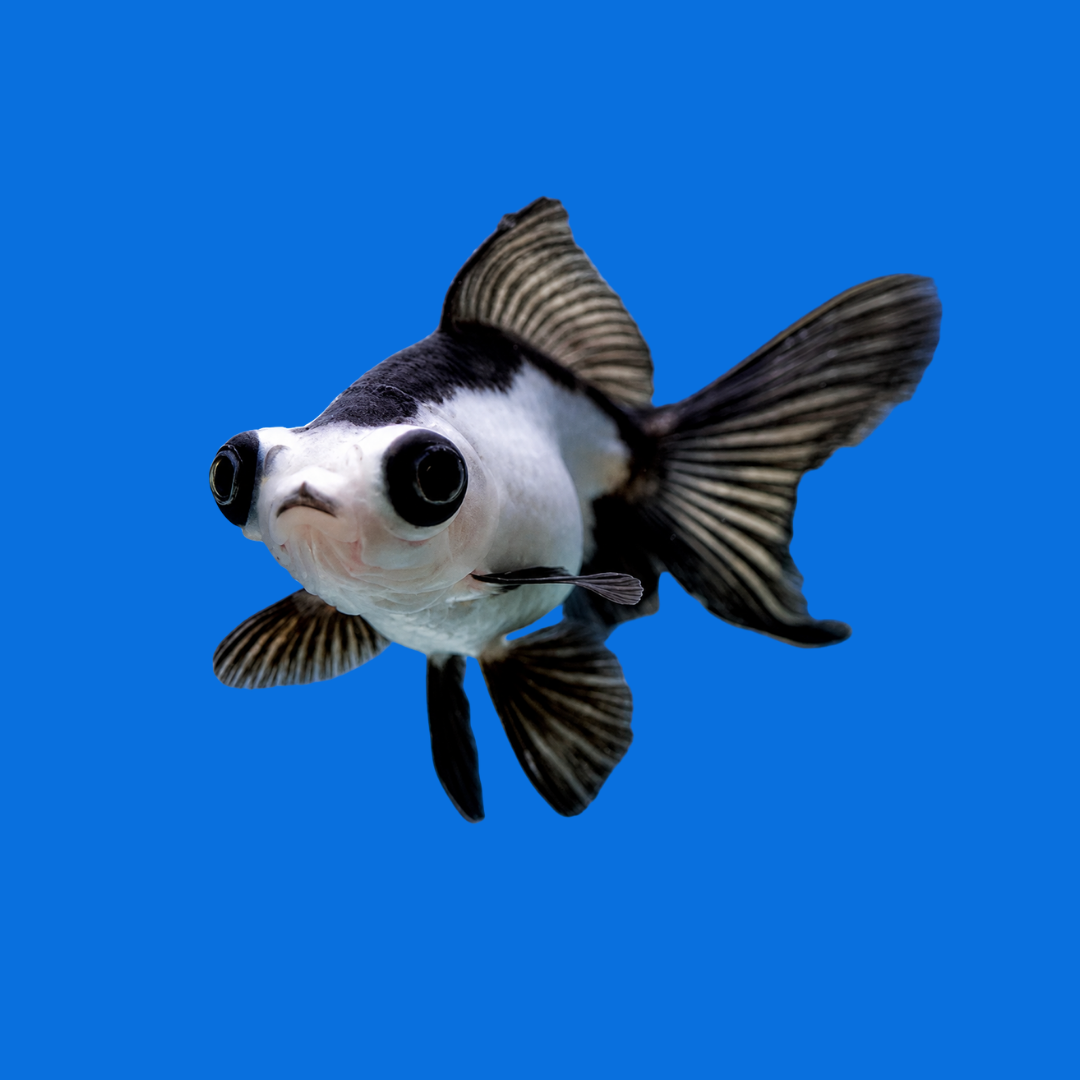
パンダ蝶尾は、白と黒のコントラストと、上から見たときに蝶が羽を広げたように左右へ大きく開く尾鰭が印象的な金魚です。一般的な蝶尾は出目型で、左右へ張り出す眼と幅広い尾をあわせ持ち、正面からの愛嬌と上見での華やかさを楽しめます。中国で発達した観賞金魚の系統に由来し、日本では輸入個体と国内繁殖個体の双方が流通しています。泳ぎは速くないため、強い水流を避け、十分な水量と底面積を確保した落ち着いた環境が向きます。また、名前の由来となる黒色部分は成長や飼育環境に伴って変化することがあり、購入時のパンダ柄が生涯そのまま保たれるとは限りません。その変化も含めて、一匹ごとの個性を楽しめる金魚です。 The Panda Butterfly Tail is a fancy goldfish known for its striking black-and-white contrast and its broad caudal fin, which spreads sideways like a butterfly’s wings when viewed from above. Butterfly Tail goldfish are generally telescope-eyed, combining protruding eyes with a broad tail and offering both a charming frontal appearance and a dramatic top-view silhouette. The variety developed from Chinese fancy goldfish lines and is distributed in Japan through both imported and domestically bred fish. Because it is not a strong swimmer, gentle water movement, adequate water volume, generous floor space, and a calm environment are appropriate. Its black pigmentation may also change as the fish grows or as environmental conditions vary, so the panda pattern is not always permanent throughout life. This natural variability is part of the individuality and appeal of the variety.
基本情報 / Basic Information
| 学名 / Scientific Name | Carassius auratus |
|---|---|
| 通称 / Common Name | パンダ蝶尾、蝶尾の白黒個体、パンダバタフライテールPanda Butterfly Tail Goldfish, Panda Butterfly Telescope Goldfish |
| 分類 / Family | コイ目・コイ科・フナ属の金魚品種Order Cypriniformes, family Cyprinidae, genus Carassius; a domesticated goldfish variety |
| 英名 / English Name | Panda Butterfly Tail Goldfish |
| 分布 / Distribution | 野生分布を持つ独立種ではなく、中国で発達した観賞金魚の系統に由来します。現在は日本を含む各国のアクアリウム市場で流通しています。It is not a separate wild species but a domesticated fancy-goldfish variety developed from Chinese ornamental strains. It is now traded in aquarium markets in Japan and other countries. |
| 最大体長 / Max Size | 体長15〜20cm前後がひとつの目安です。長く大きな尾鰭を含む全長は、良好に育った個体では20cmを超えることがあります。Around 15–20 cm in body length is a practical guide. Well-grown individuals may exceed 20 cm in total length when the long caudal fin is included. |
| 寿命 / Lifespan | 金魚全体では10〜15年ほどが一般的な目安とされ、良好な環境ではさらに長く生きる例もあります。パンダ蝶尾だけを対象にした寿命の統計は乏しいため、個体差や飼育条件による幅を見込んで考えます。Goldfish commonly live around 10–15 years, and some live longer under excellent conditions. Because lifespan data specific to the Panda Butterfly Tail are limited, individual variation and husbandry conditions should be taken into account. |
飼育環境 / Aquarium Environment
| 水槽サイズ / Tank Size | 成魚1匹でも十分な水量を確保することを優先し、60cmワイド水槽以上をひとつの目安にすると管理しやすいでしょう。複数飼育では90cm規格水槽(約157L)以上を検討し、個体数と成長に合わせて余裕を持たせます。蝶尾は底面積の広い環境と相性がよく、品評魚の育成では浅めの水位で管理されることもありますが、日常飼育では水位だけを下げて総水量を不足させないことが大切です。Even for one adult, prioritize adequate water volume; a wide 60 cm aquarium or larger is a practical starting point. For multiple adults, consider a standard 90 cm aquarium of about 157 L or larger and allow additional space as the fish grow. Butterfly-tail goldfish benefit from a broad footprint. Show fish are sometimes raised in relatively shallow water, but routine aquarium care should not reduce water volume simply for the sake of keeping the water shallow. |
|---|---|
| 水温 / Temperature | 18〜24℃前後を安定して保つと飼育しやすいでしょう。金魚は比較的幅広い水温に適応しますが、急激な温度変化は避け、低水温時は消化力の低下に合わせて給餌量を控えます。 A stable range of about 18–24°C is convenient for routine care. Goldfish tolerate a broader temperature range, but sudden changes should be avoided, and feeding should be reduced as digestion slows in cooler water. |
| 水質 / Water Quality | pH6.5〜8.0程度を目安に、アンモニアと亜硝酸が検出されない安定した水を維持します。金魚は排泄量が多いため、十分なろ過能力と定期的な換水が重要です。数値を細かく追い込むより、急変を避けて安定した水質を保つことを優先します。Maintain stable water around pH 6.5–8.0 with no detectable ammonia or nitrite. Goldfish produce substantial waste, so adequate filtration and regular water changes are essential. Stability is more important than trying to force the water toward a narrowly defined target value. |
| レイアウト / Layout | 広い遊泳スペースを確保し、ベアタンクまたは細かな底砂を使ったシンプルなレイアウトが向きます。尾鰭や突出した眼を傷つけないよう、尖った石や枝状の流木、狭い隙間は避けます。ろ過の吐出口は壁面へ向けるなどして水流を弱め、ゆったり泳げる環境を整えます。Provide broad open swimming space in a simple layout, either bare-bottomed or with fine substrate. Avoid sharp rocks, branching driftwood, and tight gaps that could damage the large fins or protruding eyes. Direct filter outflow toward a wall or otherwise diffuse it so the fish can swim without fighting a strong current. |
| 注意点 / Precautions | 最大の注意点は、強い水流、過密、過剰給餌、急な水質変化です。大きな尾は強い流れで傷みやすく、丸みのある体型は転覆症状を起こしやすいため、少量ずつの給餌と日々の観察が重要です。また黒い模様は成長とともに退色することがあり、照明や餌だけで完全に固定できるものではありません。The main concerns are strong current, overcrowding, overfeeding, and sudden changes in water conditions. The broad tail can be damaged by persistent flow, and the rounded body shape is relatively prone to buoyancy disorders, making small meals and daily observation important. Black markings may fade with age, and lighting or diet cannot guarantee that the pattern will remain permanently fixed. |
餌と給餌 / Feeding
| 餌の種類 / Diet | 沈下性の金魚用人工飼料を主食にし、必要に応じて植物質を含む飼料を組み合わせます。補助的に冷凍赤虫、ミジンコ、ブラインシュリンプなども利用できます。特定の色揚げ飼料だけに偏らせるのではなく、体調と消化状態を見ながら栄養のバランスを取ることが基本です。Use a sinking goldfish pellet as the staple diet, with foods containing plant ingredients as needed. Frozen bloodworms, daphnia, and brine shrimp can be offered as supplements. Rather than relying heavily on a single color-enhancing food, keep the diet balanced and adjust it according to the fish’s condition and digestion. |
|---|---|
| 給餌のポイント / Feeding Tips | 一度に多量を与えず、1〜2分ほどで食べ切れる少量を1日1〜2回程度に分けるのが基本です。泳ぎが遅いので、沈下性の餌を複数箇所へ落とすと取り残されにくくなります。浮上性の餌を食べる際に空気をのみ込み、浮力の乱れにつながる個体もいるため、転覆傾向がある場合は沈下性の餌が選択肢になります。腹部の張りや不自然な浮き沈みが見られた場合は、給餌だけを原因と決めつけず、水質や体調もあわせて確認します。Offer small portions rather than one large meal, usually once or twice daily in amounts that can be eaten within about one to two minutes. Because the fish swims slowly, distributing sinking food in several spots helps weaker individuals feed successfully. Some goldfish swallow excess air while feeding at the surface, so sinking foods can be useful for fish prone to buoyancy problems. If the abdomen becomes swollen or swimming balance changes, review water quality and overall health as well as feeding rather than assuming diet is the only cause. |
性格と混泳 / Temperament and Tank Mates
| 性格 / Temperament | 基本的には温和で、人に慣れると餌を求めて近寄ってくることもあります。活発に泳ぎ続けるタイプではなく、幅広い尾をゆっくり動かして泳ぐため、落ち着いた環境で本来の姿を観察しやすい金魚です。It is generally peaceful and may readily approach its keeper for food once accustomed to people. Rather than swimming constantly at high speed, it moves its broad tail slowly and is best appreciated in a calm aquarium. |
|---|---|
| 混泳の相性 / Compatibility | 琉金、オランダ獅子頭、出目金など、泳ぐ速さが近い温和な丸物金魚との混泳が向きます。和金やコメットのような俊敏な金魚と一緒にすると餌取りで負けやすく、ヒレをつつく魚や攻撃的な熱帯魚との混泳も避けます。体格差が大きい組み合わせでは、小さい個体が餌を十分に取れているか確認してください。It is best kept with peaceful fancy goldfish of similar swimming ability, such as Ryukin, Oranda, and telescope types. Fast varieties such as common goldfish and comets may outcompete it for food, and fin-nipping or aggressive tropical fish should be avoided. When sizes differ greatly, make sure smaller individuals are actually receiving enough food. |
病気と対策 / Diseases and Prevention
| かかりやすい病気 / Common Diseases | 丸い体型に関連する転覆症状のほか、白点病、尾ぐされ病、赤斑を伴う細菌感染、エラの不調など一般的な金魚の疾病に注意します。長い尾鰭は傷口から感染が広がることがあり、出目は物理的な擦れや衝突にも弱い部分です。Watch for buoyancy disorders associated with the rounded body shape, as well as common goldfish problems such as ich, fin rot, bacterial infections with reddening, and gill disorders. The long caudal fin can become infected after injury, and the protruding eyes are also vulnerable to abrasion and collision. |
|---|---|
| 対策と予防 / Prevention | 過密を避け、定期的な換水と底床の清掃を行い、強い水流や鋭利なレイアウト用品を使わないことが基本です。新しく迎えた個体は既存魚とすぐに合流させず、別系統の水と器具を使える隔離環境で少なくとも30日程度観察するのが安全です。転覆症状が見られた場合は、水質、給餌、感染や炎症、体の構造的な問題など複数の原因が考えられるため、まず環境を確認し、改善しない場合は魚類を診られる獣医師への相談や、原因に応じた治療を検討します。Avoid overcrowding, perform regular water changes and bottom cleaning, and do not use strong current or sharp decorations. Newly acquired fish should not be added directly to an established aquarium; a separate quarantine system with dedicated water-handling equipment should be used for at least about 30 days. Buoyancy disorders can have multiple causes, including water-quality problems, feeding issues, infection or inflammation, and structural abnormalities. Check the environment first, and if the problem does not improve, consider consultation with a veterinarian experienced in fish and treatment directed at the underlying cause. |
増やし方(繁殖) / Breeding
| 雌雄の判別 / Sexing | 繁殖期のオスはエラ蓋や胸鰭の前縁に白い追星が現れやすく、メスは成熟すると腹部がふっくらして見える傾向があります。肛門周辺の形にも差が出ますが、若魚や非繁殖期は外見だけでの判別が難しいことがあります。During the breeding season, males often develop small white breeding tubercles on the gill covers and leading edges of the pectoral fins, while mature females tend to show a fuller abdomen. The vent may also differ in shape, but sexing juveniles or fish outside the breeding season can be difficult from appearance alone. |
|---|---|
| 繁殖形態 / Reproduction | 卵生で、水草や産卵床に粘着性の卵をばらまくタイプです。産卵後に親魚が卵を食べることがあるため、卵を守るには親魚を別容器へ移すか、産卵床ごと隔離します。It is an egg-laying scatter spawner that deposits adhesive eggs on aquatic plants or spawning media. Because adults may eat the eggs after spawning, remove the parents or transfer the spawning medium to a separate rearing container. |
| 繁殖のポイント / Breeding Tips | 春の水温上昇期に成熟した親魚をコンディションよく仕上げ、浅めで穏やかな繁殖容器に産卵床を用意します。孵化後の稚魚には口に入る大きさの初期餌をこまめに与え、成長に合わせて選別と飼育密度の調整を行います。蝶尾らしい尾の開きやパンダ柄はすべての稚魚に同じように現れるわけではなく、狙った形質を残すには複数世代にわたる選抜が必要です。Condition mature broodstock well as temperatures rise in spring, and provide spawning media in a shallow, gently circulated breeding container. After hatching, feed fry small starter foods frequently and adjust stocking density as they grow. The characteristic butterfly-tail spread and panda coloration will not appear identically in every juvenile, so maintaining the desired traits requires selection over successive generations. |
雑学と豆知識 / Trivia and Fun Facts
| 1. 蝶のような尾は発生遺伝学の研究対象でもある / 1. The butterfly tail is also a subject of developmental genetics | 金魚の双尾は、単に「尾鰭が長くなった」だけの形ではありません。胚の初期発生で体の背腹方向を整える仕組みが変化し、尾部の中軸構造が左右に分かれることで、独特の双尾が形成されます。研究では、BMPシグナルを調節するChordinをつくるchdS遺伝子(旧称chdA)のE127X変異が、現代の双尾金魚に共通する主要な遺伝的基盤として確認されています。さらに、Sizzledに関わる遺伝子を操作しても双尾に似た形態が生じることが示されており、つまり蝶尾の背景には、胚の体づくりを調節する遺伝子ネットワークそのものの変化があります。身近な金魚の尾が、脊椎動物の形がどのように生まれるかを考える研究材料にもなっているのです。The twin tail of fancy goldfish is not simply a normal tail that has become longer. A change in the developmental system that establishes the dorsal–ventral body axis alters the midline structures of the posterior body, allowing the caudal region to divide into paired structures. Research has identified the E127X mutation in chdS, formerly called chdA, which encodes the BMP-regulating protein Chordin, as the major genetic basis shared by modern twin-tail goldfish. Experiments involving Sizzled-related genes can also produce twin-tail-like morphology, showing that the trait belongs to a broader developmental gene network. In practical terms, the butterfly-shaped tail reflects a change in the genetic regulation of how the body is built during early development. |
|---|---|
| 2. 「パンダ柄」は完成した模様ではなく、変化し続ける色彩 / 2. The panda pattern is a changing color state, not always a permanent design | パンダ蝶尾を迎えたあと、黒い模様が変化することがあります。魚類の黒色は、メラノフォアと呼ばれる色素細胞と、その内部にあるメラニンの状態に左右されます。金魚では成長に伴って黒色素胞が減少するタイプの体色変化が知られているほか、背景色や光環境に応じて体色の濃淡が変わることも研究されています。ただし、これらの研究結果をパンダ蝶尾の模様維持へそのまま当てはめることはできません。購入時の黒白模様が固定されると考えるより、成長とともに変わる可能性がある体色として見守るのが適切です。The black pattern of a Panda Butterfly Tail can change after the fish is acquired. Black coloration in fish depends on pigment cells called melanophores and the state of the melanin they contain. Goldfish are known to undergo developmental color changes in which melanophores may decrease, and studies also show that background and lighting conditions can alter body-color tone. These findings cannot, however, be directly translated into a guaranteed method for preserving the panda pattern. It is more accurate to regard the black-and-white pattern as coloration that may change with growth rather than as a permanently fixed design. |
| 3. 美しさの中心は「横から」ではなく「上から」にある / 3. Its signature beauty is designed for the top view | 一般的な水槽魚は横から眺める機会が多いのに対し、蝶尾の特徴は上から見るといっそう明確になります。左右へ大きく開いた尾葉が均整よく広がることで、蝶が羽を開いたような輪郭が現れるためです。国内でも蝶尾は上見に適した金魚として紹介されており、尾の左右のバランスや水平に張る形が魅力の中心になります。水槽で横見を楽しむこともできますが、ときどき上から眺めると「蝶尾」という名前の由来を最も直感的に感じられます。Many aquarium fish are viewed mainly from the side, but the defining feature of the Butterfly Tail becomes especially clear from above. When the paired tail lobes spread broadly and evenly, they create the outline of a butterfly with open wings. In Japan, the variety is also commonly introduced as a goldfish suited to top-view appreciation, with balance and horizontal spread of the tail forming much of its appeal. It can certainly be enjoyed from the side in an aquarium, but an occasional top view makes the origin of the name immediately clear. |
| 4. 丸物金魚の体は、人が選び続けた歴史そのもの / 4. The rounded body records centuries of human selection | 金魚は中国のフナ類から家畜化され、1000年以上にわたる人為選択の中で、色、尾、眼、体型にさまざまな形質が固定されてきました。遺伝学的な研究でも、野生集団から観賞用品種へ向かう過程で遺伝的多様性が段階的に減少したことが示されています。つまり、パンダ蝶尾の大きな尾や出目、丸みのある体は、自然界で泳ぎやすい形へ変化した結果ではなく、人が観賞価値を感じる形を世代ごとに選び残してきた歴史の延長にあります。Goldfish were domesticated from Chinese crucian-carp populations, and more than a thousand years of artificial selection fixed a remarkable range of traits affecting color, fins, eyes, and body shape. Genetic studies also show a stepwise loss of genetic diversity from wild populations toward increasingly specialized ornamental breeds. The large tail, protruding eyes, and rounded body of the Panda Butterfly Tail are therefore not adaptations for more efficient swimming in nature, but part of a long history in which people repeatedly selected forms they found attractive. |
| 5. 「パンダ蝶尾」という名前は白黒模様をそのまま表している / 5. The name “Panda Butterfly Tail” directly reflects its black-and-white pattern | 白地に黒い模様を持つ蝶尾が「パンダ」と呼ばれ、赤と黒を基調とする個体が「レッサーパンダ」と呼ばれる例があります。蝶尾そのものは中国原産で、日本には1980年頃に輸入されたとされる比較的新しい導入品種です。一方で、「パンダ蝶尾」という呼び名が誰によって、いつ定着したのかを示す確かな資料は確認できません。そのため、名称については外交史などと結びつけて由来を説明するより、ジャイアントパンダを連想させる白黒模様から付いた流通名として理解するのが自然です。Black-and-white Butterfly Tail goldfish are commonly called “Panda,” while red-and-black individuals may be sold under names such as “Lesser Panda.” The Butterfly Tail itself originated in China and is generally described as having been introduced to Japan around 1980. However, reliable documentation identifying exactly who coined the name “Panda Butterfly Tail,” or when it became established, is lacking. It is therefore more accurate to understand the name simply as a trade name inspired by the black-and-white pattern reminiscent of a giant panda, rather than to assign it a specific diplomatic or historical origin. |
| 6. 良い個体ほど「飼い方」が外見に表れやすい / 6. Husbandry is unusually visible in the appearance of a good specimen | パンダ蝶尾では、健康であることと美しく見えることが強く結びついています。強い水流で尾を傷めれば左右のバランスが崩れ、過剰給餌で浮力が不安定になれば上見の姿も崩れます。逆に、穏やかな水流、十分な底面積、清潔な水、無理のない給餌を続けると、魚は大きな尾を落ち着いて広げるようになります。色や尾形には遺伝的な限界がありますが、その個体が持つ魅力をどこまで自然に引き出せるかという点で、飼育者の工夫が見た目に反映されやすい品種です。In the Panda Butterfly Tail, health and visual quality are closely connected. Strong current can damage the tail and disturb its symmetry, while overfeeding can destabilize buoyancy and spoil the fish’s top-view posture. In contrast, gentle water movement, ample floor space, clean water, and restrained feeding allow the fish to spread its large tail calmly. Genetics set limits on coloration and fin shape, but this is a variety in which careful husbandry is especially visible in how well an individual can display the qualities it already possesses. |
まとめ / Conclusion
パンダ蝶尾は、白黒の体色、出目の愛嬌、そして上見で蝶の羽のように広がる尾をあわせ持つ金魚です。大きな尾と丸みのある体型のため俊敏な泳ぎには向かず、十分な水量と底面積、穏やかな水流、安定した水質を整え、無理のない給餌を続けることが健やかな飼育につながります。 The Panda Butterfly Tail combines black-and-white coloration, the charming expression of protruding eyes, and a caudal fin that spreads like butterfly wings when viewed from above. Its large tail and rounded body are not suited to fast swimming, so healthy long-term care depends on adequate water volume and floor space, gentle water movement, stable water quality, and restrained feeding.
黒い模様は成長とともに変化することがあり、尾の開き方にも一匹ごとの違いが現れます。購入時の姿を固定しようとするより、日々の泳ぎや食欲、浮き沈み、尾や眼の状態を観察し、その個体に合わせて環境を整えることが大切です。ゆったりとした動きと上見で広がる尾を健やかに保てたとき、パンダ蝶尾ならではの優雅さを長く楽しめます。 The black pattern may change with growth, and each fish develops its tail in a slightly different way. Rather than trying to preserve the exact appearance seen at purchase, pay attention to daily swimming, appetite, buoyancy, and the condition of the fins and eyes, then adjust the environment to the individual. When its health and characteristic top-view tail spread are maintained, the distinctive elegance of the Panda Butterfly Tail can be enjoyed for many years.

気になる道具や飼い方を見つけてみませんか?
 アイのアクアグッズ案内エンゼルフィッシュの飼育用品|高さのある水槽・ろ過・水草・餌の選び方道具の特徴や使い方、選ぶときのポイントをアイが紹介します。記事はコチラ →
 アイのアクアグッズ案内水草トリミングの道具とやり方|ハサミ・ピンセットを水草に合わせて選ぼう伸びすぎた水草は切っていい? 有茎草の差し戻し、前景草の絨毯、流木のモスを整える場面から、水草用ハサミ・ピンセット・ゴミ取りネットの選び方と片付けを紹介します。記事はコチラ →
さまざまな飼育テーマをご紹介。リンク先の記事には広告・商品紹介が含まれます。
案内・紹介記事一覧へ →分布マップ
パンダ蝶尾は野生分布を持つ独立種ではなく、中国で発達した観賞金魚の系統に由来します。下の地図では、その由来地域である中国全体を概略的に表示しています。
※この地図は、中国で発達した観賞金魚系統という記事内の分布情報をもとにした概略表示です。マーカーは地域を把握しやすくするための代表地点であり、実際の採集地点やパンダ蝶尾の特定の発祥地点を示すものではありません。
参考文献
-
Eschmeyer’s Catalog of Fishes: Carassius auratus
California Academy of Sciences. 学名、分類、東アジアにおける分布、金魚の栽培品種に関する基礎資料。
参照ページ -
Froese, R. & Pauly, D. (eds.). FishBase: Carassius auratus
生息環境、水質範囲、食性、野生個体群の分布、産卵場所、粘着卵などの生活史情報。
参照ページ -
Chen, D. et al. (2020). The evolutionary origin and domestication history of goldfish (Carassius auratus).
Proceedings of the National Academy of Sciences, 117(47), 29775–29785. 金魚の中国における家畜化、品種分化、観賞形質の選抜に関するゲノム研究。
DOI: 10.1073/pnas.2005545117 -
RSPCA Australia. How should I care for my goldfish?
水槽容量、水温、pH、アンモニア・亜硝酸管理、ろ過、換水、給餌、沈下性飼料、泳ぎの弱い改良金魚への水流配慮、寿命の目安。
参照ページ -
Li, I.-J., Lee, S.-H., Abe, G. & Ota, K. G. (2019). Embryonic and postembryonic development of the ornamental twin-tail goldfish.
Developmental Dynamics, 248(4), 251–283. 双尾金魚の発生、尾部形態、成魚の繁殖期にみられる追星や雌雄の外部形態に関する研究。
DOI: 10.1002/dvdy.15 -
MSD Veterinary Manual. Fish Taxonomy.
University of Florida College of Veterinary Medicineの獣医師らによる専門資料。コイ科魚類の解剖学的特徴、改良金魚の浮力異常と空気嚥下、沈下性飼料、白点病などの疾病リスクを扱う。
参照ページ -
MSD Veterinary Manual. Management of Aquarium Fish.
観賞魚の水質管理、アンモニア・亜硝酸対策、隔離とバイオセキュリティ、導入魚を最低30日間隔離する指針などを扱う獣医学資料。
参照ページ -
Merck Veterinary Manual. Disorders and Diseases of Fish.
白点病、皮膚・鰓の寄生虫、外傷に伴う感染リスク、Aeromonasを含む細菌感染、過密や水質悪化など疾病の誘因と予防に関する獣医学資料。
参照ページ




コメント