

解説Description
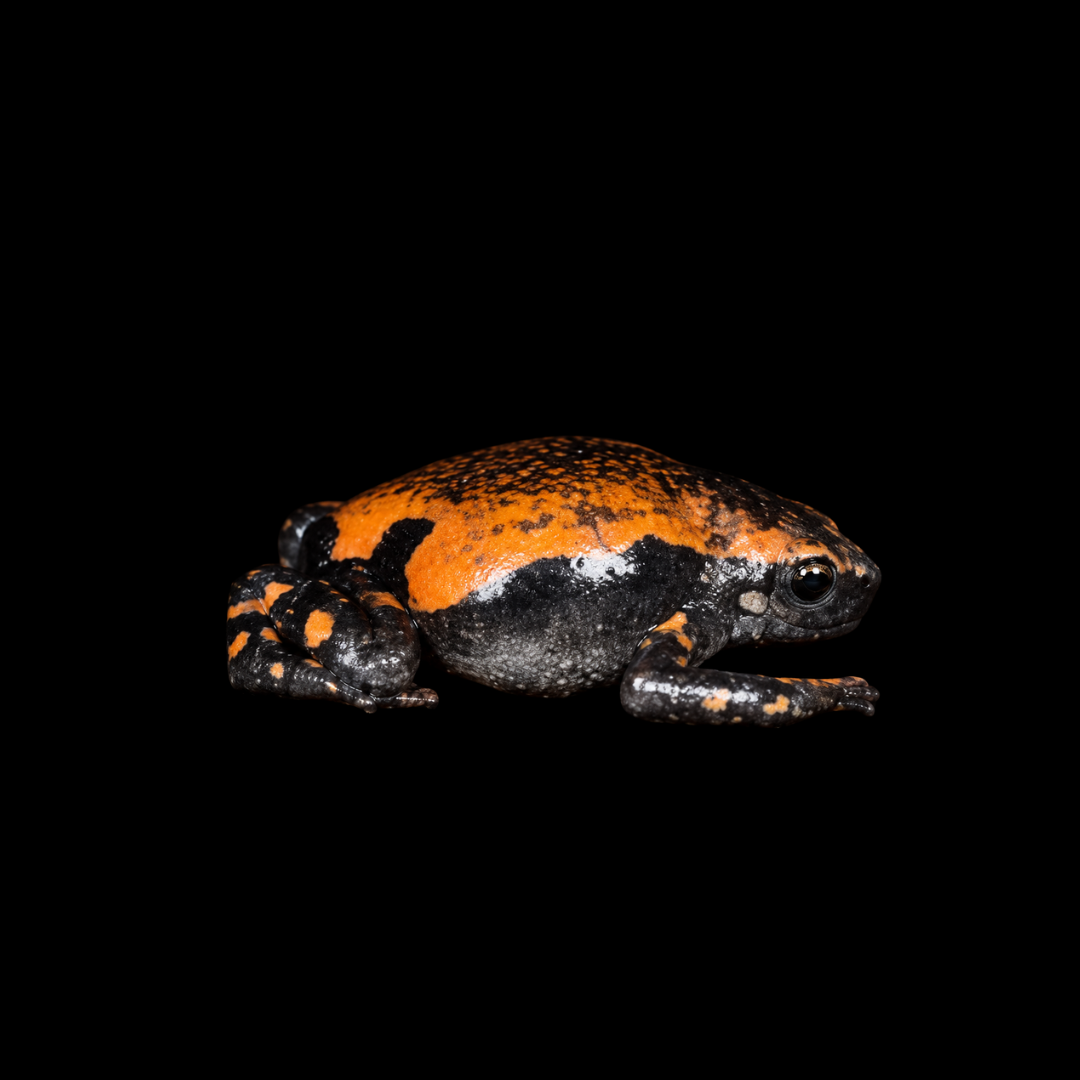
コガタナゾガエルは、西アフリカを中心に、中央アフリカから東アフリカの一部まで分布するヒメアマガエル科のカエルです。鮮やかな赤色から橙赤色の背面と、黒褐色の体側・四肢がつくる強いコントラストが目を引きます。滑らかで光沢のある皮膚から、英語では「West African Rubber Frog」と呼ばれます。細長くやや扁平な体つきで、頭部を左右へ動かせることから「Accra Snake-necked Frog」の名でも知られています。 Phrynomantis microps is a microhylid frog distributed mainly across West Africa, extending into parts of Central and eastern Africa. Its vivid red to orange-red dorsum contrasts strongly with its dark flanks and limbs. Its smooth, glossy appearance is reflected in the common name “West African Rubber Frog.” The elongated, somewhat flattened body and unusual ability to move the head laterally are also associated with the name “Accra Snake-necked Frog.”
外見だけでなく、生態にも際立った特徴があります。乾燥する時期には地下やシロアリ塚などに潜み、攻撃性の高い大型アリ Paltothyreus tarsatus の巣を利用することも知られています。実験では、コガタナゾガエルの皮膚分泌物から分離された成分が、このアリの攻撃や刺針行動を遅らせることが示されました。つまり、アリから完全に認識されなくなるのではなく、攻撃されにくい状態を作ることが、巣内でほとんど傷つかずに過ごせる理由の一つと考えられています。鮮やかな体色、皮膚分泌物、地下の隠れ場所の利用、降雨に連動した繁殖など、サバンナの変化の大きい環境に適応した生態を持つカエルです。 Its ecology is as distinctive as its appearance. During dry periods it shelters underground and in termite mounds, and it is also known to use nests of the highly aggressive ant Paltothyreus tarsatus. Experiments showed that compounds isolated from the frog’s skin secretion can delay the ants’ aggressive and stinging responses. In other words, the frog does not become completely undetectable; instead, reduced aggression appears to be one mechanism that allows it to remain largely unharmed inside the nest. Its conspicuous coloration, skin secretions, use of underground refuges and rainfall-linked reproduction all reflect adaptation to the highly variable conditions of African savannas.
基本情報Basic Information
| 学名Scientific Name | Phrynomantis microps Peters, 1875 |
|---|---|
| 通称Common Name | 和名はコガタナゾガエル。英語圏では West African Rubber Frog、Accra Snake-necked Frog、Red Rubber Frog などの名称が使われます。West African Rubber Frog, Accra Snake-necked Frog, Red Rubber Frog. |
| 分類Classification | 無尾目(Anura)・ヒメアマガエル科(Microhylidae)・ナゾガエル亜科(Phrynomerinae)・ナゾガエル属(Phrynomantis)Order Anura, Family Microhylidae, Subfamily Phrynomerinae, Genus Phrynomantis. |
| 英名English Name | West African Rubber Frog / Accra Snake-necked Frog |
| 分布Distribution | サハラ砂漠以南のアフリカに広く分布し、セネガルから西・中央アフリカを東へ、コンゴ民主共和国北東部、南スーダン、ウガンダ北西部、チャド、エチオピア最西部付近まで記録されています。主な生息地は乾燥〜湿潤サバンナ、疎林、草地、一時湿地などで、人為的に改変された環境から見つかることもあります。Widely distributed across sub-Saharan Africa, from Senegal through western and central Africa eastward to northeastern Democratic Republic of the Congo, South Sudan, northwestern Uganda, Chad and the extreme west of Ethiopia. It principally inhabits dry and humid savannas, open woodland, grasslands and temporary wetlands, and may also occur in modified habitats. |
| 成体サイズAdult Size | 吻端から総排泄孔までの体長(SVL)でおよそ40〜60mm。報告例ではオス約37〜47mm、メス約41〜62mmで、一般にメスの方が大きくなります。Approximately 40–60 mm snout-to-vent length (SVL). Reported measurements are roughly 37–47 mm for males and 41–62 mm for females, with females generally growing larger. |
| 寿命Lifespan | 本種について、信頼できる資料から確認できる飼育下寿命の標準値は十分に確立されていません。長期飼育の成否は、導入時の状態、温度管理、衛生、栄養などに左右されます。A well-established species-specific standard for captive lifespan is not currently available from reliable published sources. Long-term survival is likely to depend on factors such as condition at acquisition, temperature management, hygiene and nutrition. |
飼育環境Enclosure Environment
| 飼育容器・サイズEnclosure and Size | 地表棲〜半地中棲のため、高さよりも床面積を重視します。成体1匹なら幅45cm×奥行き30cm程度を一つの実用的な目安とし、ペアや複数飼育では幅60cm以上のゆとりある容器が扱いやすいでしょう。ガラス製テラリウムや大型プラケースなどが利用でき、脱走を防げる確実な蓋と十分な通気を確保します。指先を使って意外に器用に登るため、低い容器でも蓋は必須です。As a terrestrial to semi-fossorial frog, floor area is more important than height. An enclosure around 45 × 30 cm can serve as a practical minimum guideline for one adult, while an enclosure 60 cm or wider is preferable for a pair or small group. Glass terraria or large plastic enclosures can be used, but a secure lid and good ventilation are essential because these frogs can climb surprisingly well. |
|---|---|
| 温度Temperature | 本種だけを対象にした最適温度の詳細な検証は限られていますが、研究飼育では21〜25℃、または25±1℃で維持された例があります。飼育では25℃前後を一つの参考にしつつ、急な温度変化と過熱を避けます。冬季に加温する場合は、潜った個体が熱から逃げられるよう、ケージ底面全体を強く温めず、温度差を選べる状態を保ちます。夏は特にケージ内の過熱に注意します。Detailed studies defining an optimal temperature range specifically for this species are limited, but research colonies have been maintained at 21–25°C or at 25±1°C. Around the mid-20s Celsius therefore provides a useful reference, while sudden temperature changes and overheating should be avoided. If supplemental heat is required in winter, the enclosure should retain a cooler retreat so a burrowing frog can move away from the heat source. Preventing enclosure overheating is particularly important in summer. |
| 環境管理Environmental Management | 本種に適した湿度を一つの数値で示す十分な資料はないため、湿度計の数字だけで管理せず、湿った場所とやや乾いた場所を選べる環境を作ります。床材の下層やシェルターの一部には湿り気を残し、表面の一部は過湿にならないよう通気を確保します。水分補給用には浅く入りやすい水入れを常設し、カルキを除いた清潔な水へこまめに交換します。排泄物や食べ残しは早めに除去します。Published information does not support a single precise humidity target for this species, so management should not rely on a hygrometer reading alone. Provide both damp and relatively drier areas, retaining moisture in deeper substrate or part of a shelter while keeping adequate ventilation and avoiding persistently waterlogged surface conditions. A shallow, easily accessible water dish with clean dechlorinated water should be available and refreshed regularly, and waste or uneaten prey should be removed promptly. |
| レイアウトLayout | ココピート、無肥料の土系床材、赤玉土などを単独または混合し、体を潜らせて隠れられるだけの厚みを確保します。コルクバーク、落ち葉、樹皮などを使って暗い隠れ場所を複数作ります。本種は野外で地中の空間やシロアリ塚などを隠れ場所として利用するため、見栄えだけを優先した浅い床材より、自分で潜って落ち着ける構造を重視します。植栽する場合は、農薬や肥料が残留していない植物を使用します。Coconut fiber, fertilizer-free soil-based substrates, akadama or suitable mixtures can be used, with enough depth for the frog to burrow and conceal itself. Provide several dark retreats using cork bark, leaf litter and pieces of bark. Because the species uses underground spaces and termite mounds as refuges in the wild, a layout that allows the frog to hide naturally is more important than a shallow decorative substrate. If live plants are used, they should be free of pesticide and fertilizer residues. |
| 注意点Precautions | 皮膚分泌物には生理活性物質が含まれるため、観賞を基本として不要なハンドリングは避けます。人への具体的な毒性について確立したデータは限られていますが、安全のため、移動や清掃では湿らせたパウダーフリーのニトリル手袋を使用し、分泌物を目・口・傷口へ付着させないようにします。作業後は手洗いを徹底してください。また、野生採集個体が流通することがあるため、新規導入個体は既存の両生類から隔離し、器具の共用を避けるなど検疫とバイオセキュリティーを重視します。The skin secretion contains biologically active compounds, so this species is best regarded as a display animal and unnecessary handling should be avoided. Specific effects on humans are not well characterized; as a precaution, use damp, powder-free nitrile gloves for transfers and maintenance, and prevent secretions from contacting the eyes, mouth or broken skin. Wash thoroughly after maintenance. Because wild-caught animals occur in the pet trade, newly acquired frogs should also be quarantined from existing amphibians and equipment should not be shared between enclosures. |
餌と給餌Feeding
| 餌の種類Diet | 野生ではアリやシロアリを多く利用する昆虫食性ですが、飼育下では小型のコオロギ、ショウジョウバエ、小型ローチ、トビムシなどを利用できます。研究飼育下でもコオロギやショウジョウバエを摂食しています。単一の餌だけに偏らせず、食べられる大きさの無脊椎動物を組み合わせると栄養の偏りを抑えやすくなります。In the wild the species is strongly insectivorous and frequently consumes ants and termites. In captivity it can take appropriately sized crickets, fruit flies, small roaches, springtails and similar invertebrates. Laboratory animals have also been maintained on crickets and Drosophila. Offering several suitable prey types rather than relying on a single feeder helps reduce nutritional imbalance. |
|---|---|
| 給餌のポイントFeeding Tips | 夜間に活動するため、消灯前後は採餌行動を観察しやすい時間帯です。本種に固有の標準給餌回数は確立されていないため、年齢、体格、食欲、体型を見ながら量と頻度を調整します。幼体には成体より小さな餌を与えます。餌昆虫は適切にガットローディングし、両生類用のカルシウム剤や総合ビタミン剤を過不足なく利用します。食べ残したコオロギなどは放置せず回収し、痩せ、肥満、腹部の異常な膨らみ、食欲低下がないかを継続して確認します。Because the frogs are active at night, feeding around lights-out makes hunting behavior easier to observe. There is no well-established species-specific standard feeding frequency, so the amount and schedule should be adjusted according to age, size, appetite and body condition. Juveniles require smaller prey than adults. Feeder insects should be appropriately gut-loaded and supplemented with suitable amphibian calcium and multivitamin products without excessive dosing. Remove uneaten crickets and monitor for weight loss, obesity, abnormal abdominal swelling or reduced appetite. |
行動と同居Behavior and Cohabitation
| 行動・性質Behavior | 基本的には夜行性で、日中は床材の中や落ち葉、樹皮の下などに隠れて休みます。一般的なカエルのような大きな跳躍を繰り返すより、四肢を使ってトカゲのように歩いたり素早く走ったりする姿が目立ちます。指先が広がっているため短い垂直面を登ることもあります。刺激を受けると体を膨らませたり、体を反らして腰の鮮やかな赤色を目立たせる防御姿勢を示すことがあります。野生では乾燥期に地下の避難場所を利用し、夜間に採餌へ出る生活を送ります。The species is primarily nocturnal and spends the day concealed beneath substrate, leaf litter or bark. Instead of relying mainly on long jumps, it often walks or runs with a distinctly lizard-like gait. Expanded fingertips also allow it to climb short vertical surfaces. When disturbed, individuals may inflate the body or arch themselves so that the brightly colored pelvic region becomes conspicuous. In the wild, frogs make extensive use of subterranean refuges during dry periods and emerge at night to forage. |
|---|---|
| 同居の相性Compatibility | 野外では同じアリの巣から複数個体が見つかった例がありますが、これは飼育下での多頭飼育が常に安全であることを意味しません。同種を複数飼育する場合は、十分な床面積と隠れ場所を用意し、各個体が餌を取れているか、体格差や過密による問題がないかを確認します。他種との同居は、皮膚分泌物、病原体の相互感染、環境要求の違い、事故などのリスクが増えるため避け、基本的には本種だけで管理します。水入れやピンセットなども、別種の両生類との共用を避けるのが安全です。Several frogs have been found sharing the same ant nest in the wild, but this does not demonstrate that group housing is always safe in captivity. If conspecifics are kept together, provide ample floor space and retreats, and confirm that every individual is feeding normally and is not being disadvantaged by size differences or crowding. Mixed-species housing should be avoided because skin secretions, pathogen transmission, differing environmental requirements and accidental injury add unnecessary risks. Water dishes, forceps and other equipment should also be kept separate from those used for other amphibian species. |
病気と対策Diseases and Prevention
| かかりやすい病気・不調Common Diseases and Health Problems | 本種だけに特有の疾病情報は多くありませんが、他の飼育両生類と同様に、過湿かつ不衛生な環境では皮膚炎や細菌感染、いわゆるレッドレッグ症候群などが問題になります。逆に乾燥しすぎる環境では脱水が起こります。輸入個体では寄生虫、栄養状態の悪化、輸送ストレスにも注意が必要です。また、両生類全般で問題となるカエルツボカビなどの感染症は、外見だけでは判断できないことがあります。Species-specific disease information is limited, but as with other captive amphibians, persistently wet and unhygienic conditions can contribute to dermatitis, bacterial infection and syndromes commonly described as red leg. Excessively dry conditions can instead lead to dehydration. Imported animals may also be affected by parasites, poor nutritional condition and transport stress. Amphibian pathogens such as chytrid fungi cannot always be identified from appearance alone. |
|---|---|
| 対策と予防Prevention and Care | 通気性、清潔な水、湿度勾配、適温、栄養状態を安定させることが基本です。新しく迎えた個体は一定期間隔離し、既存個体との器具共用を避けます。食欲低下、急激な体重減少、皮膚の赤み・潰瘍、異常なむくみ、姿勢や動きの変化が続く場合は、自己判断で薬浴や人用医薬品を使用せず、両生類を診療できる獣医師へ相談します。床材を完全に無菌化することより、汚染を蓄積させず安定した環境を維持することが重要です。Stable ventilation, clean water, a moisture gradient, appropriate temperature and sound nutrition form the basis of prevention. New arrivals should be quarantined and their equipment kept separate from established animals. Persistent loss of appetite, rapid weight loss, skin reddening or ulceration, abnormal swelling, or changes in posture and movement warrant consultation with a veterinarian experienced with amphibians rather than unsupervised medication or treatment with human medicines. The aim is not to create a sterile enclosure but to prevent waste and contamination from accumulating while maintaining stable conditions. |
増やし方(繁殖)Breeding
| 雌雄の判別Sexing | 成熟個体ではメスの方が大型になる傾向があり、オスは単一の喉鳴嚢を持って繁殖期に鳴きます。体格だけでは個体差と重なるため確実な判別には向かず、成熟したオスの鳴き声や鳴嚢の確認を組み合わせるのが現実的です。若い個体では外見だけからの雌雄判別は困難です。Adult females tend to be larger, while mature males possess a single subgular vocal sac and call during the breeding season. Body size alone overlaps too much between individuals to be fully reliable, so calling behavior and the vocal sac are more useful indicators. Juveniles are difficult to sex accurately from external appearance. |
|---|---|
| 繁殖形態Reproduction | 雨季に生じる一時的な水場を利用し、降雨後に短期間で繁殖活動が集中する「爆発的繁殖」を行います。繁殖を促す降雨量は一定ではなく、地域や年、その時点の雨季の進み方によって変化することが報告されています。オスは水場へ向かいながら広告音を発し、メスと抱接して白色から黄白色の卵塊を水面に産みます。幼生は約1.5〜2日で孵化し、中層を泳ぎながら微細な懸濁物をろ過して食べます。一般的な藻類食のオタマジャクシに見られる角質の嘴や歯列を欠き、発生条件によっては約40日で変態を終えます。This species is an explosive breeder that uses temporary pools during the rainy season, with reproductive activity concentrated after rainfall. The amount of rain needed to trigger breeding is not fixed and has been reported to vary among regions, years and stages of the rainy season. Males call while moving toward breeding ponds, and pairs in amplexus deposit white to yellowish floating egg masses. Larvae hatch after about 1.5–2 days and feed by filtering fine suspended material while swimming in the water column. They lack the keratinized beak and tooth rows typical of many grazing tadpoles, and under suitable conditions metamorphosis may be completed in about 40 days. |
| 繁殖のポイントBreeding Tips | 野外では乾燥した時期から降雨期への変化が繁殖と強く結びついていますが、飼育下で再現性の高い標準繁殖法が確立されているわけではありません。繁殖を試みる場合は、個体を危険なほど乾燥させるのではなく、通常時にも湿った退避場所を確保したうえで、降雨や水場の増加といった季節変化を段階的に再現します。幼生が得られた場合は、ろ過食性であることを踏まえて微細な餌を水中に分散させ、水質悪化を避けながら管理します。変態が近づいたら、幼体が容易に上陸できる陸場を用意します。Field studies show a strong link between breeding and the transition from dry conditions to rainfall, but a standardized captive-breeding protocol with consistently demonstrated results is not established. Breeding attempts should not involve dangerously desiccating the frogs; moist refuges should remain available while seasonal changes such as increased rainfall and breeding water are introduced gradually. If larvae are produced, their suspension-feeding biology should be accommodated with finely dispersed foods while maintaining water quality. As metamorphosis approaches, provide an easily accessible land area. |
雑学と豆知識Trivia and Fun Facts
| 1. 凶暴なアリの巣を「避難所」にするカエル1. A Frog That Shelters Among Aggressive Ants | コガタナゾガエルは、大型で攻撃性の高いアリ Paltothyreus tarsatus の巣内で、ほとんど傷つかずに見つかることで知られています。実験では、皮膚分泌物を付着させたシロアリやミールワームに対して、アリが刺すまでの時間が有意に延びました。また、分泌物から分離された2種類のペプチドでも攻撃の遅延が確認されています。ただし、攻撃が完全に消えるわけではありません。研究者は、この作用をアリの攻撃性を弱める「鎮静アロモン(appeasement allomone)」として説明しており、これがカエルと攻撃的なアリが同じ巣内で共存できる仕組みの一部と考えられています。Phrynomantis microps is known for occurring largely unharmed inside nests of the large and highly aggressive ant Paltothyreus tarsatus. Experiments showed that ants took significantly longer to sting termites or mealworms coated with frog skin secretion, and two peptides isolated from the secretion also delayed aggression. The effect was not an absolute prevention of attack. The researchers interpreted it as an “appeasement allomone” that reduces ant aggression, providing a plausible mechanism for the frog and aggressive ants to coexist within the same nest. |
|---|---|
| 2. 皮膚ペプチド「フリノマンチン」の謎2. The Mystery of the Phrynomantin Peptides | 2020年の研究では、ナゾガエル属の皮膚から「フリノマンチン(phrynomantins)」と名づけられた新しいペプチド群が報告されました。これらは他のカエルの細胞溶解性防御ペプチドと進化的につながりを持つ一方、調べられたフリノマンチンでは細胞溶解作用や昆虫致死作用、炎症誘発作用は確認されず、具体的な生物学的役割はまだ分かっていません。なお、2013年にアリの攻撃を遅らせることが示された2種類のペプチドは、後にフリノマンチンと命名されたペプチド群と同一であることが確認されているわけではありません。皮膚分泌物には複数の成分が含まれ、それぞれの役割を分けて考える必要があります。A 2020 study described a new family of skin peptides from Phrynomantis, named phrynomantins. They are evolutionarily related to cytolytic defensive peptides in other frogs, but the tested phrynomantins showed no cytolytic, insecticidal or pro-inflammatory activity, and their biological function remains unknown. Importantly, the two peptides shown in 2013 to delay ant aggression have not been demonstrated to be the same peptides later named phrynomantins. The skin secretion contains multiple components whose functions should therefore be considered separately. |
| 3. 赤い大人と、地味な子ガエル3. Red Adults, Cryptic Young Frogs | 成体では赤い背面と暗色の体側・四肢がよく目立ちますが、変態直後の幼体では褐色系の体色や背中の暗色線が見られるとされています。成長に伴って赤色が目立つ成体の体色へ移行するため、同じ種でも成長段階によって見た目の印象が大きく変わります。成長に伴って体色が変化しますが、幼体の落ち着いた色彩がどのように役立つのかは、はっきりしていません。Adults are conspicuous with a red dorsum and dark flanks and limbs, whereas newly metamorphosed froglets have been described as browner and may show a dark mid-dorsal line. The red adult coloration becomes more prominent as they grow, so the species can look markedly different at different life stages. Coloration changes as the frogs mature, but the role of the more subdued juvenile coloration remains uncertain. |
| 4. 跳ぶよりも「走る」変わったカエル4. A Frog That Often Runs Instead of Leaping | 細長い体と比較的短い脚を持つコガタナゾガエルは、大ジャンプを繰り返す典型的なカエルとは少し違います。四肢を交互に動かしながら地面を素早く歩いたり走ったりする姿は、しばしばトカゲを思わせます。さらに頸部の可動性が高く、体全体を向け直さなくても頭部を左右へ動かすことができます。この独特のシルエットと動きが「snake-necked frog」という英名につながっています。With an elongated body and relatively short legs, Phrynomantis microps often walks or runs rapidly rather than relying on long leaps. The neck is unusually mobile, allowing the head to move laterally without turning the entire body. This peculiar silhouette and movement helped inspire the common name “snake-necked frog.” |
| 5. 数千匹で集まるオタマジャクシ5. Tadpoles That Form Huge Aggregations | 幼生は日中、水面近くで密集した群れを作り、視覚に頼る捕食者の存在や、水の透明度が高く見つかりやすい状況では群れが大きく高密度になることが報告されています。夜になると、この集団は解けて分散します。群れには捕食を受けにくくする効果が期待されますが、実験では群れ全体への攻撃回数が減った一方、1個体あたりの攻撃率に明確な差は確認されませんでした。そのため、「群れるほど個体の生存率が必ず上がる」とまでは断定できず、捕食リスクに応じて集団形成を変える行動そのものが重要な特徴です。During the day, tadpoles form dense aggregations near the water surface. These groups become larger and denser in the presence of visually hunting predators and when clear water makes the tadpoles more conspicuous, while the aggregations disperse at night. Grouping is expected to provide antipredator benefits, but experiments found fewer total predator strikes on aggregated groups without demonstrating a clear reduction in strikes per individual. It is therefore more accurate to emphasize the flexible, risk-dependent aggregation behavior than to claim that grouping necessarily increases each tadpole’s survival. |
| 6. 池の藻類を調節するろ過食者6. Filter-Feeding Tadpoles and Pond Ecology | コガタナゾガエルのオタマジャクシは、石や水草から餌を削り取るタイプではなく、水中を漂う微細な藻類や有機物をろ過して食べます。そのため幼生が多数暮らす一時的な池では、植物プランクトンなどの量にも影響を与えます。一見小さなオタマジャクシが水場全体の物質循環に関わっている点も、この種の興味深いところです。The tadpoles do not primarily scrape food from rocks and plants. Instead, they filter microscopic algae and organic particles suspended in the water. When present in large numbers in temporary ponds, they can therefore influence phytoplankton abundance and broader ecological processes. |
| 7. 1875年から続く名前の歴史7. A Taxonomic Story Beginning in 1875 | 本種は1875年にドイツの動物学者ヴィルヘルム・ペータースによって、現在の学名 Phrynomantis microps として記載されました。基準産地は現在のガーナ・アクラです。その後は Phrynomerus microps と呼ばれたり、近縁のアカスジナゾガエル Phrynomantis bifasciatus の亜種として扱われたりした時期もありました。現在は Phrynomantis microps が有効名として用いられています。The species was described by German zoologist Wilhelm Peters in 1875 under the name Phrynomantis microps, with Accra in present-day Ghana as the type locality. It was later referred to as Phrynomerus microps and at times treated as a subspecies of Phrynomantis bifasciatus. Today, Phrynomantis microps is the accepted name. |
| 8. 派手でも、まだ知られていないことが多い8. A Striking Frog with Many Remaining Mysteries | コガタナゾガエルの皮膚分泌物は防御に関わる生理活性成分を含み、本種は毒性を持つカエルとして研究されてきました。ただし、人に触れた場合の症状や危険度を具体的に示す臨床データは十分ではなく、「人に強い心毒性・神経毒性を示す」といった詳細な作用を本種について断定する根拠は確認できません。分かっているのは、皮膚分泌物が複雑な化学成分を含み、その一部がアリの攻撃行動へ影響すること、そして別のペプチド群にはまだ機能が分かっていないものがあることです。未知の部分を残したまま研究が続いている点も、本種の興味深さの一つです。The skin secretion of Phrynomantis microps contains biologically active defensive compounds, and the species has been studied as a poisonous frog. However, clinical data defining symptoms or risk in humans are limited, and the available evidence does not justify specific claims that this species causes severe cardiotoxic or neurotoxic effects in people. What is established is that the secretion is chemically complex, that some components affect ant aggression, and that other peptide families still have unknown functions. The remaining uncertainty is itself an important part of the species’ scientific interest. |
まとめConclusion
コガタナゾガエルは、赤と黒の目立つ体色、地中の隠れ場所を利用する生活、歩くような独特の移動、攻撃的なアリとの化学的な関係、降雨に連動した繁殖、ろ過食を行う幼生など、多くの特徴をあわせ持つカエルです。飼育では、潜れる床材と複数の隠れ場所を用意し、過湿や過熱を避けながら、個体が湿り気や温度を選べる環境を整えることが大切です。皮膚分泌物に配慮して不要な接触を避け、新しく迎えた個体は既存の両生類と分けて管理します。 Phrynomantis microps combines conspicuous red-and-black coloration with the use of underground refuges, unusual walking-like locomotion, chemical interactions with aggressive ants, rainfall-linked reproduction and filter-feeding larvae. In captivity, it should be provided with substrate deep enough to hide in, multiple retreats and an environment that avoids both persistent saturation and overheating while allowing the frog to choose among suitable microclimates. Unnecessary handling should be avoided because of the skin secretion, and newly acquired frogs should be managed separately from established amphibians.
地表を歩く姿や、隠れ場所を使い分ける様子を観察すると、派手な体色だけでは分からない本種の暮らし方が見えてきます。乾燥と降雨を繰り返すサバンナで培われた生態を踏まえて飼育環境を整えることが、コガタナゾガエルを長く観察し、その特徴を理解するうえで大切です。 Watching the frog walk across the ground and choose among its retreats reveals aspects of its biology that are easy to miss when attention is focused only on its striking coloration. Husbandry that reflects its use of refuges and the changing conditions of the savanna is important for long-term observation and for understanding the distinctive biology of this species.

気になる道具や飼い方を見つけてみませんか?
 アイのアクアグッズ案内エンゼルフィッシュの飼育用品|高さのある水槽・ろ過・水草・餌の選び方道具の特徴や使い方、選ぶときのポイントをアイが紹介します。記事はコチラ →
 アイのアクアグッズ案内おとひめ物語|養殖生まれの餌を、わが家の魚に合う一粒へ道具の特徴や使い方、選ぶときのポイントをアイが紹介します。記事はコチラ →
 アイのアクアグッズ案内水草水槽のCO₂添加|3つの方式の選び方とおすすめ用品道具の特徴や使い方、選ぶときのポイントをアイが紹介します。記事はコチラ →
 アイのアクアグッズ案内プレコ飼育に必要なもの|餌・流木・ろ過・隠れ家・掃除用品道具の特徴や使い方、選ぶときのポイントをアイが紹介します。記事はコチラ →
さまざまな飼育テーマをご紹介。リンク先の記事には広告・商品紹介が含まれます。
案内・紹介記事一覧へ →分布マップ
コガタナゾガエル(Phrynomantis microps)は、セネガルを含む西アフリカから中央アフリカを経て、チャド、南スーダン、コンゴ民主共和国北東部、ウガンダ北西部、エチオピア最西部付近まで広く分布しています。
※この地図は分布地域全体を把握するための概略表示です。マーカーは分布範囲内の代表地点として設定したもので、実際の採集地点・標本産地・個体確認地点を示すものではありません。
参考文献
- Frost, D. R. (2025). Phrynomantis microps Peters, 1875. Amphibian Species of the World: an Online Reference, Version 6.2. American Museum of Natural History, New York. 種ページ 分類、学名、異名、分布、生息環境の確認。
- Rödel, M.-O. & Braun, U. (1999). Associations between Anurans and Ants in a West African Savanna (Anura: Microhylidae, Hyperoliidae, and Hymenoptera: Formicidae). Biotropica, 31(1), 178–183. DOI サバンナでの隠れ場所利用、アリとの共存、皮膚由来の化学的作用。
- Hirschfeld, M. & Rödel, M.-O. (2011). Variable reproductive strategies of an African savanna frog, Phrynomantis microps (Amphibia, Anura, Microhylidae). Journal of Tropical Ecology, 27(6), 601–609. DOI 降雨と繁殖開始の関係、産卵、水場利用、繁殖戦略。
- Spieler, M. (2003). Risk of predation affects aggregation size: a study with tadpoles of Phrynomantis microps (Anura: Microhylidae). Animal Behaviour, 65(1), 179–184. DOI 幼生の昼間の群れ形成、夜間の分散、捕食リスクへの行動応答。
- Zongo, B. & Boussim, J. I. (2015). The effects of physicochemical variables and tadpole assemblages on microalgal communities in freshwater temporary ponds through an experimental approach. Aquatic Biosystems, 11, 1. DOI Phrynomantis microps 幼生のろ過食性と、一時水域の藻類群集・水質への影響。
- Rödel, M.-O., Brede, C., Hirschfeld, M., Schmitt, T., Favreau, P., Stöcklin, R., Wunder, C. & Mebs, D. (2013). Chemical Camouflage–A Frog’s Strategy to Co-Exist with Aggressive Ants. PLOS ONE, 8(12), e81950. DOI アリの攻撃を遅らせる皮膚分泌物と2種類のペプチド、アリ巣利用、研究飼育下での25±1℃・コオロギおよびショウジョウバエ給餌例。
- Raaymakers, C., Stijlemans, B., Martin, C., Zaman, S., Ballet, S., Martel, A., Pasmans, F. & Roelants, K. (2020). A New Family of Diverse Skin Peptides from the Microhylid Frog Genus Phrynomantis. Molecules, 25(4), 912. DOI フリノマンチン類の同定と機能解析、皮膚分泌物の生理活性に関する整理。
- Whitaker, B. R. & Yaw, T. J. (2026 update). Environment and Husbandry for Amphibians. Merck Veterinary Manual. Merck Veterinary Manual 両生類の温度勾配、環境安定性、活餌、ガットローディングと栄養補助、検疫と器具分離。
- Whitaker, B. R. & Yaw, T. J. (2026 update). Infectious Diseases of Amphibians. Merck Veterinary Manual. Merck Veterinary Manual レッドレッグ症候群、皮膚感染症、カエルツボカビ症、寄生虫、衛生・水質・飼育環境と疾病リスク。




コメント