

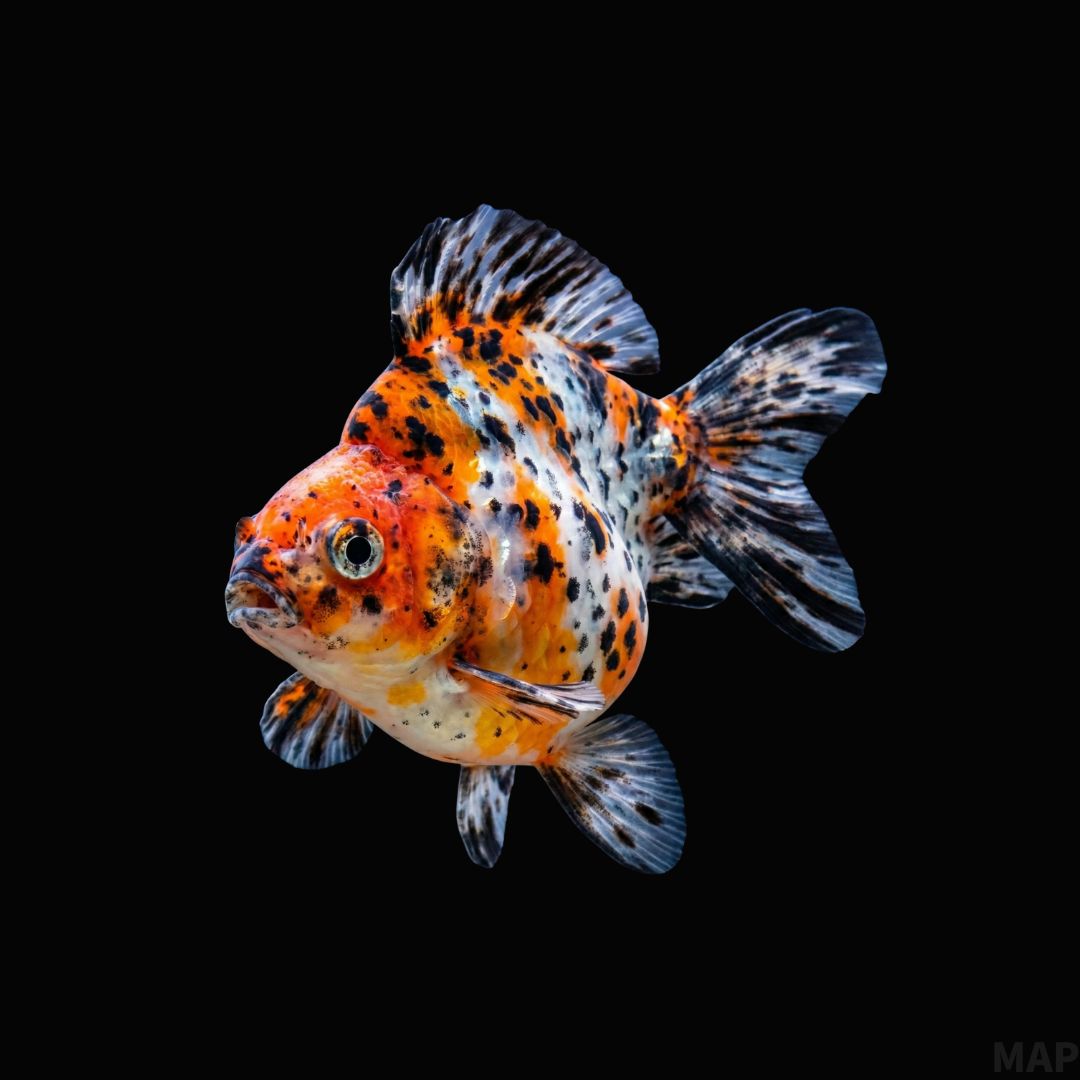
解説 / Description
だるま琉金キャリコは、琉金の高い体高と丸い胴を強調したショートテール型に、赤・黒・白・浅葱などが複雑に重なるキャリコ模様を組み合わせた観賞魚です。「だるま琉金」は独立した学術分類名ではなく、日本の観賞魚流通で短い尾をもつ琉金に用いられる呼称で、キャリコもまた体色・鱗質を示す表現です。短い尾と詰まった体型によって、横見では迫力のある丸み、上見では幅のある胴と左右に広がる模様を楽しめます。一方、丸物金魚の中でも遊泳姿勢や消化状態の変化が外見に現れやすいため、強い水流を避け、十分な水量と濾過、沈下性飼料を中心とした控えめな給餌を組み合わせることが長期飼育の基本になります。 The Calico Daruma Ryukin is a short-tail form of Ryukin goldfish combining a deep, rounded body with the layered red, black, white, and bluish-gray pattern known as calico. “Daruma Ryukin” is not a separate taxonomic unit; in the Japanese aquarium trade it is a name used for short-tail Ryukin, while “calico” describes the scale and color phenotype. Its compact tail emphasizes the body depth in side view, while the broad body and irregular pattern can also be appreciated from above. Because deep-bodied fancy goldfish may show buoyancy or digestive problems more readily than streamlined varieties, long-term care should emphasize ample water volume, efficient filtration with gentle current, stable water conditions, and conservative feeding based mainly on sinking foods.
基本情報 / Basic Information
| 学名 / Scientific Name | Carassius auratus |
|---|---|
| 通称 / Common Name | だるま琉金キャリコ、キャリコだるま琉金、ショートテールキャリコ琉金Calico Daruma Ryukin, Short-tail Calico Ryukin |
| 分類 / Family | コイ目・コイ科・フナ属。金魚の飼育品種であり、だるま琉金キャリコ自体に独立した学名はありません。Order Cypriniformes, family Cyprinidae, genus Carassius. It is a domesticated goldfish variety and does not have a separate scientific name of its own. |
| 英名 / English Name | Calico Short-tail Ryukin Goldfish |
| 分布 / Distribution | 野生分布はありません。金魚は中国で家畜化された系統で、だるま琉金キャリコは観賞用に維持される改良型です。日本国内では国産個体に加え、中国や東南アジアで生産されたショートテール琉金が流通しています。It has no natural wild distribution. Goldfish were domesticated from Chinese Carassius lineages, and the Calico Daruma Ryukin is maintained entirely as an ornamental strain. In Japan, domestically bred fish as well as short-tail Ryukin imported from China and Southeast Asia are sold through the aquarium trade. |
| 最大体長 / Max Size | 飼育下では全長15〜20cm前後が目安です。系統、年齢、給餌量、飼育水量によってはさらに大きく育つ個体もいます。Around 15–20 cm in total length is a practical adult range in aquaria, although some individuals can exceed this depending on lineage, age, diet, and available space. |
| 寿命 / Lifespan | 一般的には10〜15年ほどが目安です。安定した水質、適切な給餌、十分な飼育空間が保たれれば、それ以上の長期飼育も可能です。A typical expectation is about 10–15 years, with longer lifespans possible when water quality, nutrition, and space are consistently well managed. |
飼育環境 / Aquarium Environment
| 水槽サイズ / Tank Size | 成魚1匹でも60cm規格水槽以上を最低限の目安とし、長期飼育では60cmワイド水槽〜90cm規格水槽程度の余裕がある環境が扱いやすいです。複数飼育では90cm規格水槽以上を基準に、個体数と成魚サイズに応じて水量を増やします。丸物金魚は排泄量が多いため、単純な全長だけでなく「水量・底面積・濾過能力」をまとめて考えることが重要です。For a single adult, a standard 60 cm aquarium should be regarded as a minimum starting point; for long-term care, a wider 60 cm tank or a standard 90 cm tank is easier to manage. For groups, start from a 90 cm tank or larger and increase water volume according to the number and adult size of the fish. Because fancy goldfish produce substantial waste, water volume, floor area, and filtration capacity matter more than length alone. |
|---|---|
| 水温 / Temperature | 18〜24℃程度を安定して維持するのが扱いやすく、特に20〜24℃前後は室内飼育で消化と水質管理のバランスを取りやすい範囲です。常時28℃前後まで加温する必要はありません。季節の変わり目は急変を避け、ヒーターを使う場合も「高温化」より「温度の安定」を目的にします。 A stable range of roughly 18–24°C is practical, with about 20–24°C often providing a good balance for indoor feeding and water-quality management. Routine heating to around 28°C is unnecessary. During seasonal transitions, avoid abrupt temperature swings; if a heater is used, its main purpose should be stability rather than maintaining tropical temperatures. |
| 水質 / Water Quality | 中性〜弱アルカリ性を基本に、pH 7.0〜8.0前後を目安とします。アンモニアと亜硝酸は検出されない状態を維持し、硝酸塩も定期換水で低く保ちます。数値を追うだけでなく、急激なpH・水温変化を起こさないことが重要です。Neutral to mildly alkaline water is suitable, with a practical target around pH 7.0–8.0. Ammonia and nitrite should remain undetectable, while nitrate should be kept low through regular water changes. Stability is more important than chasing a precise number, so abrupt changes in pH or temperature should be avoided. |
| レイアウト / Layout | 広い遊泳空間を優先し、ベアタンクまたは角のない細かな底砂を薄く敷く構成が管理しやすいです。尖った石、狭い隙間、硬い人工装飾は体表やヒレを傷つけるため避けます。濾過は強力でも水流は穏やかになるよう、吐出口を壁面に当てる、シャワーパイプで分散するなどの工夫をします。上部式、スポンジ式、外部式のいずれでも、濾過容量と水流の弱さを両立できれば使用できます。Prioritize open swimming space. A bare-bottom tank or a thin layer of smooth, fine substrate is easy to maintain. Avoid sharp rocks, narrow gaps, and rigid ornaments that can damage the body or fins. Filtration may be powerful, but flow should remain gentle by directing outlets toward a wall or diffusing the return. Overhead, sponge, or canister filters can all work when adequate biological filtration is combined with low current. |
| 注意点 / Precautions | だるま体型は速い遊泳に向かず、強い流れや餌の競争が負担になります。また、琉金などの丸物金魚では浮力異常が比較的起こりやすく、空気の飲み込み、過食、消化管の膨満、浮袋そのものの異常、感染、内臓疾患など複数の原因が考えられます。新規導入魚は可能であれば別容器で状態を確認してから合流させ、水合わせでは温度と水質を急変させないようにします。The compact body is not suited to strong currents or intense feeding competition. Deep-bodied fancy goldfish such as Ryukin are also relatively prone to buoyancy problems, which can have multiple causes including swallowed air, overeating, gastrointestinal distension, gas-bladder disease, infection, or other internal disorders. Whenever possible, observe new fish separately before introduction and avoid abrupt changes in temperature or water chemistry during acclimation. |
餌と給餌 / Feeding
| 餌の種類 / Diet | 主食は金魚用の沈下性ペレットまたは沈下性顆粒が適しています。補助的に金魚向けゲルフード、冷凍赤虫、ブラインシュリンプなどを少量組み合わせると食餌に変化を付けられます。植物質は配合飼料で十分確保できますが、補助として柔らかくした葉物野菜や皮を除いたグリーンピースをごく少量与える方法もあります。A sinking goldfish pellet or granule is a suitable staple. Small portions of goldfish gel food, frozen bloodworms, or brine shrimp can be used for variety. A complete commercial diet can provide the required plant component, although tiny amounts of softened leafy greens or peeled peas may be offered occasionally as supplemental foods. |
|---|---|
| 給餌のポイント / Feeding Tips | 浮上性の餌は食事中に空気を飲み込みやすく、琉金などでは食後の浮力異常につながることがあるため、沈下性を基本にします。1日1〜2回、1〜2分で食べ切れる量を目安にし、残餌が出る量は与えません。食後に浮く、傾く、沈み続けるなどの変化が出た場合は、まず給餌を中止して水質と便の状態を確認します。症状が続く場合は単なる「便秘」と決めつけず、魚類を診療できる獣医師への相談を検討します。Floating foods can increase air intake during feeding, which may contribute to post-feeding buoyancy problems in Ryukin and other fancy goldfish, so sinking foods are preferable. Feed once or twice daily in amounts consumed within one to two minutes, and avoid leaving uneaten food. If the fish begins floating, tilting, or remaining on the bottom after meals, stop feeding temporarily and check water quality and feces. Persistent signs should not automatically be labeled “constipation”; consultation with an aquatic veterinarian is appropriate when available. |
性格と混泳 / Temperament and Tank Mates
| 性格 / Temperament | 基本的には温和で、人の接近を覚えて餌を求めるなど、飼育者に反応しやすい金魚です。個体間では餌の時間に押し合うことがありますが、縄張りを強く主張する魚ではありません。体型のため遊泳速度は遅めです。It is generally peaceful and often learns to approach its keeper at feeding time. Individuals may jostle one another around food, but they are not strongly territorial. Their compact body makes them relatively slow swimmers. |
|---|---|
| 混泳の相性 / Compatibility | 最も合わせやすいのは、同程度の大きさと遊泳力をもつだるま琉金、通常の琉金、オランダ獅子頭などの丸物金魚です。らんちゅうやピンポンパールとも飼育条件を合わせられる場合がありますが、餌取りの速さや体表の弱さには個体差があります。和金、コメット、朱文金などの長手で速い金魚は餌を独占しやすいため、同居させるなら十分な広さと給餌の工夫が必要です。プレコ類など、金魚の体表に吸い付く可能性がある魚との混泳は避けた方が安全です。The easiest companions are similarly sized, similarly paced fancy goldfish such as other Daruma Ryukin, standard Ryukin, and Oranda. Ranchu and pearlscale goldfish may also be compatible when feeding speed and individual sensitivity are considered. Fast single-tailed goldfish such as common goldfish, comets, and shubunkins can dominate food, so they require substantially more space and careful feeding if housed together. Avoid tank mates such as some plecos that may attach to or rasp the goldfish’s skin. |
病気と対策 / Diseases and Prevention
| かかりやすい病気 / Common Diseases | 特に注意したいのは、浮く・沈む・傾く・転覆するといった浮力異常です。これは一つの病名というより症候で、空気の飲み込み、消化管の膨満、浮袋の炎症や変形、感染症、腎臓など内臓の異常が関与することがあります。このほか、白点病などの寄生虫症、細菌性の皮膚炎やヒレの損傷、松かさ状の鱗立ちを伴う全身状態悪化など、一般的な金魚の疾病にも注意します。The most important problem to watch for is abnormal buoyancy—floating, sinking, tilting, or rolling. This is a syndrome rather than a single disease and may involve swallowed air, gastrointestinal distension, inflammation or deformation of the gas bladder, infection, kidney or other internal disease. As with other goldfish, parasitic diseases such as ich, bacterial skin or fin infections, and systemic illness accompanied by raised “pinecone” scales can also occur. |
|---|---|
| 対策と予防 / Prevention | 最大の予防は、過密を避け、アンモニア・亜硝酸を出さない濾過環境を作り、沈下性飼料を少量ずつ与えることです。浮力異常が出たら、まず給餌を止めて水質・水温・呼吸・排泄を確認し、急な加温や大量換水は避けます。塩水浴は魚類医療でも用いられる方法ですが、目的によって適切な濃度と時間が異なるため、「0.5%なら何にでも効く」と考えず、症状に応じて使用します。ココア浴は日本の愛好家間で知られる民間療法ですが、標準的な魚類医療としての有効性を裏づける十分な臨床証拠はないため、第一選択の治療にはしません。長引く浮力異常、腹部膨満、出血、潰瘍、食欲廃絶がある場合は、魚類を診療できる獣医師への相談が安全です。Prevention centers on avoiding overcrowding, maintaining biological filtration that keeps ammonia and nitrite at zero, and feeding small portions of sinking food. If buoyancy changes appear, stop feeding temporarily and check water quality, temperature, respiration, and feces; avoid sudden heating or very large water changes. Salt baths are used in aquatic medicine, but the appropriate concentration and duration depend on the indication, so a fixed “0.5% for everything” approach is not appropriate. Cocoa baths are known as a hobby remedy in Japan, but there is insufficient clinical evidence to recommend them as a standard first-line treatment. Persistent buoyancy problems, abdominal swelling, bleeding, ulcers, or complete loss of appetite warrant consultation with an aquatic veterinarian when possible. |
増やし方(繁殖) / Breeding
| 雌雄の判別 / Sexing | 繁殖期の雄はエラ蓋や胸ビレの前縁に白い追星が現れやすく、雌は成熟すると腹部がふっくらして見えることがあります。肛門の形や体型だけでの判別は個体差が大きいため、追星、腹部の張り、産卵期の追尾行動を組み合わせて判断します。During the breeding season, males often develop white breeding tubercles on the gill covers and leading rays of the pectoral fins, while mature females may become noticeably fuller in the abdomen. Vent shape and body form alone are unreliable, so use several clues together, including breeding tubercles, abdominal fullness, and courtship chasing. |
|---|---|
| 繁殖形態 / Reproduction | 卵生で、粘着性のある卵を水草や産卵床にばらまき、体外受精します。親魚は卵や仔魚を保護せず、むしろ食べることがあるため、採卵後は親魚と卵を分けて管理します。Goldfish are egg scatterers with external fertilization. Adhesive eggs are deposited on plants or spawning media. The adults provide no parental care and may eat eggs or fry, so breeders should be separated from the eggs after spawning. |
| 繁殖のポイント / Breeding Tips | 春の水温上昇をきっかけに繁殖行動が活発になります。産卵用のモップや人工水草を用意し、産卵後は卵を弱いエアレーション下で管理します。孵化後は仔魚の口に合う微細な初期餌から始め、成長に応じてブラインシュリンプ幼生や稚魚用飼料へ切り替えます。キャリコのモザイク透明鱗は古典的には不完全優性のT/t座で説明され、モザイク型同士を交配すると遺伝子型として1:2:1が期待されますが、実際の見た目や生存率は他の色素遺伝子、系統差、選別によってずれます。さらに、だるま体型、尾形、背なり、色柄まで揃えるには多数の稚魚から長期的な選別が必要です。Spawning activity typically increases as water temperature rises in spring. Provide spawning mops or artificial plants, then move the eggs to gentle aeration after spawning. Begin fry on appropriately tiny first foods and move to newly hatched brine shrimp or formulated fry diets as they grow. The calico nacreous-scale phenotype is classically explained by incomplete dominance at the T/t locus, so a 1:2:1 genotypic expectation can result from mating two mottled heterozygotes. Actual visible ratios and survival can differ because of other pigment genes, line-specific effects, and selective culling. Producing fish that combine the desired short-tail body, back profile, fins, and balanced calico pattern therefore requires large numbers of fry and repeated selection over generations. |
雑学と豆知識 / Trivia and Fun Facts
| 1. 琉球を経由したことが「琉金」の名に残っている / 1. The Name “Ryukin” Preserves Its Route Through the Ryukyu Islands | 琉金は江戸時代の安永〜天明年間、18世紀後半に中国から琉球を経由して日本へ入ったと伝えられています。新しい金魚が「どこから来たのか」が、そのまま品種名に刻まれたわけです。丸い腹、頭の後ろから急に持ち上がる背、長く伸びる尾という従来の琉金像に対し、現代のだるま琉金は尾を短くすることで胴の丸さをさらに強調します。古い日本の品種名と、近代以降のアジア圏で発達した短尾表現が一匹の中で重なっている点が、この金魚の面白さです。Ryukin is traditionally said to have entered Japan from China through the Ryukyu Islands in the late eighteenth century, during the An’ei–Tenmei era. In other words, the route by which the fish arrived became embedded in the variety’s name. The classical Ryukin image is a rounded abdomen, a steep rise behind the head, and a long flowing tail; the modern Daruma form shortens the tail and visually intensifies the round body. This makes the fish a meeting point between an old Japanese variety name and a later Asian short-tail breeding style. |
|---|---|
| 2. キャリコは明治期の国際交流から生まれた / 2. Calico Emerged from Meiji-Era International Exchange | キャリコ琉金は、初代・秋山吉五郎が琉金と三色出目金を交配して作出した品種として知られています。金魚業界では、アメリカ人フランクリン・パッカードの依頼がきっかけとなり、完成魚のまだら模様に「Calico」という英語名が与えられたという来歴が広く伝えられています。公的な品種解説でも、キャリコ琉金が三色出目金と琉金の交雑によって固定されたことは確認できます。日本の養殖技術だけで閉じた物語ではなく、明治期の輸出需要や外国人顧客との交流が新しい観賞魚の美意識を刺激した象徴的な例です。The Calico Ryukin is known as a variety developed by first-generation goldfish breeder Yoshigoro Akiyama by crossing Ryukin with the calico telescope-eye goldfish. Aquarium-trade histories widely recount that the project was prompted by a request from the American Franklin Packard and that the mottled fish was named “Calico.” Public Japanese descriptions also confirm the core breeding history: the variety was fixed from a cross between telescope-eye calico and Ryukin. Its story therefore reflects not only Japanese breeding skill, but also the export market and cross-cultural taste of the Meiji era. |
| 3. モザイク透明鱗は「全部を透明にする遺伝子」ではない / 3. Nacreous Scales Are Not Simply an “All-Transparent” Trait | 金魚の透明鱗は古くから遺伝学の研究対象となり、1928年には陳楨(Shisan C. Chen)が普通鱗、モザイク状の中間型、透明型の関係を不完全優性として示しました。モザイク透明鱗のキャリコは、この「中間型」に相当します。モザイク同士を掛ければすべてキャリコになるわけではなく、古典的な単一遺伝子モデルでは普通鱗型、モザイク型、透明型が1:2:1に分離すると期待されます。ところが実際の柄には赤、黒、黄色、反射色など別の遺伝要因も関わるため、「遺伝的にキャリコ」と「観賞価値の高いキャリコ」は同じ意味ではありません。ここに選別育種の難しさがあります。Goldfish transparency has been a classic subject in genetics. In 1928, Shisan C. Chen described the relationship among normal reflective scales, a mottled intermediate form, and transparent scales as incomplete dominance. The nacreous calico phenotype corresponds to that intermediate state. Crossing two nacreous fish does not produce all-calico offspring; under the classic single-locus model, normal, mottled, and transparent genotypes are expected in a 1:2:1 ratio. In real fish, however, red, black, yellow, reflective coloration, and pattern placement are influenced by additional genetic factors. A fish can therefore be genetically “calico” without possessing a high-value show pattern, which is why selective breeding remains so demanding. |
| 4. 浅葱色は単純な「青い色素」では説明できない / 4. Asagi Blue Cannot Be Explained by a Simple Blue Pigment | キャリコの浅葱は、愛好家の間では長く「透明鱗越しに黒色素が見え、チンダル現象で青く見える」と説明されてきました。ただし、現代の魚類色彩学では青の多くを、イリドフォアに含まれるグアニン結晶などが生む構造色として捉えます。2026年の透明金魚に関する分子研究でも、グアニン代謝と反射性の色素細胞が透明表現に深く関与することが示されています。そのため、キャリコの浅葱も「黒が透けているだけ」と一言で片づけるより、透明度、メラノフォア、反射性細胞、光の散乱や干渉が重なって見える複合的な色と考える方が、現在の知見に近い説明です。Among hobbyists, the bluish-gray “asagi” of calico goldfish has often been explained as black pigment seen through transparent scales, with blue produced by a Tyndall-like scattering effect. Modern fish color biology, however, explains much blue coloration as structural color involving reflective cells such as iridophores and their guanine crystals. A 2026 molecular study of transparent goldfish also linked transparency to guanine metabolism and the function of reflective pigment cells. It is therefore more accurate to treat calico asagi as a layered visual effect involving transparency, melanophores, reflective cells, and optical scattering or interference, rather than simply “black showing through.” |
| 5. 「だるま琉金」は分類名ではなく、短尾表現を示す流通名 / 5. “Daruma Ryukin” Is a Trade Name for the Short-Tail Form | 国内の観賞魚流通では、短い尾をもつショートテール琉金を「だるま琉金」と呼びます。中国由来の短尾琉金がこの名称で紹介されることが多い一方、現在は国産や東南アジア産として流通する個体もあり、「だるま」という名前だけで単一の産地や血統を示すわけではありません。丸い姿が縁起物のだるまを連想させる呼称として親しまれていますが、達磨大師の故事から直接命名されたことを裏づける一次資料は乏しいため、文化的な連想と品種の確定した作出史は分けて考えるのが安全です。In the Japanese aquarium trade, short-tail Ryukin are commonly called “Daruma Ryukin.” Chinese short-tail Ryukin have played an important role in popularizing the form, but fish are now also sold as Japanese- or Southeast Asian-bred, so “Daruma” does not identify a single origin or bloodline. The rounded shape naturally evokes Japan’s daruma good-luck doll, yet primary historical evidence directly linking the fish’s naming to the legend of Bodhidharma is limited. It is therefore best to distinguish cultural association from documented breeding history. |
| 6. 国内流通は「産地→市場→仲買→小売」だけではない / 6. Japan’s Distribution Network Is More Than a Simple Producer-to-Retail Chain | 日本の金魚流通には、弥富、大和郡山、江戸川などの歴史的産地に加え、埼玉県加須市の観賞魚卸売市場のような専門流通拠点があります。弥富では現在も複数の卸売市場に全国から仲買人が集まり、江戸川では2026年の初競りに約40品種・約2万匹が出品されました。埼玉県養殖漁業協同組合の市場は水曜日が市場開催日で、登録された出荷者と買参人を中心に取引されています。一方で、現代は養魚場から専門店への直接出荷、品評会や即売会、通販、個体別のオンライン販売も大きくなっています。だるま琉金キャリコのように「一尾ごとの柄と体型」が価格を左右する魚では、大量規格品と一点物の両方が別々の流通経路で動いているのが特徴です。Japan’s goldfish trade includes historic production centers such as Yatomi, Yamatokoriyama, and Edogawa, as well as specialist wholesale hubs such as the ornamental-fish market in Kazo, Saitama. Yatomi continues to operate multiple wholesale markets that attract buyers from around the country, while Edogawa’s 2026 first auction offered roughly 20,000 fish representing about 40 varieties. The Saitama Prefectural Aquaculture Fisheries Cooperative holds its market on Wednesdays for registered producers and buyers. Modern distribution also includes direct farm-to-shop shipments, shows and sales events, mail-order businesses, and online sales of individual fish. For a variety such as Calico Daruma Ryukin, whose value is strongly influenced by the unique body and pattern of each specimen, standardized bulk fish and one-of-a-kind individuals often move through different channels. |
| 7. 値段を決めるのは産地名だけではなく「一尾の完成度」 / 7. Price Depends More on the Individual Fish Than on Origin Alone | 国内では国産、中国産、東南アジア産などさまざまな表示で販売されますが、価格は産地だけでは決まりません。体高、背なり、尾筒、尾の開き、左右のバランス、浅葱の面積、赤と黒の配置、墨の濃さ、サイズ、年齢、輸送後の仕上がりなどが複合して評価されます。同じ「だるま琉金キャリコ」という商品名でも、小型の量販個体と、選別された大型一点物では価格が大きく異なります。したがって購入時は値札だけでなく、泳ぎが安定しているか、呼吸が速くないか、鱗やヒレに傷がないか、店で十分に養生されているかまで確認することが、結果として最も重要な「品質の見方」になります。Fish are sold in Japan under labels such as Japanese-bred, Chinese-bred, or Southeast Asian-bred, but country of origin alone does not determine value. Body depth, back profile, caudal peduncle, tail spread, left-right balance, the amount of bluish-gray ground color, placement of red and black, intensity of dark markings, size, age, and condition after transport all contribute to price. Two fish sold under the same name can therefore occupy completely different price levels if one is a small mass-market specimen and the other a carefully selected large individual. When buying, the most useful quality check is not the price tag alone but whether the fish swims steadily, breathes normally, has intact scales and fins, and has been properly conditioned by the seller. |
まとめ / Conclusion
だるま琉金キャリコの魅力は、琉金らしい高い体高と短い尾が生む丸い存在感に、モザイク透明鱗ならではの赤・黒・白・浅葱が重なることにあります。模様は一尾ごとに異なり、光の当たり方や成長によって見え方も変化するため、同じ品種名の中でも選ぶ楽しさが非常に大きい金魚です。 The appeal of the Calico Daruma Ryukin lies in the combination of a deep Ryukin body, a compact tail, and the layered red, black, white, and bluish-gray colors of nacreous scales. No two patterns are exactly alike, and the appearance can change with growth and lighting, making individual selection a major part of the enjoyment of this variety.
長く付き合うために大切なのは、丸い体型を「弱い魚」と決めつけることではなく、その遊泳力に合った穏やかな水流、十分な水量、安定した水質、沈下性飼料を少量ずつ与える給餌を積み重ねることです。体型と色彩の美しさを楽しみながら、日々の泳ぎ方や食後の姿勢を丁寧に観察できる飼育者にとって、だるま琉金キャリコは非常に奥行きのある伴侶になります。 Long-term success does not come from simply labeling the round-bodied form as “fragile.” It comes from matching husbandry to the fish: gentle current, ample water volume, stable water quality, and small portions of sinking food. For keepers who enjoy watching subtle changes in swimming, posture, and color as carefully as they admire the fish’s shape and pattern, the Calico Daruma Ryukin can be an exceptionally rewarding companion.

気になる道具や飼い方を見つけてみませんか?
 アイのアクアグッズ案内水槽のエアーポンプの選び方|水深・音・泡で選ぶおすすめ用品道具の特徴や使い方、選ぶときのポイントをアイが紹介します。記事はコチラ →
 アイのアクアグッズ案内水換え・底砂掃除の道具の選び方|砂利・砂・ソイルに合うクリーナーとポンプ道具の特徴や使い方、選ぶときのポイントをアイが紹介します。記事はコチラ →
さまざまな飼育テーマをご紹介。リンク先の記事には広告・商品紹介が含まれます。
案内・紹介記事一覧へ →分布マップ
だるま琉金キャリコには野生分布はありません。金魚は中国で家畜化された系統で、本品種は観賞用として維持されています。日本では国内生産個体のほか、中国や東南アジアで生産されたショートテール琉金も流通しているため、地図ではこれらの地域を含む東アジア〜東南アジアを概略的に表示しています。
※この地図は記事中の分布・生産地域をもとにした概略表示です。だるま琉金キャリコは飼育品種であり、野生の自然分布を示すものではありません。マーカーは表示範囲を把握しやすくするための代表地点で、実際の採集地点・産地・養殖場の所在地を示すものではありません。
参考文献
-
Froese, R. & Pauly, D. (eds.). FishBase: Carassius auratus (Linnaeus, 1758), Goldfish.
分類、自然分布、淡水環境など、金魚の原種レベルの基礎情報。
-
Chen, D. et al. (2020). The evolutionary origin and domestication history of goldfish (Carassius auratus). Proceedings of the National Academy of Sciences, 117(47), 29775–29785.
金魚の進化的起源、家畜化の歴史、透明鱗形質を含む遺伝的背景。
-
Chen, S. C. (1928). Transparency and Mottling, a Case of Mendelian Inheritance in the Goldfish Carassius auratus. Genetics, 13(5), 434–452.
普通鱗、モザイク透明鱗、透明鱗の遺伝と、不完全優性による分離の基礎。
-
Watson, C. A., Hill, J. E. & Pouder, D. B. (2004). Species Profile: Koi and Goldfish. Southern Regional Aquaculture Center, SRAC Publication No. 7201.
18〜24℃を中心とする適温域、水質、pH、濾過、給餌、繁殖、卵・仔魚管理、疾病予防に関する養殖・飼育上の基礎資料。
Southern Regional Aquaculture Center / University of Florida IFAS
-
Merck Veterinary Manual. Fish Taxonomy.
コイ科魚類の生理的特徴と、琉金などの丸物金魚で空気の飲み込みによる浮力異常を避けるため沈下性飼料を用いるという飼育上の注意。
-
Merck Veterinary Manual. Management of Aquarium Fish.
新規導入魚の隔離、観察、器具の分離など、病原体を既存水槽へ持ち込まないための検疫・衛生管理。
-
Merck Veterinary Manual. Environmental Diseases of Aquatic Animals in Aquatic Systems.
急激な水温変化や不適切な水質が魚の健康へ与える影響、淡水魚に対する塩分使用の基本的な考え方。
-
Petty, B. D., Francis-Floyd, R. & Yanong, R. P. E. Merck Veterinary Manual. Bacterial Diseases of Fish.
水質悪化、過密、輸送、急激な温度変化などが感染症の発症リスクを高めること、金魚でみられる細菌性疾患の診断と予防。





コメント