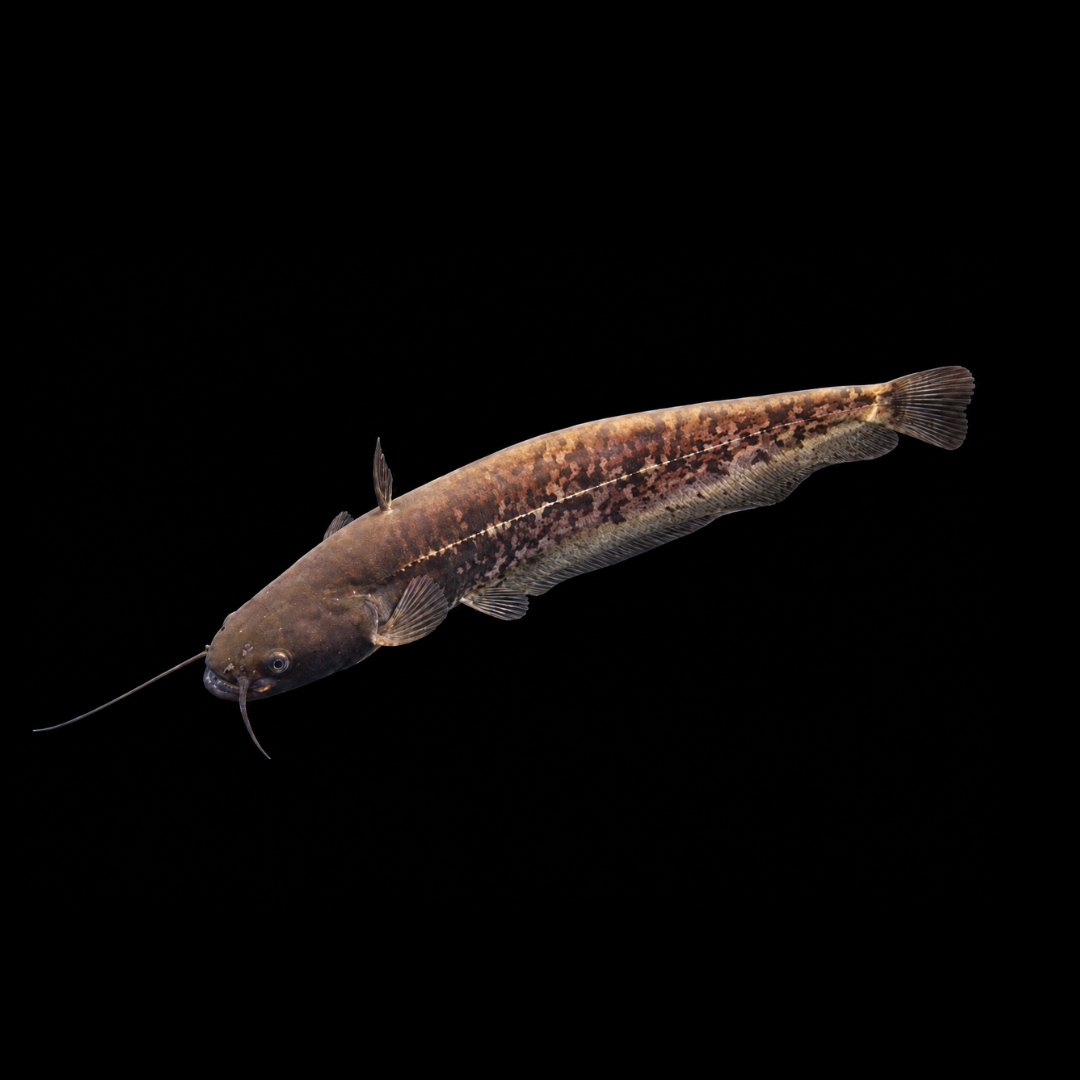
イワトコナマズは、琵琶湖水系の一部にだけ自然分布する日本固有のナマズです。平たい頭と大きな口、鱗のない滑らかな体を持ち、黒褐色の地色には黄褐色の斑紋が散ります。眼が頭部の側面寄りにあり、腹側からも見えること、長い鼻管や上顎のひげを備えることも本種の特徴です。主に岩礁帯で暮らし、夜になると水生昆虫、甲殻類、魚などを探して動き始めます。観賞魚として魅力的ですが、成魚は50〜60cmに達するため、大型水槽に加え、夏の高水温を避けながら十分な酸素と清浄な水を保つ設備、強固なふたが必要です。限られた水系に生きる保全上重要な魚でもあり、合法的に流通した個体を迎え、終生飼育と逸出防止を徹底できる経験者に向いています。The Iwatoko catfish is a Japanese endemic naturally restricted to parts of the Lake Biwa drainage. It has a flattened head, a broad mouth, and smooth scaleless skin, with irregular yellow-brown mottling scattered over a dark brown body. Eyes positioned toward the sides of the head and visible from below, together with elongated nasal tubes and maxillary barbels, are also characteristic of the species. It lives mainly in rocky habitat and becomes active at night to search for aquatic insects, crustaceans, and fish. Although attractive as an aquarium fish, an adult reaches 50–60 cm and therefore requires a large tank, equipment that keeps the water clean and well oxygenated while preventing excessive summer heat, and a firmly secured lid. Its restricted distribution also makes it important from a conservation standpoint, so it is suited to experienced aquarists able to obtain a legally traded specimen, prevent escape, and provide lifelong care.
基本情報 / Basic Information
学名 / Scientific Name
Silurus lithophilus (Tomoda, 1961)
通称 / Common Name
岩床鯰、イワトコ。イワトコナマズの黄変個体も「ベンテンナマズ」と呼ばれることがあります。Iwatoko catfish; yellow colour variants of this species may also be called Benten catfish.
分類 / Family
脊索動物門・条鰭綱・ナマズ目・ナマズ科・ナマズ属Phylum Chordata, class Actinopterygii, order Siluriformes, family Siluridae, genus Silurus
英名 / English Name
Rock catfish / Biwa rock catfish
分布 / Distribution
日本固有種。琵琶湖では主に北湖に生息し、余呉湖にも分布するほか、瀬田川でも記録されています。岩の多い場所を主な生息地としています。Endemic to Japan. Within Lake Biwa it occurs mainly in the northern basin; it is also found in Lake Yogo and has been recorded in the Seta River. It primarily inhabits rocky areas.
最大体長 / Max Size
全長約58cm。成魚は50〜60cmに達するため、飼育設備は最大サイズを基準に用意します。About 58 cm total length. Adults reach approximately 50–60 cm, so the aquarium should be planned for maximum adult size.
寿命 / Lifespan
種としての正確な寿命を示す信頼できる公表資料は乏しく、不明です。大型になる魚であるため、短期間の飼育を前提にせず、終生飼育できる設備と管理体制を整えて迎えます。Reliable published data establishing the species’ exact lifespan are scarce, so its longevity remains uncertain. Because it grows into a large fish, it should not be acquired as a short-term commitment; the aquarium and care arrangements must support lifelong keeping.
飼育環境 / Aquarium Environment
水槽サイズ / Tank Size
20cm未満の幼魚でも90cm規格水槽(約180L)を目安とし、成魚は最低でも120cmワイド水槽(約300〜400L)、できれば150cm以上の水槽を用意します。体を無理なく反転できる奥行きと、底面積を重視してください。Even juveniles under 20 cm are best started in a standard 90 cm aquarium of about 180 L. Adults require at least a 120 cm wide aquarium of roughly 300–400 L, with 150 cm or longer preferred. Prioritise floor area and enough depth for the fish to turn without bending.
水温 / Temperature
飼育上は15〜22℃をひとつの目安とします。ただし、本種に固有の最適水温を示す飼育試験の公表資料は限られています。高水温と酸欠が重なりやすい夏は水槽用クーラーを用い、25℃を超える状態を長く続けないようにします。急な温度変化も避けてください。A practical husbandry target is 15–22°C, although published trials defining a species-specific optimum are limited. Use an aquarium chiller during summer, when heat and oxygen depletion often occur together, and avoid prolonged periods above 25°C. Abrupt temperature changes should also be prevented.
水質 / Water Quality
本種に固有の適正pHを示す公表飼育試験は限られているため、中性付近を軸に、急変のない安定した水質を保ちます。アンモニアと亜硝酸は検出されない状態を維持し、硝酸塩を低く抑えます。排泄量に余裕を持たせた強力なろ過と、24時間のエアレーションで高い溶存酸素を確保してください。Published husbandry trials defining a species-specific pH range are limited, so keep the water stable around neutral and avoid abrupt shifts. Maintain undetectable ammonia and nitrite and keep nitrate low. Use filtration sized generously for a predatory fish’s waste load and continuous aeration to ensure high dissolved oxygen.
レイアウト / Layout
清掃しやすいベアタンク、または角のない細砂を薄く敷いた構成が管理しやすいでしょう。太い塩ビ管、流木、角のない岩などで、全身を隠せる暗いシェルターを作ります。岩は魚が接触しても崩れないよう確実に固定し、吸水口には保護カバーを付けます。水流を魚体へ強く当てず、水面を動かして酸素交換を促します。A bare-bottom tank is easiest to clean, although a thin layer of smooth fine sand can also be used. Provide a dark shelter large enough to conceal the entire fish, using wide pipe, driftwood, or smooth rocks. Secure rocks so they cannot collapse if the fish bumps them, and guard filter intakes. Avoid directing a strong current at the fish while maintaining surface movement for gas exchange.
注意点 / Precautions
力が強く、驚いたときや水質が悪化したときに飛び出すおそれがあります。重量のあるふたをクリップなどで固定し、配管穴やコード穴まで塞ぎます。水位を縁より3〜5cm下げ、ふたとの間に余裕を持たせると、ふたへの衝突事故を減らしやすくなります。入手時は流通由来を確認し、飼育個体を野外へ放流しないでください。イワトコナマズは滋賀県漁業調整規則第42条の許可不要種に含まれないため、滋賀県内の水域へ移植する場合は知事の許可が必要です。採集・移動・放流に関しては、事前に最新の法令と漁業権を確認します。This powerful fish may jump when startled or when water quality deteriorates. Lock a substantial lid in place and close every pipe, cable, and feeding gap. Keeping the water level 3–5 cm below the rim provides clearance that can help reduce impact with the lid. Confirm the origin of any specimen and never release a captive fish into the wild. The Iwatoko catfish is not among the species exempted under Article 42 of the Shiga Prefecture Fishery Regulation, so gubernatorial permission is required before introducing it into waters within the prefecture. Always check current regulations and fishery rights before collecting, moving, or releasing aquatic animals.
餌と給餌 / Feeding
餌の種類 / Diet
主食は栄養設計された沈下性の肉食魚用ペレットとし、補助的に解凍したアカムシ、オキアミ、エビ、貝のむき身、白身魚などを与えます。野外で採った小魚や餌用魚への依存は、寄生虫の持ち込みや栄養の偏りを招くため避けます。Use a nutritionally complete sinking carnivore pellet as the staple, supplemented with thawed bloodworms, krill, shrimp, mussel meat, or pieces of lean fish. Avoid dependence on wild-caught or feeder fish because they can introduce parasites and create nutritional imbalance.
給餌のポイント / Feeding Tips
消灯前後に、数分で食べ切る量を底近くへ与えます。導入直後に人工飼料を食べない場合は、冷凍アカムシやエビの匂いを移したペレットを同時に沈め、少しずつ置き換えます。給餌量と回数は、成長段階、水温、腹部の張り、食べ方を見ながら調整し、食べ残しは速やかに回収します。Feed near the bottom around lights-out, offering only what is eaten within a few minutes. If a newly acquired fish rejects pellets, sink them together with thawed bloodworms or shrimp so that the scent transfers, then replace the frozen food gradually. Adjust meal size and frequency according to growth stage, temperature, abdominal condition, and feeding response, and remove leftovers promptly.
性格と混泳 / Temperament and Tank Mates
性格 / Temperament
強い夜行性を示す捕食魚です。日中は岩陰や隠れ家で休むことが多く、暗くなると底層を移動して餌を探します。驚くと瞬発的に暴れることがあるため、移動や水槽管理の際は、魚体と飼育者の双方が傷つかないよう慎重に扱います。This is a strongly nocturnal predatory fish. It usually rests among rocks or in shelter by day, then moves through the lower part of the aquarium to search for food after dark. Because it may thrash suddenly when startled, handle transfers and tank maintenance carefully to avoid injury to both fish and keeper.
混泳の相性 / Compatibility
単独飼育が基本です。口に入る魚やエビは捕食対象となり、口に入らない相手でも夜間の接触、餌の競合、隠れ家を巡る争いで負傷する可能性があります。同種複数飼育にも十分な床面積と複数のシェルターが必要ですが、成長後の争いを完全には防げません。Solitary keeping is the safest approach. Fish and shrimp that fit into its mouth will be treated as prey, while larger companions can still be injured through nocturnal collisions, feeding competition, or disputes over shelter. Multiple conspecifics require extensive floor space and separate shelters, yet adult conflict cannot be ruled out.
病気と対策 / Diseases and Prevention
かかりやすい病気 / Common Diseases
本種だけに特有の疾病資料は多くありませんが、白点病、水カビ病、細菌性の皮膚炎・鰭腐れ、擦過傷からの二次感染に注意します。眼の白濁、粘液の増加、呼吸の速まり、体をこする動作、摂餌低下は、水質悪化や感染症を疑う手掛かりです。Few diseases are documented specifically for this species, but aquarists should watch for white spot disease, water mould, bacterial skin or fin infections, and secondary infection of abrasions. Cloudy eyes, excess mucus, rapid breathing, flashing, and loss of appetite can indicate deteriorating water quality or disease.
対策と予防 / Prevention
新しい魚や生餌を検疫せずに持ち込まないこと、導入個体を隔離観察すること、窒素化合物を低く抑えて高い溶存酸素を保つことが基本です。異常が見られたら、まずアンモニア、亜硝酸、pH、水温を測り、必要に応じて同じ水温の除塩素水で部分換水します。ナマズ類は鱗がなく、一部の薬剤や濃度に敏感な場合がありますが、すべての薬を一律に半量へ減らすと治療不足を招くおそれもあります。製品の対象魚、禁忌、用量を確認し、可能であれば魚類診療に詳しい獣医師へ相談してください。診断せずに昇温、塩水浴、複数薬剤の併用を行うことは避けます。Prevention starts by keeping unquarantined fish and live food out of the aquarium, observing new arrivals separately, maintaining low nitrogenous waste, and ensuring high dissolved oxygen. If abnormal signs appear, first test ammonia, nitrite, pH, and temperature, then perform a partial change with dechlorinated water at matching temperature when needed. Scaleless catfish can be sensitive to some medications or concentrations, but automatically reducing every treatment to half strength can also make it ineffective. Check the product’s permitted species, contraindications, and dose, and consult a veterinarian experienced with fish whenever possible. Avoid raising the temperature, using salt baths, or combining medications without a diagnosis.
増やし方(繁殖) / Breeding
雌雄の判別 / Sexing
通常期の外見だけで確実に判別するのは困難です。繁殖期には成熟した雌の腹部が卵で丸みを帯び、雄より大型に見えることがありますが、体格差だけでは断定できません。Reliable sexing from external appearance is difficult outside the breeding season. A mature female may develop a rounder, egg-filled abdomen and appear larger than a male during the season, but body size alone is not conclusive.
繁殖形態 / Reproduction
卵生です。野生では主に5〜7月の夜間、岸近くの浅い砂礫底や礫底で、雄が雌へ巻き付くようにして放卵・放精します。卵は黄褐色でゼリー層を持つものの粘着性はなく、22℃では受精から約55〜60時間で孵化すると報告されています。Oviparous. In the wild, spawning occurs mainly at night from May to July over shallow gravel or sand-and-gravel margins. The male wraps around the female as eggs and sperm are released. The yellow-brown eggs have a gelatinous layer but are non-adhesive; hatching has been reported approximately 55–60 hours after fertilisation at 22°C.
繁殖のポイント / Breeding Tips
家庭水槽での繁殖は研究・養殖施設に近い難度です。成熟した雌雄、季節的な水温変化、静かな夜間環境、広い産卵床を準備し、産卵後は親による捕食を避けるため卵を別容器へ移します。孵化仔魚は成長差が生じると共食いが起こりやすいため、十分な初期餌料、こまめなサイズ分け、低密度管理が必要です。野生親魚や卵の採集は行わず、人工繁殖由来の合法な個体だけで試みます。Breeding in a home aquarium is closer to a research or hatchery project than a routine hobby spawn. It requires mature fish, seasonal temperature cues, a quiet nocturnal setting, and a broad spawning substrate. Eggs should be separated after spawning to prevent predation. Once fry differ in size, cannibalism becomes likely, making abundant first food, frequent size grading, and low stocking density essential. Never collect wild broodfish or eggs; work only with legally obtained captive-bred stock.
雑学と豆知識 / Trivia and Fun Facts
1. 「岩を好む魚」と名付けられた / 1. A fish named for loving rocks
種小名のlithophilusは、ギリシャ語由来の「石・岩」を表すlithosと、「好む」を表すphilosを組み合わせた言葉です。和名の「岩床」も、本種が岩の多い場所を主な生息地とすることに由来します。学名と和名が別々の言語で同じ暮らしを表しており、名前を知るだけでも本種の生息環境が見えてきます。The specific name lithophilus combines Greek-derived lithos, meaning stone or rock, with philos, meaning loving. The Japanese name Iwatoko, literally “rock bed,” likewise refers to the species’ preference for rocky habitat. Its scientific and Japanese names describe the same way of life in different languages, so the habitat becomes apparent from the names alone.
2. 顔つきに刻まれた岩礁生活 / 2. A rocky habitat written into the face
近縁のマナマズやビワコオオナマズと見比べると、眼の位置がひときわ印象的です。イワトコナマズの眼は頭の側面寄りにあり、腹側からも見ることができます。口の奥では鋤骨歯帯が中央で分かれ、「ハの字」のように並びます。これらの特徴と岩礁生活との関係は考えられていますが、その機能が十分に検証されているわけではありません。種を見分けるときは模様だけに頼らず、眼の位置、鼻管、頭部の輪郭、歯帯など複数の形質を組み合わせて判断します。Compared with the related Amur and giant Lake Biwa catfishes, the position of the eyes is especially striking. In the Iwatoko catfish they sit toward the sides and can be seen from below. Inside the mouth, the vomerine tooth band is divided in the centre into a V-like pair. These features have been associated with life in rocky habitat, but their functions have not been fully tested. Identification should therefore combine pattern with eye position, nasal tubes, head outline, and dentition rather than relying on markings alone.
3. 漁師の知識が科学に先行していた / 3. Local knowledge came before formal science
イワトコナマズが近代分類学のもとで新種として記載されたのは1961年で、記載者は友田淑郎です。しかし琵琶湖周辺では、それよりはるか以前から、岩場にすみ、模様や味わいが異なるナマズとして認識されていました。1806年成立の『湖魚考』にもイワトコナマズの名が現れるとされます。土地の人々が積み重ねた観察を、後の形態研究が学名という形で確かめた歴史は、地域の自然知が分類学に与える大切な手掛かりを物語っています。Yoshiro Tomoda formally described the Iwatoko catfish as a new species in 1961. Yet people around Lake Biwa had recognised it much earlier as a rock-dwelling catfish distinct in pattern and flavour. The name is reported in Kogyokō, a work completed in 1806. The later arrival of a scientific name did not create the distinction; it formalised generations of local observation, illustrating how place-based knowledge can guide taxonomy.
4. 1万6524塩基対が語る系統 / 4. A 16,524-base-pair genetic record
2021年の報告では、完全ミトコンドリアゲノムは1万6524塩基対で、13個のタンパク質コード遺伝子、22個のtRNA遺伝子、2個のrRNA遺伝子などを含んでいました。解析結果はイワトコナマズとマナマズが姉妹群であることを支持し、イワトコナマズが独立した有効な種であることも示しました。つまり、外見や骨格から区別されてきた本種の位置づけを、DNAの情報も裏付けたことになります。A 2021 study reported a complete mitochondrial genome of 16,524 base pairs containing 13 protein-coding genes, 22 tRNA genes, and two rRNA genes. Its analysis supported a sister relationship between the Iwatoko and Amur catfishes and also supported the Iwatoko catfish as a valid species. In other words, DNA evidence reinforced a distinction already recognised from external form and skeletal anatomy.
5. 卵が示す非粘着性という特徴 / 5. The eggs’ distinctive lack of adhesion
日本産の近縁ナマズには粘着性の卵を産む種がいますが、イワトコナマズの卵は、表面にゼリー層を持ちながら非粘着性と報告されています。岩の多い産卵場所で見られる特徴として興味深いものの、非粘着性であることが生存にどのような利点をもたらすのかは、十分に確かめられていません。分かっている特徴と、その意味についての仮説を分けて捉える必要があります。Some related Japanese catfishes produce adhesive eggs, whereas Iwatoko catfish eggs have been reported as non-adhesive despite possessing a gelatinous surface layer. This is an intriguing feature in a species that spawns in rocky places, but any survival advantage provided by the lack of adhesion has not been firmly established. The observed characteristic should therefore be distinguished from hypotheses about what it means.
6. 黄色い「ベンテンナマズ」 / 6. The yellow Benten catfish
突然変異によって体色が黄色く変化したナマズは、総称して「ベンテンナマズ」と呼ばれることがあります。イワトコナマズにもこの色彩変異が見られ、竹生島にまつられる弁財天の使いとされ、昔から大切に扱われてきました。ここでは、確認できるのは黄色い体色を示す変異個体であることまでで、色素変化の詳しい仕組みは断定できません。琵琶湖の自然史と地域文化が、一匹の魚を通して結び付いた例といえるでしょう。Catfishes whose body colour has changed to yellow through mutation may collectively be called Benten catfish. This colour variant also occurs in the Iwatoko catfish and has long been treated with care as a messenger of Benzaiten worshipped on Chikubu Island. What can be stated with confidence is that these are yellow colour variants; the precise pigment mechanism should not be assumed. They offer an example of Lake Biwa’s natural history and regional culture meeting in a single fish.
7. 限られた水系で受け継がれる命 / 7. A lineage confined to one connected watershed
IUCNレッドリストでは2017年の評価で危急種、環境省レッドリスト2020では準絶滅危惧、滋賀県レッドデータブック2026では絶滅危機増大種に位置づけられています。分布域が限られる本種は、生息地や産卵環境の変化による影響を受けやすい魚です。飼育個体を最後まで世話し、野外へ放さず、由来の確かな個体を選ぶことは、野生個体群への負担を増やさないための基本となります。The species was assessed as Vulnerable by the IUCN Red List in 2017, Near Threatened by Japan’s Ministry of the Environment Red List 2020, and “Increasing Risk of Extinction” by the Shiga Prefecture Red Data Book 2026. Its restricted range makes it susceptible to changes in habitat and spawning conditions. Lifelong care, zero release, and selection of traceable legally sourced fish are basic measures that help avoid adding pressure to the wild population.
まとめ / Conclusion
イワトコナマズは、琵琶湖水系の岩礁を中心に暮らし、側面寄りの眼、長いひげ、黄褐色の斑紋、非粘着性の卵といった特徴を持つ固有種です。日中は暗い隠れ場所で休み、夜になると底層を動いて餌を探す姿には、活発に泳ぎ続ける魚とは異なる魅力があります。The Iwatoko catfish is endemic to the Lake Biwa drainage and lives mainly in rocky habitat. Its characteristic traits include laterally positioned eyes, long barbels, yellow-brown mottling, and non-adhesive eggs. Resting in dark shelter by day and moving along the bottom in search of food at night, it has an appeal quite different from that of fishes that remain constantly active in open water.
長く健康に飼うには、大型水槽、夏の高水温を避けた酸素の多い清浄な水、確実な飛び出し対策、そして単独飼育を基本とする管理が欠かせません。限られた水系から受け継がれてきた一匹として丁寧に向き合うことで、岩陰から見せる表情や夜の力強い動きを、落ち着いて見守ることができます。Long-term health requires a large aquarium, clean and oxygen-rich water protected from excessive summer heat, reliable escape prevention, and management based on solitary keeping. By caring for it as an individual descended from a narrowly distributed wild population, the keeper can quietly appreciate the expressions it shows from beneath shelter and its powerful movements after dark.






コメント