

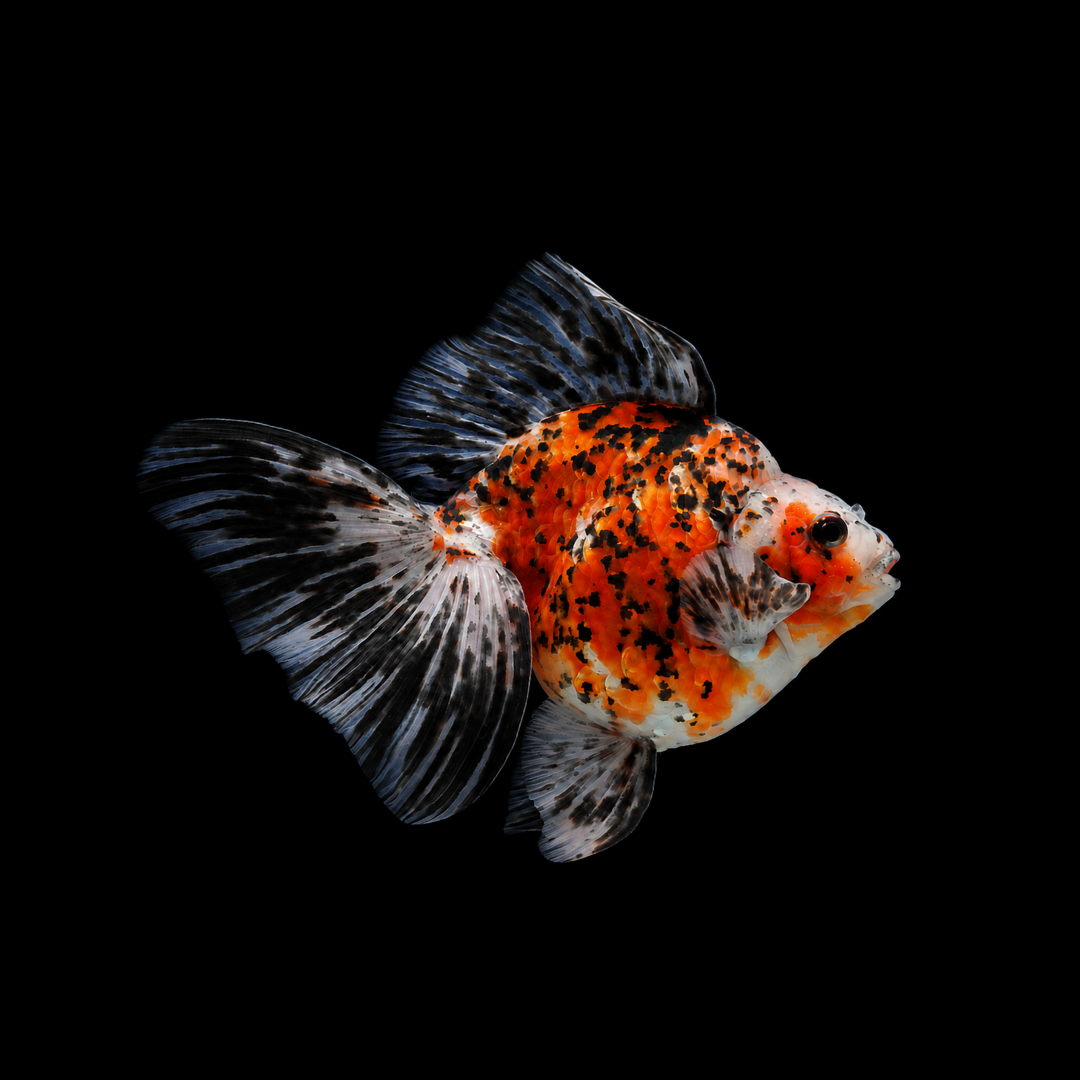
解説 / Description
ブロードテールキャリコ琉金は、琉金らしい高い体高と丸みのある短い体、赤・白・黒・浅葱が複雑に重なるキャリコ模様、そして大きく扇状に展開する尾鰭を組み合わせた金魚です。「ブロードテール」は学術的に独立した品種名というより、尾鰭の幅、張り、親骨の強さ、切れ込みの浅さなどを選抜してきた現代的な流通・育種タイプとして扱われることが多く、同じ名称でも体型や尾の形には系統差があります。横から見たときに、肩から背へ急に立ち上がる琉金特有の輪郭と、透明感のある浅葱や墨、赤斑が大きな尾とともに一体となって見えることが最大の魅力です。 The Broadtail Calico Ryukin is a fancy goldfish combining the deep, compact body of the Ryukin, a complex calico pattern of red, white, black, and blue-gray tones, and a large caudal fin that opens into a broad fan. “Broadtail” is generally used as a modern breeding and trade description rather than as a separate scientifically defined breed, so tail width, stiffness, leading-ray strength, and depth of the fork can vary among bloodlines. Its greatest appeal is seen from the side, where the steep Ryukin back, translucent asagi coloration, black markings, red patches, and expansive tail form a highly sculptural silhouette.
基本情報 / Basic Information
| 学名 / Scientific Name | Carassius auratus |
|---|---|
| 通称 / Common Name | ブロードテールキャリコ琉金、キャリコブロードテール琉金Broadtail Calico Ryukin, Calico Broadtail Ryukin |
| 分類 / Family | コイ目・コイ科・フナ属。金魚はフナ類から長い家畜化と選抜育種を経て成立した観賞魚です。Order Cypriniformes, family Cyprinidae, genus Carassius. Goldfish are domesticated ornamental forms derived from crucian-carp ancestors through long-term selective breeding. |
| 英名 / English Name | Broadtail Calico Ryukin Goldfish |
| 分布 / Distribution | 人工改良品種のため自然分布はありません。日本国内のほか、中国やタイなどでも繁殖・流通しており、日本市場では国産個体と輸入個体の双方が見られます。As a domesticated ornamental form, it has no natural wild distribution. It is bred and traded in Japan as well as in countries such as China and Thailand, and both domestically bred and imported fish are available in the Japanese market. |
| 最大体長 / Max Size | 全長15〜20cm程度の個体が多く、大型個体では20cmを超えることがあります。系統や飼育環境による差があり、体高と尾幅も大きいため、同じ全長の細長い金魚より水槽内では大きく見えます。Many individuals reach roughly 15–20 cm in total length, and larger fish may exceed 20 cm. Size varies with bloodline and husbandry, and the deep body and broad fins make the fish occupy more visual and physical space than a slender goldfish of the same length. |
| 寿命 / Lifespan | 金魚全般では10〜15年程度が一つの目安で、適切な環境ではそれ以上生きる個体もいます。実際の寿命は水質、系統、給餌、疾病歴などによって大きく変わります。For goldfish in general, about 10–15 years is a useful guideline, and some individuals live longer under good conditions. Actual lifespan varies substantially with water quality, bloodline, feeding, and disease history. |
飼育環境 / Aquarium Environment
| 水槽サイズ / Tank Size | 若魚1尾なら60cm規格水槽を最低限の目安とし、成長した個体や複数飼育では90cm規格水槽以上が扱いやすくなります。ブロードテールは体長だけでなく体高と尾幅が大きいため、遊泳面積と旋回スペースを優先してください。For one juvenile, a standard 60 cm aquarium is a practical minimum. Mature fish or groups are more comfortably managed in a standard 90 cm aquarium or larger. Because broadtail fish occupy considerable vertical and lateral space, swimming area and turning radius matter as much as water volume. |
|---|---|
| 水温 / Temperature | 15〜28℃程度に適応しますが、日常管理では20〜25℃前後の安定した範囲が扱いやすいでしょう。重要なのは急変を避けることで、冬季も必ず高温に保つ必要があるわけではありません。室内で大きく冷え込む場合や、消化状態が不安定な個体では緩やかな保温が役立ちます。 They can adapt to roughly 15–28°C, while a stable range around 20–25°C is convenient for routine indoor care. Avoiding sudden change is more important than keeping the fish warm at all times. Winter heating is not automatically required, although gentle temperature support can help in very cold rooms or with fish showing digestive instability. |
| 水質 / Water Quality | pH 7.0〜8.0程度の中性〜弱アルカリ性で、急変の少ない水が管理しやすいでしょう。アンモニアと亜硝酸は検出されない状態を維持し、硝酸塩も過度に蓄積させないことが重要です。極端な軟水より、ある程度のKHとGHがある水のほうがpHを安定させやすくなります。Stable neutral to mildly alkaline water, around pH 7.0–8.0, is generally easy to manage. Ammonia and nitrite should remain undetectable, and excessive nitrate accumulation should be avoided. Water with some carbonate and general hardness is usually easier to buffer than extremely soft water. |
| レイアウト / Layout | 大きな尾鰭を傷つけないよう、ベアタンクまたは角のない細かな底砂を薄く敷く構成が安全です。尖った岩、枝状流木、狭い隙間は避けます。濾過は十分に確保しつつ、吐出口は壁面へ向けるなどして強い直線的な水流を弱めてください。A bare-bottom aquarium or a thin layer of smooth, fine substrate is safest for the large fins. Avoid sharp rocks, branching wood, and narrow gaps. Provide adequate filtration while diffusing the outlet against a wall or otherwise reducing strong linear current. |
| 注意点 / Precautions | 短く深い体と大きな鰭は、細長い和金型よりも旋回や浮力調整に不利になりやすいため、過密飼育、強い水流、急激な水温変化、過食を避けます。通常時の水深を一律に15cm程度へ下げる必要はありませんが、浮力障害で姿勢維持が難しい病魚では、体表が空気に露出しない範囲で一時的に浅くすると負担を軽くできる場合があります。The short, deep body and large fins can make turning and buoyancy control more difficult than in streamlined single-tail goldfish, so avoid crowding, strong current, rapid temperature changes, and overfeeding. There is no need to keep healthy fish permanently in water only about 15 cm deep, but temporarily shallower water may reduce effort in a sick fish that cannot maintain posture, provided the body remains fully submerged. |
餌と給餌 / Feeding
| 餌の種類 / Diet | 金魚用の高品質な総合人工飼料を主食にします。浮力異常が出やすい個体では、沈下性またはゆっくり沈むペレットが管理しやすく、必要に応じて冷凍赤虫、ブラインシュリンプ、消化しやすい植物質を補助的に与えます。赤や橙の発色維持には、スピルリナ、アスタキサンチンなどカロテノイドを含む飼料が役立つことがあります。Use a high-quality complete goldfish diet as the staple food. For individuals prone to buoyancy problems, sinking or slowly sinking pellets are often easier to manage. Frozen bloodworms, brine shrimp, and easily digested plant material can be offered as supplements. Feeds containing carotenoids such as spirulina or astaxanthin may help maintain red and orange coloration. |
|---|---|
| 給餌のポイント / Feeding Tips | 一度に大量に与えず、少量を1日1〜3回に分け、毎回短時間で食べ切れる量にします。低水温時は消化速度が落ちるため、量と回数を減らします。浮上性飼料そのものが浮力障害の唯一の原因ではありませんが、水面で空気を大量に吸い込みやすい個体では、沈下性飼料への変更が有効な場合があります。開封後の餌は高温多湿と光を避け、酸化臭が出る前に使い切ってください。Avoid large single meals. Offer small portions one to three times per day, with each meal eaten quickly. Reduce both amount and frequency at lower temperatures because digestion slows. Floating food itself is not the sole cause of buoyancy disorders, but switching to sinking food can help individuals that gulp large amounts of air at the surface. Store opened food away from heat, humidity, and light, and replace it before it develops an oxidized odor. |
性格と混泳 / Temperament and Tank Mates
| 性格 / Temperament | 基本的には温和で、人にも慣れやすい金魚です。個体間で餌への積極性には差がありますが、縄張り性は強くありません。繁殖期の雄は雌を追尾するため、狭い水槽では雌の負担や鰭の損傷に注意します。Generally peaceful and readily accustomed to people. Individuals vary in feeding competitiveness, but they are not strongly territorial. During the breeding season, males may chase females vigorously, so confined tanks can increase stress and fin damage. |
|---|---|
| 混泳の相性 / Compatibility | 琉金、オランダ獅子頭、東錦など、泳ぐ速さや餌を取る力が近い丸手の金魚同士が合わせやすいでしょう。和金、コメット、朱文金のような細長く泳ぎの速い系統とは、餌の取り負けが起こることがあります。鰭をかじる魚、小型魚、熱帯性で高水温を要求する魚との混泳は避け、金魚同士でも体格差が大きい場合は、全個体が十分に餌を取れているか確認してください。Other rounded fancy goldfish with similar swimming speed and feeding ability, such as Ryukin, Oranda, and Azuma Nishiki, are usually the easiest companions. Fast, streamlined types such as Wakin, Comet, and Shubunkin may outcompete them for food. Avoid fin-nipping fish, very small fish, and tropical species that require high temperatures, and make sure every fish is feeding adequately when there is a large size difference. |
病気と対策 / Diseases and Prevention
| かかりやすい病気 / Common Diseases | 丸く短い体型の金魚では、水面へ浮きすぎる、沈んだままになる、姿勢を保てないといった浮力障害が問題になることがあります。一般に「転覆病」と呼ばれる症状もこの中に含まれますが、原因は単純な「腸内ガス」だけではありません。浮袋の過膨張や縮小、位置異常、液体貯留、腎臓や生殖腺など腹腔内臓器の病変、脊椎や体腔の形態、水質悪化など、複数の原因が考えられます。また、大きな尾鰭は擦れ傷を受けやすく、そこから尾腐れ症状が進むことがあります。カラムナリス症、エロモナス症、白点病、水カビ病など、金魚で一般的にみられる疾病にも注意が必要です。In round, compact goldfish, buoyancy problems may appear as excessive floating, persistent sinking, or difficulty maintaining an upright posture. These signs are often grouped by hobbyists under “swim bladder disorder,” but they are not explained by intestinal gas alone. Possible causes include overinflation or collapse of the swim bladder, abnormal position, fluid accumulation, disease of abdominal organs such as the kidneys or gonads, spinal or body-cavity conformation, and poor water quality. The large caudal fin is also prone to abrasion that can progress to fin damage. Columnaris, Aeromonas infections, ich, and fungal disease remain general risks for goldfish as well. |
|---|---|
| 対策と予防 / Prevention | 最優先は水質の確認です。アンモニア・亜硝酸、水温、pHを測定し、必要に応じて換水や濾過を見直します。軽い浮力異常が給餌直後に限ってみられる場合は、24〜72時間ほど給餌を控え、沈下性飼料へ切り替えて経過を見る方法があります。ただし、症状が長引く場合や、腹部膨満、食欲低下、出血、鱗の逆立ちなどを伴う場合は、魚類を診療できる獣医師への相談が安全です。X線検査は浮袋の大きさや位置、腹腔内病変の評価に役立ちます。浮袋への穿刺や手術は獣医療として行う処置であり、家庭で実施すべきではありません。尾腐れや口腐れが疑われる場合は隔離して水質を改善し、観賞魚用の薬剤は対象魚種と用法を確認して添付文書どおりに使用します。カラムナリス症を含む細菌性疾患は水温条件によって進行の仕方が変わるため、原因を確認せず自己判断で30℃へ加温する方法は避けます。塩水浴は補助的な管理として用いられることがありますが、病原体や基礎疾患そのものを診断・治療する方法ではありません。Water quality should be checked first. Measure ammonia, nitrite, temperature, and pH, then correct filtration or perform water changes as needed. If a mild buoyancy problem occurs only after feeding, withholding food for about 24–72 hours and switching to sinking food may be reasonable. Persistent signs, abdominal enlargement, loss of appetite, hemorrhage, or raised scales warrant consultation with a veterinarian experienced in fish. Radiography can help assess swim-bladder size and position as well as other abnormalities in the body cavity. Needle aspiration of the swim bladder and surgery are veterinary procedures and should not be attempted at home. Suspected fin or mouth rot should prompt isolation and correction of water quality, and ornamental-fish medications should be used only for the indicated fish and exactly according to the label. Because the course of bacterial diseases, including columnaris, changes with temperature, automatically raising a suspected case to 30°C without identifying the cause should be avoided. Salt baths are sometimes used as supportive management, but they do not diagnose or treat every pathogen or underlying disease. |
増やし方(繁殖) / Breeding
| 雌雄の判別 / Sexing | 成熟期には、雄の鰓蓋や胸鰭前縁に白い追星が現れやすく、雌は抱卵すると腹部がふっくらして総排泄孔がやや突出します。ただし若魚や繁殖期以外では判別が難しく、体型だけで確実に判断することはできません。During reproductive condition, males often develop small white breeding tubercles on the gill covers and leading edges of the pectoral fins, while gravid females become fuller in the abdomen and may show a slightly protruding vent. Sexing juveniles or fish outside the breeding season can be difficult, and body shape alone is not reliable. |
|---|---|
| 繁殖形態 / Reproduction | 卵生で、春から初夏にかけて水温上昇などをきっかけに追尾が始まり、水草や産卵床へ粘着性の卵をばらまきます。親魚は卵を食べるため、採卵後は親を分けるか産卵床を別容器へ移します。They are egg-layers. Rising spring temperatures often trigger courtship, with adhesive eggs scattered over plants or spawning mops. Adults may eat the eggs, so parents should be removed or the spawning substrate transferred after spawning. |
| 繁殖のポイント / Breeding Tips | ブロードテール、琉金体型、キャリコ模様は、それぞれ別の形質として選抜していく必要があります。現代の双尾系統では、chordinパラログのchdS(旧称chdA)にあるE127X変異が共通して見つかっており、この変異をホモ接合で持つことが双尾形成の主要な遺伝的基盤です。ただし、尾の分岐の現れ方には個体差があり、尾の幅や張り、体高、背の輪郭までを単一遺伝子だけで説明することはできません。古典的なモザイク透明鱗ではT/t遺伝子座の不完全優性が知られ、モザイク透明鱗同士の交配では、普通鱗、モザイク透明鱗、全透明鱗が理論上およそ1:2:1に分離します。実際の色柄や発色は他の遺伝要因や飼育環境にも左右されるため、稚魚は鱗型、体型、尾型、泳ぎ、左右対称性を総合して選別します。Broadtail form, Ryukin body shape, and calico pattern need to be selected as partly separate traits. In modern twin-tail lines, the E127X mutation in the chordin paralog chdS, formerly called chdA, is consistently found, and homozygosity for this mutation is a major genetic basis of twin-tail development. However, the degree of tail division varies, and tail breadth and stiffness, body depth, and dorsal contour cannot be explained by this single gene. In the classical nacreous-scale system, incomplete dominance at the T/t locus means that crossing two nacreous fish theoretically produces metallic, nacreous, and matte-scale offspring in a ratio of about 1:2:1. Final pattern and color expression are also influenced by other genetic factors and the rearing environment, so fry are selected by considering scale type, body shape, tail form, swimming ability, and symmetry together. |
雑学と豆知識 / Trivia and Fun Facts
| 1. キャリコ琉金は明治期の国際交流から生まれた / 1. Calico Ryukin Emerged from Meiji-Era International Exchange | キャリコ琉金は、一般に明治期に初代・秋山吉五郎が琉金と三色出目金を交配して作出したと伝えられています。また、金魚の流通史や愛好家向け資料では、アメリカ人フランクリン・パッカードの依頼が作出のきっかけとなり、まだら模様に対して英語の「Calico」という名が使われたという来歴も広く語り継がれています。こうした来歴は、キャリコ琉金が日本の育種文化だけでなく、明治期の輸出需要や海外の愛好家との交流の中で発展した金魚として理解されてきたことを示しています。Calico Ryukin is generally described in goldfish history as a Meiji-era creation of the first Kichigoro Akiyama, produced by crossing Ryukin with calico telescope-eye goldfish. Trade histories and hobbyist references also widely recount that an American, Franklin Packard, encouraged the project and that the English word “calico,” associated with a mottled textile pattern, became attached to the fish. These accounts place the development of Calico Ryukin within both Japanese breeding culture and the export-oriented international exchange surrounding ornamental goldfish in the Meiji period. |
|---|---|
| 2. 「双尾」と「ブロードテール」は同じ遺伝形質ではない / 2. Twin Tail and Broadtail Are Not the Same Genetic Trait | 琉金の二つに分かれた尾の形成には、発生初期の背腹軸形成に関わるchordin遺伝子のパラログchdS(旧称chdA)が深く関係します。代表的なE127X変異は127番目のアミノ酸位置に終止コドンを生じさせ、Chordinタンパク質の機能を大きく低下させます。その結果、胚の後方で腹側組織が拡大し、尾部が双尾方向へ発生しやすくなります。一方、「ブロードテール」は双尾を土台に、尾鰭の幅、鰭条の長さ、親骨の角度や硬さ、切れ込みの深さなどをさらに選抜した観賞形質です。現在のところ、ブロードテール全体を一つの遺伝子で説明できる根拠はなく、双尾を生じさせる遺伝的仕組みと、広く張る尾を作る育種上の選抜は分けて考えるのが適切です。The divided tail of fancy goldfish is strongly linked to chdS, formerly called chdA, a chordin paralog involved in early dorsal–ventral patterning. The well-known E127X mutation creates a stop codon at amino-acid position 127 and greatly reduces Chordin function. As a result, ventral tissue expands in the posterior embryo and development is shifted toward a twin-tail form. “Broadtail,” however, is an ornamental trait selected further on this twin-tail background through features such as fin width, fin-ray length, leading-ray angle and stiffness, and depth of the fork. There is currently no evidence that the complete broadtail phenotype is explained by a single gene, so the genetic mechanism that produces a twin tail should be distinguished from the selective breeding that produces a broad, strongly held tail. |
| 3. ゲノム重複が大胆な金魚形態を支えた / 3. Genome Duplication Helped Goldfish Tolerate Radical Morphology | 金魚系統では過去のゲノム重複によって、chordinの近縁コピーが複数残されています。双尾に関与するchdSの機能が低下しても、別のパラログであるchdL(旧称chdB)が発生機能の一部を補うことで、重い発生異常を避けられると考えられています。2024年のCRISPR/Cas9研究では、E127Xとは異なるchdSの機能欠失変異でも、生存可能な双尾個体が生じ得ることが示されました。この結果から、現代の双尾金魚でE127Xが広く固定している背景には、その変異だけが生物学的に唯一可能だったというより、歴史的な偶然や育種過程での固定が関与した可能性が示唆されています。Because the goldfish lineage experienced an ancient whole-genome duplication, multiple related chordin copies remain. It is thought that when twin-tail-associated chdS loses function, another paralog, chdL (formerly chdB), can compensate for part of its developmental role and help avoid more severe developmental defects. A 2024 CRISPR/Cas9 study showed that loss-of-function chdS mutations other than E127X can also produce viable twin-tail fish. This suggests that the widespread fixation of E127X in modern twin-tail goldfish may reflect historical contingency and fixation during selective breeding rather than an absolute biological requirement for that exact mutation. |
| 4. 琉金の「背っぱり」は脂肪の塊ではない / 4. The Ryukin Shoulder Is Not Simply a Fat Deposit | 琉金の肩から背へ急に立ち上がる輪郭を、単純な脂肪の塊や「餌で作るこぶ」とみなすのは適切ではありません。観賞用の金魚では、体型や脊柱・椎骨の構成に品種差があることが知られています。また、2026年の組織学的研究では、同じように丸く見える琉金とパールスケールでも体壁の組織構成が異なり、パールスケールでは琉金より脂肪組織が多く、筋線維密度が低いことが示されました。つまり、琉金の高い体型を単純な脂肪蓄積だけで説明することはできません。立派な体型を目指す場合も、過食で太らせるのではなく、系統が持つ体型を過不足のない栄養と十分な飼育空間で健全に育てることが基本です。It is not appropriate to treat the steep Ryukin shoulder and back as a simple mass of fat or as a “hump” that can be created by heavy feeding. Ornamental goldfish are known to differ among breeds in body form and in the organization of the vertebral column. A 2026 histological study also found that even similarly rounded breeds can reach that appearance through different tissue structures: Pearlscale goldfish had more adipose tissue and lower muscle-fiber density than Ryukin. In other words, the deep Ryukin body cannot be explained simply as fat accumulation. Developing a strong body form should therefore focus on raising the inherited conformation healthily with balanced nutrition and adequate space rather than overfeeding to make the fish heavier. |
| 5. キャリコ模様はモザイク透明鱗と色素細胞の重なりで見える / 5. Calico Patterning Comes from Nacreous Scales and Layered Pigment Cells | キャリコ系で見られるモザイク透明鱗は、反射性の高い普通鱗と、反射層が乏しく透明性の高い部分が混在することで、独特の奥行きを作ります。赤や橙には赤色色素胞や黄色色素胞、黒には黒色色素胞、銀白色の反射には虹色色素胞に含まれるグアニン結晶が関わります。浅葱は「青い色素が一種類だけ存在する」ことで生じる色ではありません。透明性の高い鱗を通して見える深部の色素と、虹色色素胞による反射や散乱が重なることで青灰色として見えるため、「チンダル現象だけで生じる」と説明するより、色素細胞の位置とグアニン由来の構造色が組み合わさった外観と考えるほうが適切です。Nacreous scales in calico goldfish create visual depth by mixing highly reflective ordinary-scale areas with regions that have little reflecting material and are relatively transparent. Red and orange involve erythrophores and xanthophores, black involves melanophores, and silvery reflection is associated with guanine crystals in iridophores. Asagi is not produced by a single blue pigment. Instead, deeper pigments seen through relatively transparent scales combine with reflection and scattering from iridophores to create a blue-gray appearance. It is therefore more accurate to understand asagi as the combined effect of pigment-cell position and guanine-based structural reflection than to attribute it solely to the Tyndall effect. |
| 6. モザイク透明鱗は古典遺伝学からゲノム解析へ進んでいる / 6. Transparent-Scale Genetics Has Moved from Classical Crosses to Genomics | 金魚の透明鱗は、古くから研究されてきた不完全優性の遺伝形質です。普通鱗、モザイク透明鱗、全透明鱗の三つの表現型がT/t遺伝子座の遺伝様式と対応することは、古典的な交配実験で示されてきました。2020年の金魚ゲノム研究では関連領域がB15染色体上へ絞り込まれ、2026年の品種横断解析では、透明鱗と共分離するBace1-like領域の一塩基多型(SNP)が育種用マーカーとして検証されています。ただし、「形質と関連するマーカー」が見つかることと、「その変異だけが形質を直接引き起こす」と証明されることは同じではありません。透明性や最終的な色柄は、反射層や各種色素細胞を含む複数の生物学的要素によって形作られます。Transparent scale in goldfish is a long-studied example of incomplete dominance. Classical crosses established that three phenotypic classes—metallic, nacreous, and matte—correspond to the T/t inheritance system. A 2020 goldfish genome study narrowed the associated region to chromosome B15, and a 2026 cross-breed analysis validated a single-nucleotide polymorphism (SNP) in a Bace1-like region that cosegregates with transparent scales as a practical breeding marker. However, finding a marker associated with a trait is not the same as proving that the marker itself is the sole mutation directly causing that trait. Final transparency and color pattern are shaped by multiple biological components, including reflective tissue and several types of pigment cells. |
| 7. 稚魚の色変わりは「一斉に完成」するものではない / 7. Juvenile Color Change Is a Gradual and Variable Process | 金魚の稚魚は初めから成魚の赤やキャリコ柄を持っているわけではなく、成長とともに黒褐色の保護色から色素細胞の構成が変化します。ただし「針仔」「青仔」「黒仔」などの呼び方や時期は生産現場や系統で幅があり、すべてのキャリコ個体が同じ月齢で同じ順序をたどるわけではありません。水温や栄養、照明は発育速度や色の見え方に影響しますが、強い直射日光や紫外線を当てれば必ず良い浅葱になるというものでもありません。キャリコでは成魚になってからも墨の濃淡や赤の面積が変わる個体が多く、固定された模様というより、生涯を通じて少しずつ表情が変わること自体が魅力の一つです。Goldfish fry do not hatch with the finished red and calico patterns of adults. As they grow, the early gray-brown camouflage coloration changes as pigment-cell populations and visibility shift. Traditional Japanese stage names such as hariko, aoko, and kuroko are useful husbandry terms, but their timing varies among farms and bloodlines, and not every calico fish follows exactly the same schedule. Temperature, diet, and lighting influence development and appearance, but intense direct sunlight or ultraviolet exposure is not a guaranteed method for producing better asagi. In many calico fish, black markings and the balance of red continue to change even in adulthood, making the pattern a living, evolving feature rather than a permanently fixed design. |
| 8. 日本の競り市場と輸入防疫が流通を支えている / 8. Auctions and Import Quarantine Shape the Japanese Supply Chain | 愛知県弥富市は生産地であると同時に全国的な流通拠点で、市内には金魚市場が3か所あり、それぞれ月・水・金曜日に開市されます。底に網を張った「かんこ」と呼ばれる箱を使い、1尾当たりの価格を独特の符牒で競る光景は弥富金魚の象徴です。関東では、埼玉県加須市の埼玉県養殖漁業協同組合・水産流通センターが観賞魚流通の拠点の一つとして知られています。一方、海外から生きた金魚を輸入する場合は、水産資源保護法に基づく輸入許可の対象です。2026年時点の農林水産省制度では、輸入許可時に疾病を広げるおそれが否定できない場合に管理命令が付され、金魚その他のフナ属では通常10日、コイ春ウイルス血症の病原体を広げるおそれがないと認められない場合は15日の管理期間が定められています。したがって、「中国産金魚は必ず一律15日」と単純化するのではなく、輸出国政府の検査証明書、輸入時の検査、疾病リスク、管理命令の有無に応じて扱われる制度と理解する必要があります。Yatomi in Aichi Prefecture is both a production center and a national distribution hub. The city has three goldfish markets operating on Monday, Wednesday, and Friday, where fish are handled in net-bottomed boxes called kanko and priced per fish using specialized auction terminology. In the Kanto region, the Saitama Aquaculture Cooperative and its Fisheries Distribution Center in Kazo are known as one of the hubs for ornamental-fish distribution. Imported live goldfish are subject to import permission under Japan’s Act on the Protection of Fishery Resources. Under the Ministry of Agriculture, Forestry and Fisheries system current in 2026, a management order may be issued when the risk of spreading a listed disease cannot be ruled out. For goldfish and other Carassius species, the management period is normally 10 days, or 15 days when the risk of spreading spring viremia of carp cannot be excluded. It is therefore inaccurate to reduce the rule to “all Chinese goldfish must always be quarantined for 15 days”; requirements depend on an inspection certificate issued by the exporting government, import inspection, disease risk, and whether a management order is imposed. |
| 9. 転覆症状は「病名」より「症候群」と考えると理解しやすい / 9. Buoyancy Trouble Is Better Understood as a Syndrome Than a Single Disease | 金魚が逆さに浮くと、すぐに「消化不良による転覆病」と考えがちですが、獣医学では浮力障害という症候として原因を切り分けます。X線検査を用いた観賞魚の報告では、浮袋の過膨張や位置異常、液体貯留、腸管内ガス、腎臓の嚢胞性病変など、見た目が似ていても異なる病態が確認されています。琉金のような短躯型では、体腔の形が浮袋や臓器の配置にも影響するため、給餌の見直しで改善する例もあれば、画像診断が必要な例もあります。実際に、浮袋の過膨張を起こした琉金に対して麻酔下で浮袋を外科的に縮小した症例も報告されています。家庭では、まず水質を確認し、次に給餌との関連を見直し、症状が続く場合は原因を診断してもらう、という順序で考えることが過度な民間療法を避けるうえで大切です。When a goldfish floats upside down, it is tempting to assume a simple digestive problem, but veterinary medicine treats abnormal buoyancy as a clinical syndrome and separates its possible causes. Reports using radiography in ornamental fish have documented overinflated or displaced swim bladders, fluid accumulation, intestinal gas, and cystic kidney disease among fish with superficially similar signs. In compact breeds such as Ryukin, the shape of the body cavity can also influence the position of the swim bladder and other organs, so some cases improve after feeding is reviewed while others require diagnostic imaging. A published case report describes surgical reduction of an overinflated swim bladder in an anesthetized Ryukin. At home, a sensible sequence is to check water quality first, review whether feeding is related to the signs, and seek a diagnosis if the problem persists. |
まとめ / Conclusion
ブロードテールキャリコ琉金は、キャリコ琉金として受け継がれてきた多彩な色彩、双尾を生み出す金魚特有の発生遺伝学、そして大きく張る尾鰭を選抜してきた育種の積み重ねが一つになった金魚です。赤、白、墨、浅葱の見え方は色素だけで決まるのではなく、モザイク透明鱗の反射性や色素細胞の位置にも左右されるため、一尾ごとに異なる表情が生まれます。The Broadtail Calico Ryukin brings together the varied coloration inherited from Calico Ryukin, the distinctive developmental genetics that produce the goldfish twin tail, and selective breeding for a large, strongly held caudal fin. Its red, white, black, and asagi tones are shaped not only by pigments but also by the reflectivity of nacreous scales and the position of pigment cells, giving each fish an individual appearance.
一方で、短く深い体と大きな尾鰭は、細長い金魚よりも遊泳や浮力調整に負担がかかりやすい形でもあります。十分な飼育空間、穏やかな水流、安定した水質、食べ過ぎを避けた給餌を基本に、姿勢や尾鰭の状態を日々観察することが大切です。無理に体型や発色を作ろうとせず、その個体の成長に合わせて健全に育てることで、堂々と広がる尾と、少しずつ移ろうキャリコ模様を長く楽しめます。At the same time, the short, deep body and large caudal fin can place greater demands on swimming and buoyancy control than a streamlined goldfish. Adequate space, gentle water movement, stable water quality, restrained feeding, and daily observation of posture and fin condition are therefore important. Rather than trying to force body shape or coloration, raising each fish steadily and healthily allows its expansive tail and gradually changing calico pattern to be enjoyed over the long term.

気になる道具や飼い方を見つけてみませんか?
 アイのアクアグッズ案内エーハイムはおもちゃから始まった? 小さな噴水から水槽へ、アイとコタロウの探訪道具の特徴や使い方、選ぶときのポイントをアイが紹介します。記事はコチラ →
 アイのアクアグッズ案内水草用ライトの選び方|緑の絨毯と赤い水草を楽しむ照明・植栽用品道具の特徴や使い方、選ぶときのポイントをアイが紹介します。記事はコチラ →
さまざまな飼育テーマをご紹介。リンク先の記事には広告・商品紹介が含まれます。
案内・紹介記事一覧へ →分布マップ
Carassius auratusの人工改良品種であるブロードテールキャリコ琉金には自然分布はありません。日本を中心に、中国やタイなど東アジア・東南アジアの各地で繁殖・流通しています。
※この地図は記事中の分布情報をもとに、日本・中国・タイなどの繁殖・流通地域を含むよう設定した概略表示です。マーカーは表示範囲を把握しやすくするための代表地点であり、実際の採集地点、生息地点、特定の養殖場を示すものではありません。
参考文献
-
Fricke, R., Eschmeyer, W. N. & Van der Laan, R. (eds.). Eschmeyer’s Catalog of Fishes: Carassius auratus.
California Academy of Sciences. Online version, updated 13 Aug 2026.
-
Froese, R. & Pauly, D. (eds.). FishBase: Carassius auratus.
FishBase. 分類、基礎種の自然分布、生息環境、生活史および繁殖情報。
-
Chen, D. et al. (2020). The evolutionary origin and domestication history of goldfish (Carassius auratus).
Proceedings of the National Academy of Sciences, 117(47), 29775–29785. doi:10.1073/pnas.2005545117
-
Watson, C. A., Hill, J. E. & Pouder, D. B. (2004). Species Profile: Koi and Goldfish.
Southern Regional Aquaculture Center Publication No. 7201. 飼育水温、水質、給餌、繁殖および養殖管理。
-
Kobayashi, M., Iwata, E. & Sorensen, P. W. (2026). Environmental and Physiological Regulation of Reproduction in the Goldfish: Gonadal Development, Maturation, and Spawning Behavior: A Review.
Animals, 16(5), 775. doi:10.3390/ani16050775
-
Francis-Floyd, R., Yanong, R. P. E. & Petty, B. D. Environmental Diseases of Aquatic Animals in Aquatic Systems.
Merck Veterinary Manual. Last updated June 2026. アンモニア、亜硝酸、pH、温度などの水質管理と環境性疾患。
-
Petty, B. D., Francis-Floyd, R. & Yanong, R. P. E. Bacterial Diseases of Fish.
Merck Veterinary Manual. Last updated September 2024. Aeromonas属、Flavobacterium属などの細菌性疾患と環境要因。
-
Declercq, A. M., Haesebrouck, F., Van den Broeck, W., Bossier, P. & Decostere, A. (2013). Columnaris disease in fish: a review with emphasis on bacterium-host interactions.
Veterinary Research, 44, 27. doi:10.1186/1297-9716-44-27
-
Britt, T., Weisse, C., Weber, E. S., Matzkin, Z. & Klide, A. (2002). Use of pneumocystoplasty for overinflation of the swim bladder in a goldfish.
Journal of the American Veterinary Medical Association, 221(5), 690–693. doi:10.2460/javma.2002.221.690
-
農林水産省「水産輸入防疫制度について」
水産資源保護法に基づく輸入許可、管理命令、金魚その他のフナ属魚類に対する管理期間。





コメント