

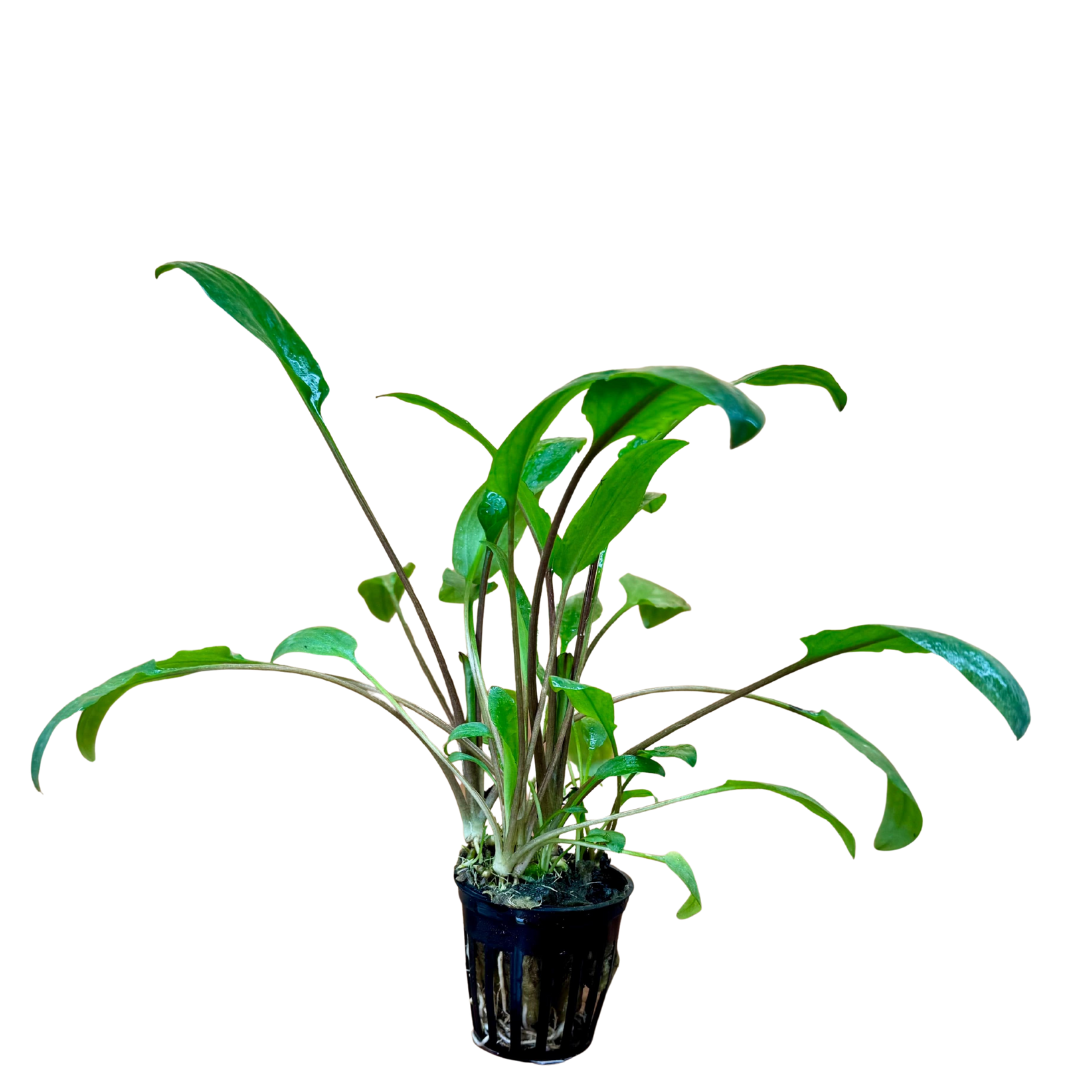
解説 / Description
クリプトコリネ・ウェンティ・ブロードリーフは、スリランカ原産のクリプトコリネ・ウェンティから選抜・流通している広葉タイプの水草です。一般的なウェンティ系統よりも葉幅が広く、ライトグリーンから深い緑色の葉をロゼット状に広げるため、中景に自然なボリュームを作りたいときに扱いやすい存在です。環境によっては葉に茶褐色の斑が入り、緑一色になりがちな水景に落ち着いた変化を添えてくれます。 Cryptocoryne wendtii ‘Broad Leaf’ is a broad-leaved cultivated form of Cryptocoryne wendtii from Sri Lanka. It forms a rosette of fairly wide leaves, ranging from light green to rich green, and is especially useful for creating natural volume in the midground of an aquarium. Depending on growing conditions, the leaves may show brownish mottling, adding subtle depth to planted layouts.
クリプトコリネの仲間らしく、強い光やCO2添加がなくても維持しやすい一方、植え替えや急な水質変化には一時的に葉を溶かすことがあります。この「溶け」は枯死とは限らず、新しい環境に合わせた葉へ作り替えるための反応として見られることが多い現象です。根と株元が健全であれば再生する可能性が高いため、導入後は頻繁に動かさず、安定した環境で見守ることが大切です。 Like many Cryptocoryne species, it can be maintained without intense lighting or mandatory CO2 injection, but it may melt its older leaves after planting or sudden environmental changes. This “crypt melt” does not always mean the plant is dead; it is often a response to a new underwater environment. If the roots and crown remain firm, the plant can recover, so stable conditions and patience are essential.
基本情報 / Basic Information
| 学名 / Scientific Name | Cryptocoryne wendtii ‘Broad Leaf’ 種としての Cryptocoryne wendtii は1958年にde Witによって記載されたスリランカ産のクリプトコリネです。’Broad Leaf’ は学術上の変種名というより、広葉の形質を持つ栽培・流通上の名称として扱うのが自然です。Cryptocoryne wendtii was described by de Wit in 1958. ‘Broad Leaf’ is best understood as a cultivated or trade name for a broad-leaved form rather than a formal botanical variety. |
|---|---|
| 通称 / Common Name | クリプトコリネ・ウェンティ・ブロードリーフ、クリプト・ウェンティ・ブロードリーフ、クリプトコリネ・ウェンティ広葉タイプCryptocoryne wendtii ‘Broad Leaf’, Broad Leaf Crypt, Water Trumpet |
| 分類 / Family | サトイモ科クリプトコリネ属Araceae, genus Cryptocoryne |
| 分布 / Distribution | 原種のクリプトコリネ・ウェンティはスリランカ西部から中央部に分布する湿生・抽水性の多年草です。水槽用に流通するブロードリーフは、主に栽培株や組織培養株として供給されます。The species Cryptocoryne wendtii is native to western and central Sri Lanka, where it grows as a helophyte or perennial in wet tropical habitats. The ‘Broad Leaf’ form in the aquarium trade is mainly supplied as cultivated or tissue-cultured stock. |
| 育成難易度 / Difficulty | やさしい部類です。低光量でも維持しやすく、水質への適応幅も広い水草ですが、植え替え直後は溶けが出ることがあります。根を傷めない植栽と、導入後に環境を大きく変えない管理が重要です。Easy. It tolerates relatively low light and a wide range of water conditions, but leaf melt may occur soon after planting. Gentle planting and stable conditions after introduction are important. |
育成環境 / Cultivation Environment
| 光量 / Light | 低光量でも維持しやすく、中光量からやや明るめの環境ではより充実したロゼットを作りやすくなります。陰になる場所ではゆっくりと育ち、開けた明るい場所では葉を低く広げる傾向があります。強光下ではコケが付くこともあるため、照明時間はまず6〜8時間程度から安定させると安心です。It can be maintained under low light, while moderate to fairly bright conditions encourage a fuller rosette. In shaded areas it grows more slowly, and in open brighter areas the leaves tend to spread lower. Under strong light, algae may appear on older leaves, so a stable photoperiod of about 6 to 8 hours is a safe starting point. |
|---|---|
| CO2添加 / CO2 Injection | CO2添加は必須ではありません。無添加の水槽でも維持できますが、添加すると新芽の展開が安定し、葉の厚みや株の充実感が出やすくなります。添加する場合も急な増減を避け、毎日同じリズムで管理することが大切です。CO2 injection is not mandatory. The plant can be maintained in low-tech aquariums, but injected CO2 supports steadier new growth and fuller leaves. If CO2 is used, it should be kept consistent rather than changed abruptly. |
| 水質 / Water Quality | 水温は20〜28℃前後、pHは弱酸性から中性付近を中心に、やや幅広く対応します。硬度にも比較的強く、一般的な水草水槽の範囲であれば大きな問題は起きにくい水草です。ただし、導入直後の大幅な水換えや急な温度変化は溶けのきっかけになるため、安定性を優先した管理が必要です。A temperature range of about 20 to 28°C is suitable, with slightly acidic to neutral water being ideal, although the plant is fairly adaptable. It also tolerates moderately hard water. Sudden large water changes or temperature swings after planting can trigger melting, so stability should be prioritized. |
| 底床 / Substrate | 根から栄養をよく吸収するロゼット型の水草なので、栄養系ソイルと相性が良好です。砂利や大磯砂でも育成できますが、その場合は根元に固形肥料を補うと株が充実しやすくなります。植え付け時は株元の成長点を深く埋めすぎず、根が広がれる余地を残しておくことが大切です。As a rosette plant that feeds heavily through its roots, it performs very well in nutrient-rich aquarium soil. It can also be grown in gravel, but root tabs help maintain strong growth. When planting, avoid burying the crown too deeply and leave room for the roots to spread. |
レイアウト / Layout
| 配置 / Positioning | 前景後方から中景に向きます。草丈はおおむね10〜20cm前後に収まりやすく、30cmキューブ水槽では主役級の中景、60cm規格水槽では流木や石の根元をつなぐ自然な茂みとして使いやすい水草です。広葉の面が出るため、細葉の有茎草やモス類と組み合わせると葉形の対比が生まれます。It is best used from the rear foreground to the midground. With a typical height of about 10 to 20 cm, it can become a main midground plant in a 30 cm cube aquarium, while in a standard 60 cm aquarium it works well around driftwood or stones. Its broad leaves contrast nicely with fine-stemmed plants and mosses. |
|---|---|
| 注意点 / Precautions | 植栽後に頻繁に抜き差しすると根が傷み、定着が遅れます。成長後はロゼットが横に広がるため、前景草を覆いすぎないように、最初から株間を少し広めに取ると扱いやすくなります。葉が大きいぶんコケが目立ちやすいので、水流が弱すぎる場所や汚れが溜まる場所は避けておくと安心です。Frequent replanting damages the roots and delays establishment. Since the rosette spreads outward as it matures, allow enough spacing from the beginning so it does not cover smaller foreground plants. Because the broad leaves can show algae easily, avoid stagnant areas where debris accumulates. |
増やし方(トリミング) / Propagation & Trimming
| 増やし方 / Propagation | 環境に慣れると、根元からランナーを伸ばして子株を出し、少しずつ群落を広げます。子株に十分な根と葉が出てから親株から分けると失敗しにくく、無理に小さな芽を切り離さないことが大切です。Once established, it slowly forms new plantlets on runners from the base. Separating plantlets after they have developed enough roots and leaves improves success, so very small shoots should not be divided too early. |
|---|---|
| トリミング / Trimming | 有茎草のように切り戻すのではなく、古くなった葉やコケが付いた葉を株元から取り除く管理が中心です。外側の葉から整理するとロゼットの形を崩しにくく、中心の新芽を傷つけないように作業することが重要です。It is not trimmed like stem plants. Maintenance mainly involves removing old, damaged, or algae-covered leaves from the base. Removing outer leaves first keeps the rosette shape intact, and the central new growth should be protected during maintenance. |
病気と対策(コケなど) / Pests & Algae
| かかりやすい病気 / Common Issues | 代表的なトラブルは、導入直後や環境変化後に起こる「クリプトの溶け」です。葉が半透明になったり、茶色く崩れたりしても、根と株元がしっかりしていれば回復することがあります。成長が遅い環境では古葉に茶ゴケや黒ひげ状のコケが付くこともあるため、照明と栄養のバランスを見ることが重要です。The most common issue is “crypt melt” after introduction or environmental change. Leaves may turn translucent or collapse, but the plant can recover if the roots and crown remain healthy. In slow-growth conditions, diatoms or brush algae may appear on older leaves, so light and nutrients should be balanced. |
|---|---|
| 対策と予防 / Prevention | 溶けた葉は水質悪化を防ぐため、根元から丁寧に取り除きます。ただし、株そのものを何度も引き抜くのは避け、根元が生きている場合はそのまま再生を待つのが基本です。組織培養カップで購入した株はスネールや農薬のリスクが少ない一方、培地をよく洗い落としてから植えると導入後の濁りや腐敗を防ぎやすくなります。Melted leaves should be removed carefully from the base to prevent water quality deterioration. However, repeated uprooting should be avoided; if the crown is alive, it is usually better to let the plant recover in place. Tissue-cultured plants have a lower risk of snails and pesticide residue, but the culture gel should be rinsed off thoroughly before planting. |
雑学と豆知識 / Trivia and Fun Facts
| 1. 「隠された棍棒」という名を持つ水草 / 1. A plant named after a hidden club | 属名のCryptocoryneは、ギリシャ語で「隠された」を意味するcryptoと、「棍棒」を意味するkoryneに由来するとされます。これはサトイモ科らしい肉穂花序が、筒状に伸びた仏炎苞の奥に隠れるように収まる花の構造を表したものです。水槽内では葉を楽しむ水草として知られますが、陸上栽培やパルダリウムでじっくり育てると、奇妙で美しい仏炎苞を観察できることがあります。葉だけでなく花の形まで見ていくと、クリプトコリネが単なる丈夫な陰性水草ではなく、サトイモ科植物としての個性を色濃く持つ存在だと分かります。The genus name Cryptocoryne is generally understood to derive from Greek roots meaning “hidden” and “club,” referring to the club-like spadix hidden within the tubular spathe. In aquariums, the plant is mainly appreciated for its leaves, but in emersed culture or paludariums it may produce its unusual spathe. Looking beyond the leaves reveals its strong identity as an aroid plant. |
|---|---|
| 2. ウェンティが多くの品種を生んだ理由 / 2. Why wendtii produced so many forms | クリプトコリネ・ウェンティは、葉の形や色、表面の凹凸、草丈に大きな変化が出やすい植物として知られます。同じウェンティの仲間でも、グリーン、ブラウン、トロピカ、ミオヤ、ブロードリーフのように、アクアリウムでは別物のような印象で流通することがあります。これは厳密な分類上の違いというより、もともとの多型性と栽培選抜、さらに組織培養による形質の固定が重なって生まれた文化的な広がりと考えると分かりやすいでしょう。ブロードリーフはその中でも、広い葉面と扱いやすい緑色を活かし、水景に落ち着いた量感を与えるための実用的なタイプです。Cryptocoryne wendtii is known for remarkable variation in leaf shape, color, texture, and size. In the aquarium trade, forms such as Green, Brown, Tropica, Mi Oya, and Broad Leaf can look almost like different plants. These names are best understood as a mix of natural variation, horticultural selection, and stable propagation through cultivation or tissue culture. Broad Leaf is a practical form valued for its wide leaves and calm green presence. |
| 3. 「溶け」は失敗ではなく、作り替えのサイン / 3. Melt is not always failure | クリプトコリネを初めて育てる人が最も驚くのが、導入後に葉が急に崩れる「溶け」です。見た目はショッキングですが、スリランカの雨季と乾季のような水位変動に適応してきた植物だと考えると、この反応には筋が通っています。水上葉から水中葉へ、あるいは別の水質へ移るとき、古い葉を維持するよりも、新しい環境に合う葉へ作り替えた方が合理的な場合があります。大切なのは、崩れた葉を掃除しながらも株元をいじりすぎず、根が新しい環境をつかむ時間を与えることです。The sudden melting of leaves after introduction can be alarming, but it is not always a sign of failure. As a plant adapted to changing water levels, Cryptocoryne may abandon old leaves and rebuild foliage suited to the new environment. The key is to remove decaying leaves while avoiding unnecessary disturbance to the crown and roots. |
| 4. 組織培養が日本の水草導入を変えた / 4. Tissue culture changed how aquarists introduce plants | かつて輸入ポットの水草では、残留農薬やスネール混入が問題になることがありました。特にヤマトヌマエビやビーシュリンプなどを入れた水槽では、農薬リスクに神経を使う必要がありました。現在は組織培養カップの流通が広がり、農薬やスネールの混入リスクを抑えた状態で導入しやすくなっています。クリプトコリネ・ウェンティ・ブロードリーフのように形質をそろえて流通させたい水草では、組織培養は安全性だけでなく、品種としての安定感にも関わる重要な技術です。Imported potted aquarium plants once carried concerns such as pesticide residue and hitchhiking snails. This was especially important for shrimp aquariums. Tissue-cultured cups have made it easier to introduce plants with lower risks of pests and pesticide contamination. For a selected form such as Cryptocoryne wendtii ‘Broad Leaf’, tissue culture also helps maintain a more consistent appearance. |
まとめ / Conclusion
クリプトコリネ・ウェンティ・ブロードリーフは、広めの葉と落ち着いた緑色が魅力の中景向け水草です。強い光やCO2添加がなくても育成しやすく、30cmキューブから60cm規格水槽、さらに大きな水槽の流木・石組み周りまで幅広く使えます。成長はゆっくりですが、そのぶんレイアウトを長く崩しにくく、安定した水景づくりに向いた水草です。 Cryptocoryne wendtii ‘Broad Leaf’ is an attractive midground plant with broad, calm green leaves. It can be grown without intense light or mandatory CO2 injection and fits a wide range of layouts, from 30 cm cube aquariums to standard 60 cm tanks and larger hardscape-based aquariums. Its slower growth helps maintain a stable layout over time.
育成のコツは、植え付け後に動かしすぎず、根が張るまで安定した環境を保つことです。導入直後に溶けが出ても、根と株元が生きていれば再生する可能性は十分あります。葉の美しさだけでなく、スリランカの環境変化に適応してきたクリプトコリネらしい生命力を楽しむ水草として、じっくり付き合うことが大切です。 The key to success is to avoid moving it too often after planting and to maintain stable conditions while the roots establish. Even if melting occurs after introduction, the plant can often recover if the crown and roots remain healthy. It is a plant to be enjoyed patiently, not only for its foliage but also for the resilience typical of Sri Lankan Cryptocoryne.

気になる道具や飼い方を見つけてみませんか?
 アイのアクアグッズ案内テトラミンって、こんなにあるの? アイとコタロウのごはん探究旅道具の特徴や使い方、選ぶときのポイントをアイが紹介します。記事はコチラ →
 アイのアクアグッズ案内水槽のエアーポンプの選び方|水深・音・泡で選ぶおすすめ用品道具の特徴や使い方、選ぶときのポイントをアイが紹介します。記事はコチラ →
さまざまな飼育テーマをご紹介。リンク先の記事には広告・商品紹介が含まれます。
案内・紹介記事一覧へ →参考文献・参照資料
本記事は、クリプトコリネ・ウェンティの分類、分布、栽培品種としての扱い、育成条件、アクアリウムでの管理方法について、以下の資料を参照して構成しています。通販ページや店舗販売ページは参考文献から除外しています。
-
Royal Botanic Gardens, Kew. Plants of the World Online. “Cryptocoryne wendtii de Wit”. 参照日:2026年5月21日。
学名の受け入れ状況、記載情報、原産地が西部・中央スリランカであること、湿性熱帯バイオームに生育する湿生・多年草であることの確認に使用しました。 -
Dennerle Plants. “Cryptocoryne wendtii ‘Broad Leaf’”. 参照日:2026年5月21日。
ブロードリーフが広葉タイプの Cryptocoryne wendtii として扱われること、スリランカ由来のウォータートランペットであること、葉色・斑の特徴、育成難易度、水温、pH、硬度、CO2、草丈、増殖形態などの育成条件の確認に使用しました。 -
Bastmeijer, Jan D. “Cryptocoryne wendtii de Wit”. The Crypts Pages. 参照日:2026年5月21日。
Cryptocoryne wendtii の形態変異が大きいこと、環境によって草姿が変わること、栽培名や地域名を含む流通上の名称の扱いを整理するために参照しました。 -
Bastmeijer, Jan D. “Structures in Cryptocoryne: inside the kettle”. The Crypts Pages. 参照日:2026年5月21日。
クリプトコリネ属の花序構造、仏炎苞、肉穂花序、雌花・雄花の配置など、雑学欄で扱ったサトイモ科植物としての形態的特徴の補助資料として参照しました。 -
Kasselmann, Christel. Aquarium Plants. 2020 English edition. Christel Kasselmann official site, “Aquarium Plants”. 参照日:2026年5月21日。
水草の自然生息地、温度、光、底床、水質、形態、レイアウト利用を総合的に扱う標準的資料として、記事全体の育成情報を整理する際の基礎資料にしました。 -
Aqua Design Amano. “ADA PLANTS GALLERY #14 Cryptocoryne wendtii”. AQUA JOURNAL, 2023年2月10日公開。参照日:2026年5月21日。
Cryptocoryne wendtii がスリランカ西部・中央部に分布する固有的な水草であり、グリーン、ブラウン、凹凸のある葉など多様なフォームが知られることを、アクアリウム文脈で確認するために参照しました。 -
Merriam-Webster. “Cryptocoryne Definition & Meaning”. 参照日:2026年5月21日。
属名 Cryptocoryne の語源として、crypt- とギリシャ語 korynē に由来する説明を確認するために参照しました。




コメント