



解説 / Description
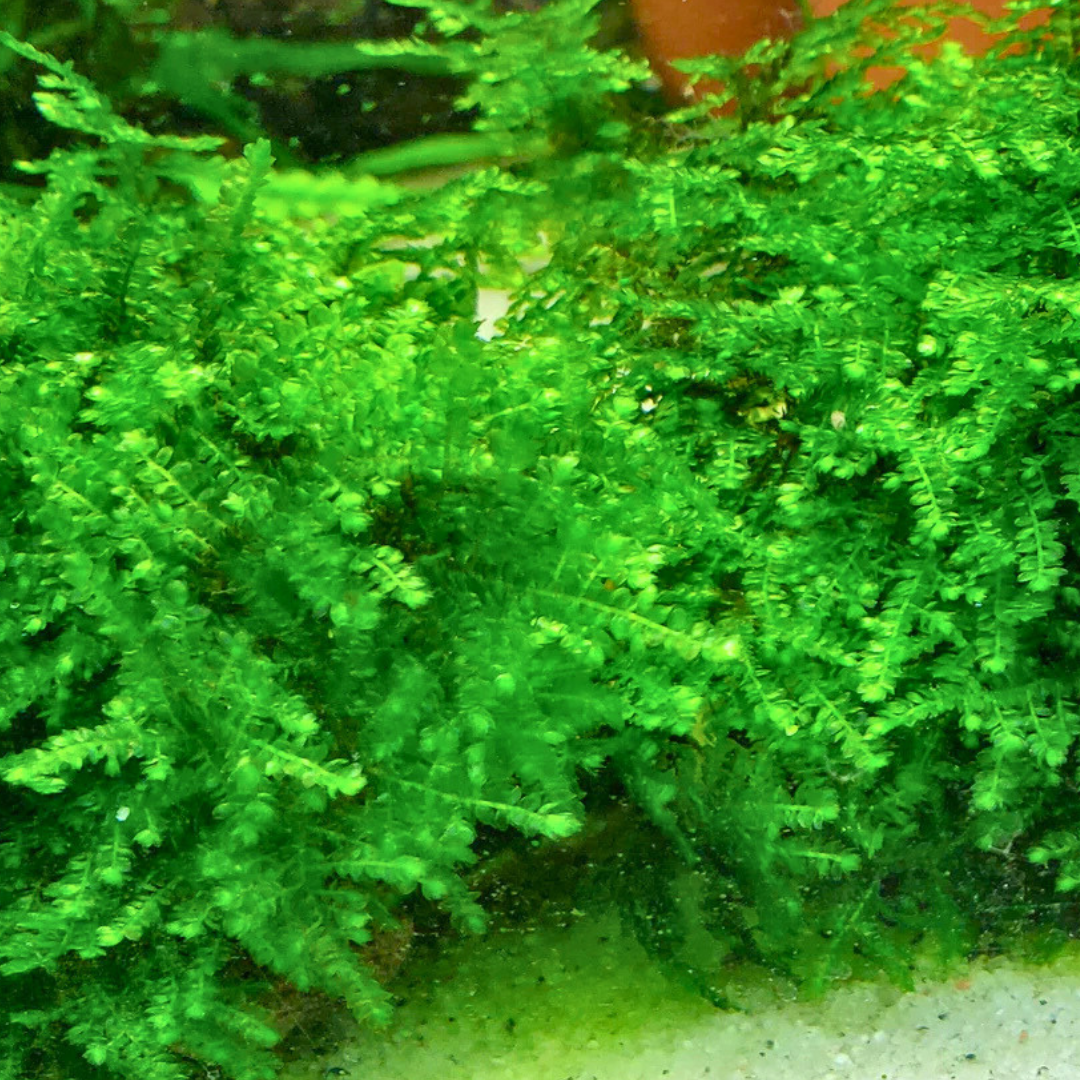
ウィーピングモスは、伸びた新芽が弓なりに曲がり、下へ垂れ下がるように茂る水生のコケです。名前の「ウィーピング(weeping)」は英語で「枝垂れる」という意味で、まさにこの姿を表しています。流木の枝先や石組みの上部に活着させると、葉先がふんわりと下を向き、小さな老木や苔むした崖のような情景が水槽の中に生まれます。上や横へ広がる一般的なモスとはひと味違う、この下向きの成長こそが本種いちばんの個性です。 Weeping Moss is an aquatic moss whose new shoots arch over and hang downward as they grow. Its name comes from the English word “weeping,” meaning drooping, which describes this habit perfectly. When attached to the tips of driftwood branches or the top of a rockscape, the shoots fall softly downward, creating scenes reminiscent of an ancient miniature tree or a moss-covered cliff inside the tank. This downward growth, so different from mosses that spread upward or sideways, is the defining charm of the species.
コケの仲間は本当の根や維管束を持たず、水分も養分も体の表面から直接取り込んで育ちます。日本の水道水でも無理なく育つ丈夫さがある一方、夏の高水温や、茂りすぎて内側が蒸れることには弱い面があります。暑さ対策とこまめな間引きを心がければ、美しい茂みを長く楽しめます。細かく入り組んだ茂みはエビ類の隠れ家にもなり、シュリンプ水槽との相性も抜群です。 Like other mosses, it has no true roots or vascular tissue and absorbs water and nutrients directly through its surface. It grows readily even in Japanese tap water, yet it is sensitive to high summer temperatures and to stagnation inside overgrown clumps. With heat management and regular thinning, it rewards you with long-lasting, beautiful growth. Its dense, intricate tufts also provide shelter for shrimp, making it an excellent match for shrimp tanks.
基本情報 / Basic Information
| 学名 / Scientific Name | Vesicularia ferriei (Cardot & Thér.) Broth. アクアリウム用のモスは、かつて流通名と学名の対応がはっきりしていませんでしたが、2000年代の研究によって、ウィーピングモスとして売られていたものが本種であると確かめられました。よく似たクリスマスモス(Vesicularia montagnei)は同じ属の別種です。The trade names and scientific names of aquarium mosses were once poorly matched, but research in the 2000s confirmed that the moss sold as Weeping Moss is this species. The similar Christmas Moss (Vesicularia montagnei) is a separate species in the same genus. |
|---|---|
| 通称 / Common Name | ウィーピングモス、フクロハイゴケ(和名)Weeping Moss |
| 分類 / Family | ハイゴケ科 ベシキュラリア属(ハイゴケ目)Hypnaceae, genus Vesicularia (order Hypnales) |
| 分布 / Distribution | 中国、台湾、日本などの東アジア。日本では本州以南に自生し、渓流沿いの湿った岩の上や湿った土の上などで見られます。減少が心配されている地域もあるため、野外での採集は控え、販売されている株を利用しましょう。East Asia, including China, Taiwan, and Japan. In Japan it grows from Honshu southward, on damp rocks along streams and on moist soil. Because it is declining in some areas, avoid collecting from the wild and use commercially available plants instead. |
| 育成難易度 / Difficulty | 易しい〜普通。水質への適応幅が広く、CO2を添加しなくても育ちます。ただし28℃を超える水温が続くと茶色く枯れやすいため、夏場の水温管理が最大のポイントです。きれいな枝垂れ姿を引き出すには、ある程度しっかりした光も必要です。Easy to moderate. It tolerates a wide range of water conditions and grows without added CO2. However, sustained temperatures above 28°C easily cause browning, so summer temperature control is the key challenge. Reasonably strong light is also needed to bring out the attractive weeping form. |
育成環境 / Cultivation Environment
| 光量 / Light | 中程度からやや強めの光量がおすすめです。光が足りないと横に這ったり上へ間延びしたりして、本種らしい下向きの姿が出にくくなります。反対に光が強すぎると糸状のコケが絡みやすくなるため、照明時間は1日8時間前後を目安にバランスを取りましょう。Moderate to fairly strong light is recommended. In low light, the moss tends to creep sideways or stretch upward, and its characteristic downward form is lost. Very strong light, on the other hand, invites filamentous algae, so aim for a balance with a photoperiod of around 8 hours a day. |
|---|---|
| CO2添加 / CO2 Injection | 必須ではありませんが、添加すると成長が早まり、葉色も深い緑になります。光合成が盛んになると、葉の表面から酸素の小さな泡が立ちのぼる「パーリング」が見られることもあります。無添加で育てる場合は成長がゆっくりになるため、光を控えめにしてコケの発生を抑えると安定します。Not required, but CO2 speeds up growth and deepens the green color. When photosynthesis is active, you may see tiny oxygen bubbles rising from the leaves, known as pearling. Without CO2, growth is slower, so keeping light moderate helps prevent algae and keeps the tank stable. |
| 水質 / Water Quality | 水温15〜28℃(最適20〜26℃)、pH5.0〜7.5の弱酸性〜中性、軟水〜中程度の硬度が目安です。日本の水道水であれば問題なく育ちます。特に注意したいのが高水温で、夏は冷却ファンや水槽用クーラー、エアコンによる室温管理などで26℃前後に抑えるのが理想です。冷却ファンを使うと水の蒸発が増えるので、足し水も忘れずに行いましょう。適度な水流があると、茂みの中に汚れがたまりにくくなります。Temperature 15–28°C (ideally 20–26°C), pH 5.0–7.5 (slightly acidic to neutral), and soft to moderately hard water. It grows well in Japanese tap water. High temperature deserves particular attention: in summer, aim to keep the tank around 26°C using a cooling fan, an aquarium chiller, or air conditioning. Cooling fans increase evaporation, so remember to top up the water. Moderate water flow helps keep debris from settling inside the clumps. |
| 底床 / Substrate | 底床には植えず、流木や石に活着させて育てます。根から養分を吸うわけではないので、底床に入れる固形肥料よりも液体肥料のほうが効果的です。鉄分やカリウムを含む液肥を少量ずつ与えると、濃い緑色を保ちやすくなります。ただし窒素やリンが多すぎると糸状のコケが絡みやすくなるため、入れすぎに注意し、定期的な水換えと組み合わせましょう。Rather than planting it in the substrate, grow it attached to driftwood or stones. Since it does not take up nutrients through roots, liquid fertilizer is more effective than root tabs. Small, regular doses of liquid fertilizer containing iron and potassium help maintain a deep green color. Excess nitrogen and phosphorus, however, encourage filamentous algae, so dose carefully and pair fertilization with regular water changes. |
レイアウト / Layout
| 配置 / Positioning | 中景から後景の高い位置で真価を発揮します。枝分かれした流木の先端に付ければ、枝垂れる樹冠を持つ大木を表現した「盆栽レイアウト」に。石組みの上部に付ければ、苔の垂れる崖や滝のような景色を演出できます。上向きに伸びるモスと組み合わせると、立体感がいっそう際立ちます。30cmキューブ水槽(約27L)程度の小型水槽でもミニ盆栽として楽しめ、60cm規格水槽(約57L)なら複数の枝流木を使った森の情景も作れます。湿度を高く保てるパルダリウムやテラリウムの壁面にも使えますが、水上では葉が厚く硬くなり、這うように育つ傾向が強まります。It shows its true potential in elevated midground to background positions. Attached to the tips of branching driftwood, it creates the drooping canopy of a large tree, the classic “bonsai layout.” On top of rockwork, it evokes moss-draped cliffs or waterfalls. Pairing it with upward-growing mosses enhances the sense of depth. It works as a mini bonsai even in a 30 cm cube tank (about 27 L), and a standard 60 cm tank (about 57 L) allows forest scenes with several branching pieces of driftwood. It can also be used on the walls of humid paludariums and terrariums, though emersed growth produces thicker, stiffer leaves and a more creeping habit. |
|---|---|
| 注意点 / Precautions | ジャワモスなどに比べると活着力がやや弱いため、最初にしっかり固定することが大切です。溶岩石のような穴の多い石や、表面にひび割れのある流木は仮根が絡みやすく、活着も早く進みます。固定するときは、モスを重ねずにできるだけ薄く広げるのが鉄則です。厚く巻くと内側に光と水が届かず、活着する前に枯れてしまいます。木綿糸は活着する前に分解して切れることがあるため、テグスで巻くほうが安心です。枝先など糸を巻きにくい場所には水草用接着剤が便利で、水気をよく拭き取ってから少量を点付けすると、接着部が白くなるのを抑えられます。Its grip is somewhat weaker than that of Java Moss and similar species, so secure attachment at the start is important. Porous stones such as lava rock and driftwood with cracks let rhizoids grip easily and speed up attachment. The golden rule is to spread the moss thinly without layering it. Thick bundles block light and water from the inner layers, which then die before attaching. Cotton thread may dissolve before the moss has attached, so nylon fishing line is the safer choice. For branch tips and other spots where tying is awkward, aquarium plant glue is handy; wiping off moisture first and applying small dots helps keep the glue from turning white. |
増やし方(トリミング) / Propagation & Trimming
| 増やし方 / Propagation | 小さくちぎった断片から再生するので、増やし方はとてもシンプルです。トリミングで出た緑の新芽を集めて新しい流木や石に薄く広げ、巻き付けておけば新しい株として育っていきます。1cmほどの断片でも、条件が整えば再び茂みを作ってくれます。Propagation is very simple, as the moss regenerates from small fragments. Gather the green shoots from trimming, spread them thinly on a new piece of driftwood or stone, and tie them down to start a new clump. Even fragments around 1 cm long can grow back into a full tuft under good conditions. |
|---|---|
| トリミング / Trimming | 茂みが厚くなりすぎると、内側に光が届かず汚れもたまって蒸れ、根元から茶色く枯れてしまいます。ハサミで表面を刈り込んだり指で間引いたりして、内部まで光と水が通る厚みを保ちましょう。枝垂れの形を活かしたい場合は、垂れた先端を残しつつ、上面や内側を中心に整えると自然な姿になります。トリミング後は、プロホースなどで茂みの中の汚れを吸い出しておくと安心です。When clumps grow too thick, light cannot reach the inner layers and debris builds up, causing the moss to brown from the base. Trim the surface with scissors or thin it with your fingers to keep it thin enough for light and water to reach inside. To preserve the weeping form, leave the hanging tips and focus on shaping the top and inner parts. After trimming, siphon debris out of the clumps with a gravel cleaner. |
病気と対策(コケなど) / Pests & Algae
| かかりやすい病気 / Common Issues | 最も多いトラブルは、モスが茶色くなって枯れる「茶枯れ」です。夏場に全体が溶けるように茶色くなる場合は、高水温が主な原因と考えられます。茂みの内側や根元だけが茶色い場合は、厚く育ちすぎて光が届かず、汚れがたまったことが原因です。コケ抑制剤や液状炭素源の入れすぎ、急激な水質変化で傷むこともあります。また、糸状のコケや黒ひげ状のコケが茂みに絡みつくこともよくあります。厚くなりすぎたモスは仮根が弱り、ある日マット状に剥がれて浮いてしまうこともあります。The most common problem is browning, where the moss turns brown and dies. If the whole clump browns and melts in summer, high water temperature is the most likely cause. If only the inside or base is brown, the clump has grown too thick, blocking light and trapping debris. Overdosing algae inhibitors or liquid carbon, or sudden changes in water chemistry, can also damage it. Filamentous algae and black beard algae often tangle in the moss as well. Overgrown moss may lose its rhizoid grip and suddenly detach and float away as a mat. |
|---|---|
| 対策と予防 / Prevention | 一度茶色くなった部分は元に戻りません。枯れが進んだら素材ごと取り出し、緑の残った新芽を切り分けて飼育水で軽くすすぎ、新しい素材に薄く巻き直しましょう。高水温や汚れといった原因を取り除いてから水槽へ戻せば、数週間から数か月で再び茂ってくれます。予防には、夏の水温管理、定期的な間引き、肥料を入れすぎないことが効果的です。エビ類は茂みの汚れや細かいコケを食べてくれる心強い掃除役になります。導入時は、貝やコケ、農薬が持ち込まれる心配のない組織培養カップの株が安心です。使う前には根元の寒天培地をしっかり洗い流してください。培地が水槽に入ると、水カビやコケの原因になります。Browned sections do not recover. Once browning spreads, remove the clump with its hardscape, cut out the remaining green shoots, rinse them lightly in tank water, and tie them thinly onto new material. After removing the cause, such as high temperature or debris, return them to the tank and they will regrow within a few weeks to a few months. For prevention, manage summer temperatures, thin regularly, and avoid over-fertilizing. Shrimp are reliable helpers that eat debris and fine algae in the clumps. When introducing new moss, tissue-culture cups are a safe choice, with no risk of bringing in snails, algae, or pesticides. Before use, rinse the agar gel thoroughly from the base, since gel carried into the tank can cause fungus and algae outbreaks. |
雑学と豆知識 / Trivia and Fun Facts
| 1. 実は日本にも自生する在来種 / 1. A Moss Native to Japan | 輸入水草のイメージが強いウィーピングモスですが、実は日本にも自生する在来種で、植物学上の和名は「フクロハイゴケ」といいます。学名の後ろに付く「(Cardot & Thér.) Broth.」は、フランスの蘚苔類学者カルドとテリオが最初に記載し、のちにブラザーズが現在の属へ移したことを示しています。種小名のferrieiは人名にちなむ献名です。水槽ではおなじみのモスが、身近な渓流沿いの岩の上でもひっそりと暮らしていると思うと、少し見方が変わってきます。ただし減少が心配されている地域もあるため、楽しむのは販売されている株に限り、野外のものはそっと見守りたいところです。Though often thought of as an imported aquarium plant, Weeping Moss is actually native to Japan, where its botanical Japanese name is Fukuro-haigoke. The “(Cardot & Thér.) Broth.” after the scientific name shows that French bryologists Cardot and Thériot first described it, and Brotherus later moved it to its current genus. The epithet ferriei honors a person. It is intriguing to think that this familiar aquarium moss also lives quietly on rocks along Japanese streams. Since it is declining in some regions, enjoy commercially grown plants and leave wild populations undisturbed. |
|---|---|
| 2. 混乱していたモスの名前を整理した研究 / 2. The Research That Sorted Out Aquarium Moss Names | 2000年代初頭まで、アクアリウムで流通するモスの名前はかなり混乱していました。同じ名前で別の種類が売られていたり、学名が誤っていたりすることも珍しくなかったのです。これを整理したのが、シンガポールの蘚苔類学者ベニト・タン博士らの研究です。市場や愛好家から集めた多くのモスを顕微鏡で調べた結果、ウィーピングモスがVesicularia ferrieiであること、一般的なジャワモスがTaxiphyllum barbieriであることなどが明らかになりました。名前と種類の対応がはっきりしたことで、それぞれのモスの性質を比べながら選べるようになったのです。Until the early 2000s, aquarium moss names were in considerable disarray. Different species were sold under the same name, and incorrect scientific names were common. A study led by Singaporean bryologist Dr. Benito Tan helped sort this out. By examining many mosses collected from the market and hobbyists under the microscope, the team showed that Weeping Moss is Vesicularia ferriei and that the common Java Moss is Taxiphyllum barbieri, among other findings. Once names were matched to species, hobbyists could compare the traits of each moss and choose accordingly. |
| 3. クリスマスモスとの見分け方 / 3. Telling It Apart from Christmas Moss | 同じ属のクリスマスモスとは、茂みの形を比べると見分けやすくなります。クリスマスモスは枝が水平に近い角度で規則正しく重なり、モミの木のような三角形の層を作ります。一方ウィーピングモスは、枝先が弓なりに下へ垂れ、涙のしずくのような柔らかい輪郭になります。顕微鏡で見ると違いはさらにはっきりしていて、クリスマスモスの葉先が鋭く尖るのに対し、ウィーピングモスの葉先は比較的なだらかで、細胞も細長い形をしています。ルーペや顕微鏡をお持ちなら、ぜひ一度のぞいてみてください。Comparing the shape of the tufts makes it easier to distinguish it from Christmas Moss, a member of the same genus. Christmas Moss branches grow at a nearly horizontal angle in regular, overlapping tiers, forming triangular, fir-tree-like layers. Weeping Moss, by contrast, has arching tips that hang downward, creating a soft, teardrop-like outline. Under the microscope, the difference is even clearer: Christmas Moss has sharply pointed leaf tips, while Weeping Moss leaves end more gently and have long, narrow cells. If you have a loupe or microscope, it is well worth a look. |
| 4. 光と重力の「綱引き」 / 4. A Tug-of-War Between Light and Gravity | 多くの水草が光に向かって上へ伸びるなか、ウィーピングモスは生まれつき下向きに伸びる性質を持っています。ただ、この性質の表れ方は光の強さによって変わります。十分な光があると下向きの成長がはっきり現れますが、暗い環境では少しでも多くの光を受けようとする性質のほうが勝り、横に這ったり上へ間延びしたりすることがあります。つまり、あの美しい枝垂れ姿は光が足りている証拠でもあるのです。思ったように垂れないときは、まず照明を見直してみるとよいでしょう。While most aquatic plants grow upward toward light, Weeping Moss naturally tends to grow downward. How strongly this trait shows, however, depends on light. With ample light, the downward growth is pronounced, but in dim conditions the drive to capture more light can win out, and the moss may creep sideways or stretch upward. In other words, that graceful weeping form is also a sign of sufficient light. If your moss is not drooping as expected, check the lighting first. |
| 5. エビとモスの持ちつ持たれつ / 5. A Give-and-Take Between Shrimp and Moss | ウィーピングモスの細かく入り組んだ茂みは、ミナミヌマエビやビーシュリンプなどの稚エビにとって格好の隠れ家です。モスの表面には微生物や微細な有機物の膜が自然と付き、まだ人工飼料をうまく食べられない稚エビの大切な食べ物になります。一方、エビたちが脚先のはさみで茂みをついばむことで、モスにたまりがちな汚れや細かいコケが取り除かれ、モスの健康維持にもつながります。シュリンプ水槽でモスがよく使われるのは、見た目の美しさに加えて、こうした互いに助け合う関係があるからです。The fine, intricate tufts of Weeping Moss make an ideal hiding place for baby shrimp such as Neocaridina and bee shrimp. Microorganisms and thin films of organic matter naturally form on the moss surface, providing vital food for young shrimp that cannot yet eat prepared foods well. In turn, as shrimp pick through the clumps with their tiny claws, they remove debris and fine algae that tend to accumulate, helping keep the moss healthy. Moss is a staple of shrimp tanks not only for its beauty, but because of this mutually beneficial relationship. |
まとめ / Conclusion
ウィーピングモスは、下へ向かって枝垂れるという、ほかのモスにはない成長の仕方で水景に奥行きを与えてくれる水草です。流木の先に付ければ枝を垂らす老木に、石組みに付ければ苔むした渓谷の崖に。小さな水槽の中に、長い時間の流れを感じさせる景色を描けることが、このモスならではの魅力です。 Weeping Moss adds depth to an aquascape through its downward-hanging growth, unlike that of any other moss. On driftwood tips it becomes an ancient tree with drooping branches; on rockwork it becomes a moss-draped ravine cliff. Its unique appeal lies in painting scenes that suggest the long passage of time within a small tank.
育成のコツは、夏の水温を上げすぎないことと、茂みを厚くしすぎないこと。この二つを心がければ、深い緑の枝垂れ姿を長く楽しめます。エビたちが行き交う茂みを眺めながら、少しずつ育っていく小さな森を見守る時間は、アクアリウムの楽しみをいっそう豊かにしてくれるでしょう。 The keys to success are keeping summer temperatures in check and not letting the clumps grow too thick. Mind these two points, and you can enjoy its deep green, weeping form for a long time. Watching shrimp wander through the tufts while a little forest slowly grows will make your aquarium hobby all the richer.

困りごとの解決から、用品えらび、水槽づくり、生き物えらびまで。飼育に役立つ案内です。
分布マップ
Vesicularia ferriei(ウィーピングモス)は、中国、台湾、日本などの東アジアに分布します。日本では本州以南に自生し、渓流沿いの湿った岩の上や湿った土の上などで見られます。
※地図は分布地域全体を示す概略表示です。マーカーは表示上の代表地点であり、実際の採集地点や自生地を示すものではありません。
参考文献 / References
- Cardot, J. & Thériot, I. (1908). Diagnoses d’espèces nouvelles. Bulletin de l’Académie Internationale de Géographie Botanique, 18: II–III.(Ectropothecium ferriei として原記載)
https://www.tropicos.org/reference/9019805 - GBIF Secretariat. Ectropothecium ferriei Cardot & Thér.(accepted name: Vesicularia ferriei). GBIF Backbone Taxonomy.
https://www.gbif.org/species/7579261 - Iwatsuki, Z. (2004). New catalog of the mosses of Japan. The Journal of the Hattori Botanical Laboratory, 96: 1–182.
https://www.jstage.jst.go.jp/article/jhbl/96/0/96_1/_article/-char/ja - Suzuki, T. (2016). A revised new catalog of the mosses of Japan. Hattoria, 7: 9–223.
https://www.jstage.jst.go.jp/article/hattoria/7/0/7_9/_article/-char/ja - Tan, B. C., Koh, K.-L. & Gan, C.-W. (2004). A case of mistaken identity? What is the true identity of Java moss and other aquarium mosses sold in Singapore shops? Singapore Scientist, 102: 8–11.
- Glime, J. M. (2017). Aquaria. Chapter 4. In: Glime, J. M. Bryophyte Ecology. Volume 5. Uses. Michigan Technological University and the International Association of Bryologists.
https://digitalcommons.mtu.edu/bryophyte-ecology5/7/ - Tropica Aquarium Plants. Vesicularia ferriei ‘Weeping Moss’. Plant details.
https://tropica.com/en/plants/plantdetails/4398/4398




コメント