

解説 / Description
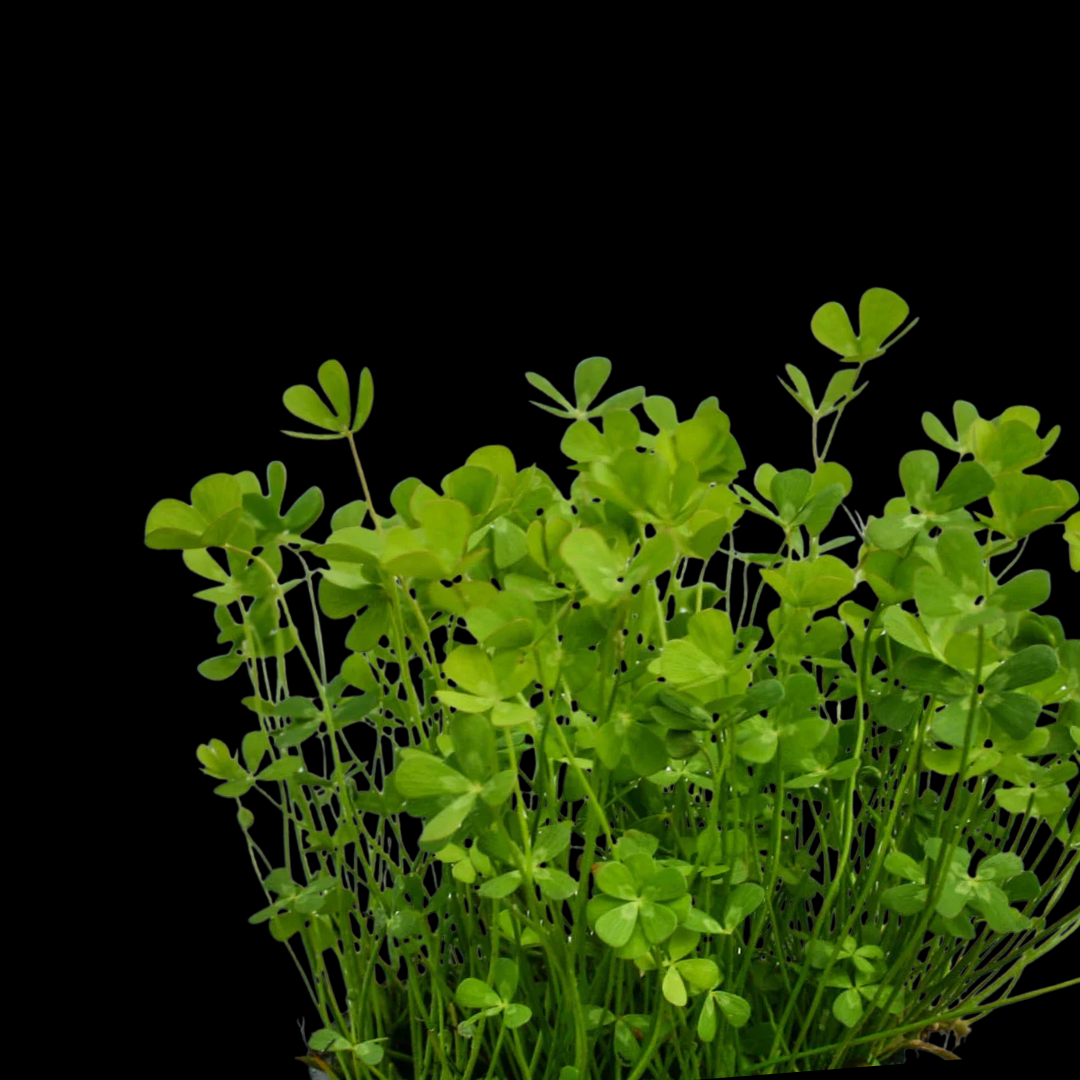
ウォータークローバーの名で親しまれているマルシレア・ヒルスタは、オーストラリア原産のデンジソウ属(マルシレア属)のシダ植物です。小さな葉が4枚、十字に並ぶ姿はシロツメクサの四つ葉にそっくりですが、クローバーの仲間ではありません。花を咲かせず、胞子で殖えるれっきとしたシダ植物です。アクアリウムでは前景草として定番の存在で、強い光やCO2添加がなくても育つ丈夫さから、水草レイアウトの入門種としても人気があります。 Marsilea hirsuta, widely known in Japan simply as “water clover,” is an Australian fern of the genus Marsilea. With four small leaflets arranged in a cross, it looks remarkably like a four-leaf clover, but it is not related to true clovers. It is a genuine fern that never flowers and reproduces by spores. It is a staple foreground plant in the aquarium hobby, and because it grows without strong light or CO2 injection, it is also a popular choice for beginners in planted tank layouts.
このヒルスタのいちばんの面白さは、置かれた環境によって葉の形が大きく変わることです。販売されている株はたいてい四つ葉の水上葉ですが、水槽に植えてしばらくすると、スプーンのような丸い1枚葉や、2〜4裂の葉を出すようになります。光が強くCO2が十分にあると、1枚葉が底床を這うように密に広がり、背の低いフラットな緑の絨毯ができあがります。一方、光が控えめな環境ではクローバーらしい切れ込みのある葉が背丈を伸ばし、ふんわりとした草姿になります。どちらの姿になるかを見守るのも、この水草ならではの楽しみです。 What makes M. hirsuta especially fascinating is how dramatically its leaves change with the environment. Plants are usually sold with emersed four-leaf foliage, but after a while in the aquarium they begin producing round, spoon-shaped single leaves or leaves divided into two to four lobes. Under strong light with ample CO2, the single leaves creep densely across the substrate, forming a low, flat green carpet. Under gentler light, clover-like lobed leaves grow taller for a softer, airier look. Watching which form it takes is one of the unique pleasures of this plant.
基本情報 / Basic Information
| 学名 / Scientific Name | Marsilea hirsuta ウォータークローバーはデンジソウ属全体の総称としても使われるため、ほかの種が同じ名前で売られることもあります。似た流通品に、より葉の小さいマルシレア・ミヌータ(M. minuta)があり、国内では「ヨーロピアンクローバー」の名で扱われることがあります。なお、マルシレア・クレナータ(M. crenata)はミヌータのシノニム(同じ種の別名)として扱われることがあり、流通名と学名の対応はメーカーによって異なります。Because “water clover” is also used as a general name for the whole genus, other species are sometimes sold under the same name. A similar plant in the trade is the smaller-leaved Marsilea minuta, sometimes sold in Japan as “European clover.” Marsilea crenata is sometimes treated as a synonym of M. minuta, and how trade names correspond to scientific names varies between producers. |
|---|---|
| 通称 / Common Name | ウォータークローバー、マルシレア・ヒルスタ、ヒルスタWater clover, Hairy water clover, Marsilea hirsuta |
| 分類 / Family | サンショウモ目 デンジソウ科 デンジソウ属(マルシレア属)Salviniales, Marsileaceae, genus Marsilea |
| 分布 / Distribution | オーストラリア原産。浅い池や沼、季節的に水をかぶる湿地など、水位が変わりやすい水辺に生育します。デンジソウ属そのものは熱帯から温帯まで世界中に広く分布し、日本にも在来種のデンジソウ(M. quadrifolia)が自生しています。Native to Australia. It grows in waterside habitats where water levels fluctuate, such as shallow ponds, marshes, and seasonally flooded wetlands. The genus Marsilea as a whole is distributed worldwide from the tropics to temperate regions, and Japan has its own native species, M. quadrifolia. |
| 育成難易度 / Difficulty | やさしい。低光量・CO2無添加でも育ちます。ただし成長は速いほうではないため、絨毯状に仕上げるまでには時間がかかります。植え付け後、水上葉から水中葉へ切り替わる最初の数週間を乗り切ることがポイントです。Easy. It grows even under low light without CO2. However, it is not a fast grower, so forming a full carpet takes time. The key is getting through the first few weeks after planting, while the plant switches from emersed to submerged leaves. |
育成環境 / Cultivation Environment
| 光量 / Light | 弱い光から強い光まで幅広く対応します。光が弱いと2〜4裂のクローバー型の葉を出しやすい一方、光を求めて葉柄が伸び、草丈が高くなりがちです。中〜強光では1枚葉になりやすく、草丈1〜3cmほどの低く詰まった草姿にまとまります。Adapts to a wide range of light, from low to high. Under low light it tends to produce clover-like leaves with two to four lobes, but the petioles stretch toward the light and the plant tends to grow taller. Under medium to high light, it tends to produce single leaves and stays compact at about 1–3 cm. |
|---|---|
| CO2添加 / CO2 Injection | 無添加でも育ちますが、添加するとランナーの伸びが良くなり、葉が密に詰まった絨毯をつくりやすくなります。早く仕上げたい場合や、1枚葉が並ぶフラットな草姿を目指す場合は添加がおすすめです。It grows without CO2, but injection improves runner growth and makes it easier to form a dense carpet. CO2 is recommended if you want faster results or a flat carpet of single leaves. |
| 水質 / Water Quality | 水温20〜28℃、pH6.0〜7.5程度が目安です。軟水から中程度の硬度の水が適しており、硬度が高すぎると成長が鈍りやすくなります。Aim for a temperature of 20–28°C and a pH of about 6.0–7.5. Soft to moderately hard water is suitable; very hard water tends to slow growth. |
| 底床 / Substrate | ソイル系の底床が最も扱いやすく、根張りもスムーズです。砂利や砂で育てる場合は、根元に固形肥料を埋め込むと成長が安定します。Aqua soil is the easiest substrate to work with and supports good rooting. If using gravel or sand, burying root tabs near the plants helps stabilize growth. |
レイアウト / Layout
| 配置 / Positioning | 前景草として、底床一面を覆う絨毯づくりに最適です。30cmキューブ水槽(約27L)や45cm規格水槽(約35L)のような小型水槽でも扱いやすく、60cm規格水槽(約57L)では石や流木の足元を縁取るように植えるのも効果的です。1枚葉の草姿は丸い葉が並ぶやわらかな印象で、ほかの前景草とはひと味違う景色をつくれます。光を控えめにして切れ込みのある葉を伸ばせば、前景から中景へのつなぎとしても使えます。Ideal as a foreground plant for carpeting the substrate. It is easy to use even in small tanks such as a 30 cm cube (about 27 L) or a standard 45 cm tank (about 35 L), and in a standard 60 cm tank (about 57 L) it works well planted along the base of rocks and driftwood. In its single-leaf form, rows of round leaves give a soft look that sets it apart from other foreground plants. With gentler light, its taller lobed leaves can also bridge the foreground and midground. |
|---|---|
| 注意点 / Precautions | 成長がゆっくりなので、小分けにした株を間隔を詰めて植えると早く仕上がります。ランナーで広がる性質があるため、ほかの前景草と組み合わせる場合は、境界を意識して配置しましょう。オーストラリア原産の外来の植物なので、不要になった株や切れ端を野外の川や池、水田に捨てたり植えたりすることは絶対にしないでください。Because growth is slow, planting small portions close together helps the carpet fill in sooner. Since it spreads by runners, plan the boundaries carefully when combining it with other foreground plants. As a non-native plant from Australia, never discard or plant unwanted plants or cuttings in rivers, ponds, or rice paddies. |
増やし方(トリミング) / Propagation & Trimming
| 増やし方 / Propagation | 地下茎(ランナー)を底床の表面や浅いところに伸ばし、節ごとに根と葉を出して広がります。増えた株はランナーごと切り分けて、別の場所に植え直せます。It spreads by sending rhizomes (runners) along or just below the substrate surface, producing roots and leaves at each node. Established clumps can be cut apart along the runner and replanted elsewhere. |
|---|---|
| トリミング / Trimming | 頻繁なトリミングは必要ありません。絨毯が厚くなりすぎたり、ほかの水草の領域にはみ出したりしたときに、ランナーを切って取り除く程度で十分です。葉が混み合って下葉が傷んできたら、部分的に間引いて更新すると、きれいな状態を保てます。Frequent trimming is unnecessary. It is enough to cut and remove runners when the carpet becomes too thick or spreads into other plants’ areas. When leaves become crowded and the lower ones start to deteriorate, thinning out sections to renew the carpet keeps it looking neat. |
病気と対策(コケなど) / Pests & Algae
| かかりやすい病気 / Common Issues | 水上葉の株を水中に植えると、数週間のうちに元の四つ葉が茶色く溶けることがあります。これは水中葉への切り替えにともなう自然な変化で、やがてランナーから新しい葉が出てきます。また、成長がゆっくりなぶん、古い葉に斑点状のコケや糸状のコケが付きやすい点には注意が必要です。ポット苗には、スネール(巻貝)やその卵が付いていることもあります。When emersed plants are planted underwater, the original four-leaf foliage often turns brown and melts within a few weeks. This is a natural part of the transition to submerged leaves, and new leaves will eventually emerge from the runners. Also, because growth is slow, older leaves are prone to spot algae and thread algae. Potted plants may also carry snails or snail eggs. |
|---|---|
| 対策と予防 / Prevention | 組織培養カップの株は無農薬で、スネールやコケを持ち込む心配がほとんどないため、エビ水槽にも安心して使えます。植える前に、根元の培地をよく洗い落としておきましょう。溶けた葉は早めに取り除き、こまめに水換えをすることで水質の悪化を防げます。コケ対策には、ヤマトヌマエビやオトシンクルスなどのコケ取り生体の導入や、照明時間の見直しが効果的です。Tissue-cultured plants are pesticide-free and carry almost no risk of introducing snails or algae, making them safe for shrimp tanks. Rinse the gel medium thoroughly from the roots before planting. Remove melted leaves promptly and change water regularly to prevent water quality from declining. To control algae, adding algae eaters such as Amano shrimp or Otocinclus and reviewing the photoperiod are effective. |
雑学と豆知識 / Trivia and Fun Facts
| 1. 「毛深い」四つ葉のシダ / 1. The “Hairy” Four-Leaf Fern | 種小名の hirsuta は、ラテン語で「毛深い」という意味です。水上で育つ葉や胞子をつくる器官に細かな毛が見られることにちなむと考えられ、英語でも「Hairy water clover」と呼ばれます。属名のマルシレアは、17〜18世紀のイタリアの博物学者ルイージ・フェルディナンド・マルシーリにちなんだものです。見た目はクローバーでも、胞子をつくる器官を葉の付け根近くに付ける、正真正銘のシダ植物です。The species name hirsuta is Latin for “hairy.” It is thought to refer to the fine hairs seen on its emersed leaves and spore-bearing organs, and in English it is also called hairy water clover. The genus name Marsilea honors Luigi Ferdinando Marsili, an Italian naturalist of the 17th and 18th centuries. Despite its clover-like appearance, it is a true fern that bears its spore-producing organs near the base of its leaves. |
|---|---|
| 2. 水の中と外で別人のように変わる葉 / 2. Leaves That Transform Above and Below Water | 同じ株が環境に応じて違う形の葉を出す性質を「異形葉性」といい、デンジソウ属はその研究によく使われる代表的な植物です。水上葉は気孔が多く、乾燥に耐える丈夫な葉ですが、水中葉は気孔がほとんどない薄い葉になります。仲間のデンジソウを使った研究では、この切り替えに植物ホルモンが関わっていることがわかっています。水中ではガスが外へ逃げにくいため、植物体内にエチレンがたまります。するとエチレンが、水上葉づくりを促すアブシジン酸(ABA)を減らし、その結果として水中葉がつくられます。実際に水中の株にABAを与えると、水に沈んだままでも水上葉の形の葉が出ることが確かめられています。つまり、水槽に植えたヒルスタの葉が溶けて新しい葉に替わるのは、植物が「いまは水の中だ」と判断して葉をつくり直している証拠なのです。The ability of one plant to produce differently shaped leaves depending on its environment is called heterophylly, and the genus Marsilea is a classic group for studying it. Emersed leaves have many stomata and are tough enough to withstand drying, while submerged leaves are thin and have few or no stomata. Research on its relative M. quadrifolia has shown that plant hormones control this switch. Because gases escape slowly underwater, ethylene builds up inside the plant. The ethylene then reduces abscisic acid (ABA), the hormone that promotes emersed-type leaves, and submerged leaves form as a result. Experiments have confirmed that giving ABA to submerged plants causes them to produce emersed-type leaves even while underwater. In other words, when the leaves of a newly planted M. hirsuta melt and are replaced, it is a sign that the plant has recognized it is underwater and is rebuilding its leaves accordingly. |
| 3. 夜になると葉を閉じて眠る / 3. Folding Its Leaves to Sleep at Night | デンジソウ属の水上葉は、夜になると4枚の小葉を上に向けて閉じ合わせます。これは「就眠運動」と呼ばれる現象で、マメ科のネムノキなどと同じように、葉の付け根にある「葉枕(ようちん)」という部分で起こります。光や体内時計の刺激によって葉枕の細胞の間をイオンと水が移動し、片側がふくらんで反対側が縮むことで、葉が動くしくみです。購入したばかりの四つ葉の株を観察すると、昼と夜で表情が変わる様子を楽しめるかもしれません。At night, the emersed leaves of Marsilea fold their four leaflets upward and close them together. This is called nyctinasty, or “sleep movement,” and, as in the silk tree and other legumes, it takes place in a joint at the leaf base called the pulvinus. Triggered by light and the internal clock, ions and water move between cells of the pulvinus, causing one side to swell and the other to shrink, which moves the leaves. If you watch a newly purchased four-leaf plant, you may be able to see its expression change between day and night. |
| 4. 100年の眠りから目覚める「胞子嚢果」 / 4. Sporocarps That Wake After a Century | デンジソウ属の植物は、インゲン豆のような硬い殻を持つ「胞子嚢果(ほうしのうか)」の中に胞子を収めています。この殻は非常に丈夫で乾燥にも強く、およそ100年前の標本に残っていた胞子嚢果から胞子が発芽した例も報告されています。水に浸かると内部のゼラチン状の組織が水を吸ってふくらみ、その力で殻が割れて、胞子の袋を連ねたひも状の組織が押し出されてきます。放出された小さな胞子からは、多数の繊毛を持つらせん形の精子が泳ぎ出し、大きな胞子から育った雌の配偶体にたどり着いて受精します。雨が降るたびに水をかぶり、やがて干上がるオーストラリアの水辺で生き抜くための、見事な仕掛けといえるでしょう。Marsilea plants keep their spores inside sporocarps, hard bean-like capsules. These shells are extremely durable and drought-resistant, and spores have been reported to germinate from sporocarps preserved in herbarium specimens about 100 years old. When soaked in water, a gelatinous tissue inside absorbs water and swells, splitting the shell open and pushing out a cord-like structure lined with spore sacs. Spiral-shaped sperm with many cilia swim out from the small spores (microspores) and reach the female gametophytes that develop from the large spores (megaspores) to fertilize them. It is a remarkable strategy for surviving in Australian wetlands that flood with each rain and then dry out again. |
| 5. 「固有種」の正体はヒルスタだった / 5. The “Endemic Species” That Turned Out to Be M. hirsuta | 大西洋に浮かぶポルトガル領アゾレス諸島では、ある池に生えるデンジソウ属の植物が、そこにしか生えない固有種 M. azorica として記載され、ヨーロッパの保全上の重要種として扱われていました。ところが、DNAを使った調べ直しの結果、その正体はオーストラリア原産のヒルスタだったことが判明します。人の手によって持ち込まれた外来の植物が、長いあいだ貴重な在来種として守られていたことになります。この出来事は、水中葉だけでは種を見分けにくいデンジソウ属の難しさを示すと同時に、水草が思いがけない場所に定着しうることも教えてくれます。On the Azores, a Portuguese archipelago in the Atlantic, a Marsilea plant growing in a single pond was described as an endemic species, M. azorica, and treated as a European conservation priority. DNA-based re-examination, however, revealed that it was actually the Australian M. hirsuta. In other words, a plant introduced by people had long been protected as a precious native species. The episode shows how difficult Marsilea species are to tell apart, and also how aquatic plants can establish themselves in unexpected places. |
| 6. 探検家の悲劇と「ナルドゥ」 / 6. Nardoo and an Explorers’ Tragedy | ヒルスタと同じくオーストラリアに分布する M. drummondii などは、先住民アボリジニの言葉で「ナルドゥ」と呼ばれ、胞子嚢果を粉にして食べる貴重な食料でした。1861年、オーストラリア大陸の縦断に挑んだバークとウィルズの探検隊は食料が尽き、先住民にならってナルドゥを食べましたが、次第に衰弱して命を落としました。原因のひとつと考えられているのが、ナルドゥに含まれる「チアミナーゼ」という酵素です。この酵素はビタミンB1を分解してしまうため、下処理をせずに食べ続けると体がビタミンB1不足に陥り、脚気のような症状を引き起こします。先住民は水にさらしたり加熱したりする下処理でこの害を防いでいたとされ、伝統的な知恵の有無が生死を分けた出来事として語り継がれています。Species such as M. drummondii, which, like M. hirsuta, grow in Australia, were called “nardoo” in Aboriginal languages, and their sporocarps were ground into flour as a valuable food. In 1861, the Burke and Wills expedition, attempting to cross the Australian continent from south to north, ran out of supplies and began eating nardoo as the local Aboriginal people did, but the explorers gradually weakened and died. One suspected cause is thiaminase, an enzyme in nardoo that breaks down vitamin B1; eating it without proper preparation over time leaves the body short of vitamin B1 and can cause beriberi-like symptoms. Aboriginal people are said to have prevented this harm by leaching and heating the sporocarps, and the episode is remembered as a case where traditional knowledge meant the difference between life and death. |
| 7. 日本の仲間「デンジソウ」の今 / 7. Japan’s Own Water Clover Today | 日本にも在来の仲間としてデンジソウが自生しています。4枚の葉を真上から見ると漢字の「田」に見えることから「田字草」と名付けられ、かつては全国の水田や水路でごく普通に見られる雑草でした。しかし昭和の中頃から、除草剤の普及、水路のコンクリート化、冬に田んぼの水を抜いて乾かす乾田化などが進み、生育できる場所は急速に失われていきました。現在では環境省のレッドリストで絶滅危惧II類に選定されています。水槽で育てるヒルスタの四つ葉の向こうに、こうした身近な水辺の変化を思い浮かべてみるのもいいかもしれません。Japan has its own native relative, M. quadrifolia, known as “Denjiso” (田字草) because its four leaflets, seen from above, resemble the kanji 田 (rice field). It was once a common weed in rice paddies and irrigation channels across the country. From the mid-20th century, however, the spread of herbicides, concrete-lined channels, and the practice of draining paddies in winter rapidly eliminated the places where it could grow. Today it is listed as Vulnerable on the Ministry of the Environment’s Red List. Looking at the four-leaf foliage of M. hirsuta in your tank, it may be worth remembering these changes in Japan’s own waterside landscapes. |
まとめ / Conclusion
ウォータークローバー(マルシレア・ヒルスタ)は、四つ葉の愛らしさと、水中で1枚葉の絨毯へと姿を変える意外性をあわせ持つ、表情豊かなシダ植物です。強い光やCO2がなくても育つ丈夫さがありながら、環境を整えれば低く詰まった美しい前景をつくり、光を控えれば切れ込みのある葉がふんわりと立ち上がります。 Water clover (Marsilea hirsuta) is an expressive fern that combines the charm of its four-leaf form with the surprise of turning into a carpet of single leaves underwater. Hardy enough to grow without strong light or CO2, it forms a beautiful, compact foreground when conditions are right, and under gentler light its lobed leaves rise softly from the substrate.
育成のいちばんのコツは、植え付け直後に葉が溶けても慌てず、新しい葉が伸びてくるのをじっくり待つことです。ゆっくりと、けれど確かに広がっていく緑の絨毯は、待った時間のぶんだけ愛着のわく存在になるでしょう。足元に小さな葉が並ぶ水景を、ぜひ楽しんでみてください。 The most important tip is not to panic when leaves melt after planting, and to wait patiently for new growth. A green carpet that spreads slowly but surely becomes all the more cherished for the time you spend waiting. Enjoy an aquascape with tiny leaves lining its floor.

困りごとの解決から、用品えらび、水槽づくり、生き物えらびまで。飼育に役立つ案内です。
分布マップ
ウォータークローバー(Marsilea hirsuta)はオーストラリア原産で、浅い池や沼、季節的に水をかぶる湿地など、水位が変わりやすい水辺に生育します。
※地図は原産地オーストラリアの全体を示す概略表示です。正確な自生範囲を示すものではありません。マーカーは地図表示のために設定した代表地点で、実際の採集地点ではありません。地図データ:© OpenStreetMap contributors
- 植物学的分類・詳細データ(PlantNET) Marsilea hirsuta R.Br. – New South Wales Flora Online ニューサウスウェールズ王立植物園による公式データベース。本種の形態学的特徴や分布に関する最も信頼性の高い資料です。
- オーストラリア国内の分布データ(ALA) Marsilea hirsuta : Rough Water-clover | Atlas of Living Australia オーストラリア政府支援の生物多様性データプラットフォーム。地理的分布や標本データを確認できます。
- 近縁種の自然史(食用史・胞子嚢果の乾燥耐性) Marsilea drummondii – Australian National Botanic Gardens オーストラリア国立植物園による近縁種の資料。ナルドゥの食用史と胞子嚢果の乾燥耐性を確認。本種の食用や乾燥耐性を示す資料ではありません。
- 原産地における植物相(VICFLORA) Flora of Victoria – Marsilea hirsuta ビクトリア王立植物園による植物図鑑。原産地における生育環境や他種との識別点について記載されています。
- 分類学の歴史(原著論文) Prodromus florae Novae Hollandiae et Insulae Van-Diemen (1810) – Robert Brown ロバート・ブラウンによる本種の初記載。植物分類学における歴史的な原典資料です。
- 水槽内での葉形・育成Marsilea hirsuta – Tropica Aquarium Plants生産者による栽培解説。移行期後の小葉数の変化とランナーでの生長を確認。
コメント