

解説 / Description
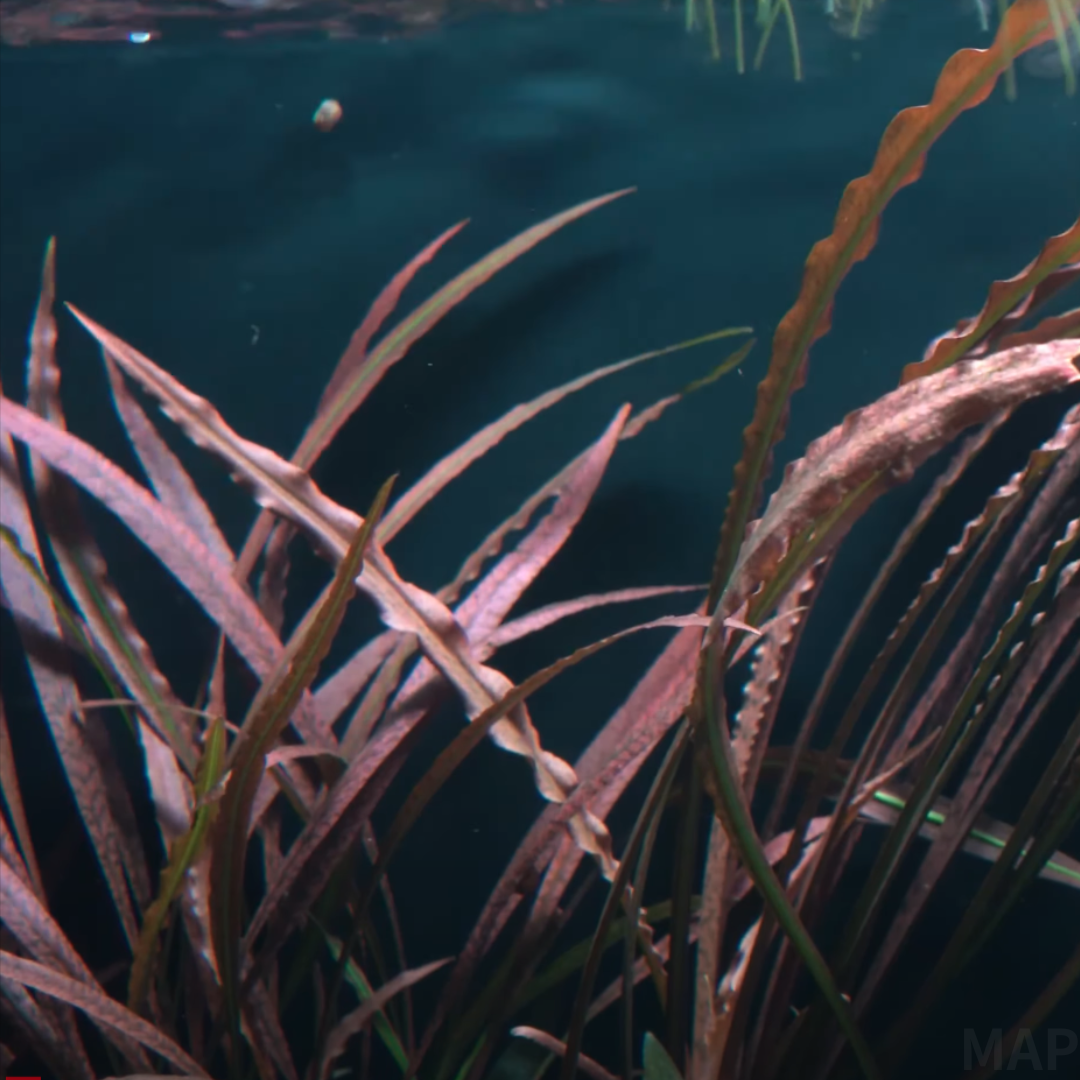
クリプトコリネ・スピラリス ‘レッド’は、細長い赤褐色の葉を株元から伸ばす、ロゼット型の水草です。葉の縁には緩やかな波打ちがあり、中央に沿って緑色の筋が見えることもあります。その目立ち方は育成環境によって変わります。赤みは明るい朱色というより、銅色やブロンズ色を思わせる落ち着いた色合い。流木や石になじみながら、緑の水草の間にさりげない彩りを添えてくれます。 Cryptocoryne spiralis ‘Red’ is a rosette-forming aquatic plant with long, slender, reddish-brown leaves. Their edges are gently wavy, and a green stripe may be visible along the center, with its prominence varying according to growing conditions. The foliage is often closer to copper or bronze than bright scarlet, making it an understated accent among green plants, wood, and rocks.
草丈は20〜50cmほどがひとつの目安で、十分に育つと50cmを超える場合もあります。幼株の姿から想像するより大きくなるため、中景から後景に余裕をもって植えると、伸びやかな葉姿を楽しめます。定着後は有茎草のような頻繁な差し戻しを必要とせず、少しずつ充実する株を長く眺められるのも魅力です。 A height of around 20–50 cm is a useful guide, and well-established plants can exceed 50 cm. Allow more room than a small young plant might suggest, usually in the midground or background. Once settled, it needs no frequent cutting and replanting of stem tops, offering the pleasure of watching a clump gradually mature.
基本情報 / Basic Information
| 学名 / Scientific Name | Cryptocoryne spiralis ‘Red’ 種の学名は Cryptocoryne spiralis (Retz.) Fisch. ex Wydler。‘Red’は園芸・流通上の名称で、植物分類上の変種名とは区別されます。種の旧名には Arum spirale Retz. があります。The species name is Cryptocoryne spiralis (Retz.) Fisch. ex Wydler. ‘Red’ is a horticultural or trade designation, distinct from a botanical variety name. Arum spirale Retz. is an earlier name for the species. |
|---|---|
| 通称 / Common Name | クリプトコリネ・スピラリス ‘レッド’、クリプトコリネ スピラリス レッド。‘タイガー’、‘ナリ’、‘CK’などの流通名を持つ株もありますが、外見が似ていても同一系統とは限りません。購入時には商品名を確認しましょう。Cryptocoryne spiralis ‘Red’, often shortened to spiralis ‘Red’. Plants are also sold under names such as ‘Tiger’, ‘Nari’, and ‘CK’, but similar appearance does not necessarily mean they are the same stock. Check the name supplied with the plant. |
| 分類 / Family | サトイモ科・クリプトコリネ属。根茎を持つ多年草で、水中でも、水辺の湿った地面でも育つ性質があります。Family Araceae; genus Cryptocoryne. A rhizomatous perennial capable of growing both submerged and emersed on moist ground at the water’s edge. |
| 分布 / Distribution | 種としてのスピラリスはインドからバングラデシュに分布し、河川の岸辺や湿地などに生育します。この分布域が、そのまま ‘レッド’として流通する株の採集地を示すわけではありません。The species occurs from India to Bangladesh in habitats such as river margins and wetlands. This species-wide distribution does not establish the collection locality of plants sold as ‘Red’. |
| 育成難易度 / Difficulty | 比較的育てやすいものの、導入直後の環境変化には注意が必要です。赤みのある葉を充実させるには、適度な光と養分を確保し、植えた株を繰り返し動かさずに根付かせることが大切です。Relatively manageable, though sensitive to changes during establishment. Adequate light and nutrition help it develop attractive reddish foliage. Allow it to root without repeatedly moving it after planting. |
育成環境 / Cultivation Environment
| 光量 / Light | 中程度の光量を基本に、株元まで光が届く位置で育てます。点灯時間はまず1日6〜8時間ほどを目安とし、新葉の状態とコケの発生を見ながら調整してください。葉色は光だけで決まるわけではなく、株の性質や養分なども関わります。暗い場所で生育が鈍いときは、照明を急に強くする前に、周囲の茂みを整理して光を届けるとよいでしょう。Start with moderate lighting and a position where light reaches the base of the plant. An initial photoperiod of about 6–8 hours a day can be adjusted according to new growth and algae. Color depends on the plant stock and nutrition as well as light. If growth slows in a shaded position, first thin nearby plants to improve light access before making a sudden increase in intensity. |
|---|---|
| CO2添加 / CO2 Injection | CO2無添加でも育成できる場合がありますが、葉の充実や安定した生長を目指すなら、適度な添加が有効です。光と養分に見合ったCO2の供給は、新葉の展開を助けます。添加する場合は点灯中の供給を安定させ、魚やエビの様子も確認しながら調整しましょう。赤みを求めて過剰に添加する必要はありません。Cultivation without injected CO2 is possible under suitable conditions, but moderate supplementation is beneficial for fuller foliage and consistent growth. A CO2 supply balanced with light and nutrients supports new leaf production. Keep the supply consistent during the lighting period and adjust it with close attention to fish and shrimp. Excess CO2 is unnecessary for achieving good color. |
| 水質 / Water Quality | 水温22〜28℃、pH6.0〜7.5程度を管理の目安に、軟水から中程度の硬度の淡水で育てます。これは育成可能な範囲の上限・下限を示すものではありません。数値を合わせるために水質を急変させるより、安定した環境を保つことを優先してください。石組みで硬度が上がる水槽でも育成できますが、石の種類や水換えによる水質の変化を把握しておくと安心です。夏場は高温が長く続かないよう、通風や冷却を工夫しましょう。As a practical starting point, use freshwater at about 22–28°C and pH 6.0–7.5, with soft to moderately hard water. These are working guidelines rather than the limits of its growing range. Stable conditions are preferable to abrupt adjustments made solely to meet a target. It can also grow in rock layouts where hardness rises, but monitor changes caused by the rocks and water changes. Avoid prolonged overheating in summer. |
| 底床 / Substrate | 根を広く張るため、根を収められる厚みのある底床が向いています。植栽部分は5cm前後をひとつの目安に、株の大きさに合わせて深さを確保しましょう。養分を含むソイルは扱いやすく、砂や大磯砂でも底床用肥料を補えば育成できます。肥料は製品の使用量に従って根の近くへ埋め、株元へ大量に集中させないこと。鉄分だけを増やすより、窒素・リン・カリウムと微量元素をバランスよく供給することが大切です。Provide enough substrate depth to accommodate an extensive root system. Around 5 cm in the planting area is a useful starting point, adjusted to the size of the plant. Nutrient-rich aquarium soil is convenient, while sand or gravel can also work with suitable root fertilization. Follow the fertilizer label and bury it near the roots without concentrating a large amount against the crown. Balanced macronutrients and trace elements matter more than adding iron alone. |
レイアウト / Layout
| 配置 / Positioning | 中景から後景のアクセントに向きます。容量約65Lの60cm規格水槽(60×30×36cm)では後景や左右の奥に、容量約180Lの90cm規格水槽(90×45×45cm)では中景の茂みとしても取り入れやすい水草です。明るい緑の有茎草や丸い葉の水草と組み合わせると、色と葉形の違いが引き立ちます。流木の脇に植えれば、長い葉が硬い輪郭をやわらげ、水流になびく動きも楽しめます。Use it as an accent in the midground or background. In a standard 60 cm aquarium with a nominal capacity of approximately 65 L (60×30×36 cm), the rear or back corners are suitable. In a standard 90 cm aquarium of approximately 180 L (90×45×45 cm), it can also form a midground clump. Bright green stems and round-leaved plants emphasize its contrasting color and shape. Beside driftwood, the long leaves soften hard outlines and add movement in the current. |
|---|---|
| 注意点 / Precautions | 根は底床に収め、葉が出る株元を深く埋めないように植えます。流木や石に活着させるタイプではありません。株同士を詰め込みすぎず、根と葉が広がる余地を残してください。長くなった葉が水面で横に広がり、下の水草を陰にすることもあるため、育ったときの草丈を見込んで配置しましょう。定着後の移動は株の負担になるので、植える場所はあらかじめ決めておくとよいでしょう。Bury the roots while keeping the crown, where the leaves emerge, from being planted too deeply. This is not a plant to attach to wood or rocks. Leave room between plants for both roots and foliage to spread. Long leaves may bend across the surface and shade plants below, so plan for mature size. Choose the location before planting, since moving an established plant can disrupt it. |
増やし方(トリミング) / Propagation & Trimming
| 増やし方 / Propagation | 定着した株から地下を伸びる匍匐茎が出て、周囲に子株が育ちます。子株に数枚の葉と十分な根がそろったら、親株とのつながりを清潔なハサミで切り、根を傷めないように分けて植え直します。増える速さは育成環境や株の状態によって異なるため、幼株のうちから繰り返し分割せず、まず親株を充実させましょう。切り取った葉を差し戻して増やすことはできません。Established plants produce underground runners that develop into daughter plants nearby. Once a daughter plant has several leaves and a sufficient root system, cut the connection with clean scissors and replant it carefully. Multiplication varies with growing conditions and plant health, so allow the parent to establish before repeatedly dividing young growth. Detached leaves cannot be replanted to produce new plants. |
|---|---|
| トリミング / Trimming | 傷んだ葉や古い葉、周囲を覆う長い葉を、葉柄の付け根に近い位置から少しずつ取り除きます。葉の途中を切って高さをそろえると切り口が残るため、葉ごと整理するほうが自然な姿を保てます。一度に多くの健全な葉を落とさず、茂みが混み合ったときは子株の間引きも組み合わせてください。有茎草のような頻繁な差し戻しは不要です。Gradually remove damaged, aging, or overly long leaves by cutting the petiole close to its base. Cutting across the leaf blade leaves a visible edge, so removing whole leaves preserves a more natural appearance. Avoid removing many healthy leaves at once. If the clump becomes crowded, thin daughter plants as well. Frequent stem-style cutting and replanting is unnecessary. |
病気と対策(コケなど) / Pests & Algae
| かかりやすい病気 / Common Issues | 導入や移植、水質の変化をきっかけに、葉が透けて崩れる「クリプト溶け」が起こることがあります。葉が溶けたことだけで感染症や株全体の枯死とは判断できず、根茎が健全なら再び芽を出す可能性があります。一方、株元まで軟らかく腐っている場合は回復が難しくなります。また、長く残る葉には黒ひげ状のコケなどが付着することがあり、光量に対して水草の生長が追いつかない環境では注意が必要です。Introduction, transplanting, or changes in water conditions can trigger “crypt melt,” in which leaves become translucent and break down. Leaf loss alone does not establish an infection or the death of the whole plant; a healthy rhizome may regrow. Recovery is less likely if the crown itself is soft and rotten. Long-lived leaves can also collect algae, including black beard algae, particularly when light levels exceed what plant growth can support. |
|---|---|
| 対策と予防 / Prevention | 溶けた葉は水を汚さないよう取り除き、株元が健全なら抜かずに環境を安定させて見守ります。回復には数週間以上かかることもあり、必ず再生するとは限りません。コケが増えたら、点灯時間、肥料の量、CO2供給、周囲にたまった汚れを確認し、傷んだ葉を整理してください。導入時は、組織培養株の培地をやさしく洗い落とし、ポット株のロックウールなどを丁寧に除いて植えます。巻貝や卵の付着、農薬使用の有無も確認し、とくにエビ水槽では販売者の説明を確かめてから導入しましょう。Remove decomposing leaves before they foul the water. If the crown remains healthy, leave it planted and keep conditions stable. Recovery may take several weeks or longer, and regrowth is not guaranteed. For algae, review the photoperiod, fertilizer dosage, CO2 supply, and accumulated debris, and remove damaged leaves. Before planting, gently rinse culture medium from tissue-cultured plants and carefully remove rock wool from potted plants. Check for snails and eggs, and confirm pesticide information with the seller, especially before adding plants to a shrimp aquarium. |
雑学と豆知識 / Trivia and Fun Facts
| 1. 「スピラリス」の螺旋は、葉よりも花に注目 / 1. The Spiral in the Name Points to the Flower | 種小名の spiralis は「螺旋状の」という意味です。細長い葉が目を引く水草ですが、名前の由来は、花を包む仏炎苞のねじれた形にあります。クリプトコリネでは、小さな花が集まった棒状の花序を仏炎苞が包んでいます。属名の Cryptocoryne も「隠された棍棒」を意味する言葉に由来し、この構造を表したものです。ふだん水槽では葉を楽しむ植物ですが、花にもサトイモ科ならではの特徴があります。The epithet spiralis means “spiral” and refers to the twisted spathe rather than the long leaves. In Cryptocoryne, small flowers are arranged on a rod-like inflorescence enclosed by a spathe. The genus name comes from words meaning “hidden club,” describing this structure. Although aquarists usually enjoy the foliage, its flowers also reveal distinctive features of the arum family. |
|---|---|
| 2. 赤い葉だけでは、系統を見分けられない / 2. Red Leaves Alone Do Not Identify the Stock | スピラリスは葉の大きさや形に幅があり、植物分類上も複数の変種が認められている種です。一方、アクアリウムで使う ‘レッド’や ‘タイガー’といった名前は、園芸・流通上の区別であり、分類上の変種と一対一に対応するとは限りません。さらに、同じ株でも水中・水上の違いや光の条件によって葉姿が変わります。赤みの強さや中央の緑の筋だけで、流通名や系統を判断するのは難しいのです。育成環境とともに葉の変化を記録すると、この仲間の多様な姿をより楽しめます。Cryptocoryne spiralis varies considerably in leaf size and shape, and several botanical varieties are recognized. Aquarium names such as ‘Red’ and ‘Tiger’, however, are horticultural or trade distinctions and do not necessarily correspond directly to those varieties. The same plant can also change its appearance between submerged and emersed growth or under different lighting. Red coloration and the green central stripe alone are therefore insufficient to identify its trade name or stock. Recording conditions alongside leaf changes makes its varied appearance even more rewarding to observe. |
| 3. 水中と陸上、二つの姿を持つ水辺の植物 / 3. A Waterside Plant with Two Ways of Growing | スピラリスの自生地には、雨季と乾季で水位が変わる場所があります。水に沈む時期と湿った地面が現れる時期の両方に対応し、水中葉と水上葉を育てられる植物です。水上栽培では花を観察できる場合があり、葉だけでは見分けにくい種類や変種を調べる手がかりにもなります。ただし、水中と水上の両方で育つことと、急な環境変化に耐えられることは同じではありません。植え付け後は環境を安定させ、その水槽に合った新葉が育つのを待ちましょう。Some habitats of C. spiralis experience changing water levels between wet and dry seasons. The plant can grow both underwater and on moist exposed ground, producing submerged or emersed foliage. Emersed cultivation may also allow flowering, providing clues for distinguishing species and varieties that are difficult to identify from leaves alone. Growing in both settings does not mean that abrupt changes are harmless. After planting, stable conditions give it time to produce leaves suited to its new aquarium. |
| 4. 小さな組織培養株を育てる楽しみ / 4. The Pleasure of Raising Small Tissue-Cultured Plants | 組織培養は、植物の小さな組織から、無菌的に管理された環境で株を増やす方法です。巻貝やコケなどを持ち込みにくい形態として親しまれ、少数の親株から多くの苗を生産できる利点もあります。ただし、開封後まで無菌の状態が保たれるわけではなく、小さな苗も水槽への順応が必要です。細い葉の幼株が根を張り、やがて長い赤褐色の葉を広げる過程には、大株を植えるのとは違った楽しみがあります。導入時は無理に細かく分けすぎず、根と芽を傷めない大きさに分けて植えると扱いやすくなります。Tissue culture multiplies plants from small pieces of tissue under aseptically controlled conditions. It is valued for reducing the chance of introducing snails and algae and for producing many young plants from limited parent material. Sterility is not maintained automatically after opening, however, and small plants still need to adapt to aquarium conditions. Watching slender juveniles root and develop long bronze-red foliage offers a different pleasure from planting a mature specimen. Divide them into manageable portions without damaging the roots or growing points, rather than separating them into unnecessarily tiny pieces. |
まとめ / Conclusion
クリプトコリネ・スピラリス ‘レッド’の魅力は、赤褐色の深みと、細長い葉が描く伸びやかな姿にあります。緑の茂みや流木の間に添えると、水景に落ち着いた彩りと動きが生まれます。株が育つにつれて存在感を増し、頻繁な差し戻しを必要としないため、時間をかけてなじませるレイアウトによく似合う水草です。 The appeal of Cryptocoryne spiralis ‘Red’ lies in its rich reddish-brown tones and graceful, elongated foliage. Among green plants and driftwood, it brings understated color and motion. Its presence grows as the clump matures, without demanding frequent cutting and replanting, making it well suited to layouts developed patiently over time.
育成では、根付くまで株を動かさず、適度な光と養分をそろえることが大切です。導入直後の葉だけで成否を判断せず、株元の状態と新葉の生長を見守りましょう。水槽になじんだ株がゆっくりと葉を広げる姿に、長く育てる楽しみを感じられます。 Allow the plant to root without disturbance and provide adequate light and balanced nutrition. Judge progress by the condition of the crown and emerging leaves, rather than the first leaves alone. Watching an established clump gradually spread its foliage is a lasting part of its appeal.

気になる道具や飼い方を見つけてみませんか?
 アイのアクアグッズ案内水槽の底砂の選び方|砂・砂利の違いとおすすめ商品道具の特徴や使い方、選ぶときのポイントをアイが紹介します。記事はコチラ →
 アイのアクアグッズ案内お魚を撮ったのに、ボクが写ってる! スマホで楽しむ水槽撮影と便利な道具道具の特徴や使い方、選ぶときのポイントをアイが紹介します。記事はコチラ →
 アイのアクアグッズ案内水槽のエアーポンプの選び方|水深・音・泡で選ぶおすすめ用品道具の特徴や使い方、選ぶときのポイントをアイが紹介します。記事はコチラ →
 アイのアクアグッズ案内ベタの一匹飼いを楽しむ|水槽・ヒーター・ふた・フィルターの選び方ベタの一匹飼いに向く水槽容量、ふたと空気層、ヒーターと水温計、弱い水流のフィルターを、コタロウとアイの会話で分かりやすく解説します。記事はコチラ →
さまざまな飼育テーマをご紹介。リンク先の記事には広告・商品紹介が含まれます。
案内・紹介記事一覧へ →分布マップ
クリプトコリネ・スピラリスは、種としてインドからバングラデシュに分布し、河川の岸辺や湿地などに生育します。
地図は分布地域全体を見渡すための概略表示で、正確な生育範囲を示すものではありません。マーカーは表示上の代表地点であり、実際の採集地点ではありません。また、種としての分布域は、‘レッド’として流通する株の採集地を示すものではありません。
参考文献・参考資料
-
Royal Botanic Gardens, Kew.
Plants of the World Online:Cryptocoryne spiralis (Retz.) Fisch. ex Wydler
学名、異名、サトイモ科・クリプトコリネ属への分類、インドからバングラデシュにかけての自然分布。 -
Bogner, J.(2013).
A new variety of Cryptocoryne spiralis (Retzius) Fischer ex Wydler (Araceae) from India.
Aqua Planta, 38(4), 141–148(英訳併載PDF)。
スピラリスの変種分類、自生地の生息環境、水中・水上での葉姿の違い、花の形態を用いた識別。 -
Tropica Aquarium Plants.
Cryptocoryne spiralis ‘Red’
生産者による公式植物解説。葉の形態、中央の緑色の筋、草丈、生長速度、光量とCO2の要求度。 -
Dennerle Plants.
Cryptocoryne spiralis ‘Red’
生産者による公式植物解説。葉色と底床栄養、中景・後景への配置、水温・pH・硬度の育成範囲、匍匐茎による増殖。 -
Tropica Aquarium Plants.
Planting in the aquarium
クリプトコリネを含むロゼット型水草の植え付け、ポットやロックウールの除去、株の分割。 -
Tropica Aquarium Plants.
Trimming
クリプトコリネの傷んだ葉の除去と、密生した株の間引き。 -
Kane, M. E., Gilman, E. F., Jenks, M. A. & Sheehan, T. J.(1990).
Micropropagation of the Aquatic Plant Cryptocoryne lucens.
HortScience, 25(6), 687–689.
クリプトコリネ・ルーケンスを対象とした組織培養と苗の順化の研究。序論には、クリプトコリネ属で知られる葉の崩壊現象「クリプト溶け」についての記載もあります。 -
Tropica Aquarium Plants.
1-2-Grow!
組織培養苗の特徴と、培地の洗い落とし、分割、植え付けに関する生産者の公式説明。 -
Tropica Aquarium Plants.
Frequently Asked Questions
底床用肥料の利用、導入時の洗浄、枯れた葉の除去、光・栄養・水換えを通じたコケの予防に関する一般的な管理指針。
ウェブ資料の閲覧日:2026年10月7日





コメント