




解説 / Description
アヌビアス・ペッチーは、西アフリカ原産のアヌビアス・ナナから生まれた小型の園芸品種です。葉の長さは1~3cmほどで、草丈も数cmに収まり、流通しているアヌビアスの中でもひときわ小さな部類に入ります。濃い緑色の肉厚な葉は少し下向きに反り、這うように伸びる根茎に沿って密に並びます。小さいながらも重厚感があり、流木や石の上に置くだけで、長い年月を経た古木のような落ち着いた雰囲気が生まれます。 Anubias ‘Petchii’ is a dwarf cultivar derived from Anubias barteri var. nana, a plant native to West Africa. Its leaves are only about 1–3 cm long and the whole plant stays just a few centimeters tall, making it one of the smallest Anubias in the trade. The thick, dark green leaves curve slightly downward and grow densely along a creeping rhizome. Despite its small size, it has a solid, mature presence, and simply placing it on driftwood or stone gives a scene the calm look of an old tree.
最大の魅力は、小ささと丈夫さをあわせ持っていることです。弱い光でも育ち、CO2を添加しなくても長く維持でき、水質にもあまりうるさくありません。葉が革のように硬いため、水草をかじりがちな魚と一緒に飼っても食べられにくいのもうれしい点です。成長はとてもゆっくりですが、そのぶん一度作った景観が崩れにくく、30cmキューブ水槽(約27L)クラスの小型水槽から、大型水槽の細部づくりまで幅広く活躍します。 Its greatest appeal is that it is both tiny and tough. It grows under low light, can be kept long-term without CO2 injection, and is not fussy about water chemistry. Its leathery leaves also make it unappealing to fish that tend to nibble on plants. Growth is very slow, but that means a finished layout keeps its shape for a long time. It works well everywhere from small tanks around 27 L (a 30 cm cube) to the fine details of larger aquascapes.
基本情報 / Basic Information
| 学名 / Scientific Name | Anubias barteri var. nana ‘Petite’ アヌビアス・ナナ(Anubias barteri var. nana)の矮性品種です。「ペッチー」は日本での流通名で、学名には含まれていません。海外では ‘Petite’ の名前で流通し、よく似た ‘Bonsai’ と同じものとして扱われることも少なくありません。A dwarf cultivar of Anubias barteri var. nana. “Petchii” is a Japanese trade name and is not part of the scientific name. Elsewhere it is sold as ‘Petite’ and is often treated as identical to the very similar ‘Bonsai’. |
|---|---|
| 通称 / Common Name | アヌビアス・ペッチー、ペッチー・ラウンド、アヌビアス・ナナ・プチ、ナナ・ミニ などAnubias nana ‘Petite’, Anubias Petite, Anubias Petchii (Japanese trade name) |
| 分類 / Family | サトイモ科 アヌビアス属Araceae, genus Anubias |
| 分布 / Distribution | 栽培下で生まれた園芸品種で、野生には存在しません。原種のアヌビアス・ナナは西アフリカのカメルーンに自生し、森の中を流れる川の浅瀬などで、岩や倒木に根を張って育ちます。A cultivar that arose in cultivation and does not occur in the wild. Its parent, Anubias barteri var. nana, is native to Cameroon in West Africa, where it grows in shallow parts of forest streams, rooting onto rocks and fallen wood. |
| 育成難易度 / Difficulty | 易しい水草です。ただし、根茎を底床に埋めないこと、光を当てすぎないことの2点は必ず守ってください。これを外すと、丈夫な本種でも根茎の腐敗やコケに悩まされることがあります。Easy. Two rules are essential, though: never bury the rhizome in the substrate, and do not give it too much light. Ignoring either can lead to rhizome rot or algae, even in a plant this hardy. |
育成環境 / Cultivation Environment
| 光量 / Light | 弱い光でも十分に育つ、典型的な陰性水草です。強い光の下でも育ちますが、成長はほとんど速くならず、かえって葉にコケが付きやすくなります。有茎草の陰や流木の下など、少し日陰になる場所に置くと、葉をきれいに保てます。A classic shade-tolerant plant that grows well under low light. It can also grow under strong light, but growth barely speeds up and the leaves become more prone to algae. Placing it in partial shade, such as beneath stem plants or under driftwood, keeps the leaves clean. |
|---|---|
| CO2添加 / CO2 Injection | なくても育ちます。添加すると新しい葉が出るペースが少し上がり、株の調子も安定しやすくなりますが、劇的な変化はありません。CO2を添加しない水槽でも、主役を任せられる水草です。Not required. CO2 can slightly speed up new leaf production and help keep the plant in good condition, but the difference is modest. It can take center stage even in a tank without CO2. |
| 水質 / Water Quality | 水温は22~28℃ほどが適しています。pHはおよそ5.0~8.0の弱酸性から弱アルカリ性まで、軟水でも硬水でも育ちます。苦手なのは30℃を超える高水温です。水中の酸素が減るうえに雑菌も増えやすくなり、根茎腐敗のきっかけになります。夏場はファンやクーラーで水温を下げてあげましょう。A temperature of about 22–28°C (72–82°F) is ideal. It grows in pH from roughly 5.0 to 8.0 and in both soft and hard water. Its weak point is temperatures above 30°C (86°F): oxygen levels drop and bacteria multiply more easily, which can trigger rhizome rot. Use a fan or chiller to keep the tank cool in summer. |
| 底床 / Substrate | 流木や石に活着させて育てるのが基本なので、底床の種類はあまり問いません。栄養はおもに水中から吸収するため、魚の少ない水槽ではカリウムや鉄を含む液体肥料をときどき与えるとよいでしょう。底床に植える場合は根だけを砂に差し込み、根茎は必ず底床の上に出しておきます。Because it is usually grown attached to driftwood or rock, the type of substrate matters little. It takes most of its nutrients from the water, so in lightly stocked tanks an occasional liquid fertilizer containing potassium and iron is helpful. If planting in substrate, push only the roots in and always keep the rhizome above the surface. |
レイアウト / Layout
| 配置 / Positioning | 前景から中景、あるいは流木や石の表面に向いています。30cmキューブ水槽(約27L)などの小型水槽ではメインの水草として、60cm規格水槽(約57L)以上ではレイアウトの細部を引き締める名脇役として使えます。流木の分かれ目や石のすき間に少しずつ置いていくと、自然に生えてきたような仕上がりになります。Suited to the foreground and midground, or to driftwood and stone surfaces. In small tanks such as a 30 cm cube (about 27 L), it can be the main plant; in tanks of 60 cm (about 57 L) and up, it is a supporting player that sharpens the details. Placing small pieces in driftwood forks or rock crevices gives a natural, self-grown look. |
|---|---|
| 注意点 / Precautions | 固定にはビニタイや木綿糸、水草用の瞬間接着剤が便利です。ただし、糸で強く縛りすぎたり、接着剤で根茎を広く覆ったりすると、根茎が傷んだり呼吸できなくなったりします。接着剤はごく少量を点で付け、根茎の大部分が水に触れている状態を保ってください。根が岩や流木にしっかり絡みつくまでには、数週間から1か月ほどかかります。Plant ties, cotton thread, or aquarium-safe cyanoacrylate gel are handy for attaching it. However, tying too tightly or covering much of the rhizome with glue can damage it or cut off its gas exchange. Use only a small dot of glue and keep most of the rhizome in contact with the water. Roots take a few weeks to about a month to grip rock or wood firmly. |
増やし方(トリミング) / Propagation & Trimming
| 増やし方 / Propagation | 根茎を切り分ける株分けで増やします。根茎が十分に伸びたら、1株に3~4枚以上の葉が残るよう、清潔なハサミやカッターで切り分けます。切り分けた株をほかの流木や石に活着させれば、そのまま新しい株として育っていきます。成長がゆっくりなので、気長に待つのがコツです。Propagate by dividing the rhizome. Once it has grown long enough, cut it with clean scissors or a blade so that each piece keeps at least three or four leaves. Attach the divisions to other wood or stone and they will grow on as new plants. Growth is slow, so patience is key. |
|---|---|
| トリミング / Trimming | 頻繁なトリミングは必要ありません。葉が長持ちするので、コケが付いたり傷んだりした葉を葉柄の根元から切り取る程度で十分です。葉が混み合って重なってきたら何枚か間引き、水が通りやすくしてあげると、株の内側まで健康に保てます。Regular trimming is unnecessary. Since the leaves last a long time, simply removing algae-covered or damaged ones at the base of the petiole is enough. When leaves become crowded and overlap, thin out a few to improve water flow and keep the inside of the clump healthy. |
病気と対策(コケなど) / Pests & Algae
| かかりやすい病気 / Common Issues | よく見られるのは、葉に付く斑点状の緑色のコケや黒ひげゴケです。成長が遅く葉が長く残るため、光が強いとコケの付き場所になりやすいのです。より深刻なのは根茎腐敗で、根茎が茶色や黒に変色してブヨブヨになり、緑色のままの葉が根元からポロポロ外れていきます。また、水上で栽培された株を水中に入れると、最初の数週間は古い葉が黄ばんだり溶けたりすることがあります。これは水中に慣れていく過程で起こるもので、根茎が硬いままなら心配はいりません。古い葉の縁が黄ばんで小さな穴が開く場合はカリウム不足、新芽が白っぽくなる場合は鉄不足が疑われます。Common problems include green spot algae and black beard algae on the leaves. Because the plant grows slowly and its leaves last so long, they easily become a home for algae under strong light. A more serious issue is rhizome rot: the rhizome turns brown or black and soft, and still-green leaves fall off at the base. Plants grown emersed may also yellow or melt for the first few weeks after being submerged. This happens as the plant adjusts to life underwater, and there is no cause for concern as long as the rhizome stays firm. Yellowing edges and pinholes on old leaves suggest a potassium deficiency, while pale new leaves point to a lack of iron. |
|---|---|
| 対策と予防 / Prevention | コケ対策の基本は、光を控えめにして日陰に置くことです。コケが付いた葉は早めに取り除きましょう。根茎腐敗で傷んだ部分は元には戻りません。株を取り出し、消毒した刃物で、硬くきれいな緑色の部分が見えるまで切り落とすのがもっとも確実な対処法です。予防のためには、根茎を埋めない、強く縛らない、高水温を避けることが大切です。ポット植えなどの輸入株には、エビ類に害のある農薬が残っている可能性があります。「水草その前に」などの下処理剤で処理し、よくすすいでから水槽に入れると安心です。最初から農薬やスネールの心配がない組織培養カップを選ぶのも良い方法です。The basic defense against algae is moderate light and a shaded position; remove affected leaves early. Tissue damaged by rhizome rot will not recover. The most reliable fix is to remove the plant and cut away the affected part with a sterilized blade until firm, clean green tissue appears. To prevent it, never bury the rhizome, avoid tight ties, and keep temperatures down. Imported potted plants may carry pesticide residues harmful to shrimp, so treat them with a plant dip (such as the Japanese product “Mizukusa Sono Mae ni”) and rinse well before adding them. Choosing tissue-culture cups, which are free of pesticides and snails from the start, is another good option. |
雑学と豆知識 / Trivia and Fun Facts
| 1. 「ペッチー」はもともとクリプトコリネの名前 / 1. “Petchii” Originally Belongs to a Cryptocoryne | 日本ですっかりおなじみの「ペッチー」ですが、本種の学名にこの言葉は含まれていません。海外での品種名は「Petite(プチ)」で、フランス語で「小さい」という意味です。一方の「ペッチー(petchii)」は、スリランカ原産のクリプトコリネ・ベケッティ ‘ペッチー’ に使われてきた名前で、もとはスリランカのクリプトコリネを研究したT・ペッチにちなんで名付けられた種名でした。発音の似た「プチ」が流通の過程で「ペッチー」に置き換わり、そのまま定着したといわれています。お店によって「ナナ・プチ」「ペッチー」「ナナ・ミニ」など呼び名が違うのは、こうした事情があるためです。“Petchii” is a familiar name in Japan, but it is not part of this plant’s scientific name. Internationally the cultivar is called ‘Petite’, French for “small.” “Petchii,” by contrast, is the name used for Cryptocoryne beckettii ‘Petchii’ from Sri Lanka; it was originally a species name honoring T. Petch, who studied Sri Lankan Cryptocoryne. It is said that the similar-sounding “Petite” turned into “Petchii” somewhere along the trade route and stuck. That is why shops sell the same plant as “Nana Petite,” “Petchii,” or “Nana Mini.” |
|---|---|
| 2. 独立種から変種へ:ナナの分類史 / 2. From Species to Variety: The Taxonomic Story of Nana | 親にあたるアヌビアス・ナナは、1899年にドイツの植物学者アドルフ・エングラーによって、独立した種「Anubias nana」として記載されました。その後1979年、オランダのヴィム・クルシオがアヌビアス属全体を見直した際、ナナは形や大きさに幅のあるアヌビアス・バルテリーの一変種として整理し直され、現在の学名になりました。つまり、ナナは独立した種ではなく、バルテリーの中の小型のタイプという位置づけです。ちなみに属名の「アヌビアス」は、エジプト神話の冥界の神アヌビスに由来するといわれ、日陰に生える姿にちなむという説があります。The parent plant was described in 1899 by German botanist Adolf Engler as a separate species, Anubias nana. In 1979, Dutch botanist Wim Crusio revised the whole genus and reclassified nana as a variety of Anubias barteri, a species that varies widely in shape and size, giving us today’s name. In other words, nana is not a separate species but a small form within barteri. The genus name is said to come from Anubis, the Egyptian god of the underworld, possibly a nod to the plant’s shady habitat. |
| 3. 栽培場で生まれた小さな突然変異 / 3. A Tiny Mutation Born in a Nursery | ペッチー(’Petite’)の起源ははっきりしない部分もありますが、シンガポールの水草ファームで栽培されていたナナの中に突然変異として現れた、という説がよく知られています。現在では栽培品種として定着しており、株分けや組織培養で増やしても小さな葉の特徴が受け継がれています。環境によっては葉が2~3cmほどになることもありますが、原種ほど大きくはなりません。流通している株の多くは組織培養で増やされたものです。アヌビアス・ナナを5年間培養した株を調べた研究でも、染色体のセット数に変化は見られませんでした。つまり、培養で大量に増やしても性質が崩れにくいということで、小型の株が安定した品質で届けられる背景には、こうした植物の性質があります。The exact origin of ‘Petite’ is somewhat unclear, but the best-known account is that it appeared as a mutation among nana plants at a nursery in Singapore. Today it is an established cultivar, and its small leaves are passed on whether it is divided or tissue-cultured. Leaves can reach about 2–3 cm in some conditions, but never grow as large as those of its parent. Most plants on the market are produced by tissue culture, and a study of Anubias nana kept in culture for five years found no change in the number of chromosome sets. In other words, the plant keeps its characteristics even when mass-produced in the lab, which helps explain why the dwarf form reaches hobbyists with such consistent quality. |
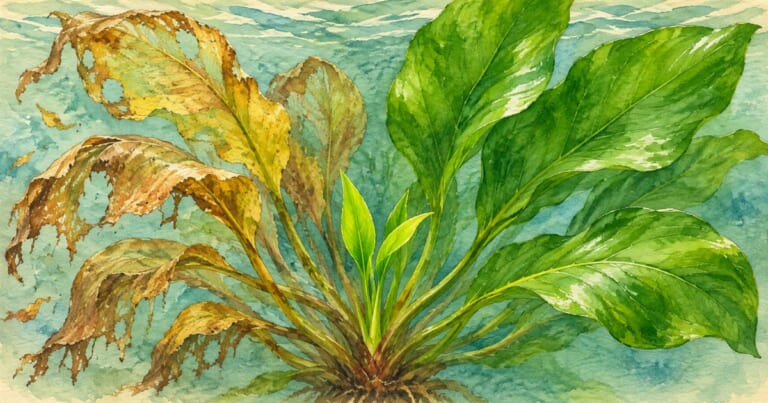
| 4. 水に沈めると葉が溶けるのはなぜ? / 4. Why Do Leaves Melt When Submerged? | ファームでは、成長を早めてコケを防ぐために、湿度の高い空気中で栽培されることがよくあります。こうして育った水上葉は、空気中でガス交換をするための気孔と、乾燥を防ぐ厚い表皮を持っています。ところが水中では、ガスが空気中よりはるかにゆっくりとしか移動しないため、水上葉のつくりのままでは効率よく光合成ができません。そこで植物は古い葉を手放し、水中に合った新しい葉づくりに力を回します。購入後に葉が溶けても、それは株が水中に適応しようとしているサインです。根茎さえ元気なら、焦らず見守ってあげてください。Nurseries often grow the plant in humid air to speed growth and avoid algae. These emersed leaves have stomata for exchanging gases with the air and a thick surface layer that prevents drying out. Underwater, however, gases move far more slowly than in air, so leaves built for air cannot photosynthesize efficiently. The plant responds by letting go of its old leaves and putting its energy into new leaves suited to life underwater. If leaves melt after purchase, it is a sign the plant is adapting. As long as the rhizome stays healthy, simply give it time. |
| 5. 魚にかじられにくい「シクリッド・プルーフ」 / 5. “Cichlid-Proof” Leaves | アヌビアスの葉は、表面がクチクラ層という厚い保護膜で覆われ、革のような手ざわりをしています。この硬さは水槽の中で思わぬ強みになります。水草をよく食べるアフリカンシクリッドや金魚でもかじりにくく、海外では「シクリッド・プルーフ(シクリッドにも負けない)」水草として知られています。小さなペッチーもこの性質を受け継いでいるので、ほかの水草が育ちにくい水槽にも緑を添えることができます。Anubias leaves are covered with a thick protective cuticle that gives them a leathery feel. This toughness becomes an unexpected strength in the aquarium: even plant-eating African cichlids and goldfish find the leaves hard to chew, and the plant is known abroad as “cichlid-proof.” The tiny ‘Petite’ shares this trait, so it can bring green to tanks where other plants struggle. |
まとめ / Conclusion
アヌビアス・ペッチーは、指先ほどの小さな葉に、アヌビアスらしい丈夫さと落ち着いた存在感を詰め込んだ水草です。流木や石の上でゆっくりと葉を重ねていく姿は、水槽の中に、何年もかけて育った森の一角を思わせる景色をつくり出します。強い光やCO2がなくても育つので、水草を始めたばかりの方から細部まで作り込みたい方まで、幅広く楽しめます。 Anubias ‘Petchii’ packs the toughness and calm presence of Anubias into leaves no bigger than a fingertip. As it slowly adds leaf after leaf on driftwood or stone, it creates a scene reminiscent of a corner of forest grown over many years. Because it thrives without strong light or CO2, it suits everyone from beginners to aquascapers who love fine detail.
育てるうえで大切なのは、根茎を水中に出しておくことと、光を控えめにすることの2つです。あとは急がず、新しい葉が1枚ずつ開いていくのを見守るだけ。手をかけすぎずに長く付き合える、小さくて頼もしい存在として、水槽の景色を静かに支えてくれる水草です。 The two keys are keeping the rhizome exposed to the water and keeping the light gentle. After that, all it asks is patience as each new leaf unfolds. Easy to live with for years, this small, dependable plant quietly holds an aquascape together.

困りごとの解決から、用品えらび、水槽づくり、生き物えらびまで。飼育に役立つ案内です。
分布マップ
アヌビアス・ペッチー(Anubias barteri var. nana ‘Petite’)は栽培下で生まれた園芸品種で、野生には存在しません。地図では、原種のアヌビアス・ナナが自生する西アフリカのカメルーンを示しています。原種は森の中を流れる川の浅瀬などで、岩や倒木に根を張って育ちます。
※この地図は分布のおおまかな範囲を示す概略表示です。表示範囲はカメルーン全体を含むように設定しており、実際の自生地の詳細な範囲を示すものではありません。マーカーは地域の目安として置いた代表地点で、実際の採集地点ではありません。また、アヌビアス・ペッチー自体は園芸品種のため、野生の分布はありません。
参考文献
-
Engler, A. (1899). Anubias nana Engl. の原記載. Botanische Jahrbücher für Systematik, Pflanzengeschichte und Pflanzengeographie 26: 423.
参照:Plants of the World Online(Royal Botanic Gardens, Kew)https://powo.science.kew.org/taxon/urn:lsid:ipni.org:names:85535-1 - Crusio, W. (1979). A revision of Anubias Schott (Araceae). (Primitiae Africanae XII). Mededelingen Landbouwhogeschool Wageningen 79(14): 1–48.
- Govaerts, R. & Frodin, D. G. (2002). World Checklist and Bibliography of Araceae (and Acoraceae). The Board of Trustees of the Royal Botanic Gardens, Kew. 560 pp.
-
POWO (2026). Anubias barteri Schott. Plants of the World Online. Royal Botanic Gardens, Kew.
https://powo.science.kew.org/taxon/urn:lsid:ipni.org:names:85520-1 - Kasselmann, C. (2010). Aquarienpflanzen. 3. Auflage. Eugen Ulmer, Stuttgart.
-
Kanchanapoom, K., Chunui, P. & Kanchanapoom, K. (2012). Micropropagation of Anubias barteri var. nana from Shoot Tip Culture and the Analysis of Ploidy Stability. Notulae Botanicae Horti Agrobotanici Cluj-Napoca 40(2): 148–151.
https://doi.org/10.15835/nbha4027520 -
Petch, T. (1928). Notes on Cryptocoryne.
https://www.aroidsociety.org/gallery/gibernau/1929/Notes%20on%20cryptocoryne%20-%20Petch%201928.pdf




コメント