



解説 / Description
ストロギネ・レペンスは、南米ブラジル原産のキツネノマゴ科の水草です。丸みのある明るい緑の葉を対生させ、草丈を低く保ちやすいのが特徴です。有茎草でありながら、十分な光のもとでは上へ伸びるよりも横へ広がる性質が強く、株元からランナーを出しながら、こんもりとした小さな茂みをつくっていきます。前景の低い絨毯と後景の背の高い有茎草のあいだを自然につなげる水草は意外と少なく、レイアウトの「中景」を担う定番種として、日本でも多くのアクアリストに親しまれています。 Staurogyne repens is an aquatic plant in the acanthus family (Acanthaceae), native to Brazil in South America. It bears pairs of rounded, bright green leaves and is easy to keep low. Although it is a stem plant, under sufficient light it tends to spread sideways rather than grow upward, sending out runners from the base to form compact, cushion-like bushes. Few plants bridge the gap between a low foreground carpet and tall background stems as naturally as this one, which is why it has become a staple midground plant loved by aquarists in Japan and around the world.
本来は水位が大きく変わる川沿いに生える両生植物で、水上と水中で姿を変えます。販売されている水上葉の株は、茎が赤みを帯びて細かな毛に覆われ、硬く直立しています。水中に移ると茎は緑色になり、葉はやわらかく、やや細長いライトグリーンの水中葉へと切り替わります。成長はゆっくりめで扱いやすく、CO2を添加しない水槽でも育てられます。その一方で、光とCO2を十分に与えると驚くほど密な茂みに仕上がる、懐の深い水草です。 In the wild it is an amphibious plant growing along rivers where water levels fluctuate greatly, and it changes its appearance above and below the water. The emersed plants sold in shops have reddish stems covered in fine hairs and stand stiff and upright. Once submerged, the stems turn green and the plant switches to softer, slightly longer, light green submersed leaves. It grows at a moderate, manageable pace and can be kept even without CO2 injection. At the same time, with ample light and CO2 it forms remarkably dense bushes, making it a very versatile plant.
基本情報 / Basic Information
| 学名 / Scientific Name | Staurogyne repens (Nees) Kuntze 1847年にEbermaiera repensとして記載され、1891年にストロギネ属へ移されました。アクアリウムでは2008年にStaurogyne sp.、あるいはStaurogyne sp. “Rio Cristalino”の名で流通が始まり、2010年に本種と同定されています。Originally described in 1847 as Ebermaiera repens and transferred to the genus Staurogyne in 1891. It entered the aquarium trade in 2008 as Staurogyne sp. or Staurogyne sp. “Rio Cristalino” and was identified as this species in 2010. |
|---|---|
| 通称 / Common Name | ストロギネ・レペンス、スタウロギネ・レペンス、レペンスStaurogyne repens, Staurogyne, Repens |
| 分類 / Family | キツネノマゴ科 ストロギネ属Acanthaceae, genus Staurogyne |
| 分布 / Distribution | 南米ブラジル。アクアリウムで流通している系統は、マットグロッソ州を流れるアマゾン水系のリオ・クリスタリーノ周辺に由来するとされます。川岸の岩の上や岩の隙間に根を張って生え、季節による水位の変化で、水上に出る時期と水中に沈む時期を繰り返す環境で暮らしているといわれます。Brazil, South America. The strain in the aquarium trade is said to originate from the Rio Cristalino, part of the Amazon basin in the state of Mato Grosso. It is reported to grow rooted on rocks and in rock crevices along riverbanks, where seasonal changes in water level leave it alternately exposed above the water and submerged. |
| 育成難易度 / Difficulty | やさしい〜ふつう。丈夫で水質への適応範囲も広く、初心者にもおすすめできます。ただし光が足りないと間延びして横に広がらなくなるため、きれいな茂みに仕上げるには、十分な光量と定期的なトリミングがポイントになります。Easy to moderate. It is hardy and tolerates a wide range of water conditions, making it a good choice for beginners. However, with insufficient light it becomes leggy and stops spreading sideways, so sufficient light and regular trimming are the keys to a beautiful bush. |
育成環境 / Cultivation Environment
| 光量 / Light | 中光量以上がおすすめです。弱い光でも枯れることは少ないものの、光を求めて節と節のあいだが伸び、背の低い有茎草のような姿になってしまいます。60cm規格水槽(約57L)であれば、水草育成用のLEDを1日8時間前後点灯するのが目安です。光が強いほど脇芽がよく出て節間が詰まり、石や流木の輪郭に沿って這うように広がります。Medium light or higher is recommended. It rarely dies in low light, but the stems stretch between the leaf nodes as they reach for light, and the plant ends up looking like a short stem plant. For a standard 60 cm tank (about 57 L), a planted-aquarium LED running around 8 hours a day is a good guideline. The stronger the light, the more side shoots it produces and the tighter the internodes, allowing it to creep along the contours of rocks and driftwood. |
|---|---|
| CO2添加 / CO2 Injection | 必須ではありませんが、添加すると成長も見た目も大きく向上します。無添加でもゆっくりと育ちますが、CO2を安定して添加すると節間が短くなり、トリミング後の新芽も早く伸びて、密度の高い茂みになります。強い照明を使う場合、CO2が不足するとコケが出やすくなるため、光とCO2のバランスを意識しましょう。Not essential, but adding it greatly improves both growth and appearance. Without CO2 it grows slowly, while a stable CO2 supply shortens the internodes, speeds up new growth after trimming, and produces a much denser bush. Under strong lighting, a lack of CO2 makes algae more likely, so keep light and CO2 in balance. |
| 水質 / Water Quality | 水温20〜28℃、pH6.0〜7.5、軟水〜中硬水が目安です。適応範囲は広く、数値そのものよりも、日々の変動が少なく安定していることが長期維持のコツになります。Temperature 20–28°C, pH 6.0–7.5, soft to moderately hard water. It adapts to a wide range, and keeping conditions stable with little day-to-day fluctuation matters more for long-term success than hitting exact values. |
| 底床 / Substrate | しっかりした根を張り、根からも盛んに養分を吸収するため、栄養系ソイルとの相性が抜群です。砂や砂利を使う場合は、株元に固形肥料を埋め込んであげましょう。葉からも養分を取り込むので、窒素・リン・カリウムに加えて鉄などの微量元素を含む液体肥料を適量添加すると、葉色よく健康に育ちます。It develops a sturdy root system and absorbs plenty of nutrients through its roots, so it does exceptionally well in nutrient-rich aqua soil. If using sand or gravel, insert root tabs near the base. It also takes up nutrients through its leaves, so moderate doses of liquid fertilizer containing nitrogen, phosphorus, potassium, and trace elements such as iron will keep it healthy and well coloured. |
レイアウト / Layout
| 配置 / Positioning | 前景〜中景にかけてが定位置です。キューバパールグラスやグロッソスティグマのようなごく背の低い前景草と、ロタラなどの後景の有茎草とのあいだに植えると、高さの差がなめらかにつながり、水景に奥行きが生まれます。岩組の根元や流木の際に植えれば、硬い輪郭をやわらかく包み込み、長い時間をかけて育ったような自然な雰囲気を演出できます。小型水槽では前景草としても十分に活躍します。水上葉も美しいため、湿度を保てるパルダリウムやテラリウムの水際にもよく似合います。Its natural place is the foreground to midground. Planted between very low foreground plants such as Cuban pearl grass or Glossostigma and background stems such as Rotala, it smooths the height transition and adds depth to the scape. At the base of a rock arrangement or along driftwood, it softens hard outlines and creates a natural look, as if the scene had matured over many years. In small tanks it also works well as a foreground plant. Its emersed form is attractive too, so it suits the waterline of humid paludariums and terrariums. |
|---|---|
| 注意点 / Precautions | ポットや培養カップの株は数本ずつに小分けし、少し間隔をあけて深めに植えると、浮き上がりにくく、横への広がりもよくなります。ピンセットで強くつまむと茎を傷めやすいので、株元をそっと挟んで植え込みましょう。周囲の背の高い水草に光を遮られると間延びしやすいため、植える位置に上からの光がしっかり届くかも確認してください。Divide potted or tissue-culture plants into small clumps of a few stems, and plant them fairly deep with some spacing; this keeps them from floating up and encourages sideways spread. Gripping the stems too hard with tweezers can damage them, so hold the plant gently at the base when inserting it. Because it stretches when shaded by taller neighbours, also make sure plenty of overhead light reaches the planting spot. |
増やし方(トリミング) / Propagation & Trimming
| 増やし方 / Propagation | 差し戻しとランナーで増やせます。トリミングで切った茎から、長さ2〜3cm以上で葉が2対ほどついた健康なものを選び、下葉を取り除いて底床に挿すと、1〜2週間ほどで発根します。横へ伸びたランナーを切り離して植え替える方法も手軽です。これを繰り返せば、ひとつのポットからでも少しずつ広い群落に育てていけます。It can be propagated from cuttings and runners. Choose healthy trimmed stems at least 2–3 cm long with about two pairs of leaves, remove the lower leaves, and push them into the substrate; they usually root within one to two weeks. Separating and replanting runners that have spread sideways is another easy method. By repeating this, even a single pot can gradually grow into a wide stand. |
|---|---|
| トリミング / Trimming | 茎が5〜6cmほどに伸び、下葉に光が届きにくくなってきたらトリミングのタイミングです。健康な葉を数枚残す位置で、カーブハサミを使って水平に切りそろえましょう。茎の先端を切ると、それまで成長を抑えられていた脇芽がいっせいに伸び始めます。つまり、切るたびに枝数が増え、茂みが低く密になっていくわけです。成長がゆっくりなので、手入れの頻度はそれほど多くありません。Trim when stems reach about 5–6 cm and light no longer reaches the lower leaves. Using curved scissors, cut horizontally at a point that leaves a few healthy leaves. Removing the stem tip releases the side buds that were being held back, and they all start growing at once. In other words, each trim increases the number of branches and makes the bush lower and denser. Since it grows slowly, maintenance is not frequent. |
病気と対策(コケなど) / Pests & Algae
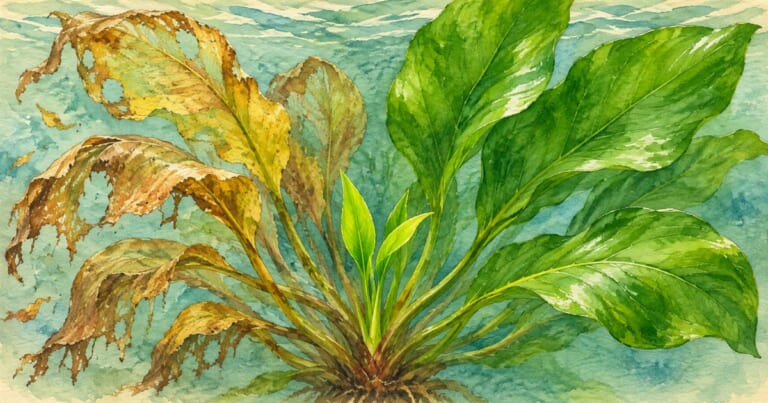
| かかりやすい病気 / Common Issues | 導入直後によく見られるのが、水上葉が水中の環境に順応する過程で起こる「溶け」です。植え付けから1〜2週間ほどで古い葉が傷み始め、数週間続くこともありますが、多くは枯れているのではなく、水中葉へ切り替わっているサインです。長く育てている株で、下葉の縁が黄色や茶色になり、小さな穴が開いて落ちる場合はカリウム不足が疑われます。新芽が白っぽくなる場合は鉄不足、株全体が均一に黄色っぽくなる場合は窒素不足が考えられます。また、新芽が出ず、茎の根元が黒くなってドロドロに崩れる場合は、茎が腐り始めているサインです。強い光のもとでCO2や養分が不足すると、葉に斑点状のコケや糸状のコケが付きやすくなります。Right after planting, the most common issue is “melting” as emersed leaves adapt to life underwater. Old leaves may begin to deteriorate one to two weeks after planting and this can continue for several weeks, but in most cases it means the plant is switching to submersed leaves rather than dying. In established plants, lower leaves with yellow or brown edges and small pinholes that eventually drop suggest potassium deficiency. Pale new growth points to iron deficiency, while uniform yellowing of the whole plant suggests nitrogen deficiency. If no new shoots appear and the stem base turns black and mushy, the stem has begun to rot. Under strong light, a lack of CO2 or nutrients makes spot algae and thread algae more likely to settle on the leaves. |
|---|---|
| 対策と予防 / Prevention | 溶けの時期は、心配でも株を抜いて根を確認するのは控えましょう。伸び始めた細い根を傷つけ、回復を遅らせてしまいます。透明になって溶けた葉はハサミで取り除いて吸い出し、茎の先から明るい緑の新芽が出てくれば順応は成功です。栄養不足には固形肥料の追肥やカリウムを含む液肥で対応し、穴の開いた古い葉は新芽が伸びてきたのを確認してから取り除きます。根元が腐った茎は元に戻らないため、しっかりした緑色の部分まで切り戻して植え直してください。腐敗は底床の汚れや水質の悪化と関係していることが多いので、底床の掃除と定期的な水換えを心がけ、トリミング用のハサミも使用後に洗って清潔に保ちましょう。導入時には、無農薬で貝やコケを持ち込む心配が少ない組織培養カップを選ぶのもおすすめです。During melting, resist the urge to pull up the plant to check its roots; this damages fine new roots and delays recovery. Snip off and siphon out leaves that have turned translucent, and once bright green shoots appear at the stem tips, the transition has succeeded. Address deficiencies with additional root tabs or liquid fertilizer containing potassium, and remove old holed leaves after confirming that new growth is coming in. Stems rotted at the base will not recover, so cut back to firm green tissue and replant. Rot is often linked to a dirty substrate or poor water quality, so keep up substrate cleaning and regular water changes, and wash your trimming scissors after use. When buying, choosing pesticide-free tissue-culture cups, which carry little risk of introducing snails or algae, is also recommended. |
雑学と豆知識 / Trivia and Fun Facts
| 1. 「十字」と「雌しべ」を組み合わせた名前 / 1. A Name Combining “Cross” and “Pistil” | 属名のStaurogyneは、ギリシャ語で十字架を意味する「stauros」と、女性や雌しべを表す「gyne」を組み合わせたもので、花のつくりにちなんだ名前と考えられています。種小名のrepensはラテン語で「這う」という意味で、地面を這うように広がる本種の姿をよく表しています。ちなみに同じキツネノマゴ科には、アクアリウムでおなじみのハイグロフィラ属も含まれます。葉が対になってつくところや茎のつくりにどこか似た雰囲気があるのは、こうした近縁関係によるものです。The genus name Staurogyne combines the Greek “stauros” (cross) and “gyne” (woman, or pistil), and is thought to refer to the structure of the flower. The species name repens is Latin for “creeping”, which aptly describes how this plant spreads across the ground. The acanthus family also includes the genus Hygrophila, familiar to aquarists; the similarity in their paired leaves and stem structure reflects this kinship. |
|---|---|
| 2. 150年以上「眠っていた」水草 / 2. A Plant That “Slept” for Over 150 Years | 本種が学術的に記載されたのは1847年ですが、アクアリウムの世界に登場したのはずっと後の2008年でした。デンマークの水草ファーム、トロピカ社がドイツの国際見本市で新しい水草として紹介し、当初は種名が分からないまま流通していました。正体が判明したのは2010年のことです。ドイツの水草研究家クリステル・カッセルマン氏が水上栽培で花を咲かせて標本をつくり、キツネノマゴ科の専門家に鑑定を依頼したところ、19世紀に名付けられていたStaurogyne repensと一致することが確かめられました。植物の種類を見分けるうえで花は重要な手がかりになるため、花が咲いてようやく名前が分かるというのは、水草では珍しくありません。This species was formally described in 1847, yet it did not appear in the aquarium hobby until much later, in 2008. The Danish plant nursery Tropica introduced it as a new plant at an international trade fair in Germany, and it was initially sold without a known species name. Its identity was revealed in 2010, when German aquatic plant researcher Christel Kasselmann grew it emersed, brought it into flower, and sent a specimen to an Acanthaceae expert for examination; it matched Staurogyne repens, named back in the 19th century. Because flowers are key to telling plant species apart, it is not unusual for an aquatic plant to be named only once it blooms. |
| 3. 川岸の岩場で育まれた姿 / 3. Shaped by Rocky Riverbanks | 原産地の川は、季節によって水位が大きく変わるといわれます。水位が下がる時期には水上に姿をさらし、増水すると流れの中に沈むという、変化の大きな環境です。水上葉の茎を覆う細かな毛や、つやのある葉の表面は乾燥から身を守るのに役立ち、岩をしっかりつかむ丈夫な根は増水した流れに耐えるのに役立っていると考えられます。水槽の中で石の隙間に根を伸ばし、岩肌に沿うように広がっていくのも、こうした環境に合わせて身につけてきた性質の表れといえそうです。The rivers in its native range are said to change greatly in level with the seasons. The plant is exposed above water when levels drop and submerged in the current when the river rises, a constantly changing environment. The fine hairs on emersed stems and the glossy leaf surfaces likely help protect against drying, while the sturdy roots that grip the rocks likely help it withstand high water. Its habit in the aquarium of rooting into gaps between stones and spreading along rock surfaces can be seen as a trait shaped by this environment. |
| 4. ご飯に風味をつける親戚 / 4. A Relative That Flavours Rice | ストロギネ属は熱帯のアジア、アフリカ、南北アメリカなどに広く分布し、なかには人の暮らしと結びついた種もあります。東南アジアに分布するStaurogyne merguensisはその代表で、現地では葉をご飯と一緒に炊いて風味付けに使うことがあるといわれます。この植物からは甘味をもつ配糖体(糖が結びついた化合物)が見つかっており、研究者の関心を集めてきました。水槽で静かに茂るレペンスの仲間に、食文化と関わる植物がいると思うと、少し親しみが増してくるのではないでしょうか。The genus Staurogyne is widespread across tropical Asia, Africa, and the Americas, and some species are tied to human life. A notable example is Staurogyne merguensis of Southeast Asia, whose leaves are said to be cooked with rice locally to add flavour. Sweet-tasting glycosides (compounds bound to sugars) have been found in this plant, attracting the interest of researchers. Knowing that a relative of the quietly growing repens in your tank plays a part in local food culture may make it feel a little more familiar. |
まとめ / Conclusion
ストロギネ・レペンスは、丸く明るい緑の葉がこんもりと茂る、やさしい表情の水草です。前景と後景のあいだを自然につなぎ、石や流木の足もとを包み込む姿は、水景にまとまりと奥行きを与えてくれます。丈夫で育てやすく、CO2を添加しない水槽でも楽しめる手軽さも大きな魅力です。 Staurogyne repens is a gentle-looking plant whose rounded, bright green leaves form soft mounds. By linking foreground and background naturally and wrapping around the bases of rocks and driftwood, it brings unity and depth to an aquascape. Its hardiness and ease of care, even in tanks without CO2, are also a big part of its appeal.
美しい茂みに育てるコツは、しっかりした光と、焦らず続けるトリミングです。切るたびに枝が増え、少しずつ低く密な群落へと変わっていく様子は、育てる人ならではの楽しみといえます。植え付け直後は葉が溶けて戸惑うこともありますが、新芽が顔を出せば、そこから本来の姿へと育っていきます。小さな株が、やがて水景を支える緑の茂みになっていく過程を、じっくり味わってみてください。 The secret to a beautiful bush is good light and patient, steady trimming. Watching the branches multiply with each trim as the plant gradually becomes a low, dense stand is a pleasure unique to those who grow it. The leaves may melt right after planting, which can be unsettling, but once new shoots appear the plant begins to grow into its true form. Take your time and enjoy watching a few small stems become a lush green bush that anchors your aquascape.

困りごとの解決から、用品えらび、水槽づくり、生き物えらびまで。飼育に役立つ案内です。
分布マップ
Staurogyne repensは南米ブラジル原産です。アクアリウムで流通している系統は、マットグロッソ州を流れるアマゾン水系のリオ・クリスタリーノ周辺に由来するとされます。
※地図はブラジル全体を示す概略表示です。マーカーはリオ・クリスタリーノ周辺を示す代表地点であり、実際の採集地点や正確な自生地を示すものではありません。
参考文献 / References
- POWO (2026). Staurogyne repens (Nees) Kuntze. Plants of the World Online. Royal Botanic Gardens, Kew.
https://powo.science.kew.org/taxon/urn:lsid:ipni.org:names:243616-2(閲覧日:2026年11月11日) - Braz, D. M. & Monteiro, R. (2017). Taxonomic revision of Staurogyne (Nelsonioideae, Acanthaceae) in the Neotropics. Phytotaxa, 296(1), 1–40.
https://doi.org/10.11646/phytotaxa.296.1.1 - GBIF Secretariat. Staurogyne repens (Nees) Kuntze. GBIF Backbone Taxonomy.
https://www.gbif.org/species/3773480(閲覧日:2026年11月11日) - Flowgrow. Staurogyne repens. Flowgrow Aquatic Plant Database.
https://www.flowgrow.de/db/aquaticplants/staurogyne-repens(閲覧日:2026年11月11日) - Tropica Aquarium Plants. Staurogyne repens. Plant details.
https://tropica.com/en/plants/plantdetails/4481/4481(閲覧日:2026年11月11日) - Rittirat, S., Klaocheed, S. & Thammasiri, K. (2022). A reliable protocol for micropropagation of an ornamental aquatic plant, Staurogyne repens. Acta Horticulturae, 1339, 227–236.
https://ishs.org/ishs-article/1339_29/ - Hiura, A. et al. (1996). Taste-modifying triterpene glycosides from Staurogyne merguensis. Phytochemistry, 43(5), 1023–1027.



コメント