

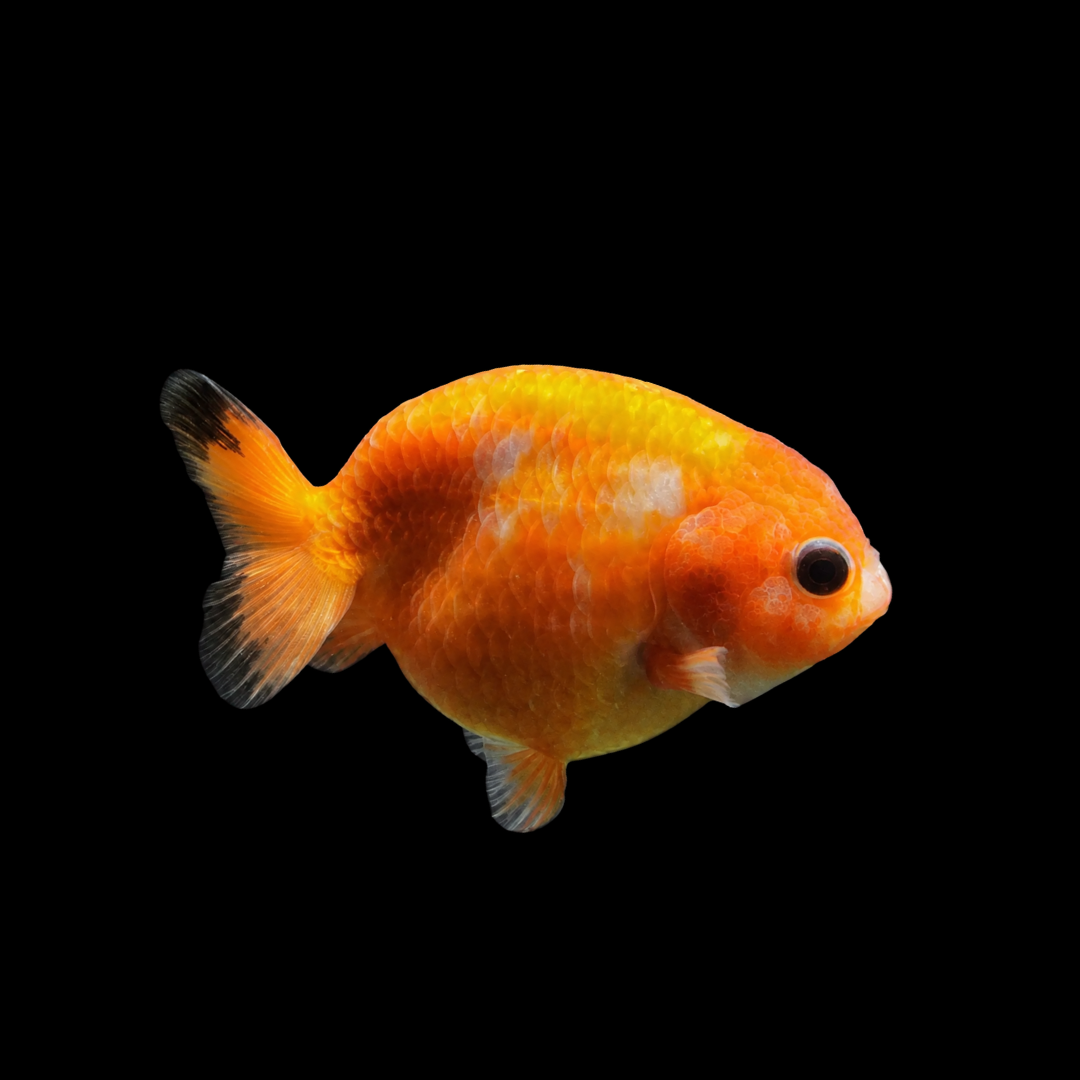
解説 / Description
紅葉らんちゅう(もみじらんちゅう)は、背びれを持たない丸みのある体型、発達する頭部の肉瘤、左右に開く尾といったらんちゅうらしい姿に、「網透明鱗(あみとうめいりん)」と呼ばれる独特の鱗表現を備えた金魚です。網透明鱗では、一枚の鱗の中にグアニン由来の光沢が見える部分と見えにくい部分が混在し、それが連続することで体表に細かな網目のような表情が生まれます。オレンジから赤を基調とする色彩と重なり、見る角度や光の当たり方によって印象が変わるのが特徴です。伝統的ならんちゅうと同じく、上から眺めた背なりや尾の開きが見どころですが、ガラス水槽で横から観察すると鱗の細かな反射も確認しやすく、上見と横見の双方で楽しめます。泳ぎはゆっくりしているため、十分な水量、穏やかな水流、安定した水質、活動量に合わせた適量の給餌が長期飼育の基本になります。 Momiji Ranchu is a fancy goldfish that combines the classic Ranchu form—no dorsal fin, a rounded body, developing head growth, and a broadly spread tail—with a distinctive scale expression known as reticulated transparent scales. In these scales, guanine-derived reflective areas and less reflective areas occur within the same scale, and their repetition creates a fine net-like appearance across the body. This effect overlaps orange-to-red coloration and changes with viewing angle and lighting. Like traditional Ranchu, the fish can be appreciated from above for the curve of the back and the balance of the tail, while side viewing in a glass aquarium makes the fine scale reflections easier to observe. Its swimming ability is modest, so long-term success depends on generous water volume, gentle current, stable water quality, and feeding appropriate to the fish’s activity level.
基本情報 / Basic Information
| 学名 / Scientific Name | Carassius auratus |
|---|---|
| 通称 / Common Name | 紅葉らんちゅう、もみじらんちゅうMomiji Ranchu |
| 分類 / Family | コイ目・コイ科・フナ属。金魚の改良品種で、らんちゅう系統に属します。Order Cypriniformes, family Cyprinidae, genus Carassius. A domesticated goldfish variety belonging to the Ranchu group. |
| 英名 / English Name | Momiji Ranchu |
| 分布 / Distribution | 野生分布を持たない観賞用品種です。日本国内で生産・流通しており、網透明鱗を持つらんちゅうとして「もみじらんちゅう」の名で扱われています。A domesticated ornamental variety with no natural wild distribution. It is bred and distributed in Japan under the name Momiji Ranchu, referring to Ranchu that express reticulated transparent scales. |
| 最大体長 / Max Size | 全長約15〜20cmが目安です。系統、飼育密度、給餌、成長期間によって差があり、大型個体ではさらに大きくなることがあります。Usually around 15–20 cm in total length, although size varies with lineage, stocking density, feeding, and growth conditions, and some individuals may become larger. |
| 寿命 / Lifespan | 紅葉らんちゅうだけを対象にした寿命の統計は確認されていません。金魚は適切な環境で10年以上生きることがあり、さらに長寿になる例もあります。水質、飼育密度、給餌、日々の健康管理が寿命を大きく左右します。No reliable lifespan statistics specific to Momiji Ranchu are available. Goldfish can live for more than 10 years under appropriate conditions, and considerably longer lifespans are possible. Water quality, stocking density, feeding, and routine health management all have a major influence on longevity. |
飼育環境 / Aquarium Environment
| 水槽サイズ / Tank Size | 若魚1匹でも60cm規格水槽(実水量およそ50〜60L前後)以上を出発点とし、成魚をゆったり育てるなら1匹あたり75L前後の水量を確保すると管理しやすくなります。成魚2匹以上の長期飼育では90cm規格水槽(約150L前後)以上が安心です。高さよりも底面積と水量を優先し、上見を楽しむ場合は浅めで広い容器も適します。Even for a single juvenile, a standard Japanese 60 cm aquarium, with roughly 50–60 L of actual water volume, is a sensible starting point. For an adult, providing around 75 L per fish makes water quality easier to manage. For two or more adults, a standard 90 cm aquarium of roughly 150 L or larger is preferable. Floor area and water volume are more important than excessive depth, and broad shallow tubs also suit traditional top-view appreciation. |
|---|---|
| 水温 / Temperature | 18〜24℃前後で安定させると管理しやすく、室内飼育では20〜23℃程度が一つの目安になります。高水温になるほど溶存酸素が低下し、水質も悪化しやすいため、夏場は十分なエアレーションを確保します。低水温期は魚の活動と食欲を見ながら給餌量を減らし、ほとんど活動しない状態では無理に与えません。具体的な温度そのものより、急激な変化を避けることが重要です。 A stable range of roughly 18–24°C is practical, with about 20–23°C serving as a useful target for indoor care. As water becomes warmer, dissolved oxygen declines and water quality can deteriorate more quickly, so ample aeration is important in summer. During cooler periods, reduce feeding according to the fish’s activity and appetite, and do not force-feed fish that are largely inactive. Avoiding sudden temperature changes is more important than maintaining one exact number. |
| 水質 / Water Quality | pH6.5〜7.5程度の中性付近を中心に、急変のない安定した水質を維持します。アンモニアと亜硝酸は0mg/Lを維持し、硝酸塩は換水で低く抑えます。金魚は排泄量が多いため、十分に成熟した生物ろ過と定期的な換水が重要です。硬度への適応幅は比較的広いものの、導入時には購入元との水質差を小さくしてください。Maintain stable water near neutral, approximately pH 6.5–7.5, and avoid abrupt shifts. Ammonia and nitrite should remain at 0 mg/L, while nitrate should be kept low through regular water changes. Goldfish produce substantial waste, so mature biological filtration is essential. They tolerate a fairly broad hardness range, but large differences between source water and the new aquarium should be minimized during acclimation. |
| レイアウト / Layout | ベアタンク、または角の丸い大磯砂や細かな川砂など、体表やヒレを傷つけにくい底床が向きます。尖った石や複雑な流木は避け、遊泳空間を広く確保します。投げ込み式フィルターやスポンジフィルターなどで穏やかな流れを作り、十分なエアレーションを行います。横見では正面や斜め上から柔らかく照明を当てると、網透明鱗の細かな反射を観察しやすくなります。A bare-bottom setup is practical, or use smooth substrate such as rounded gravel or fine river sand that is unlikely to damage scales and fins. Avoid sharp stones and complicated woodwork, leaving broad open swimming space. Box filters or sponge filters are suitable for creating gentle circulation while maintaining strong aeration. For side viewing, soft lighting from the front or slightly above makes the fine reticulated reflections easier to observe. |
| 注意点 / Precautions | 背びれがなく丸い体型のため、泳ぎは速くありません。強い水流、過密飼育、急な水温変化、急激なpH変動を避けてください。金魚は食欲が強い一方で過食による消化不良や浮力異常を起こしやすいため、残餌が出る給餌は禁物です。新しい魚はすぐに本水槽へ入れず、可能であれば別容器で健康状態を確認してから合流させると病気の持ち込みを減らせます。Because Ranchu lack a dorsal fin and have a compact body, they are not fast swimmers. Avoid strong current, overcrowding, sudden temperature changes, and rapid pH shifts. Goldfish are enthusiastic feeders but are prone to digestive and buoyancy problems when overfed, so uneaten food should not be left in the aquarium. Whenever possible, observe new fish separately before introduction to reduce the risk of bringing disease into the main system. |
餌と給餌 / Feeding
| 餌の種類 / Diet | 主食は消化性のよい金魚用の沈下性人工飼料が扱いやすく、補助的に冷凍アカムシ、ミジンコ、ブラインシュリンプなどを利用できます。成長期には適度なタンパク質を含む餌、発色を維持したい時期にはアスタキサンチンやスピルリナなどを含む色揚げ飼料を少量組み合わせます。植物質も利用する雑食性なので、栄養が偏らないよう単一の餌だけに依存しないことが大切です。A digestible sinking goldfish pellet is convenient as the staple diet. Frozen bloodworms, daphnia, and brine shrimp can be used as supplementary foods. During active growth, a moderate-protein diet is useful, while small amounts of color-enhancing food containing ingredients such as astaxanthin or spirulina may help maintain red and orange tones. As omnivorous fish that also utilize plant matter, they benefit from a balanced diet rather than dependence on a single food. |
|---|---|
| 給餌のポイント / Feeding Tips | 一度に多く与えるより、活性の高い時期は少量を1日2〜3回に分け、短時間で食べ切れる量に抑える方法が安全です。水温が下がって活動や食欲が落ちたら、量と回数も減らします。水面で空気をのみ込みやすい個体や食後に浮きやすい個体では、沈下性飼料を少量ずつ与えると管理しやすくなります。色揚げ飼料も多ければよいわけではなく、体色や体調を見ながら補助的に使います。During active periods, it is safer to divide food into two or three small meals rather than giving a large amount at once, offering only what can be eaten in a short time. As water temperature falls and activity and appetite decline, reduce both quantity and frequency. For fish that gulp air or tend to float after eating, small portions of sinking food are often easier to manage. Color-enhancing diets are best used as a supplement while monitoring body color and condition. |
性格と混泳 / Temperament and Tank Mates
| 性格 / Temperament | 基本的には温和で、人にもよく慣れる金魚です。餌の時間には活発に寄ってきますが、体型上の理由から急旋回や速い遊泳は得意ではありません。個体間で軽い追尾や餌の取り合いが見られることはありますが、強い縄張り性を示す魚ではありません。Generally peaceful and responsive to people, Momiji Ranchu often become very active at feeding time. Their body shape makes rapid turns and sustained fast swimming difficult. Mild chasing or competition for food may occur, but they are not strongly territorial fish. |
|---|---|
| 混泳の相性 / Compatibility | 最も相性がよいのは、らんちゅう、オランダ獅子頭、東錦など、泳ぐ速さと給餌能力が近い丸手の金魚です。和金、コメット、朱文金のような速泳型は餌を先に取ってしまいやすく、紅葉らんちゅうが痩せる原因になります。小型魚やエビとの混泳も、捕食、餌競争、水温条件の違いが生じるため、基本的には金魚中心の水槽にするのが安全です。The best companions are other slower fancy goldfish with similar feeding ability, such as Ranchu, Oranda, and Azuma Nishiki. Fast-swimming varieties such as common goldfish, Comets, and Shubunkins may monopolize food and leave Momiji Ranchu underfed. Mixing with small fish or shrimp can also create problems involving predation, food competition, or different temperature needs, so a goldfish-focused aquarium is usually safest. |
病気と対策 / Diseases and Prevention
| かかりやすい病気 / Common Diseases | 白点病やエラの寄生虫症、尾ぐされ病などの細菌性疾患、体表の擦れ傷からの二次感染に注意します。また、丸い体型の金魚では、給餌過多や消化状態、内臓や浮き袋の異常など、複数の要因が関与する浮力異常が見られることがあります。いわゆる「転覆病」は単一原因の病名ではなく、複数の要因で似た症状が出るため、原因を決めつけないことが重要です。Watch for white spot disease and gill parasites, bacterial conditions such as fin rot, and secondary infection following abrasions. Compact-bodied goldfish may also develop buoyancy disorders associated with multiple factors, including excessive feeding, digestive condition, internal disease, or swim-bladder abnormalities. So-called “swim bladder disease” is a symptom pattern with multiple possible causes rather than a single diagnosis, so the underlying cause should not be assumed without observation. |
|---|---|
| 対策と予防 / Prevention | 病気を減らす基本は、アンモニア・亜硝酸を検出させない成熟したろ過、定期換水、過密回避、適量給餌、新規導入魚の隔離観察です。異常が出たら、まず水質と水温を確認し、必要に応じて隔離します。0.3〜0.5%程度の塩水浴は一部の状況で補助的に用いられますが、原因を問わず使える治療法ではありません。塩分濃度の急変や漫然とした長期使用を避け、薬剤を使用する場合は症状に合った観賞魚用薬を選び、濃度、使用期間、併用可否を製品表示に従ってください。The foundation of prevention is mature filtration that keeps ammonia and nitrite undetectable, regular water changes, sensible stocking density, controlled feeding, and observation of new fish before introduction. When abnormal behavior appears, check water quality and temperature first and isolate the fish when appropriate. Salt at roughly 0.3–0.5% is sometimes used as supportive care in selected situations, but it is not a universal treatment. Avoid abrupt changes in salinity or indefinite routine use, and if medication is needed, choose an aquarium fish medicine appropriate to the suspected condition and follow the product instructions for concentration, duration, and compatibility with other treatments. |
増やし方(繁殖) / Breeding
| 雌雄の判別 / Sexing | 繁殖期の雄はエラ蓋や胸びれの前縁に白い追星が現れやすく、雌を追尾する行動が目立ちます。成熟した雌は抱卵すると腹部がふっくらし、総排泄孔がやや突出して見えることがあります。ただし若魚や非繁殖期では外見だけの判別が難しく、複数の特徴を合わせて判断します。During the breeding season, males often develop small white breeding tubercles on the gill covers and leading rays of the pectoral fins and show persistent chasing behavior. Mature females carrying eggs develop a fuller abdomen, and the vent may appear slightly more prominent. Sexing juveniles or fish outside the breeding season is difficult, so several signs should be considered together. |
|---|---|
| 繁殖形態 / Reproduction | 卵生で、春先など水温上昇をきっかけに繁殖行動が始まりやすい散乱型の産卵を行います。雄が雌を追い、産卵藻や人工産卵床、水草などに粘着性の卵を産み付けます。親魚は卵を保護せず食べてしまうため、採卵後は親魚と卵を分けるのが基本です。Momiji Ranchu are egg-laying fish that scatter adhesive eggs. Spawning activity commonly increases as water temperature rises in spring. Males chase females, which deposit sticky eggs on spawning mops, artificial media, or aquatic plants. The parents provide no care and may eat the eggs, so adults are normally separated from the eggs after spawning. |
| 繁殖のポイント / Breeding Tips | 繁殖水槽では十分なエアレーションと清潔な水を保ち、孵化後は稚魚の口に合う初期飼料から段階的に餌を切り替えます。紅葉らんちゅうらしい表現を残すには、背びれの欠損、背なり、尾の形、肉瘤だけでなく、網透明鱗の出方や体色も見ながら長期的な選別が必要です。網透明鱗の表現には個体差が生じるため、別品種との交雑を避け、由来の明確な紅葉らんちゅう同士で系統を維持することが、特徴を安定して残すうえで重要です。Maintain clean water and ample aeration in the breeding tank, then move newly hatched fry through progressively larger foods as their mouths and swimming ability develop. Preserving the Momiji Ranchu appearance requires long-term selection not only for the dorsal-finless back, body curve, tail, and head growth, but also for the expression of reticulated transparent scales and body color. Because scale expression varies among offspring, avoiding crosses with unrelated varieties and maintaining clearly documented Momiji Ranchu lines is important when the goal is to preserve the characteristic phenotype. |
雑学と豆知識 / Trivia and Fun Facts
| 1. 「もみじ」は色だけでなく鱗の呼び名 / 1. “Momiji” refers to a scale expression, not just a color | 紅葉らんちゅうという名前からは、まず秋の赤や橙を思い浮かべます。しかし金魚の世界では「もみじ」という言葉が、網透明鱗を持つ魚を表す呼称としても広がってきました。現在では、もみじ琉金、もみじオランダなど、らんちゅう以外の品種でも網目状の反射を示すタイプに「もみじ」の名が使われます。つまり紅葉らんちゅうは、一つの美しい品種名であると同時に、後の金魚の命名文化へ影響を与えた存在でもあります。The name Momiji Ranchu naturally evokes the red and orange colors of autumn leaves. In Japanese goldfish culture, however, “momiji” has also expanded into a term for fish showing the reticulated transparent-scale expression. Names such as Momiji Ryukin and Momiji Oranda are now used for similar scale patterns in other varieties. Momiji Ranchu is therefore not only a variety name, but also part of a naming tradition that influenced how this distinctive scale expression is described across modern goldfish. |
|---|---|
| 2. 長期の選別が生んだ個性 / 2. A distinctive phenotype shaped by long-term selection | 紅葉らんちゅうの作出史では、三重県菰野町の太田水園で透明鱗のらんちゅうを長期間選別し、網透明鱗の表現を安定させた系統として伝えられています。観賞魚の品種は、一度の交配だけで形質がそろうわけではありません。狙った特徴が次世代にも現れる個体を残し、体型や健康状態などを見ながら選別を重ねることで、その品種らしい姿が整えられていきます。水槽で一瞬きらめく網目模様の背後には、何世代にもわたる選択の積み重ねがあります。The formative history of Momiji Ranchu is commonly attributed to Ota Suien in Komono, Mie Prefecture, where transparent-scale Ranchu are said to have been selected over an extended period to stabilize the reticulated expression. Ornamental varieties do not become consistent through a single cross. Breeders repeatedly retain fish that reproduce the desired traits while also judging body form and health over many generations. The brief sparkle of a net-like pattern in the aquarium is therefore the visible result of long-term selection. |
| 3. 網目は「模様」だけではなく光の現象 / 3. The reticulation is an optical effect as well as a pattern | 金魚の鱗が金属的に輝く背景には、グアニン結晶を持つ虹色素胞による反射があります。網透明鱗では、一枚の鱗の中に光沢が現れる部分と現れにくい部分が混在し、その並びが連続することで体表が網目状に見えます。照明の位置や観察角度によって見え方が変わるのは、こうした反射の性質によるものです。静止画では淡く見える個体でも、水中で体の向きが変わると細かな反射が目立ち、紅葉らんちゅうらしい立体感が現れることがあります。The metallic shine of goldfish scales is produced in part by reflective iridophores containing guanine crystals. In reticulated transparent scales, reflective and less reflective areas occur within the same scale, and their repeated arrangement creates a net-like appearance across the body. This is why the fish can look different as lighting and viewing angle change. An individual that appears subtle in a still photograph may reveal much stronger fine reflections when it turns in the water. |
| 4. 上見の伝統と横見の現代性を両立する金魚 / 4. A fish that connects traditional top viewing with modern side viewing | 日本のらんちゅう文化は、鉢や舟で上から眺め、背の曲線、尾の開き、泳ぎの軌跡を味わう「上見」を中心に育ってきました。紅葉らんちゅうもその美学を受け継ぎますが、網透明鱗の細かな反射はガラス水槽の横見でこそ見つけやすい特徴です。上からはらんちゅうとしての骨格と尾を、横からは鱗と色の重なりを観察できるため、一匹の魚が二つの鑑賞文化を自然につないでくれます。Japanese Ranchu culture developed around top viewing in bowls and broad tubs, where the curve of the back, the spread of the tail, and the path of the fish through the water are central to appreciation. Momiji Ranchu inherits that aesthetic, yet its fine reticulated reflections are easier to discover from the side in a glass aquarium. From above, the viewer reads the Ranchu body and tail; from the side, the interaction of scales, light, and color becomes prominent. One fish therefore bridges two different viewing traditions. |
| 5. 背びれのない姿は発生生物学の研究対象にもなった / 5. The dorsal-finless body became a subject of developmental biology | らんちゅうの背びれがない姿は、愛好家にとっては美の基準ですが、研究者にとっては脊椎動物の体の形がどのように作られるかを調べる手がかりでもあります。2022年の研究では、胚の背腹方向の形成に関わるchordin遺伝子の一つであるchdSが、金魚の二つ尾だけでなく、背びれを欠く形質にも関与することが実験的に示されました。つまり、品種改良で選び残されてきた「二つ尾」と「背びれがない」という二つの特徴は、遺伝的に無関係な変化ではなく、発生の仕組みを介して結びついていることが分かってきたのです。For Ranchu keepers, the absence of a dorsal fin is an aesthetic standard; for researchers, it is also a clue to how vertebrate body form is constructed during development. A 2022 study experimentally showed that chdS, one of the chordin genes involved in dorsal–ventral patterning during embryonic development, contributes not only to the twin-tail condition of goldfish but also to the dorsal-finless phenotype. In other words, two traits preserved through ornamental breeding—the twin tail and the absence of a dorsal fin—are not genetically independent changes, but are linked through the mechanisms that shape the developing body. |
| 6. 「固定品種」でも一匹ずつ表情が違う / 6. Even a stabilized variety still varies from fish to fish | 品種として名前が定着していても、紅葉らんちゅうの網透明鱗、赤の濃さ、肉瘤、背なり、尾の開きがすべて同じになるわけではありません。繁殖では親の特徴がそのまま複製されるのではなく、稚魚の中にさまざまな組み合わせが現れます。そのため生産者は成長に合わせて何度も魚を見直し、紅葉らんちゅうらしさを備えた個体を残します。均一な工業製品とは正反対で、一匹ごとの差そのものが、改良金魚を育て、選び、眺める楽しさにつながっています。Even when a variety name is well established, no two Momiji Ranchu are identical in reticulated scale expression, red intensity, head growth, back curve, and tail spread. Breeding does not simply copy the parents; offspring display many different combinations of traits. Breeders therefore reassess fish repeatedly as they grow and retain individuals that best express the Momiji Ranchu character. This natural variation is the opposite of industrial uniformity, and the differences between individual fish are part of the pleasure of breeding, selecting, and observing fancy goldfish. |
まとめ / Conclusion
紅葉らんちゅうは、らんちゅうの伝統的な体型に、光で表情を変える網透明鱗を重ねた独自性の高い金魚です。豪快に泳ぐ魚ではありませんが、ゆっくりと進む体の動きに合わせて鱗の細かな反射がきらめき、上から眺めた時と横から眺めた時で異なる魅力を見せてくれます。 Momiji Ranchu combines the traditional Ranchu body with reticulated transparent scales that change character under different light. It is not a powerful swimmer, but the slow movement of the body allows the fine scale reflections to shimmer, revealing different qualities when viewed from above and from the side.
十分な水量と穏やかな水流、安定した水質を保ち、活動量に合わせて餌を調整すれば、紅葉らんちゅうとは長く付き合うことができます。毎日の健康観察を兼ねて光の当たり方や尾の動きを眺めていると、一匹ごとに異なる網目の見え方や体色の変化にも気づけます。ゆっくり泳ぐ姿と繊細な鱗の表情を時間をかけて楽しめることが、この金魚ならではの魅力です。 With generous water volume, gentle flow, stable water quality, and feeding adjusted to activity, Momiji Ranchu can be kept as a long-term companion. Daily health checks also become opportunities to notice how light changes the appearance of the scales and how individual fish differ in pattern and body color. Its slow swimming and delicate scale expression are qualities that become more rewarding with careful, patient observation.

気になる道具や飼い方を見つけてみませんか?
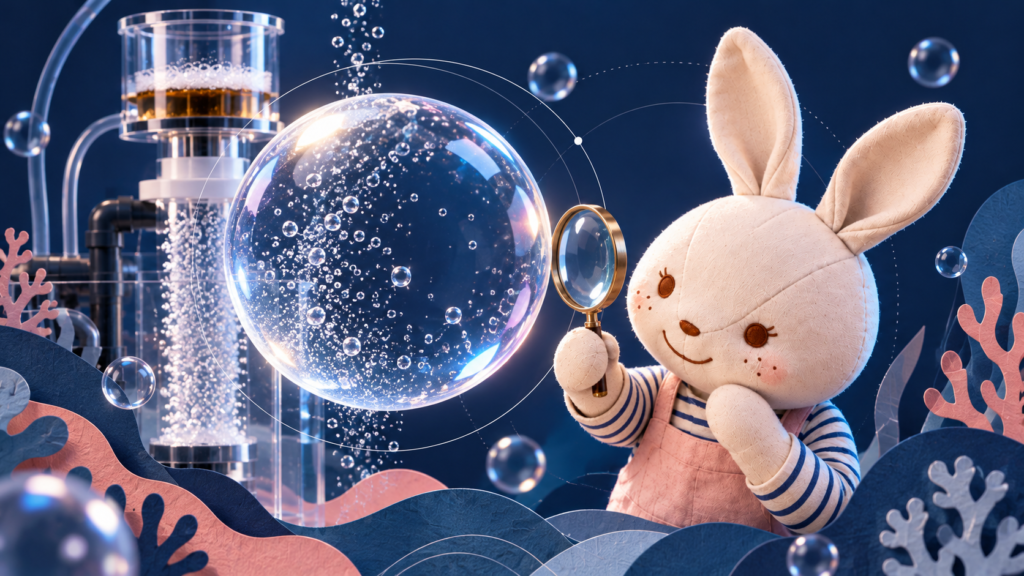 アイのアクアグッズ案内あい先生のアクアグッズ深堀り!|泡で汚れを取り出す? プロテインスキマーの歴史と仕組み道具の特徴や使い方、選ぶときのポイントをアイが紹介します。記事はコチラ →
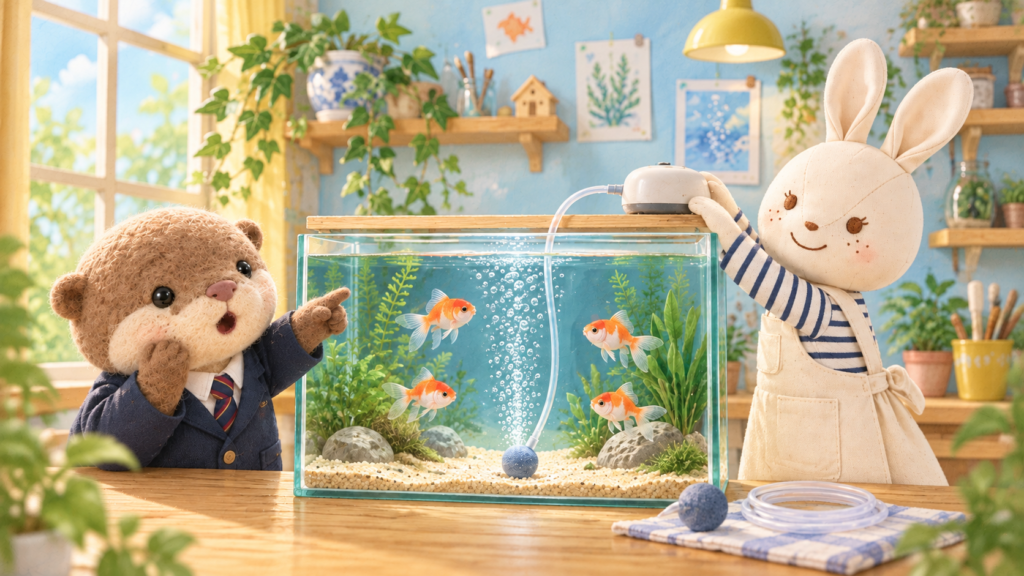 アイのアクアグッズ案内水槽のエアーポンプの選び方|水深・音・泡で選ぶおすすめ用品道具の特徴や使い方、選ぶときのポイントをアイが紹介します。記事はコチラ →
さまざまな飼育テーマをご紹介。リンク先の記事には広告・商品紹介が含まれます。
案内・紹介記事一覧へ →分布マップ
紅葉らんちゅう(Carassius auratus)は野生分布を持たない観賞用品種で、日本国内で生産・流通しています。地図では、日本国内で扱われる品種であることを示すため、日本列島全体が見える概略範囲を表示しています。
※この地図は分布・流通地域を把握するための概略表示です。マーカーは日本を代表する目安の地点として設定したもので、実際の採集地点・生産地・個体の由来を示すものではありません。
参考文献
-
California Academy of Sciences. Eschmeyer’s Catalog of Fishes: Carassius auratus. Online Version, updated 13 Aug. 2026.
分類・学名の確認。 -
U.S. Geological Survey, Nonindigenous Aquatic Species Database. Goldfish (Carassius auratus) — Species Profile. 2026.
金魚という種の分布、生息環境、一般的な体サイズ・生態の確認。 -
RSPCA Australia Knowledgebase. How should I care for my goldfish?. Updated 1 May 2024.
水槽容量、水温、pH、アンモニア・亜硝酸、ろ過、エアレーション、換水などの飼育条件の確認。 -
Petty BD, Francis-Floyd R, Yanong RPE. Management of Aquarium Fish. MSD Veterinary Manual. Updated June 2026.
水質管理、急変によるストレス、隔離・バイオセキュリティ、アンモニア・亜硝酸管理、塩分利用上の注意の確認。 -
Petty BD, Francis-Floyd R, Yanong RPE. Parasitic Diseases of Fish. MSD Veterinary Manual. Updated June 2026.
白点病、Gyrodactylus・Dactylogyrusなどの皮膚・エラ寄生虫症、隔離と診断の考え方の確認。 -
Petty BD, Francis-Floyd R, Yanong RPE. Bacterial Diseases of Fish. MSD Veterinary Manual. Updated September 2024.
金魚を含む観賞魚の細菌性疾患と、水質悪化・過密・温度変化などの発症要因の確認。 -
Kobayashi M, Iwata E, Sorensen PW. Environmental and Physiological Regulation of Reproduction in the Goldfish: Gonadal Development, Maturation, and Spawning Behavior: A Review. Animals. 2026;16(5):775. doi:10.3390/ani16050775.
金魚の成熟、環境条件と産卵行動、繁殖生理の確認。 -
Canadian Veterinary Medical Association. Swim Bladder Problems in Goldfish. 24 Oct. 2012.
丸手の改良金魚でみられる浮力異常と体型上の素因の確認。




コメント