

解説 / Description
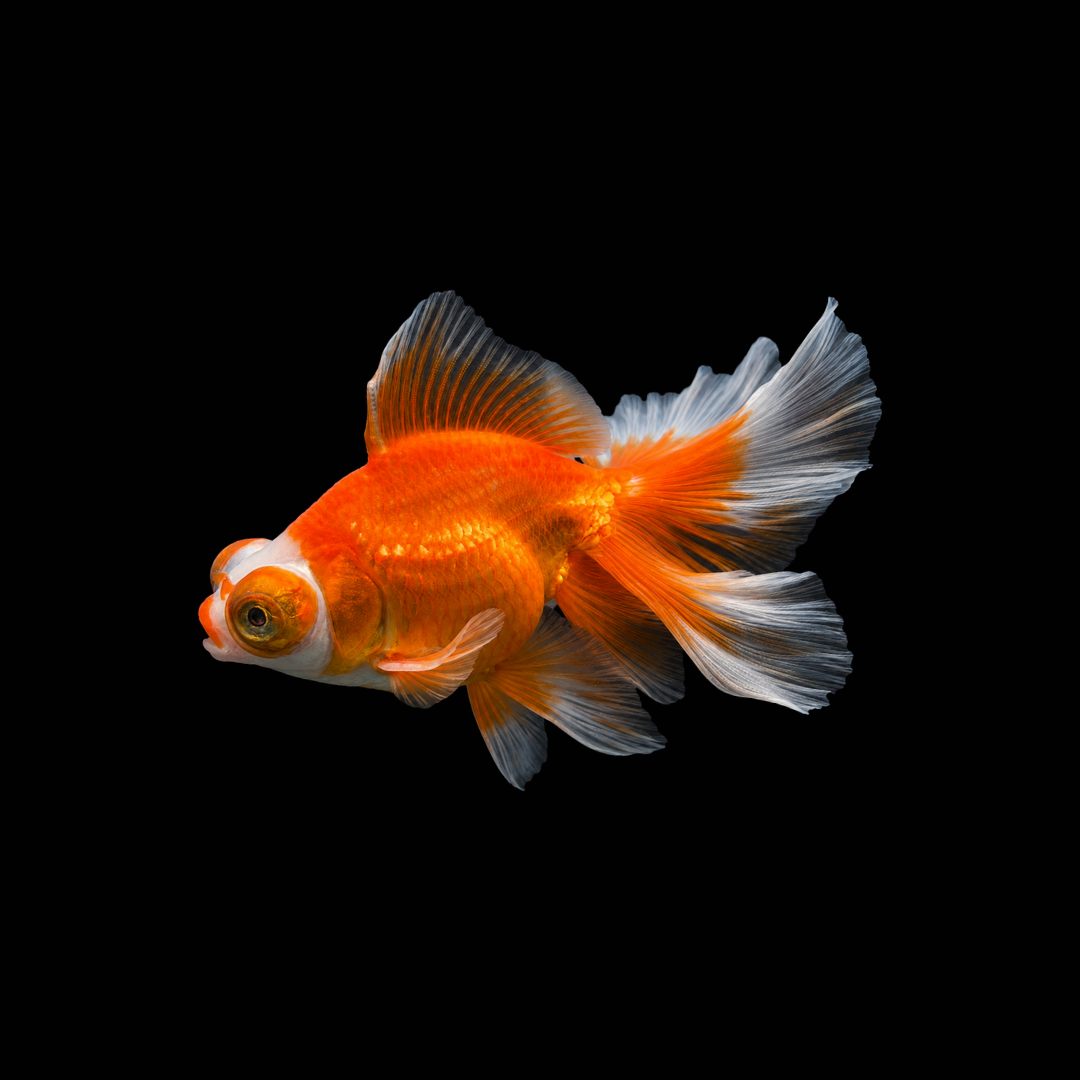
更紗蝶尾(サラサチョウビ)は、紅白の更紗模様と、上から見たときに蝶が羽を広げたように水平へ展開する尾鰭をあわせ持つ金魚です。出目金と同じく左右に張り出す眼を持ち、丸みのある体から大きな尾が広がる姿には、横見とは異なる上見ならではの美しさがあります。特に尾の左右対称性や尾肩の張り、赤と白の配置には個体差があり、同じ更紗蝶尾でも一尾ごとに印象が異なります。流線型の金魚に比べると泳ぎがゆっくりで、突出した眼のため餌を見つけるのに時間がかかることもあります。強い水流や尖った装飾を避け、落ち着いて採餌できる環境を整えることが長期飼育の基本です。 Sarasa Butterfly Tail Goldfish combine a red-and-white sarasa pattern with a caudal fin that spreads horizontally like the open wings of a butterfly when viewed from above. Like other telescope-eye goldfish, their eyes project outward, while the rounded body and broad tail create a distinctive top-view silhouette. Tail symmetry, the strength of the leading edges of the tail, and the placement of red and white markings vary from fish to fish, giving each specimen an individual appearance. Compared with streamlined goldfish, they are slower swimmers and may take longer to locate food because of their projecting eyes. Gentle water movement, a safe obstacle-free layout, and feeding conditions that reduce competition are therefore important for long-term care.
基本情報 / Basic Information
| 学名 / Scientific Name | Carassius auratus |
|---|---|
| 通称 / Common Name | 更紗蝶尾、サラサチョウビ、蝶尾(金魚の紅白更紗タイプ)Sarasa Butterfly Tail Goldfish, Butterfly Telescope Goldfish |
| 分類 / Family | コイ目・コイ科・フナ属。キンギョの改良品種Order Cypriniformes, family Cyprinidae, genus Carassius; a domesticated fancy variety of the goldfish |
| 英名 / English Name | Sarasa Butterfly Tail Goldfish / Butterfly Telescope Goldfish |
| 分布 / Distribution | 改良品種のため自然分布はありません。蝶尾は中国で発達した出目金系の品種として知られ、現在は日本を含む各国で飼育・繁殖されています。As a domesticated variety, it has no natural wild distribution. The butterfly form developed as a telescope-eye type in China and is now kept and bred in Japan and many other countries. |
| 最大体長 / Max Size | 成魚では12〜20cm程度がひとつの目安です。系統や飼育環境によって差があり、大きな尾鰭が水平に広がるため、上見では体長の数値以上に大きく見えます。About 12–20 cm is a useful adult-size guide, although growth varies with lineage and husbandry. The wide, horizontally spread tail also makes a mature fish appear larger than its measured body length when viewed from above. |
| 寿命 / Lifespan | 適切な環境では10〜15年程度が目安で、良好な管理下ではそれ以上生きる個体もいます。Around 10–15 years is a practical expectation under good care, and some individuals may live longer in consistently favorable conditions. |
飼育環境 / Aquarium Environment
| 水槽サイズ / Tank Size | 水量と底面積の両方を重視し、若魚1匹でも60cm規格水槽(約57L)程度から検討します。成魚の長期飼育や複数飼育では、90cm規格水槽(約180L)など、より余裕のある水量と遊泳面積を確保すると管理しやすくなります。上見を楽しむ場合は、広い水面を確保できるトロ舟や角型タライも選択肢になります。Consider both water volume and floor area. A 60 cm standard Japanese aquarium, about 57 L before displacement, is a practical starting point even for one young fish. For long-term adult care or multiple fish, a roomier setup such as a 90 cm standard aquarium of about 180 L is easier to manage. Wide tubs and rectangular containers are also suitable options when the fish are primarily viewed from above. |
|---|---|
| 水温 / Temperature | 日常管理では18〜24℃前後をひとつの目安とします。金魚は比較的幅広い水温に適応しますが、特定の数値に合わせることより急激な変化を避けることが重要です。換水時も水温差をできるだけ小さくします。 About 18–24°C is a useful routine-care guide. Goldfish tolerate a fairly broad temperature range, but avoiding rapid changes is more important than targeting a single exact number. Keep temperature differences during water changes as small as practical. |
| 水質 / Water Quality | pHはおおむね6.5〜8.0の範囲で安定させ、アンモニアと亜硝酸は検出されない状態を目指します。硝酸塩は低く保つことが望ましく、50mg/L未満をひとつの管理目安としながら、過密飼育や過剰給餌を避けて上昇を抑えます。硬度の数値を細かく追うことより、水質を急変させないことを優先します。Keep pH broadly stable within about 6.5–8.0 and aim for undetectable ammonia and nitrite. Nitrate should be kept low; below 50 mg/L is a useful management guide, with lower levels preferred when practical. Rather than chasing a narrow hardness target, prioritize stable water chemistry and avoid abrupt changes. |
| レイアウト / Layout | 突出した眼と大きな尾鰭を傷つけないよう、尖った石や枝状の流木を避けたバリアフリーな構成が基本です。底床はベアタンク、細かな砂、角のない素材が扱いやすく、装飾を入れる場合も丸みのあるものに限定します。ろ過は十分な能力を確保しながら、吐出口を壁面に向ける、スポンジを使うなどして水流を穏やかにします。Use a barrier-free layout to protect the projecting eyes and broad fins. Avoid sharp rocks and branching driftwood. Bare-bottom tanks, fine sand, or smooth materials are easiest to manage, and any decorations should have rounded surfaces. Provide adequate filtration while keeping the current gentle by directing outlets toward the tank wall or diffusing the flow with suitable sponge material. |
| 注意点 / Precautions | 視力と遊泳力が低く、強い水流、過密飼育、餌の競争に弱い品種です。飛び出した眼は擦り傷から感染につながりやすいため、網ですくう際も眼を引っ掛けないよう注意します。水を汚しやすい金魚なので、ろ過能力だけに頼らず定期的な換水と底の清掃を行い、水質を安定させることが重要です。This variety has limited eyesight and swimming ability and is vulnerable to strong currents, crowding, and intense feeding competition. The projecting eyes can be injured easily, so extra care is needed when netting or moving the fish. Because goldfish produce a substantial waste load, stable water quality depends on regular water changes and bottom cleaning rather than filtration alone. |
餌と給餌 / Feeding
| 餌の種類 / Diet | 金魚用の栄養バランスの取れたペレットを主食にし、冷凍赤虫、柔らかくした葉野菜、植物質を含むフードなどを補助的に与えます。出目性のある個体では沈下性ペレットが扱いやすく、更紗の赤を保つ目的では、アスタキサンチンやスピルリナなどカロテノイド源を含む色揚げ飼料も利用できます。Use a nutritionally balanced goldfish pellet as the staple diet, supplemented with foods such as frozen bloodworms, softened leafy vegetables, and feeds containing plant material. Sinking pellets are often easier to manage for telescope-eyed fish, and color-enhancing diets containing carotenoid sources such as astaxanthin or spirulina may help support red coloration. |
|---|---|
| 給餌のポイント / Feeding Tips | 1日1〜2回を基本に、数分で食べ切れる量を少量ずつ与えます。突出した眼を持つ個体は餌の位置を捉えるのに時間がかかることがあるため、一か所へ大量に落とすより、各個体が見つけやすい位置へ分けて与えると食べ残しを減らせます。浮きやすい症状が出る個体では沈下性の餌が扱いやすい場合があり、低水温時は活動量と摂餌の様子を見ながら給餌量を減らします。Feed small portions once or twice daily, offering only what can be consumed within a few minutes. Fish with projecting eyes may take longer to locate food, so distributing it where each individual can find it is often more effective than dropping a large amount in one spot. Sinking food can be easier to manage for fish that develop post-feeding buoyancy problems, and feeding should be reduced at low temperatures according to activity and appetite. |
性格と混泳 / Temperament and Tank Mates
| 性格 / Temperament | 基本的には温和で、他魚を積極的に攻撃するタイプではありません。人の気配に慣れると餌を求めて近寄ることもありますが、泳ぎはゆっくりで、出目による視野の癖もあるため、驚かせない落ち着いた環境が向いています。Generally peaceful and not inclined to attack tank mates. Many individuals become accustomed to their keeper and approach at feeding time, but their swimming is slow and their telescope eyes alter the way they perceive their surroundings, so a calm environment suits them best. |
|---|---|
| 混泳の相性 / Compatibility | 最も相性がよいのは同程度の泳力を持つ蝶尾や、穏やかな丸手の金魚です。和金、コメット、朱文金などの俊敏な品種とは餌の競争で不利になりやすく、眼や尾鰭を傷める可能性もあるため避けたほうが安全です。らんちゅうや水泡眼なども混泳相手の候補になり得ますが、体型や視力の違いを観察し、全個体に十分な餌が行き渡るかを確認します。The best companions are other Butterfly Tails or similarly slow, peaceful fancy goldfish. Fast varieties such as Common Goldfish, Comets, and Shubunkins can outcompete them for food and may increase the risk of fin or eye injuries, so such combinations are best avoided. Ranchu or Bubble Eye may also be compatible, provided every fish can feed successfully and differences in body shape and vision are taken into account. |
病気と対策 / Diseases and Prevention
| かかりやすい病気 / Common Diseases | 白点病、細菌性の尾ぐされや体表炎症、エラの異常、突出した眼の外傷と二次感染、浮力異常などに注意します。淡水の白点病は繊毛虫Ichthyophthirius multifiliisの寄生によって起こり、感染魚や器具などを介して水槽へ持ち込まれることがあります。浮いたまま姿勢を保てない、沈んだまま上がれないといった浮力異常は感染症とは限らず、体型や浮き袋、消化管、水質など複数の要因が関係します。Watch for freshwater ich, bacterial fin or skin infections, gill problems, injuries and secondary infection of the projecting eyes, and buoyancy disorders. Freshwater ich is caused by the ciliate Ichthyophthirius multifiliis and can be introduced with infected fish or contaminated equipment. Buoyancy disorders are not necessarily infectious; body conformation, the swim bladder, the digestive tract, and water quality can all be involved. |
|---|---|
| 対策と予防 / Prevention | 予防の中心は、水温と水質の急変を避けること、新しく迎えた魚を十分に観察してから合流させること、尖った装飾や強い水流をなくすことです。毎日の観察では、呼吸の速さ、ヒレをたたんでいないか、白点や充血がないか、餌を食べられているかを確認します。病気が疑われる場合は早めに隔離し、症状だけで薬を重ねず、原因を見極めて観賞魚用薬の表示に従って対処します。Prevention centers on avoiding sudden changes in temperature or water chemistry, observing new fish carefully before mixing them with established stock, and eliminating sharp objects and strong currents. Daily checks should include breathing rate, clamped fins, white spots or redness, and whether the fish is feeding normally. If disease is suspected, isolate the fish early and treat according to the likely cause and the labeled instructions of an appropriate aquarium-fish medication rather than combining treatments without diagnosis. |
増やし方(繁殖) / Breeding
| 雌雄の判別 / Sexing | 繁殖期のオスでは、エラ蓋や胸ビレ前縁に「追星」と呼ばれる白い小突起が現れやすく、メスを追う行動も目立ちます。メスは成熟すると腹部がふっくらしやすいものの、体型だけでの判別は誤りもあるため、追星や繁殖行動を合わせて判断します。During the breeding season, males commonly develop small white breeding tubercles on the gill covers and leading edges of the pectoral fins and often begin actively chasing females. Mature females may appear fuller through the abdomen, but body shape alone is not always reliable, so breeding tubercles and behavior should also be considered. |
|---|---|
| 繁殖形態 / Reproduction | 卵生で、粘着性のある卵を水草や産卵床などへばらまくタイプです。親魚には卵を食べる習性があるため、採卵後は親を別容器へ移す方法が一般的です。An egg-scattering species that releases adhesive eggs onto aquatic plants, spawning mops, or similar surfaces. Because adult goldfish will eat their own eggs, breeders commonly remove the parents after spawning. |
| 繁殖のポイント / Breeding Tips | 春の水温上昇に伴って繁殖行動が活発になりやすいため、成熟した親魚の状態を見ながら産卵床を用意します。産卵後は親魚による食卵を避け、卵を清潔で十分に酸素のある水で管理します。稚魚が育つにつれて尾の開き、左右対称性、体型、眼の発達が見え始めるため、蝶尾らしい形を残す繁殖では段階的な選別が重要です。更紗模様は親と同じ配置がそのまま再現されるとは限らず、形と色の両方が整った個体を得るには、多くの稚魚を育てながら観察する必要があります。Breeding activity commonly increases as water temperatures rise in spring, so provide suitable spawning media when mature adults show breeding behavior. After spawning, protect the eggs from being eaten by the parents and keep them in clean, well-oxygenated water. As the fry develop, tail spread, symmetry, body shape, and eye formation become visible, so staged selection is important when breeding toward a stable Butterfly Tail form. The exact sarasa pattern is not reproduced predictably from the parents, meaning that many fry must be raised and observed to obtain individuals with both strong conformation and attractive coloration. |
雑学と豆知識 / Trivia and Fun Facts
| 1. 上見文化が磨いた「蝶の尾」 / 1. A Butterfly Tail Shaped by Top-View Culture | 蝶尾の魅力は、横から泳ぐ姿だけでは語り切れません。中国で出目金系の改良が進むなか、尾鰭を左右へ大きく開かせ、上から見たときに蝶の羽のような輪郭を見せる個体が選ばれてきました。日本でも上見で尾の張りや左右対称性を楽しむ飼育・選別が行われ、蝶尾ならではの鑑賞文化が定着しています。水面近くをゆっくり進む姿を真上から眺めると、尾の開閉によって輪郭が大きく変化します。「蝶尾」という名は、尾の形だけでなく、その魅力が最も伝わりやすい見方とも結びついています。The appeal of the Butterfly Tail cannot be understood from side view alone. As telescope-eye goldfish were refined in China, breeders selected fish whose caudal fins opened broadly to the left and right, creating a butterfly-like outline when viewed from above. In Japan, the variety has likewise been appreciated and selected for the spread and symmetry of the tail in top view. Seen directly from above, the fish’s outline changes as the tail opens and closes. The name “Butterfly Tail” therefore describes not only the fin shape but also the viewing angle from which that shape is most clearly appreciated. |
|---|---|
| 2. 「更紗」は一尾ごとの偶然がつくる景色 / 2. Sarasa Patterns Make Every Fish Unique | 金魚でいう「更紗」は、白地に赤が入る紅白模様を指します。ただし、親魚が美しい配置を持っていても、子にまったく同じ模様が写し取られるわけではありません。体色は複数の色素細胞の分布や発達に左右され、細かな斑紋の位置には大きな個体差が生まれます。そのため、頭部に赤が入る個体、背中に大胆な赤斑が伸びる個体、白場を広く残す個体など、同じ腹から育っても印象はさまざまです。尾型という「形の美しさ」に、再現しにくい「柄の美しさ」が重なることが、更紗蝶尾を選ぶ楽しさにつながっています。In goldfish terminology, sarasa refers to a red-and-white pattern on a pale background. Even when the parents have attractive markings, however, the exact design is not simply copied into their offspring. Color depends on the distribution and development of several types of pigment cells, and the fine placement of markings varies greatly between individuals. Some fish develop red over the head, others carry bold patches along the back, while some retain broad areas of white. The appeal of Sarasa Butterfly Tails therefore comes from the meeting of two kinds of individuality: the carefully selected form of the tail and a color pattern that is difficult to reproduce exactly. |
| 3. 学名の「auratus」は金色を意味する / 3. The Name auratus Refers to a Golden Color | 金魚の学名はCarassius auratusです。属名Carassiusはユーラシアのフナ類を指す古い呼称に由来し、種小名auratusには「金色の」「金で飾られた」といった意味があります。野生型のフナに近い暗色の魚から、人の選抜によって赤、白、黒、透明鱗など多彩な表現が生まれた現在でも、学名の中には「金魚」という存在を象徴する黄金色の記憶が残っています。更紗蝶尾の鮮烈な紅白を眺めながら学名をたどると、現代の品種改良と古い命名の歴史が一つの魚の中で重なって見えてきます。The scientific name of the goldfish is Carassius auratus. The genus name Carassius traces back to older Eurasian names for crucian-carp-like fishes, while auratus means “golden” or “gilded.” Modern selective breeding has produced red, white, black, nacreous, and many other forms from fish much closer in appearance to darker wild crucian carp, yet the scientific name still preserves a linguistic memory of the golden fish that first captured human attention. Looking at the brilliant red and white of a Sarasa Butterfly Tail while tracing the meaning of its name connects centuries of breeding with the older history of taxonomy. |
| 4. 出目性は遺伝学の研究対象にもなっている / 4. Telescope Eyes Are Also a Subject of Genetic Research | 金魚は長い品種改良の歴史を持つだけでなく、ゲノム研究の材料としても注目されています。2019年には全ゲノム配列が報告され、全ゲノム重複を経た複雑な遺伝子構成を調べる基盤が整いました。さらに2025年の研究では、出目眼と頂天眼という似た眼の形態に、LRP2という同じ遺伝子の異なる変異が関わることが示されました。つまり、同じ遺伝子の働きが別々に変化しても、似た形態へつながる場合があることを示す例です。ヒトではLRP2の病的変異がドンナイ・バロー症候群の原因になることが知られていますが、金魚の品種形質とヒトの疾患が同じ現象という意味ではありません。金魚の多様な姿は、遺伝子の変化と形態形成の関係を考える比較研究の手がかりになっています。Goldfish are not only products of a long history of selective breeding; they are also useful subjects for genome research. A goldfish genome assembly published in 2019 established a foundation for studying the species’ complex genetic structure following whole-genome duplication. A 2025 study further showed that telescope eyes and celestial eyes involve different mutations in the same gene, LRP2. In other words, separate changes in one gene can contribute to similar eye forms. Pathogenic variants in human LRP2 are known to cause Donnai-Barrow syndrome, but the goldfish traits and the human disorder are not the same biological condition. Instead, goldfish provide a comparative way to examine how changes in gene function can influence anatomical development. |
| 5. 英国でも正式な品種標準に加わった / 5. The Butterfly Earned an Official UK Standard | 蝶尾は東アジアの上見文化から発達した魚ですが、その形態美は横見文化の強い欧州にも広がりました。英国のNationwide Goldfish Societies UKでは、繁殖を重ねて形質が安定して再現できるかを確認する5年間のプロトコルを経たうえで、Butterfly Goldfishの標準が2022年に正式承認されました。琉金以来の新しい追加品種として扱われたことは、単なる珍品ではなく、繁殖によって一定の特徴を受け継げる独立した品種タイプとして評価されたことを意味します。中国、日本、英国と鑑賞文化の異なる地域を渡りながら、同じ「蝶の尾」が愛好家を結びつけてきた点も、この品種の面白い歴史です。Although the Butterfly Tail developed within the top-view traditions of East Asia, its unusual form eventually attracted breeders in Europe, where side-view aquarium appreciation has historically been stronger. In the United Kingdom, the Nationwide Goldfish Societies UK formally accepted a Butterfly Goldfish standard in 2022 after a five-year breeding protocol designed to demonstrate that the defining traits could be reproduced consistently. Its recognition as a new standardized variety after the Ryukin showed that the Butterfly was being treated not merely as a novelty, but as a repeatable breeding form with a recognizable set of characteristics. The journey of the same “butterfly tail” through Chinese, Japanese, and British goldfish cultures is a striking example of how one ornamental form can connect very different traditions. |
| 6. 赤を濃くするのは餌だけではない / 6. Red Color Depends on More Than Food Alone | 更紗の赤を保つうえで、カロテノイドを含む餌は重要な要素のひとつです。金魚は色素に関わる成分を食物から取り込むため、アスタキサンチンやスピルリナを含む飼料は色揚げに利用され、金魚で発色の向上が報告されています。ただし、体色は遺伝や成長、健康状態、飼育環境など複数の要因に左右されるため、餌だけで更紗模様そのものを思いどおりに変えられるわけではありません。色揚げだけを優先するのではなく、安定した水質と適切な栄養を保ち、その個体が持つ本来の発色を引き出すことが基本です。Dietary carotenoids are one factor that can help maintain the red areas of a sarasa pattern. Goldfish obtain pigment-related compounds from food, and diets containing astaxanthin or spirulina are used for color enhancement; studies in goldfish have reported improved coloration with such ingredients. Color is also influenced by genetics, growth, health, and husbandry, so feed alone cannot redesign the sarasa pattern. The sound approach is to maintain stable water quality and balanced nutrition so each fish can express its natural coloration rather than treating color enhancement as a substitute for general care. |
まとめ / Conclusion
更紗蝶尾は、出目の表情、紅白の鮮やかさ、そして上見で蝶のように広がる尾をあわせ持つ金魚です。泳ぎはゆっくりしており、尾の輪郭が動きに合わせて変化する姿に大きな魅力があります。十分な水量と遊泳面積、穏やかな水流、安全なレイアウトを整えることで、無理なく泳ぎ、採餌できる状態を保ちやすくなります。 The Sarasa Butterfly Tail combines the distinctive expression of telescope eyes, vivid red-and-white coloration, and a broad tail that opens like butterfly wings in top view. Its appeal lies in slow movement and the changing outline of the tail rather than speed. Adequate water volume and swimming space, gentle flow, and a safe layout help the fish swim and feed without unnecessary difficulty.
更紗模様や尾型だけでなく、餌の見つけ方や泳ぎ方にも個体差があります。そうした違いを観察しながら、水質を安定させ、食べ負けや強い水流のない環境で育てることが大切です。時間とともに体格や尾の印象が変化していく過程も、更紗蝶尾を長く飼育する楽しみのひとつです。 Individual differences extend beyond the sarasa pattern and tail shape to the way each fish finds food and swims. Careful observation, stable water quality, and an environment without strong current or feeding competition are therefore important. Watching the body and tail change in proportion and presence as the fish matures is also one of the lasting rewards of keeping a Sarasa Butterfly Tail.

気になる道具や飼い方を見つけてみませんか?
 アイのアクアグッズ案内ショップで見かけるカラフルなバケツ。いったい何が入ってる?道具の特徴や使い方、選ぶときのポイントをアイが紹介します。記事はコチラ →
 アイのアクアグッズ案内水槽の流木の選び方|枝・マングローブ・アク抜きとおすすめ商品水槽に小さな森を作る流木。枝流木やマングローブという名前の違いから、魚の隠れ家、水草の取り付け、浮く・水が茶色くなるときの準備まで、アイとコタロウが商品とともに案内します。記事はコチラ →
さまざまな飼育テーマをご紹介。リンク先の記事には広告・商品紹介が含まれます。
案内・紹介記事一覧へ →分布マップ
更紗蝶尾(Carassius auratus)は改良品種のため自然分布はありません。蝶尾は中国で発達した出目金系の品種として知られ、現在は日本を含む世界各地で飼育・繁殖されています。
※この地図は、自然分布ではなく、品種が中国で発達し現在は世界各地で飼育・繁殖されていることを示す概略表示です。マーカーは中国を示すための代表地点であり、実際の採集地点・産地・品種成立地点を示すものではありません。
参考文献
-
Froese, R. & Pauly, D. (eds.). FishBase. Carassius auratus (Linnaeus, 1758).
対応項目:分類、野生型の分布・生息環境、食性、繁殖形態、粘着性卵。 -
Chen, D. et al. (2020). The evolutionary origin and domestication history of goldfish (Carassius auratus). Proceedings of the National Academy of Sciences, 117(47), 29775–29785. DOI: 10.1073/pnas.2005545117.
対応項目:金魚が中国で長期にわたり家畜化・選択育種されてきた改良魚であること、各改良品種が同じ金魚の系統に属すること。 -
RSPCA Australia. How should I care for my goldfish? RSPCA Knowledgebase.
対応項目:水槽容量、水温、pH、アンモニア・亜硝酸・硝酸塩、濾過、換水、弱い水流、鋭利な装飾の回避、沈下性飼料、低水温時の給餌、混泳上の注意。 -
Ornamental Aquatic Trade Association (OATA). How to look after fancy goldfish.
対応項目:黒出目金を含む丸物金魚の水質、水槽容量、穏やかな水流、眼を傷つけにくいレイアウト、給餌、混泳、雌雄判別、家庭水槽での繁殖。 -
Easter, S. S. Jr. & Hitchcock, P. F. (1986). The myopic eye of the Black Moor goldfish. Vision Research, 26(11), 1831–1833. DOI: 10.1016/0042-6989(86)90135-5.
対応項目:黒出目金の眼が強い近視であること、眼の構造に配慮した飼育上の注意。 -
Li, I.-J., Chang, C.-J., Liu, S.-C., Abe, G. & Ota, K. G. (2015). Postembryonic staging of wild-type goldfish, with brief reference to skeletal systems. Developmental Dynamics, 244(12), 1485–1518. DOI: 10.1002/dvdy.24340.
対応項目:繁殖期の雄に見られる鰓蓋・胸鰭の追星、成熟雌の総排泄孔、季節的な水温・光周期と産卵の関係。 -
Merck Veterinary Manual. Bacterial Diseases of Fish.
対応項目:観賞魚の細菌性感染症、水質悪化・有機物負荷・過密・急激な水温変化などが疾病発生の素因になること、眼球突出を含む臨床症状。 -
Merck Veterinary Manual. Parasitic Diseases of Fish.
対応項目:白点病(Ichthyophthirius multifiliis)などの寄生虫症、衛生管理、適応可能な魚種における塩分5g/L(0.5%)を用いた管理例。




コメント