

解説 / Description
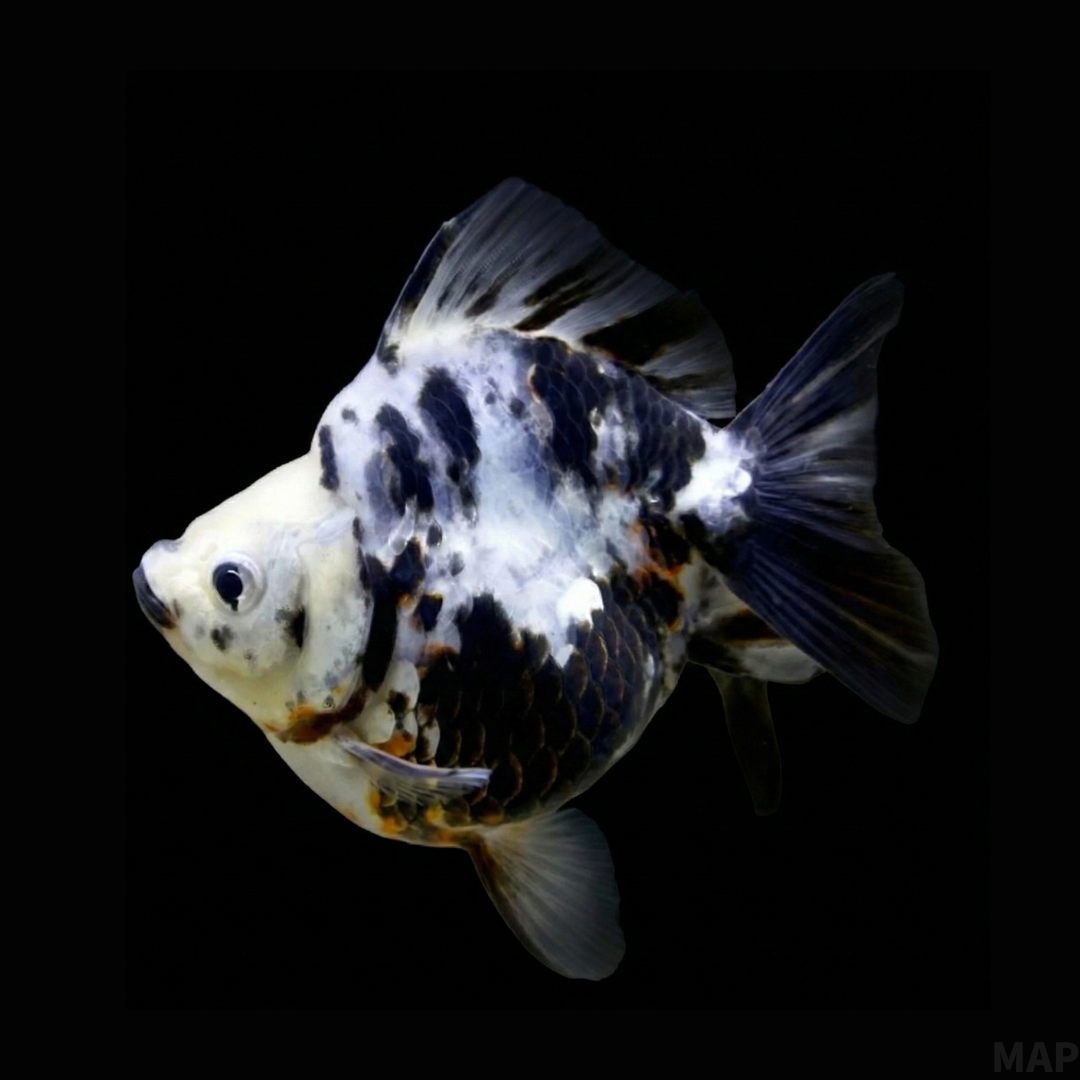
白黒だるま琉金は、体高が高く丸みの強い琉金に短い尾鰭を組み合わせた「短尾琉金」「ショートテール琉金」のうち、白地に黒斑が入る個体を指す流通名です。「パンダショートテール琉金」「パンダ短尾琉金」などの名前でも販売されます。球体に近い体と短い尾、白黒のコントラストが大きな魅力です。ただし、黒斑は成長や飼育環境に伴って見え方や残り方が変化することがあり、丸く短い改良体型では浮力異常にも注意が必要です。体色を恒久的に固定する飼育法が確立しているわけではないため、模様の変化を個体差として見守りながら、十分な水量と安定した水質を優先して飼育します。 The black-and-white Daruma Ryukin is a trade name for short-tail Ryukin with a deep, rounded body and white-and-black patterning. It is also sold as Panda Short-Tail Ryukin or Panda Short-Tail Goldfish. Its nearly spherical silhouette, compact tail and strong contrast are its main attractions. The black markings may change in appearance or persistence as the fish grows or its environment changes, and the compact fancy body form can be prone to buoyancy problems. No husbandry method is known to lock the black pattern in permanently, so stable water quality and adequate tank volume should take priority over attempts to preserve color.
基本情報 / Basic Information
| 学名 / Scientific Name | Carassius auratus |
|---|---|
| 通称 / Common Name | 白黒だるま琉金、パンダショートテール琉金、パンダ短尾琉金、短尾琉金Black-and-white Daruma Ryukin, Panda Short-Tail Ryukin, Short-Tail Ryukin |
| 分類 / Family | コイ科フナ属の金魚。白黒だるま琉金は独立した野生種ではなく、金魚の改良品種・流通系統です。Family Cyprinidae, genus Carassius. The black-and-white Daruma Ryukin is a domesticated goldfish variety rather than a separate wild species. |
| 英名 / English Name | Panda Short-Tail Ryukin Goldfish |
| 分布 / Distribution | 観賞用品種のため自然分布はありません。金魚の祖先系統は東アジアに由来します。日本では国内で流通する個体に加え、中国やタイから輸入された白黒・短尾系の琉金も見られます。生産地や系統は販売個体ごとに異なるため、購入時に確認すると確実です。As a domesticated ornamental variety, it has no natural distribution, and goldfish ancestry is East Asian. In Japan, black-and-white short-tail Ryukin may be domestically distributed or imported from producers in countries such as China and Thailand. Production origin and line vary by individual shipment. |
| 最大体長 / Max Size | 白黒だるま琉金だけを対象とした統一的な最大体長の基準値はありません。販売個体では10cmを超えるものも見られますが、表記方法や成長度合いで差があるため、購入時は実測サイズを確認します。There is no single standardized maximum size specifically for black-and-white Daruma Ryukin. Specimens over 10 cm are seen in the trade, but size descriptions vary with measuring method and growth stage, so the actual measured size should be checked when purchasing. |
| 寿命 / Lifespan | 白黒だるま琉金に限った信頼できる寿命データはありません。長期飼育では、水質を安定させ、浮力異常などの変化を早めに見つけることが重要です。Reliable lifespan data specific to black-and-white Daruma Ryukin are not established. For long-term care, stable water quality and early detection of buoyancy or other health changes are important. |
飼育環境 / Aquarium Environment
| 水槽サイズ / Tank Size | 1匹でも60L程度以上を目安に、60cm規格水槽以上から検討します。金魚は排泄量が多く、小さな水量では水質が変化しやすいため、過密飼育を避け、ろ過能力と遊泳空間に余裕を持たせます。For a single fish, plan on roughly 60 L or more and consider a 60 cm standard aquarium or larger. Goldfish produce substantial waste, and small water volumes are less stable, so avoid crowding and provide adequate filtration and swimming room. |
|---|---|
| 水温 / Temperature | 18〜24℃程度を管理の目安とし、急激な日内変動を避けます。金魚は常時高水温を必要とする魚ではありませんが、冬季や室温変化の大きい環境では、必要に応じてヒーターで温度変化を小さくします。A practical range is about 18–24°C, with abrupt daily fluctuations avoided. Goldfish do not require permanently high temperatures, but a heater can be used when necessary to reduce large temperature swings in winter or unstable indoor environments. |
| 水質 / Water Quality | pH 7.0〜8.0をひとつの目安とし、アンモニアと亜硝酸は検出されない状態を維持します。硝酸塩をため込まないよう定期的に換水し、水質の急変を避けます。Use pH 7.0–8.0 as a practical guide, keep ammonia and nitrite undetectable, and use regular water changes to prevent nitrate accumulation. Avoid sudden changes in water chemistry. |
| レイアウト / Layout | 短い尾と高い体高のため俊敏な遊泳には向かないので、障害物を詰め込みすぎず、広い遊泳空間を確保します。強い水流は避け、ろ過装置の吐出口は穏やかに調整します。暗色の背景や底床では背景適応によって体色が濃く見えやすくなることがありますが、黒斑の褪色を恒久的に防ぐ方法ではありません。Because the short tail and deep body reduce swimming agility, keep the layout open and avoid crowding the tank with obstacles. Strong current should be avoided and filter outflow kept gentle. A dark background or substrate can make body color appear darker through background adaptation, but it does not permanently prevent loss of black markings. |
| 注意点 / Precautions | 白黒模様の黒色は固定的とは限らず、成長に伴って薄くなったり消えたりする個体があります。また、丸い改良体型の金魚では浮袋の形状や位置に個体差が生じやすく、浮力異常が見られることがあります。傾き、浮き上がり、沈み込みは消化だけでなく水質やほかの疾患でも起こるため、原因を一つに決めつけないことが大切です。The black pattern is not necessarily permanent and may fade or disappear as the fish grows. In rounded fancy goldfish, the shape and position of the swim bladder can vary and buoyancy problems are relatively common. Tilting, floating or sinking can also result from poor water quality or other disease processes, so these signs should not automatically be attributed to digestion alone. |
餌と給餌 / Feeding
| 餌の種類 / Diet | 金魚用の沈下性完全飼料を基本とし、成長段階に合った製品を選びます。タンパク質量だけで消化の良し悪しが決まるわけではないため、「低タンパクほど安全」と一律に考える必要はありません。開封後は高温多湿と空気への長時間の曝露を避け、密閉して早めに使い切ります。Use a complete sinking food formulated for goldfish and choose a product appropriate for the fish’s growth stage. Protein percentage alone does not determine digestibility, so lower protein should not automatically be treated as safer. Store opened food sealed, away from heat and humidity, and use it while fresh. |
|---|---|
| 給餌のポイント / Feeding Tips | 一度に大量に与えず、短時間で食べ切れる少量を1日1〜3回に分け、体調と水温に応じて調整します。食後に浮きやすい個体では、水面で空気を取り込みにくい沈下性飼料を優先します。食べ残しは水質悪化につながるため、残さない量に抑えます。Avoid large meals. Divide the daily ration into one to three small feedings and adjust the amount to the fish’s condition and water temperature. For individuals that float after meals, sinking food can reduce air intake during surface feeding. Keep portions small enough that no food is left to foul the water. |
性格と混泳 / Temperament and Tank Mates
| 性格 / Temperament | 白黒だるま琉金に固有の性格差は明確ではありません。飼育上は、短い尾と丸い体型から俊敏な遊泳を得意としない点を前提に扱います。No distinct temperament unique to the black-and-white Daruma Ryukin is clearly established. In practical care, its short tail and rounded body mean it should not be treated as a fast or highly agile swimmer. |
|---|---|
| 混泳の相性 / Compatibility | 短尾で泳ぎが速くないため、強い水流を必要とする魚や、餌取りが極端に速い魚との混泳は避けたほうが安全です。混泳する場合も、遊泳力と餌取りの差が大きくならない組み合わせにし、だるま琉金が十分に食べられているか確認します。Because this variety is not a fast swimmer, avoid tank mates that require strong current or greatly outcompete it for food. When keeping it with other fish, choose companions with similar swimming ability and confirm that the Daruma Ryukin is feeding normally. |
病気と対策 / Diseases and Prevention
| かかりやすい病気 / Common Diseases | 最も注意したいのは、体が傾く、水面に浮き続ける、水底に沈み続けるなどの浮力異常です。一般に「転覆病」と呼ばれますが、一つの病気を指す名称ではなく、複数の原因で起こる症状のまとまりとして考えるほうが適切です。丸い改良体型では浮袋の形状や位置の影響を受けやすく、食後の空気取り込み、腸管内のガス、水質悪化、感染やほかの内臓疾患などでも似た症状が現れます。The main concern is abnormal buoyancy, such as persistent tilting, floating at the surface or remaining on the bottom. The hobby term “swim bladder disease” or “flip-over disease” does not describe a single disease; it is better understood as a group of signs with several possible causes. Rounded fancy body forms may have unusual swim-bladder anatomy, while surface air intake after feeding, intestinal gas, poor water quality, infection or other internal disease can produce similar signs. |
|---|---|
| 対策と予防 / Prevention | 予防では、過密を避け、十分なろ過と定期換水、穏やかな水流、適量の給餌を徹底します。浮力異常が見られたら、まずアンモニア・亜硝酸、水温、酸素供給などの飼育環境を確認します。食後に浮く個体では沈下性飼料への変更が有効な場合があります。一方、加温や0.5%塩水浴を浮力異常の標準治療として一律に行う根拠は十分ではありません。症状が続く、腹部が腫れる、出血や潰瘍がある、餌を食べない場合は、魚類を診療できる獣医師への相談が適切です。Prevention centers on avoiding crowding, maintaining strong biological filtration and regular water changes, keeping current gentle, and feeding appropriate portions. If buoyancy changes appear, first check ammonia, nitrite, temperature and aeration. Switching to sinking food may help fish that float after surface feeding. Routine heating or a 0.5% salt bath should not be treated as a universal standard therapy for buoyancy disorders. Persistent signs, abdominal swelling, bleeding, ulcers or loss of appetite warrant consultation with a veterinarian experienced in fish medicine. |
増やし方(繁殖) / Breeding
| 雌雄の判別 / Sexing | 白黒模様や短尾体型そのものから雌雄を判別することはできません。白黒だるま琉金に固有の判別法は特に知られていません。The black-and-white pattern and short-tail body shape do not themselves indicate sex, and no sexing method unique to this variety is established. |
|---|---|
| 繁殖形態 / Reproduction | 白黒模様や極端な短尾体型は観賞用品種として選抜されてきた形質であり、親魚と同じ外見がすべての稚魚にそのまま現れるとは限りません。白黒だるま琉金だけに特有の繁殖形態があるわけではありません。The panda coloration and extreme short-tail body form are selectively maintained ornamental traits, so offspring do not necessarily reproduce the exact parental appearance. The variety does not have a reproduction mode unique to black-and-white Daruma Ryukin. |
| 繁殖のポイント / Breeding Tips | 白黒模様と短尾・高体高の体型を同時に揃えるには、成長後の表現を見ながら選別する必要があります。ただし、白黒だるま琉金に限定した固定率や遺伝様式は、一般向けに確立した情報として扱えるほど明確ではありません。Producing both the black-and-white pattern and the short-tailed, deep-bodied form requires selection as the young fish develop. However, fixation rates and inheritance patterns specific to black-and-white Daruma Ryukin are not established well enough to present as simple rules. |
雑学と豆知識 / Trivia and Fun Facts
| 1. 琉金の名前は「琉球経由」に由来する / 1. The Ryukin name reflects its historical route | 琉金は江戸時代に中国から琉球を経て日本へ入ったことから、「琉金」と呼ばれるようになったと説明されています。現在のだるま琉金は、琉金らしい高い体高を残しながら、短い尾を大きな鑑賞点として選抜した系統です。つまり、同じ琉金の中でも、尾の長さに対する美意識が異なる方向へ発展した姿と見ることができます。Ryukin are generally described as having entered Japan from China through the Ryukyu Islands during the Edo period, with that route reflected in the name. Daruma Ryukin retain the deep-bodied Ryukin form while making the short tail itself a major point of appreciation. In other words, the same Ryukin lineage has developed a different aesthetic emphasis on tail length. |
|---|---|
| 2. 双尾を支える金魚のゲノム進化 / 2. Genome evolution behind the double tail | 金魚の双尾形成には、体軸形成に関わるchordin A(chdA)の機能を損なう変異が強く関係することが示されています。金魚はコイとの共通祖先で約1,400万年前に全ゲノム重複を経験しており、近縁のchdBも持っています。研究では、この重複がchdA変異の発生上の影響を補い、双尾個体が生存できた背景の一つになった可能性が示されています。ここで重要なのは、これは「双尾」の成立を説明する研究であり、だるま体型の短い胴やパンダ柄まで同じ遺伝子で説明できるという意味ではないことです。Twin-tail development in goldfish has been strongly linked to a loss-of-function mutation in chordin A (chdA), a gene involved in body-axis development. Goldfish share a whole-genome duplication with common carp that occurred about 14 million years ago and also retain the related chdB gene. Researchers have proposed that this duplication helped buffer the developmental consequences of the chdA mutation, allowing viable twin-tail fish. This finding explains the duplicated tail axis; it does not by itself explain the shortened Daruma body or panda coloration. |
| 3. パンダ柄の黒は「完成色」とは限らない / 3. Panda black is not always a permanent finished color | 白黒個体の黒斑は、メラニンを持つメラノフォアの状態に左右されます。金魚では、背景色に応じて体色が可逆的に濃くなったり淡くなったりすることが研究で確認されており、成長に伴う体色変化ではメラノフォアが減少する例も知られています。ただし、「パンダショートテール琉金の黒が抜ける仕組み」が特定の遺伝子やホルモンだけで解明されたわけではありません。暗い背景は黒を濃く見せる助けにはなっても、将来の黒斑を保証する方法ではありません。Black patches depend on melanophores containing melanin. Studies in goldfish show reversible darkening and paling during background adaptation, and developmental color change can also involve loss of melanophores. However, fading in panda short-tail Ryukin has not been reduced to one proven gene or hormonal pathway. A dark background may make black appear stronger, but it cannot guarantee that the markings will remain permanently. |
| 4. キャリコの歴史が白黒表現の背景にある / 4. Calico history lies behind the black-and-white expression | キャリコ琉金は、明治期に琉金と三色出目金の交配から作られたと一般に説明されています。白黒だるま琉金にも、透明鱗やモザイク状の色素配置を思わせる個体があります。ただし、「パンダ柄はキャリコから赤色だけが抜けたもの」と単純化できる遺伝学的根拠は確認されていません。見た目の共通点と、直接の遺伝的系譜は分けて考えるのが適切です。Calico Ryukin are generally described as having been developed in the Meiji era from crosses between Ryukin and tricolor telescope goldfish. Some black-and-white Daruma Ryukin show transparent-scale and mosaic-like color features reminiscent of calico fish. However, there is not enough genetic evidence to reduce panda coloration to “calico with the red removed”; visual similarity and direct genetic lineage should be treated separately. |
| 5. 輸入魚の価格には検疫と物流も含まれる / 5. Import prices reflect quarantine and logistics | 2026年6月の制度改正後も、生きているフナ属魚類(きんぎょ等)の輸入には水産資源保護法に基づく輸入許可が必要です。現在の輸入防疫対象疾病はコイ春ウイルス血症(SVC)とレッドマウス病で、輸出国政府機関の検査証明書、国ごとに合意された衛生条件、到着時の現物検査などが前提になります。輸入許可申請は原則として到着5日前までです。現物検査で疾病リスクを否定できず管理命令を受けて輸入する場合の管理期間は通常10日、SVCの病原体を広げるおそれがないと認められない場合は15日とされています。そのため、「中国産は必ず15日隔離、タイ産は国内隔離なし」と国だけで一律に説明するのは正確ではありません。After Japan’s June 2026 revision of the aquatic-animal import system, live Carassius species including goldfish still require import permission under the Act on the Protection of Fishery Resources. The current target diseases are spring viraemia of carp (SVC) and enteric redmouth disease, and imports require an official health certificate, country-specific agreed sanitary conditions and inspection on arrival. Applications are in principle submitted five days before arrival. If disease risk cannot be excluded and a management order is used, the management period is normally 10 days, or 15 days when the risk of spreading SVC cannot be ruled out. It is therefore inaccurate to describe quarantine solely as “always 15 days for China” and “no domestic quarantine for Thailand.” |
| 6. 金魚は「3秒しか記憶できない」魚ではない / 6. Goldfish do not have only a three-second memory | 「金魚の記憶は3秒」という俗説を支持する科学的根拠はありません。金魚は学習課題をこなし、音の違いを識別できることも実験で示されています。一方、記憶が必ず「数か月続く」と一律に言えるわけではなく、保持期間は課題や実験条件によって変わります。大切なのは、金魚が周囲の刺激を学習し、それに応じて行動を変えられる魚だという点です。There is no scientific basis for the popular claim that goldfish remember for only three seconds. Experiments show that goldfish can learn tasks and discriminate between different sounds. The exact duration of memory depends on the task and experimental conditions, so a fixed “months-long memory” should not be presented as a universal number. The important point is that goldfish can learn from their surroundings and alter behavior accordingly. |
| 7. 四色覚と背景色への反応 / 7. Tetrachromatic vision and background response | 金魚には複数種類の錐体があり、条件によっては紫外線域を含む四色覚が行動実験で示されています。ただし、光への順応条件や成長段階によって使われる波長域は変化し、「いつでも人間より広い色域を同じように見ている」と単純化はできません。また、赤外線まで見えるという説明は支持されていません。背景色が体色反応に影響することは確認されているため、暗色背景で黒が濃く見える現象は視覚情報と内分泌反応の組み合わせとして理解できます。Goldfish possess several cone types, and behavioral studies have demonstrated tetrachromatic vision including ultraviolet sensitivity under some adaptation conditions. The effective wavelength range can change with light adaptation and life stage, so this should not be simplified into a claim that goldfish always see a uniformly broader spectrum than humans; claims of infrared vision are not supported. Background color does affect body-color responses, so darker appearance against a dark background can be understood as a combination of visual input and physiological color regulation. |
| 8. 1994年には宇宙実験のモデル生物にもなった / 8. Goldfish also served as spaceflight research animals in 1994 | 1994年のスペースシャトル「コロンビア号」STS-65/IML-2では、日本の金魚6匹が水生動物実験装置で宇宙飛行し、微小重力下での姿勢制御と前庭系の適応が調べられました。JAXAは、この金魚を愛知県弥富市のワキンと紹介しています。家庭で親しまれる金魚が、重力感覚を研究するモデル動物として宇宙へ行ったという、金魚研究史の印象的な一例です。During the 1994 STS-65/IML-2 mission aboard Space Shuttle Columbia, six Japanese goldfish flew in an aquatic animal experiment unit to study postural control and vestibular adaptation in microgravity. JAXA identifies the fish as Wakin from Yatomi, Aichi Prefecture. It is a memorable example of a familiar aquarium fish serving as a model for research on gravity sensing. |
まとめ / Conclusion
白黒だるま琉金は、琉金らしい高い体高と短い尾に、パンダを思わせる白黒模様を重ねた金魚です。白と黒の配置、背中の盛り上がり、体の厚み、尾の短さが組み合わさり、同じ呼び名でも一匹ごとに異なる表情を見せます。 The black-and-white Daruma Ryukin combines the deep-bodied Ryukin form, a short tail and panda-like black-and-white patterning. The balance of pattern, back profile, body thickness and tail length gives each individual a different appearance even under the same trade name.
黒斑は成長とともに変化することがあり、丸い体型では浮力異常にも注意が必要です。黒色を残すことだけを優先するのではなく、十分な水量、安定した水質、穏やかな水流、適量の給餌を基本に、日々の姿勢や泳ぎ方を観察します。模様の変化も含めて一匹の成長として受け止めながら、無理のない環境で長く付き合うことが、この金魚の魅力を楽しむうえで最も大切です。 The black markings may change with growth, and the rounded body form calls for careful attention to buoyancy. Rather than prioritizing color retention above health, provide adequate water volume, stable water quality, gentle current and appropriate feeding, while watching posture and swimming every day. Accepting pattern changes as part of the individual fish’s development and maintaining a low-stress environment are the best foundations for long-term enjoyment.

気になる道具や飼い方を見つけてみませんか?
 アイのアクアグッズ案内エビのおうち、食べちゃっていいの!? コタロウと探る、不思議なエビのごはん道具の特徴や使い方、選ぶときのポイントをアイが紹介します。記事はコチラ →
 アイのアクアグッズ案内エーハイムはおもちゃから始まった? 小さな噴水から水槽へ、アイとコタロウの探訪道具の特徴や使い方、選ぶときのポイントをアイが紹介します。記事はコチラ →
さまざまな飼育テーマをご紹介。リンク先の記事には広告・商品紹介が含まれます。
案内・紹介記事一覧へ →分布マップ
観賞用品種のため自然分布はありません。金魚の祖先系統は東アジアに由来し、日本では国内で流通する個体に加え、中国やタイから輸入された白黒・短尾系の琉金も見られます。
※この地図は、記事中の東アジア由来および日本・中国・タイに関する記述をもとにした概略表示です。マーカーは地域を把握しやすくするための代表地点であり、実際の採集地点や特定個体の生産地を示すものではありません。
参考文献
-
Fricke, R., Eschmeyer, W. N. & Van der Laan, R. (eds.). Eschmeyer's Catalog of Fishes: Genera, Species, References. California Academy of Sciences. Online version, updated 7 July 2026. (分類・学名)
California Academy of Sciences -
Froese, R. & Pauly, D. (eds.). FishBase: Carassius auratus (Linnaeus, 1758). (分類・分布・生息環境・食性・繁殖)
FishBase -
RSPCA Australia. How should I care for my goldfish? Updated 1 May 2024. (水槽容量・水温・pH・アンモニア・亜硝酸・硝酸塩・ろ過・換水)
RSPCA Knowledgebase -
Royal Society for the Prevention of Cruelty to Animals (RSPCA). Choosing an Aquarium for Pet Fish. (水槽容量・ろ過・水質管理・温度変動)
RSPCA -
Petty, B. D. & Francis-Floyd, R. (2004). Pet fish care and husbandry. Veterinary Clinics of North America: Exotic Animal Practice, 7(2), 397–419, vii. doi:10.1016/j.cvex.2004.02.003. (給餌・飼料保管・水質管理・健康管理)
PubMed -
Watson, C. A., Hill, J. E. & Pouder, D. B. (2004). Species Profile: Koi and Goldfish. Southern Regional Aquaculture Center Publication No. 7201. (金魚の生態・飼育・繁殖・産卵・選別)
Southern Regional Aquaculture Center / Extension -
Petty, B. D., Francis-Floyd, R. & Yanong, R. P. E. Fish Taxonomy. Merck Veterinary Manual. Last updated June 2026. (コイ科魚類の解剖・琉金を含むファンシー金魚の浮力異常・沈下性飼料)
Merck Veterinary Manual -
Francis-Floyd, R., Yanong, R. P. E. & Petty, B. D. Environmental Diseases of Aquatic Animals in Aquatic Systems. Merck Veterinary Manual. Last updated June 2026. (アンモニア・亜硝酸・酸素・温度変動などの環境性疾患と初期確認事項)
Merck Veterinary Manual
各オンライン資料の最終確認日:2026年8月27日
か




コメント