

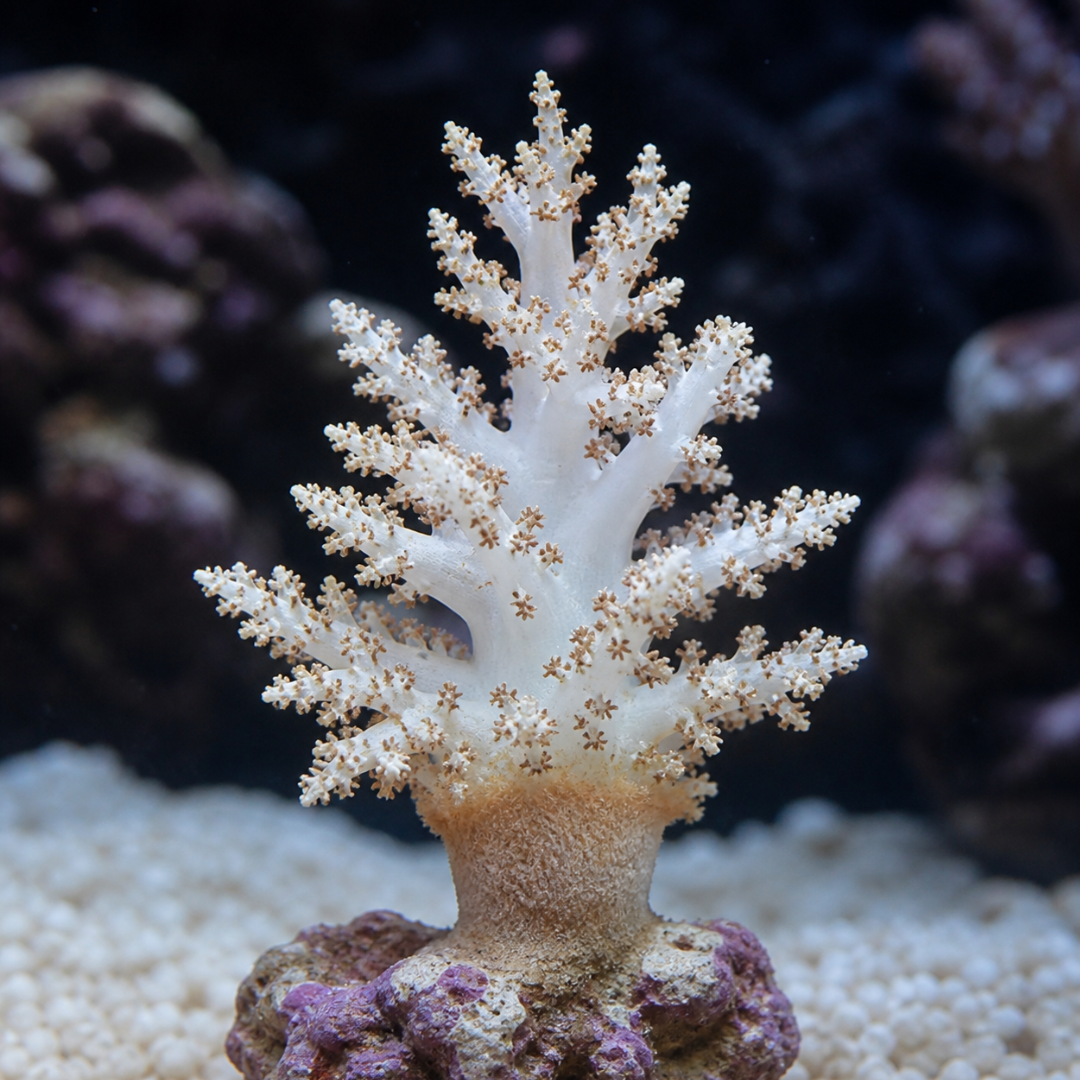
解説 / Description
クリスマスツリートサカは、活動時に枝を広げて小さなポリプを一斉に咲かせ、警戒時には枝全体を太い柄の内部へ完全に格納する、きわめて特異なソフトコーラルです。学名は Studeriotes longiramosa。褐虫藻を持たない完全陰日性で、光ではなく水中を漂う動物プランクトンや微細な有機物を捕食して生きます。細かな砂の中へ基部を埋め、巻きひげ状の組織で体を固定するため、一般的なサンゴのように岩へ接着する飼い方は適しません。美しさと希少性の一方で、頻回給餌と強力な水質管理を同時に求める、上級者向けの難種です。 The Christmas Tree Coral is an unusual soft coral that expands into a branching tree covered with small polyps, then retracts the entire crown into its thick stalk when disturbed. Its scientific name is Studeriotes longiramosa. It is fully azooxanthellate and survives by capturing zooplankton and fine suspended organic matter rather than by photosynthesis. Its base is buried in fine sand and anchored by tendril-like tissues, so gluing it to rock is unsuitable. Its beauty and rarity come with exceptional husbandry demands, including frequent feeding and powerful nutrient control.
基本情報 / Basic Information
| 学名 / Scientific Name | Studeriotes longiramosa |
|---|---|
| 通称 / Common and English Names | クリスマスツリートサカ、メデューサコーラル、パインツリーコーラル、スネークロックスコーラル Christmas Tree Coral, Medusa Coral, Pine Tree Coral, Snake Locks Coral |
| 分類 / Classification | 刺胞動物門・花虫亜門・八放サンゴ綱・Malacalcyonacea目・Paralcyoniidae科・Studeriotes属 Phylum Cnidaria, Subphylum Anthozoa, Class Octocorallia, Order Malacalcyonacea, Family Paralcyoniidae, Genus Studeriotes |
| 分布 / Distribution | インド太平洋西部。インドネシア、シンガポール、フィリピン、タイ周辺などの、砂や細かな礫が混じる浅海から中程度の水深帯に生息します。日本近海での確実な自然分布記録は乏しく、未解明な点が残ります。 Western Indo-Pacific, including waters around Indonesia, Singapore, the Philippines, and Thailand. It inhabits sandy or fine-rubble bottoms from shallow to moderate depths. Confirmed natural records from Japanese waters are scarce and remain uncertain. |
| 最大サイズ / Maximum Size | 最大群体サイズについて、統一された詳しい記録はありません。展開時と完全収縮時では見かけの大きさが大きく変わるため、配置には十分な余裕を持たせます。 A standardized maximum colony size has not been clearly documented. Because its apparent size changes greatly between full expansion and complete contraction, generous placement space is advisable. |
| 寿命 / Lifespan | 自然下・飼育下ともに詳細不明です。飼育下では給餌不足による慢性的な餓死が多く、長期維持は難しいとされています。 The natural and captive lifespan is not well documented. In aquaria, chronic starvation is common, making long-term maintenance difficult. |
飼育環境 / Aquarium Environment
| 水槽サイズ / Tank Size | 明確な最低水量は定まっていません。頻回給餌による水質変化を抑えられる十分な水量と濾過容量が必要で、一般的な規格水槽では90cm規格水槽以上を検討し、本種専用または陰日性サンゴ中心のシステムとして管理するのが現実的です。 No definitive minimum volume has been established. The system must provide enough water volume and filtration to absorb the effects of frequent feeding; in standard aquarium sizes, a 90 cm tank or larger is a practical starting point, ideally dedicated to this species or other azooxanthellate corals. |
|---|---|
| 水温・比重 / Temperature and Specific Gravity | 水温22~28℃、理想は24~25℃で安定維持。比重1.023~1.025。蒸発による塩分上昇を避けるため、自動給水装置が有効です。 Temperature 22–28°C, ideally stable at 24–25°C. Specific gravity 1.023–1.025. An automatic top-off system helps prevent salinity rise from evaporation. |
| 水質 / Water Quality | pH 8.0~8.4、アルカリ度2.5~3.0 meq/L、カルシウム380~430 mg/L、硝酸塩2~10 ppm、リン酸塩0.05 ppm以下が目安です。極端な貧栄養より、給餌できる適度な懸濁環境を保ちつつ、アンモニア・亜硝酸の発生と栄養塩の蓄積を抑えます。 Target pH 8.0–8.4, alkalinity 2.5–3.0 meq/L, calcium 380–430 mg/L, nitrate 2–10 ppm, and phosphate below 0.05 ppm. Rather than an ultra-low-nutrient system, maintain a lightly suspended-food environment while preventing ammonia, nitrite, and excessive nutrient accumulation. |
| 光量 / Lighting | 完全陰日性のため強い照明は不要です。PAR 100以下を目安とし、青色LED中心の弱光、岩陰、オーバーハング下などに配置します。強光は体表の藻類やシアノバクテリアを増やし、ポリプ展開を妨げるおそれがあります。 Strong light is unnecessary because the species is fully azooxanthellate. Keep PAR below about 100 and place it under dim blue-dominant lighting, in shade, or beneath an overhang. Strong light can promote algae and cyanobacteria on the tissue and interfere with polyp expansion. |
| 水流 / Water Flow | 中程度でランダムな水流が適します。群体全体がゆっくり揺れ、粘液やデトリタスが残らない流れを作ります。一定方向からの強い直線水流は、姿勢を崩しポリプを閉じさせるため避けます。 Moderate, random flow is suitable. The colony should sway gently while mucus and detritus are carried away. Avoid a strong, constant jet from one direction because it can topple the colony and suppress polyp extension. |
| レイアウト・配置 / Layout and Placement | 細かなアラゴナイトサンドを5~10cmほど敷いた深底砂へ、柄の基部を埋め込むように配置します。専用の深い容器に砂を入れて植え込む方法も有効です。岩やフラグ台への接着は行いません。 Place the stalk base in 5–10 cm of fine aragonite sand. A deep dedicated container filled with fine sand can also work. Do not glue the animal to rock or a frag plug. |
| 注意点 / Precautions | 輸送ストレスと急変に弱いため、慎重に水合わせします。基部をつぶさず、転倒やポンプへの吸い込みを防ぎます。表面への砂、粘液、藻類、シアノバクテリアの付着をこまめに確認し、頻回給餌に見合う強力なプロテインスキマーと残餌処理を用意します。 Acclimate carefully because the coral is sensitive to transport stress and sudden changes. Avoid crushing the base, prevent toppling and pump intake, and inspect frequently for sand, mucus, algae, or cyanobacteria on the surface. Use a strong protein skimmer and efficient waste removal to match the feeding load. |
餌と給餌 / Feeding
| 栄養の得方・餌 / Nutrition and Diet | 褐虫藻を持たず、栄養は捕食に全面的に依存します。ワムシ、ふ化直後のブラインシュリンプ、コペポーダなどの生きた動物プランクトン、微粒子のサンゴ用粉末飼料、液体プランクトンフードが適します。 It lacks zooxanthellae and depends entirely on feeding. Suitable foods include live rotifers, newly hatched brine shrimp nauplii, copepods, fine coral powders, and liquid plankton feeds. |
|---|---|
| 給餌のポイント / Feeding Tips | 少なくとも1日2回を目安に、ポリプが開いている時間帯にターゲット給餌します。給餌前に水流を弱め、海水で溶いた微粒子餌をスポイトで霧状に吹きかけ、10~15分ほど捕食を待ってから水流を再開します。食べ残しは速やかに除去し、硝酸塩とリン酸塩を監視します。 Target feed at least twice daily while the polyps are open. Reduce flow, gently cloud the colony with finely suspended food, allow 10–15 minutes for capture, then restart circulation. Remove leftovers promptly and monitor nitrate and phosphate. |
性質と相性 / Characteristics and Compatibility
| 形態・成長 / Form and Growth | 強固な石灰質骨格を持たず、組織内の微小な骨片と体内へ取り込んだ海水の圧力で樹木状の姿を支えます。単独性の群体を形成し、冠部全体を柄の内部へ完全に収縮できます。成長速度に関する定量的な記録は乏しく、安定した長期飼育そのものが難題です。 It has no massive stony skeleton. Microscopic sclerites and internal water pressure support its tree-like form. It forms a solitary colony and can retract the entire crown into the stalk. Quantitative growth records are scarce, partly because stable long-term husbandry is itself difficult. |
|---|---|
| 攻撃性 / Aggression | 本種に特有の強い攻撃性や長いスイーパー触手は知られていません。ただし刺胞動物であるため、ほかのサンゴとの直接接触は避け、粘液やソフトコーラル同士の化学的干渉にも配慮して十分な間隔を取ります。 Strong species-specific aggression and long sweeper tentacles are not known. However, as a cnidarian it should not touch neighboring corals, and generous spacing is prudent because mucus and chemical interactions among soft corals may occur. |
| 相性 / Compatibility | 陰日性サンゴ中心の落ち着いた水槽が適します。砂を掘り返す魚、大型ヤドカリ、接触や転倒を起こす生体、ポリプをついばむ魚との同居は避けます。クマノミとの特別な共生関係は知られていません。 A calm aquarium focused on azooxanthellate corals is best. Avoid burrowing fish, large hermit crabs, animals that cause contact or toppling, and fish that nip polyps. No special symbiosis with clownfish is known. |
病気と対策 / Diseases and Prevention
| 不調・病気・害虫 / Problems, Diseases, and Pests | 長期間ポリプを開かない、徐々に縮む、基部が軟化する、組織が溶ける、表面に藻類やシアノバクテリアが付着するといった変化は危険信号です。主な原因として、給餌不足、強すぎる光、弱すぎる水流、栄養塩の蓄積、輸送時の傷、細菌感染などが考えられます。本種に特有の害虫については、詳しい情報がほとんどありません。 Failure to open, gradual shrinkage, softening of the base, tissue dissolution, or growth of algae or cyanobacteria on the surface are serious warning signs. Likely causes include starvation, excessive light, insufficient flow, nutrient buildup, shipping injury, and bacterial infection. Little detailed information is available about species-specific pests. |
|---|---|
| 対策と予防 / Prevention | 安定した水温・比重を維持し、弱光と中程度のランダム水流を確保します。給餌量と濾過能力の釣り合いを取り、プロテインスキマー、機械濾過、定期換水で残餌を除去します。組織切除は急速な崩壊を招くおそれがあるため、安易なフラギングや患部切除は避けます。薬浴やディップは本種での安全性が十分に確立されていないため慎重に判断します。 Maintain stable temperature and salinity, dim light, and moderate random flow. Balance feeding with filtration and remove leftovers through protein skimming, mechanical filtration, and water changes. Avoid casual fragmentation or tissue cutting because injury may trigger rapid collapse. Dips and medications should be used cautiously because their safety for this species is not well established. |
増やし方(繁殖・株分け) / Reproduction and Propagation
| 無性生殖・株分け / Asexual Reproduction and Fragmentation | 人為的な切断によるフラギングは、安定した増殖方法として確立されていません。切り傷をきっかけに組織が急速に崩壊することがあるため、枝を切って増やす方法は推奨されません。 Artificial fragmentation has not been established as a reliable propagation method. Cutting can trigger rapid tissue collapse, so propagation by severing branches is not recommended. |
|---|---|
| 有性生殖 / Sexual Reproduction | 本種の産卵様式、雌雄、幼生保育については詳しいことが分かっていません。ソフトコーラル類ではプラヌラ幼生の着底研究が進んでいますが、本種の人工繁殖技術はまだ確立されていません。 The spawning mode, sexes, and larval brooding of this species remain poorly understood. Although settlement research on soft-coral planula larvae is progressing, captive propagation of this species has not yet been established. |
| 増殖のポイント / Propagation Tips | 増殖を目的とした切断は避け、まず親群体を長期維持できる給餌・水質管理の確立を優先します。将来的な完全養殖には、産卵誘発、幼生回収、適切な着底基質、初期餌料の解明が必要です。 Avoid cutting for propagation and prioritize establishing feeding and water-quality methods that keep the parent colony alive long term. Future captive culture will require controlled spawning, larval collection, suitable settlement substrates, and appropriate first foods. |
毒性と取り扱い / Toxicity and Handling
| 毒性 / Toxicity | 本種からパリトキシンなどの強い毒が確認されたという報告は知られていません。ただし刺胞動物であるため、刺胞や粘液が皮膚や目を刺激する可能性があります。 Potent toxins such as palytoxin are not known to have been confirmed in this species. However, as a cnidarian, its nematocysts and mucus may irritate skin and eyes. |
|---|---|
| 取り扱い上の注意 / Handling Precautions | 取り扱う際はニトリル手袋を着用し、必要に応じて保護眼鏡も使用します。群体を素手で強く握らず、粘液が傷口や目に触れないよう注意してください。作業後は手と器具を十分に洗浄します。 Wear nitrile gloves and use eye protection when appropriate. Do not squeeze the colony, keep mucus away from wounds and eyes, and wash hands and tools thoroughly after handling. |
雑学と豆知識 / Trivia and Fun Facts
| 完全に消える樹木 / A tree that disappears | 展開した姿は小さな針葉樹のようですが、刺激を受けると枝を折りたたみ、冠部全体を円柱状の柄へ収納します。収縮後は海底の肉質な塊にしか見えず、同じ個体とは思えないほど印象が変わります。 When expanded it resembles a miniature conifer, but when disturbed it folds the branches and stores the entire crown inside the cylindrical stalk. Once contracted, it can look like an unremarkable fleshy lump on the seafloor. |
|---|---|
| 骨ではなく水圧で立つ / Standing by water pressure, not bone | 硬い骨格の代わりに、体内の細い管へ海水を取り込み、静水圧で体を膨らませます。組織中の微小な骨片は、膨らみすぎを防ぎながら形を整える補強材として働くと考えられています。 Instead of a rigid skeleton, it draws seawater into internal canals and inflates through hydrostatic pressure. Microscopic sclerites are thought to act as reinforcement, limiting overexpansion and helping maintain shape. |
| 砂に根を張るような生活 / A root-like life in sand | 多くのサンゴが岩に固着するのに対し、本種は細かな砂へ柄を埋め、巻きひげ状の組織を伸ばして固定します。その姿は植物に似ていますが、実際には流れてくる微小動物を捕らえる捕食者です。 Unlike many corals that attach to rock, this species buries its stalk in fine sand and anchors itself with tendril-like tissues. It looks plant-like, yet it is a predator that captures drifting microscopic animals. |
| 名前の混同に注意 / Beware of name confusion | 日本の流通では、丈夫で好日性のケニアツリーコーラルが同じ「クリスマスツリー」の名で紹介されることがあります。真の Studeriotes longiramosa は完全陰日性で、強い光よりも頻回給餌が必要です。見た目だけでなく学名を確認することが、生存率を左右します。 In the Japanese trade, the hardy photosynthetic Kenya Tree Coral is sometimes sold under a similar “Christmas Tree” name. True Studeriotes longiramosa is fully azooxanthellate and needs frequent feeding rather than strong light. Confirming the scientific name can determine whether the animal survives. |
| 分類が動き続ける仲間 / A lineage under taxonomic revision | 八放サンゴ類は形態だけでは区別が難しく、分子系統解析によって目や科の整理が進んでいます。本種も旧来の分類群から現在の Paralcyoniidae科へ整理されてきた経緯があり、名前の歴史そのものが八放サンゴ研究の変化を映しています。 Octocorals are difficult to distinguish by form alone, and molecular studies continue to reorganize orders and families. This species has also moved through older classifications into the modern family Paralcyoniidae, reflecting the changing history of octocoral research. |
まとめ / Conclusion
クリスマスツリートサカの魅力は、樹木のように広がる姿と、冠部を完全に収納する劇的な変化にあります。その美しさを保つ鍵は、岩へ固定せず深い細砂へ植え込むこと、強い光を避けること、中程度のランダム水流を与えること、そして動物プランクトンサイズの餌を毎日欠かさず届けることです。 The appeal of the Christmas Tree Coral lies in its tree-like expansion and dramatic ability to hide its entire crown. The keys to maintaining that beauty are burying it in deep fine sand rather than gluing it to rock, avoiding strong light, providing moderate random flow, and delivering plankton-sized food every day.
頻回給餌と水質浄化を高い水準で両立できれば、暗がりの砂地からゆっくり枝を伸ばす姿が、水槽に静かで神秘的な存在感をもたらします。日々の展開や収縮を丁寧に観察することは、体調の変化を早く捉え、この繊細なサンゴと長く向き合うための大切な習慣になります。 When frequent feeding and strong nutrient export are balanced successfully, the coral’s slow emergence from a dim sandy bed gives the aquarium a quiet, mysterious presence. Careful observation of its daily expansion and contraction helps reveal changes in condition early and supports a lasting relationship with this delicate coral.

気になる道具や飼い方を見つけてみませんか?
 アイのアクアグッズ案内海水魚の底砂の選び方|サンゴ砂・ライブサンドとおすすめ商品道具の特徴や使い方、選ぶときのポイントをアイが紹介します。記事はコチラ →
 アイのアクアグッズ案内アカヒレの仲間に合わせる飼育用品|無加温・混泳・繁殖の水槽とろ過道具の特徴や使い方、選ぶときのポイントをアイが紹介します。記事はコチラ →
 アイのアクアグッズ案内水槽用ヒーターの選び方|固定式・温度調節式と、水量に合うW数の考え方水槽の魚は冬に寒くない? アイとコタロウが水温計から固定式・温度調節式・分離式ヒーターまで比較。水量と室温に合うW数、設置場所、水換えや交換の注意点を、国内メーカーの商品とともに紹介します。記事はコチラ →
 アイのアクアグッズ案内水草の肥料の選び方|底床用・液肥・メネデールの使い分け道具の特徴や使い方、選ぶときのポイントをアイが紹介します。記事はコチラ →
さまざまな飼育テーマをご紹介。リンク先の記事には広告・商品紹介が含まれます。
案内・紹介記事一覧へ →分布マップ
クリスマスツリートサカ(Studeriotes longiramosa)は、インドネシア、シンガポール、フィリピン、タイ周辺を含むインド太平洋西部に分布するとされています。下の地図では、記事に記載された広域分布を概略範囲と代表地点で示しています。表示地点は実際の採集地点や厳密な生息地ではありません。
この地図は文献的な分布記述をもとにした概略表示です。マーカーは分布域を見渡すための代表地点であり、実際の採集地点、個体確認地点、厳密な生息範囲を示すものではありません。日本近海の記録は確実性が乏しいため、確実な分布地点として表示していません。
参考文献・参照資料
分類学的情報には国際的な生物分類データベースと査読済みの分類学研究を使用し、生態、栄養、繁殖、病気に関する記述には八放サンゴ類を対象とした査読論文および公的研究機関の資料を参照しています。クリスマスツリートサカ(Studeriotes longiramosa)に限定した飼育実験の報告は少ないため、八放サンゴ類や褐虫藻を持たないソフトコーラルの一般的知見を含みます。
分類・学名
-
World Register of Marine Species(WoRMS), World List of Octocorallia.
World List of Octocorallia
Studeriotes属および八放サンゴ類の有効な学名、命名者、分類上の位置を確認するための基礎資料です。分類は改訂されることがあるため、学名を掲載する際は同データベースの最新版を優先します。 -
McFadden, C. S., van Ofwegen, L. P. & Quattrini, A. M.(2022)Revisionary systematics of Octocorallia (Cnidaria: Anthozoa) guided by phylogenomics.
Bulletin of the Society of Systematic Biologists, 1(3)
分子系統解析に基づいて八放サンゴ類の高次分類を再編した研究です。従来のAlcyonaceaを中心とする分類と、現在用いられるMalacalcyonaceaなどの分類体系を整理する根拠になります。 -
van Ofwegen, L. P. & Benayahu, Y.(2006)A new genus of paralcyoniid soft corals (Octocorallia, Alcyonacea, Paralcyoniidae) from the Indo-West Pacific.
日本サンゴ礁学会誌 8巻1号, 25–37
Paralcyoniidae科の形態と属間の違いを検討し、Studeriotes属を近縁属と比較した分類学資料です。群体上部を基部へ収縮させる形態や、骨片を用いた同定についての記述を支えます。
生態・栄養・水流
-
Fabricius, K. E., Genin, A. & Benayahu, Y.(1995)Flow-dependent herbivory and growth in zooxanthellae-free soft corals.
Limnology and Oceanography, 40(7), 1290–1301
褐虫藻を持たないソフトコーラルの摂食と成長が水流に左右されることを実験的に検討した研究です。陰日性ソフトコーラルでは、光よりも水中の粒子状餌料と適切な流れが重要になるという説明を支えます。ただし、対象はStuderiotes longiramosaではありません。 -
van de Water, J. A. J. M. et al.(2018)Host-microbe interactions in octocoral holobionts: recent advances and perspectives.
Microbiome, 6, 64
八放サンゴと共生藻、細菌、真菌、ウイルスとの関係を整理した総説です。褐虫藻を持たない八放サンゴが従属栄養に依存することや、環境変化、栄養状態、微生物群集と健康状態の関係を確認する資料として使用できます。 -
Gómez-Gras, D. et al.(2025)A global database of trait information for octocoral species.
Scientific Data
八放サンゴ類の分布、生息深度、共生藻の有無、群体形態、繁殖などの形質情報を集約したデータベース論文です。種ごとに利用できる情報量には差がありますが、八放サンゴ類の生態的特徴を横断的に確認する資料になります。
繁殖
-
Kahng, S. E., Benayahu, Y. & Lasker, H. R.(2011)Sexual reproduction in octocorals.
Marine Ecology Progress Series, 443, 265–283
25科79属182種の報告をもとに、八放サンゴ類の放卵放精、保育、雌雄性、繁殖時期などを整理した総説です。八放サンゴ類には複数の有性生殖様式があることを示しますが、Studeriotes longiramosa固有の産卵様式を確定する資料ではありません。
病気・組織障害・取り扱い上の注意
-
Weil, E., Rogers, C. S. & Croquer, A.(2017)Octocoral Diseases in a Changing Ocean.
Marine Animal Forests
八放サンゴ類で報告されている感染症、組織壊死、環境ストレス、捕食被害などを整理した総説です。組織の後退や変色だけで原因を断定できないこと、水温、堆積物、水質、病原体などを総合的に確認する必要があることを支えます。 -
U.S. Geological Survey(USGS)Coral Diseases.
USGS Diseases of Aquatic Organisms
サンゴおよび八放サンゴの病気に関する研究成果を集約した米国地質調査所の資料です。病変の外観だけでは感染症、捕食、堆積物、物理損傷などを区別できない場合があるため、安易な診断や薬剤処置を避けるという注意事項の根拠になります。
参考文献の適用範囲
公開されている学術資料だけでは、Studeriotes longiramosaの適正水温、比重、硝酸塩、リン酸塩、PAR、最低水槽容量、底砂の厚さ、給餌回数、人工飼料の銘柄、フラギング成功率を種固有の数値として確定できません。飼育条件の数値は、一般的な海産無脊椎動物の管理や飼育経験に基づく目安です。本種を対象とした比較試験で確立された値ではありません。また、インドネシア、シンガポール、フィリピン、タイなどを含む詳しい分布範囲には、標本記録や採集地点の確認が十分でない地域もあります。





コメント