

解説 / Description
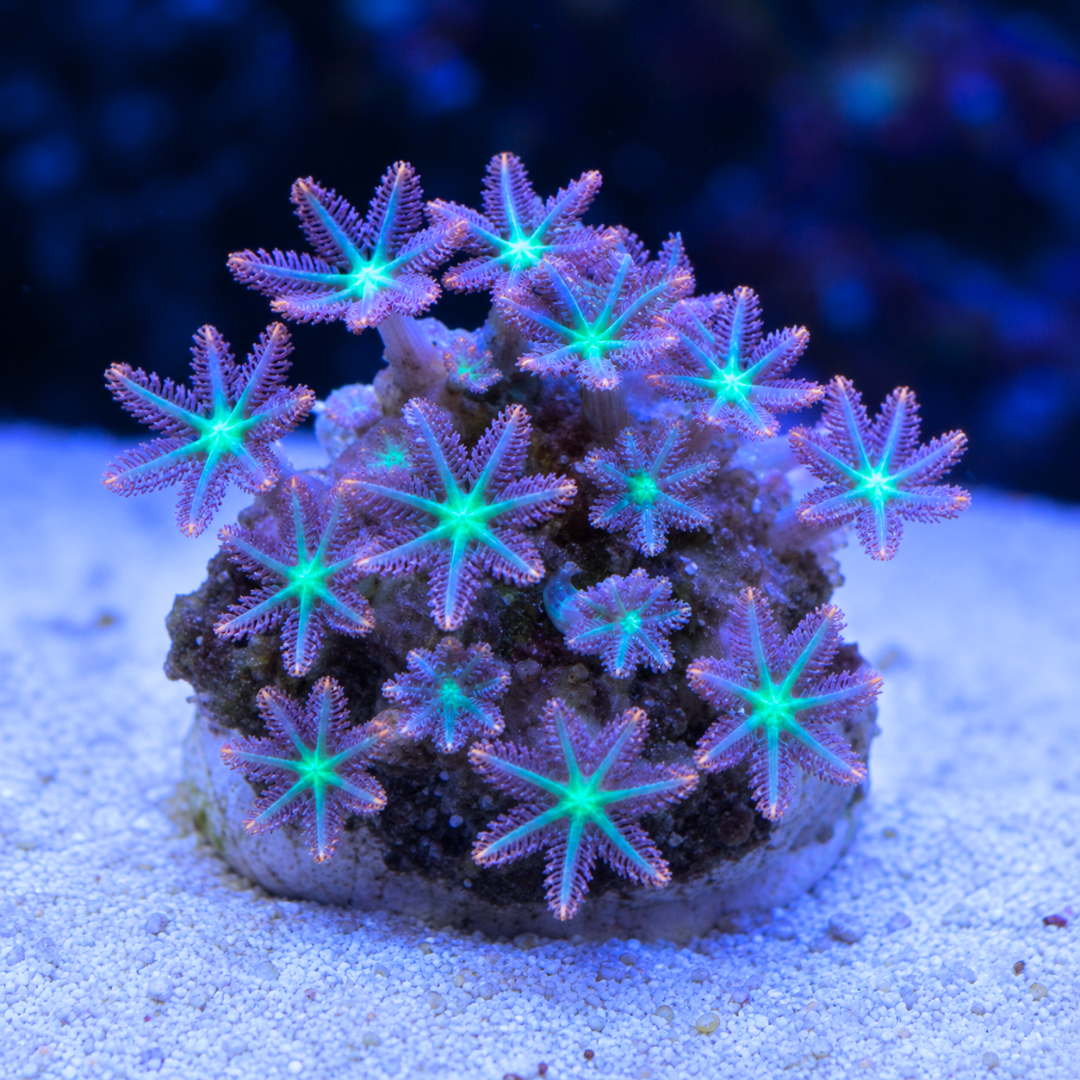
ツツウミヅタは、岩の表面を這う紫褐色のストロンから細い管状のポリプを立ち上げ、8本の羽状触手を花やヤシの葉のように広げるソフトコーラルです。グリーン、ブラウン、ピンク、ホワイトなどの色彩があり、中心部だけがネオングリーンやイエローに輝く個体も流通します。硬い石灰質骨格をつくらず、水質変動への耐性も比較的高いため、サンゴ飼育を始めたばかりの人にも親しまれています。一方で、状態が良いとストロンを速やかに伸ばして周囲を覆うため、配置と増殖範囲の管理が長期飼育の重要なポイントになります。 Clove polyps are soft corals that extend slender tubular polyps from purple to brown creeping stolons. Each polyp opens eight pinnate tentacles, creating the appearance of tiny flowers, palm fronds, or fern leaves. Aquarium specimens may be green, brown, pink, white, or brightly fluorescent around the oral center. Because they lack a rigid calcareous skeleton and tolerate moderate environmental variation, they are often suitable for aquarists beginning coral husbandry. Their rapid stolon growth, however, can cover neighboring surfaces, so long-term success depends on careful placement and control of their spreading colony.
基本情報 / Basic Information
| 学名 / Scientific Name | Clavularia spp. 流通個体は種まで確定できないことが多く、代表種として Clavularia viridis、Clavularia inflata、Clavularia koellikeri などが知られます。Many aquarium specimens cannot be identified reliably to species. Representative names include Clavularia viridis, Clavularia inflata, and Clavularia koellikeri. |
|---|---|
| 通称 / Common and English Names | ツツウミヅタ、クローブポリプ、ヤシノキポリプClove Polyps, Palm Tree Polyps |
| 分類 / Classification | 刺胞動物門、花虫綱、八放サンゴ亜綱、ウミトサカ目、ウミヅタ科、ツツウミヅタ属。ウミヅタ科周辺は分子系統解析による再編が進んでおり、外見が似ていても別属や隠蔽種を含む可能性があります。Phylum Cnidaria, Class Anthozoa, Subclass Octocorallia, Order Alcyonacea, Family Clavulariidae, Genus Clavularia. Molecular studies are reorganizing this group, and visually similar colonies may represent different genera or cryptic species. |
| 分布 / Distribution | インド洋から西部太平洋の熱帯・亜熱帯海域に広く分布し、紅海、南アフリカ、パラオ、グアム、ニューギニア、グレートバリアリーフ、日本の琉球列島などのサンゴ礁や岩礁で見られます。岩やサンゴ礫など、ストロンを広げられる硬い基質上に群落を形成します。Widely distributed through tropical and subtropical waters of the Indian Ocean and western Pacific, including the Red Sea, South Africa, Palau, Guam, New Guinea, the Great Barrier Reef, and the Ryukyu Islands of Japan. Colonies grow on hard reef surfaces, rocks, and coral rubble where their stolons can spread. |
| 最大サイズ / Maximum Size | 1個のポリプは数センチメートルほどまで伸びます。群体はストロンを伸ばしながら広がるため、明確な最大径は定めにくく、飼育下では配置した岩面の広さに応じて群落を形成します。Individual polyps commonly reach several centimeters in height. Because the colony expands by extending its stolons, it has no clearly defined maximum diameter and forms a mat according to the available rock surface in the aquarium. |
| 寿命 / Lifespan | 個々のポリプと群体の正確な寿命は、詳しく分かっていません。群体はストロンから新しいポリプをつくりながら維持されるため、単一のポリプの寿命と群体全体の存続期間は分けて考える必要があります。The exact lifespan of individual polyps and entire colonies is not well established. Because a colony maintains itself by producing new polyps from its stolons, the lifespan of one polyp should be distinguished from the persistence of the colony as a whole. |
飼育環境 / Aquarium Environment
| 水槽サイズ / Tank Size | 最低水量に一律の基準はありませんが、水質の安定性と増殖範囲を考えると、45cm規格水槽以上が実用的な目安です。ほかのサンゴと同じ水槽で飼育する場合は、60cm規格水槽以上で独立した岩島を用意すると、広がりを管理しやすくなります。There is no universal minimum volume, but a standard 45 cm aquarium or larger is a practical choice for water stability and growth management. In a mixed reef, a standard 60 cm aquarium or larger makes it easier to place the colony on an isolated rock and control its spread. |
|---|---|
| 水温・比重 / Temperature and Specific Gravity | 水温22~27℃、比重1.021~1.025が目安です。24℃前後で安定させると管理しやすく、急激な温度や塩分変化はポリプの収縮や白化、組織障害につながるため避けます。Maintain 22–27°C and a specific gravity of 1.021–1.025. A stable temperature near 24°C is practical. Rapid changes in temperature or salinity may cause prolonged polyp retraction, bleaching, or tissue damage. |
| 水質 / Water Quality | pH8.1~8.4、KH8~12dKH、カルシウム400~450ppm、マグネシウム1200~1300ppmを目安に安定させます。硬い骨格をつくらないためSPSほどカルシウムを消費しませんが、急変の少ない海水環境が重要です。硝酸塩は5~15ppm程度を目安とし、完全に枯渇させないようにします。リン酸塩は0.05ppm以下を目安にしつつ、極端な貧栄養化も避けます。Aim for pH 8.1–8.4, alkalinity 8–12 dKH, calcium 400–450 ppm, and magnesium 1200–1300 ppm. Although this coral does not consume calcium like an SPS coral, stable seawater chemistry remains important. Nitrate around 5–15 ppm can support its symbiotic algae, while phosphate is generally kept below about 0.05 ppm without driving the system into extreme nutrient depletion. |
| 光量 / Lighting | 低光量から中光量が適し、PAR50~150が目安です。極端に暗いとポリプが間延びし、色が褐色寄りになることがあります。強い照明下へ移す場合は、照明の出力や設置位置を調整しながら2~3週間かけて光順化させます。照明時間は1日8~10時間程度が扱いやすい目安です。Low to moderate lighting is suitable, with a practical target of 50–150 PAR. Under very dim light the polyps may elongate and lose vivid coloration. When moving the colony into stronger lighting, acclimate it gradually over two to three weeks by adjusting intensity or placement. A photoperiod of about eight to ten hours per day is generally manageable. |
| 水流 / Water Flow | 中程度からやや強めの、ランダムで間接的な水流を好みます。ポリプ全体が優しくたなびき、ストロン上のデトリタスがたまらない流れが理想です。ポンプから直線的な強い水流を当て続けると、ポリプを閉じたままになることがあります。Provide moderate to moderately strong, random, indirect flow. The polyps should sway gently while detritus is kept from settling on the stolons. Continuous direct flow from a pump can stress the colony and cause persistent retraction. |
| レイアウト・配置 / Layout and Placement | 設置する高さを固定せず、PAR50~150程度の光と適度な間接水流が得られる位置を選びます。増殖が速いため、メインの岩組みから離した独立した岩島に固定すると、ほかのサンゴへの広がりを抑えやすくなります。フラグプラグや小さな岩に定着させ、砂やデトリタスがストロンを覆わない位置に配置します。Choose the placement by measured or estimated light and flow rather than by tank height alone, aiming for about 50–150 PAR with moderate indirect circulation. Because the colony spreads quickly, an isolated rock away from the main reef structure helps limit overgrowth onto neighboring corals. Attach the frag to a plug or small rock where sand and detritus will not cover the stolons. |
| 注意点 / Precautions | 導入時は水温と比重を急変させず、照明も弱めから始めます。ポリプが開かない場合は、まず水流の直撃、KHや塩分の急変、ストロンへの汚れやコケの付着、害虫の有無を確認します。増殖範囲を放置すると、成長の遅いサンゴを覆うことがあるため、定期的な観察と切り戻しが必要です。Avoid sudden changes in temperature and salinity during introduction, and begin with reduced light. If the polyps remain closed, first check for direct pump flow, abrupt alkalinity or salinity changes, algae or debris on the stolons, and pests. Regular inspection and trimming are necessary because an unmanaged colony may overgrow slower corals. |
餌と給餌 / Feeding
| 栄養の得方・餌 / Nutrition and Diet | 組織内の褐虫藻が行う光合成から、必要なエネルギーの多くを得ます。同時に、水中の微細な有機物やプランクトンも利用すると考えられます。極度に栄養塩が少ない水槽では、微粒子のサンゴ用粉末フードやアミノ酸系添加剤を補助的に利用できます。Most of its energy is supplied by photosynthesis performed by symbiotic dinoflagellates in its tissues. The colony is also thought to use suspended fine organic matter and plankton. In an extremely nutrient-poor system, finely powdered coral food or amino-acid supplements may be used as additional nutrition. |
|---|---|
| 給餌のポイント / Feeding Tips | 通常は個別の給餌をしなくても維持できます。補助給餌を行う場合は、数日おきにごく少量の微粒子フードを水流に乗せて与えます。大量に吹きかけるとストロン上に残餌がたまり、コケの繁茂や水質悪化を招くため、食べ残しが出ない量に抑えます。Target feeding is not normally required. When supplemental feeding is used, offer a very small amount of fine food every few days and allow the current to distribute it. Avoid heavy application, because uneaten food can collect on the stolons, encourage algae, and deteriorate water quality. |
性質と相性 / Characteristics and Compatibility
| 形態・成長 / Form and Growth | 硬い石灰質骨格を持たない群体性のソフトコーラルです。紫色から褐色のストロンが岩面を這い、そのネットワークから管状のポリプを立ち上げます。各ポリプには八放サンゴ類に共通する8本の羽状触手があります。環境が合うと成長は速く、切断されたストロンからも回復して新しい群体をつくります。This is a colonial soft coral without a rigid calcareous skeleton. Purple to brown stolons creep over the substrate and produce upright tubular polyps, each bearing eight pinnate tentacles typical of octocorals. Growth can be rapid under favorable conditions, and cut stolon fragments can recover and establish new colonies. |
|---|---|
| 攻撃性 / Aggression | 長いスイーパー触手を伸ばすタイプではありませんが、ストロンによる物理的な被覆と、周囲の生物に影響する二次代謝産物によって競争します。接触させなくても成長によって距離を詰めるため、成長の遅いサンゴから十分に離し、必要に応じて独立した岩に隔離します。It does not usually attack with long sweeper tentacles, but it competes through rapid physical overgrowth and biologically active secondary metabolites. Because the colony can close distances by spreading, keep it well separated from slow-growing corals and isolate it on its own rock when necessary. |
| 相性 / Compatibility | ほかのサンゴとの相性では、直接の接触だけでなく、ストロンによる被覆とアレロパシーに注意が必要です。魚や無脊椎動物との相性は種類によって異なるため、サンゴをついばむ魚、ポリプを傷つける大型甲殻類、ツツウミヅタを捕食するウミウシ類は避けます。クマノミとの特別な共生関係は知られていません。Compatibility with other corals is affected not only by direct contact but also by stolon overgrowth and allelopathy. Compatibility with fishes and invertebrates varies by species, so avoid coral-nipping fishes, large crustaceans that damage polyps, and nudibranchs that may feed on the colony. No specialized symbiotic relationship with clownfish is known. |
病気と対策 / Diseases and Prevention
| 不調・病気・害虫 / Problems, Diseases, and Pests | よく見られる不調は、長期間のポリプ収縮、色落ち、白化、ストロンの剥離や壊死です。原因には強すぎる直線的な水流、急な光量増加、温度・比重・KHの変動、デトリタスやコケの堆積、極端な貧栄養化が挙げられます。ヒラムシ、ウミウシ類、多毛類などの付着生物や、細菌感染による急速な組織崩壊にも注意します。Common problems include prolonged polyp retraction, fading, bleaching, and peeling or necrosis of the stolons. Potential causes include excessive direct flow, abrupt increases in light, unstable temperature, salinity, or alkalinity, accumulated detritus or algae, and extreme nutrient depletion. Flatworms, nudibranchs, polychaetes, and rapid bacterial tissue deterioration should also be considered. |
|---|---|
| 対策と予防 / Prevention | 水質の急変を避け、ポリプがやさしく揺れる水流に調整し、ストロン上の汚れをスポイトなどで吹き飛ばします。新規個体は本水槽へ入れる前に観察し、必要に応じて市販のサンゴ用ディップ剤を製品指定の濃度と時間で使用します。薬浴後は別容器の飼育水ですすぎ、使用済みの薬浴水は本水槽へ戻しません。壊死が進む場合は、健康な部分を清潔な器具で切り分けて救済します。Prevent abrupt water changes, adjust the current so the polyps sway gently, and remove debris from the stolons with a pipette or similar tool. Inspect all new specimens and, when needed, use a commercial coral dip at the concentration and duration specified by the manufacturer. Rinse the coral in a separate container of aquarium water and never return used dip water to the display tank. If necrosis advances, save healthy tissue by cutting it away with clean tools. |
増やし方(繁殖・株分け) / Reproduction and Propagation
| 無性生殖・株分け / Asexual Reproduction and Fragmentation | 水槽内では、ストロンを伸ばして新しいポリプを形成する無性生殖が中心です。増殖させる場合は、複数の健康なポリプが付いたストロンを清潔なハサミやメスで切り、小さな岩やフラグプラグへ固定します。適切な光と水流があれば、切断部が回復し、新しいストロンが伸び始めます。In aquaria, propagation mainly occurs asexually as stolons spread and produce new polyps. To make a frag, cut a section of healthy stolon bearing several polyps with clean scissors or a scalpel, then attach it to a small rock or frag plug. Under suitable light and flow, the cut area heals and new stolons begin to extend. |
|---|---|
| 有性生殖 / Sexual Reproduction | 有性生殖の詳細は、流通名でまとめられる個体群全体について確定的に説明できるほど整理されていません。種同定が難しく、雌雄や放卵放精の時期も種ごとに確認する必要があります。一般的な家庭水槽では、ストロンの伸長とフラグ化による増殖が現実的です。Sexual reproduction is not documented well enough to describe every colony sold under this trade name in the same way. Species identification is difficult, and sex and spawning season must be confirmed for each species. In home aquaria, stolon growth and fragmentation are the practical methods of propagation. |
| 増殖のポイント / Propagation Tips | ポリプが十分に開き、壊死やコケのない親群体を選びます。器具と作業台を清潔にし、ストロンをつぶさないよう鋭利な刃で切断します。切り分けた組織は、シアノアクリレート系のゼリー状接着剤でフラグプラグや小さな岩へ固定します。作業後は中程度の間接水流で汚れをためず、強光を避けながら回復を待ちます。Choose a parent colony whose polyps open fully and whose stolons show no necrosis or algae. Keep the tools and work surface clean, and use a sharp blade to avoid crushing the stolon. Secure the fragment to a plug or small rock with cyanoacrylate gel. During recovery, provide moderate indirect flow, prevent debris accumulation, and avoid intense light. |
毒性と取り扱い / Toxicity and Handling
| 毒性 / Toxicity | 刺胞動物として刺胞を備え、生理活性を持つ二次代謝産物も産生します。ツツウミヅタでパリトキシンが常に確認されるわけではありませんが、観賞用サンゴの粘液や組織への接触、加熱や洗浄で生じた飛沫やエアロゾルによる健康被害が報告されています。安全上は、刺激性または毒性のある成分を含む可能性を考え、慎重に扱います。As a cnidarian, it has stinging cells and produces biologically active secondary metabolites. Palytoxin is not established as a constant feature of Clavularia, but health incidents have been reported after contact with aquarium-coral mucus or tissue and after exposure to droplets or aerosols generated during heating or washing. Handle the colony cautiously because it may contain irritating or toxic compounds. |
|---|---|
| 取り扱い上の注意 / Handling Precautions | フラグ化や清掃では耐水手袋と保護眼鏡を着用し、傷口や目、口に粘液が触れないようにします。換気の良い場所で作業し、サンゴや付着した岩を熱湯で洗う、煮沸する、蒸気が出る状態で加熱する行為は避けます。作業後は器具と手を十分に洗い、薬浴水や切断片は子どもやペットが触れられない方法で処理します。呼吸困難、胸痛、激しい咳、強い皮膚症状などが出た場合は、作業を中止して新鮮な空気の場所へ移動し、速やかに医療機関へ相談します。Wear waterproof gloves and eye protection during fragging or cleaning, and keep mucus away from wounds, eyes, and the mouth. Work in a well-ventilated area. Never wash coral-covered rock with boiling water, boil it, or heat it in a way that produces steam or aerosols. Wash hands and tools thoroughly afterward, and dispose of dip water and tissue fragments in a way that keeps them out of reach of children and pets. If breathing difficulty, chest pain, severe coughing, or strong skin reactions occur, stop work, move to fresh air, and seek prompt medical advice. |
雑学と豆知識 / Trivia and Fun Facts
| 分類学の変遷 / A Changing Classification | ツツウミヅタ属の歴史は19世紀までさかのぼります。ところが、岩を這うストロンからポリプを立ち上げるという姿は複数の系統で似通っており、骨片の形だけでは種を見分けにくいことが長年の課題でした。その結果、外見の似たサンゴが便宜的に同じ属へ集められた時期があります。現在はDNA解析と形態観察を組み合わせ、KnopiaやBairdiumなどの別属へ移されたものや、復活した属もあります。水槽で同じ流通名が付いていても、生物学的には異なる系統が含まれる可能性があるのです。The taxonomic history of Clavularia reaches back to the nineteenth century. Many unrelated stoloniferous octocorals share a deceptively simple body plan, and traditional identification based mainly on sclerites often proved difficult. As a result, visually similar corals were historically grouped together for convenience. Modern studies combine DNA evidence with morphology, transferring some species to genera such as Knopia and Bairdium and reviving other genera. Corals sold under one aquarium name may therefore represent biologically distinct lineages. |
|---|---|
| 蛍光色は環境適応の一部 / Fluorescence as Environmental Adaptation | 鮮やかなグリーンやレッドの蛍光は、単なる飾りではないと考えられています。浅い海では強い光や紫外線から組織と褐虫藻を守る働きがあり、光の少ない環境では青色光を別の波長へ変換して光合成を助ける可能性があります。ツツウミヅタでは蛍光タンパク質が細胞内の多数の小胞に集まる珍しい局在も観察されており、新しい蛍光プローブの研究にも着想を与えています。Its vivid green and red fluorescence is thought to be more than decoration. In shallow water, fluorescent proteins may help protect tissues and symbiotic algae from intense light and ultraviolet radiation. In dimmer habitats, they may shift blue light into wavelengths that can assist photosynthesis. An unusual concentration of fluorescent proteins in numerous intracellular vesicles has also been observed in Clavularia, inspiring research into new fluorescent probes. |
| 海に戻してはいけない理由 / Why Aquarium Colonies Must Never Be Released | 丈夫で増えやすい性質は、水槽内では魅力である一方、生息域外では脅威になります。ブラジル南東部では、インド太平洋原産のツツウミヅタ類が岩礁へ定着し、在来の底生生物を覆う外来種問題が報告されています。飼育個体や切れ端、飼育水を海や河川へ捨てると、地域の生態系を変えてしまうおそれがあります。不要になった個体は、販売店や引き取り先へ相談し、自然環境へは決して放さないことが大切です。Hardiness and rapid growth are attractive in an aquarium but can become dangerous outside the native range. Stoloniferous corals from the Indo-Pacific have established on rocky reefs in southeastern Brazil, where they can cover native benthic organisms. Releasing colonies, fragments, or aquarium water into the sea or waterways may alter local ecosystems. Unwanted specimens should be transferred through responsible aquarium channels and never released into nature. |
| 国内流通と採捕規制 / Japanese Trade and Collection Rules | 日本のサンゴ礁海域では、サンゴ類や付着基質の採捕が漁業法や都道府県の規則で厳しく管理されています。ツツウミヅタのようなソフトコーラルも、販売目的で自由に採ってよい生物ではありません。国内で入手する際は、正規輸入品や、合法的に流通した親株から水槽内で増殖されたフラグを選ぶことが、自然環境を守りながら長く趣味を楽しむことにつながります。Corals and coral-bearing substrates are strictly managed under Japanese fisheries law and prefectural regulations in reef regions. Soft corals such as Clavularia are not organisms that may be freely collected for sale. Choosing documented imports or aquacultured fragments propagated from legally traded parent colonies supports both responsible husbandry and conservation. |
| 海洋天然物研究の宝庫 / A Rich Source of Marine Natural Products | ツツウミヅタ属からは、クラブロン類、ストロニジオール、さまざまなジテルペノイドやステロイドなど、多数の二次代謝産物が見つかっています。これらは自然界では捕食者や競争相手への化学防御に関わると考えられますが、研究室では白血病、口腔がん、大腸がんなどの培養細胞に対する作用や、神経伝達に関わる酵素の活性化が調べられています。現段階で飼育個体が医薬品として使えるわけではありませんが、サンゴ礁の小さな群体が新しい薬の手がかりを秘めていることは、海の生物多様性を守る大きな理由の一つです。Numerous secondary metabolites have been discovered from Clavularia, including clavulones, stolonidiol, diterpenoids, and steroids. In nature these compounds are thought to contribute to chemical defense against predators and competitors. In laboratory studies, some have been examined for activity against cultured leukemia, oral cancer, and colon cancer cells, or for effects on enzymes involved in neurotransmission. Aquarium colonies are not medicines, but the possibility that small reef organisms may contain leads for future drugs is a powerful reason to protect marine biodiversity. |
| 水槽では美しさと管理が表裏一体 / Beauty and Management Go Together | 水流に合わせて一斉に揺れるポリプは、静かな水槽に草原のような動きを与えます。その群落は、ストロンが岩の表面や裏側へ広がるにつれて少しずつ大きくなります。最初から独立した岩へ置き、広がり方を観察しながら切り戻せば、旺盛な生命力を負担ではなく魅力として楽しめます。ツツウミヅタは、群体が育つ過程を通じて、水槽の時間の積み重なりを感じさせてくれるサンゴです。A field of polyps swaying together gives a quiet reef aquarium the movement of an underwater meadow. The colony gradually enlarges as its stolons spread across the front and back of the rock. Starting it on an isolated rock and trimming it while observing its growth turns its vigor into an attraction rather than a burden. Through the visible expansion of the colony, clove polyps reveal the gradual passage of time in the aquarium. |
まとめ / Conclusion
ツツウミヅタは、花のように広がる8本の羽状触手と鮮やかな蛍光色、水流に合わせて群体全体が揺れる姿が魅力のソフトコーラルです。PAR50~150程度の光、デトリタスをためないランダムな水流、安定した水質を整えることで、比較的丈夫に育てられます。極端な貧栄養化を避け、ストロンにコケや汚れをためないことが、ポリプのよく開く状態を長く保つための基本です。 Clove polyps are valued for their eight feathery tentacles, vivid fluorescence, and the way the entire colony sways with the current. They are comparatively hardy when provided with roughly 50–150 PAR, random flow that prevents detritus accumulation, and stable seawater conditions. Avoiding extreme nutrient depletion and keeping the stolons free of algae and debris help the polyps remain fully extended over the long term.
成長とともにストロンが岩面へ広がり、水槽の景観を少しずつ変えていきます。独立した岩に配置し、広がりすぎた部分を切り戻しながら育てれば、その旺盛な生命力も安心して楽しめます。日々の揺れ方やポリプの開き方は、水流や水質の変化を知る手がかりにもなります。群体がゆっくり育っていく様子を観察するほど、ツツウミヅタならではの繊細さと力強さを深く味わえるでしょう。 As the stolons spread, the colony gradually changes the rock surface and the appearance of the aquarium. Placing it on an isolated rock and trimming excessive growth allows its vigor to be enjoyed with confidence. Daily changes in movement and polyp extension can also provide clues to shifts in flow and water quality. The longer the colony is observed as it develops, the more clearly its combination of delicacy and resilience can be appreciated.

気になる道具や飼い方を見つけてみませんか?
 アイのアクアグッズ案内マジックリーフ物語|一枚の葉がアクアリウム用品になるまで道具の特徴や使い方、選ぶときのポイントをアイが紹介します。記事はコチラ →
 アイのアクアグッズ案内水槽の流木の選び方|枝・マングローブ・アク抜きとおすすめ商品水槽に小さな森を作る流木。枝流木やマングローブという名前の違いから、魚の隠れ家、水草の取り付け、浮く・水が茶色くなるときの準備まで、アイとコタロウが商品とともに案内します。記事はコチラ →
 アイのアクアグッズ案内ショップで見かけるカラフルなバケツ。いったい何が入ってる?道具の特徴や使い方、選ぶときのポイントをアイが紹介します。記事はコチラ →
 アイのアクアグッズ案内ダニオの仲間に合わせる飼育用品|ゼブラダニオから超小型種まで水槽・ろ過・餌を選ぶ道具の特徴や使い方、選ぶときのポイントをアイが紹介します。記事はコチラ →
さまざまな飼育テーマをご紹介。リンク先の記事には広告・商品紹介が含まれます。
案内・紹介記事一覧へ →分布マップ
ツツウミヅタ属は、紅海や南アフリカを含むインド洋から、琉球列島、パラオ、グアム、ニューギニア、グレートバリアリーフなどの西部太平洋にかけて広く分布します。地図の範囲と代表地点は、記事に記載された地域をもとにした概略表示であり、実際の採集地点や厳密な生息範囲を示すものではありません。
この地図は、インド洋から西部太平洋に及ぶ広域分布を簡略化した概略図です。着色範囲には陸域や未確認海域も含まれるため、実際の採集地点、個体群の連続性、厳密な生息境界を表すものではありません。マーカーは分布域内の概略代表地点であり、特定標本の採集地点ではありません。
参考文献
ツツウミヅタの分類、分布、生息環境、飼育管理、増殖、病気および安全な取り扱いに関係する資料のうち、学術論文、公的な生物分類データベース、大学・研究機関が公開する専門資料を選定しています。
文献を読む際の重要な注意
ツツウミヅタ属では分類の再検討が進んでおり、過去に Clavularia viridis や Clavularia inflata として報告された日本、オーストラリア、その他の地域の個体が、模式標本と同じ種であるとは限りません。そのため、種同定が確認されていない流通個体については、Clavularia spp. として扱うのが適切です。
また、水温、比重、PAR、硝酸塩、リン酸塩などの細かな数値は、ツツウミヅタだけを対象に比較実験で確立された種特異的な限界値ではなく、サンゴ飼育の専門資料と水族館・養殖施設における管理原則を基にした実用上の目安です。
分類・形態・分布・生息環境
-
World Register of Marine Species. Clavularia Blainville, 1830. WoRMS Taxon Details.
対応範囲: ツツウミヅタ属の有効名、上位分類、異名、収載種を確認するための基礎資料です。
-
McFadden, C. S., van Ofwegen, L. P. and Quattrini, A. M. 2022. Revisionary systematics of Octocorallia (Cnidaria: Anthozoa) guided by phylogenomics. Bulletin of the Society of Systematic Biologists, 1(3): 8735.
対応範囲: 分子系統解析に基づく八放サンゴ類全体の分類再編と、従来のウミヅタ科が単純な一系統ではないことを支える資料です。
-
Borghi, S., McFadden, C. S., Bridge, T. C. L., Baird, A. H., Ekins, M., Mitchell, M. L., Reimer, J. D. and Cowman, P. F. 2026. Redescription of the type material of Clavularia de Blainville, 1830 (Anthozoa: Octocorallia), with descriptions of new taxa and a new family. Invertebrate Systematics, 40(1): IS25071.
対応範囲: C. viridis、C. inflata、C. koellikeri の模式標本に基づく再記載、属の多系統性、新属の設立、形態的な識別点を扱う最新の中核資料です。過去の日本産記録や広域分布をそのまま現在の種同定へ適用できない可能性も示しています。
-
Imahara, Y., Yamamoto, H., Takaoka, H. and Nonaka, M. 2017. First records of four soft coral species from Japan, with a list of soft corals previously found from the shallow waters of the Ryukyu Archipelago, Japan, and an overview on the systematics of the genera Siphonogorgia and Chironephthya. Fauna Ryukyuana, 38: 1–30.
対応範囲: 琉球列島の浅海域から過去に報告されたソフトコーラル類と、当時ツツウミヅタ類として扱われていた記録を確認できます。種名については、2026年の再記載と併せて解釈する必要があります。
-
Fabricius, K. E. and Alderslade, P. 2001. Soft Corals and Sea Fans: A Comprehensive Guide to the Tropical Shallow-Water Genera of the Central-West Pacific, the Indian Ocean and the Red Sea. Australian Institute of Marine Science, Townsville. 264 pp.
対応範囲: 熱帯インド太平洋のソフトコーラル類について、ポリプ、触手、骨片、ストロンなどの形態、生息場所、地域的な分布を属レベルで確認するための専門図鑑です。
飼育条件・水質・照明・水流
-
Leewis, R. J. and Janse, M. eds. 2008. Advances in Coral Husbandry in Public Aquariums. Public Aquarium Husbandry Series, Volume 2. Burgers’ Zoo, Arnhem. 444 pp.
対応範囲: 公共水族館におけるサンゴの水質管理、照明、水流、ろ過、栄養、微量元素、検疫、病害管理および繁殖管理をまとめた査読済み専門書です。記事中の飼育条件を支える一般的な管理原則に対応します。
無性生殖・フラグ化
-
Barton, J. A., Willis, B. L. and Hutson, K. S. 2017. Coral propagation: a review of techniques for ornamental trade and reef restoration. Reviews in Aquaculture, 9(3): 238–256.
対応範囲: 観賞用およびサンゴ礁修復に用いられる無性・有性繁殖、切断、固定、育成、移植技術を総合的に検討したレビューです。
-
Kim, S., Wild, C. and Tilstra, A. 2022. Effective asexual reproduction of a widespread soft coral: comparative assessment of four different fragmentation methods. PeerJ, 10: e12589.
対応範囲: 柔らかい組織を持つソフトコーラルの切断、固定方法、回復および生残を比較した研究です。対象種はツツウミヅタではないため、具体的な回復日数ではなく、フラグ化と固定に関する一般原則の裏付けとして使用します。
不調・病変・安全な取り扱い
-
Raymundo, L. J., Couch, C. S. and Harvell, C. D. eds. 2008. Coral Disease Handbook: Guidelines for Assessment, Monitoring and Management. Coral Reef Targeted Research and Capacity Building for Management Program.
対応範囲: 白化、変色、組織消失、沈殿物、捕食痕などの観察方法と、外見だけで病因を断定しないための診断上の考え方を支える資料です。特定の病原体をツツウミヅタ固有の病気として示す資料ではありません。
-
Pelin, M., Brovedani, V., Sosa, S. and Tubaro, A. 2016. Palytoxin-containing aquarium soft corals as an emerging sanitary problem. Marine Drugs, 14(2): 33.
対応範囲: 観賞用サンゴの取り扱い時に生じたパリトキシン曝露、皮膚・眼への接触、加熱や洗浄に伴うエアロゾル吸入事故をまとめたレビューです。
病気と毒性に関する表現上の注意
ツツウミヅタにパリトキシンが常に含まれることを示す直接的な資料ではありません。パリトキシン事故の中心は主に Palythoa 属や Zoanthus 属などのマメスナギンチャク類です。ツツウミヅタでも、切断・洗浄時には予防的な安全対策として手袋と保護眼鏡を使い、換気を行い、加熱は避けてください。これは、本種にパリトキシンが含まれると確認されたことを意味するものではありません。
市販ディップ剤の濃度や薬浴時間は製品ごとに異なるため、一般文献から一律に「10~15分」などと定めず、必ず各製品の表示に従う必要があります。
最終確認日:2026年7月31日




コメント