

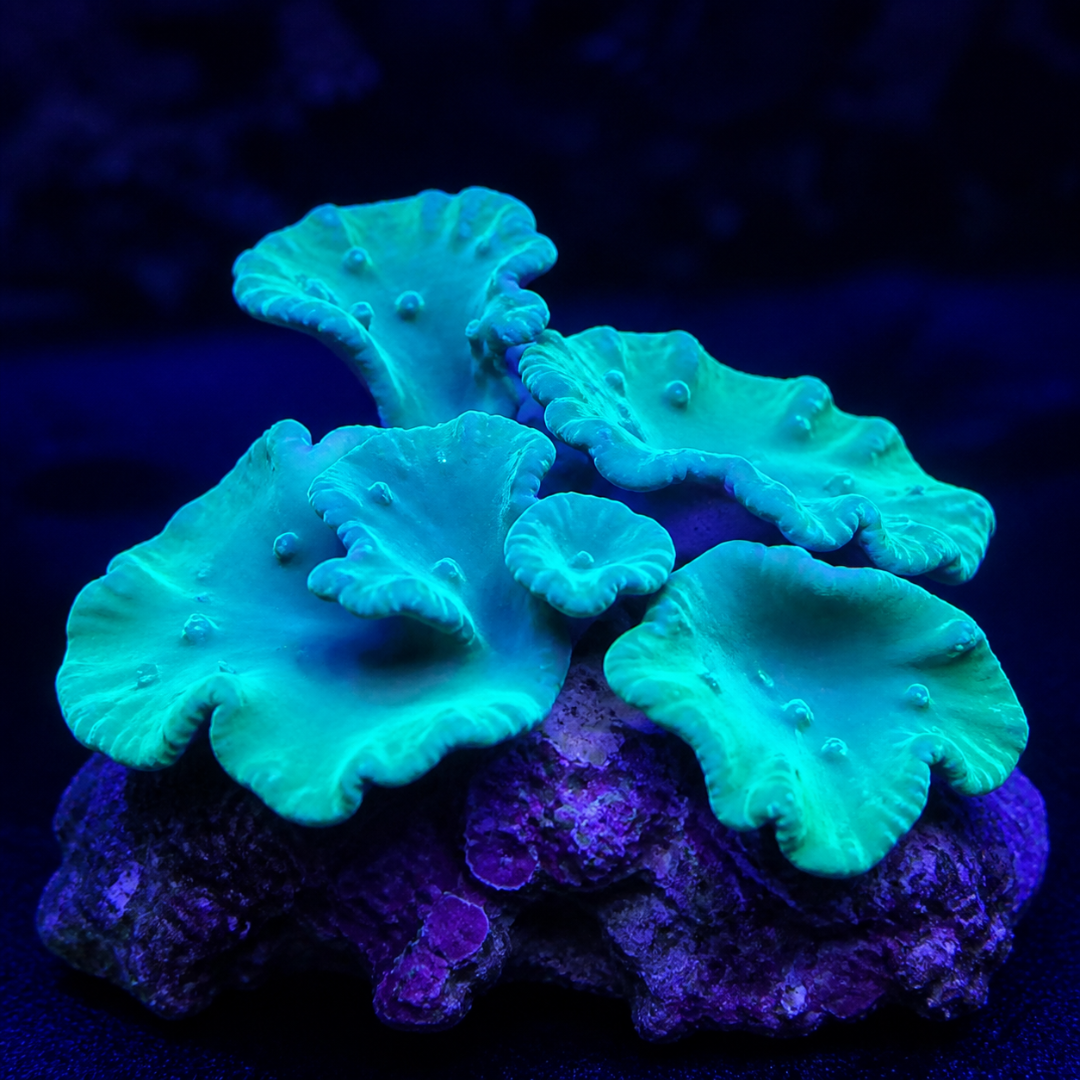
解説 / Description
キャベツレザーコーラルは、波打つ葉が幾重にも重なったような群体をつくるソフトコーラルです。褐色や緑褐色を基調とし、明るい緑色を帯びる個体も流通しています。硬い連続骨格はありませんが、組織内には石灰質の微小な骨片が分布し、柔軟に揺れながら葉状の姿を支えています。一般に環境への適応力が高く、ソフトコーラルの入門種として扱われます。ただし、成長すると広い面積を占め、周囲のサンゴへ化学的な影響を及ぼす可能性もあるため、安定した水質、適切な光と水流、余裕のある配置が長期飼育の要点です。 Cabbage leather coral is a soft coral that develops colonies resembling layers of broad, wavy leaves. Most specimens are brown or olive-brown, although brighter green forms also occur in the aquarium trade. It has no continuous hard skeleton, but numerous calcareous sclerites within the tissue provide support while allowing the colony to flex with the current. It is generally adaptable and is often considered suitable for aquarists beginning with soft corals. As it matures, however, it can occupy considerable space and may chemically affect neighboring corals, so stable water quality, suitable light and flow, and generous placement are important for long-term care.
基本情報 / Basic Information
| 学名 / Scientific Name | Sinularia brassica May, 1898(現行の主要な海洋生物データベースで採用される学名。Sinularia dura (Pratt, 1903) は新参主観的シノニムとして扱われますが、遺伝的差異を示す研究があり、独立種や隠蔽種の可能性は未解決です)Sinularia brassica May, 1898 (the name currently accepted by major marine taxonomic databases. Sinularia dura (Pratt, 1903) is treated as a junior subjective synonym, although genetic variation reported in the group leaves the possibility of a valid or cryptic species unresolved.) |
|---|---|
| 通称・英名 / Common and English Names | キャベツレザーコーラル、キャベツコーラル。日本の流通では、シノニムとされる Sinularia dura の名称も現在まで広く用いられています。Cabbage leather coral and cabbage coral. The trade name Sinularia dura remains widely used, although it is currently treated as a synonym. |
| 分類 / Classification | 刺胞動物門・花虫綱・八放サンゴ亜綱・Malacalcyonacea目・Sinulariidae科・Sinularia属。2022年の系統分類では、Sinularia brassica の独立した系統を収めるためSinulariidae科が設けられ、旧来Sinularia属に含まれていた多くの種はSclerophytum属へ移されました。Phylum Cnidaria, Class Anthozoa, Subclass Octocorallia, Order Malacalcyonacea, Family Sinulariidae, Genus Sinularia. A 2022 phylogenetic revision established Sinulariidae for the distinct lineage containing Sinularia brassica, while many species formerly assigned to Sinularia were transferred to Sclerophytum. |
| 分布 / Distribution | 熱帯インド太平洋の浅海域に広く分布します。紅海、東アフリカ、インド洋の島々、東南アジア、西部太平洋、日本を含む地域から記録があり、光の届く岩礁やサンゴ礁で基盤に固着して生育します。ただし、Sinularia dura として報告された記録には、分類上の再検討が必要な個体群が含まれる可能性があります。Widely distributed in shallow tropical Indo-Pacific waters, with records from the Red Sea, East Africa, Indian Ocean islands, Southeast Asia, the western Pacific, and Japan. Colonies attach to hard substrate on illuminated reefs and rocky habitats. Some records published under Sinularia dura may require taxonomic reassessment. |
| 最大サイズ / Maximum Size | 種として一律に示せる厳密な最大値は確認されていません。流通する小型フラグは数cm程度ですが、飼育下では条件が合うと群体径が数十cmに達し、横方向へ大きく広がることがあります。導入時から成長後の占有面積を見込んで配置します。No single, well-established maximum size is available for the species. Frags may be only a few centimeters across, but established aquarium colonies can spread to several tens of centimeters under favorable conditions. Placement should anticipate the eventual footprint. |
| 寿命 / Lifespan | 正確な寿命は不明です。群体を構成する組織は成長や分裂を繰り返し、株分けによっても維持されるため、単一個体の寿命として区切ることは困難です。安定した環境では長期飼育が可能です。The exact lifespan is unknown. Colonial tissue persists through continued growth and can also be maintained through fragmentation, making a single individual lifespan difficult to define. Long-term aquarium maintenance is possible under stable conditions. |
飼育環境 / Aquarium Environment
| 水槽サイズ / Tank Size | 生態上の厳密な最低水量は定められていません。小型フラグでも水質の安定性を考え、60cm規格水槽(約60L)以上を実用的な目安とします。成長後の広がりや他のサンゴとの間隔を確保するなら、90cm規格水槽(約180L)以上が扱いやすく、大型群体には120cm規格水槽(約240L)以上が適しています。There is no strict biological minimum volume. For practical stability, a small frag is best kept in at least a standard 60 cm aquarium of about 60 L. A standard 90 cm tank of about 180 L or larger provides more manageable long-term space, while large colonies benefit from a standard 120 cm tank of about 240 L or more. |
|---|---|
| 水温・比重 / Temperature and Specific Gravity | 水温24~26℃、比重1.023~1.026を基本の目安とします。一定範囲内の数値よりも、短時間で変動させないことが重要です。蒸発した分は塩を含まない淡水で補い、比重の上昇を防ぎます。Use 24–26°C and a specific gravity of 1.023–1.026 as general targets. Avoiding rapid changes is more important than holding a single exact value. Replace evaporation with unsalted freshwater to prevent salinity from rising. |
| 水質 / Water Quality | 一般的なソフトコーラル水槽の目安として、pH7.9~8.3、KH8~12dKH、カルシウム380~450ppm、マグネシウム1250~1350ppmを安定させます。アンモニアと亜硝酸は検出されない状態を保ち、硝酸塩とリン酸塩は同居する生体に合わせて低く安定させます。活性炭やプロテインスキマーは、溶存有機物やサンゴ由来の化学物質の蓄積を抑える補助になります。As general soft-coral targets, maintain pH 7.9–8.3, alkalinity 8–12 dKH, calcium 380–450 ppm, and magnesium 1250–1350 ppm. Ammonia and nitrite should remain undetectable, while nitrate and phosphate should be kept low and stable according to the needs of the other livestock. Activated carbon and protein skimming can help limit dissolved organics and coral-derived compounds. |
| 光量 / Lighting | 中程度の光を基本とし、PAR50~150µmol/m²/sほどを導入時の実用的な目安にします。個体や照明環境によって適応範囲は異なるため、固定的な上限値として扱わず、開き方や色を見ながら調整します。強い照明下へ移す場合は、設置位置や照明出力を数週間かけて段階的に変えます。Moderate lighting is a practical starting point, with roughly 50–150 µmol/m²/s PAR as an initial guideline. Individual colonies and lighting systems vary, so this should not be treated as a fixed limit. Adjust according to expansion and coloration, and acclimate gradually over several weeks before moving the coral into stronger light. |
| 水流 / Water Flow | 中程度から強めの、方向や強さが変化する水流に適応します。葉状部が無理なく揺れ、表面の粘液や堆積物が流される状態が目安です。組織を一方向へ押し付ける直線的な強流や、ひだの間に汚れが残る弱すぎる流れは避けます。It adapts to moderate through strong, variable flow. The folds should move without being forced, while mucus and settled debris are carried away. Avoid a narrow jet that continuously presses the tissue in one direction, as well as flow too weak to keep the folds clean. |
| レイアウト・配置 / Layout and Placement | 基部が動かないようライブロックへ固定し、中層を中心に、光と水流を調整しやすい場所へ置きます。収縮しているときより大きく開くことや、成長に伴って横へ張り出すことを見込み、上方と周囲に空間を残します。他のサンゴとは接触しない距離を確保し、成長に応じて配置を見直します。Secure the base to live rock and place it mainly in the middle region of the aquarium where light and flow can be adjusted. Leave space above and around the colony because it expands beyond its contracted size and spreads laterally as it grows. Prevent contact with other corals and reassess spacing over time. |
| 注意点 / Precautions | 導入時は水温と比重を合わせ、照明は弱めから順応させます。レザーコーラル類は、ポリプを閉じて表面に薄い膜をつくり、後にそれを脱ぐことがあります。短期間の収縮だけで直ちに病気と判断せず、水流で膜が剥がれやすい環境を整えて経過を観察します。収縮が長引く、組織が崩れる、基部が剥がれる場合は、水質と水流を優先して点検します。Match temperature and salinity during introduction, and begin with reduced light. Leather corals may close their polyps, develop a thin surface film, and later shed it. A brief period of contraction is not automatically a disease; provide sufficient flow to help remove the film and observe the colony. Prolonged closure, tissue breakdown, or detachment of the base warrants an immediate review of water quality and flow. |
餌と給餌 / Feeding
| 栄養の得方・餌 / Nutrition and Diet | 共生する褐虫藻の光合成産物が主要な栄養源です。同時に、水中の微細な有機粒子やプランクトンを取り込むと考えられています。安定した照明と水質が整っていれば、固形餌の直接給餌を必須とする生体ではありません。Photosynthates from symbiotic zooxanthellae provide the main source of nutrition. The coral is also thought to take up fine suspended organic particles and plankton. With stable lighting and water quality, direct feeding of solid food is not essential. |
|---|---|
| 給餌のポイント / Feeding Tips | 補助給餌を行う場合は、植物プランクトンや微細なサンゴ用フードを少量、水流に乗せて与えます。決まった頻度を一律に設けるより、栄養塩、成長、ポリプの反応を見て調整します。食べ残しや液体添加剤の過剰使用は水質悪化を招くため、給餌量を増やす前に濾過能力と測定値を確認します。If supplemental feeding is used, offer small amounts of phytoplankton or finely sized coral food into the water flow. Rather than following a fixed schedule, adjust according to nutrient levels, growth, and polyp response. Uneaten food and excessive liquid supplements can degrade water quality, so check filtration capacity and test results before increasing the amount. |
性質と相性 / Characteristics and Compatibility
| 形態・成長 / Form and Growth | 硬い連続骨格を持たない群体性の八放サンゴです。被覆状の基部や短い茎から、カップ状、漏斗状、または平たい葉状のひだを広げます。ポリプは単型で、群体上部にほぼ均等に分布し、組織内へ引き込めます。表層には頭部の広いこん棒状骨片、内部には複雑な突起を備えた大型の紡錘状骨片があり、柔軟な群体を支えています。This is a colonial octocoral without a continuous hard skeleton. Cup-shaped, funnel-shaped, or flattened leaf-like folds arise from an encrusting base or short stalk. The polyps are monomorphic, distributed across the upper colony surface, and retractile. Broad-headed club sclerites occur near the surface, while large spindle-shaped sclerites with complex tubercles reinforce the interior. |
|---|---|
| 攻撃性 / Aggression | 長いスイーパー触手で周囲を刺すタイプではありませんが、接触による刺胞の影響に加え、二次代謝産物を介したアレロパシーが起こる可能性があります。影響の程度は水量、濾過、換水、同居種によって変わるため、他のサンゴと接触させず、混合リーフでは活性炭、スキマー、定期的な換水を組み合わせます。It does not attack primarily with long sweeper tentacles, but direct contact and allelopathy mediated by secondary metabolites may affect nearby organisms. The severity depends on water volume, filtration, water changes, and the species present. Prevent contact and use a combination of activated carbon, protein skimming, and regular water changes in mixed reefs. |
| 相性 / Compatibility | 一般的なリーフセーフの海水魚や多くの無脊椎動物とは同居させやすい生体です。ただし、ヤッコ類や一部のチョウチョウウオなど、サンゴをついばむ可能性のある魚には注意します。クマノミの自然宿主ではなく、繰り返し体をこすり付けられるとポリプを閉じることがあります。サンゴ同士は、直接接触と化学的影響の両方を考えて距離を取ります。It is generally compatible with reef-safe marine fish and many invertebrates. Use caution with angelfish, some butterflyfish, and other species that may nip coral tissue. It is not a natural host for clownfish, and repeated rubbing may cause the polyps to remain closed. Space it from other corals to reduce both direct contact and chemical interaction. |
病気と対策 / Diseases and Prevention
| 不調・病気・害虫 / Problems, Diseases, and Pests | 一時的な収縮や表面膜の形成は、レザーコーラル類に見られる通常の脱皮過程である場合があります。一方、急な光量増加や高水温では退色や白化、弱すぎる水流や堆積物の蓄積では表面の汚れや局所的な組織損傷が起こり得ます。長期間開かない、組織が溶けるように崩れる、基部が剥離する状態は不調のサインです。本種に固有と確認された代表的な害虫については情報が限られます。Temporary contraction and formation of a surface film may be part of the normal shedding process seen in leather corals. In contrast, sudden increases in light or excessive temperature may cause paling or bleaching, while weak flow and accumulated debris can lead to fouling and localized tissue damage. Persistent failure to open, dissolving tissue, or detachment at the base indicates a problem. Information on pests specific to this species remains limited. |
|---|---|
| 対策と予防 / Prevention | 水温、比重、pH、照明を急変させず、表面を清潔に保てる変化のある水流を維持します。定期的な換水と適切な濾過で有機物の蓄積を抑え、新しい生体は可能であれば隔離して観察します。組織損傷が広がる場合は別容器へ移し、原因を確認したうえで、健全部の切り分けを検討します。薬剤やディップは対象生物と製品の適用範囲を確認し、根拠なく使用しません。Avoid rapid changes in temperature, salinity, pH, and light, and maintain variable flow that keeps the surface clean. Regular water changes and appropriate filtration reduce organic accumulation, while new livestock should be observed in quarantine when possible. If tissue loss spreads, isolate the coral, identify the likely cause, and consider salvaging healthy tissue. Do not use medications or dips without confirming that they are appropriate for the organism and problem. |
増やし方(繁殖・株分け) / Reproduction and Propagation
| 無性生殖・株分け / Asexual Reproduction and Fragmentation | 飼育下ではフラグ化による株分けが一般的です。状態の良い葉状部を清潔なハサミやメスで切り分け、ネット、糸、緩い輪ゴムなどで小石やフラグプラグへ固定します。粘液が多く、接着剤だけでは外れやすいため、組織が基盤へ自然に活着するまで動かさないことが重要です。Fragmentation is the usual propagation method in aquariums. Cut a healthy fold with clean scissors or a scalpel and secure it to rubble or a frag plug using mesh, thread, or a loose rubber band. Because the tissue produces abundant mucus, adhesive alone often fails; keep the fragment stable until it naturally attaches. |
|---|---|
| 有性生殖 / Sexual Reproduction | Sinularia dura の名称で扱われた過去の記録には、雌雄が分かれ、卵と精子を海中へ放出する放卵放精型とする報告があります。ただし、S. dura と S. brassica の分類関係には未解決の点があり、繁殖時期や地域差を本種全体へ一律に当てはめることはできません。家庭水槽では計画的な有性生殖は一般的ではなく、実用的な増殖は株分けが中心です。Historical records published under the name Sinularia dura describe separate sexes and broadcast spawning. Because the taxonomic relationship between S. dura and S. brassica remains partly unresolved, spawning season and population-level details should not be generalized to every colony. Controlled sexual reproduction is uncommon in home aquariums, so practical propagation relies mainly on fragmentation. |
| 増殖のポイント / Propagation Tips | 十分に開き、傷みのない親株を選び、器具と作業面を清潔にします。切断後は水質を安定させ、切り口へ汚れがたまらない程度の水流を当てます。輪ゴムや糸を強く締めると柔らかな組織を切るため、固定は外れない範囲で緩く行います。活着が確認できるまでは、魚や掃除生体に動かされにくい場所で養生します。Choose a fully expanded parent colony with intact tissue, and keep tools and the work surface clean. After cutting, maintain stable water quality and enough flow to prevent debris from settling on the wound. Rubber bands or thread can cut through the soft tissue if tightened too much, so secure the fragment only as firmly as necessary. Keep it where fish and cleanup animals are unlikely to dislodge it until attachment is confirmed. |
毒性と取り扱い / Toxicity and Handling
| 毒性 / Toxicity | 本種はパリトキシンを保有するサンゴとして確認されているわけではありません。一方、組織や粘液には、捕食防御や空間競争に関わる二次代謝産物が含まれると考えられます。これらの成分をすべて本種固有の毒性として整理できるだけの情報はなく、人への影響も十分には確立されていませんが、粘液への不要な接触は避けます。This species has not been established as a palytoxin-bearing coral. Its tissues and mucus are nevertheless expected to contain secondary metabolites involved in predator defense and competition for space. Available evidence does not allow every reported compound to be treated as a species-specific human toxin, but unnecessary contact with mucus should still be avoided. |
|---|---|
| 取り扱い上の注意 / Handling Precautions | 移動や株分けではニトリル手袋と保護眼鏡を着用し、傷口、目、口に粘液が触れないようにします。作業後は器具を洗浄し、手と腕を石けんで洗います。本種を過度に危険視する必要はありませんが、サンゴや付着したライブロックを加熱・煮沸する行為は、未知の有機物や微生物を空気中へ放出するおそれがあるため避けます。目や傷口へ入った場合や、刺激が続く場合は流水で洗い、医療機関へ相談します。Wear nitrile gloves and eye protection when moving or fragmenting the coral, and prevent mucus from contacting cuts, eyes, or the mouth. Clean tools afterward and wash hands and forearms with soap. The coral need not be regarded as exceptionally dangerous, but heating or boiling it or attached live rock should be avoided because unknown organic material or microorganisms may become airborne. If mucus enters the eyes or a wound, or irritation persists, rinse with running water and seek medical advice. |
雑学と豆知識 / Trivia and Fun Facts
| 二つの学名をめぐる物語 / A Tale of Two Scientific Names | キャベツレザーコーラルの分類史は、外見だけでソフトコーラルを見分ける難しさをよく示しています。Sinularia brassica は1898年に、のちに Sinularia dura と組み替えられる種は1903年に Sclerophytum durum として記載されました。葉状、カップ状、漏斗状と大きく姿が変わる標本を比較した1998年の研究では、骨片の特徴が連続しているとして両者の同物異名が提案され、現在も主要なデータベースは S. brassica を採用しています。しかし、分子系統研究では遺伝的な違いも示されており、S. dura が再び独立種として認められる可能性や、複数の隠蔽種が含まれる可能性は残されています。流通名として親しまれる一つの名前の背後に、今も研究が続く分類上の物語があります。The taxonomic history of cabbage leather coral shows how difficult soft corals can be to identify by appearance alone. Sinularia brassica was described in 1898, while the species later combined as Sinularia dura was described in 1903 as Sclerophytum durum. A 1998 comparison of leaf-like, cup-shaped, and funnel-shaped specimens found continuity in their sclerites and proposed synonymy, and major databases still accept S. brassica. Molecular studies, however, have also detected genetic differences, leaving open the possibility that S. dura may be reinstated or that several cryptic species are involved. A familiar trade name therefore carries an unresolved scientific story. |
|---|---|
| 柔らかい体を支える小さな骨片 / Tiny Sclerites Supporting a Soft Body | 柔らかく見える群体の内部には、スクレライトと呼ばれる石灰質の骨片が無数に埋め込まれています。表層には、頭部が非常に広く、先端が二つまたは三つの突起に分かれるこん棒状骨片があり、内部には複雑な突起を備えた大型の紡錘状骨片があります。過去の形態研究では、表層の骨片が約0.10~0.20mm、内部の大型骨片が数mmに達する標本も報告されました。連続した骨格をつくらず、小さな支持材を組織全体へ分散させることで、波にしなやかに応じながら葉状の形を保っています。この独特な骨片は、2022年にSinulariidae科が設けられた際の重要な形態的特徴にもなりました。Countless calcareous sclerites are embedded within the apparently soft colony. Near the surface are clubs with exceptionally broad heads, usually divided into two or three prominences, while the interior contains large spindle-shaped sclerites with complex tubercles. Earlier morphological studies reported surface sclerites around 0.10–0.20 mm and internal elements reaching several millimeters in some specimens. By distributing many small supports through the tissue rather than building a continuous skeleton, the coral can retain its leaf-like form while flexing with waves. These distinctive sclerites were also important morphological characters when the family Sinulariidae was established in 2022. |
| 動けない生物が使う化学の防御 / Chemical Defense in a Stationary Animal | 光の当たる岩の表面が限られるサンゴ礁では、動けない生物同士も空間をめぐって競争します。ソフトコーラルは刺胞だけでなく、捕食者、微生物、近隣の生物へ作用する二次代謝産物も利用します。ただし、過去に「Sinularia属」から報告されたセンブレン型ジテルペンやセスキテルペノイドなどの研究には、2022年以降の分類ではSclerophytum属へ移された種も含まれます。そのため、多様な薬理活性を示す化合物をすべてキャベツレザーコーラル固有の成分とみなすことはできません。水槽内で活性炭、換水、スキマーが役立つのは、こうした目に見えない化学的相互作用の蓄積を抑える意味もあります。On coral reefs, organisms that cannot move still compete for limited illuminated substrate. Soft corals use not only cnidocytes but also secondary metabolites that can affect predators, microbes, and neighboring organisms. However, historical chemical studies attributed to the genus Sinularia include species that were transferred to Sclerophytum in the 2022 classification. The many cembranoid diterpenes, sesquiterpenoids, and other compounds reported from the former broad genus therefore cannot all be treated as unique to cabbage leather coral. In aquariums, activated carbon, water changes, and protein skimming can help reduce the accumulation of these invisible chemical interactions. |
| フラグがつなぐ持続的な楽しみ / Fragging and Sustainable Enjoyment | キャベツレザーコーラルは切断片が基盤へ活着しやすく、フラグ個体としても流通しています。一つの親株を繰り返し増殖できることは、小型水槽へ導入しやすいサイズを選べるだけでなく、野生群体への採集圧を減らす手段になり得ます。ただし、養殖や株分けであれば自動的に環境負荷がなくなるわけではありません。親株の由来、輸送、設備、切断後の養生まで含め、健全な個体を長く維持する仕組みがあって初めて持続的な流通につながります。小さな一片が新しい葉を重ねていく過程は、このサンゴの再生力と成長を身近に観察できる機会でもあります。Cabbage leather coral attaches readily after fragmentation and is commonly available as cultured frags. Repeated propagation from a parent colony can provide sizes suitable for smaller aquariums and may help reduce collection pressure on wild colonies. Aquaculture does not automatically eliminate environmental impacts, however; sustainability also depends on the origin of broodstock, transport, facilities, and careful recovery after cutting. Watching a small fragment develop new folds offers a close view of the coral’s regenerative capacity and growth. |
まとめ / Conclusion
キャベツレザーコーラルは、重なり合う葉の造形と、水流に応じてゆったりと揺れる姿を楽しめるソフトコーラルです。丈夫とされる一方で、本来の形や色を保つには、水温と比重の安定、中程度の光、表面に汚れを残さない変化のある水流が欠かせません。収縮時の大きさだけで配置を決めず、成長後の広がりと周囲への化学的な影響まで見込んで空間を確保することが大切です。 Cabbage leather coral is valued for the sculptural form of its overlapping folds and the relaxed movement of its tissue in the current. Although regarded as hardy, it maintains its best form and coloration when temperature and salinity remain stable, lighting is moderate, and variable flow prevents debris from settling on the surface. Placement should account not only for its contracted size but also for future expansion and possible chemical effects on neighboring corals.
小さなフラグから育てた群体は、時間とともに葉を重ね、水槽内に落ち着いた量感と自然な動きをもたらします。日々の開き方、表面の状態、色合いの変化を丁寧に観察すれば、環境のずれにも早く気づけます。基本的な管理を安定して続けることで、力強さと繊細さをあわせ持つ姿を長く楽しめるサンゴです。 A colony raised from a small frag gradually adds new folds and brings both visual weight and natural movement to the aquarium. Careful observation of daily expansion, surface condition, and coloration can reveal environmental problems at an early stage. With consistent basic husbandry, this coral can display its combination of resilience and delicacy for many years.

気になる道具や飼い方を見つけてみませんか?
 アイのアクアグッズ案内エンゼルフィッシュの飼育用品|高さのある水槽・ろ過・水草・餌の選び方道具の特徴や使い方、選ぶときのポイントをアイが紹介します。記事はコチラ →
 アイのアクアグッズ案内テトラミンって、こんなにあるの? アイとコタロウのごはん探究旅道具の特徴や使い方、選ぶときのポイントをアイが紹介します。記事はコチラ →
 アイのアクアグッズ案内水槽のろ材の選び方|ウール・リング・活性炭の違いとおすすめ商品フィルターの中の綿や石は何をしている? アイとコタロウが、ウール・スポンジ・セラミック・焼結ガラス・活性炭・ゼオライトを比較。機種との相性、入れ方、洗い方と交換まで商品とともに紹介します。記事はコチラ →
 アイのアクアグッズ案内水槽フィルターの選び方|外掛け・外部・上部から小型オーバーフローまで道具の特徴や使い方、選ぶときのポイントをアイが紹介します。記事はコチラ →
さまざまな飼育テーマをご紹介。リンク先の記事には広告・商品紹介が含まれます。
案内・紹介記事一覧へ →分布マップ
キャベツレザーコーラル(Sinularia brassica)は、紅海、東アフリカ、インド洋の島々、東南アジア、西部太平洋、日本を含む熱帯インド太平洋の浅海域から広く記録されています。光の届く岩礁やサンゴ礁の硬い基盤に固着して生育します。Sinularia dura名義の一部記録は分類上の再検討が必要なため、確実な地点として個別には表示していません。
この地図の枠とマーカーは、記事に記載された広域分布を把握するための概略表示です。実際の採集地点、確認標本の位置、個体群ごとの分布境界、厳密な生息範囲を示すものではありません。
キャベツレザーコーラルの分類、分布、生息環境、飼育、繁殖、健康管理および安全な取り扱いを確認するため、査読論文、学術データベース、公的・専門機関の資料から選定しています。店舗、通販サイト、個人ブログ、まとめサイトは含めていません。データベースおよびウェブ資料は2026年7月30日に確認しました。
-
分類・学名
World Register of Marine Species(WoRMS). Sinularia brassica May, 1898.
WoRMSの分類ページを開く現行の受容名、命名者、原記載、Sinularia duraおよびSclerophytum durumの異名関係、標本記録と主要文献を支える基礎資料です。
-
分類・形態・分布
Benayahu, Y., van Ofwegen, L. P. & Alderslade, P. (1998). A case study of variation in two nominal species of Sinularia, S. brassica May, 1898, and S. dura (Pratt, 1903), with a proposal for their synonymy. Zoologische Verhandelingen, 323, 277–309.
Naturalis所蔵PDFを開く両名の同物異名提案、葉状・カップ状に変化する群体形、ポリプと骨片の形態、浅海性、インド太平洋各地の標本記録を直接支える、本種群の中心的な再記載論文です。
-
分子系統
McFadden, C. S., van Ofwegen, L. P., Beckman, E. J., Benayahu, Y. & Alderslade, P. (2009). Molecular systematics of the speciose Indo-Pacific soft coral genus, Sinularia (Anthozoa: Octocorallia). Invertebrate Biology, 128(4), 303–323.
DOI: 10.1111/j.1744-7410.2009.00179.x形態分類と分子系統の不一致を検討し、S. brassica/S. duraで異なるハプロタイプが見つかったことから、分類上の再検討余地を示す資料です。
-
現行分類
McFadden, C. S., van Ofwegen, L. P. & Quattrini, A. M. (2022). Revisionary systematics of Octocorallia (Cnidaria: Anthozoa) guided by phylogenomics. Bulletin of the Society of Systematic Biologists, 1(3), 8735.
DOI: 10.18061/bssb.v1i3.8735八放サンゴ類の系統ゲノム解析に基づく改訂で、Malacalcyonacea目、Sinulariidae科、現在のSinularia属の位置づけを支えます。
-
日本の分布
Benayahu, Y. (2002). Soft corals (Octocorallia: Alcyonacea) of the southern Ryukyu Archipelago: The families Tubiporidae, Clavulariidae, Alcyoniidae and Briareidae. Journal of the Japanese Coral Reef Society, 2002(4), 11–32.
J-STAGEの論文ページを開く南部琉球列島のソフトコーラル相を扱った査読資料で、日本周辺からの記録と地域的な分布記述を補強します。
-
生息環境・増殖
Ellis, S. (1999). Farming Soft Corals for the Marine Aquarium Trade. Center for Tropical and Subtropical Aquaculture, Publication No. 140.
NOAA Library収録PDFを開くSinularia類が熱帯太平洋の礁湖や礁縁の岩盤・硬い礫上に見られること、褐虫藻との共生、切断片の再付着を利用したフラグ化と養生の基本を支えます。
-
一般飼育指針
Ornamental Aquatic Trade Association(OATA). How to look after soft corals.
OATAケアシートを開く水温、比重、pH、KH、カルシウム、マグネシウムなどの一般的なソフトコーラル水槽の目安、光合成と補助給餌、水流、順応、隔離、健康状態の観察、フラグ化を支える専門団体資料です。掲載値は本種だけを対象とした実験値ではありません。
-
繁殖形質
Coral Trait Database. Sexual system: Sinularia brassica.
Coral Trait Databaseの記録を開く本種の性的システムを雌雄異体として収録する、研究文献に基づく生物形質データベースです。
-
有性生殖
Kahng, S. E., Benayahu, Y. & Lasker, H. R. (2011). Sexual reproduction in octocorals. Marine Ecology Progress Series, 443, 265–283.
DOI: 10.3354/meps09414八放サンゴ182種の繁殖情報を整理した査読レビューで、雌雄性、放卵放精、保育型などの用語と生殖様式を確認する基礎資料です。地域や分類群による差があるため、繁殖時期を一律に当てはめる根拠には用いていません。
-
病理・健康管理
Oceanographic Institute of Monaco. (2025). Coral Pathology: Identification and Management in Aquaria. Last version: October 2025.
モナコ海洋研究所のハンドブックを開く白化、退色、組織壊死、感染症と環境ストレスの見分け方、安定した水質と水流、隔離、切除、診断前の安易な処置を避ける考え方を支える専門機関の病理ハンドブックです。
-
安全な取り扱い
Sinno-Tellier, S. / ANSES. (2018). Saltwater aquarium corals should be handled with care. Vigil’Anses, No. 5.
ANSESの安全資料を開く手袋・保護眼鏡の使用、目や皮膚への接触回避、作業後の洗浄、サンゴや付着生物を熱湯処理・煮沸しないことを支える公的機関資料です。内容の中心はパリトキシンをもつスナギンチャク類であり、キャベツレザーコーラルがパリトキシンを保有する証拠として引用するものではありません。
- 水温・比重・主要元素などの数値は、OATAが示すソフトコーラル全般の飼育目安です。Sinularia brassicaだけを用いた比較実験で確立された最適値ではありません。
- PAR 50~150µmol/m²/s、水槽容量、飼育下の最大群体径は、本種固有の確定値ではなく、飼育上の目安です。実用上の導入目安として扱い、個体の反応と水槽環境に応じて調整する必要があります。
- 短期間の収縮や表面膜の剥離を正常な脱皮と判断する際も、組織崩壊、悪臭、長期の閉鎖などが伴う場合は病変や環境障害を除外できません。単一の症状だけで診断しないことが重要です。





コメント