

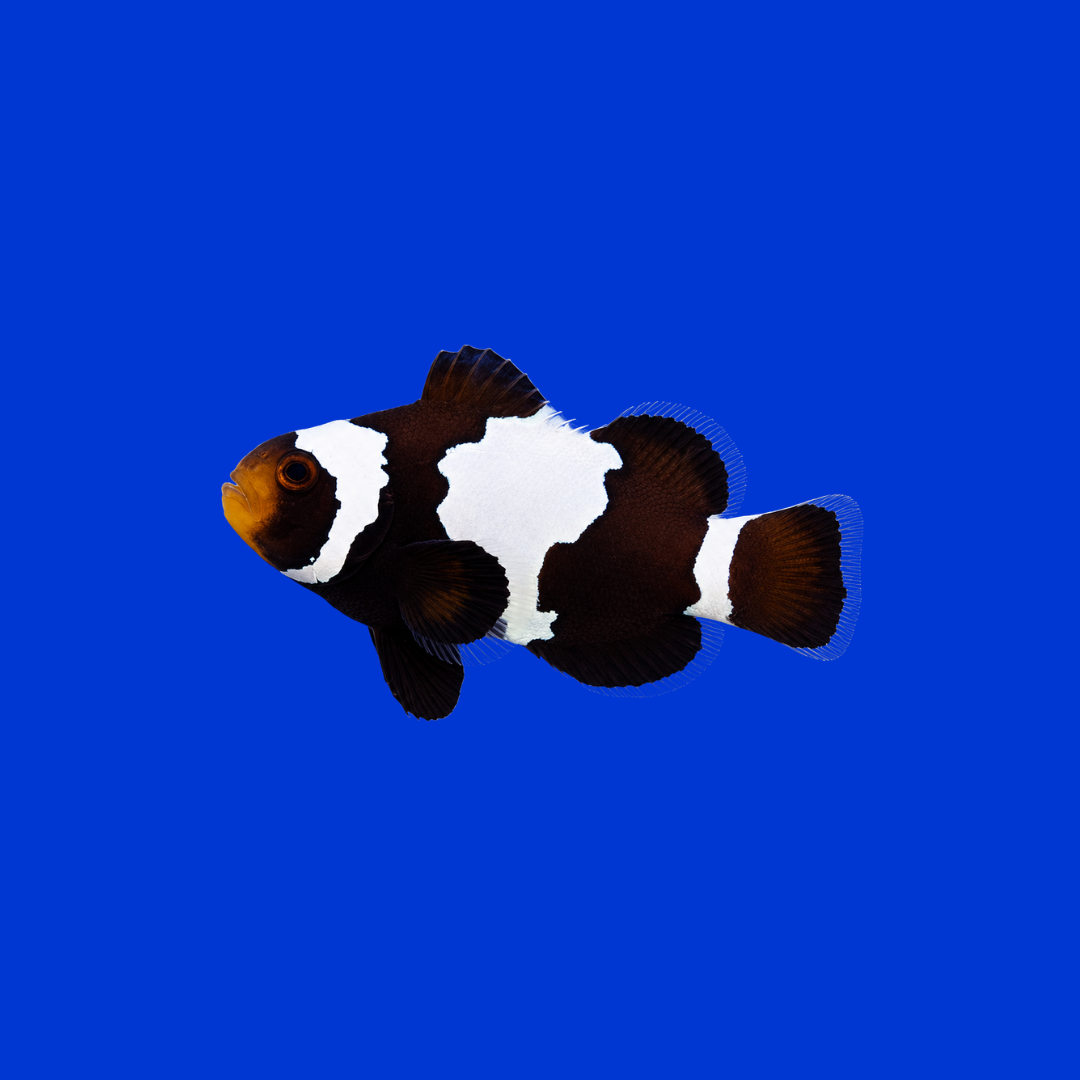
解説 / Description
スノーフレークブラックオセラリスは、カクレクマノミ(Amphiprion ocellaris)の黒色系統と、白帯が不規則に広がるスノーフレーク系統を交配し、選抜を重ねて作出された人工繁殖品種です。黒い体色と、雪片を思わせる白帯の鮮明なコントラストが特徴で、その模様は個体ごとに異なります。流通名やグレードの基準はブリーダーや販売者によって多少異なりますが、分類上は独立した種ではなく、カクレクマノミの一系統です。人工飼料に慣れた個体が多く比較的飼育しやすい一方、長期飼育には安定した水質と、クマノミ特有の縄張り行動への配慮が欠かせません。 The Black Snowflake Ocellaris is a captive-bred strain produced through repeated crossing and selection of black ocellaris and Snowflake-pattern lineages of Amphiprion ocellaris. Its defining features are a dark body and sharply contrasting white bars that resemble scattered snowflakes, with a pattern unique to each fish. Trade names and grading standards vary somewhat among breeders and sellers, but taxonomically it remains a strain of the ocellaris clownfish rather than a separate species. Captive-bred individuals usually accept prepared foods readily and are comparatively manageable, although long-term care still requires stable water quality and careful management of the territorial behavior typical of clownfish.
基本情報 / Basic Information
| 学名 / Scientific Name | Amphiprion ocellaris |
|---|---|
| 通称 / Common Name | スノーフレークブラック、ブラックスノーフレーク、ブラック・スノーフレーク・オセラリス(いずれも流通名)Snowflake Black Ocellaris, Black Snowflake Ocellaris; trade names vary among breeders |
| 分類 / Family | スズメダイ科(Pomacentridae)クマノミ属(Amphiprion)Family Pomacentridae, genus Amphiprion |
| 英名 / English Name | Black Snowflake Ocellaris Clownfish |
| 分布 / Distribution | 本品種は養殖下で維持される流通品種であり、固有の自然分布はありません。原種のカクレクマノミはインド西太平洋に分布し、東部インド洋から東南アジア、フィリピン、台湾、琉球列島、オーストラリア北西部にかけての浅いサンゴ礁や穏やかな礁湖で見られます。This aquarium strain is maintained through captive breeding and therefore has no natural range of its own. Wild Amphiprion ocellaris occurs in the Indo-West Pacific, from the eastern Indian Ocean through Southeast Asia and the Philippines to Taiwan, the Ryukyu Islands, and northwestern Australia, primarily in shallow coral reefs and sheltered lagoons. |
| 最大体長 / Max Size | 最大全長は約11cmです。社会集団や飼育ペアでは、成熟したメスが最大個体となり、オスはそれより小さい体格を保ちます。Maximum total length is about 11 cm. Within a social group or established aquarium pair, the mature female is the largest fish and the male remains smaller. |
| 寿命 / Lifespan | 長期飼育が可能な魚で、FishBaseには飼育下で12年に達した例が記録されています。実際の寿命は、導入時の健康状態、水質の安定性、栄養、疾病予防などによって大きく左右されます。This species can be maintained for many years; FishBase records an individual that reached 12 years in captivity. Actual lifespan varies substantially with initial health, water stability, nutrition, and disease prevention. |
飼育環境 / Aquarium Environment
| 水槽サイズ / Tank Size | 小型の若魚1匹を30cmキューブ水槽(約25〜27L)で飼うことはできますが、水量が少ないほど水温や水質が急変しやすくなります。長期飼育では45cm規格水槽(約35L)以上、ペア飼育・混泳・イソギンチャクの導入では60cm規格水槽(約55〜60L)以上を目安にすると管理しやすくなります。A single small juvenile can be kept in a 30 cm cube aquarium of roughly 25–27 L, but smaller volumes are more vulnerable to rapid changes in temperature and water quality. For long-term care, a standard 45 cm aquarium of about 35 L or larger is easier to manage; a standard 60 cm aquarium of roughly 55–60 L or larger is preferable for a pair, a community, or an anemone. |
|---|---|
| 水温 / Temperature | 24〜26℃を中心に、年間を通して安定させます。許容範囲の広さよりも急変を避けることが重要で、日本の夏は水槽用クーラーや室温管理、冬は適切な容量のヒーターを用います。 Maintain the aquarium near 24–26°C throughout the year. Avoiding rapid change is more important than relying on a broad tolerance range; in Japan, this commonly requires an aquarium chiller or room cooling in summer and a correctly sized heater in winter. |
| 水質 / Water Quality | 通常の海水環境として、比重1.023〜1.026、pH8.0〜8.4を目安にします。アンモニアと亜硝酸は検出されない状態を保ち、硝酸塩も低く管理します。生物ろ過が安定していない立ち上げ直後の水槽は避け、定期的な換水と十分な酸素供給を行います。Use normal full-strength marine conditions, with a specific gravity of approximately 1.023–1.026 and a pH of 8.0–8.4. Ammonia and nitrite should remain undetectable, with nitrate kept low. Avoid newly established aquariums with immature biological filtration, and provide regular water changes and adequate oxygenation. |
| レイアウト / Layout | 安定した岩組みで休める場所と視線を遮る場所を作り、前面には給餌と観察がしやすい空間を残します。カクレクマノミの飼育にイソギンチャクは必須ではありません。導入する場合は、照明、水流、水質、成長後の大きさに加え、移動したイソギンチャクが吸水口へ巻き込まれない対策まで含め、イソギンチャク側の条件を優先します。Build stable rockwork that provides resting places and visual barriers while leaving open space at the front for feeding and observation. A host anemone is not required for keeping ocellaris clownfish. When one is added, prioritize the anemone’s requirements for lighting, flow, water quality, and adult size, and protect pump intakes in case the anemone moves. |
| 注意点 / Precautions | 同種を無計画に複数導入すると、順位争いによって弱い個体が追い詰められることがあります。体格差のある2匹を組み合わせる方法はペア形成の一つの目安ですが、相性を保証するものではありません。激しい追尾、ヒレの損傷、呼吸の乱れ、餌を食べられない状態が続く場合は、速やかに隔離できる準備を整えておきます。Unplanned groups of clownfish may develop severe rank disputes that leave weaker fish cornered. Pairing two fish of different sizes is a useful starting approach, but it does not guarantee compatibility. Be prepared to separate them promptly if persistent chasing, fin damage, abnormal breathing, or inability to feed continues. |
餌と給餌 / Feeding
| 餌の種類 / Diet | 海水魚用の小粒人工飼料を主食にし、冷凍イサザアミ、冷凍ブラインシュリンプ、細かくしたオキアミなどを補助的に与えます。野生のカクレクマノミは動物プランクトンと藻類を利用する雑食性であるため、動物質だけに偏らず、藻類原料を含む総合飼料も組み合わせます。Use small marine-fish pellets or granules as the staple diet, with frozen mysids, frozen brine shrimp, or finely chopped krill as supplements. Wild Amphiprion ocellaris is omnivorous and consumes both zooplankton and algae, so the aquarium diet should not be limited to animal-based foods; include a complete food containing algal ingredients. |
|---|---|
| 給餌のポイント / Feeding Tips | 1日1〜2回、食べ残しが出ない量を少量ずつ与えます。単一の冷凍餌だけに偏らせず、粒の大きさや原料の異なる人工飼料を組み合わせると、栄養の偏りを抑えやすくなります。導入直後に食べない場合は、まず呼吸状態と水質を確認し、落ち着いた環境で嗜好性の高い冷凍餌を少量試します。Feed once or twice daily in small portions that leave no uneaten food. Avoid relying on a single frozen food; rotating prepared foods with different particle sizes and ingredients helps reduce nutritional imbalance. If a newly introduced fish refuses food, first check respiration and water quality, then offer a small amount of a highly palatable frozen food in a quiet setting. |
性格と混泳 / Temperament and Tank Mates
| 性格 / Temperament | 給餌の時間や飼育者の動きに慣れると、水槽前面へ出てくることが多い活発な魚です。一方、定着した場所、宿主代わりに選んだ対象、産卵床の周囲には強い縄張り意識を示します。ペアが成立すると、社会順位の高い大きな個体がメス、小さな個体がオスになります。An active fish, it commonly learns feeding routines and approaches the front of the aquarium. At the same time, it may defend an established site, a chosen surrogate host, or the area around a spawning surface. Once a pair is established, the larger dominant fish becomes female and the smaller fish functions as the male. |
|---|---|
| 混泳の相性 / Compatibility | 十分な水量と隠れ場所があれば、生活域が重なりにくい温和な小型海水魚とは混泳できる場合が多いものの、相性には個体差があります。別種を含むクマノミ類や、攻撃性の強いスズメダイ類を安易に追加することは避けます。サンゴを捕食する魚ではありませんが、特定のサンゴを宿主代わりに選び、繰り返し体をこすりつけることでサンゴが開きにくくなることがあります。With adequate volume and shelter, it can often share an aquarium with peaceful small marine fishes that occupy different areas, although individual compatibility varies. Avoid casually adding other clownfish, including different species, or highly aggressive damselfishes. It does not normally eat corals, but it may adopt a coral as a surrogate host and repeatedly rub against it, sometimes preventing the coral from expanding normally. |
病気と対策 / Diseases and Prevention
| かかりやすい病気 / Common Diseases | 海水白点病、ウーディニウム病、ブルックネラ症、トリコディナなどの体表寄生虫症、体表やひれの細菌感染症が候補になります。白点、粘液の増加、呼吸の速まり、体をこすりつける行動、ひれをたたむ、食欲が落ちるといった症状は複数の病気で共通して見られるため、外見だけで原因を断定することはできません。Possible problems include marine ich, marine velvet, Brooklynella, external protozoan infections such as Trichodina, and bacterial infections of the skin or fins. White spots, excess mucus, rapid breathing, flashing, clamped fins, and loss of appetite can occur in several different diseases, so the cause cannot be confirmed from appearance alone. |
|---|---|
| 対策と予防 / Prevention | 新しい魚は可能であれば別水槽で一定期間観察し、輸送袋の水を本水槽へ入れないようにします。導入時は水温と比重を急変させず、安定した水質と十分な酸素量を保つことが予防の基本です。呼吸困難や粘液異常が見られた場合は早めに隔離し、海水魚の疾病に詳しい専門店や獣医師へ相談します。淡水浴や薬浴は一部の病原体に用いられることがありますが、すべての病気に有効な方法ではありません。診断や薬剤の適用条件を確認せず、本水槽で実施しないことが重要です。Whenever possible, observe new fish in a separate aquarium for a period of time and avoid adding transport water to the display tank. Preventive care begins with gradual temperature and salinity acclimation, stable water quality, and strong oxygenation. If respiratory distress or abnormal mucus appears, isolate the fish promptly and consult a marine-fish specialist or veterinarian. Freshwater dips and medications are used for some pathogens, but they are not universal treatments and should not be applied in the display aquarium without confirming the diagnosis and treatment conditions. |
増やし方(繁殖) / Breeding
| 雌雄の判別 / Sexing | 若魚を外見だけで確実に雌雄判別することはできません。カクレクマノミは雄性先熟で、未成熟段階を経てまずオスとして成熟し、社会順位に応じてメスへ性転換します。集団では最大個体がメス、次に大きい個体が繁殖オスとなります。体格差のある若い2匹を育てる方法が一般的ですが、形成までの時間と相性には個体差があります。Juveniles cannot be sexed reliably from appearance alone. Ocellaris clownfish are protandrous hermaphrodites: after an immature stage, they first mature as males and can later change to females according to social rank. The largest fish in a group is female and the second-largest is the breeding male. Raising two young fish of different sizes is a common pairing method, but compatibility and the time required vary. |
|---|---|
| 繁殖形態 / Reproduction | 基質産卵型です。ペアは岩、タイル、植木鉢などの硬く平らな面を掃除し、粘着性のある卵を産み付けます。主にオスが卵へ胸びれで水を送り、状態の悪い卵を取り除きながら守ります。ふ化した仔魚は浮遊生活へ移るため、親魚とは別の育成環境が必要です。This is a substrate-spawning species. A pair cleans a hard, flat surface such as rock, tile, or a flowerpot and deposits adhesive eggs. The male performs most of the care, fanning the clutch with his pectoral fins and removing poor eggs. Newly hatched larvae enter a planktonic phase and therefore require a rearing system separate from the adults. |
| 繁殖のポイント / Breeding Tips | 安定した成熟ペア、一定の照明時間、多様で質の高い餌、清浄な水質が産卵の基礎です。ふ化は消灯後に起こることが多いため、卵の発眼や色の変化を観察して時期を見極めます。仔魚の初期餌料には適切な大きさのワムシなどが必要で、専用の育成水槽、餌料生物の培養、必要に応じた植物プランクトンの利用、ブラインシュリンプ幼生への段階的な移行を事前に準備します。黒色や白帯の出方は遺伝的組み合わせと個体差の影響を受けるため、子が親と同じ外観になるとは限りません。A stable mature pair, a consistent lighting schedule, varied high-quality foods, and clean water form the basis of spawning. Hatching often occurs after lights-out, so eye development and changes in egg color help indicate timing. Early larvae require suitably small live prey such as rotifers, along with a dedicated rearing tank, live-food cultures, optional use of microalgae, and a planned transition to Artemia nauplii. Black coloration and white-bar form depend on genetic combinations and individual development, so offspring will not necessarily match their parents. |
雑学と豆知識 / Trivia and Fun Facts
| 1. 模様は個体ごとに異なり、左右には対応がある / 1. Individual Patterns Still Show Left–Right Correspondence | スノーフレーク系統では白い面積が広がり、帯の輪郭が波打ったり、隣り合う帯がつながったりします。模様の細部は個体ごとに大きく異なる一方、2026年の研究では、同じ個体の左右は比較的よく対応していることも示されました。完全な偶然だけで模様が決まるのではなく、個体全体の発生を整える仕組みの中で、固有の輪郭が作られていると考えられます。In Snowflake fish, white areas expand and the bar edges may become wavy or join neighboring bars. Fine details vary greatly among individuals, yet a 2026 study also found that the two sides of the same fish remain comparatively well matched. The pattern is therefore not produced by unrestricted randomness alone; individual outlines emerge within a broader developmental system that coordinates the whole body. |
|---|---|
| 2. gja5bの一塩基変化がスノーフレーク模様を生む / 2. A gja5b Change Produces the Snowflake Pattern | 2026年にNature Communicationsで発表された研究は、スノーフレーク表現型の原因として、ギャップ結合タンパク質コネキシン41.8をコードするgja5bのE42K変異を特定しました。同じ変化をゲノム編集で導入するとスノーフレークに似た模様が再現され、変異型タンパク質が細胞間通信を強く弱めることも確認されています。さらに、帯の境界はエドワーズ・ウィルキンソンモデルで解析され、野生型よりも境界を乱す揺らぎが相対的に強く、輪郭を整える働きが弱い状態として説明されました。A 2026 Nature Communications study identified an E42K mutation in gja5b, which encodes the gap-junction protein Connexin 41.8, as the cause of the Snowflake phenotype. Introducing the same change by genome editing reproduced Snowflake-like patterns, and functional tests showed that the mutant protein greatly reduces communication between cells. The bar boundaries were also analyzed with an Edwards–Wilkinson model, which described Snowflake edges as having stronger relative fluctuations and weaker boundary-smoothing effects than wild type. |
| 3. シアル酸の少ない粘液は共生を支える要素の一つ / 3. Low-Sialic-Acid Mucus Is One Part of Anemone Protection | 2025年にBMC Biologyで発表された研究では、クマノミ類の体表粘液は、共生しない近縁のスズメダイ類よりシアル酸が少なく、カクレクマノミでは発生に伴うシアル酸の減少とイソギンチャクへの耐性上昇が対応していました。イソギンチャク自身の粘液からも有意な量のシアル酸が検出されず、刺胞の発射を避ける仕組みとの関係が支持されています。ただし、研究者はシアル酸の少なさだけですべてを説明できるとはしておらず、順応、皮膚構造、機械刺激への反応など、ほかの要素も関与すると考えています。A 2025 BMC Biology study found that anemonefish skin mucus contains less sialic acid than that of closely related non-symbiotic damselfishes. In Amphiprion ocellaris, declining sialic acid levels during development corresponded with increasing survival in contact with anemones. Significant sialic acid was also not detected in the mucus of the tested host anemones, supporting a link with avoidance of nematocyst discharge. The authors did not claim that this explains the entire protection system; acclimation, skin structure, mechanical stimulation, and other factors are also likely involved. |
| 4. 性別は社会順位と結び付いている / 4. Sex Is Closely Linked to Social Rank | カクレクマノミの集団では、体の大きさを基準とした順位が維持されます。最大個体がメス、次に大きい個体が繁殖オスとなり、それより小さな個体は未成熟の立場にとどまります。メスがいなくなると、繁殖オスがメスへ性転換し、次順位の個体がオスとして成熟します。限られた宿主イソギンチャクの中で繁殖相手を確保し続けるために成立した、クマノミ類を象徴する繁殖戦略です。In an ocellaris clownfish group, rank is maintained largely through body-size differences. The largest fish is female, the second-largest is the breeding male, and smaller fish remain immature nonbreeders. If the female disappears, the breeding male changes sex and the next-ranked individual matures as male. This characteristic strategy helps preserve a reproductive pair within the limited space of a host anemone. |
| 5. 白帯の本数は侵入者への反応を変える / 5. Bar Number Changes the Response to Intruders | 2024年に報告された実験では、カクレクマノミは自分と同じ3本の白帯を持つ魚や模型に最も強い攻撃反応を示し、帯が少なくなるほど反応が弱まりました。この結果から、白帯の本数を種や競争相手を見分ける手掛かりとして利用している可能性が示唆されています。ただし、帯が融合したスノーフレーク個体をほかのクマノミがどのように認識するかは、現時点では直接検証されていません。In experiments reported in 2024, Amphiprion ocellaris showed its strongest aggressive response to fish and models with the same three white bars, with weaker responses as the number of bars decreased. The results suggest that bar number may be used as a cue for identifying species and potential competitors. How other clownfish perceive Snowflake individuals with merged or distorted bars has not yet been tested directly. |
まとめ / Conclusion
スノーフレークブラックオセラリスは、選択交配によって生まれた独特の色彩と、カクレクマノミ本来の社会行動や繁殖生態を併せ持つ品種です。黒い体色と白帯の面積だけで価値が決まるものではなく、体形、遊泳、食欲、呼吸状態が安定した健康な個体を選ぶことが、長期飼育の第一歩になります。 The Black Snowflake Ocellaris combines the distinctive coloration created through selective breeding with the natural social behavior and reproductive biology of Amphiprion ocellaris. Its value is not determined by black depth or white coverage alone; selecting a healthy fish with sound body shape, normal swimming, a strong appetite, and steady respiration is the first step toward successful long-term care.
安定した海水環境、偏りの少ない給餌、慎重なペア形成、導入時の疾病予防を積み重ねることで、成長に伴う色彩の変化や、順位関係、宿主を選ぶ行動、産卵に至るまでの過程を長く観察できます。一匹ごとに異なる模様を楽しみながら、その背景にある生物学にも触れられることが、スノーフレークブラックオセラリスの大きな魅力です。 With stable marine conditions, a varied diet, cautious pair formation, and sound disease prevention at introduction, aquarists can observe not only changes in coloration but also social rank, host selection, pair bonding, and eventual spawning. The lasting appeal of the Black Snowflake Ocellaris lies in enjoying each fish’s unique pattern while also witnessing the biology that shapes its life.

気になる道具や飼い方を見つけてみませんか?
 アイのアクアグッズ案内水草水槽のCO₂添加|3つの方式の選び方とおすすめ用品道具の特徴や使い方、選ぶときのポイントをアイが紹介します。記事はコチラ →
 アイのアクアグッズ案内あい先生のアクアグッズ深堀り!|泡で汚れを取り出す? プロテインスキマーの歴史と仕組み道具の特徴や使い方、選ぶときのポイントをアイが紹介します。記事はコチラ →
さまざまな飼育テーマをご紹介。リンク先の記事には広告・商品紹介が含まれます。
案内・紹介記事一覧へ →分布マップ
スノーフレークブラックオセラリスは養殖下で維持される改良品種のため、固有の自然分布はありません。地図には、原種のカクレクマノミが見られるインド西太平洋の分布イメージを概略表示しています。
地図を読み込んでいます。
この地図は、記事の分布記述をもとにした概略的な分布イメージです。表示した範囲や代表地点は、実際の採集地点、個体の確認地点、厳密な生息境界を示すものではありません。
参考文献
本文の分類、分布、生息環境、飼育条件、繁殖、疾病予防および導入時の注意点を裏づける資料を、学術論文、公的データベース、大学の水産・獣医学資料から選定しています。店舗、通販サイト、個人ブログ、まとめサイト、販売価格や流通グレードを主題とする資料は含めていません。
-
分類
WoRMS Editorial Board. “Amphiprion ocellaris Cuvier, 1830.” World Register of Marine Species.
対応項目:有効学名、著者名、スズメダイ科・クマノミ属という分類上の位置づけ。
-
分布・生態
Froese, R. and Pauly, D., eds. “Amphiprion ocellaris, Clown anemonefish.” FishBase.
対応項目:インド・西太平洋の分布、水深、浅い礁湖での生活、最大全長、宿主イソギンチャク、雄性先熟、基質産卵、雄による卵保護。
-
生態・繁殖
U.S. Geological Survey. “Amphiprion ocellaris Species Profile.” Nonindigenous Aquatic Species Database.
対応項目:イソギンチャクへの定着、縄張り性、ペア形成、群れの順位、最大個体が雌になる性転換、雄による卵の世話、動物プランクトンと藻類を含む食性。
-
宿主・飼育環境
Nguyen, H.-T. T., Tran, A.-N. T., Ha, L. T. L., Ngo, D. N., Dang, B. T. and Geffen, A. J. (2019). “Host choice and fitness of anemonefish Amphiprion ocellaris living with host anemones in captive conditions.” Journal of Fish Biology, 94, 937–947.
対応項目:宿主イソギンチャクの選択、宿主の有無や種類と行動・成長との関係、共生環境を設ける際の注意点。
-
飼育・繁殖
Roux, N. et al. (2021). “A star is born again: Methods for larval rearing of an emerging model organism, the False clownfish Amphiprion ocellaris.” Journal of Experimental Zoology Part B: Molecular and Developmental Evolution, 336, 376–385.
対応項目:親魚の水温・塩分・pH管理、窒素化合物を低く保つ必要性、産卵基質、産卵周期、孵化時刻、ワムシとアルテミアを用いる仔魚育成、イソギンチャクを必須としない飼育。
-
繁殖
Kumar, T. T. A. and Balasubramanian, T. (2009). “Broodstock development, spawning and larval rearing of the false clown fish, Amphiprion ocellaris, in captivity using estuarine water.” Current Science, 97, 1483–1486.
対応項目:親魚養成、産卵、卵管理、孵化後の仔魚飼育という繁殖工程全体。
-
水質管理
Francis-Floyd, R., Watson, C., Petty, D. and Pouder, D. B. “Ammonia in Aquatic Systems.” University of Florida IFAS Extension.
対応項目:アンモニアの毒性、えらへの影響、定期測定の必要性、生物ろ過と窒素循環、新設水槽で水質が不安定になりやすい理由。
-
導入・予防
Yanong, R. P. E. “Fish Health Management Considerations in Recirculating Aquaculture Systems—Part 3: General Recommendations and Problem-Solving Approaches.” University of Florida IFAS Extension.
対応項目:新規個体の隔離観察、器具の衛生管理、順応、過密回避、既存個体へ病原体を持ち込まないためのバイオセキュリティ。
-
病気・診断
Petty, B. D., Francis-Floyd, R. and Yanong, R. P. E. “Parasitic Diseases of Fish.” MSD Veterinary Manual. Updated September 2024.
対応項目:海水白点病、ウーディニウム病、ブルックリネラ症、トリコディナ症、症状が重なりやすいこと、皮膚・えら標本の顕微鏡検査を含む診断の必要性、病名を外観だけで決めつけない注意。
資料最終確認日:2026年7月13日




コメント