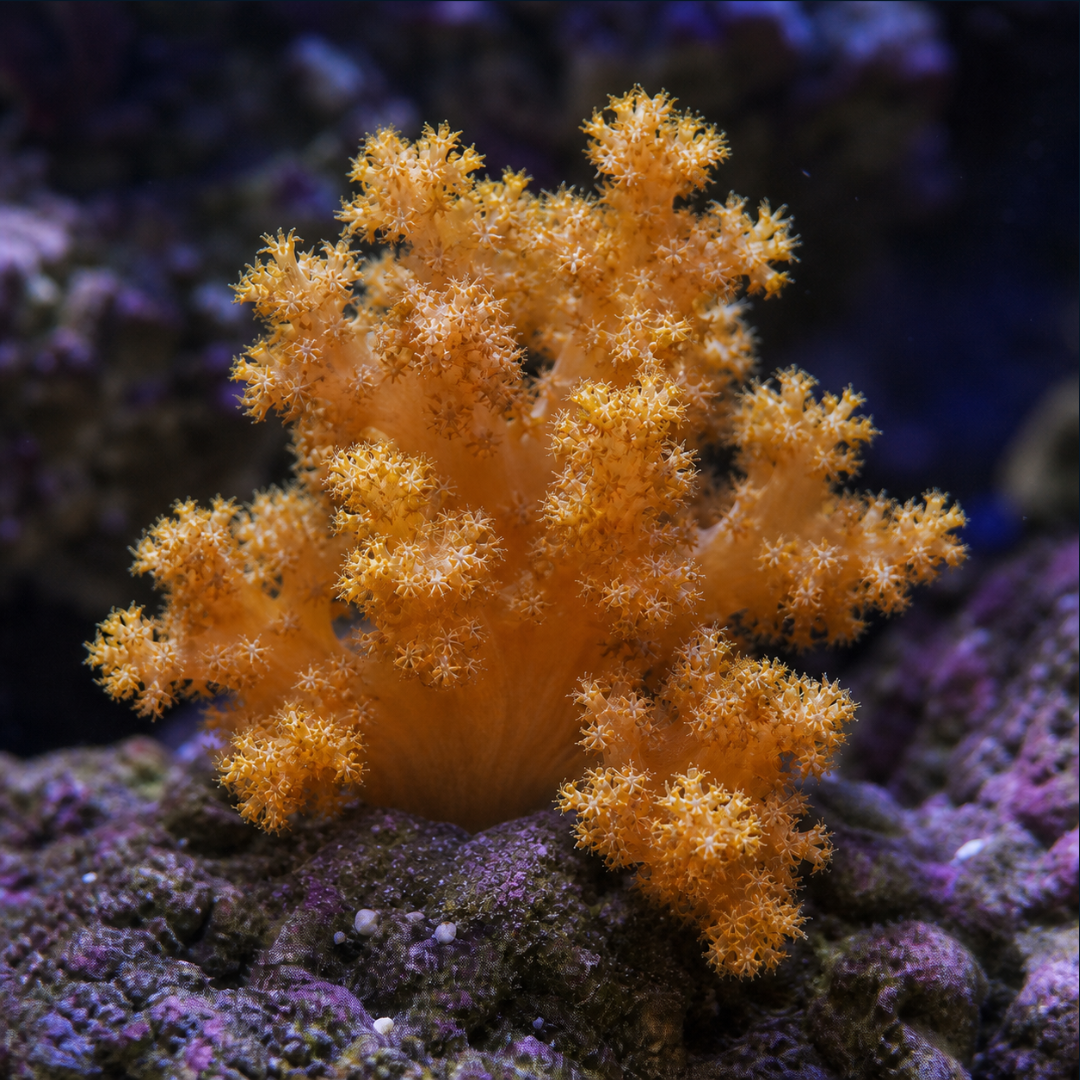
キバナトサカは、日本近海の浅い岩礁域で見られる樹枝状のソフトコーラルです。群体は盤状の基部から複数の主枝を伸ばし、その表面に小さな末枝とポリプを広げます。最大の魅力は鮮やかな黄色で、この色は群体をつなぐ柔らかな組織である共肉そのものではなく、組織内に散在する微小な骨片が黄色く発色することで生まれます。光合成を行う褐虫藻と共生する好日性種であり、水槽内では十分な光と、脱皮を助ける複雑で適度に強い水流が長期維持の鍵になります。Kibana-tosaka is a branching soft coral found on shallow rocky reefs around Japan. Its colony grows from a disc-like base into several main branches covered with small branchlets and polyps. Its most striking feature is its vivid yellow color, which is produced not by the soft tissue itself but by numerous yellow microscopic sclerites embedded in the colony. It is a photosymbiotic coral that hosts zooxanthellae, so long-term aquarium care depends on sufficient light and complex, moderately strong water movement that also assists its periodic shedding process.
基本情報 / Basic Information
学名 / Scientific Name
Stereonephthya japonica
通称 / Common and English Names
キバナトサカ。英語圏で広く定着した通称については詳細情報がなく、学名で扱われることがあります。Japanese common name: Kibana-tosaka. Detailed information on a widely established English common name is unavailable, and the species may be referred to by its scientific name.
分類 / Classification
刺胞動物門、花虫綱、八放サンゴ亜綱、Malacalcyonacea目、チヂミトサカ科、ハナトサカ属。従来はウミトサカ目に含められていましたが、近年の分子系統解析に基づく再編で現在の位置づけが示されています。Phylum Cnidaria, Class Anthozoa, Subclass Octocorallia, Order Malacalcyonacea, Family Nephtheidae, Genus Stereonephthya. It was formerly placed in Alcyonacea, but recent molecular phylogenetic revisions support its current placement.
分布 / Distribution
日本の温帯から亜熱帯沿岸に分布し、本州中部、九州西岸、南西諸島、沖縄などで記録されています。主に水深0〜12mほどの潮下帯、タイドプール、浅い岩礁域に生息します。Distributed along temperate to subtropical coasts of Japan, with records from central Honshu, the western coast of Kyushu, the Nansei Islands, and Okinawa. It mainly inhabits subtidal zones, tide pools, and shallow rocky reefs at depths of approximately 0–12 m.
最大サイズ / Maximum Size
完全に伸展した群体で高さ約10〜15cmが目安です。個体差や飼育環境によって枝張りは変化します。A fully expanded colony is generally about 10–15 cm tall. Branch spread varies with the individual and its environment.
寿命 / Lifespan
自然下および飼育下での正確な寿命に関する詳細情報はありません。安定した環境では長期飼育が期待できます。ただし、高水温や脱皮不全の影響を受けやすいため、日常的な状態確認が必要です。Detailed information on its exact lifespan in the wild or in captivity is unavailable. Long-term care may be possible under stable conditions. However, regular observation is important because the coral is sensitive to elevated temperature and incomplete shedding.
飼育環境 / Aquarium Environment
水槽サイズ / Tank Size
45〜60cm規格水槽(約35〜60L)以上が目安です。小型水槽でも飼育できますが、水温と水質を安定させやすく、複雑な水流も作りやすい60cm規格水槽以上のほうが管理しやすくなります。A 45–60 cm standard aquarium (about 35–60 L) or larger is a practical minimum. The coral can be kept in a smaller marine aquarium, but a 60 cm standard tank or larger makes it easier to stabilize temperature and water quality and to create complex flow.
水温・比重 / Temperature and Specific Gravity
水温は24〜26℃を目安にします。異常な高水温は白化や衰弱につながるため、夏季は特に水温上昇を防ぎます。本種に適した比重の具体値については詳細な情報がありませんが、一般的な海水水槽の範囲で急変を避け、安定させることが重要です。Maintain a temperature of approximately 24–26°C. Abnormally high temperatures can cause bleaching and decline, so prevent excessive warming during summer. A species-specific target for specific gravity is unavailable; the priority is to keep normal marine conditions stable and avoid sudden fluctuations.
水質 / Water Quality
SPSサンゴほどカルシウムやアルカリ度の厳密な管理は求められません。硝酸塩がわずかに検出される一般的なソフトコーラル向けの環境でも飼育可能ですが、有機物の蓄積や急激な水質変化は避けます。pH、KH、カルシウム、マグネシウム、リン酸塩について、本種に固有の具体値は明らかになっていません。It does not require calcium and alkalinity control as strict as that used for SPS corals. It can be maintained in a typical soft-coral system with slightly detectable nitrate, but organic buildup and abrupt water-quality changes should be avoided. Detailed species-specific targets for pH, KH, calcium, magnesium, and phosphate are unavailable.
光量 / Lighting
中〜強光を好みます。青色と白色をバランスよく含む高出力のサンゴ育成用フルスペクトルLEDが適します。本種に適したPARの具体値については、詳細な情報がありません。導入直後は輸送前後の光環境の差を考慮し、急激に強い光へさらさず、段階的に慣らします。Moderate to strong lighting is preferred. A high-output full-spectrum reef LED with a balanced blue and white spectrum is suitable. A species-specific PAR range is unavailable. Newly introduced colonies should be acclimated gradually and not exposed immediately to a sharp increase in light intensity.
水流 / Water Flow
中〜強程度で、複数方向から変化をつけて当たる、ランダムで複雑な水流が適します。一方向から押し続ける単調な流れより、枝全体がゆっくり揺れ、体表の粘液膜やデトリタスが運び去られる流れが理想です。水流不足は脱皮不全や組織の傷みにつながります。Use moderate to strong, random, multidirectional turbulent flow. Rather than a constant one-way jet, aim for movement that gently sways the entire colony and carries away mucus films and detritus. Insufficient flow can lead to incomplete shedding and tissue deterioration.
レイアウト・配置 / Layout and Placement
十分な光と複雑な水流が届く岩上に、群体を安定して固定します。ポリプが閉じているという理由だけで配置が悪いと判断せず、一度条件のよい位置に置いた後は頻繁に動かさないことが大切です。枝が完全に開いたときにも周囲の生体へ触れないよう、十分な余白を確保します。Secure the colony on rockwork where it receives sufficient light and complex flow. Do not assume the placement is wrong merely because the polyps remain closed; once it is set in a suitable location, avoid frequent relocation. Leave enough space for the branches to expand without touching nearby animals.
注意点 / Precautions
輸送直後や導入初期には、数日から数週間ポリプを開かないことがあります。表面に薄いワックス状またはコケ状の膜が現れた場合は、脱皮に入っている可能性があります。すぐに触ったり剥がしたりせず、水流によって膜が自然に外れるかを観察します。高水温、転倒、頻繁な移動、弱すぎる水流を避けます。After transport or introduction, the colony may remain closed for several days or even weeks. A thin waxy or algae-like surface film may indicate shedding, so avoid touching or peeling it manually and observe whether suitable flow removes it naturally. Avoid overheating, prevent the colony from toppling, and avoid frequent relocation or insufficient flow.
餌と給餌 / Feeding
栄養の得方・餌 / Nutrition and Diet
組織内の褐虫藻が行う光合成から多くのエネルギーを得ます。補助的に、アミノ酸やビタミンを含む液体サンゴフード、微細な粉末フード、マリンスノー状の微粒子餌を利用できます。It obtains much of its energy from photosynthesis by symbiotic zooxanthellae. Supplemental foods can include liquid coral diets containing amino acids and vitamins, very fine powdered foods, and marine-snow-type particulate foods.
給餌のポイント / Feeding Tips
給餌は必須ではありませんが、ポリプが開いているときに週1〜2回、飼育水でよく溶いた微細な餌をスポイトで穏やかに吹きかけると、成長と状態維持を助けます。餌がポリプへ届く前に流れ去る場合は、必要な時間だけ水流を一時的に弱めます。過剰給餌による水質悪化を避け、食べ残しが水槽内に蓄積しないようにします。Feeding is not essential, but target feeding once or twice per week while the polyps are open can support growth and condition. Mix fine food thoroughly with aquarium water and gently deliver it with a pipette. If the food disperses before reaching the polyps, briefly reduce the flow just long enough for target feeding. Avoid overfeeding and prevent uneaten food from accumulating in the aquarium.
性質と相性 / Characteristics and Compatibility
形態・成長 / Form and Growth
硬い連続骨格を持たない群体性のソフトコーラルです。盤状の基部から主枝を伸ばし、枝上一面に小さな末枝とポリプを付けます。体内には支持と防御に役立つ炭酸カルシウム質の微小な骨片があります。成長速度の具体的な情報はありませんが、状態がよければ、切断片は新しい共肉を広げながら土台へ定着していきます。This is a colonial soft coral without a rigid continuous skeleton. Several main branches arise from a disc-like base, with small branchlets and polyps distributed over the branches. Microscopic calcium-carbonate sclerites inside the tissues provide support and defense. Detailed growth-rate information is unavailable, but healthy fragments can attach and spread tissue over a substrate.
攻撃性 / Aggression
長いスイーパー触手を伸ばすタイプではありませんが、刺胞を備え、粘液を分泌します。切断したときや強い刺激を受けたときには、防御物質を含む粘液を多く放出する可能性があります。直接接触は双方の組織を傷めるおそれがあるため、周囲のサンゴとは間隔を取ります。It does not produce long sweeper tentacles, but it has nematocysts and secretes mucus. When cut or strongly disturbed, it may release larger amounts of mucus containing defensive compounds. Direct contact may damage either coral, so maintain space from neighboring colonies.
相性 / Compatibility
一般的なリーフ水槽で飼育できますが、強い刺胞毒を持つサンゴや、急速に覆い広がる生体との接触は避けます。魚類や甲殻類との特別な共生関係や、クマノミが本種を宿主として利用するかどうかについては、詳細な情報がありません。枝をついばむ魚や、群体上へ砂やデトリタスをかける生体には注意します。It can be maintained in a typical reef aquarium, but contact with strongly stinging corals or rapidly spreading organisms should be avoided. Detailed information on special relationships with fish or crustaceans, including use as a host by clownfish, is unavailable. Watch for fish that nip soft corals and animals that deposit sand or detritus on the colony.
病気と対策 / Diseases and Prevention
不調・病気・害虫 / Problems, Diseases, and Pests
代表的な不調のサインには、ポリプを開かない、群体が垂れ下がる、色が薄くなる、白化する、表面の膜が剥がれない、組織が溶けるように壊死するといった変化があります。光量不足、水流不足、脱皮不全、輸送ストレス、急激な環境変化、高水温などが主な要因として考えられます。特定の害虫や捕食者については、詳細な情報がありません。Common signs of trouble include persistent closure, drooping, color loss, bleaching, a surface film that does not detach, and tissue that appears to dissolve or become necrotic. Major causes include insufficient light, inadequate flow, incomplete shedding, shipping stress, abrupt environmental changes, and elevated temperature. Detailed information on species-specific pests or predators is unavailable.
対策と予防 / Prevention
水温と水質を安定させ、十分な照明と複雑な水流を確保します。導入後はむやみに移動させず、脱皮中は膜が自然に外れる流れを保ちます。組織の崩れが局所的に進む場合は群体を隔離し、清潔な器具で健全部を切り分けて救済する方法があります。切断後は、製品表示に従ってヨウ素系コーラルディップを使用し、感染を予防する方法もあります。Keep temperature and water quality stable and provide adequate lighting and complex flow. Avoid repeated relocation after introduction, and during shedding provide enough movement for the film to detach naturally. If localized tissue breakdown progresses, isolate the colony and consider separating healthy tissue with sterile tools. An iodine-based coral dip may be used after cutting according to the product instructions.
増やし方(繁殖・株分け) / Reproduction and Propagation
無性生殖・株分け / Asexual Reproduction and Fragmentation
健康な親株の枝分かれ部分を、清潔で切れ味のよいメスやハサミで一度に切断するフラッギングが可能です。断片はセラミック製フラグプラグなどに固定し、切断面が回復して新しい共肉が土台を覆うまで養生します。The species can be propagated by fragging. Cut a branching point of a healthy parent colony in one clean motion with a sharp, sterile scalpel or scissors. Secure the fragment to a ceramic frag plug and allow it to recover until new tissue attaches and begins covering the base.
有性生殖 / Sexual Reproduction
雌雄、放卵放精の時期、幼生保育の有無など、飼育下で利用できる具体的な有性生殖情報はありません。Detailed practical information on sex, spawning season, broadcast spawning, or brooding behavior is unavailable for aquarium propagation.
増殖のポイント / Propagation Tips
完全に定着し、ポリプがよく開き、白化や衰弱のない親株だけを選びます。切断は同じ場所を何度も潰すように行わず、一度で鋭く切ります。粘液で接着剤が効きにくいため、切断面の余分な水分を優しく素早く取り、ゼリー状のシアノアクリレート系接着剤で固定します。接着直後は弱めの水流と穏やかな照明で養生し、回復後に通常の水流へ戻します。Use only a well-established parent colony with fully opening polyps and no bleaching or decline. Make one clean cut rather than crushing the same area repeatedly. Because mucus can interfere with adhesion, gently and quickly remove excess water from the cut surface and secure the fragment with gel cyanoacrylate. Immediately after attachment, allow it to heal under gentler flow and subdued light, then return it gradually to normal circulation after recovery.
毒性と取り扱い / Toxicity and Handling
毒性 / Toxicity
人に重篤な被害を与える猛毒は報告されていませんが、刺胞による刺激があり、テルペン類などの防御物質を含む可能性のある粘液も放出します。切断時や強い刺激を受けたときは粘液の放出が増えるため、皮膚や粘膜への接触を避けます。パリトキシンを持つとの情報はありません。No severe human toxin has been reported for this species, but it possesses nematocysts and can release mucus that may contain defensive compounds such as terpenes. Mucus production may increase during cutting or strong disturbance, so avoid contact with skin and mucous membranes. There is no information indicating that it contains palytoxin.
取り扱い上の注意 / Handling Precautions
株分けや接着作業では手袋と保護眼鏡を着用し、傷口、目、口に粘液が触れないようにします。作業は本水槽内ではなく、飼育水を入れた別容器で行い、使用した器具と手を十分に洗浄します。粘液を含む作業水は本水槽へ戻さず、他の生体に触れさせないようにします。Wear gloves and eye protection during fragging and attachment, and prevent mucus from contacting wounds, eyes, or the mouth. Work in a separate container filled with aquarium water rather than directly in the display tank, and wash tools and hands thoroughly afterward. Do not return mucus-rich work water to the aquarium or expose other animals to it.
雑学と豆知識 / Trivia and Fun Facts
黄色の正体は骨片 / The Yellow Color Comes from Sclerites
キバナトサカの黄色は、柔らかな共肉そのものの色だけで生まれているわけではありません。体内に散らばる炭酸カルシウム質の微小な骨片が鮮やかに発色し、群体全体を黄色く見せています。骨片は色彩だけでなく、柔らかな体を支え、捕食者に対する防御にも役立つ小さな構造物です。The yellow appearance of Kibana-tosaka is not simply caused by pigment in its soft tissue. Numerous microscopic calcium-carbonate sclerites embedded throughout the colony produce the vivid color. These structures do more than create its appearance: they also support the soft body and contribute to defense against predators.
トゲトサカとの見分け方 / Distinguishing It from Dendronephthya
近縁のトゲトサカ属は、枝先にポリプが密集してカリフラワーのような塊を作り、強大な背側支持骨片束を持ちます。一方、キバナトサカではポリプが単独または小さな房状に枝上一面へ付き、ポリプ腹側に桿状の骨片が見られます。外見だけでは似ているため、厳密な同定では顕微鏡による骨片観察が重要になります。Related Dendronephthya species usually form dense, cauliflower-like clusters of polyps at branch tips and possess prominent dorsal supporting bundles of sclerites. Kibana-tosaka instead bears solitary polyps or small clusters across the branches and has distinctive rod-like sclerites on the ventral side of the polyp. Because the colonies can look similar, microscopic examination of sclerites is important for reliable identification.
1954年に記載された日本のサンゴ / A Japanese Coral Described in 1954
本種は、日本の八放サンゴ研究を大きく進めた内海冨士夫博士によって1954年に記載されました。紀伊半島、愛媛県沿岸、相模湾などの調査を背景に学名が与えられ、日本沿岸の豊かな八放サンゴ相を伝える存在となっています。The species was described in 1954 by Dr. Huzio Utinomi, a major contributor to Japanese octocoral research. Its description grew from surveys that included the Kii Peninsula, the coast of Ehime, and Sagami Bay, making the species part of the scientific record of Japan’s rich octocoral fauna.
分子系統解析が変えた分類 / Molecular Phylogeny Reshaped Its Classification
八放サンゴの分類は長く骨片や群体形態に依存していましたが、分子系統解析によって従来の大きな分類群に多系統性があることが示されました。2022年の大規模な再編では、かつてのウミトサカ目が見直され、キバナトサカはMalacalcyonacea目のチヂミトサカ科に位置づけられました。水槽で見る一群体の背後にも、分類学が大きく書き換わる研究史があります。Octocoral classification long depended on colony form and sclerite morphology, but molecular phylogenetic studies revealed that several traditional groups were polyphyletic. A major revision in 2022 reorganized the former Alcyonacea framework and placed Kibana-tosaka in the family Nephtheidae within Malacalcyonacea. Behind a single aquarium colony lies a history of taxonomic change driven by modern genomics.
桜島の浅海域で行われた長期調査では、1998年の異常高水温後にキバナトサカの被度と群体数が大きく減り、その後も以前の水準へ戻らない状態が観察されました。本種が共生する褐虫藻の系統はクレードGと報告され、共生藻の熱耐性の違いが宿主の生存に影響する可能性が示されています。こうした自然界での脆弱性を踏まえても、水槽内で高水温を避けることは重要です。A long-term survey in shallow waters around Sakurajima recorded a major decline in the cover and number of Kibana-tosaka colonies after the abnormal high temperatures of 1998, with no return to previous levels during the observation period. Its symbiotic algae were reported as clade G, suggesting that differences in algal heat tolerance may influence host survival. This vulnerability observed in the wild reinforces the importance of avoiding elevated temperatures in the aquarium.
自らステロールを作る珍しい能力 / A Rare Ability to Synthesize Sterols
多くの海洋無脊椎動物は、細胞膜などに必要なステロールを餌や共生生物に頼ります。キバナトサカでは、標識したメバロン酸を用いた実験によって、宿主自身がステロールを生合成できることが示されました。褐虫藻の光合成産物を受け取るだけでなく、独自の脂質代謝を持つ点は、この柔らかなサンゴの生理が見た目以上に複雑であることを物語ります。Many marine invertebrates depend on food or symbionts for sterols needed in cell membranes and other functions. Experiments using labeled mevalonate indicated that Kibana-tosaka can synthesize sterols within the host itself. This means the coral does more than receive photosynthetic products from its zooxanthellae; it also maintains an unusual lipid-metabolism pathway of its own.
まとめ / Conclusion
キバナトサカは、黄色い骨片がつくる鮮やかな色彩と、柔らかな枝が水流に揺れる姿が魅力の、日本近海を代表するソフトコーラルです。飼育の基本は、中〜強程度の光、複数方向から変化をつけて届く中〜強程度の水流、そして24〜26℃を目安とした安定した水温です。なかでも、脱皮時に表面の膜が自然に剥がれるよう水流を保つことが、健康な群体を維持するうえで重要になります。Kibana-tosaka is a soft coral representative of Japanese coastal waters, admired for the vivid color created by its yellow sclerites and the way its flexible branches sway in the current. The foundations of care are moderate to strong lighting, moderate to strong multidirectional flow that varies over time, and a stable temperature of approximately 24–26°C. Above all, maintaining enough flow for the surface film to peel away naturally during shedding is important for keeping the colony healthy.
導入直後に群体が縮んだり、数日間ポリプを閉じたりしても、すぐに置き場所を変えず、光、水流、水温、水質を一つずつ落ち着いて確認します。環境に順応して枝を伸ばし、細かなポリプを広げるようになると、その黄色い群体は水槽の中で柔らかな樹木のような存在感を見せます。日々の伸縮や定期的な脱皮も含め、状態の変化をじっくり観察できることが、キバナトサカを育てる大きな楽しみです。Even if a newly introduced colony contracts or keeps its polyps closed for several days, avoid moving it immediately. Instead, check lighting, flow, temperature, and water quality one at a time. Once acclimated, the colony extends its branches and opens its fine polyps, creating the impression of a soft yellow tree in the aquarium. Watching its daily expansion and contraction, as well as its periodic shedding, is one of the main rewards of keeping Kibana-tosaka.
Utinomi, H.(1954)“Dendronephthya of Japan, II.—New Species and New Records of Dendronephthya and the Allied Stereonephthya from Kii Region—.” Publications of the Seto Marine Biological Laboratory, 3(3), 319–338.
京都大学学術情報リポジトリ
McFadden, C. S., van Ofwegen, L. P. and Quattrini, A. M.(2022)“Revisionary Systematics of Octocorallia (Cnidaria: Anthozoa) Guided by Phylogenomics.” Bulletin of the Society of Systematic Biologists, 1(3), 1–79.
DOI: 10.18061/bssb.v1i3.8735
国立研究開発法人海洋研究開発機構(JAMSTEC)「Stereonephthya japonica キバナトサカ」Biological Information System for Marine Life(BISMaL).
BISMaL分類群情報
Ono, S., Reimer, J. D., Nozawa, Y. and Tsukahara, J.(2010)“Long-term Changes of Infra-littoral Zone Zooxanthellate Cnidarians in the Taisho Lava Field, Sakurajima, Kagoshima, Japan.” Galaxea, Journal of Coral Reef Studies, 12(1), 15–22.
DOI: 10.3755/galaxea.12.15
Fabricius, K. E. and Klumpp, D. W.(1995)“Widespread Mixotrophy in Reef-inhabiting Soft Corals: The Influence of Depth, and Colony Expansion and Contraction on Photosynthesis.” Marine Ecology Progress Series, 125, 195–204.
DOI: 10.3354/meps125195
飼育環境・水流・照明・水質管理
Leewis, R. J. and Janse, M.(eds.)(2008)Advances in Coral Husbandry in Public Aquariums. Public Aquarium Husbandry Series, Vol. 2, Burgers’ Zoo, Arnhem, 444 pp.
書誌情報
Ellis, S. and Sharron, L.(1999)The Culture of Soft Corals (Order: Alcyonacea) for the Marine Aquarium Trade. Center for Tropical and Subtropical Aquaculture, Publication No. 137.
CTSA公開資料
Rocha, R. J. M., Serôdio, J., Costa, M., Cartaxana, P. and Calado, R.(2013)“Effect of Light Intensity on Post-fragmentation Photobiological Performance of the Soft Coral Sinularia flexibilis.” Aquaculture, 388–391, 24–29.
DOI: 10.1016/j.aquaculture.2013.01.013
繁殖・株分け・切断後の管理
Kim, S., Wild, C. and Tilstra, A.(2022)“Effective Asexual Reproduction of a Widespread Soft Coral: Comparative Assessment of Four Different Fragmentation Methods.” PeerJ, 10, e12589.
DOI: 10.7717/peerj.12589
病気・白化・取り扱い上の注意
Raymundo, L. J., Couch, C. S. and Harvell, C. D.(eds.)(2008)A Coral Disease Handbook: Guidelines for Assessment, Monitoring and Management. Coral Reef Targeted Research & Capacity Building for Management Program.
公開ハンドブック
Coll, J. C.(1992)“The Chemistry and Chemical Ecology of Octocorals (Coelenterata, Anthozoa, Octocorallia).” Chemical Reviews, 92(4), 613–631.
DOI: 10.1021/cr00012a006



 アイのアクアグッズ案内水草トリミングの道具とやり方|ハサミ・ピンセットを水草に合わせて選ぼう伸びすぎた水草は切っていい? 有茎草の差し戻し、前景草の絨毯、流木のモスを整える場面から、水草用ハサミ・ピンセット・ゴミ取りネットの選び方と片付けを紹介します。記事はコチラ →
 アイのアクアグッズ案内海水魚初心者の必需品|水槽・人工海水・比重計・水質検査道具の特徴や使い方、選ぶときのポイントをアイが紹介します。記事はコチラ →
 アイのアクアグッズ案内アカヒレの仲間に合わせる飼育用品|無加温・混泳・繁殖の水槽とろ過道具の特徴や使い方、選ぶときのポイントをアイが紹介します。記事はコチラ →
 アイのアクアグッズ案内水槽用ヒーターの選び方|固定式・温度調節式と、水量に合うW数の考え方水槽の魚は冬に寒くない? アイとコタロウが水温計から固定式・温度調節式・分離式ヒーターまで比較。水量と室温に合うW数、設置場所、水換えや交換の注意点を、国内メーカーの商品とともに紹介します。記事はコチラ →




コメント