

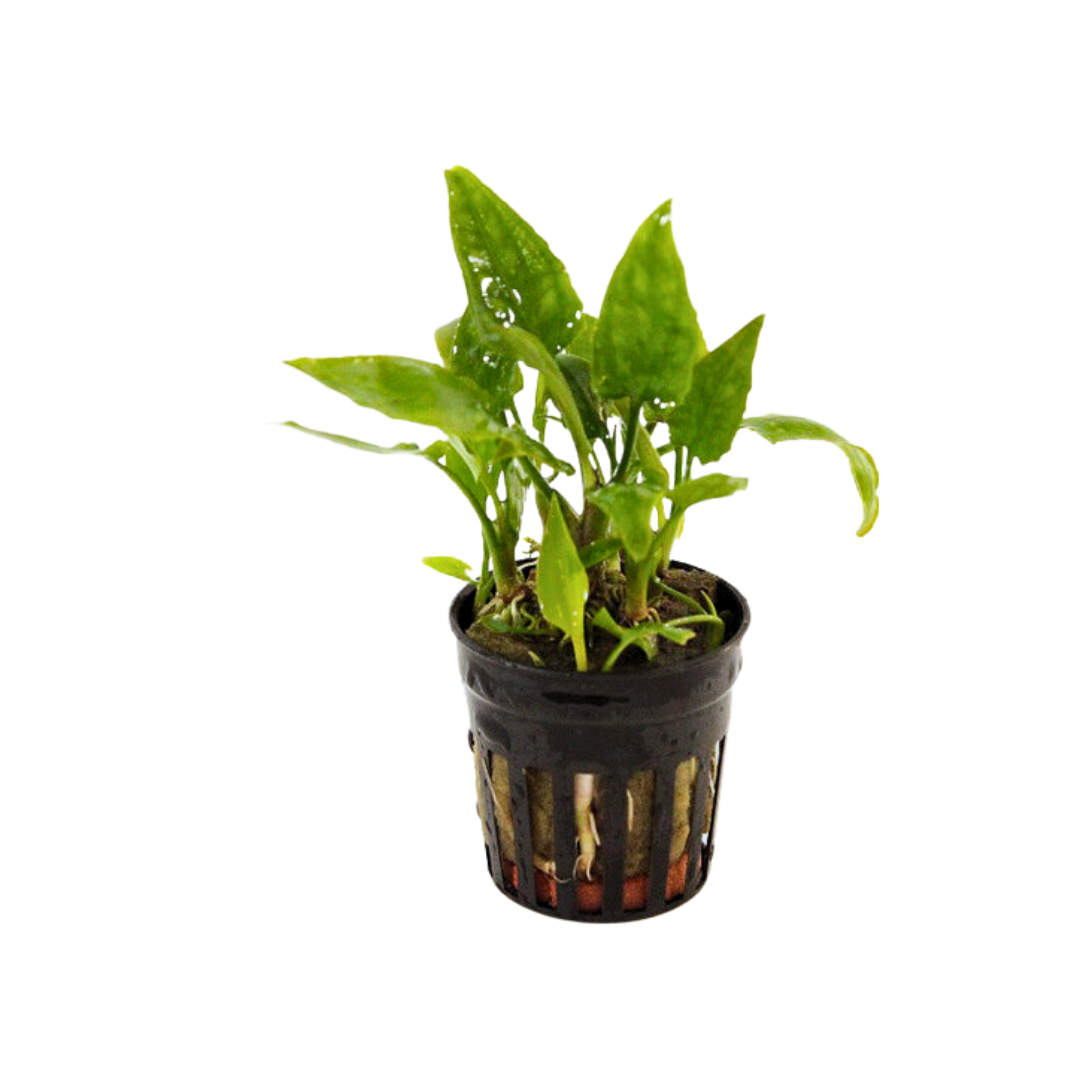
解説 / Description
クリプトコリネ・ポンテデリフォリアは、スマトラ島を主な原産地とするサトイモ科クリプトコリネ属の水草です。広めの矢じり型から卵形に近い葉をロゼット状に展開し、落ち着いた緑色の葉姿としっかりした株立ちで、水槽の中景から後景に自然な存在感を加えてくれます。強い光を必要としにくく、環境に慣れると長期維持しやすいため、クリプトコリネの入門種としても扱いやすい種類です。 Cryptocoryne pontederiifolia is an aquatic aroid mainly associated with Sumatra. It forms a rosette of broad arrow-shaped to ovate leaves, giving the aquarium a calm green texture and a substantial midground to background presence. It does not require intense lighting and, once established, is generally regarded as one of the easier Cryptocoryne species to maintain.
一方で、導入直後や大きな水質変化のあとには、古い葉が溶けるように傷む「クリプトコリネの溶け」が起こることがあります。本種はクリプトコリネの中では比較的安定しやすい種類とされますが、環境差が大きい導入直後は注意が必要です。これは必ずしも枯死を意味するものではなく、根茎が健全であれば新しい環境に合った葉を再展開することがあります。植え付け後はむやみに掘り返さず、安定した水質と栄養のある底床でじっくり根を張らせることが大切です。 Like many crypts, it may show so-called “crypt melt” after introduction or sudden environmental changes. This species is considered comparatively stable among Cryptocoryne plants, but newly introduced plants should still be handled carefully. Melt does not always mean the plant has died; if the rhizome remains firm and healthy, it may produce new leaves adapted to the new conditions. After planting, it is best not to disturb the plant and to let it settle in a stable aquarium with a nutrient-rich substrate.
基本情報 / Basic Information
| 学名 / Scientific Name | Cryptocoryne pontederiifolia Schott 1863年にSchottによって記載された種です。かつて別種として扱われたCryptocoryne sulphureaは、現在では本種のシノニムとして扱われます。種小名のpontederiifoliaは、ミズアオイ科のポンテデリア類を思わせる葉を持つことに由来すると考えられます。This species was described by Schott in 1863. The name Cryptocoryne sulphurea, once treated as a separate species, is now regarded as a synonym of this taxon. The specific epithet pontederiifolia refers to leaves reminiscent of Pontederia-like plants. |
|---|---|
| 通称 / Common Name | クリプトコリネ・ポンテデリフォリア、ポンテデリフォリア、クリプト・ポンテデリフォリアCryptocoryne pontederiifolia, Pontederia-leaved crypt; “water trumpet” is a general common name used for Cryptocoryne species |
| 分類 / Family | サトイモ科クリプトコリネ属Araceae, genus Cryptocoryne |
| 分布 / Distribution | インドネシアのスマトラ島西部を中心に知られる水草です。流れの緩やかな河川、湿地、季節的に冠水する水辺などに生育し、水位変化に合わせて水上葉と水中葉を切り替える性質を持ちます。This species is known mainly from western Sumatra, Indonesia. It inhabits slow-moving rivers, wetlands, and seasonally flooded margins, where it can grow in emersed or submerged form depending on water level. |
| 育成難易度 / Difficulty | やさしい〜普通。クリプトコリネの中では丈夫で、低〜中光量でも維持しやすい種類です。ただし、導入直後の環境変化には敏感なため、植え替えを繰り返さず、安定した環境で根付かせることが重要です。Easy to moderate. It is one of the hardier crypts and can be maintained under low to moderate light. However, it is sensitive to abrupt changes after planting, so repeated relocation should be avoided. |
育成環境 / Cultivation Environment
| 光量 / Light | 低〜中光量で育成できます。強光下でも育成は可能ですが、光だけを強めるとコケの付着や葉傷みにつながることがあるため、CO2、肥料、水換えのバランスを合わせる必要があります。陰性水草を中心にした落ち着いた水槽では、中程度の明るさでじっくり育てると扱いやすい水草です。Low to moderate light is sufficient. It can grow under stronger lighting, but light should be balanced with CO2, nutrients, and water changes to avoid algae or leaf damage. In a calm low-tech layout, moderate lighting is usually the easiest approach. |
|---|---|
| CO2添加 / CO2 Injection | CO2添加は必須ではありませんが、添加すると葉の展開が安定し、株の充実も早くなります。無添加水槽では成長がゆっくりになるため、底床肥料と水質の安定を重視するとよいでしょう。美しい群落を早めに作りたい場合は、弱め〜中程度のCO2添加を行うと安心です。CO2 injection is not mandatory, but it improves leaf development and helps the plant establish more vigorously. In non-CO2 aquariums, growth is slower, so substrate nutrition and stable water conditions become especially important. |
| 水質 / Water Quality | 目安は水温22〜26℃前後、pH6.0〜7.5前後です。弱酸性から中性付近の水を好みますが、極端でなければ日本の一般的な水道水でも育成しやすい種類です。もっとも避けたいのは急激なpH、硬度、水温の変化で、安定した水質を保つことが溶けの予防につながります。A practical range is around 22–26°C and pH 6.0–7.5. It prefers slightly acidic to near-neutral water, but it is adaptable if conditions are not extreme. Sudden shifts in pH, hardness, or temperature should be avoided because stability is the key to preventing melt. |
| 底床 / Substrate | 根から栄養を吸収する力が強いため、栄養系ソイルや、底床肥料を仕込んだ砂利系底床と相性がよい水草です。植え付け時は生長点や株元を深く埋め込みすぎず、根が底床に広がるように植えると安定します。長期維持では底床の栄養切れに注意し、株元へ固形肥料を補うことが大切です。As a strong root feeder, it grows well in nutrient-rich aquasoil or gravel supplemented with root tabs. Avoid burying the crown too deeply, and allow the roots to spread into the substrate. For long-term maintenance, periodic root fertilization is important. |
レイアウト / Layout
| 配置 / Positioning | 草丈はおおむね20〜30cmほどになりやすく、45cm水槽では後景寄り、60cm規格水槽以上では中景から後景に向きます。幅のある葉は細葉の有茎草やシダ類、流木、石組みとよく対比し、自然な陰影を作ります。葉の下は小型魚やエビの隠れ場所にもなり、水景に落ち着きを出したい場面で使いやすい水草です。It often reaches around 20–30 cm, making it suitable for the rear area of a 45 cm aquarium and the midground to background of a standard 60 cm tank or larger. Its broad leaves contrast well with fine-stemmed plants, ferns, driftwood, and stones, while also providing shelter for small fish and shrimp. |
|---|---|
| 注意点 / Precautions | 一度根付くとランナーで広がり、株が大きくなります。小型水槽では前景草や小型クリプトコリネを圧迫することがあるため、植える場所を最初に決めておくことが大切です。導入直後に葉が溶けても、根茎が残っていれば回復する可能性があるため、焦って抜かずに傷んだ葉だけを取り除くとよいでしょう。Once established, it spreads by runners and can become a substantial plant. In small aquariums, it may shade or crowd foreground plants and smaller crypts, so choose its position carefully from the start. If the leaves melt after introduction, remove only the decaying leaves and avoid uprooting the plant if the rhizome remains healthy. |
増やし方(トリミング) / Propagation & Trimming
| 増やし方 / Propagation | 主にランナーによって子株を増やします。子株が十分な葉数と根を持つようになってから、親株とつながるランナーを清潔なハサミで切り離し、別の場所へ植え直します。小さすぎる段階で分けると回復に時間がかかるため、株が自立できる大きさまで待つことが必要です。Propagation is mainly by runners. Once a young plant has several leaves and its own roots, the runner can be cut with clean scissors and the plant can be replanted. Very small offsets recover slowly, so it is better to wait until the plantlet can support itself. |
|---|---|
| トリミング / Trimming | 有茎草のように途中で切り戻すのではなく、古くなった葉、傷んだ葉、コケが目立つ葉を株元から取り除く方法が基本です。大きくなりすぎた場合は、葉を減らすだけでなく、余分な子株を間引いてスペースを確保します。根を大きく動かすと調子を崩しやすいため、必要最小限の作業にとどめることが大切です。Unlike stem plants, it is not trimmed by cutting the stem. Remove old, damaged, or algae-covered leaves from the base. If the colony becomes too large, thin out extra daughter plants rather than repeatedly disturbing the main root system. |
病気と対策(コケなど) / Pests & Algae
| かかりやすい病気 / Common Issues | 代表的なトラブルは、導入時や水質変化後に起こる葉の溶け、古葉への黒ヒゲ状のコケ、成長停滞による葉の小型化です。本種はクリプトコリネの中では比較的溶けにくいとされますが、水上葉で流通した株や環境差が大きい場合は、水中環境へ切り替わる過程で古い葉を落とすことがあります。病気というより環境変化への反応として見ると、落ち着いて対処しやすくなります。Common issues include leaf melt after introduction or water changes, black beard algae on older leaves, and smaller leaves caused by stalled growth. This species is considered relatively resistant to crypt melt, but emersed-grown plants or plants moved into very different conditions may still shed older leaves while adapting to submerged growth. In many cases, this is better understood as an adaptation response rather than a disease. |
|---|---|
| 対策と予防 / Prevention | 予防の基本は、急な水質変化を避け、光量と栄養、CO2のバランスを崩さないことです。溶けた葉は水を汚しやすいため早めに取り除きますが、根茎が硬く残っている株は抜かずに様子を見ます。ポット苗を導入する場合は農薬やスネールに注意し、エビ水槽では組織培養株や十分に下処理された株を選ぶと安心です。Prevention depends on avoiding sudden changes and keeping light, nutrients, and CO2 in balance. Decaying leaves should be removed promptly, but a plant with a firm rhizome should usually be left in place. For shrimp tanks, tissue-cultured plants or carefully prepared plants are the safer choice because they reduce the risk of pesticides and hitchhikers. |
雑学と豆知識 / Trivia and Fun Facts
| 1. 黄色い仏炎苞が解いた分類学上の謎 / 1. A yellow spathe that solved a taxonomic puzzle | クリプトコリネ属の同定では、葉だけでなく仏炎苞の形が大きな手がかりになります。本種は1863年に記載されましたが、基準標本が花を欠いていたため、長く正体が分かりにくい植物でした。後に黄色い舷部を持つ株がCryptocoryne sulphureaとして記載されましたが、古い標本の再検討によって、それがポンテデリフォリアと同じものだと判断されます。水槽で見慣れた丈夫な水草の背後に、標本室での再発見から名前が整理されていく植物分類学の物語が隠れているのです。In Cryptocoryne, the spathe is often essential for identification. Although this species was described in 1863, the type material lacked a mature inflorescence, which made its identity difficult for a long time. A plant with a yellow limb was later described as Cryptocoryne sulphurea, but re-examination of historical material showed it to be the same taxon as C. pontederiifolia. Behind this familiar aquarium plant lies a botanical story of herbarium work and corrected names. |
|---|---|
| 2. 近縁種メールマニーとの微妙な関係 / 2. Its subtle relationship with C. moehlmannii | 同じスマトラ島に由来するクリプトコリネ・メールマニーは、本種と非常によく似た葉を持つ近縁種です。葉だけで両者を見分けるのは難しく、違いは主に仏炎苞の色や襟部の形に表れます。野外個体には黄色、赤み、斑点などの変異も知られ、両者の境界については分類学的に興味深い部分が残ります。アクアリウムでは見た目の美しさや育てやすさに目が向きますが、その一株が地域変異や種分化を考える入口にもなる点がクリプトコリネの面白さです。Cryptocoryne moehlmannii, also associated with Sumatra, is a close relative with very similar foliage. It is difficult to separate the two by leaves alone, and the main differences are seen in the color and shape of the spathe. Wild populations show variation in yellow, reddish, and spotted forms, making the boundary between related taxa an interesting subject. In the aquarium, this plant is attractive and practical, but it also opens a window into regional variation and plant evolution. |
| 3. 「溶け」は失敗ではなく作り直しのサイン / 3. Melt is not always failure | クリプトコリネの溶けは、初心者には枯れたように見えるため不安になりやすい現象です。本種は比較的安定して育つクリプトコリネとされますが、自生地では水位や光環境が変わる水辺に生育するため、環境差が大きいと葉を作り替えるような反応が起こることがあります。古い環境に合わせて作られた葉を維持するより、新しい環境に合う葉を作り直すほうが合理的な場合があるのです。根茎が健全なら再生の余地は十分にあるため、溶けた葉を取り除き、株を動かさず、静かに回復を待つ姿勢が重要です。Crypt melt can look alarming, especially to beginners. This species is generally considered one of the more stable crypts in cultivation, but large environmental changes can still trigger older leaves to decline. Rather than maintaining leaves built for an old environment, the plant may shed them and produce new ones better suited to the current aquarium. If the rhizome remains healthy, recovery is often possible, so patience is important. |
| 4. 組織培養株が日本の水草導入を変えた理由 / 4. Why tissue culture changed aquarium plant introductions | 現在の日本市場では、クリプトコリネ類も組織培養カップで入手しやすくなっています。組織培養株は無菌的な環境で増殖されるため、スネール、藻類、残留農薬のリスクを抑えやすいのが大きな利点です。とくにレッドビーシュリンプやヤマトヌマエビを入れた水槽では、農薬に対する不安が導入時の大きな問題になります。カップから取り出して培地を丁寧に洗い落とし、小分けして植えられる組織培養株は、現代のアクアリウムに合った合理的な流通形態といえます。In the Japanese market, tissue-cultured crypts have become increasingly accessible. Because they are propagated under sterile conditions, they reduce the risk of snails, algae, and pesticide residues. This is especially valuable in shrimp aquariums, where pesticide sensitivity is a serious concern. After the culture gel is rinsed away, the small plants can be divided and planted, making tissue culture a practical modern format for aquarium use. |
まとめ / Conclusion
クリプトコリネ・ポンテデリフォリアは、幅のある葉と落ち着いた緑色で、水槽の中景から後景に安定感を与えるスマトラ産のクリプトコリネです。強光や高いCO2を必須とせず、環境に慣れれば丈夫に育つため、陰性水草中心の水槽から本格的な水草レイアウトまで幅広く活躍します。 Cryptocoryne pontederiifolia is a Sumatran crypt with broad green leaves that bring stability and depth to the midground or background. It does not require intense light or high CO2, and once established, it can be used in anything from low-light planted tanks to more elaborate aquascapes.
育成の要点は、植えた場所を頻繁に動かさず、急な水質変化を避け、根から栄養を吸える底床環境を整えることです。導入時に葉が溶けても、根茎が残っていれば再生する可能性があります。焦らず株を落ち着かせることで、長く楽しめる力強いクリプトコリネとして水景に根付いてくれるでしょう。 The key points are to avoid moving it repeatedly, prevent sudden water changes, and provide a substrate where the roots can obtain nutrients. Even if the leaves melt after introduction, a healthy rhizome may regrow. With patience and stability, this plant can become a long-lived and dependable feature in the aquarium.

気になる道具や飼い方を見つけてみませんか?
 アイのアクアグッズ案内小型カラシンの群れを楽しむ|餌と水換えから考える飼育用品ガイド小型カラシンの群れを眺める時間を、もっと楽しく。泳ぐ余白、餌の食べ方、続けやすい水換えを軸に、日本で揃えやすい用品の選び方を紹介します。記事はコチラ →
 アイのアクアグッズ案内ローチの仲間に合わせる飼育用品|クーリー・流水性・ボーシャの水槽と底砂道具の特徴や使い方、選ぶときのポイントをアイが紹介します。記事はコチラ →
さまざまな飼育テーマをご紹介。リンク先の記事には広告・商品紹介が含まれます。
案内・紹介記事一覧へ →参考文献
本記事では、学名・分類・分布、原記載、分類史、水槽育成条件の確認にあたり、以下の資料を参考にしました。
-
Royal Botanic Gardens, Kew. Plants of the World Online. Cryptocoryne pontederiifolia Schott. The Board of Trustees of the Royal Botanic Gardens, Kew.
https://powo.science.kew.org/taxon/urn:lsid:ipni.org:names:86722-1 -
Schott, H. W. 1863. Cryptocoryne Fischer. In F. A. W. Miquel, Annales Musei Botanici Lugduno-Batavi 1: 122–123. Biodiversity Heritage Library.
https://www.biodiversitylibrary.org/item/2540 -
Bastmeijer, J. D. The Crypts Pages. Cryptocoryne pontederiifolia Schott.
https://www.cryptocoryneworld.org/c_pontederiifolia.php -
Flowgrow Aquatic Plant Database. Cryptocoryne pontederiifolia.
https://www.flowgrow.de/db/aquaticplants/cryptocoryne-pontederiifolia
販売店・通販ページなどの店舗系資料は含めていません。




コメント