

解説 / Description
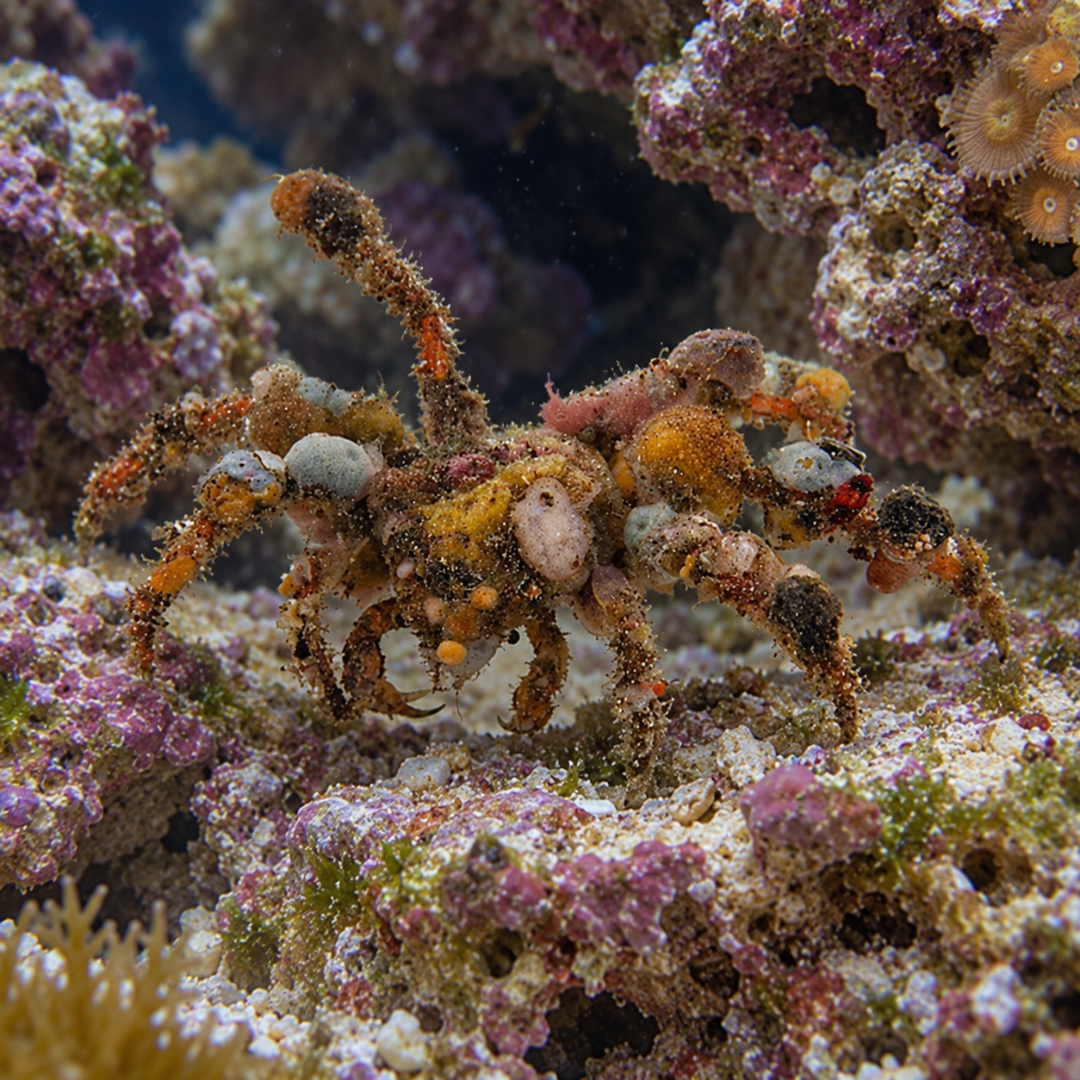
モクズショイは、海藻や海綿、デトリタスなど周囲にある素材を体につけ、自分の輪郭を目立ちにくくする「装飾行動」で知られる海産のカニです。甲羅や歩脚には素材を保持するのに適した剛毛があり、鋏脚を使って選んだ素材を体の特定の場所へ取りつけます。自然状態では装飾によって本来の体の形が分かりにくくなることもあり、その姿は周囲の環境によって大きく変化します。研究では、単に手近なものを無作為につけているのではなく、甲羅や後方の歩脚などを選んで装飾することも確認されています。水槽では完成した姿だけでなく、素材を選び、少しずつ外見を変えていく過程そのものが大きな見どころになります。 Camposcia retusa is a marine crab best known for its decorating behavior, attaching materials such as algae, sponges, and detritus to its body to make its outline less conspicuous. The carapace and walking legs bear specialized setae suited to retaining these materials, which the crab places on selected parts of its body using its chelipeds. In the wild, decoration can obscure much of the crab’s natural shape, and its appearance may change considerably depending on the surrounding habitat. Research has shown that decoration is not distributed randomly; the crab actively favors areas such as the carapace and rear walking legs. In an aquarium, much of the appeal comes not only from its finished appearance but also from watching the crab gradually select and arrange its decoration.
基本情報 / Basic Information
| 学名 / Scientific Name | Camposcia retusa (Latreille, 1829) |
|---|---|
| 通称 / Common Name | モクズショイSpider Decorator Crab, Decorator Crab |
| 分類 / Family | 節足動物門・軟甲綱・十脚目・クモガニ上科・クモガニ科(Inachidae)・モクズショイ属(Camposcia)Phylum Arthropoda, Class Malacostraca, Order Decapoda, Superfamily Majoidea, Family Inachidae, Genus Camposcia |
| 英名 / English Name | Spider Decorator Crab |
| 分布 / Distribution | インド西太平洋に広く分布し、紅海や東アフリカからインド洋、東南アジア、オーストラリア、日本まで記録があります。日本でも相模湾、伊豆半島、紀伊半島、奄美諸島、沖縄など複数の海域から記録されています。Widely distributed across the Indo-West Pacific, with records extending from the Red Sea and East Africa through the Indian Ocean and Southeast Asia to Australia and Japan. Within Japan it has been recorded from several areas including Sagami Bay, the Izu and Kii peninsulas, the Amami Islands, and Okinawa. |
| 最大体長 / Max Size | 甲羅は数cm程度になるカニです。細長い歩脚を持つため、脚を広げた際の見かけの大きさは甲羅よりかなり大きくなります。資料によって測定部位が異なるため、脚を含めた厳密な最大サイズを一つの数値で示すのは適切ではありません。The carapace reaches several centimeters in size. Because the walking legs are long and slender, the crab appears considerably larger when its legs are extended. Published measurements are not always based on the same body dimension, so a single precise maximum size including the legs is difficult to state reliably. |
| 寿命 / Lifespan | 本種に限った信頼性の高い寿命データは十分に確認されていません。Reliable species-specific lifespan data are currently insufficient. |
飼育環境 / Aquarium Environment
| 水槽サイズ / Tank Size | 一般家庭での最低水槽サイズを科学的に定めた資料は確認されていません。繁殖研究では成体をペアで50L水槽に収容した例がありますが、これは循環式の研究設備での条件であり、最低飼育サイズを意味するものではありません。50Lは容量として一般的な60cm規格水槽に近いものの、実際の飼育では水量だけでなく、十分な隠れ家と安定した水質を確保できることを優先します。No scientifically established minimum home-aquarium size has been identified. Captive-breeding studies have maintained adult pairs in 50-L tanks, but these were connected to research recirculation systems and should not be interpreted as a minimum aquarium recommendation. In practice, sufficient shelter and stable water conditions are more important than relying on tank volume alone. |
|---|---|
| 水温 / Temperature | 飼育・繁殖研究では、親個体や稚ガニが26~28℃で維持されています。この範囲は実際に飼育された条件として参考になりますが、本種の耐えられる温度範囲そのものを示した実験ではありません。家庭では急激な温度変化を避け、安定させることを重視します。 In captive-rearing studies, broodstock and juvenile crabs were maintained at 26–28°C. This provides a useful reference for conditions under which the species has been successfully kept, although it should not be interpreted as a experimentally determined full tolerance range. Stable temperature is more important than allowing abrupt fluctuations. |
| 水質 / Water Quality | 通常の海水環境で、塩分やpHを安定させて飼育します。研究では親個体と稚ガニを塩分34~36、pH7.9~8.2で維持した実績があります。これらは飼育実験で使用された条件であり、一般飼育における厳密な許容範囲を示すものではありません。アンモニアや亜硝酸が蓄積しない、十分に立ち上がった海水水槽を用意することが重要です。Maintain stable marine conditions with consistent salinity and pH. Captive studies successfully maintained broodstock and juveniles at a salinity of 34–36 and pH 7.9–8.2. These values describe research conditions rather than experimentally established tolerance limits for home aquaria. A mature marine system without accumulating ammonia or nitrite is important. |
| レイアウト / Layout | 岩やライブロックを使い、体全体を隠せる隙間や洞窟状のシェルターを用意します。実際の飼育研究でも岩や素焼き鉢を隠れ家として使用しています。また、行動実験ではシェルターがない条件で装飾量が増えたことが確認されており、隠れ家の有無と装飾行動には関係があると考えられています。自然な装飾行動を観察するには、海藻や海綿など利用できる素材がある環境が適しています。Provide rocks or live rock arranged to create crevices and cave-like shelters large enough for the crab to conceal itself. Captive studies have also used rocks and terracotta shelters. Behavioral experiments showed that crabs decorated more when shelter was unavailable, indicating a relationship between shelter availability and decorating effort. An environment containing usable materials such as algae or sponge growth can also allow more natural decorating behavior. |
| 注意点 / Precautions | 導入時は水温や塩分を急変させず、輸送水と水槽水の差を確認しながら徐々に慣らします。甲殻類を含む海産無脊椎動物は銅の影響を受けやすいため、銅系薬剤を使用する水槽での飼育は避けます。また、モクズショイは周囲の生物や素材を装飾に利用するため、サンゴや海綿などを配置した水槽では、レイアウトが変化する可能性を考慮する必要があります。特定のサンゴを必ず食害する生体と断定できる資料は十分ではありませんが、完全に何も触らない生体として扱うのも適切ではありません。During introduction, avoid abrupt changes in temperature or salinity and acclimate the crab gradually according to differences between transport water and aquarium water. Marine invertebrates, including crustaceans, are sensitive to copper exposure, so copper-based medications should be avoided in the display system. Camposcia retusa also uses surrounding organisms and materials for decoration, meaning that reef aquascapes may be altered. Evidence is insufficient to state that it will invariably damage particular coral species, but it should not be assumed to leave all sessile organisms untouched. |
餌と給餌 / Feeding
| 餌の種類 / Diet | 本種の野生下での食性を詳細に定量化した情報は限られています。飼育研究では、親個体にエビや二枚貝の身、冷凍アカムシが与えられています。また、育成中の稚ガニにはアルテミアやイサザアミなどが利用されています。家庭飼育では、海産甲殻類が食べられる動物性の餌を中心に、個体が確実に摂餌できるものを与えます。Detailed quantitative information on the natural diet of this species is limited. In captive studies, broodstock were fed chopped prawns, mussels, and thawed bloodworms. Juveniles were also reared using Artemia and mysid-type foods. In home aquaria, appropriate meaty foods suitable for marine crustaceans can be offered while confirming that the crab is actually feeding. |
|---|---|
| 給餌のポイント / Feeding Tips | 装飾物や水槽内の有機物があるからといって、それだけを餌として期待するのは避けます。飼育研究では親個体に定期的な給餌が行われており、モクズショイも水槽内では別途餌を与える前提で管理するのが適切です。岩陰に隠れて餌を取りにくい場合は、ピンセットなどを使って近くへ餌を置くと摂餌を確認しやすくなります。残餌は水質悪化を防ぐため取り除きます。Do not assume that decoration materials or organic matter already present in the aquarium will provide a complete diet. Broodstock in captive studies received regular feeding, so aquarium specimens should likewise be provided with supplemental food. If the crab remains concealed and has difficulty reaching food, placing a small portion nearby with feeding tongs can make feeding easier to confirm. Remove uneaten food to prevent water-quality deterioration. |
性格と混泳 / Temperament and Tank Mates
| 性格 / Temperament | モクズショイでは装飾行動について詳しい研究がありますが、観賞魚との混泳時の攻撃性を定量的に調べた情報は多くありません。自ら周囲の素材を集めて装飾する行動が非常に目立つ一方、一般的なカニと同様、小型の無脊椎動物などと組み合わせる場合は捕食や干渉の可能性を考えて観察する必要があります。Decorating behavior has been studied in detail in Camposcia retusa, but there is comparatively little quantitative information on aggression toward aquarium tank mates. Its most conspicuous activity is collecting and arranging material on its body. As with other crabs, however, interactions with very small invertebrates should be monitored rather than assuming complete compatibility. |
|---|---|
| 混泳の相性 / Compatibility | モクズショイ自身を捕食する可能性のある大型魚や、甲殻類を餌とする魚との混泳は避けます。特に脱皮直後は外骨格が柔らかく、防御力が低下するため、安全に隠れられる場所が欠かせません。また、海綿や海藻などを装飾材料として利用することが確認されているため、繊細なレイアウトを維持したい水槽では行動をよく観察します。Avoid housing the crab with large fish or species likely to prey on crustaceans. Secure shelter is especially important immediately after molting, when the new exoskeleton is still soft and the crab is vulnerable. Because the species is known to use materials such as sponges and algae for decoration, its behavior should also be watched carefully in aquariums where maintaining a precise aquascape is important. |
病気と対策 / Diseases and Prevention
| かかりやすい病気 / Common Diseases | モクズショイに特有の「かかりやすい病気」については、観賞用飼育を前提とした十分な資料がありません。甲殻類では脱皮が大きな生理的変化となるため、脱皮前後の衰弱や脱皮が正常に完了しない状態には注意が必要です。幼生の飼育研究でも、特にメガロッパ期の生残と脱皮が繁殖上の重要な課題として扱われています。There is insufficient aquarium-specific information to identify particular diseases as especially common in Camposcia retusa. Molting is a major physiological event in crustaceans, so weakness around the molt or failure to complete molting normally deserves attention. Larval-rearing studies have likewise identified survival and molting during the megalopal stage as important challenges in captive propagation. |
|---|---|
| 対策と予防 / Prevention | 基本は、水温や塩分を急変させず、アンモニアや亜硝酸が蓄積しない安定した環境を維持することです。脱皮中や脱皮直後に他の生体から身を守れる隠れ家も用意します。元資料にあった特定濃度のヨウ素添加を脱皮不全予防として必須とする記述については、本種でその効果を裏づける十分な根拠を確認できないため、定量的な添加推奨は行いません。微量元素を添加する場合も、測定せずに過剰添加するのではなく、使用している人工海水や水換えを含めた水質管理を基本とします。Prevention centers on maintaining stable conditions without abrupt temperature or salinity changes and avoiding the accumulation of ammonia and nitrite. Provide shelter where the crab can remain protected during and immediately after molting. The original material recommended specific iodine supplementation as essential for preventing molting failure, but sufficient species-specific evidence for such a quantitative recommendation could not be confirmed. Trace-element supplementation should therefore not replace basic water-quality management or be dosed excessively without measurement. |
増やし方(繁殖) / Breeding
| 雌雄の判別 / Sexing | 飼育下で育てた個体を調べた研究では、第5稚ガニ期(C5)以降、腹面の遊泳肢の形態に雌雄差が現れ、メスでは4対、オスでは2対が確認されています。一方、その研究では第10稚ガニ期まで腹部の幅に統計的な明瞭差は確認されていません。そのため、若い個体を単純に「腹部が広いからメス、細いからオス」と判断するより、腹面の付属肢を確認する方法のほうが根拠があります。A study of captive-reared juveniles found that sexual dimorphism became visible from the fifth juvenile crab stage (C5), principally in the pleopods: females developed four pairs while males had two pairs. In the same study, abdominal width did not differ significantly between sexes through the C10 stage. Therefore, in young crabs, examining ventral appendage morphology is better supported than relying simply on a broad-versus-narrow abdomen. |
|---|---|
| 繁殖形態 / Reproduction | メスは受精卵を腹部に抱え、ふ化すると浮遊性の幼生を放出します。現在の飼育研究では、モクズショイの幼生発生は第1ゾエア、第2ゾエアの2つのゾエア期と、1つのメガロッパ期からなり、その後、第1稚ガニへ変態することが確認されています。過去にはより多くのゾエア期を持つとする記載もありましたが、飼育下で親から得た幼生を追跡した研究によって、2ゾエア期と1メガロッパ期であることが示されています。Females carry fertilized eggs beneath the abdomen and release planktonic larvae after hatching. Captive-rearing research has confirmed that larval development consists of two zoeal stages, Zoea I and Zoea II, followed by a single megalopal stage before metamorphosis into the first juvenile crab. Earlier descriptions differed, but studies that followed larvae hatched from identified broodstock established the two-zoea, one-megalopa sequence. |
| 繁殖のポイント / Breeding Tips | 親個体の抱卵から先、とくに浮遊幼生の育成には専用の管理が必要です。研究ではワムシだけでは第2ゾエアからメガロッパまで育たず、ふ化直後のアルテミア幼生を1mLあたり10個体与えた条件で、メガロッパまで高い生残率が得られています。また、幼生は成長段階によって適する塩分が異なり、ゾエア期は高めの塩分、メガロッパ期はそれより低めの塩分で生残が向上しました。つまり、単に親と同じ水槽でふ化させるだけではなく、餌の大きさや密度、塩分、幼生が吸い込まれない水流を段階ごとに管理することが繁殖の重要点です。Rearing larvae beyond hatching requires dedicated management. In experiments, rotifers alone did not support development from Zoea II to the megalopal stage, whereas newly hatched Artemia nauplii supplied at 10 individuals per milliliter produced high survival to the megalopal stage. Suitable salinity also changed during development: zoeae performed better at relatively higher salinity, while megalopae survived better at lower salinity. Successful breeding therefore requires stage-specific management of prey size and density, salinity, and water movement that does not remove or damage the larvae. |
雑学と豆知識 / Trivia and Fun Facts
| 1. 学名には少し複雑な歴史がある / 1. Its Scientific Name Has a Complicated History | 現在受け入れられている学名はCamposcia retusa (Latreille, 1829)です。1829年の原記載ではMaia retujaという綴りが使われましたが、現在はretujaを不適切な原綴りとして扱い、retusaの綴りが維持されています。属も現在のCamposciaへ移されているため、命名者名のLatreille, 1829は括弧に入れて表記されます。名前の細部だけでも、200年近く続く分類学の歴史を感じられる生き物です。The currently accepted scientific name is Camposcia retusa (Latreille, 1829). The original 1829 description used the spelling Maia retuja, but retuja is now treated as an incorrect original spelling and retusa is maintained in prevailing usage. Because the species is now placed in the genus Camposcia rather than its original genus, the author’s name and date are placed in parentheses. Even its name preserves part of nearly two centuries of taxonomic history. |
|---|---|
| 2. 体表の鉤状毛が装飾を支える / 2. Hooked Setae Help Hold the Decoration | クモガニ上科の装飾行動を支える代表的な構造が、体表にある先端の曲がった剛毛です。モクズショイでも、装飾に関係する鉤状の剛毛と、鋏脚などに多い別の形の剛毛が確認されています。体のどこにどのような剛毛があるかが、装飾する場所の違いにも関係すると考えられています。つまり、モクズショイの「着飾る能力」は行動だけでなく、装飾しやすい体の構造と組み合わさって成り立っています。One of the characteristic structures supporting decoration in majoid crabs is the curved, hook-like seta found on the body surface. In Camposcia retusa, hooked setae associated with decoration occur alongside other setal forms, including those common on the chelipeds. Differences in the distribution of these setae are thought to help explain why some areas of the body receive more decoration than others. Its remarkable disguise therefore depends on both behavior and body structure. |
| 3. 何をどこにつけるかは無作為ではない / 3. Decoration Placement Is Not Random | 野外個体と行動実験の観察では、モクズショイの装飾は体全体へ均一につけられているわけではなく、甲羅や後方の歩脚に多く配置されることが分かっています。さらに実験では、与えられた装飾素材を体の特定の場所へ選択的につける行動も確認されました。周囲のものが偶然引っ掛かっているのではなく、カニ自身の行動によって装飾の配置が作られていることを意味します。Observations of wild crabs and controlled behavioral experiments show that decoration is not spread evenly across the body. The carapace and rear walking legs tend to receive more material, and experiments demonstrated that crabs actively place available decoration on selected body regions. In other words, the distinctive covering is produced by the crab’s own behavior rather than being debris that has simply become caught by chance. |
| 4. 隠れ家がないと装飾が増える / 4. Less Shelter Leads to More Decorating | モクズショイの装飾行動で特に興味深いのが、周囲の安全性によって行動量が変わる点です。シェルターを用意した場合と用意しなかった場合を比較した実験では、隠れ場所がない条件の個体ほど多くの素材を身につけました。研究者はこの結果から、装飾が捕食者に見つかったり襲われたりする危険を減らすための防御行動として重要であると考えています。つまり装飾は、いつでも同じ量を身につける固定的な行動ではなく、置かれた状況に応じて強さが変化する行動なのです。One of the most interesting aspects of decorating behavior is that its intensity changes with environmental conditions. In an experiment comparing crabs with and without access to shelter, individuals lacking shelter attached more decoration. Researchers interpreted this as evidence that decorating plays an important role in reducing predation risk. Decoration is therefore not simply performed at a fixed rate; the crab can change its investment according to the situation it faces. |
| 5. 海綿や海藻を使うことには、隠れる以外の意味もあるかもしれない / 5. Sponges and Algae May Offer More Than Visual Camouflage | 野外で観察されたモクズショイは、主に海綿、肉質の海藻や糸状の海藻、デトリタスを装飾に使っていました。クモガニ類では、味や化学物質のため捕食者に好まれにくい生物を身につけることで、防御効果が高まる例も知られています。ただし、モクズショイ自身について「有毒な素材を意図的に選び、化学防御を行っている」とまで実証されたわけではありません。現在の研究からいえるのは、視覚的なカモフラージュが重要であり、装飾素材の性質がさらに防御へ役立つ可能性もある、という段階です。Wild Camposcia retusa have been observed decorating primarily with sponges, fleshy and filamentous algae, and detritus. In majoid crabs more generally, carrying organisms that predators find distasteful or chemically defended can provide additional protection. However, it has not been demonstrated that Camposcia retusa deliberately selects toxic materials specifically to create a chemical defense. The evidence supports an important camouflage function, with additional defensive effects from particular materials remaining plausible but not fully established. |
| 6. 成長しても装飾をやめるとは限らない / 6. Adults Do Not Necessarily Abandon Decoration | 一部の装飾ガニでは、体が大きくなるにつれて装飾量が減ることがあります。しかし、モクズショイを調べた研究では、個体サイズが大きくなっても体を覆う装飾の割合が低下する傾向は確認されませんでした。この結果は、少なくとも調査された成長段階を通じて、装飾することの重要性が失われていない可能性を示しています。Some decorator crabs reduce their decorating effort as they grow larger. In Camposcia retusa, however, researchers did not find a decline in the proportion of the body covered with decoration as crab size increased. This suggests that the value of decorating may remain important throughout the growth stages examined. |
| 7. 幼生の姿は親ガニとはまったく違う / 7. The Larvae Look Nothing Like the Adult Crab | 卵からふ化したモクズショイは、すぐに小さなカニの姿で歩き始めるわけではありません。最初は海中を浮遊するゾエア幼生で、第1ゾエア、第2ゾエア、メガロッパと形を変えたあと、ようやく底生生活をする稚ガニへ変態します。親ガニの奇妙な装飾姿からは想像しにくいものの、繁殖の初期には水中を漂うプランクトンとして生活する時期があるのです。A newly hatched Camposcia retusa does not immediately begin life as a miniature walking crab. It first enters a planktonic zoeal phase, progressing through Zoea I, Zoea II, and the megalopal stage before metamorphosing into a benthic juvenile crab. Despite the adult’s unmistakable decorated appearance, its early life therefore includes a period spent drifting in the water column as plankton. |
| 8. 幼生は成長途中で好む塩分条件が変わる / 8. Salinity Requirements Change During Larval Development | 繁殖研究では、ゾエア幼生とメガロッパで生き残りやすい塩分条件が異なることが分かっています。ゾエアでは塩分35~38付近で良好な生残が得られた一方、メガロッパでは塩分32で最も高い生残率が記録されました。これは「海水生物だから同じ濃さの海水を維持すればよい」という単純な話ではなく、成長に伴って生理的に適した環境が変化することを示しています。なお、これは幼生育成時の研究結果であり、成体水槽の塩分を同じように変化させる必要があるという意味ではありません。Breeding research has shown that zoeae and megalopae perform best under different salinity conditions. Zoeal survival was strong around salinities of 35–38, whereas the highest megalopal survival was recorded at a salinity of 32. This demonstrates that the physiologically favorable environment can change during development. These findings apply to larval culture and do not mean that salinity in an adult display aquarium should be manipulated in the same way. |
| 9. 日本にも昔から記録がある / 9. It Has a Long History of Records in Japan | モクズショイは南方のサンゴ礁だけに限られるカニではありません。日本では奄美大島や沖縄だけでなく、相模湾、下田、紀伊半島周辺、八丈島、小笠原など各地から記録されています。インド西太平洋に広く分布する種であり、日本の海もその自然分布域の一部です。Camposcia retusa is not restricted to tropical coral reefs far south of Japan. Japanese records include not only Amami and Okinawa but also Sagami Bay, Shimoda, areas around the Kii Peninsula, Hachijojima, and the Ogasawara Islands. Japan forms part of the species’ broad natural Indo-West Pacific distribution. |
まとめ / Conclusion
モクズショイの最大の魅力は、周囲の素材を自ら選んで身につけ、環境に溶け込む姿を作り上げていく装飾行動にあります。その行動は単なる偶然の付着ではなく、装飾する場所を選び、隠れ家の有無によって装飾量まで変化させる、捕食回避と深く関係した行動であることが研究から分かってきました。水槽でも、どの素材を選び、体のどこへ配置するのかを観察することで、見た目だけでは分からないモクズショイの生態を楽しめます。 The defining appeal of Camposcia retusa is its ability to select materials from its surroundings and construct a disguise on its own body. Research shows that this is not simply accidental attachment: the crab chooses where decoration is placed and can alter its decorating effort according to shelter availability, linking the behavior closely with predator avoidance. In an aquarium, observing what the crab selects and where it places each item reveals far more about the species than its unusual appearance alone.
飼育では、安定した海水環境と十分な隠れ家を用意し、適切な餌を継続して与えることが基本になります。周囲の海綿や海藻などを装飾に利用する習性があるため、繊細なレイアウトとの組み合わせには注意が必要です。一方、繁殖研究の進展によって、幼生が2つのゾエア期と1つのメガロッパ期を経ることや、成長段階によって適した餌や塩分条件が異なることも明らかになっています。独特な外見だけでなく、自ら環境に働きかけながら暮らす行動をじっくり観察したい人にとって、非常に興味深い海産甲殻類です。 Successful husbandry centers on stable marine conditions, adequate shelter, and regular appropriate feeding. Because the crab naturally uses surrounding sponges, algae, and other materials for decoration, care is required when it is combined with delicate aquascaping. Captive-breeding research has also clarified that its larvae pass through two zoeal stages and one megalopal stage, with feeding and salinity requirements changing during development. Beyond its unusual appearance, Camposcia retusa is a particularly interesting marine crustacean for aquarists who enjoy observing how an animal actively interacts with and responds to its environment.
気になる道具や飼い方を見つけてみませんか?
 アイのアクアグッズ案内おとひめ物語|養殖生まれの餌を、わが家の魚に合う一粒へ道具の特徴や使い方、選ぶときのポイントをアイが紹介します。記事はコチラ →
 アイのアクアグッズ案内水草用ライトの選び方|緑の絨毯と赤い水草を楽しむ照明・植栽用品道具の特徴や使い方、選ぶときのポイントをアイが紹介します。記事はコチラ →
 アイのアクアグッズ案内コケを食べるコイの仲間に合わせる飼育用品|フライングフォックス・アルジイーター・ガラ道具の特徴や使い方、選ぶときのポイントをアイが紹介します。記事はコチラ →
 アイのアクアグッズ案内水槽のエアーポンプの選び方|水深・音・泡で選ぶおすすめ用品道具の特徴や使い方、選ぶときのポイントをアイが紹介します。記事はコチラ →
さまざまな飼育テーマをご紹介。リンク先の記事には広告・商品紹介が含まれます。
案内・紹介記事一覧へ →分布マップ
モクズショイ(Camposcia retusa)はインド西太平洋に広く分布し、紅海・東アフリカからインド洋、東南アジア、オーストラリア、日本にかけて記録されています。日本では相模湾、伊豆半島、紀伊半島、奄美諸島、沖縄などから知られています。
この地図は文献上の分布地域をもとにした概略表示です。表示範囲は個々の生息地点や分布境界を厳密に示すものではありません。マーカーは分布域を把握しやすくするために設定した代表地点であり、実際の採集地点を示すものではありません。
参考文献
-
WoRMS Editorial Board. Camposcia retusa (Latreille, 1829). World Register of Marine Species.
分類、受容学名、命名者、原記載名の確認。
World Register of Marine Species -
Japan Agency for Marine-Earth Science and Technology (JAMSTEC). Camposcia retusa モクズセオイ/モクズショイ. Biological Information System for Marine Life (BISMaL).
日本国内の記録、和名、国内文献の確認。
BISMaL -
Western Australian Museum. Camposcia retusa. WA Museum Collections.
インド西太平洋における分布、浅海のサンゴ礫・海草域などの生息環境、分類情報の確認。
Western Australian Museum Collections -
Brooker, R. M., Muñoz Ruiz, E. C., Sih, T. L., & Dixson, D. L. (2018). Shelter availability mediates decorating in the majoid crab, Camposcia retusa. Behavioral Ecology, 29(1), 179–185. https://doi.org/10.1093/beheco/arx119
装飾素材、装飾部位、シェルターの有無による装飾量の変化、捕食回避との関係の確認。
Oxford Academic -
Xu, T., Zeng, C., & Hutson, K. S. (2019). Morphological descriptions of the larval and first juvenile stages of the decorator crab Camposcia retusa (Latreille, 1829) from laboratory-reared material. Zootaxa, 4577(2), 295–315. https://doi.org/10.11646/zootaxa.4577.2.4
第1・第2ゾエア、メガロッパ、第1稚ガニまでの幼生発生と形態の確認。
Zootaxa -
Xu, T., & Zeng, C. (2022). Establishing larval feeding regimens for the decorator crab Camposcia retusa: Effects of live prey types and density on larval survival and development. Aquaculture Research, 53(7), 2772–2784. https://doi.org/10.1111/are.15792
親個体の飼育条件、給餌内容、隠れ家、幼生への生餌の種類と密度の確認。
Wiley Online Library -
Xu, T., & Zeng, C. (2023). Effects of salinity on larval survival and development of the decorator crab Camposcia retusa and food consumption patterns of megalopae. Aquaculture, 562, 738753. https://doi.org/10.1016/j.aquaculture.2022.738753
ゾエア期とメガロッパ期における塩分と生残・発生の関係の確認。
ScienceDirect -
Banaee, M., et al. (2024). Assessing Metal Toxicity on Crustaceans in Aquatic Ecosystems: A Comprehensive Review. Biological Trace Element Research, 202, 5743–5761. https://doi.org/10.1007/s12011-024-04122-7
甲殻類に対する銅を含む金属曝露の毒性と、鰓を介した金属取り込みなどの注意点の確認。
PubMed




コメント